Question bank

Q&A: practice questions with answers

Search questions on any topic. Filter by exam category, exam, subject and topic, try the question, then open the answer and explanation.

Courses – airGurukul

6,600 questions found.

Q6401.
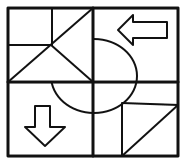
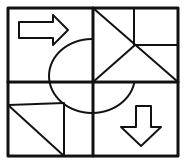
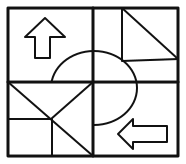
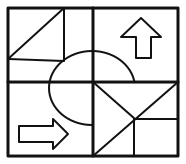
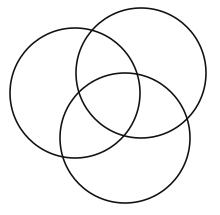
Select the option in which the given figure is embedded (rotation is NOT allowed).
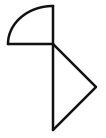
उस विकल्प का चयन कीजिए जिसमें दी गई आकृति सन्निहित है (घुमाने की अनुमति नहीं है)।
  1. A
  2. B
  3. C
  4. D
Show answer

Concept: The given figure (a quarter-circle arc on top of a straight edge, followed by a slanting arrow-head shape) must appear inside an option exactly as it is — same size and same orientation, with no rotation.

  1. Locate the curved part first: every option has a central circle, so look for a quarter of that circle whose straight edge continues into a slanting V-shaped part.
  2. In option (D) the upper-left quarter of the circle, together with the vertical grid line and the slanting lines of the triangle part, traces the given figure in the same orientation.
  3. In (A), (B) and (C) the slanting part lies on the wrong side of the arc, so the figure would fit only after rotation or flipping.

Trick: Fix the most distinctive part (the arc) first, then check only the direction of the remaining lines.

Answer: (D) Option (D)

अवधारणा: दी गई आकृति (ऊपर चौथाई वृत्त का चाप, नीचे सीधी रेखा और तिरछा V-आकार) किसी विकल्प में बिना घुमाए, उसी आकार और दिशा में छिपी होनी चाहिए।

  1. सबसे पहले चाप (arc) खोजें: हर विकल्प में बीच में वृत्त है, इसलिए उसका वह चौथाई भाग देखें जिसकी सीधी रेखा आगे तिरछे V-भाग से जुड़ती हो।
  2. विकल्प (D) में वृत्त का ऊपर-बायाँ चौथाई भाग, ऊर्ध्वाधर रेखा और त्रिभुज की तिरछी रेखाएँ मिलकर दी गई आकृति को उसी दिशा में बनाती हैं।
  3. (A), (B) और (C) में तिरछा भाग चाप के गलत ओर है, यानी आकृति घुमाने या पलटने पर ही फिट होती।

ट्रिक: सबसे अलग दिखने वाला भाग (चाप) पहले मिलाएँ, फिर बाकी रेखाओं की दिशा जाँचें।

उत्तर: (D) विकल्प (D)
SSC CPO Paper IGeneral Intelligence and ReasoningEmbedded FigureSSC CPO Paper I 2023 · 3 Oct Shift 1 →
Q6402.
Which letter cluster will replace the question mark (?) to complete the given series? ELSV, FJVR, GHYN, ?, IDEF
दी गई श्रृंखला को पूरा करने के लिए प्रश्न चिह्न (?) के स्थान पर कौन-सा अक्षर-समूह आएगा? ELSV, FJVR, GHYN, ?, IDEF
  1. AHFJB
  2. BHBJF
  3. CHFBJ
  4. DGHFJ
Show answer

Concept: Track each of the four letter positions separately.

  1. 1st letters: E, F, G, ?, I → +1 each, so H.
  2. 2nd letters: L, J, H, ?, D → −2 each, so F.
  3. 3rd letters: S, V, Y, ?, E → +3 each (Y +3 wraps to B), so B.
  4. 4th letters: V, R, N, ?, F → −4 each, so J.

Trick: Write position values (E = 5, L = 12 …) column-wise; constant gaps appear at once.

Answer: (C) HFBJ

अवधारणा: चारों स्थानों के अक्षरों को अलग-अलग देखें।

  1. पहला अक्षर: E, F, G, ?, I → हर बार +1, अतः H।
  2. दूसरा अक्षर: L, J, H, ?, D → हर बार −2, अतः F।
  3. तीसरा अक्षर: S, V, Y, ?, E → हर बार +3 (Y के बाद +3 = B), अतः B।
  4. चौथा अक्षर: V, R, N, ?, F → हर बार −4, अतः J।

ट्रिक: अक्षरों के स्थानीय मान (E = 5, L = 12 …) कॉलम-वार लिखें, अंतर तुरंत दिखेगा।

उत्तर: (C) HFBJ

SSC CPO Paper IGeneral Intelligence and ReasoningLetter SeriesSSC CPO Paper I 2023 · 3 Oct Shift 1 →
Q6403.
Three of the following four letter-clusters are alike in a certain way and one is different. Pick the odd one out.
निम्नलिखित चार अक्षर-समूहों में से तीन किसी निश्चित प्रकार से एकसमान हैं और एक उनसे असंगत है। असंगत का चयन कीजिए।
  1. AWVTD
  2. BJIGQ
  3. CSRPH
  4. DKLNP
Show answer

Concept: Check the gaps between the first three letters and the relation of the last letter with the first.

  1. WVTD: W → V (−1), V → T (−2); W and D are opposite letters (23+4=27).
  2. JIGQ: −1, −2; J and Q opposite (10+17=27). SRPH: −1, −2; S and H opposite (19+8=27).
  3. KLNP: K → L is +1, L → N is +2 — the gaps move forward, not backward. So KLNP is different.

Trick: Opposite-letter pairs add up to 27 (A–Z, D–W, H–S, J–Q).

Answer: (D) KLNP

अवधारणा: पहले तीन अक्षरों के बीच का अंतर और अंतिम अक्षर का पहले अक्षर से संबंध देखें।

  1. WVTD: W → V (−1), V → T (−2); W और D विपरीत अक्षर (23+4=27)।
  2. JIGQ: −1, −2; J–Q विपरीत (10+17=27)। SRPH: −1, −2; S–H विपरीत (19+8=27)।
  3. KLNP: K → L +1, L → N +2 — अंतर उल्टी नहीं, आगे की दिशा में है। इसलिए KLNP अलग है।

ट्रिक: विपरीत अक्षरों का योग 27 होता है (A–Z, D–W, H–S, J–Q)।

उत्तर: (D) KLNP

SSC CPO Paper IGeneral Intelligence and ReasoningOdd One Out (Letters)SSC CPO Paper I 2023 · 3 Oct Shift 1 →
Q6404.
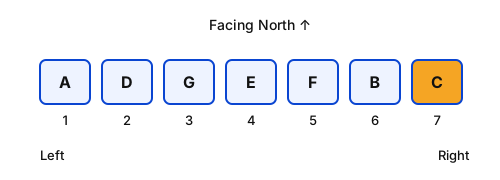
Seven people, A, B, C, D, E, F and G, are sitting in a straight row, facing north (not
necessarily in the same order). Only 1 person sits to the left of D. A is an immediate neighbour of D. Only 2 people sit between F and D. Only 3 people sit between C and G. B is not an immediate neighbour of G. Only 2 people sit between E and A.
Who sits at the extreme right end of the row?
सात व्यक्ति, A, B, C, D, E, F और G, एक सीधी पंक्ति में उत्तर की ओर मुख करके बैठे हैं (जरूरी नहीं कि इसी
क्रम में हों)। D के बाईं ओर केवल 1 व्यक्ति बैठा है। A, D का निकटतम पड़ोसी है। F और D के बीच केवल 2 व्यक्ति बैठे हैं। C और G के बीच केवल 3 व्यक्ति बैठे हैं। B, G का निकटतम पड़ोसी नहीं है। E और A के बीच केवल 2 व्यक्ति बैठे हैं।
पंक्ति के एकदम दाएँ छोर पर कौन बैठा है?
  1. AA
  2. BG
  3. CC
  4. DB
Show answer

Concept: Fix the definite positions first (D, then F), then try the cases for the pairs.

  1. Only 1 person to the left of D → D is 2nd from left. A is a neighbour of D → A is 1st or 3rd.
  2. 2 people between F and D → F is 5th. 3 people between C and G → they take 3rd and 7th (1st/5th is not possible with F at 5th).
  3. So A is 1st, and 2 people between E and A → E is 4th; B is 6th.
  4. B is not a neighbour of G → G is not 7th, so G = 3rd and C = 7th. Row: A D G E F B C.

Trick: In a north-facing row, your left = row's left; place the 'only 1 to the left' person first.

Answer: (C) C

अवधारणा: पहले निश्चित स्थान (D, फिर F) तय करें, फिर बचे जोड़ों के केस बनाएँ।

  1. D के बाएँ केवल 1 व्यक्ति → D बाएँ से दूसरे स्थान पर। A, D का पड़ोसी → A पहले या तीसरे स्थान पर।
  2. F और D के बीच 2 व्यक्ति → F पाँचवें स्थान पर। C और G के बीच 3 व्यक्ति → वे 3rd और 7th पर (F के 5th होने से 1st/5th संभव नहीं)।
  3. इसलिए A पहले स्थान पर; E और A के बीच 2 → E चौथे पर; B छठे पर।
  4. B, G का पड़ोसी नहीं → G 7th नहीं, अतः G = 3rd और C = 7th। पंक्ति: A D G E F B C।

ट्रिक: उत्तर की ओर मुख वाली पंक्ति में व्यक्ति का बायाँ = पंक्ति का बायाँ; 'केवल 1 बाएँ' वाले को पहले बैठाएँ।

उत्तर: (C) C

SSC CPO Paper IGeneral Intelligence and ReasoningLinear Seating ArrangementSSC CPO Paper I 2023 · 3 Oct Shift 1 →
Q6405.
In a certain code language, ‘GAME’ is coded as ‘8426’ and ‘MUST’ is coded as ‘7853’. What is the code for ‘M’ in the given code language?
एक निश्चित कूट भाषा में, ‘GAME’ को ‘8426’ के रूप में कूटबद्ध किया जाता है और ‘MUST’ को ‘7853’ के रूप में कूटबद्ध किया जाता है। दी गई कूट भाषा में ‘M’ के लिए कूट क्या है?
  1. A8
  2. B2
  3. C3
  4. D7
Show answer

Concept: A letter common to two words gets the digit common to their codes.

  1. GAME = 8426 and MUST = 7853.
  2. The only common letter is M; the only common digit is 8.
  3. So M = 8.

Trick: Common letter ↔ common digit — no need to decode anything else.

Answer: (A) 8

अवधारणा: दो शब्दों में उभयनिष्ठ (common) अक्षर का कोड उनके कोडों में उभयनिष्ठ अंक होता है।

  1. GAME = 8426 और MUST = 7853।
  2. दोनों शब्दों में केवल M समान है; दोनों कोडों में केवल 8 समान है।
  3. अतः M = 8।

ट्रिक: समान अक्षर ↔ समान अंक — बाकी डिकोड करने की ज़रूरत नहीं।

उत्तर: (A) 8

SSC CPO Paper IGeneral Intelligence and ReasoningCoding-Decoding (Common Letter)SSC CPO Paper I 2023 · 3 Oct Shift 1 →
Q6406.
Two statements are given, followed by two conclusions numbered I and II. Assuming the statements to be true, even if they seem to be at variance with commonly known facts, decide which of the conclusions logically follow(s) from the statements.
Statements:
All flowers are trees.
All leaves are flowers.
Conclusion:
I)All trees are flowers.
II)All leaves are trees.
दो कथन दिए गए हैं, जिनके बाद I और II क्रमांकित दो निष्कर्ष दिए गए हैं। कथनों को सत्य मानते हुए, भले ही वे सामान्यतः ज्ञात तथ्यों से भिन्न प्रतीत होते हों, निर्णय कीजिए कि कौन-सा/से निष्कर्ष कथनों का तार्किक रूप से अनुसरण करता है/करते हैं।
कथन:
सभी फूल, पेड़ हैं।
सभी पत्तियाँ, फूल हैं।
निष्कर्ष:
I)सभी पेड़, फूल हैं।
II)सभी पत्तियाँ, पेड़ हैं।
  1. AOnly Conclusion I followsकेवल निष्कर्ष I अनुसरण करता है
  2. BNeither Conclusion I nor II follows.न तो निष्कर्ष I और न ही II अनुसरण करता है।
  3. COnly Conclusion II follows.केवल निष्कर्ष II अनुसरण करता है।
  4. DBoth Conclusions I and II follow.निष्कर्ष I और II दोनों अनुसरण करते हैं।
Show answer

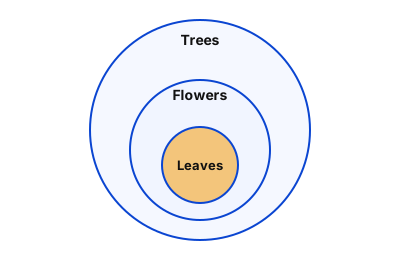
Concept: Draw the minimal Venn diagram: 'All X are Y' puts circle X fully inside circle Y.

  1. All leaves are flowers and all flowers are trees → Leaves ⊂ Flowers ⊂ Trees.
  2. Conclusion II: All leaves are trees — leaves lie inside trees, so it follows.
  3. Conclusion I: All trees are flowers — trees may be bigger than flowers, so it does not follow.

Trick: 'All A are B' + 'All B are C' ⇒ 'All A are C'; the reverse 'All C are B' never follows.

Answer: (C) Only Conclusion II follows.

अवधारणा: न्यूनतम वेन आरेख बनाएँ: 'All X are Y' में X का वृत्त पूरी तरह Y के अंदर होता है।

  1. All leaves are flowers और all flowers are trees → Leaves ⊂ Flowers ⊂ Trees।
  2. निष्कर्ष II: All leaves are trees — leaves, trees के अंदर हैं, अतः यह अनुसरण करता है।
  3. निष्कर्ष I: All trees are flowers — trees, flowers से बड़ा हो सकता है, अतः यह अनुसरण नहीं करता।

ट्रिक: 'All A are B' + 'All B are C' ⇒ 'All A are C'; उल्टा 'All C are B' कभी निश्चित नहीं।

उत्तर: (C) केवल निष्कर्ष II अनुसरण करता है।

SSC CPO Paper IGeneral Intelligence and ReasoningSyllogismSSC CPO Paper I 2023 · 3 Oct Shift 1 →
Q6407.
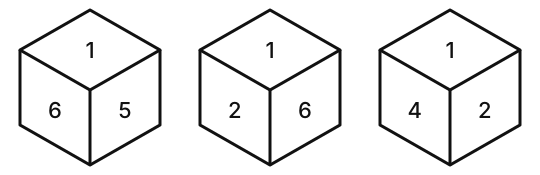
Three different positions of the same dice are shown. Find the number on the face
opposite the face showing ‘1’.
एक ही पासे की तीन अलग-अलग स्थितियाँ दर्शाई गई हैं। ‘1’ दर्शाने वाले फलक के
विपरीत फलक पर संख्या ज्ञात कीजिए।
  1. A3
  2. B2
  3. C6
  4. D4
Show answer

Concept: Numbers seen together with a face are adjacent to it; the one never seen with it is opposite.

  1. Face 1 appears in all three positions.
  2. Faces shown with 1: 6, 5 (fig 1), 2, 6 (fig 2), 4, 2 (fig 3) → adjacent faces 2, 4, 5, 6.
  3. The only number never seen with 1 is 3, so 3 is opposite 1.

Trick: A cube face has exactly 4 neighbours; the 5th number left over is its opposite.

Answer: (A) 3

अवधारणा: किसी फलक के साथ दिखने वाली संख्याएँ उसके आसन्न (adjacent) हैं; जो कभी साथ न दिखे वह विपरीत है।

  1. फलक 1 तीनों स्थितियों में दिख रहा है।
  2. 1 के साथ दिखी संख्याएँ: 6, 5, 2, 4 → ये चारों आसन्न हैं।
  3. 1 के साथ कभी न दिखने वाली संख्या 3 है, अतः 3 विपरीत है।

ट्रिक: घन के हर फलक के ठीक 4 पड़ोसी होते हैं; बची हुई 5वीं संख्या विपरीत होती है।

उत्तर: (A) 3

SSC CPO Paper IGeneral Intelligence and ReasoningDiceSSC CPO Paper I 2023 · 3 Oct Shift 1 →
Q6408.
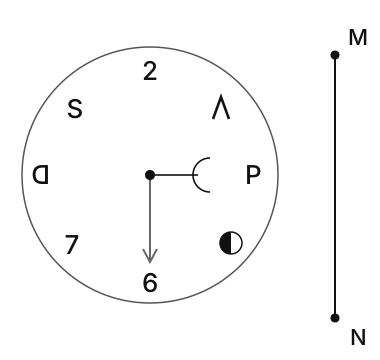
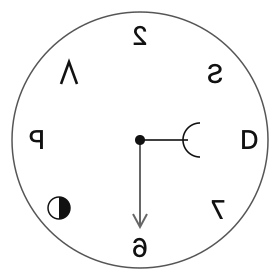
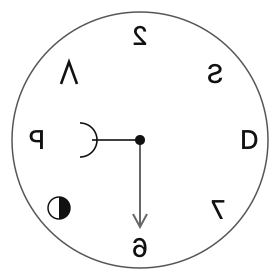
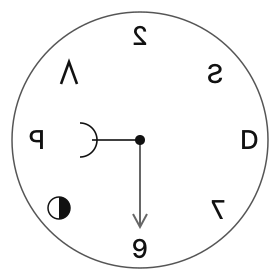
Select the correct mirror image of the given figure, when the mirror is placed at line MN as shown.
दी गई आकृति के सही दर्पण प्रतिबिंब का चयन कीजिए, जब दर्पण को दर्शाए गए अनुसार MN रेखा पर रखा गया हो।
  1. A
  2. B
  3. C
  4. D
Show answer

Concept: With a vertical mirror (MN) on the right, left and right are interchanged while top and bottom stay the same; every letter/number is also laterally inverted.

  1. Elements on the right (P, the half-shaded circle, V) shift to the left side, and D, 7, S shift to the right; 2 stays on top and 6 stays at the bottom.
  2. The horizontal hand that pointed right (towards P) now points left, ending with its small arc; the arrow still points down.
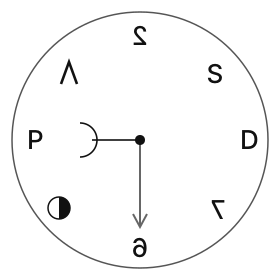
  3. Each character must be mirrored: (D) shows an unmirrored 6, (A) shows an unmirrored P, and in (B) the hand still points right. Only (C) satisfies all.

Trick: Vertical mirror: swap left ↔ right only; check one asymmetric character (like 6 or P) to eliminate options fast.

Answer: (C) Option (C)

अवधारणा: दाईं ओर ऊर्ध्वाधर दर्पण (MN) में बायाँ-दायाँ आपस में बदलते हैं, ऊपर-नीचे वही रहते हैं; हर अक्षर/अंक भी उल्टा (laterally inverted) दिखता है।

  1. दाईं ओर के तत्व (P, आधा-छायांकित वृत्त, V) बाईं ओर और D, 7, S दाईं ओर आ जाते हैं; 2 ऊपर और 6 नीचे ही रहता है।
  2. दाईं ओर (P की ओर) जाने वाली क्षैतिज सुई अब बाईं ओर जाती है; नीचे वाला तीर नीचे ही रहता है।
  3. हर अक्षर उल्टा होना चाहिए: (D) में 6 सीधा है, (A) में P सीधा है, (B) में सुई दाईं ओर ही है। केवल (C) सही है।

ट्रिक: ऊर्ध्वाधर दर्पण: केवल बायाँ ↔ दायाँ बदलें; किसी असममित अक्षर (6 या P) से विकल्प जल्दी हटाएँ।

उत्तर: (C) विकल्प (C)

SSC CPO Paper IGeneral Intelligence and ReasoningMirror ImageSSC CPO Paper I 2023 · 3 Oct Shift 1 →
Q6409.
If ‘+’ means ‘–’, ‘–’ means ‘×’, ‘×’ means ‘÷’, ‘÷’ means ‘+’, then what will come in place of the question mark (?) in the following equation?
137 ÷ 56 × 7 – 6 + 31 = ?
यदि ‘+’ का अर्थ ‘–’, ‘–’ का अर्थ ‘×’, ‘×’ का अर्थ ‘÷’ और ‘÷’ का अर्थ ‘+’ है, तो निम्नलिखित समीकरण में प्रश्न चिह्न (?) के स्थान पर क्या आएगा?
137 ÷ 56 × 7 – 6 + 31 = ?
  1. A149
  2. B163
  3. C145
  4. D154
Show answer

Concept: Replace the symbols as directed, then apply BODMAS.

  1. ÷ → +, × → ÷, – → ×, + → –.
  2. 137÷56×7−6+31→137+56÷7×6−31
  3. =137+8×6−31=137+48−31
  4. =154

Trick: Rewrite the whole expression with new symbols first; never mix substitution and calculation.

Answer: (D) 154

अवधारणा: दिए गए चिह्नों को बदलें, फिर BODMAS लगाएँ।

  1. ÷ → +, × → ÷, – → ×, + → –।
  2. 137÷56×7−6+31→137+56÷7×6−31
  3. =137+8×6−31=137+48−31
  4. =154

ट्रिक: पहले पूरा व्यंजक नए चिह्नों के साथ लिखें, फिर गणना करें।

उत्तर: (D) 154

SSC CPO Paper IGeneral Intelligence and ReasoningMathematical OperationsSSC CPO Paper I 2023 · 3 Oct Shift 1 →
Q6410.
Select the option that represents the correct order of the given words as they would appear in an English dictionary?
1.Lollipop
2.Loincloth
3.Longways
4.Logician
5.Lonely
उस विकल्प का चयन कीजिए जो दिए गए शब्दों के उस सही क्रम को दर्शाता है, जिस क्रम में वे अंग्रेज़ी शब्दकोश में आते हैं।
1.Lollipop
2.Loincloth
3.Longways
4.Logician
5.Lonely
  1. A3, 2, 1, 5, 4
  2. B4, 3, 1, 5, 2
  3. C4, 2, 1, 5, 3
  4. D3, 4, 1, 5, 2
Show answer

Concept: Compare words letter by letter; the first differing letter decides the order.

  1. All start with 'Lo'. Third letters: Logician (g), Loincloth (i), Lollipop (l), Lonely (n), Longways (n).
  2. Lonely vs Longways: 'lone' vs 'long' → e comes before g, so Lonely first.
  3. Order: Logician, Loincloth, Lollipop, Lonely, Longways = 4, 2, 1, 5, 3.

Trick: Ignore the common prefix and compare the first differing letter.

Answer: (C) 4, 2, 1, 5, 3

अवधारणा: शब्दों की अक्षर-दर-अक्षर तुलना करें; पहला अलग अक्षर क्रम तय करता है।

  1. सभी 'Lo' से शुरू होते हैं। तीसरा अक्षर: Logician (g), Loincloth (i), Lollipop (l), Lonely (n), Longways (n)।
  2. Lonely बनाम Longways: 'lone' बनाम 'long' → e, g से पहले, अतः Lonely पहले।
  3. क्रम: Logician, Loincloth, Lollipop, Lonely, Longways = 4, 2, 1, 5, 3।

ट्रिक: समान शुरुआत (prefix) छोड़कर पहला अलग अक्षर देखें।

उत्तर: (C) 4, 2, 1, 5, 3

SSC CPO Paper IGeneral Intelligence and ReasoningDictionary OrderSSC CPO Paper I 2023 · 3 Oct Shift 1 →
Q6411.
Which of the following terms will replace the question mark (?) in the given series?
ABEG, FFHI, KJKK, PNNM, ?
दी गई श्रृंखला में प्रश्न चिह्न (?) के स्थान पर निम्नलिखित में से कौन-सा पद आएगा?
ABEG, FFHI, KJKK, PNNM, ?
  1. AURQO
  2. BVRQO
  3. CRUQO
  4. DUROQ
Show answer

Concept: Check each letter position of the clusters separately.

  1. 1st letters: A, F, K, P → +5 each → U.
  2. 2nd letters: B, F, J, N → +4 → R.
  3. 3rd letters: E, H, K, N → +3 → Q.
  4. 4th letters: G, I, K, M → +2 → O.

Trick: Gaps +5,+4,+3,+2 across the four positions — a neat decreasing pattern.

Answer: (A) URQO

अवधारणा: हर समूह के अक्षरों को स्थान-वार अलग देखें।

  1. पहला अक्षर: A, F, K, P → हर बार +5 → U।
  2. दूसरा अक्षर: B, F, J, N → +4 → R।
  3. तीसरा अक्षर: E, H, K, N → +3 → Q।
  4. चौथा अक्षर: G, I, K, M → +2 → O।

ट्रिक: चारों स्थानों पर अंतर +5,+4,+3,+2 — घटता हुआ पैटर्न।

उत्तर: (A) URQO

SSC CPO Paper IGeneral Intelligence and ReasoningLetter SeriesSSC CPO Paper I 2023 · 3 Oct Shift 1 →
Q6412.
Select the Venn diagram that best illustrates the relationship between the following classes.
Electrical Appliance, Refrigerator, Freezer
उस वेन आरेख का चयन कीजिए जो निम्नलिखित वर्गों के बीच संबंध को सर्वोत्तम रूप से दर्शाता है।
विद्युत उपकरण (Electrical Appliance), रेफ्रिजरेटर (Refrigerator), फ्रीज़र (Freezer)
  1. A
  2. B
  3. C
  4. D
Show answer

Concept: Find which class contains which, and which classes only partly overlap.

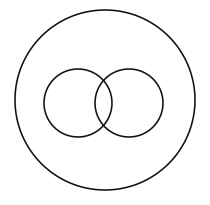
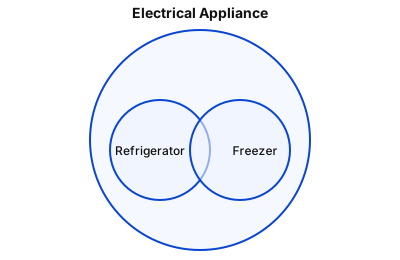
  1. Refrigerators and freezers are both electrical appliances → both circles lie inside 'Electrical Appliance'.
  2. Many refrigerators have a freezer compartment, and some freezers work as refrigerators → the two classes partly overlap.
  3. So: one big circle containing two intersecting circles — option (B).

Trick: Whole class outside, related sub-classes inside; overlap them if some members are common.

Answer: (B) Option (B)

अवधारणा: पता करें कि कौन-सा वर्ग किसे समाहित करता है और कौन-से वर्ग आंशिक रूप से एक-दूसरे से मिलते हैं।

  1. Refrigerator और Freezer दोनों Electrical Appliance हैं → दोनों वृत्त बड़े वृत्त के अंदर।
  2. कई Refrigerator में freezer होता है और कुछ Freezer, refrigerator की तरह भी काम करते हैं → दोनों आंशिक रूप से प्रतिच्छेदी।
  3. अतः एक बड़ा वृत्त जिसके अंदर दो प्रतिच्छेदी वृत्त — विकल्प (B)।

ट्रिक: बड़ा वर्ग बाहर, उप-वर्ग अंदर; कुछ सदस्य साझा हों तो उन्हें मिलाकर बनाएँ।

उत्तर: (B) विकल्प (B)

SSC CPO Paper IGeneral Intelligence and ReasoningVenn DiagramSSC CPO Paper I 2023 · 3 Oct Shift 1 →
Q6413.
Select the set in which the numbers are related in the same way as are the numbers of the following sets.
(NOTE : Operations should be performed on the whole numbers, without breaking
down the numbers into its constituent digits. E.g. 13 – Operations on 13 such as
adding /subtracting /multiplying etc. to 13 can be performed. Breaking down 13 into 1 and 3 and then performing mathematical operations on 1 and 3 is NOT allowed)
(7, 35, 42), (4, 20, 24)
उस समुच्चय का चयन कीजिए जिसमें संख्याएँ उसी प्रकार संबंधित हैं, जिस प्रकार निम्नलिखित समुच्चयों की संख्याएँ संबंधित हैं।
(नोट: संक्रियाएँ संख्याओं को उनके घटक अंकों में विभाजित किए बिना, पूर्ण संख्याओं पर की जानी चाहिए। उदाहरण के लिए, 13 – 13 पर की जाने वाली संक्रियाएँ, जैसे 13 में जोड़ना/घटाना/गुणा करना आदि की जा सकती हैं। 13 को 1 और 3 में विभाजित करके फिर 1 और 3 पर गणितीय संक्रियाएँ करने की अनुमति नहीं है।)
(7, 35, 42), (4, 20, 24)
  1. A(8, 56, 72)
  2. B(6, 36, 48)
  3. C(9, 45, 54)
  4. D(12, 60, 48)
Show answer

Concept: Find the rule linking the three numbers in each given set.

  1. (7,35,42): 7×5=35 and 35+7=42.
  2. (4,20,24): 4×5=20 and 20+4=24.
  3. (9,45,54): 9×5=45 and 45+9=54 ✓. Check (A): 8×5=40≠56 ✗.

Trick: Third number =6× first number (42=6×7, 24=6×4, 54=6×9).

Answer: (C) (9,45,54)

अवधारणा: दिए गए समूहों में तीनों संख्याओं का नियम खोजें।

  1. (7,35,42): 7×5=35 और 35+7=42।
  2. (4,20,24): 4×5=20 और 20+4=24।
  3. (9,45,54): 9×5=45 और 45+9=54 ✓। (A) जाँचें: 8×5=40≠56 ✗।

ट्रिक: तीसरी संख्या =6× पहली संख्या (42=6×7, 24=6×4, 54=6×9)।

उत्तर: (C) (9,45,54)

SSC CPO Paper IGeneral Intelligence and ReasoningNumber Analogy (Sets)SSC CPO Paper I 2023 · 3 Oct Shift 1 →
Q6414.
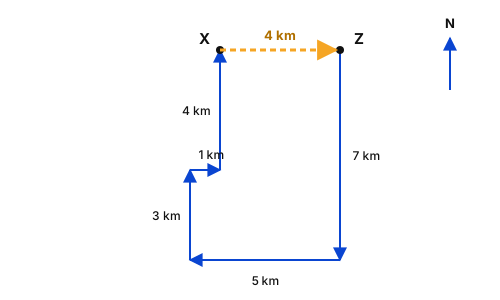
A person starts from point Z and moves 7 km towards the South. He turns right and moves 5 km, turns right, and moves 3 km, then turns right and moves 1 km. He takes a left turn and moves 4 km to reach a point X. How much and in which direction does he need to move now to reach point Z?
एक व्यक्ति बिंदु Z से चलना शुरू करता है और दक्षिण की ओर 7 km चलता है। वह दाएँ मुड़ता है और 5 km चलता है, दाएँ मुड़ता है और 3 km चलता है, फिर दाएँ मुड़ता है और 1 km चलता है। वह बाएँ मुड़ता है और 4 km चलकर बिंदु X पर पहुँचता है। बिंदु Z पर पहुँचने के लिए उसे अब कितनी दूरी और किस दिशा में चलना होगा?
  1. A4 km South4 km दक्षिण
  2. B4 km East4 km पूर्व
  3. C4 km West4 km पश्चिम
  4. D6 km East6 km पूर्व
Show answer

Concept: Plot each move on a grid with Z at the origin; a right turn while facing south means facing west.

  1. 7 km south → (0,−7). Right turn (west) 5 km → (−5,−7).
  2. Right turn (north) 3 km → (−5,−4). Right turn (east) 1 km → (−4,−4).
  3. Left turn (north) 4 km → X =(−4,0).
  4. Z =(0,0) is 4 km to the east of X.

Trick: Net N–S: −7+3+4=0; net E–W: −5+1=−4 → Z is 4 km east of X.

Answer: (B) 4 km East

अवधारणा: Z को मूल बिंदु मानकर हर चाल ग्रिड पर बनाएँ; दक्षिण की ओर मुख करके दाएँ मुड़ने पर पश्चिम।

  1. 7 km दक्षिण → (0,−7)। दाएँ (पश्चिम) 5 km → (−5,−7)।
  2. दाएँ (उत्तर) 3 km → (−5,−4)। दाएँ (पूर्व) 1 km → (−4,−4)।
  3. बाएँ (उत्तर) 4 km → X =(−4,0)।
  4. Z =(0,0), X से 4 km पूर्व में है।

ट्रिक: कुल उत्तर-दक्षिण: −7+3+4=0; कुल पूर्व-पश्चिम: −5+1=−4 → Z, X से 4 km पूर्व।

उत्तर: (B) 4 km पूर्व (East)

SSC CPO Paper IGeneral Intelligence and ReasoningDirection and DistanceSSC CPO Paper I 2023 · 3 Oct Shift 1 →
Q6415.
Select the figure that will replace the question mark (?) in the following figure series.
उस आकृति का चयन कीजिए जो निम्नलिखित आकृति श्रृंखला में प्रश्न चिह्न (?) के स्थान पर आएगी।
  1. A
  2. B
  3. C
  4. D
Show answer

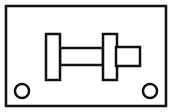
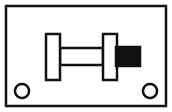
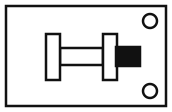
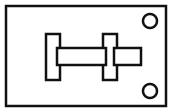
Concept: Track the two small circles and the end block of the shape separately.

  1. Circles: (top-right, bottom-right) → (top-left, top-right) → (top-left, bottom-left): the pair moves one side anticlockwise each step.
  2. Next pair: bottom-left and bottom-right.
  3. End block alternates black → white → black, so the 4th figure has a white block.
  4. Only (A) has circles at the two bottom corners with a white block.

Trick: Split the figure into parts and find one rule per part.

Answer: (A) Option (A)

अवधारणा: दोनों छोटे वृत्तों और आकृति के सिरे वाले खाने (block) को अलग-अलग देखें।

  1. वृत्त: (ऊपर-दाएँ, नीचे-दाएँ) → (ऊपर-बाएँ, ऊपर-दाएँ) → (ऊपर-बाएँ, नीचे-बाएँ): जोड़ा हर बार एक भुजा वामावर्त (anticlockwise) खिसकता है।
  2. अगला जोड़ा: नीचे-बाएँ और नीचे-दाएँ।
  3. सिरे का खाना काला → सफ़ेद → काला, अतः चौथी आकृति में सफ़ेद।
  4. केवल (A) में दोनों नीचे वाले कोनों पर वृत्त और सफ़ेद खाना है।

ट्रिक: आकृति को भागों में बाँटकर हर भाग का अलग नियम खोजें।

उत्तर: (A) विकल्प (A)

SSC CPO Paper IGeneral Intelligence and ReasoningFigure SeriesSSC CPO Paper I 2023 · 3 Oct Shift 1 →
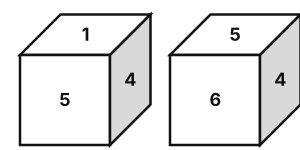
Q6416.
Two different positions of the same dice are shown, the six faces of which are numbered from 1 to 6. Select the number that will be on the face opposite to the one showing ‘1’.
एक ही पासे की दो अलग-अलग स्थितियाँ दर्शाई गई हैं, जिसके छह फलकों पर 1 से 6 तक की संख्याएँ अंकित हैं। उस संख्या का चयन कीजिए जो ‘1’ दर्शाने वाले फलक के विपरीत फलक पर होगी।
  1. A6
  2. B4
  3. C5
  4. D3
Show answer

Concept: If two positions share a face in the same place, the other faces rotate around it; track where 1 goes.

  1. Position 1: top 1, front 5, right 4. Position 2: top 5, front 6, right 4.
  2. Face 4 stays on the right, so the die has rolled about that axis: 5 went from front to top, 1 from top to back, and 6 came from the bottom to the front.
  3. The bottom of position 1 (opposite 1) is therefore 6.

Trick: Common face in the same place → rotate the other faces in one direction (top → back, front → top, bottom → front).

Answer: (A) 6

अवधारणा: यदि दो स्थितियों में एक फलक एक ही जगह हो, तो बाकी फलक उसके चारों ओर घूमते हैं; देखें 1 कहाँ गया।

  1. स्थिति 1: ऊपर 1, सामने 5, दाएँ 4। स्थिति 2: ऊपर 5, सामने 6, दाएँ 4।
  2. 4 दाईं ओर ही है, अतः पासा उसी अक्ष पर लुढ़का: 5 सामने से ऊपर, 1 ऊपर से पीछे और 6 नीचे से सामने आया।
  3. अतः स्थिति 1 में नीचे (1 के विपरीत) 6 है।

ट्रिक: समान फलक समान जगह → बाकी फलक एक दिशा में घुमाएँ (ऊपर → पीछे, सामने → ऊपर, नीचे → सामने)।

उत्तर: (A) 6

SSC CPO Paper IGeneral Intelligence and ReasoningDiceSSC CPO Paper I 2023 · 3 Oct Shift 1 →
Q6417.
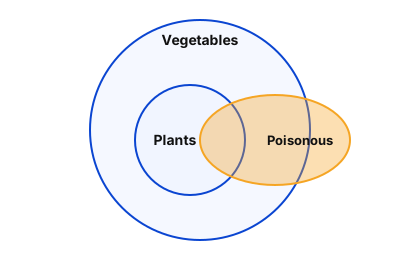
Two statements are given, followed by two conclusions numbered I and II. Assuming the statements to be true, even if they seem to be at variance with commonly known facts, decide which of the conclusions logically follow(s) from the statements.
Statements:
All plants are vegetables.
Some plants are poisonous.
Conclusions:
I. All vegetables are poisonous.
II. Some vegetables are plants.
दो कथन दिए गए हैं, जिनके बाद I और II क्रमांकित दो निष्कर्ष दिए गए हैं। कथनों को सत्य मानते हुए, भले ही वे सामान्यतः ज्ञात तथ्यों से भिन्न प्रतीत होते हों, निर्णय कीजिए कि कौन-सा/से निष्कर्ष कथनों का तार्किक रूप से अनुसरण करता है/करते हैं।
कथन:
सभी पौधे, सब्जियाँ हैं।
कुछ पौधे, ज़हरीले हैं।
निष्कर्ष:
I. सभी सब्जियाँ, ज़हरीली हैं।
II. कुछ सब्जियाँ, पौधे हैं।
  1. ANeither conclusion I nor II followsन तो निष्कर्ष I और न ही II अनुसरण करता है
  2. BOnly conclusion I followsकेवल निष्कर्ष I अनुसरण करता है
  3. CBoth conclusions I and II followनिष्कर्ष I और II दोनों अनुसरण करते हैं
  4. DOnly conclusion II followsकेवल निष्कर्ष II अनुसरण करता है
Show answer

Concept: Draw a basic Venn diagram and test each conclusion for certainty.

  1. All plants are vegetables → Plants circle inside Vegetables. Some plants are poisonous → Poisonous overlaps Plants.
  2. Conclusion I (All vegetables are poisonous): not certain — part of Vegetables may lie outside Poisonous. ✗
  3. Conclusion II (Some vegetables are plants): 'All plants are vegetables' converts to 'Some vegetables are plants'. ✓

Trick: 'All A are B' always gives 'Some B are A' (conversion).

Answer: (D) Only conclusion II follows

अवधारणा: मूल वेन आरेख बनाकर हर निष्कर्ष की निश्चितता जाँचें।

  1. All plants are vegetables → Plants का वृत्त Vegetables के अंदर। Some plants are poisonous → Poisonous, Plants से मिलता है।
  2. निष्कर्ष I (All vegetables are poisonous): निश्चित नहीं — Vegetables का भाग Poisonous से बाहर हो सकता है। ✗
  3. निष्कर्ष II (Some vegetables are plants): 'All plants are vegetables' का रूपांतरण 'Some vegetables are plants' है। ✓

ट्रिक: 'All A are B' से हमेशा 'Some B are A' निकलता है (conversion)।

उत्तर: (D) केवल निष्कर्ष II अनुसरण करता है

SSC CPO Paper IGeneral Intelligence and ReasoningSyllogismSSC CPO Paper I 2023 · 3 Oct Shift 1 →
Q6418.
Select the correct option that indicates the arrangement of the given words in the
order in which they appear in an English dictionary.
1. Desire
2. Destination
3. Descend
4. Destructive
5. Desolate
6. Desperate
उस सही विकल्प का चयन कीजिए जो दिए गए शब्दों की उस व्यवस्था को दर्शाता है, जिस
क्रम में वे अंग्रेज़ी शब्दकोश में आते हैं।
1. Desire
2. Destination
3. Descend
4. Destructive
5. Desolate
6. Desperate
  1. A3, 1, 2, 6, 5, 4
  2. B3, 1, 6, 5, 2, 4
  3. C3, 1, 5, 6, 2, 4
  4. D3, 1, 5, 6, 4, 2
Show answer

Concept: All words begin with 'Des'; compare from the fourth letter onward.

  1. 4th letters: Descend (c), Desire (i), Desolate (o), Desperate (p), Destination (t), Destructive (t).
  2. Destination vs Destructive: 5th letters i and r → Destination first.
  3. Order: Descend, Desire, Desolate, Desperate, Destination, Destructive = 3, 1, 5, 6, 2, 4.

Trick: Write only the first differing letters: c, i, o, p, ti, tr.

Answer: (C) 3, 1, 5, 6, 2, 4

अवधारणा: सभी शब्द 'Des' से शुरू होते हैं; चौथे अक्षर से तुलना करें।

  1. चौथा अक्षर: Descend (c), Desire (i), Desolate (o), Desperate (p), Destination (t), Destructive (t)।
  2. Destination बनाम Destructive: पाँचवाँ अक्षर i और r → Destination पहले।
  3. क्रम: Descend, Desire, Desolate, Desperate, Destination, Destructive = 3, 1, 5, 6, 2, 4।

ट्रिक: केवल पहले अलग अक्षर लिखें: c, i, o, p, ti, tr।

उत्तर: (C) 3, 1, 5, 6, 2, 4

SSC CPO Paper IGeneral Intelligence and ReasoningDictionary OrderSSC CPO Paper I 2023 · 3 Oct Shift 1 →
Q6419.
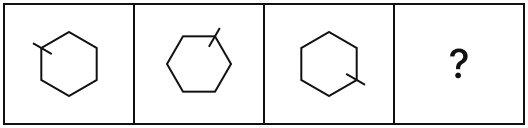
Select the figure that will come next in the following figure series.
उस आकृति का चयन कीजिए जो निम्नलिखित आकृति श्रृंखला में अगले स्थान पर आएगी।
  1. A
  2. B
  3. C
  4. D
Show answer

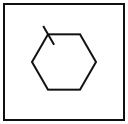
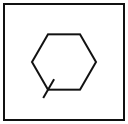
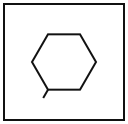
Concept: Follow the position of the short line that crosses one vertex of the hexagon.

  1. Fig 1: line at the upper-left vertex; Fig 2: upper-right vertex; Fig 3: lower-right vertex.
  2. The line moves clockwise round the hexagon, skipping ahead by about a quarter turn each step.
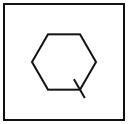
  3. Next position: the lower-left vertex, with the line crossing the vertex (part inside, part outside) as in every figure.
  4. Option (C) shows this; (D) has only an outside stub and (A), (B) are at wrong vertices.

Trick: Track one moving element; check both its position and its style (crossing vs touching).

Answer: (C) Option (C)

अवधारणा: षट्भुज (hexagon) के एक शीर्ष को काटने वाली छोटी रेखा की स्थिति देखें।

  1. आकृति 1: ऊपर-बाएँ शीर्ष; आकृति 2: ऊपर-दाएँ शीर्ष; आकृति 3: नीचे-दाएँ शीर्ष।
  2. रेखा हर चरण में लगभग चौथाई चक्कर दक्षिणावर्त (clockwise) आगे बढ़ती है।
  3. अगली स्थिति: नीचे-बाएँ शीर्ष, और रेखा शीर्ष को काटती हुई (आधी अंदर, आधी बाहर)।
  4. (C) में यही है; (D) में केवल बाहर छोटी रेखा है, (A), (B) में शीर्ष गलत है।

ट्रिक: एक चलने वाले तत्व की स्थिति और शैली (काटना या केवल छूना) दोनों जाँचें।

उत्तर: (C) विकल्प (C)

SSC CPO Paper IGeneral Intelligence and ReasoningFigure SeriesSSC CPO Paper I 2023 · 3 Oct Shift 1 →
Q6420.
Three different positions of the same dice are shown. Find the number on the face
opposite the face showing ‘4’.
एक ही पासे की तीन अलग-अलग स्थितियाँ दर्शाई गई हैं। ‘4’ दर्शाने वाले फलक के
विपरीत फलक पर संख्या ज्ञात कीजिए।
  1. A6
  2. B2
  3. C3
  4. D1
Show answer

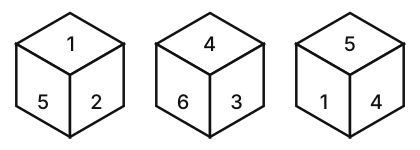
Concept: All numbers seen together with a face are adjacent to it; the remaining one is opposite.

  1. Faces shown with 4: 6, 3 (fig 2) and 5, 1 (fig 3).
  2. So 4 is adjacent to 1, 3, 5, 6.
  3. The only number left is 2 → 2 is opposite 4.

Trick: Once four neighbours of a face are known, the fifth leftover number is its opposite.

Answer: (B) 2

अवधारणा: किसी फलक के साथ दिखने वाली सभी संख्याएँ उसकी आसन्न हैं; बची हुई विपरीत है।

  1. 4 के साथ दिखी संख्याएँ: 6, 3 (आकृति 2) और 5, 1 (आकृति 3)।
  2. अतः 4 के आसन्न: 1, 3, 5, 6।
  3. बची संख्या 2 → 2, 4 के विपरीत है।

ट्रिक: चार पड़ोसी मिलते ही पाँचवीं बची संख्या विपरीत होती है।

उत्तर: (B) 2

SSC CPO Paper IGeneral Intelligence and ReasoningDiceSSC CPO Paper I 2023 · 3 Oct Shift 1 →