Question bank

Q&A: practice questions with answers

Search questions on any topic. Filter by exam category, exam, subject and topic, try the question, then open the answer and explanation.

Courses – airGurukul

6,600 questions found.

Q6521.
If xy+yx=1 and x+y=2, then the value of x3+y3 is:
यदि xy+yx=1 और x+y=2 है, तो x3+y3 का मान है:
  1. A1
  2. B3
  3. C0
  4. D2
Show answer

Concept: x3+y3=(x+y)(x2−xy+y2).

  1. xy+yx=1⇒x2+y2=xy
  2. So x2−xy+y2=0
  3. x3+y3=2×0=0

Trick: xy+yx=1 always gives x3+y3=0, whatever x+y is.

Answer: (C) 0

अवधारणा: x3+y3=(x+y)(x2−xy+y2)।

  1. xy+yx=1⇒x2+y2=xy
  2. अतः x2−xy+y2=0
  3. x3+y3=2×0=0

ट्रिक: xy+yx=1 हो तो x3+y3=0 — x+y कुछ भी हो।

उत्तर: (C) 0

SSC CPO Paper IQuantitative AptitudeAlgebra – Cube IdentitySSC CPO Paper I 2023 · 3 Oct Shift 1 →
Q6522.
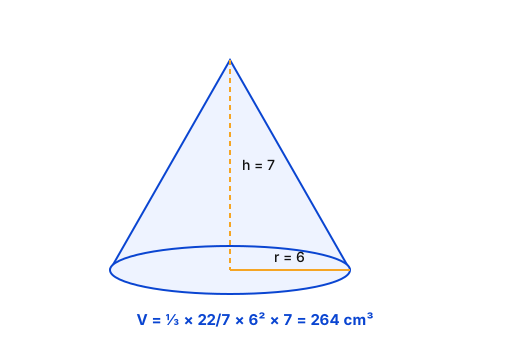
If the height of a cone is 7 cm and the diameter of the circular base is 12 cm, then its volume is (nearest to integer):
यदि एक शंकु की ऊँचाई 7 cm है और वृत्ताकार आधार का व्यास 12 cm है, तो इसका आयतन (निकटतम पूर्णांक तक) है:
  1. A254 cm3
  2. B284 cm3
  3. C264 cm3
  4. D274 cm3
Show answer

Concept: Volume of cone =13πr2h.

  1. r=122=6cm, h=7cm
  2. V=13×227×36×7
  3. =22×363=264cm3

Trick: h=7 cancels the 7 of 227: V=22×363.

Answer: (C) 264cm3

अवधारणा: शंकु का आयतन =13πr2h।

  1. r=122=6cm, h=7cm
  2. V=13×227×36×7
  3. =22×363=264cm3

ट्रिक: h=7, 227 के 7 को काट देता है: V=22×363।

उत्तर: (C) 264cm3

SSC CPO Paper IQuantitative AptitudeMensuration – ConeSSC CPO Paper I 2023 · 3 Oct Shift 1 →
Q6523.
A, B and C can do a piece of work in 20 days, 30 days and 60 days respectively. If A works daily and on every third day B and C also work with A, then in how many days, will the work be completed?
A, B और C एक कार्य को क्रमशः 20 दिन, 30 दिन और 60 दिन में कर सकते हैं। यदि A प्रतिदिन कार्य करता है और प्रत्येक तीसरे दिन B और C भी A के साथ कार्य करते हैं, तो कार्य कितने दिनों में पूरा होगा?
  1. A21
  2. B18
  3. C12
  4. D15
Show answer

Concept: Use total work = LCM of days and find work done in one repeating cycle.
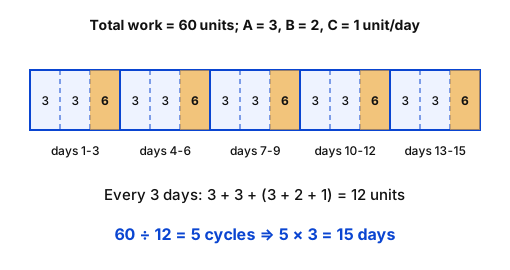
  1. Work =60 units; A =3, B =2, C =1 unit/day
  2. 3-day cycle: 3+3+(3+2+1)=12 units
  3. Cycles =6012=5
  4. Days =5×3=15

Trick: Work finishes exactly at the end of a cycle, so no leftover check is needed.

Answer: (D) 15

अवधारणा: कुल कार्य = दिनों का LCM लें और एक दोहराए जाने वाले चक्र का काम निकालें।

  1. कार्य =60 इकाई; A =3, B =2, C =1 इकाई/दिन
  2. 3 दिन का चक्र: 3+3+(3+2+1)=12 इकाई
  3. चक्र =6012=5
  4. दिन =5×3=15

ट्रिक: काम ठीक चक्र के अंत में पूरा होता है, बचा काम जाँचने की ज़रूरत नहीं।

उत्तर: (D) 15

SSC CPO Paper IQuantitative AptitudeTime and Work – Alternate DaysSSC CPO Paper I 2023 · 3 Oct Shift 1 →
Q6524.
Darjeeling gets tourists from two countries A and B. Percentage wise distribution of the influx of tourists is given below for the first six months of the year. Total number of tourists = 60000.
MonthShare of total touristsRatio (A : B)
Jan5%5 : 7
Feb10%6 : 7
March20%3 : 2
April25%8 : 7
May30%4 : 5
June10%3 : 4
Find the ratio of tourists from country A coming in during March and April.
दार्जिलिंग में दो देशों A और B से पर्यटक आते हैं। वर्ष के पहले छह महीनों के लिए पर्यटकों के आगमन का प्रतिशत-वार वितरण नीचे दिया गया है। पर्यटकों की कुल संख्या = 60000।
महीनाकुल पर्यटकों में हिस्साअनुपात (A : B)
जनवरी5%5 : 7
फरवरी10%6 : 7
मार्च20%3 : 2
अप्रैल25%8 : 7
मई30%4 : 5
जून10%3 : 4
मार्च और अप्रैल के दौरान देश A से आने वाले पर्यटकों का अनुपात ज्ञात कीजिए।
  1. A4∶7
  2. B3∶7
  3. C7∶10
  4. D9∶10
Show answer

Concept: Tourists from A in a month =Total×share×AA+B.

  1. March: 60000×20%=12000; A =12000×35=7200
  2. April: 60000×25%=15000; A =15000×815=8000
  3. Ratio =7200:8000=9:10

Trick: Skip the total: 20×35:25×815=12:403=9:10.

Answer: (D) 9:10

अवधारणा: किसी माह में A के पर्यटक =कुल×हिस्सा×AA+B।

  1. मार्च: 60000×20%=12000; A =12000×35=7200
  2. अप्रैल: 60000×25%=15000; A =15000×815=8000
  3. अनुपात =7200:8000=9:10

ट्रिक: कुल छोड़ दें: 20×35:25×815=12:403=9:10।

उत्तर: (D) 9:10

SSC CPO Paper IQuantitative AptitudeData Interpretation – Pie & TableSSC CPO Paper I 2023 · 3 Oct Shift 1 →
Q6525.
The value of 11 × 11 + 11 ÷ 11 - 11 × 11 + 11 + 11 × 11 - 11 - 11 × 11 is:
11 × 11 + 11 ÷ 11 - 11 × 11 + 11 + 11 × 11 - 11 - 11 × 11 का मान है:
  1. A1
  2. B11
  3. C121
  4. D0
Show answer

Concept: BODMAS: do ÷ and × first, then + and − from left to right.

  1. 11×11=121, 11÷11=1
  2. Expression =121+1−121+11+121−11−121
  3. =1

Trick: The 121s and 11s cancel in pairs, leaving only 1.

Answer: (A) 1

अवधारणा: BODMAS: पहले ÷ और ×, फिर बाएँ से दाएँ + और −।

  1. 11×11=121, 11÷11=1
  2. व्यंजक =121+1−121+11+121−11−121
  3. =1

ट्रिक: 121 और 11 जोड़ों में कट जाते हैं, केवल 1 बचता है।

उत्तर: (A) 1

SSC CPO Paper IQuantitative AptitudeSimplification – BODMASSSC CPO Paper I 2023 · 3 Oct Shift 1 →
Q6526.
A man spends 72% of his salary and saves ₹5,740 per month. What is 10% of his
annual salary (in ₹)?
एक व्यक्ति अपने वेतन का 72% खर्च करता है और प्रति माह ₹5,740 बचाता है। उसके
वार्षिक वेतन का 10% (₹ में) कितना है?
  1. A₹21600
  2. B₹24600
  3. C₹20500
  4. D₹28400
Show answer

Concept: Savings %=100%−Expenditure%.

  1. Savings =100−72=28% of monthly salary = ₹5740
  2. Monthly salary =57400.28= ₹20500
  3. Annual salary =20500×12= ₹246000
  4. 10% of it = ₹24600

Trick: 10% of annual =1.2× monthly salary =1.2×20500.

Answer: (B) ₹24600

अवधारणा: बचत %=100%−खर्च%।

  1. बचत =100−72=28% मासिक वेतन का = ₹5740
  2. मासिक वेतन =57400.28= ₹20500
  3. वार्षिक वेतन =20500×12= ₹246000
  4. इसका 10%= ₹24600

ट्रिक: वार्षिक का 10%=1.2× मासिक वेतन =1.2×20500।

उत्तर: (B) ₹24600

SSC CPO Paper IQuantitative AptitudePercentage – Salary and SavingsSSC CPO Paper I 2023 · 3 Oct Shift 1 →
Q6527.
The population of a city is 3,52,314. It increases annually at the rate of 15% per annum. What was its population 2 years ago?
एक शहर की जनसंख्या 3,52,314 है। यह प्रति वर्ष 15% वार्षिक की दर से बढ़ती है। 2 वर्ष पहले इसकी जनसंख्या कितनी थी?
  1. A3,02,400
  2. B3,06,360
  3. C2,66,400
  4. D2,56,400
Show answer

Concept: Population n years ago =Present(1+r100)n.

  1. (1.15)2=1.3225
  2. Population 2 years ago =3523141.3225
  3. =266400

Trick: 1.15=2320, so divide by 529 and multiply by 400: 352314529=666, 666×400=266400.

Answer: (C) 2,66,400

अवधारणा: n वर्ष पहले की जनसंख्या =वर्तमान(1+r100)n।

  1. (1.15)2=1.3225
  2. 2 वर्ष पहले जनसंख्या =3523141.3225
  3. =266400

ट्रिक: 1.15=2320, अतः 529 से भाग और 400 से गुणा: 352314529=666, 666×400=266400।

उत्तर: (C) 2,66,400

SSC CPO Paper IQuantitative AptitudePopulation – Compound GrowthSSC CPO Paper I 2023 · 3 Oct Shift 1 →
Q6528.
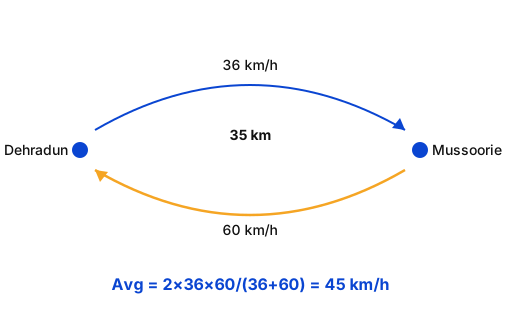
A tourist van travels the distance of 35 km from Dehradun to Mussoorie at an average speed of 36 km/h and returns at 60 km/h. What is the approximate average speed (in km/h) of the tourist van for the entire journey?
एक पर्यटक वैन देहरादून से मसूरी तक 35 km की दूरी 36 km/h की औसत चाल से तय करती है और 60 km/h की चाल से वापस आती है। पूरी यात्रा के लिए पर्यटक वैन की लगभग औसत चाल (km/h में) कितनी है?
  1. A48
  2. B42
  3. C45
  4. D50
Show answer

Concept: For equal distances, average speed =2xyx+y.

  1. x=36, y=60
  2. Average =2×36×6036+60=432096
  3. =45km/h

Trick: The distance (35km) does not matter when both legs are equal.

Answer: (C) 45

अवधारणा: समान दूरी के लिए औसत चाल =2xyx+y।

  1. x=36, y=60
  2. औसत =2×36×6036+60=432096
  3. =45km/h

ट्रिक: दोनों तरफ़ दूरी समान हो तो दूरी (35km) की ज़रूरत नहीं।

उत्तर: (C) 45

SSC CPO Paper IQuantitative AptitudeAverage Speed – Round TripSSC CPO Paper I 2023 · 3 Oct Shift 1 →
Q6529.
The HCF and the LCM of two numbers are 5 and 175, respectively. If the ratio of the two numbers is 5:7, the larger of the two numbers is _______.
दो संख्याओं का HCF और LCM क्रमशः 5 और 175 है। यदि दोनों संख्याओं का अनुपात 5:7 है, तो दोनों में से बड़ी संख्या _______ है।
  1. A35
  2. B25
  3. C45
  4. D75
Show answer

Concept: If numbers are in ratio a:b (co-prime), they are a×HCF and b×HCF.

  1. Numbers =5×5=25 and 7×5=35
  2. Check: LCM(25,35)=175 ✓
  3. Larger number =35

Trick: Larger = larger ratio term × HCF =7×5.

Answer: (A) 35

अवधारणा: यदि संख्याएँ a:b (सह-अभाज्य) अनुपात में हों, तो वे a×HCF और b×HCF होंगी।

  1. संख्याएँ =5×5=25 और 7×5=35
  2. जाँच: LCM(25,35)=175 ✓
  3. बड़ी संख्या =35

ट्रिक: बड़ी संख्या = अनुपात का बड़ा पद × HCF =7×5।

उत्तर: (A) 35

SSC CPO Paper IQuantitative AptitudeHCF and LCMSSC CPO Paper I 2023 · 3 Oct Shift 1 →
Q6530.
The product of two numbers is 726 and their HCF is 11, then their LCM is:
दो संख्याओं का गुणनफल 726 है और उनका HCF 11 है, तो उनका LCM है:
  1. A58
  2. B68
  3. C66
  4. D76
Show answer

Concept: Product of two numbers =HCF×LCM.

  1. 726=11×LCM
  2. LCM =72611=66

Trick: LCM must be a multiple of HCF 11 — only 66 is.

Answer: (C) 66

अवधारणा: दो संख्याओं का गुणनफल =HCF×LCM।

  1. 726=11×LCM
  2. LCM =72611=66

ट्रिक: LCM, HCF 11 का गुणज होना चाहिए — केवल 66 है।

उत्तर: (C) 66

SSC CPO Paper IQuantitative AptitudeHCF and LCM – Product RuleSSC CPO Paper I 2023 · 3 Oct Shift 1 →
Q6531.
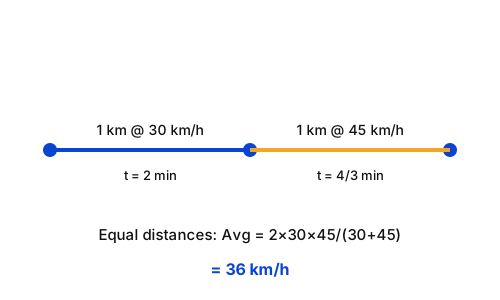
If a truck moves at a constant speed of 30 km/h for 1 kilometre and 45 km/h for the
next 1 kilometre. What is the average speed of the truck?
यदि एक ट्रक 1 किलोमीटर तक 30 km/h की स्थिर चाल से और अगले 1 किलोमीटर तक 45 km/h की
चाल से चलता है, तो ट्रक की औसत चाल क्या है?
  1. A32 km/h
  2. B36 km/h
  3. C38 km/h
  4. D34 km/h
Show answer

Concept: Average speed =Total distanceTotal time; for two equal distances it is 2xyx+y.

  1. 2×30×4530+45=270075
  2. =36km/h
  3. Check: time =130+145=118h; 21/18=36

Trick: Average for equal distances is the harmonic mean — always less than the simple average 37.5.

Answer: (B) 36km/h

अवधारणा: औसत चाल =कुल दूरीकुल समय; दो समान दूरियों के लिए 2xyx+y।

  1. 2×30×4530+45=270075
  2. =36km/h
  3. जाँच: समय =130+145=118h; 21/18=36

ट्रिक: समान दूरी पर औसत चाल हरात्मक माध्य है — सामान्य औसत 37.5 से हमेशा कम।

उत्तर: (B) 36km/h

SSC CPO Paper IQuantitative AptitudeAverage Speed – Equal DistancesSSC CPO Paper I 2023 · 3 Oct Shift 1 →
Q6532.
P, Q and R, when working individually, can complete a job in, respectively, 36 days, 48 days and 144 days. P, Q and R start working together. P leaves the job 12 days before completion and Q leaves the job 8 days before completion. R works from the
beginning till the end of the job. Determine the total number of days taken to complete the job.
P, Q और R अकेले कार्य करते हुए एक कार्य को क्रमशः 36 दिन, 48 दिन और 144 दिन में पूरा कर सकते हैं। P, Q और R एक साथ कार्य करना शुरू करते हैं। P कार्य पूरा होने से 12 दिन पहले कार्य छोड़ देता है और Q कार्य पूरा होने से 8 दिन पहले कार्य छोड़ देता है। R कार्य के
आरंभ से अंत तक कार्य करता है। कार्य को पूरा करने में लगे कुल दिनों की संख्या ज्ञात कीजिए।
  1. A24
  2. B27
  3. C30
  4. D25
Show answer

Concept: Let the job take T days; each person's work = efficiency × days worked; total = whole work.
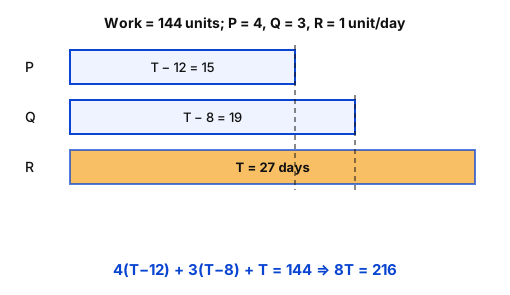
  1. Work = LCM(36,48,144)=144; P =4, Q =3, R =1 unit/day
  2. 4(T−12)+3(T−8)+1×T=144
  3. 8T−72=144⇒T=27

Trick: Add back the missed work: (144+4×12+3×8)÷(4+3+1)=216÷8=27.

Answer: (B) 27

अवधारणा: मान लें काम T दिन में पूरा; हर व्यक्ति का काम = क्षमता × काम के दिन; कुल = पूरा काम।

  1. कार्य = LCM(36,48,144)=144; P =4, Q =3, R =1 इकाई/दिन
  2. 4(T−12)+3(T−8)+1×T=144
  3. 8T−72=144⇒T=27

ट्रिक: छूटा काम जोड़ दें: (144+4×12+3×8)÷(4+3+1)=216÷8=27।

उत्तर: (B) 27

SSC CPO Paper IQuantitative AptitudeTime and Work – Leaving Before CompletionSSC CPO Paper I 2023 · 3 Oct Shift 1 →
Q6533.
If a + b = 10 and ab = 6, then the value of a3 + b3 is:
यदि a + b = 10 और ab = 6 है, तो a3 + b3 का मान है:
  1. A800
  2. B820
  3. C860
  4. D840
Show answer

Concept: a3+b3=(a+b)3−3ab(a+b).

  1. (a+b)3=103=1000
  2. 3ab(a+b)=3×6×10=180
  3. a3+b3=1000−180=820

Trick: Cube of sum minus 3×product×sum.

Answer: (B) 820

अवधारणा: a3+b3=(a+b)3−3ab(a+b)।

  1. (a+b)3=103=1000
  2. 3ab(a+b)=3×6×10=180
  3. a3+b3=1000−180=820

ट्रिक: योग का घन घटा 3×गुणनफल×योग।

उत्तर: (B) 820

SSC CPO Paper IQuantitative AptitudeAlgebra – Cube IdentitySSC CPO Paper I 2023 · 3 Oct Shift 1 →
Q6534.
If cosθ−sinθ=2sinθ, then (cosθ+sinθ) is:
यदि cosθ−sinθ=2sinθ है, तो (cosθ+sinθ) है:
  1. A−2cosθ
  2. B2cosθ
  3. C2tanθ
  4. D−2sinθ
Show answer

Concept: Express sinθ in terms of cosθ and use (2+1)(2−1)=1.

  1. cosθ=(2+1)sinθ⇒sinθ=cosθ2+1=(2−1)cosθ
  2. cosθ+sinθ=cosθ+(2−1)cosθ
  3. =2cosθ

Trick: Standard pair: if cosθ−sinθ=2sinθ then cosθ+sinθ=2cosθ.

Answer: (B) 2cosθ

अवधारणा: sinθ को cosθ में लिखें और (2+1)(2−1)=1 का प्रयोग करें।

  1. cosθ=(2+1)sinθ⇒sinθ=cosθ2+1=(2−1)cosθ
  2. cosθ+sinθ=cosθ+(2−1)cosθ
  3. =2cosθ

ट्रिक: मानक जोड़ी: cosθ−sinθ=2sinθ हो तो cosθ+sinθ=2cosθ।

उत्तर: (B) 2cosθ

SSC CPO Paper IQuantitative AptitudeTrigonometry – IdentitiesSSC CPO Paper I 2023 · 3 Oct Shift 1 →
Q6535.
The sides of a triangle are in the ratio 5 : 12 : 13 and its perimeter is 90 cm. Find its area (in cm2).
एक त्रिभुज की भुजाएँ 5 : 12 : 13 के अनुपात में हैं और इसका परिमाप 90 cm है। इसका क्षेत्रफल (cm2 में) ज्ञात कीजिए।
  1. A150
  2. B270
  3. C30
  4. D60
Show answer

Concept: 5:12:13 is a Pythagorean triplet, so the triangle is right-angled.
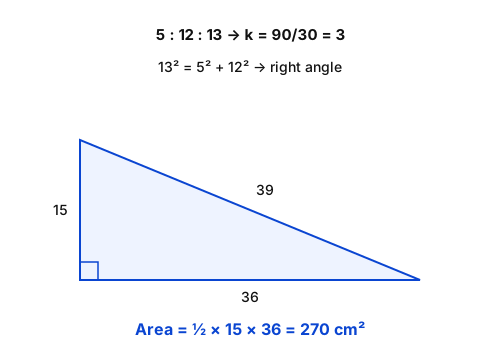
  1. 5k+12k+13k=30k=90⇒k=3
  2. Sides 15, 36, 39 (right angle between 15 and 36)
  3. Area =12×15×36=270cm2

Trick: Area of 5–12–13 triangle =30k2=30×9.

Answer: (B) 270

अवधारणा: 5:12:13 पाइथागोरस त्रिक है, अतः त्रिभुज समकोण है।

  1. 5k+12k+13k=30k=90⇒k=3
  2. भुजाएँ 15, 36, 39 (समकोण 15 और 36 के बीच)
  3. क्षेत्रफल =12×15×36=270cm2

ट्रिक: 5–12–13 त्रिभुज का क्षेत्रफल =30k2=30×9।

उत्तर: (B) 270

SSC CPO Paper IQuantitative AptitudeTriangle – AreaSSC CPO Paper I 2023 · 3 Oct Shift 1 →
Q6536.
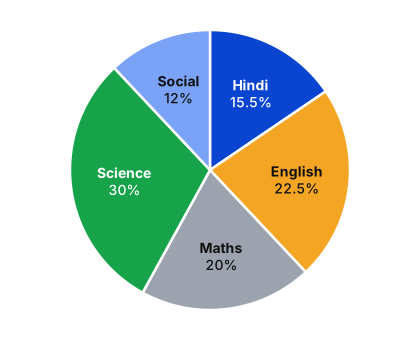
The given pie-chart shows the distribution of the marks scored by Ram in five different subjects (in percentage).

What is the ratio of the central angle of Maths to the central angle of Science?
दिया गया पाई चार्ट पाँच अलग-अलग विषयों में राम द्वारा प्राप्त अंकों का वितरण (प्रतिशत में) दर्शाता है।

गणित के केंद्रीय कोण और विज्ञान के केंद्रीय कोण का अनुपात क्या है?
  1. A5 : 2
  2. B2 : 3
  3. C4 : 3
  4. D3 : 5
Show answer

Concept: Central angles are proportional to percentages, so compare percentages directly.

  1. Maths =20%, Science =30%
  2. Ratio =20:30=2:3

Trick: No need to convert to degrees (72∘:108∘ gives the same 2:3).

Answer: (B) 2:3

अवधारणा: केंद्रीय कोण प्रतिशत के समानुपाती होते हैं, इसलिए सीधे प्रतिशत की तुलना करें।

  1. Maths =20%, Science =30%
  2. अनुपात =20:30=2:3

ट्रिक: डिग्री में बदलने की ज़रूरत नहीं (72∘:108∘ भी 2:3)।

उत्तर: (B) 2:3

SSC CPO Paper IQuantitative AptitudeData Interpretation – Pie ChartSSC CPO Paper I 2023 · 3 Oct Shift 1 →
Q6537.
Study the given data and answer the question that follows.
The tables shows the number of candidates (in lakh) appearing in an entrance exam from four different cities and the ratio of candidates passing and failing in the same.
CityABCD
Number of candidates2.151.141.562.35
Ratio of candidates passing and failing within the city.
CityPassingFailing
A42
B53
C64
D46
What is the number of failed candidates (in lakh) in city D?
दिए गए आँकड़ों का अध्ययन कीजिए और उसके बाद आने वाले प्रश्न का उत्तर दीजिए।
तालिकाएँ चार अलग-अलग शहरों से एक प्रवेश परीक्षा में उपस्थित होने वाले उम्मीदवारों की संख्या (लाख में) और उसमें उत्तीर्ण और अनुत्तीर्ण होने वाले उम्मीदवारों का अनुपात दर्शाती हैं।
शहरABCD
उम्मीदवारों की संख्या2.151.141.562.35
शहर के भीतर उत्तीर्ण और अनुत्तीर्ण होने वाले उम्मीदवारों का अनुपात।
शहरउत्तीर्णअनुत्तीर्ण
A42
B53
C64
D46
शहर D में अनुत्तीर्ण उम्मीदवारों की संख्या (लाख में) कितनी है?
  1. A1.70
  2. B1.25
  3. C1.85
  4. D1.41
Show answer

Concept: Failed =Total×FailingPassing+Failing.

  1. City D: total =2.35 lakh, ratio 4:6
  2. Failed =2.35×610=1.41 lakh

Trick: 610=60%; 60% of 2.35=1.41.

Answer: (D) 1.41

अवधारणा: असफल =कुल×असफलसफल+असफल।

  1. शहर D: कुल =2.35 लाख, अनुपात 4:6
  2. असफल =2.35×610=1.41 लाख

ट्रिक: 610=60%; 2.35 का 60%=1.41।

उत्तर: (D) 1.41

SSC CPO Paper IQuantitative AptitudeData Interpretation – Ratio TableSSC CPO Paper I 2023 · 3 Oct Shift 1 →
Q6538.
Two circles of radius 13 cm and 15 cm intersect each other at points A and B. If the length of the common chord is 12 cm, then what is the distance between their
centres?
13 cm और 15 cm त्रिज्या वाले दो वृत्त एक-दूसरे को बिंदु A और B पर प्रतिच्छेद करते हैं। यदि उभयनिष्ठ जीवा की लंबाई 12 cm है, तो उनके
केंद्रों के बीच की दूरी कितनी है?
  1. A145+184
  2. B131+181
  3. C145+169
  4. D133+189
Show answer

Concept: The line joining the centres is the perpendicular bisector of the common chord.
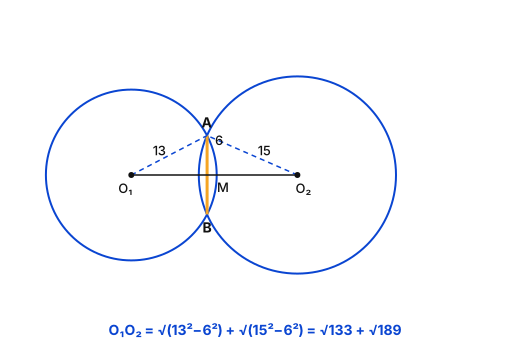
  1. Half chord AM=6cm
  2. O1M=132−62=133
  3. O2M=152−62=189
  4. O1O2=133+189cm

Trick: Distance =r12−(c2)2+r22−(c2)2.

Answer: (D) 133+189

अवधारणा: केंद्रों को मिलाने वाली रेखा उभयनिष्ठ जीवा का लंब समद्विभाजक होती है।

  1. आधी जीवा AM=6cm
  2. O1M=132−62=133
  3. O2M=152−62=189
  4. O1O2=133+189cm

ट्रिक: दूरी =r12−(c2)2+r22−(c2)2।

उत्तर: (D) 133+189

SSC CPO Paper IQuantitative AptitudeCircles – Common ChordSSC CPO Paper I 2023 · 3 Oct Shift 1 →
Q6539.
Study the given bar-graph and answer the question that follows.
The bar-graph shows the higher secondary students of a school for the years 2008, 2009 and 2010.
Year1st division2nd Division3rd DivisionFail
200820606030
200930605050
201040607030
The percentage of students who passed in the second division in the year 2010 was:
दिए गए दंड आलेख का अध्ययन कीजिए और उसके बाद आने वाले प्रश्न का उत्तर दीजिए।
दंड आलेख वर्ष 2008, 2009 और 2010 के लिए एक विद्यालय के उच्चतर माध्यमिक विद्यार्थियों को दर्शाता है।
वर्षप्रथम श्रेणीद्वितीय श्रेणीतृतीय श्रेणीअनुत्तीर्ण
200820606030
200930605050
201040607030
वर्ष 2010 में द्वितीय श्रेणी में उत्तीर्ण होने वाले विद्यार्थियों का प्रतिशत था:
  1. A25%
  2. B28%
  3. C30%
  4. D32%
Show answer

Concept: Percentage =PartTotal students of that year×100 (total includes the failed students).

  1. Total in 2010 =40+60+70+30=200
  2. 2nd division =60
  3. 60200×100=30%

Trick: Do not leave out the 'Fail' bar while finding the total.

Answer: (C) 30%

अवधारणा: प्रतिशत =भागउस वर्ष के कुल छात्र×100 (कुल में अनुत्तीर्ण छात्र भी शामिल)।

  1. 2010 में कुल =40+60+70+30=200
  2. द्वितीय श्रेणी =60
  3. 60200×100=30%

ट्रिक: कुल निकालते समय 'Fail' वाले छात्रों को न छोड़ें।

उत्तर: (C) 30%

SSC CPO Paper IQuantitative AptitudeData Interpretation – Bar GraphSSC CPO Paper I 2023 · 3 Oct Shift 1 →
Q6540.
Two numbers are in the ratio 5:3 and the difference between these two numbers is 34. Find the smaller of the two numbers.
दो संख्याएँ 5:3 के अनुपात में हैं और इन दोनों संख्याओं का अंतर 34 है। दोनों में से छोटी संख्या ज्ञात कीजिए।
  1. A51
  2. B85
  3. C68
  4. D34
Show answer

Concept: Write the numbers as 5k and 3k.

  1. 5k−3k=2k=34⇒k=17
  2. Smaller =3×17=51

Trick: Difference of ratio terms =2 parts =34, so 1 part =17.

Answer: (A) 51

अवधारणा: संख्याएँ 5k और 3k लें।

  1. 5k−3k=2k=34⇒k=17
  2. छोटी संख्या =3×17=51

ट्रिक: अनुपात का अंतर =2 भाग =34, अतः 1 भाग =17।

उत्तर: (A) 51

SSC CPO Paper IQuantitative AptitudeRatioSSC CPO Paper I 2023 · 3 Oct Shift 1 →