Q641.
Six students - A, B, C, D, E and F - are sitting around a circular table, facing the centre. A is the immediate neighbour of both E and F.
B is sitting second to the right of E.
D is sitting third to the left of F.
C is the immediate neighbour of both B and F.
Who among the following is the immediate neighbour of both A and D?
B is sitting second to the right of E.
D is sitting third to the left of F.
C is the immediate neighbour of both B and F.
Who among the following is the immediate neighbour of both A and D?
छह विद्यार्थी - A, B, C, D, E और F - एक वृत्ताकार मेज़ के चारों ओर केंद्र की ओर मुख करके बैठे हैं। A, E और F दोनों का निकटतम पड़ोसी है।
B, E के दाएँ से दूसरे स्थान पर बैठा है।
D, F के बाएँ से तीसरे स्थान पर बैठा है।
C, B और F दोनों का निकटतम पड़ोसी है।
निम्नलिखित में से कौन A और D दोनों का निकटतम पड़ोसी है?
B, E के दाएँ से दूसरे स्थान पर बैठा है।
D, F के बाएँ से तीसरे स्थान पर बैठा है।
C, B और F दोनों का निकटतम पड़ोसी है।
निम्नलिखित में से कौन A और D दोनों का निकटतम पड़ोसी है?
- AE
- BB
- CC
- DF
Show answer
Concept: Facing the centre: left = clockwise, right = anticlockwise.
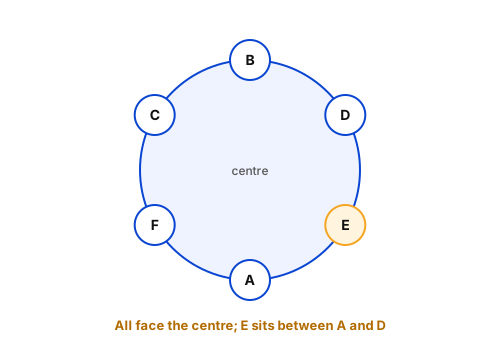
- A sits between E and F; F's other neighbour must be C (C is next to F and B), and B is next to C.
- D is third to the left of F → D is opposite F.
- Order (clockwise): A, F, C, B, D, E. Check: B is second to the right of E ✓.
- Neighbours of A: F, E; neighbours of D: B, E → common: E.
Trick: In a 6-seat circle, 'third to the left/right' always means directly opposite.
Answer: (A) E
अवधारणा: केंद्र की ओर मुख: बायाँ = दक्षिणावर्त (clockwise), दायाँ = वामावर्त।
- A, E और F के बीच; F का दूसरा पड़ोसी C (C, F और B के पास), और B, C के पास।
- D, F के बाएँ तीसरा → D, F के ठीक सामने।
- क्रम (clockwise): A, F, C, B, D, E। जाँच: B, E के दाएँ दूसरा ✓।
- A के पड़ोसी F, E; D के पड़ोसी B, E → समान: E।
ट्रिक: 6 सीटों के वृत्त में 'तीसरा बाएँ/दाएँ' = ठीक सामने।
उत्तर: (A) E