Q1001.
Two statements are given followed by two conclusions numbered I and II. Assuming the statements to be true, even if they seem to be at variance with commonly known facts, decide which of the conclusions logically follow(s) from the statements.
Statements:
1) All games are tournaments.
2) Some tournaments are matches.
Conclusions:
I. All games are matches.
II. No game is a tournament.
Statements:
1) All games are tournaments.
2) Some tournaments are matches.
Conclusions:
I. All games are matches.
II. No game is a tournament.
दो कथन दिए गए हैं, जिनके बाद I और II से क्रमांकित दो निष्कर्ष दिए गए हैं। कथनों को सत्य मानते हुए, भले ही वे सामान्य रूप से ज्ञात तथ्यों से भिन्न प्रतीत होते हों, निर्णय कीजिए कि कौन-सा/से निष्कर्ष कथनों का तार्किक रूप से अनुसरण करता है/करते हैं।
कथन:
1) सभी खेल, टूर्नामेंट हैं।
2) कुछ टूर्नामेंट, मैच हैं।
निष्कर्ष:
I. सभी खेल, मैच हैं।
II. कोई भी खेल, टूर्नामेंट नहीं है।
कथन:
1) सभी खेल, टूर्नामेंट हैं।
2) कुछ टूर्नामेंट, मैच हैं।
निष्कर्ष:
I. सभी खेल, मैच हैं।
II. कोई भी खेल, टूर्नामेंट नहीं है।
- AOnly Conclusion I follows.केवल निष्कर्ष I अनुसरण करता है।
- BNeither Conclusion I nor II follows.न तो निष्कर्ष I और न ही II अनुसरण करता है।
- CBoth Conclusions I and II follow.निष्कर्ष I और II दोनों अनुसरण करते हैं।
- DOnly Conclusion II follows.केवल निष्कर्ष II अनुसरण करता है।
Show answer
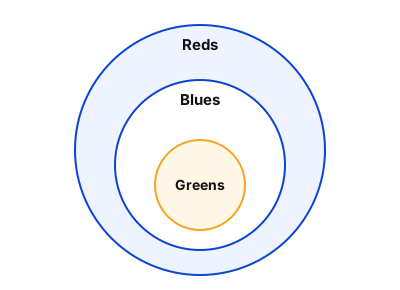
Concept: Draw the least-overlap Venn diagram allowed by the statements and test each conclusion; a conclusion follows only if it is true in every possible diagram.
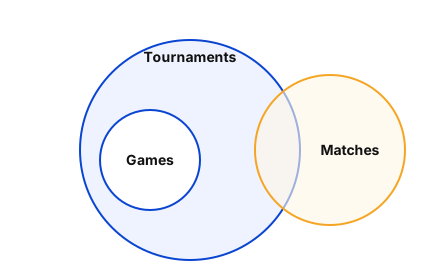
- "All games are tournaments" puts the Games circle fully inside Tournaments.
- "Some tournaments are matches" lets Matches overlap Tournaments, but Matches need not touch Games at all (see figure). So I ("All games are matches") is not certain.
- II ("No game is a tournament") directly contradicts statement 1, so it is false.
Trick: "Some" never gives an "All" conclusion, and a conclusion that contradicts a statement can never follow.
Answer: (B) Neither Conclusion I nor II follows.
अवधारणा: कथनों के अनुसार न्यूनतम overlap वाला Venn diagram बनाइए; निष्कर्ष तभी सही है जब वह हर संभव diagram में सत्य हो।
- "All games are tournaments" — Games का वृत्त पूरा Tournaments के अंदर है।
- "Some tournaments are matches" — Matches, Tournaments को काटता है, पर Games को छूना ज़रूरी नहीं (चित्र देखें)। इसलिए I ("All games are matches") निश्चित नहीं है।
- II ("No game is a tournament") सीधे कथन 1 के विपरीत है, इसलिए असत्य है।
ट्रिक: "Some" से कभी "All" वाला निष्कर्ष नहीं निकलता, और कथन के विपरीत निष्कर्ष कभी सही नहीं होता।
उत्तर: (B) Neither Conclusion I nor II follows.