Question bank

Q&A: practice questions with answers

Search questions on any topic. Filter by exam category, exam, subject and topic, try the question, then open the answer and explanation.

Courses – airGurukul

600 questions found.

Q361.
Select the most appropriate option to substitute the underlined segment in the given
sentence. If there is no need to substitute it, select ‘No substitution’.
I am much taller than I was a year ago.
  1. Athat I were a year ago
  2. Bas I was the year before
  3. CNo substitution
  4. Dthan a year before
Show answer

Concept: A comparative (‘taller’) is followed by ‘than’, and the second part keeps its own correct tense.

  1. ‘taller than I was a year ago’ – correct comparative + past ‘was’ with ‘a year ago’.
  2. ‘that I were’ – ‘that’ cannot follow a comparative.
  3. ‘as I was’ – ‘as’ does not follow ‘taller’; ‘than a year before’ drops the subject and is not natural.

Yaad rakhein: -er / more … than; as … as.

Answer: (C) No substitution

अवधारणा: Comparative (‘taller’) के बाद ‘than’ आता है, और दूसरे भाग का tense अपने समय के अनुसार रहता है।

  1. ‘taller than I was a year ago’ – सही comparative और ‘a year ago’ के साथ past ‘was’।
  2. ‘that I were’ – comparative के बाद ‘that’ नहीं आता।
  3. ‘as I was’ – ‘taller’ के साथ ‘as’ नहीं; ‘than a year before’ में subject छूट गया है।

याद रखें: -er / more … than; as … as।

उत्तर: (C) No substitution
SSC CPO Paper IIEnglish Language and ComprehensionSentence ImprovementSSC CPO Paper II 2021 · 26 Jul Shift 1 →
Q362.
Select the correct indirect form of the given sentence.
I said to the postman, “Is there a letter for me?”
  1. AI asked the postman was there a letter for me.
  2. BI asked the postman that is there a letter for me.
  3. CI asked the postman if there was a letter for me.
  4. DI asked the postman if there is a letter for me.
Show answer

Concept: A Yes/No question is reported with ‘asked + if/whether’, in assertive order, with tense backshift.

  1. said to → asked; ‘Is there’ → ‘if there was’ (assertive order, past).
  2. me → me (first person follows the speaker ‘I’).
  3. Answer: I asked the postman if there was a letter for me.

Trick: Yes/No question → if/whether + subject + verb.

Answer: (C) I asked the postman if there was a letter for me.

अवधारणा: Yes/No प्रश्न को ‘asked + if/whether’ से, assertive क्रम और tense बदलकर report करते हैं।

  1. said to → asked; ‘Is there’ → ‘if there was’ (assertive क्रम, past)।
  2. me → me (first person, वक्ता ‘I’ के अनुसार)।
  3. उत्तर: I asked the postman if there was a letter for me।

ट्रिक: Yes/No प्रश्न → if/whether + subject + verb।

उत्तर: (C) I asked the postman if there was a letter for me.

SSC CPO Paper IIEnglish Language and ComprehensionDirect and Indirect SpeechSSC CPO Paper II 2021 · 26 Jul Shift 1 →
Q363.
Identify the segment in the sentence which contains a grammatical error.
Her health has being / steadily improving / since she started / practising yoga.
  1. Asteadily improving
  2. Bpractising yoga
  3. Csince she started
  4. DHer health has being
Show answer

Concept: Present perfect continuous = has/have + been + V-ing.

  1. ‘has being improving’ is wrong.
  2. Correct: Her health has been steadily improving.
  3. ‘since she started’ confirms perfect continuous tense.

Yaad rakhein: has/have + been + ing (never ‘has being’).

Answer: (D) Her health has being

अवधारणा: Present perfect continuous = has/have + been + V-ing।

  1. ‘has being improving’ गलत है।
  2. सही: Her health has been steadily improving।
  3. ‘since she started’ perfect continuous tense की पुष्टि करता है।

याद रखें: has/have + been + ing (‘has being’ कभी नहीं)।

उत्तर: (D) Her health has being

SSC CPO Paper IIEnglish Language and ComprehensionSpot the ErrorSSC CPO Paper II 2021 · 26 Jul Shift 1 →
Q364.
Select the correct active form of the given sentence.
May you be blessed with good health!
  1. AMay God blessed you with good health!
  2. BMay you bless God with good health!
  3. CMay God bless you with good health!
  4. DMay God be blessing you with good health!
Show answer

Concept: For a wish (optative) ‘May + subject + be + V3’, the active form is ‘May + doer + V1 + object’.

  1. Hidden doer of blessing = God.
  2. be blessed → bless (V1 after ‘may’).
  3. Active: May God bless you with good health!

Trick: After ‘may’, always V1: May God bless you.

Answer: (C) May God bless you with good health!

अवधारणा: इच्छा/आशीर्वाद वाले वाक्य ‘May + subject + be + V3’ का active ‘May + कर्ता + V1 + कर्म’ होता है।

  1. आशीर्वाद देने वाला (doer) = God।
  2. be blessed → bless (‘may’ के बाद V1)।
  3. Active: May God bless you with good health!

ट्रिक: ‘may’ के बाद हमेशा V1: May God bless you।

उत्तर: (C) May God bless you with good health!

SSC CPO Paper IIEnglish Language and ComprehensionActive and Passive VoiceSSC CPO Paper II 2021 · 26 Jul Shift 1 →
Q365.
Select the correct passive form of the given sentence.
Someone robbed the man of all his possessions.
  1. ASomeone has been robbed by the man of all his possessions.
  2. BThe man was being robbed of all his possessions by someone.
  3. CThe man was robbed of all his possessions by someone.
  4. DThe man is robbed all his possessions by someone.
Show answer

Concept: Simple past active (V2) → passive ‘was/were + V3’; the phrase ‘of all his possessions’ stays with the verb.

  1. Object ‘the man’ → subject.
  2. robbed (V2) → was robbed.
  3. Passive: The man was robbed of all his possessions by someone.

Trick: Simple past: V2 → was/were + V3.

Answer: (C) The man was robbed of all his possessions by someone.

अवधारणा: Simple past active (V2) → passive ‘was/were + V3’; ‘of all his possessions’ verb के साथ रहता है।

  1. कर्म ‘the man’ → कर्ता।
  2. robbed (V2) → was robbed।
  3. Passive: The man was robbed of all his possessions by someone।

ट्रिक: Simple past: V2 → was/were + V3।

उत्तर: (C) The man was robbed of all his possessions by someone.

SSC CPO Paper IIEnglish Language and ComprehensionActive and Passive VoiceSSC CPO Paper II 2021 · 26 Jul Shift 1 →
Q366.
Select the correct indirect form of the given sentence.
“Let us go to the hills for a vacation,” Mother said to us.
  1. AMother suggested that let us go to the hills for a vacation.
  2. BMother ordered us to go to the hills for a vacation.
  3. CMother said that should we go to the hills for a vacation.
  4. DMother suggested that we should go to the hills for a vacation.
Show answer

Concept: A ‘Let us …’ proposal is reported with ‘suggested/proposed that we should …’.

  1. said to → suggested (to us).
  2. Let us go → that we should go.
  3. Answer: Mother suggested that we should go to the hills for a vacation.

Trick: Let us (proposal) → suggested that … should.

Answer: (D) Mother suggested that we should go to the hills for a vacation.

अवधारणा: ‘Let us …’ वाले प्रस्ताव को ‘suggested/proposed that we should …’ से report करते हैं।

  1. said to → suggested।
  2. Let us go → that we should go।
  3. उत्तर: Mother suggested that we should go to the hills for a vacation।

ट्रिक: Let us (प्रस्ताव) → suggested that … should।

उत्तर: (D) Mother suggested that we should go to the hills for a vacation.

SSC CPO Paper IIEnglish Language and ComprehensionDirect and Indirect SpeechSSC CPO Paper II 2021 · 26 Jul Shift 1 →
Q367.
Identify the segment in the sentence which contains a grammatical error.
This is / only mistake / he has made / in the dictation.
  1. AThis is
  2. Bonly mistake
  3. Cin the dictation
  4. Dhe has made
Show answer

Concept: ‘Only’ used as an adjective meaning ‘single, sole’ before a particular noun takes the article ‘the’.

  1. The mistake is a definite, specific one.
  2. ‘only mistake’ → ‘the only mistake’.
  3. Correct: This is the only mistake he has made in the dictation.

Yaad rakhein: the only, the same, the very + noun.

Answer: (B) only mistake

अवधारणा: ‘Only’ जब ‘एकमात्र’ के अर्थ में किसी निश्चित noun से पहले आए तो ‘the’ लगता है।

  1. यह एक निश्चित गलती है।
  2. ‘only mistake’ → ‘the only mistake’।
  3. सही: This is the only mistake he has made in the dictation।

याद रखें: the only, the same, the very + noun।

उत्तर: (B) only mistake

SSC CPO Paper IIEnglish Language and ComprehensionSpot the ErrorSSC CPO Paper II 2021 · 26 Jul Shift 1 →
Q368.
Select the most appropriate synonym of the given word.
CONTRADICT
  1. Arefute
  2. Bagree
  3. Cadvise
  4. Dshorten
Show answer

Concept: ‘Contradict’ means to deny a statement by saying the opposite.

  1. Refute = prove a statement to be false – closest synonym.
  2. Agree is the antonym.
  3. Advise, shorten are unrelated.

Trick: contra = against + dict = say → speak against.

Answer: (A) refute

अवधारणा: ‘Contradict’ का अर्थ है खंडन करना, उल्टी बात कहकर नकारना।

  1. Refute = गलत सिद्ध करना/खंडन करना – निकटतम पर्यायवाची।
  2. Agree विलोम है।
  3. Advise, shorten असंबंधित हैं।

ट्रिक: contra = विरुद्ध + dict = कहना।

उत्तर: (A) refute

SSC CPO Paper IIEnglish Language and ComprehensionSynonymsSSC CPO Paper II 2021 · 26 Jul Shift 1 →
Q369.
Select the most appropriate option to fill in the blank.
I request the favour of ______ granting me two days’ leave.
  1. Ayours
  2. Byourself
  3. Cyour
  4. Dyou
Show answer

Concept: A noun/pronoun before a gerund (V-ing used as a noun) is put in the possessive form.

  1. ‘granting’ is a gerund (object of ‘of’).
  2. So we need possessive adjective ‘your’.
  3. ‘yours’ is a pronoun (stands alone); ‘you’, ‘yourself’ are wrong here.

Yaad rakhein: Possessive + gerund: your coming, his leaving.

Answer: (C) your

अवधारणा: Gerund (noun की तरह प्रयुक्त V-ing) से पहले noun/pronoun possessive रूप में आता है।

  1. ‘granting’ gerund है (‘of’ का object)।
  2. इसलिए possessive adjective ‘your’ चाहिए।
  3. ‘yours’ अकेला प्रयोग होता है; ‘you’, ‘yourself’ यहाँ गलत हैं।

याद रखें: Possessive + gerund: your coming, his leaving।

उत्तर: (C) your

SSC CPO Paper IIEnglish Language and ComprehensionGerund and PossessiveSSC CPO Paper II 2021 · 26 Jul Shift 1 →
Q370.
Select the most appropriate meaning of the underlined idiom in the given sentence.
India’s problem boils down to just one thing – lack of infrastructure for health services.
  1. Aheats up to
  2. Bsums up to
  3. Cfulfils something
  4. Dadapts to something
Show answer

Concept: ‘Boil down to’ means to be reduced to the main point; in short, to come down to.

  1. The whole problem, in essence, is ‘lack of infrastructure’.
  2. So it ‘sums up to’ one thing.
  3. ‘Heats up to’ is the literal meaning – wrong in this context.

Yaad rakhein: boil down → reduce to the essence.

Answer: (B) sums up to

अवधारणा: ‘Boil down to’ का अर्थ है सार रूप में निकलना, मूल बात तक सीमित होना।

  1. पूरी समस्या का सार है ‘lack of infrastructure’।
  2. अतः ‘sums up to’ एक बात।
  3. ‘Heats up to’ शाब्दिक अर्थ है – यहाँ गलत।

याद रखें: boil down → सार निकल आना।

उत्तर: (B) sums up to

SSC CPO Paper IIEnglish Language and ComprehensionIdioms and PhrasesSSC CPO Paper II 2021 · 26 Jul Shift 1 →
Q371.
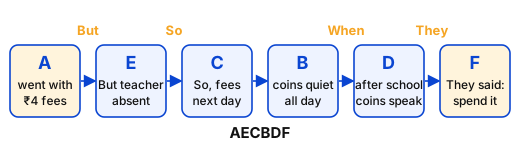
Given below are six sentences A-F, of which A and F are static and B-E have been jumbled. Pick the option that gives the correct order of the jumbled sentences.
A. One day I went to school with four rupees in my pocket to pay the school fees.
B. All through the day, the coins sat quietly in my pocket.
C. So, I was told that the fees would be collected the next day.
D. When school got over, the coins in my pocket began to speak.
E. But the teacher who was to collect the fees was absent.
F. They said that money was meant to be spent on good things like hot ‘jalebis’.
  1. AADEBCF
  2. BABCDEF
  3. CACBEDF
  4. DAECBDF
Show answer

Concept: Join sentences with connectors (But, So, When) and time order.

  1. A: went to pay fees → E: ‘But the teacher was absent’.
  2. E → C: ‘So, fees would be collected the next day’.
  3. C → B: coins stayed in pocket all day.
  4. B → D: ‘When school got over’, coins began to speak → F: ‘They said …’.

Trick: Connectors ‘But’ and ‘So’ fix the pair E-C.

Answer: (D) AECBDF

अवधारणा: Connectors (But, So, When) और समय-क्रम से वाक्य जोड़ें।

  1. A: फीस देने स्कूल गया → E: ‘But शिक्षक अनुपस्थित था’।
  2. E → C: ‘So, फीस अगले दिन ली जाएगी’।
  3. C → B: सिक्के पूरे दिन जेब में पड़े रहे।
  4. B → D: ‘When school got over’ सिक्के बोले → F: ‘They said …’।

ट्रिक: ‘But’ और ‘So’ से E-C जोड़ी तय होती है।

उत्तर: (D) AECBDF

SSC CPO Paper IIEnglish Language and ComprehensionSentence RearrangementSSC CPO Paper II 2021 · 26 Jul Shift 1 →
Q372.
Select the most appropriate option to substitute the underlined segment in the given
sentence. If there is no need to substitute it, select ‘No substitution’.
It is time for the children to go to bed.
  1. Afor going in bed
  2. Bto being in bed
  3. Cshould be in bed
  4. DNo substitution
Show answer

Concept: ‘It is time for + someone + to + V1’ is a correct pattern (it does not need the past tense).

  1. ‘It is time for the children to go to bed’ – correct infinitive.
  2. ‘for going in bed’, ‘to being in bed’ are ungrammatical.
  3. ‘should be in bed’ cannot follow ‘for the children’.

Yaad rakhein: It is time for X to V1 = It is time X + V2.

Answer: (D) No substitution

अवधारणा: ‘It is time for + व्यक्ति + to + V1’ सही संरचना है (इसमें past tense की ज़रूरत नहीं)।

  1. ‘It is time for the children to go to bed’ – सही infinitive।
  2. ‘for going in bed’, ‘to being in bed’ अव्याकरणिक हैं।
  3. ‘should be in bed’ ‘for the children’ के बाद नहीं आ सकता।

याद रखें: It is time for X to V1 = It is time X + V2।

उत्तर: (D) No substitution

SSC CPO Paper IIEnglish Language and ComprehensionSentence ImprovementSSC CPO Paper II 2021 · 26 Jul Shift 1 →
Q373.
Select the correct indirect form of the given sentence.
I said to my daughter, “Why are you angry with me?”
  1. AI said to my daughter that why she was angry with me.
  2. BI asked my daughter why she was angry with me.
  3. CI asked to my daughter why was she angry with me.
  4. DI asked my daughter why you are angry with me.
Show answer

Concept: A Wh-question is reported with ‘asked + wh-word + subject + verb’ (assertive order), no ‘that’.

  1. said to → asked (not ‘asked to’).
  2. are you angry → she was angry (pronoun + tense change).
  3. Answer: I asked my daughter why she was angry with me.

Trick: Wh-question → asked + why/what + S + V; no ‘that’.

Answer: (B) I asked my daughter why she was angry with me.

अवधारणा: Wh-प्रश्न को ‘asked + wh-word + subject + verb’ (assertive क्रम) से report करते हैं; ‘that’ नहीं लगता।

  1. said to → asked (‘asked to’ नहीं)।
  2. are you angry → she was angry (pronoun व tense बदलकर)।
  3. उत्तर: I asked my daughter why she was angry with me।

ट्रिक: Wh-प्रश्न → asked + why/what + S + V; ‘that’ नहीं।

उत्तर: (B) I asked my daughter why she was angry with me.

SSC CPO Paper IIEnglish Language and ComprehensionDirect and Indirect SpeechSSC CPO Paper II 2021 · 26 Jul Shift 1 →
Q374.
Select the most appropriate option to fill in the blank.
The Allies ______ the war in 1945.
  1. Ahave won
  2. Bwere winning
  3. Cwon
  4. Dwin
Show answer

Concept: A completed action at a definite past time (in 1945) takes the simple past.

  1. ‘in 1945’ = definite past time.
  2. So: The Allies won the war in 1945.
  3. Present perfect ‘have won’ is never used with a past time marker.

Yaad rakhein: Past year / yesterday / ago → simple past (V2).

Answer: (C) won

अवधारणा: निश्चित भूतकाल (in 1945) में पूरे हुए कार्य के लिए simple past आता है।

  1. ‘in 1945’ = निश्चित भूतकाल।
  2. इसलिए: The Allies won the war in 1945।
  3. Present perfect ‘have won’ भूतकाल-सूचक शब्द के साथ नहीं आता।

याद रखें: बीता वर्ष / yesterday / ago → simple past (V2)।

उत्तर: (C) won

SSC CPO Paper IIEnglish Language and ComprehensionTensesSSC CPO Paper II 2021 · 26 Jul Shift 1 →
Q375.
Identify the segment in the sentence which contains a grammatical error.
Much of us / lack the / important virtue / of patience.
  1. Aimportant virtue
  2. Black the
  3. CMuch of us
  4. Dof patience
Show answer

Concept: ‘Much’ is used with uncountable nouns; for countable people (us) we use ‘many’.

  1. ‘us’ = countable persons.
  2. ‘Much of us’ → ‘Many of us’.
  3. Correct: Many of us lack the important virtue of patience.

Yaad rakhein: many → countable; much → uncountable.

Answer: (C) Much of us

अवधारणा: ‘Much’ uncountable nouns के साथ; गिने जा सकने वाले लोगों (us) के लिए ‘many’।

  1. ‘us’ = गिनने योग्य व्यक्ति।
  2. ‘Much of us’ → ‘Many of us’।
  3. सही: Many of us lack the important virtue of patience।

याद रखें: many → countable; much → uncountable।

उत्तर: (C) Much of us

SSC CPO Paper IIEnglish Language and ComprehensionSpot the ErrorSSC CPO Paper II 2021 · 26 Jul Shift 1 →
Q376.
Select the most appropriate option to substitute the underlined segment in the given
sentence. If there is no need to substitute it, select ‘No substitution’.
What kind of the book do you want?
  1. Akind of the books
  2. Bkind of book
  3. Ckinds of a book
  4. DNo substitution
Show answer

Concept: After ‘kind of / sort of’ a singular countable noun takes no article.

  1. ‘What kind of the book’ – the article ‘the’ is wrong.
  2. Correct: What kind of book do you want?
  3. ‘kinds of a book’ wrongly adds ‘a’ and plural ‘kinds’.

Yaad rakhein: kind of + noun (no a/an/the).

Answer: (B) kind of book

अवधारणा: ‘Kind of / sort of’ के बाद singular noun पर article नहीं लगता।

  1. ‘What kind of the book’ – ‘the’ गलत है।
  2. सही: What kind of book do you want?
  3. ‘kinds of a book’ में ‘a’ और plural ‘kinds’ गलत हैं।

याद रखें: kind of + noun (a/an/the नहीं)।

उत्तर: (B) kind of book

SSC CPO Paper IIEnglish Language and ComprehensionSentence ImprovementSSC CPO Paper II 2021 · 26 Jul Shift 1 →
Q377.
Identify the segment in the sentence which contains a grammatical error.
Please switch off / all the lights / before you / are leaving the room.
  1. Aare leaving the room
  2. Bbefore you
  3. Call the lights
  4. DPlease switch off
Show answer

Concept: In a time clause (before, after, when, until) we use the simple present for a future action, not the continuous.

  1. ‘before you are leaving’ is wrong.
  2. Correct: … before you leave the room.
  3. The main clause is an imperative (future idea), so the time clause uses V1.

Yaad rakhein: before / after / when / till + simple present.

Answer: (A) are leaving the room

अवधारणा: Time clause (before, after, when, until) में भविष्य के कार्य के लिए simple present आता है, continuous नहीं।

  1. ‘before you are leaving’ गलत है।
  2. सही: … before you leave the room।
  3. मुख्य वाक्य आदेशात्मक (भविष्य का भाव) है, इसलिए time clause में V1।

याद रखें: before / after / when / till + simple present।

उत्तर: (A) are leaving the room

SSC CPO Paper IIEnglish Language and ComprehensionSpot the ErrorSSC CPO Paper II 2021 · 26 Jul Shift 1 →
Q378.
Select the most appropriate one-word substitution for the given group of words.
A statement open to more than one interpretation
  1. Aapparent
  2. Babsurd
  3. Cambiguous
  4. Daxiom
Show answer

Concept: A statement with more than one possible meaning is ambiguous.

  1. Ambiguous = open to two or more interpretations.
  2. Apparent = clearly visible; absurd = foolish.
  3. Axiom = an accepted truth – one clear meaning.

Yaad rakhein: ambi = both (ambidextrous, ambivalent).

Answer: (C) ambiguous

अवधारणा: एक से अधिक अर्थ वाला कथन = ambiguous (अस्पष्ट/द्वि-अर्थी)।

  1. Ambiguous = जिसके दो या अधिक अर्थ निकलें।
  2. Apparent = स्पष्ट; absurd = बेतुका।
  3. Axiom = स्वयंसिद्ध सत्य – एक स्पष्ट अर्थ।

याद रखें: ambi = दोनों (ambidextrous, ambivalent)।

उत्तर: (C) ambiguous

SSC CPO Paper IIEnglish Language and ComprehensionOne Word SubstitutionSSC CPO Paper II 2021 · 26 Jul Shift 1 →
Q379.
Select the correct direct form of the given sentence.
Mother ordered the children to stop playing then.
  1. AMother said to the children, “Please stop playing then.”
  2. BMother said to the children, “Don’t play then.”
  3. CMother said to the children, “Stop playing now.”
  4. DMother said to the children, “Can you stop playing now?”
Show answer

Concept: ‘ordered … to + V1’ comes from a plain imperative; ‘then’ in reported speech goes back to ‘now’.

  1. ordered → plain command (no ‘please’, which shows request).
  2. to stop playing → ‘Stop playing’.
  3. then → now: Mother said to the children, “Stop playing now.”

Trick: Indirect to direct: then → now, ordered → imperative.

Answer: (C) Mother said to the children, “Stop playing now.”

अवधारणा: ‘ordered … to + V1’ साधारण आदेश (imperative) से आता है; reported speech का ‘then’ direct में ‘now’ बनता है।

  1. ordered → सीधा आदेश (‘please’ अनुरोध दर्शाता है)।
  2. to stop playing → ‘Stop playing’।
  3. then → now: Mother said to the children, “Stop playing now.”

ट्रिक: Indirect से direct: then → now, ordered → imperative।

उत्तर: (C) Mother said to the children, “Stop playing now.”

SSC CPO Paper IIEnglish Language and ComprehensionDirect and Indirect SpeechSSC CPO Paper II 2021 · 26 Jul Shift 1 →
Q380.
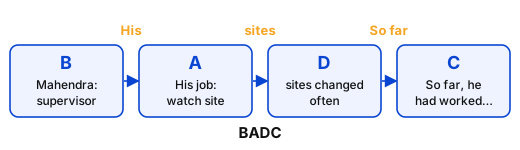
Given below are four sentences in jumbled order. Pick the option that gives their correct order.
A. His job was to keep an eye on the activities at the work site.
B. Mahendra was a junior supervisor in a firm.
C. So far, he had worked at stone quarries, coal mines, construction sites and chemical
plants.
D. The work sites changed often so he had to move from place to place.
  1. AACBD
  2. BBADC
  3. CDBCA
  4. DCADB
Show answer

Concept: Start with the sentence that introduces the person by name; pronouns follow.

  1. B introduces ‘Mahendra’ – opening sentence.
  2. A: ‘His job’ – describes his work.
  3. D: work sites changed, he moved place to place.
  4. C: ‘So far’ he had worked at many sites – concludes.

Trick: Name first, then he/his.

Answer: (B) BADC

अवधारणा: वाक्य जो व्यक्ति का नाम बताता है, वही पहले आता है; फिर pronouns।

  1. B ‘Mahendra’ का परिचय देता है – पहला वाक्य।
  2. A: ‘His job’ – उसका काम बताता है।
  3. D: काम की जगह बदलती थी, उसे घूमना पड़ता था।
  4. C: ‘So far’ कई जगह काम कर चुका – निष्कर्ष।

ट्रिक: पहले नाम, फिर he/his।

उत्तर: (B) BADC

SSC CPO Paper IIEnglish Language and ComprehensionSentence RearrangementSSC CPO Paper II 2021 · 26 Jul Shift 1 →