Read the following passage and answer the questions given after it.
Western MP has received 1,335.4 millimetres of average rainfall from June 1 to September 25, 58% more than the region’s historical normal of 845.3 mm for this period. However, the real story lies in the month-wise figures. In June, the opening month of the southwest
monsoon season, the rains were actually 25.6% below the long-period average. In July, they were 31.2% above average. That surplus rose to 63.6% in August, while a whopping 158% more, so far in September.
The monsoon has taken its toll mainly on soyabean. According to the Union agriculture
ministry’s data, a total area of 113.449 lakh hectares (lh) has been planted under this
leguminous oilseed in the current kharif season, with the bulk of it accounted for by MP
(55.16 lh), Maharashtra (39.595 lh) and Rajasthan (10.608 lh). Within MP, the main soyabean- growing districts are Ujjain, Dewas, Indore, Dhar, Ratlam, Mandsaur, Rajgarh, Shajapur, Sehore and Vidisha. The crop in low-lying areas is the one that has been worst affected.
“Farmers who had sown early-maturity (80-90 days duration) varieties such as JS 9560 and JS 2034 just after mid-June will take the biggest hit. Their crop would already have matured; the longer it remains in the field, the more the chances of the grain rotting. Also, these
farmers will not be able to save this grain for using as seed next year,” admits V S Bhatia, director of the Indian Institute of Soyabean Research at Indore.
On the other hand, longer-duration varieties maturing in 95-105 days, like JS 20-69, NRC 86 and JS 97-52, are unlikely to suffer major yield loss, as their grain is not fully ripe yet for
harvesting. Moreover, since the rains were poor in June, much of sowing anyway took place in July, thereby further reducing the likelihood of damage. “The vegetative growth and pod
formation has been very good. As of now, the overall loss may be 10-15% and the areas where the crop is still good should compensate for those badly impacted,” adds Bhatia.
Q441.Which of the following is a short-duration variety of soyabean maturing in 80-90 days?
- AJS 97-52
- BNRC 86
- CJS 9560
- DJS 20-69
Show answer
Concept: Separate the two lists of varieties given in the passage.
- Early-maturity (80–90 days): JS 9560 and JS 2034.
- Longer-duration (95–105 days): JS 20-69, NRC 86 and JS 97-52.
- Only JS 9560 is in the short-duration list.
Yaad rakhein: Short duration → JS 9560, JS 2034; long → JS 20-69, NRC 86, JS 97-52.
Answer: (C) JS 9560
अवधारणा: गद्यांश में दी गई किस्मों की दो सूचियाँ अलग करें।
- जल्दी पकने वाली (80–90 दिन): JS 9560 और JS 2034।
- लंबी अवधि (95–105 दिन): JS 20-69, NRC 86, JS 97-52।
- केवल JS 9560 छोटी अवधि वाली सूची में है।
याद रखें: छोटी अवधि → JS 9560, JS 2034।
उत्तर: (C) JS 9560
Read the following passage and answer the questions given after it.
Western MP has received 1,335.4 millimetres of average rainfall from June 1 to September 25, 58% more than the region’s historical normal of 845.3 mm for this period. However, the real story lies in the month-wise figures. In June, the opening month of the southwest
monsoon season, the rains were actually 25.6% below the long-period average. In July, they were 31.2% above average. That surplus rose to 63.6% in August, while a whopping 158% more, so far in September.
The monsoon has taken its toll mainly on soyabean. According to the Union agriculture
ministry’s data, a total area of 113.449 lakh hectares (lh) has been planted under this
leguminous oilseed in the current kharif season, with the bulk of it accounted for by MP
(55.16 lh), Maharashtra (39.595 lh) and Rajasthan (10.608 lh). Within MP, the main soyabean- growing districts are Ujjain, Dewas, Indore, Dhar, Ratlam, Mandsaur, Rajgarh, Shajapur, Sehore and Vidisha. The crop in low-lying areas is the one that has been worst affected.
“Farmers who had sown early-maturity (80-90 days duration) varieties such as JS 9560 and JS 2034 just after mid-June will take the biggest hit. Their crop would already have matured; the longer it remains in the field, the more the chances of the grain rotting. Also, these
farmers will not be able to save this grain for using as seed next year,” admits V S Bhatia, director of the Indian Institute of Soyabean Research at Indore.
On the other hand, longer-duration varieties maturing in 95-105 days, like JS 20-69, NRC 86 and JS 97-52, are unlikely to suffer major yield loss, as their grain is not fully ripe yet for
harvesting. Moreover, since the rains were poor in June, much of sowing anyway took place in July, thereby further reducing the likelihood of damage. “The vegetative growth and pod
formation has been very good. As of now, the overall loss may be 10-15% and the areas where the crop is still good should compensate for those badly impacted,” adds Bhatia.
Q442.In which month, according to the passage, has the rainfall been the maximum?
- AJune
- BJuly
- CAugust
- DSeptember
Show answer
Concept: Compare the month-wise deviation from the average given in the passage.
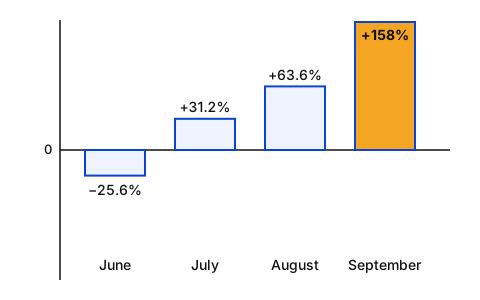
- June: (below average).
- July: ; August: .
- September: ‘a whopping more’ – the largest surplus.
Yaad rakhein: ‘Whopping’ signals the biggest figure.
Answer: (D) September
अवधारणा: गद्यांश में दिए माह-वार विचलन की तुलना करें।
- June: (औसत से कम)।
- July: ; August: ।
- September: ‘a whopping more’ – सबसे अधिक।
याद रखें: ‘Whopping’ = सबसे बड़ा आँकड़ा।
उत्तर: (D) September
Read the following passage and answer the questions given after it.
Western MP has received 1,335.4 millimetres of average rainfall from June 1 to September 25, 58% more than the region’s historical normal of 845.3 mm for this period. However, the real story lies in the month-wise figures. In June, the opening month of the southwest
monsoon season, the rains were actually 25.6% below the long-period average. In July, they were 31.2% above average. That surplus rose to 63.6% in August, while a whopping 158% more, so far in September.
The monsoon has taken its toll mainly on soyabean. According to the Union agriculture
ministry’s data, a total area of 113.449 lakh hectares (lh) has been planted under this
leguminous oilseed in the current kharif season, with the bulk of it accounted for by MP
(55.16 lh), Maharashtra (39.595 lh) and Rajasthan (10.608 lh). Within MP, the main soyabean- growing districts are Ujjain, Dewas, Indore, Dhar, Ratlam, Mandsaur, Rajgarh, Shajapur, Sehore and Vidisha. The crop in low-lying areas is the one that has been worst affected.
“Farmers who had sown early-maturity (80-90 days duration) varieties such as JS 9560 and JS 2034 just after mid-June will take the biggest hit. Their crop would already have matured; the longer it remains in the field, the more the chances of the grain rotting. Also, these
farmers will not be able to save this grain for using as seed next year,” admits V S Bhatia, director of the Indian Institute of Soyabean Research at Indore.
On the other hand, longer-duration varieties maturing in 95-105 days, like JS 20-69, NRC 86 and JS 97-52, are unlikely to suffer major yield loss, as their grain is not fully ripe yet for
harvesting. Moreover, since the rains were poor in June, much of sowing anyway took place in July, thereby further reducing the likelihood of damage. “The vegetative growth and pod
formation has been very good. As of now, the overall loss may be 10-15% and the areas where the crop is still good should compensate for those badly impacted,” adds Bhatia.
Q443.This passage is mainly about:
- Athe rainfall from June to September in MP
- Bthe varieties of soyabean grown in MP
- Cthe impact of rains on the soyabean crop in MP
- Dthe growth of soyabean in MP
Show answer
Concept: The main idea links all parts of the passage.
- Para 1 gives the excess rainfall in western MP; para 2 onward says “The monsoon has taken its toll mainly on soyabean”.
- The rest explains which varieties will be hit and the expected loss.
- So it is about the impact of rains on soyabean – (A) and (B) are only parts.
Yaad rakhein: Rain + crop damage → ‘impact of rains on the crop’.
Answer: (C) the impact of rains on the soyabean crop in MP
अवधारणा: मुख्य विचार गद्यांश के सभी भागों को जोड़ता है।
- पहला भाग अधिक वर्षा बताता है; फिर “The monsoon has taken its toll mainly on soyabean”।
- शेष भाग किस्मों पर असर और अनुमानित नुकसान बताता है।
- अतः विषय: soyabean पर वर्षा का प्रभाव – (A), (B) केवल अंश हैं।
याद रखें: वर्षा + फसल हानि → ‘impact of rains on the crop’।
उत्तर: (C) the impact of rains on the soyabean crop in MP
Read the following passage and answer the questions given after it.
Western MP has received 1,335.4 millimetres of average rainfall from June 1 to September 25, 58% more than the region’s historical normal of 845.3 mm for this period. However, the real story lies in the month-wise figures. In June, the opening month of the southwest
monsoon season, the rains were actually 25.6% below the long-period average. In July, they were 31.2% above average. That surplus rose to 63.6% in August, while a whopping 158% more, so far in September.
The monsoon has taken its toll mainly on soyabean. According to the Union agriculture
ministry’s data, a total area of 113.449 lakh hectares (lh) has been planted under this
leguminous oilseed in the current kharif season, with the bulk of it accounted for by MP
(55.16 lh), Maharashtra (39.595 lh) and Rajasthan (10.608 lh). Within MP, the main soyabean- growing districts are Ujjain, Dewas, Indore, Dhar, Ratlam, Mandsaur, Rajgarh, Shajapur, Sehore and Vidisha. The crop in low-lying areas is the one that has been worst affected.
“Farmers who had sown early-maturity (80-90 days duration) varieties such as JS 9560 and JS 2034 just after mid-June will take the biggest hit. Their crop would already have matured; the longer it remains in the field, the more the chances of the grain rotting. Also, these
farmers will not be able to save this grain for using as seed next year,” admits V S Bhatia, director of the Indian Institute of Soyabean Research at Indore.
On the other hand, longer-duration varieties maturing in 95-105 days, like JS 20-69, NRC 86 and JS 97-52, are unlikely to suffer major yield loss, as their grain is not fully ripe yet for
harvesting. Moreover, since the rains were poor in June, much of sowing anyway took place in July, thereby further reducing the likelihood of damage. “The vegetative growth and pod
formation has been very good. As of now, the overall loss may be 10-15% and the areas where the crop is still good should compensate for those badly impacted,” adds Bhatia.
Q444.Why would the farmers who sowed their crop in June be the worst hit?
- ATheir crop would already be mature and could rot in the rain.
- BThey sowed their crop in low lying areas.
- CWhen they sowed their crop there wasn’t enough rain.
- DThey had sowed a late maturing variety of soyabean.
Show answer
Concept: Find Bhatia’s reason why early sowers take ‘the biggest hit’.
- Farmers who sowed early-maturity varieties ‘just after mid-June will take the biggest hit’.
- Reason: “Their crop would already have matured; the longer it remains in the field, the more the chances of the grain rotting.”
- (D) is the opposite – they sowed early-maturing, not late-maturing varieties.
Yaad rakhein: Mature crop + continuous rain = rotting grain.
Answer: (A) Their crop would already be mature and could rot in the rain.
अवधारणा: जल्दी बोने वाले किसानों को सबसे अधिक नुकसान क्यों – Bhatia का कारण खोजें।
- ‘just after mid-June’ बोने वाले ‘will take the biggest hit’।
- कारण: फसल पक चुकी है; खेत में जितनी देर रहेगी, दाना सड़ने की संभावना उतनी अधिक।
- (D) उल्टा है – उन्होंने जल्दी पकने वाली किस्म बोई थी।
याद रखें: पकी फसल + लगातार बारिश = दाना सड़ना।
उत्तर: (A) Their crop would already be mature and could rot in the rain.
Read the following passage and answer the questions given after it.
Western MP has received 1,335.4 millimetres of average rainfall from June 1 to September 25, 58% more than the region’s historical normal of 845.3 mm for this period. However, the real story lies in the month-wise figures. In June, the opening month of the southwest
monsoon season, the rains were actually 25.6% below the long-period average. In July, they were 31.2% above average. That surplus rose to 63.6% in August, while a whopping 158% more, so far in September.
The monsoon has taken its toll mainly on soyabean. According to the Union agriculture
ministry’s data, a total area of 113.449 lakh hectares (lh) has been planted under this
leguminous oilseed in the current kharif season, with the bulk of it accounted for by MP
(55.16 lh), Maharashtra (39.595 lh) and Rajasthan (10.608 lh). Within MP, the main soyabean- growing districts are Ujjain, Dewas, Indore, Dhar, Ratlam, Mandsaur, Rajgarh, Shajapur, Sehore and Vidisha. The crop in low-lying areas is the one that has been worst affected.
“Farmers who had sown early-maturity (80-90 days duration) varieties such as JS 9560 and JS 2034 just after mid-June will take the biggest hit. Their crop would already have matured; the longer it remains in the field, the more the chances of the grain rotting. Also, these
farmers will not be able to save this grain for using as seed next year,” admits V S Bhatia, director of the Indian Institute of Soyabean Research at Indore.
On the other hand, longer-duration varieties maturing in 95-105 days, like JS 20-69, NRC 86 and JS 97-52, are unlikely to suffer major yield loss, as their grain is not fully ripe yet for
harvesting. Moreover, since the rains were poor in June, much of sowing anyway took place in July, thereby further reducing the likelihood of damage. “The vegetative growth and pod
formation has been very good. As of now, the overall loss may be 10-15% and the areas where the crop is still good should compensate for those badly impacted,” adds Bhatia.
Q445.Which statement is NOT true according to the passage?
- AThe longer-duration variety of soyabean will not suffer much due to this excessive rain.
- BThe rainfall in June was poor in MP.
- CIn July, the rainfall was 63.6% above average.
- DThe crops in low-lying areas were worst affected by rains.
Show answer
Concept: Check each figure and fact against the passage.
- (A) True – longer-duration varieties ‘are unlikely to suffer major yield loss’.
- (B) True – June rain was below average.
- (D) True – ‘The crop in low-lying areas is the one that has been worst affected’.
- (C) False – in July rain was above average; was August.
Yaad rakhein: In data-based passages, ‘NOT true’ usually swaps a number between months.
Answer: (C) In July, the rainfall was above average.
अवधारणा: हर आँकड़ा और तथ्य गद्यांश से मिलाएँ।
- (A) सही – लंबी अवधि की किस्मों को बड़ा नुकसान नहीं।
- (B) सही – June में वर्षा कम थी।
- (D) सही – निचले क्षेत्रों की फसल सबसे अधिक प्रभावित।
- (C) गलत – July में अधिक; August का आँकड़ा है।
याद रखें: आँकड़ों वाले गद्यांश में ‘NOT true’ प्रायः महीने का आँकड़ा बदल देता है।
उत्तर: (C) In July, the rainfall was above average.
In the following passage some words have been deleted. Fill in the blanks with the help of the alternatives given. Select the most appropriate option for each number.
Two Pandas are expected to be returned to China (1) ______ a zoo in Canada because of a (2) ______ of bamboo. Pandas only eat fresh bamboo (3) ______ which the zoo had been
importing from China (4) ______ corona virus grounded most flights. The pandas (5) ______ in Canada in 2014 and were due to stay for 10 years.
Q446.Select the most appropriate option to fill in the blank no. 1.
- Awith
- Bin
- Cfrom
- Dfor
Show answer
Concept: ‘Return to A from B’ – ‘from’ shows the place of starting.
- “Two Pandas are expected to be returned to China ___ a zoo in Canada”.
- They go from the zoo in Canada to China.
- ‘with, in, for’ do not show movement away from a place.
Yaad rakhein: Movement: from (starting point) → to (destination).
Answer: (C) from
अवधारणा: ‘Return to A from B’ – ‘from’ आरंभ स्थान बताता है।
- “returned to China ___ a zoo in Canada”.
- Pandas Canada के zoo से China जाएँगे → from।
- ‘with, in, for’ किसी स्थान से दूर जाना नहीं बताते।
याद रखें: गति: from (आरंभ) → to (गंतव्य)।
उत्तर: (C) from
In the following passage some words have been deleted. Fill in the blanks with the help of the alternatives given. Select the most appropriate option for each number.
Two Pandas are expected to be returned to China (1) ______ a zoo in Canada because of a (2) ______ of bamboo. Pandas only eat fresh bamboo (3) ______ which the zoo had been
importing from China (4) ______ corona virus grounded most flights. The pandas (5) ______ in Canada in 2014 and were due to stay for 10 years.
Q447.Select the most appropriate option to fill in the blank no. 2.
- Ashortage
- Bsurplus
- Cstorage
- Dexcess
Show answer
Concept: The reason for returning the pandas must be a lack of their food.
- Pandas eat only fresh bamboo, which could no longer be imported because flights were grounded.
- So there was a shortage of bamboo.
- ‘surplus/excess’ give the opposite sense; ‘storage’ does not explain returning them.
Yaad rakhein: No flights → no imports → shortage.
Answer: (A) shortage
अवधारणा: Pandas लौटाने का कारण उनके भोजन की कमी होनी चाहिए।
- Pandas केवल ताज़ा bamboo खाते हैं, जो उड़ानें बंद होने से आयात नहीं हो सका।
- अतः bamboo की shortage (कमी) थी।
- ‘surplus/excess’ उल्टा अर्थ देते हैं; ‘storage’ कारण नहीं बनता।
याद रखें: उड़ानें बंद → आयात बंद → कमी।
उत्तर: (A) shortage
In the following passage some words have been deleted. Fill in the blanks with the help of the alternatives given. Select the most appropriate option for each number.
Two Pandas are expected to be returned to China (1) ______ a zoo in Canada because of a (2) ______ of bamboo. Pandas only eat fresh bamboo (3) ______ which the zoo had been
importing from China (4) ______ corona virus grounded most flights. The pandas (5) ______ in Canada in 2014 and were due to stay for 10 years.
Q448.Select the most appropriate option to fill in the blank no. 3.
- Afood
- Bplants
- Cnourishment
- Dmeal
Show answer
Concept: The noun must describe what bamboo is and be something that can be imported.
- “Pandas only eat fresh bamboo ___ which the zoo had been importing”.
- Bamboo is a plant, so ‘fresh bamboo plants’ correctly names the thing imported.
- ‘food, nourishment, meal’ would be vague/redundant after ‘eat’ (‘eat … food/meal’).
Yaad rakhein: eat + fresh bamboo plants; avoid ‘eat … meal’ redundancy.
Answer: (B) plants
अवधारणा: Noun ऐसा हो जो बताए कि bamboo क्या है और जिसका आयात हो सके।
- “Pandas only eat fresh bamboo ___ which the zoo had been importing”.
- Bamboo एक पौधा है → ‘fresh bamboo plants’।
- ‘food, nourishment, meal’ ‘eat’ के बाद अस्पष्ट/दोहराव वाले हैं।
याद रखें: eat + fresh bamboo plants।
उत्तर: (B) plants
In the following passage some words have been deleted. Fill in the blanks with the help of the alternatives given. Select the most appropriate option for each number.
Two Pandas are expected to be returned to China (1) ______ a zoo in Canada because of a (2) ______ of bamboo. Pandas only eat fresh bamboo (3) ______ which the zoo had been
importing from China (4) ______ corona virus grounded most flights. The pandas (5) ______ in Canada in 2014 and were due to stay for 10 years.
Q449.Select the most appropriate option to fill in the blank no. 4.
- Aunless
- Buntil
- Cafter
- Dwhile
Show answer
Concept: ‘Until’ marks the point at which a continuing action stopped.
- “which the zoo had been importing from China ___ corona virus grounded most flights”.
- The importing continued up to the time flights were grounded → until.
- ‘unless’ (condition), ‘after’ and ‘while’ do not show an action ending at that point.
Yaad rakhein: had been + V-ing … until + past event = continued up to that moment.
Answer: (B) until
अवधारणा: ‘Until’ बताता है कि चल रहा कार्य किस समय तक चला।
- “had been importing from China ___ corona virus grounded most flights”.
- आयात उड़ानें बंद होने तक चलता रहा → until।
- ‘unless’ (शर्त), ‘after’, ‘while’ यह अर्थ नहीं देते।
याद रखें: had been + V-ing … until + past event।
उत्तर: (B) until
In the following passage some words have been deleted. Fill in the blanks with the help of the alternatives given. Select the most appropriate option for each number.
Two Pandas are expected to be returned to China (1) ______ a zoo in Canada because of a (2) ______ of bamboo. Pandas only eat fresh bamboo (3) ______ which the zoo had been
importing from China (4) ______ corona virus grounded most flights. The pandas (5) ______ in Canada in 2014 and were due to stay for 10 years.
Q450.Select the most appropriate option to fill in the blank no. 5.
- Ahave arrived
- Barrive
- Chad arrived
- Dhad been arriving
Show answer
Concept: An earlier past action, told after later past events, is put in the past perfect.
- The pandas arrived in 2014, before the bamboo imports stopped (also described in past perfect: ‘had been importing’).
- The earlier completed past action → had arrived in Canada in 2014, and ‘were due to stay’ continues the past narration.
- ‘have arrived’ cannot go with a past time ‘in 2014’; ‘arrive’ is present; ‘had been arriving’ wrongly shows a continuing action.
Yaad rakhein: Past time word (in 2014) never takes present perfect.
Answer: (C) had arrived
अवधारणा: बाद की past घटनाओं के बाद बताई गई पहले की past क्रिया past perfect में आती है।
- Pandas 2014 में आए – यह bamboo आयात रुकने से पहले की घटना है (वहाँ भी ‘had been importing’)।
- पहले पूरी हुई past क्रिया → had arrived; ‘were due to stay’ past कथन को आगे बढ़ाता है।
- ‘have arrived’ past समय ‘in 2014’ के साथ नहीं आता; ‘arrive’ present है; ‘had been arriving’ निरंतरता दिखाता है।
याद रखें: Past time (in 2014) के साथ present perfect नहीं आता।
उत्तर: (C) had arrived
Q451.Select the most appropriate option to substitute the underlined segment in the given
sentence. If there is no need to substitute it, select ‘No substitution required’.
If you will buy one shirt, you will get another one free.
- ANo substitution required
- Byou buy
- Cyou have bought
- Dyou would buy
Show answer
Concept: In a first conditional (a real, possible future), the if-clause takes the simple present and the main clause takes will + V1.
- The main clause 'you will get another one free' is future, so the if-clause must be simple present.
- 'If you will buy' is wrong – will is not used in the if-clause of a condition.
- 'you have bought' (present perfect) and 'you would buy' (second conditional) do not match 'will get'.
Trick: If + present, will + V1. Never put will on both sides.
Answer: (B) you buy
अवधारणा: First conditional (भविष्य की संभावित शर्त) में if-clause में simple present और main clause में will + V1 आता है।
- Main clause 'you will get another one free' future में है, इसलिए if-clause simple present में होगा।
- 'If you will buy' गलत है – शर्त वाले if-clause में will नहीं लगता।
- 'you have bought' और 'you would buy' (second conditional) 'will get' से मेल नहीं खाते।
ट्रिक: If + present, will + V1 – दोनों तरफ will कभी नहीं।
उत्तर: (B) you buy
Q452.Select the most appropriate option to fill in the blank.
The box was ______ heavy for that little child to carry.
- Alot
- Bmuch
- Ctoo
- Denough
Show answer
Concept: too + adjective + (for someone) + to-infinitive shows an excess that makes something impossible.
- The sentence has 'heavy … for that little child to carry' – the pattern too … to.
- Meaning: the box was so heavy that the child could not carry it – 'too' gives this negative sense.
- 'much heavy' and 'lot heavy' are ungrammatical; 'enough' comes after the adjective (heavy enough).
Trick: too … to = so … that … not.
Answer: (C) too
अवधारणा: too + adjective + (for someone) + to-infinitive 'ज़रूरत से ज़्यादा' का भाव देता है, जिससे काम संभव नहीं होता।
- वाक्य में 'heavy … for that little child to carry' है – यानी too … to का pattern।
- अर्थ: बक्सा इतना भारी था कि बच्चा उसे उठा नहीं सका – यह नकारात्मक भाव 'too' देता है।
- 'much heavy', 'lot heavy' गलत हैं; 'enough' adjective के बाद आता है (heavy enough)।
ट्रिक: too … to = so … that … not (इतना … कि … नहीं)।
उत्तर: (C) too
Q453.Select the correct passive form of the given sentence.
Hasn’t India established the air travel bridge to the Maldives?
- AHasn’t the air travel bridge to the Maldives been established by India?
- BShouldn’t the air travel bridge to the Maldives be established by India?
- CWhy hasn’t the air travel bridge to the Maldives been established by India?
- DIsn’t the air travel bridge to the Maldives being established by India?
Show answer
Concept: Present perfect passive = has/have + been + V3. In a negative question the helping verb 'Hasn't' stays at the start.
- Object 'the air travel bridge to the Maldives' becomes the subject (singular → has).
- Hasn't India established → Hasn't the bridge been established by India?
- (B) changes to 'Shouldn't', (C) adds 'Why', (D) changes the tense to present continuous.
Trick: Keep the same helping verb and tense; just add 'been + V3' and 'by + doer'.
Answer: (A) Hasn't the air travel bridge to the Maldives been established by India?
अवधारणा: Present perfect passive = has/have + been + V3। Negative प्रश्न में 'Hasn't' शुरुआत में ही रहता है।
- Object 'the air travel bridge to the Maldives' subject बनेगा (singular → has)।
- Hasn't India established → Hasn't the bridge been established by India?
- (B) में 'Shouldn't', (C) में 'Why' जोड़ा गया, (D) में tense बदल गया – सब गलत।
ट्रिक: वही helping verb और tense रखें; बस 'been + V3' और 'by + कर्ता' जोड़ें।
उत्तर: (A) Hasn't the air travel bridge to the Maldives been established by India?
Q454.Select the most appropriate meaning of the given idiom.
To take pains
- ATo punish someone
- BTo make efforts
- CTo bear atrocities
- DTo remain silent
Show answer
Concept: To take pains means to make great efforts or to work very carefully to do something well.
- Example: She took pains to make the project perfect.
- 'Pains' here means effort/trouble, not physical pain – so 'punish', 'bear atrocities' are wrong.
- 'Remain silent' has no link with the idiom.
Yaad rakhein: take pains = put in effort (मेहनत करना).
Answer: (B) To make efforts
अवधारणा: To take pains का अर्थ है किसी काम को अच्छे से करने के लिए बहुत मेहनत/प्रयास करना।
- उदाहरण: She took pains to make the project perfect.
- यहाँ 'pains' का अर्थ मेहनत है, शारीरिक दर्द नहीं – इसलिए 'punish', 'bear atrocities' गलत हैं।
- 'Remain silent' का इस मुहावरे से कोई संबंध नहीं।
याद रखें: take pains = कड़ी मेहनत करना।
उत्तर: (B) To make efforts (प्रयास करना)
Q455.Select the most appropriate synonym of the given word.
RESOLUTION
- Aapathy
- Bflexibility
- Ctimidity
- Ddecision
Show answer
Concept: Resolution means a firm decision to do or not to do something (also a formal decision of a meeting).
- Example: a New Year resolution = a decision taken for the new year.
- 'Apathy' = lack of interest; 'flexibility' = ability to bend/change; 'timidity' = lack of courage.
- Only 'decision' carries the same meaning.
Yaad rakhein: resolve → resolution → firm decision.
Answer: (D) decision
अवधारणा: Resolution का अर्थ है दृढ़ निश्चय / संकल्प – कुछ करने या न करने का पक्का निर्णय।
- उदाहरण: New Year resolution = नए साल का संकल्प।
- 'Apathy' = उदासीनता; 'flexibility' = लचीलापन; 'timidity' = डरपोकपन।
- केवल 'decision' (निर्णय) का अर्थ समान है।
याद रखें: resolve → resolution → पक्का निर्णय।
उत्तर: (D) decision (निर्णय)
Q456.Select the most appropriate direct form of the given sentence.
The sports teacher told the Principal that if their school wanted to start a sports club they would need to buy some cricket kits, basketballs and footballs initially.
- AThe sports teacher said to the Principal, “If their school wanted to start a sports club they needed to buy some cricket kits, basketballs and footballs initially.”
- BThe sports teacher said to the Principal, “If our school wants to start a sports club we will need to buy some cricket kits, basketballs and footballs initially.”
- CThe sports teacher said to the Principal, “If their school wanted to start a sports club we would need to buy some cricket kits, basketballs and footballs initially.”
- DThe sports teacher said to the Principal, “If your school wants to start a sports club they needed to buy some cricket kits, basketballs and footballs initially.”
Show answer
Concept: To turn indirect speech back to direct: use inverted commas, change 'told' to 'said to', bring the tense one step back to the present, and restore first/second-person pronouns.
- 'their school' (the teacher's own school) → our school; 'they' → we.
- 'wanted' → wants; 'would need' → will need.
- So: “If our school wants to start a sports club we will need to buy …”
- (A), (C), (D) keep reported-speech pronouns or past tenses inside the quotes.
Trick: Inside quotes, the speaker speaks as 'I/we' in present tense.
Answer: (B) The sports teacher said to the Principal, “If our school wants to start a sports club we will need to buy some cricket kits, basketballs and footballs initially.”
अवधारणा: Indirect को direct में बदलते समय: inverted commas लगाएँ, 'told' को 'said to' करें, tense को एक कदम पीछे present में लाएँ और pronouns को first/second person में वापस करें।
- 'their school' (शिक्षक का अपना स्कूल) → our school; 'they' → we।
- 'wanted' → wants; 'would need' → will need।
- अतः: “If our school wants to start a sports club we will need to buy …”
- (A), (C), (D) में quotes के अंदर भी reported speech के pronouns/past tense बचे हैं – गलत।
ट्रिक: Quotes के अंदर वक्ता खुद 'I/we' बनकर present tense में बोलता है।
उत्तर: (B) The sports teacher said to the Principal, “If our school wants to start a sports club we will need to buy some cricket kits, basketballs and footballs initially.”
Q457.Select the most appropriate option to substitute the underlined segment in the given
sentence. If there is no need to substitute it, select ‘No substitution required’.
In spite of a steep hike in the prices of crude oil, the government did not rise the price of fuel.
- Ais not rising
- BNo substitution required
- Cdid not raise
- Dhas not risen
Show answer
Concept: Rise (rose, risen) is intransitive – it takes no object. Raise (raised, raised) is transitive – someone raises something.
- Here the government acts on an object: 'the price of fuel'.
- So the transitive verb is needed: did not raise the price.
- 'is not rising' and 'has not risen' are intransitive and also break the past-tense sequence ('In spite of … hike … did not').
Trick: Prices rise by themselves; somebody raises prices.
Answer: (C) did not raise
अवधारणा: Rise (rose, risen) intransitive है – इसके बाद object नहीं आता। Raise (raised, raised) transitive है – कोई किसी चीज़ को बढ़ाता/उठाता है।
- यहाँ सरकार एक object पर क्रिया कर रही है: 'the price of fuel'।
- इसलिए transitive verb चाहिए: did not raise the price।
- 'is not rising', 'has not risen' intransitive हैं और past tense के क्रम से भी मेल नहीं खाते।
ट्रिक: कीमतें खुद rise होती हैं; कोई कीमतें raise करता है।
उत्तर: (C) did not raise
Q458.Select the most appropriate indirect form of the given sentence.
David said, “Don’t worry Frank. I will bring you up to date when I meet you next.”
- ADavid told Frank not to worry as he would bring him up to date when he met him next.
- BDavid told Frank he shouldn’t worry as he will bring him up to date when he meets him next.
- CDavid told Frank not to worry as I would bring you up to date when I meet you next.
- DDavid told Frank don’t worry as he would bring you up to date when he met him next.
Show answer
Concept: A negative imperative ('Don't worry') becomes told … not to + V1. The joined statement changes pronouns and tense: will → would, meet → met.
- 'Don't worry Frank' → David told Frank not to worry.
- 'I will bring you' → he would bring him; 'when I meet you next' → when he met him next.
- (B) keeps 'will/meets', (C) keeps 'I/you', (D) keeps 'don't' and 'you' – all wrong.
Trick: Don't + V1 → not to + V1; then shift every tense one step back.
Answer: (A) David told Frank not to worry as he would bring him up to date when he met him next.
अवधारणा: Negative imperative ('Don't worry') बदलकर told … not to + V1 बनता है। साथ जुड़े कथन में pronoun और tense बदलते हैं: will → would, meet → met।
- 'Don't worry Frank' → David told Frank not to worry।
- 'I will bring you' → he would bring him; 'when I meet you next' → when he met him next।
- (B) में 'will/meets', (C) में 'I/you', (D) में 'don't' और 'you' बचे हैं – सब गलत।
ट्रिक: Don't + V1 → not to + V1; फिर हर tense एक कदम पीछे।
उत्तर: (A) David told Frank not to worry as he would bring him up to date when he met him next.
Q459.Select the most appropriate indirect form of the given sentence.
Pauline said to Cornelius, “Will Mr. Vincent be coming for dinner on Thursday evening?”
- APauline wanted to know from Cornelius if Mr. Vincent is coming for dinner on
Thursday evening. - BPauline said to Cornelius will Mr. Vincent be coming for dinner on Thursday evening.
- CPauline asked Cornelius if Mr. Vincent would be coming for dinner on Thursday
evening. - DPauline told Cornelius that Mr. Vincent would be coming for dinner on Thursday
evening.
Show answer
Concept: A yes/no question is reported with asked + if/whether, in statement word order, with the tense shifted back (will → would).
- said to → asked; join with if.
- 'Will Mr. Vincent be coming' → Mr. Vincent would be coming (subject before verb).
- (A) keeps 'is', (B) keeps the question form, (D) uses 'told … that' as if it were a statement.
Trick: Yes/No question → asked + if + subject + verb (no question mark).
Answer: (C) Pauline asked Cornelius if Mr. Vincent would be coming for dinner on Thursday evening.
अवधारणा: हाँ/ना वाले प्रश्न को asked + if/whether से report करते हैं, वाक्य को statement के क्रम में लिखते हैं और tense पीछे करते हैं (will → would)।
- said to → asked; जोड़ने के लिए if।
- 'Will Mr. Vincent be coming' → Mr. Vincent would be coming (पहले subject, फिर verb)।
- (A) में 'is', (B) में प्रश्न का रूप, (D) में 'told … that' – सब गलत।
ट्रिक: Yes/No प्रश्न → asked + if + subject + verb (प्रश्नचिह्न नहीं)।
उत्तर: (C) Pauline asked Cornelius if Mr. Vincent would be coming for dinner on Thursday evening.
Q460.Given below are six sentences. A and F are the first and the last sentences. The rest of the sentences namely B, C, D and E are jumbled. Select the option that gives their correct order. A. It was a bright, cold day.
B. The ground was covered with a sleet that had frozen.
C. But it was difficult to stand or walk on the glassy surface.
D. I took my dog for a little walk up the road.
E. The dog slipped and I fell twice, hard.
F. I got back home in the afternoon.
- AABDECF
- BACDBEF
- CABDCEF
- DACBEDF
Show answer
Concept: Arrange the sentences as a chain of cause and time: setting → situation → action → problem → result.
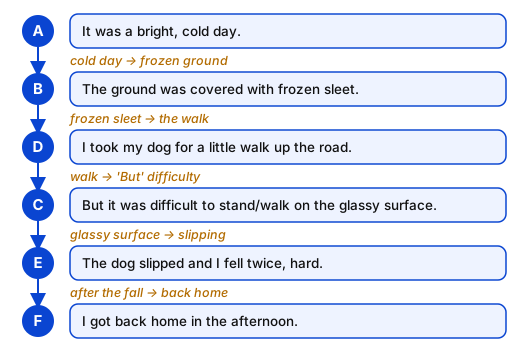
- A (cold day) → B: the cold explains why the ground was covered with frozen sleet.
- D: in this setting the narrator takes the dog for a walk.
- C begins with But – the difficulty of walking on the glassy surface must follow the walk.
- E: the result of the glassy surface – the dog slipped, I fell; then F.
Trick: A sentence starting with 'But' needs an action before it to contrast with.
Answer: (C) ABDCEF
अवधारणा: वाक्यों को कारण और समय की कड़ी में लगाएँ: माहौल → स्थिति → कार्य → कठिनाई → परिणाम।
- A (ठंडा दिन) → B: ठंड के कारण ज़मीन पर जमी हुई sleet थी।
- D: इसी माहौल में लेखक कुत्ते को सैर पर ले गया।
- C But से शुरू होता है – चलने में कठिनाई सैर के बाद ही आएगी।
- E: चिकनी सतह का परिणाम – कुत्ता फिसला, मैं गिरा; फिर F।
ट्रिक: 'But' वाले वाक्य से पहले वह कार्य होना चाहिए जिसका विरोध दिखाया जा रहा है।
उत्तर: (C) ABDCEF

