Question bank

Q&A: practice questions with answers

Search questions on any topic. Filter by exam category, exam, subject and topic, try the question, then open the answer and explanation.

Courses – airGurukul

600 questions found.

Q481.
Select the most appropriate synonym of the given word.
ENORMOUS
  1. Acommon
  2. Btiny
  3. Cordinary
  4. Dmassive
Show answer

Concept: Enormous means very large in size or amount.

  1. Synonyms: huge, vast, immense, massive.
  2. 'Tiny' is its antonym; 'common' and 'ordinary' mean usual.
  3. So 'massive' is the synonym.

Trick: Don't pick the antonym (tiny) in a synonym question.

Answer: (D) massive

अवधारणा: Enormous का अर्थ है बहुत बड़ा / विशाल।

  1. पर्यायवाची: huge, vast, immense, massive।
  2. 'Tiny' (बहुत छोटा) विलोम है; 'common' और 'ordinary' = साधारण।
  3. इसलिए 'massive' सही पर्यायवाची है।

ट्रिक: Synonym प्रश्न में विलोम (tiny) के जाल से बचें।

उत्तर: (D) massive (विशाल)
SSC CPO Paper IIEnglish Language and ComprehensionSynonymsSSC CPO Paper II 2021 · 8 Nov Shift 1 →
Q482.
Select the most appropriate meaning of the given idiom.
A hard nut to crack
  1. AA comfortable situation
  2. BAn easy problem
  3. CA highly priced item
  4. DA difficult person
Show answer

Concept: A hard nut to crack is a person who is difficult to understand, deal with or persuade (also a difficult problem).

  1. Example: The new manager is a hard nut to crack.
  2. 'Comfortable situation' and 'easy problem' are opposite in sense.
  3. 'Highly priced item' is unrelated; among the options, 'a difficult person' fits.

Yaad rakhein: hard nut = hard to break open = hard to handle.

Answer: (D) A difficult person

अवधारणा: A hard nut to crack ऐसा व्यक्ति है जिसे समझना, संभालना या मनाना कठिन हो (या कठिन समस्या)।

  1. उदाहरण: The new manager is a hard nut to crack.
  2. 'Comfortable situation' और 'easy problem' उल्टे अर्थ हैं।
  3. 'Highly priced item' असंबंधित है; विकल्पों में 'a difficult person' सही है।

याद रखें: कड़ा अखरोट = तोड़ना कठिन = टेढ़ी खीर।

उत्तर: (D) A difficult person

SSC CPO Paper IIEnglish Language and ComprehensionIdiomsSSC CPO Paper II 2021 · 8 Nov Shift 1 →
Q483.
Select the most appropriate option to substitute the underlined segment in the given
sentence. If there is no need to substitute it, select ‘No substitution required’.
Corona virus has not yet reached some parts in world.
  1. Asome world parts
  2. Bsome part of the world
  3. Csome parts of the world
  4. DNo substitution required
Show answer

Concept: We say parts of the world – 'of' shows the parts belong to the whole world, and 'world' needs 'the'.

  1. 'some parts in world' lacks 'the' and uses the wrong preposition.
  2. 'some part of the world' – 'some … parts' should be plural here (several regions).
  3. 'some world parts' is unidiomatic.

Trick: the world is unique → always 'the world'.

Answer: (C) some parts of the world

अवधारणा: सही प्रयोग parts of the world है – 'of' बताता है कि भाग पूरे विश्व के हैं, और 'world' के साथ 'the' आता है।

  1. 'some parts in world' में 'the' नहीं है और preposition गलत है।
  2. 'some part of the world' – यहाँ कई क्षेत्रों की बात है, इसलिए plural 'parts' चाहिए।
  3. 'some world parts' मुहावरेदार अंग्रेज़ी नहीं है।

ट्रिक: world एक ही है → हमेशा 'the world'।

उत्तर: (C) some parts of the world

SSC CPO Paper IIEnglish Language and ComprehensionSentence improvement (prepositions/nouns)SSC CPO Paper II 2021 · 8 Nov Shift 1 →
Q484.
Parts of the following sentence are given as options. Identify the segment that contains a grammatical error.
They were completely taking unawares by the shocking remarks of Mr. Sharma about the security of the colony.
  1. Aof the colony
  2. Bby the shocking remarks
  3. Cabout the security
  4. Dwere completely taking unawares
Show answer

Concept: The idiom is to be taken unawares = to be surprised. The subject 'They' received the action, so the passive (were + V3) is needed.

  1. 'were … taking unawares' is active continuous – wrong here.
  2. Correct: 'They were completely taken unawares by the shocking remarks …'
  3. 'by the shocking remarks' confirms the passive; other parts are correct.

Trick: 'by + doer' in the sentence → verb must be passive (be + V3).

Answer: (D) were completely taking unawares

अवधारणा: मुहावरा है to be taken unawares = अचानक चौंक जाना। 'They' पर क्रिया हुई है, इसलिए passive (were + V3) चाहिए।

  1. 'were … taking unawares' active continuous है – यहाँ गलत।
  2. सही: 'They were completely taken unawares by the shocking remarks …'
  3. 'by the shocking remarks' passive की पुष्टि करता है; बाकी भाग सही हैं।

ट्रिक: वाक्य में 'by + कर्ता' हो → verb passive (be + V3)।

उत्तर: (D) were completely taking unawares

SSC CPO Paper IIEnglish Language and ComprehensionSpotting errors (passive voice)SSC CPO Paper II 2021 · 8 Nov Shift 1 →
Q485.
Select the most appropriate option to substitute the underlined segment in the given
sentence. If there is no need to substitute it, select ‘No substitution required’.
Our microwave oven is out of order and repairing is needed for it.
  1. Aneed to be repairing.
  2. BNo substitution required
  3. Cneeds to be repaired.
  4. Dneeding that it be repaired.
Show answer

Concept: When the subject receives the action, use need(s) + to be + V3 (passive infinitive).

  1. The oven does not repair itself – it must be repaired, so: it needs to be repaired.
  2. The subject 'microwave oven' is singular → 'needs'.
  3. 'repairing is needed for it' is wordy; 'need to be repairing' and 'needing that it be repaired' are ungrammatical.

Trick: Thing + needs + to be + V3 (The car needs to be washed).

Answer: (C) needs to be repaired.

अवधारणा: जब subject पर क्रिया होती है, तो need(s) + to be + V3 (passive infinitive) का प्रयोग करें।

  1. Oven खुद मरम्मत नहीं करता – उसकी मरम्मत होनी है, इसलिए: it needs to be repaired।
  2. Subject 'microwave oven' singular है → 'needs'।
  3. 'repairing is needed for it' अनावश्यक लंबा है; 'need to be repairing', 'needing that it be repaired' व्याकरण की दृष्टि से गलत हैं।

ट्रिक: वस्तु + needs + to be + V3 (The car needs to be washed)।

उत्तर: (C) needs to be repaired.

SSC CPO Paper IIEnglish Language and ComprehensionSentence improvement (passive infinitive)SSC CPO Paper II 2021 · 8 Nov Shift 1 →
Q486.
Parts of the following sentence are given as options. Identify the segment that contains a grammatical error.
The magistrate asked the prisoner what was he doing with his hand in the gentleman’s
pocket.
  1. Ain the gentleman’s pocket
  2. Bwith his hand
  3. Cwhat was he doing
  4. DThe magistrate asked
Show answer

Concept: In reported (indirect) questions, the word order is that of a statement: wh-word + subject + verb.

  1. 'asked … what was he doing' keeps the question order (verb before subject).
  2. Correct: 'The magistrate asked the prisoner what he was doing with his hand …'
  3. The other segments are correct.

Trick: After 'asked', no inversion: what he was, where she lived, why they came.

Answer: (C) what was he doing

अवधारणा: Indirect प्रश्न में शब्दों का क्रम कथन जैसा होता है: wh-word + subject + verb।

  1. 'asked … what was he doing' में प्रश्न वाला क्रम (पहले verb) है – गलत।
  2. सही: 'The magistrate asked the prisoner what he was doing with his hand …'
  3. बाकी भाग सही हैं।

ट्रिक: 'asked' के बाद inversion नहीं: what he was, where she lived।

उत्तर: (C) what was he doing

SSC CPO Paper IIEnglish Language and ComprehensionSpotting errors (indirect question)SSC CPO Paper II 2021 · 8 Nov Shift 1 →
Q487.
Select the correct active form of the given sentence.
I was greatly impressed by the Madhubani painting Avika made.
  1. AThe Madhubani painting Avika made has greatly impressed me.
  2. BThe Madhubani painting Avika made is very impressive.
  3. CThe Madhubani painting Avika made greatly impressed me.
  4. DThe Madhubani painting Avika made is greatly impressing me.
Show answer

Concept: 'was + V3' (was impressed) is simple past passive; the active voice uses V2, with the doer as subject.

  1. Doer: 'the Madhubani painting Avika made'; receiver: 'I' → object 'me'.
  2. was greatly impressed → greatly impressed me.
  3. (A) present perfect, (D) present continuous; (B) changes the meaning and drops 'me'.

Trick: I → me when it becomes the object.

Answer: (C) The Madhubani painting Avika made greatly impressed me.

अवधारणा: 'was + V3' (was impressed) simple past passive है; active में V2 आएगा और कर्ता subject बनेगा।

  1. कर्ता: 'the Madhubani painting Avika made'; प्रभावित होने वाला 'I' → object 'me'।
  2. was greatly impressed → greatly impressed me।
  3. (A) present perfect, (D) present continuous; (B) अर्थ बदलता है और 'me' हटा देता है।

ट्रिक: Object बनने पर I → me।

उत्तर: (C) The Madhubani painting Avika made greatly impressed me.

SSC CPO Paper IIEnglish Language and ComprehensionPassive to active (simple past)SSC CPO Paper II 2021 · 8 Nov Shift 1 →
Q488.
Select the most appropriate option to substitute the underlined segment in the given
sentence. If there is no need to substitute it, select ‘No substitution required’.
The committee worked up the matter for two hours but could not reach any consensus.
  1. ANo substitution required
  2. Btalked over
  3. Cworked for
  4. Dcame round
Show answer

Concept: Talk over = to discuss something thoroughly, usually to reach a decision.

  1. A committee discusses a matter in order to reach a consensus – so 'talked over the matter'.
  2. 'Work up' = to develop/excite (work up an appetite); it does not mean discuss.
  3. 'Worked for' = laboured for; 'came round' = regained consciousness / changed opinion.

Trick: talk over = discuss; consensus comes from discussion.

Answer: (B) talked over

अवधारणा: Talk over = किसी विषय पर विस्तार से चर्चा करना, प्रायः निर्णय तक पहुँचने के लिए।

  1. समिति किसी मामले पर सहमति (consensus) के लिए चर्चा करती है – इसलिए 'talked over the matter'।
  2. 'Work up' = विकसित करना/उत्तेजित करना (work up an appetite); चर्चा नहीं।
  3. 'Worked for' = के लिए काम किया; 'came round' = होश में आना / राय बदलना।

ट्रिक: talk over = चर्चा करना; consensus चर्चा से बनती है।

उत्तर: (B) talked over

SSC CPO Paper IIEnglish Language and ComprehensionPhrasal verbsSSC CPO Paper II 2021 · 8 Nov Shift 1 →
Q489.
Select the most appropriate direct form of the given sentence.
She asked me affectionately what she could do for me.
  1. AShe said to me, “What she could do for me?”
  2. BShe said to me, “What can I do for you, dear?”
  3. CShe said to me, “What can you do for her, dear?”
  4. DShe said to me, “What could I do for me?”
Show answer

Concept: Reverse the reported question: put it in question form inside quotes, shift the tense forward (could → can) and restore pronouns. 'Affectionately' can be shown by an address like 'dear'.

  1. 'what she could do for me' → “What can I do for you?”
  2. 'affectionately' → the loving address dear.
  3. (A) keeps statement order and 'she/me'; (C) and (D) mix up the pronouns.

Trick: In direct speech: she (speaker) → I, me (listener) → you.

Answer: (B) She said to me, “What can I do for you, dear?”

अवधारणा: Reported प्रश्न को उलटें: quotes में प्रश्न का रूप दें, tense आगे करें (could → can) और pronoun वापस करें। 'Affectionately' को 'dear' जैसे संबोधन से दिखाते हैं।

  1. 'what she could do for me' → “What can I do for you?”
  2. 'affectionately' → प्यार भरा संबोधन dear।
  3. (A) में statement का क्रम और 'she/me' है; (C), (D) में pronouns गड़बड़ हैं।

ट्रिक: Direct में: she (वक्ता) → I, me (श्रोता) → you।

उत्तर: (B) She said to me, “What can I do for you, dear?”

SSC CPO Paper IIEnglish Language and ComprehensionIndirect to direct speech (question)SSC CPO Paper II 2021 · 8 Nov Shift 1 →
Q490.
Select the most appropriate direct form of the given sentence.
She says that she would like to be an ambassador to a foreign country when she grows up.
  1. AShe told, “I like to be an ambassador to a foreign country when I grow up.”
  2. BShe says, “I would like to be an ambassador to a foreign country when I grow up.”
  3. CShe says, “She likes to be an ambassador to a foreign country when she grows up.”
  4. DShe said, “She would like to be an ambassador to a foreign country when she grew up.”
Show answer

Concept: When the reporting verb is in the present ('says'), the tense of the reported words does not change; only pronouns change.

  1. Keep 'says' → She says, “… ”
  2. 'she would like … when she grows up' → “I would like … when I grow up.”
  3. (A) and (D) change 'says' to past; (C) keeps 'She' inside the quotes.

Trick: says/tells (present) → no tense change, only pronoun change.

Answer: (B) She says, “I would like to be an ambassador to a foreign country when I grow up.”

अवधारणा: जब reporting verb present में हो ('says'), तो reported भाग का tense नहीं बदलता; केवल pronoun बदलते हैं।

  1. 'says' वही रहेगा → She says, “… ”
  2. 'she would like … when she grows up' → “I would like … when I grow up.”
  3. (A) और (D) में 'says' को past कर दिया; (C) में quotes के अंदर 'She' है।

ट्रिक: says/tells (present) → tense नहीं बदलता, केवल pronoun बदलते हैं।

उत्तर: (B) She says, “I would like to be an ambassador to a foreign country when I grow up.”

SSC CPO Paper IIEnglish Language and ComprehensionIndirect to direct speech (present reporting verb)SSC CPO Paper II 2021 · 8 Nov Shift 1 →
Q491.
Given below are six sentences. A and F are the first and the last sentences. The rest of the sentences namely B, C, D and E are jumbled. Select the option that gives their correct order. A. The well was highly useful to the people who lived in the surrounding huts.
B. The well was dangerous: but it had been there for so long that no one worried about it. C. Consequently, the mouth of the well had gradually widened as the soil and rocks on the side fell in.
D. There had never been any money for a wall around the well.
E. They had dug it two years before because the only water tap in the colony was not
enough for the slum’s growing population.
F. Apart from a chicken that had fallen in and had been rescued, the well seemed harmless.
  1. AADBECF
  2. BAEBDCF
  3. CADBCEF
  4. DAEDCBF
Show answer

Concept: Link pronouns to their nouns and follow cause → effect markers such as 'Consequently'.

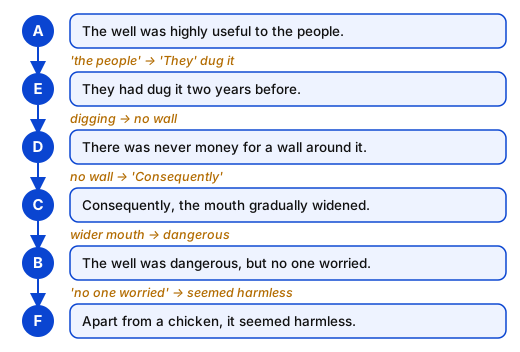
  1. A mentions 'the people' → E: 'They had dug it two years before'.
  2. D: there was never money for a wall around the well.
  3. C: 'Consequently, the mouth … widened' – the result of having no wall.
  4. B: so the well was dangerous, but no one worried → F: apart from a chicken, it seemed harmless.

Trick: 'Consequently' always follows its cause – D (no wall) → C (mouth widened).

Answer: (D) AEDCBF

अवधारणा: Pronoun को उसके noun से जोड़ें और 'Consequently' जैसे कारण → परिणाम वाले शब्दों का क्रम देखें।

  1. A में 'the people' है → E: 'They had dug it two years before'।
  2. D: कुएँ के चारों ओर दीवार के लिए कभी पैसे नहीं थे।
  3. C: 'Consequently, the mouth … widened' – दीवार न होने का परिणाम।
  4. B: इसलिए कुआँ खतरनाक था, पर किसी को चिंता नहीं थी → F: एक मुर्गी को छोड़कर कुआँ हानिरहित लगता था।

ट्रिक: 'Consequently' हमेशा अपने कारण के बाद आता है – D (दीवार नहीं) → C (मुँह चौड़ा)।

उत्तर: (D) AEDCBF

SSC CPO Paper IIEnglish Language and ComprehensionSentence rearrangement (para-jumble)SSC CPO Paper II 2021 · 8 Nov Shift 1 →
Q492.
Select the most appropriate synonym of the given word.
DILEMMA
  1. Aadvantage
  2. Bsuccess
  3. Cquandary
  4. Dsolution
Show answer

Concept: Dilemma = a situation in which a difficult choice has to be made between two options.

  1. Its synonym is quandary (a state of uncertainty about what to do).
  2. 'Solution' is the opposite idea; 'advantage' and 'success' are unrelated.
  3. Example: I am in a quandary/dilemma about which job to accept.

Yaad rakhein: dilemma = di (two) + lemma → caught between two choices.

Answer: (C) quandary

अवधारणा: Dilemma = दुविधा; ऐसी स्थिति जिसमें दो विकल्पों में से कठिन चुनाव करना हो।

  1. इसका पर्यायवाची quandary (असमंजस) है।
  2. 'Solution' (हल) उल्टा भाव है; 'advantage', 'success' असंबंधित हैं।
  3. उदाहरण: I am in a quandary/dilemma about which job to accept.

याद रखें: dilemma = di (दो) + lemma → दो विकल्पों में फँसना।

उत्तर: (C) quandary (दुविधा)

SSC CPO Paper IIEnglish Language and ComprehensionSynonymsSSC CPO Paper II 2021 · 8 Nov Shift 1 →
Q493.
Parts of the following sentence are given as options. Identify the segment that contains a grammatical error.
The plant will die unless you will water it every day.
  1. Ayou will water
  2. Bwill die
  3. Cevery day
  4. Dunless
Show answer

Concept: In clauses of condition with if, unless, when, till, as soon as referring to the future, the simple present is used, not 'will'.

  1. 'unless you will water it' → 'unless you water it'.
  2. 'will die' in the main clause is correct.
  3. 'unless' itself means 'if not', so no extra 'not' is needed.

Trick: Unless/if-clause: no 'will'. Main clause: will.

Answer: (A) you will water

अवधारणा: भविष्य की शर्त बताने वाले if, unless, when, till, as soon as वाले clause में simple present आता है, 'will' नहीं।

  1. 'unless you will water it' → 'unless you water it'।
  2. Main clause का 'will die' सही है।
  3. 'unless' का अर्थ ही 'if not' है, अलग से 'not' नहीं लगेगा।

ट्रिक: Unless/if-clause में 'will' नहीं; main clause में will।

उत्तर: (A) you will water

SSC CPO Paper IIEnglish Language and ComprehensionSpotting errors (conditional clause)SSC CPO Paper II 2021 · 8 Nov Shift 1 →
Q494.
Select the most appropriate option to substitute the underlined segment in the given
sentence. If there is no need to substitute it, select ‘No substitution required’.
Since 10 o’clock in the morning he worked on this design.
  1. Ahe was working
  2. Bhe had worked
  3. Che has been working
  4. DNo substitution required
Show answer

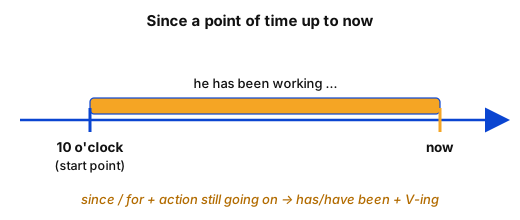
Concept: An action that began at a point in the past and is still continuing takes the present perfect continuous: has/have + been + V-ing, with 'since' (point of time) or 'for' (period).

  1. 'Since 10 o'clock in the morning' marks the starting point of an action still going on.
  2. So: he has been working on this design.
  3. 'worked', 'was working', 'had worked' are past forms and do not connect the action to now.

Trick: since/for + continuing action → has/have been + V-ing.

Answer: (C) he has been working

अवधारणा: जो कार्य past में किसी समय शुरू होकर अब तक चल रहा है, उसके लिए present perfect continuous: has/have + been + V-ing आता है; 'since' (समय-बिंदु) या 'for' (अवधि) के साथ।

  1. 'Since 10 o'clock in the morning' उस कार्य का आरंभ-बिंदु है जो अब भी जारी है।
  2. इसलिए: he has been working on this design।
  3. 'worked', 'was working', 'had worked' past के रूप हैं, कार्य को वर्तमान से नहीं जोड़ते।

ट्रिक: since/for + जारी कार्य → has/have been + V-ing।

उत्तर: (C) he has been working

SSC CPO Paper IIEnglish Language and ComprehensionTenses (present perfect continuous)SSC CPO Paper II 2021 · 8 Nov Shift 1 →
Q495.
Select the correct passive form of the given sentence.
We use this hall on special occasions.
  1. AThis hall is used on special occasions.
  2. BThis hall was being used on special occasions.
  3. CThis hall has been used on special occasions.
  4. DThis hall is being used on special occasions.
Show answer

Concept: Simple present active (V1/V5) → passive is/am/are + V3. A general subject like 'we' can be dropped in the passive.

  1. Object 'this hall' becomes the subject (singular → is).
  2. use → is used; 'by us' is usually omitted.
  3. (B) past continuous, (C) present perfect, (D) present continuous – the tense changes.

Trick: V1 → is/are + V3; drop 'by us/them/people'.

Answer: (A) This hall is used on special occasions.

अवधारणा: Simple present active (V1/V5) → passive is/am/are + V3। 'we' जैसे सामान्य कर्ता को passive में हटा सकते हैं।

  1. Object 'this hall' subject बनेगा (singular → is)।
  2. use → is used; 'by us' प्रायः हटा दिया जाता है।
  3. (B) past continuous, (C) present perfect, (D) present continuous – tense बदल गया।

ट्रिक: V1 → is/are + V3; 'by us/them/people' हटा दें।

उत्तर: (A) This hall is used on special occasions.

SSC CPO Paper IIEnglish Language and ComprehensionActive to passive (simple present)SSC CPO Paper II 2021 · 8 Nov Shift 1 →
Q496.
Select the most appropriate option to fill in the blank.
It was ______ who encouraged me while I was sunk in despair.
  1. Aus
  2. Bhe
  3. Cour
  4. Dwe
Show answer

Concept: After 'It is/was', the pronoun that is the doer of the following 'who' clause takes the subjective (nominative) case.

  1. 'It was ___ who encouraged me' – the blank is the person who did the encouraging (subject).
  2. Subject forms: I, we, he, she, they → 'he' fits.
  3. 'us' is objective and 'our' is possessive; 'we' includes the speaker, who cannot be the one encouraging himself ('me') – so it is illogical.

Trick: It was + subject pronoun + who … (It was he who …).

Answer: (B) he

अवधारणा: 'It is/was' के बाद यदि pronoun अगले 'who' clause का कर्ता हो, तो वह subjective (nominative) case में आता है।

  1. 'It was ___ who encouraged me' – रिक्त स्थान वाला व्यक्ति ही प्रोत्साहित करने वाला (कर्ता) है।
  2. Subject रूप: I, we, he, she, they → 'he' उपयुक्त है।
  3. 'us' objective और 'our' possessive है; 'we' में वक्ता स्वयं शामिल है, जो खुद को ('me') प्रोत्साहित नहीं कर सकता – इसलिए अतार्किक।

ट्रिक: It was + subject pronoun + who … (It was he who …)।

उत्तर: (B) he

SSC CPO Paper IIEnglish Language and ComprehensionPronouns (subjective case)SSC CPO Paper II 2021 · 8 Nov Shift 1 →
Q497.
Select the most appropriate option to substitute the underlined segment in the given
sentence. If there is no need to substitute it, select ‘No substitution required’.
If the police hasn’t stopped us we would have reached home by now.
  1. Ahadn’t stopped us we would have reached
  2. BNo substitution required
  3. Chasn’t stopped us we would reach
  4. Dhadn’t stopped us we will reach
Show answer

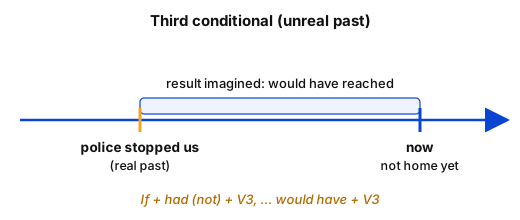
Concept: Third conditional (an imaginary past): If + had (not) + V3, … would have + V3.

  1. The main clause 'we would have reached' shows an unreal past result.
  2. So the if-clause needs past perfect: If the police hadn't stopped us.
  3. (C) and (D) keep wrong tense pairs ('hasn't … would reach', 'hadn't … will reach').

Trick: would have + V3 ↔ had + V3.

Answer: (A) hadn't stopped us we would have reached

अवधारणा: Third conditional (past की काल्पनिक स्थिति): If + had (not) + V3, … would have + V3।

  1. Main clause 'we would have reached' past का अवास्तविक परिणाम दिखाता है।
  2. इसलिए if-clause में past perfect: If the police hadn't stopped us।
  3. (C) और (D) में tense की जोड़ी गलत है ('hasn't … would reach', 'hadn't … will reach')।

ट्रिक: would have + V3 ↔ had + V3।

उत्तर: (A) hadn't stopped us we would have reached

SSC CPO Paper IIEnglish Language and ComprehensionConditional sentences (third conditional)SSC CPO Paper II 2021 · 8 Nov Shift 1 →
Q498.
Parts of the following sentence are given as options. Identify the segment that contains a grammatical error.
This question paper comprises from questions on general awareness and reasoning.
  1. Aquestions on
  2. Bgeneral awareness
  3. CThis question paper
  4. Dcomprises from
Show answer

Concept: Comprise takes a direct object, without any preposition. 'Consist of' or 'be composed of' take 'of'.

  1. 'comprises from questions' – 'from' is wrong.
  2. Correct: 'This question paper comprises questions …' or 'consists of questions …'.
  3. The other segments are correct.

Trick: comprise (no preposition) = consist of = be composed of.

Answer: (D) comprises from

अवधारणा: Comprise के बाद सीधे object आता है, कोई preposition नहीं। 'Consist of' या 'be composed of' के साथ 'of' लगता है।

  1. 'comprises from questions' – 'from' गलत है।
  2. सही: 'This question paper comprises questions …' या 'consists of questions …'।
  3. बाकी भाग सही हैं।

ट्रिक: comprise (बिना preposition) = consist of = be composed of।

उत्तर: (D) comprises from

SSC CPO Paper IIEnglish Language and ComprehensionSpotting errors (verb + preposition)SSC CPO Paper II 2021 · 8 Nov Shift 1 →
Q499.
Select the correct passive form of the given sentence.
The Railway has started special trains for the workers.
  1. ASpecial trains are being started for the workers by the Railway.
  2. BSpecial trains have been started for the workers by the Railway.
  3. CSpecial trains has been started for the workers by the Railway.
  4. DSpecial trains will be started for the workers by the Railway.
Show answer

Concept: Present perfect active (has/have + V3) → passive has/have + been + V3; the helping verb agrees with the new subject.

  1. New subject 'special trains' is plural → have been started.
  2. has started → have been started by the Railway.
  3. (C) uses 'has' with a plural subject; (A) present continuous; (D) future.

Trick: Check the number of the new subject: plural → have.

Answer: (B) Special trains have been started for the workers by the Railway.

अवधारणा: Present perfect active (has/have + V3) → passive has/have + been + V3; helping verb नए subject के अनुसार होता है।

  1. नया subject 'special trains' plural है → have been started।
  2. has started → have been started by the Railway।
  3. (C) में plural subject के साथ 'has'; (A) present continuous; (D) future।

ट्रिक: नए subject की संख्या देखें: plural → have।

उत्तर: (B) Special trains have been started for the workers by the Railway.

SSC CPO Paper IIEnglish Language and ComprehensionActive to passive (present perfect)SSC CPO Paper II 2021 · 8 Nov Shift 1 →
Q500.
Parts of the following sentence are given as options. Identify the segment that contains a grammatical error.
These tutorials are so elementary that they can help neither you nor I.
  1. Aso elementary that
  2. Bneither you nor I
  3. CThese tutorials are
  4. Dthey can help
Show answer

Concept: A pronoun that is the object of a verb takes the objective case: me, him, her, us, them.

  1. 'they can help neither you nor I' – 'I' is the object of 'help'.
  2. Correct: 'neither you nor me'.
  3. 'so elementary that', 'These tutorials are', 'they can help' are correct.

Trick: Remove 'neither you nor' – 'help I' sounds wrong, 'help me' is right.

Answer: (B) neither you nor I

अवधारणा: जो pronoun किसी verb का object हो, वह objective case में आता है: me, him, her, us, them।

  1. 'they can help neither you nor I' – यहाँ 'I', 'help' का object है।
  2. सही: 'neither you nor me'।
  3. 'so elementary that', 'These tutorials are', 'they can help' सही हैं।

ट्रिक: 'neither you nor' हटाकर देखें – 'help I' गलत, 'help me' सही।

उत्तर: (B) neither you nor I

SSC CPO Paper IIEnglish Language and ComprehensionSpotting errors (pronoun case)SSC CPO Paper II 2021 · 8 Nov Shift 1 →