Question bank

Q&A: practice questions with answers

Search questions on any topic. Filter by exam category, exam, subject and topic, try the question, then open the answer and explanation.

Courses – airGurukul

600 questions found.

Q541.
Parts of the following sentence are given as options. Identify the segment that contains a grammatical error.
This newspaper has a bigger circulation from any other newspaper in our town.
  1. Afrom any other newspaper
  2. Bin our town
  3. CThis newspaper has
  4. Da bigger circulation
Show answer

Concept: A comparative adjective (bigger, better, more) is followed by than, not from.

  1. a bigger circulation than any other newspaper.
  2. any other is correctly used because the paper is compared with others of its own class.
  3. So the error is in from any other newspaper.

Yaad rakhein: Comparative + than (exceptions: superior/inferior/senior/junior + to).

Answer: (A) from any other newspaper

अवधारणा: Comparative विशेषण (bigger, better, more) के बाद than आता है, from नहीं।

  1. a bigger circulation than any other newspaper।
  2. any other सही है क्योंकि अपने ही वर्ग के अन्य अख़बारों से तुलना है।
  3. अतः त्रुटि from any other newspaper में है।

याद रखें: Comparative + than (अपवाद: superior/inferior/senior/junior + to)।

उत्तर: (A) from any other newspaper
SSC CPO Paper IIEnglish Language and ComprehensionError Spotting – ComparisonSSC CPO Paper II 2021 · 8 Nov Shift 1 →
Q542.
Parts of the following sentence are given as options. Identify the segment that contains a grammatical error.
His family lives in Bihar but he works on a factory in Mumbai.
  1. AHis family lives
  2. Bin Mumbai
  3. Cbut he works
  4. Don a factory
Show answer

Concept: We work in a building or organisation such as a factory, office or bank; on is used for surfaces or for projects (work on a project).

  1. works on a factory → works in a factory.
  2. His family lives (singular collective noun) is correct.
  3. in Mumbai and but he works are correct.

Yaad rakhein: work in a factory/office; work on a project/problem.

Answer: (D) on a factory

अवधारणा: किसी भवन या संस्था (factory, office, bank) में काम करने के लिए in; on सतह या project के लिए (work on a project)।

  1. works on a factory → works in a factory।
  2. His family lives (एकवचन समूहवाचक) सही है।
  3. in Mumbai और but he works सही हैं।

याद रखें: work in a factory/office; work on a project/problem।

उत्तर: (D) on a factory

SSC CPO Paper IIEnglish Language and ComprehensionError Spotting – PrepositionsSSC CPO Paper II 2021 · 8 Nov Shift 1 →
Q543.
Parts of the following sentence are given as options. Identify the segment that contains a grammatical error.
Instead of attend the class he went to watch the cricket match.
  1. Ahe went
  2. Battend the class
  3. Cto watch
  4. DInstead of
Show answer

Concept: A preposition (instead of, without, before, after) is followed by a noun or gerund (V-ing), not the base verb.

  1. Instead of attend → Instead of attending the class.
  2. he went to watch is correct (purpose infinitive).
  3. So the error is in attend the class.

Yaad rakhein: Preposition + V-ing: instead of going, without asking, before leaving.

Answer: (B) attend the class

अवधारणा: Preposition (instead of, without, before, after) के बाद संज्ञा या gerund (V-ing) आता है, मूल क्रिया नहीं।

  1. Instead of attend → Instead of attending the class।
  2. he went to watch सही है (उद्देश्य बताने वाला infinitive)।
  3. अतः त्रुटि attend the class में है।

याद रखें: Preposition + V-ing: instead of going, without asking, before leaving।

उत्तर: (B) attend the class

SSC CPO Paper IIEnglish Language and ComprehensionError Spotting – GerundSSC CPO Paper II 2021 · 8 Nov Shift 1 →
Q544.
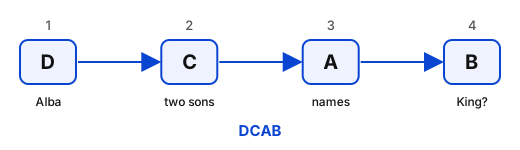
Given below are four jumbled sentences. Select the option that gives their correct order. A. Their names were Amulius and Numitor and both were equally brave.
B. The people of Alba could not decide who should be made the King.
C. It so happened that the King of Alba died leaving behind two sons.
D. In the beautiful land of Italy, there was a city called Alba.
  1. ADCAB
  2. BDACB
  3. CADCB
  4. DABCD
Show answer

Concept: A story opens with the setting (place), then the event, then the characters and finally the problem.

  1. D sets the scene: a city called Alba in Italy – the opener.
  2. C: the King of Alba died leaving two sons.
  3. A: Their names – their = the two sons (C→A); B: people could not decide who should be King.

Yaad rakhein: Their names (A) needs ‘two sons’ (C) just before it.

Answer: (A) DCAB

अवधारणा: कहानी पहले स्थान से शुरू होती है, फिर घटना, फिर पात्र और अंत में समस्या।

  1. D दृश्य बताता है: Italy में Alba नामक नगर – आरंभ।
  2. C: Alba का राजा two sons छोड़कर मर गया।
  3. A: Their names – their = दोनों पुत्र (C→A); B: लोग तय नहीं कर पाए कि राजा कौन बने।

याद रखें: Their names (A) से ठीक पहले 'two sons' (C) चाहिए।

उत्तर: (A) DCAB

SSC CPO Paper IIEnglish Language and ComprehensionSentence RearrangementSSC CPO Paper II 2021 · 8 Nov Shift 1 →
Q545.
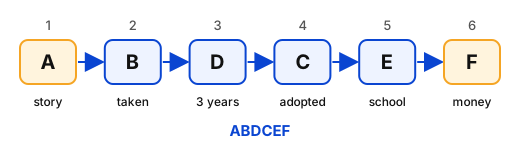
Given below are six sentences. A and F are the first and the last sentences. The rest of the sentences namely B, C, D and E are jumbled. Select the option that gives their correct order. A. All three went home with the young man, who told them his story.
B. The circus people had taken him away from his village.
C. Then one day, a rich lady gave the circus people a sum of money and adopted him.
D. For three years he had travelled with them through many countries.
E. As he was intelligent, he was sent to school and college.
F. As the old lady had no children of her own, she left all her money to him.
  1. AABCDEF
  2. BAEBCDF
  3. CADBCEF
  4. DABDCEF
Show answer

Concept: The young man’s story runs in time order: taken away → years with the circus → adoption → education → inheritance.

  1. A: he told them his story; B: the circus people had taken him away – the beginning.
  2. D: for three years he travelled with them (circus people); C: Then one day a rich lady adopted him.
  3. E: he was sent to school and college; F: the old lady left all her money to him.

Yaad rakhein: Then one day (C) breaks the routine described in D, so D→C.

Answer: (D) ABDCEF

अवधारणा: युवक की कहानी समय-क्रम में: ले जाया गया → circus के साथ वर्ष → गोद लिया गया → शिक्षा → उत्तराधिकार।

  1. A: उसने अपनी कहानी सुनाई; B: circus वाले उसे गाँव से ले गए थे – शुरुआत।
  2. D: तीन साल वह them (circus वालों) के साथ घूमा; C: Then one day एक धनी महिला ने उसे गोद लिया।
  3. E: उसे school और college भेजा गया; F: वृद्ध महिला ने सारा धन उसे दे दिया।

याद रखें: Then one day (C) D की दिनचर्या को तोड़ता है, अतः D→C।

उत्तर: (D) ABDCEF

SSC CPO Paper IIEnglish Language and ComprehensionSentence RearrangementSSC CPO Paper II 2021 · 8 Nov Shift 1 →
Q546.
Select the correct passive form of the given sentence.
Why do we have to do the house chores during this lockdown period?
  1. AThe house chores are to be done during this lockdown period by us.
  2. BWhy are the house chores being done during this lockdown period by us?
  3. CWhy do the house chores have to be done by us during this lockdown period?
  4. DWhy will the house chores have to be done by us during this lockdown period?
Show answer

Concept: In a wh-question, keep the question word first; do we have to + V1 becomes do + object + have to be + V3 in the passive.

  1. Object the house chores (plural) → subject: Why do the house chores have to be done.
  2. by us replaces we; the tense (simple present) stays the same.
  3. (A) is not a question; (B) is present continuous; (D) uses future will.

Yaad rakhein: Question stays a question; have to + V1 → have to be + V3.

Answer: (C) Why do the house chores have to be done by us during this lockdown period?

अवधारणा: wh-प्रश्न में प्रश्नवाचक शब्द पहले ही रहेगा; do we have to + V1 का passive do + object + have to be + V3।

  1. Object the house chores (बहुवचन) → कर्ता: Why do the house chores have to be done।
  2. we के स्थान पर by us; काल (simple present) वही।
  3. (A) प्रश्न नहीं है; (B) present continuous; (D) में future will।

याद रखें: प्रश्न प्रश्न ही रहेगा; have to + V1 → have to be + V3।

उत्तर: (C) Why do the house chores have to be done by us during this lockdown period?

SSC CPO Paper IIEnglish Language and ComprehensionActive and Passive Voice – InterrogativeSSC CPO Paper II 2021 · 8 Nov Shift 1 →
Q547.
Parts of the following sentence are given as options. Identify the segment that contains a grammatical error.
The doctor did not put the patient on the ventilator, yet still made him comfortable.
  1. Ahim comfortable
  2. Bon the ventilator
  3. Cdid not put
  4. Dyet still made
Show answer

Concept: Yet and still both mean ‘nevertheless’; using them together is redundant (superfluous).

  1. Correct: … on the ventilator, yet made him comfortable (or but still made).
  2. did not put … on the ventilator and him comfortable are correct.
  3. So the error lies in yet still made.

Yaad rakhein: Avoid double words of the same meaning: yet still, return back, repeat again.

Answer: (D) yet still made

अवधारणा: Yet और still दोनों का अर्थ 'फिर भी' है; दोनों साथ लिखना अनावश्यक (superfluous) है।

  1. सही: … on the ventilator, yet made him comfortable (या but still made)।
  2. did not put … on the ventilator और him comfortable सही हैं।
  3. अतः त्रुटि yet still made में है।

याद रखें: समान अर्थ वाले दो शब्द साथ न लिखें: yet still, return back, repeat again।

उत्तर: (D) yet still made

SSC CPO Paper IIEnglish Language and ComprehensionError Spotting – RedundancySSC CPO Paper II 2021 · 8 Nov Shift 1 →
Q548.
Select the most appropriate option to fill in the blank.
We’ll accept your application _______ you fulfil all the conditions.
  1. Aprovided
  2. Bso that
  3. Calthough
  4. Deven if
Show answer

Concept: Provided (that) means ‘on the condition that / only if’ and introduces a condition.

  1. Acceptance depends on fulfilling the conditions → provided.
  2. so that shows purpose; although shows contrast; even if means the condition does not matter – all change the sense.
  3. Hence (A).

Yaad rakhein: provided / providing / as long as = only if.

Answer: (A) provided

अवधारणा: Provided (that) का अर्थ है 'इस शर्त पर कि / केवल यदि' – यह शर्त बताता है।

  1. आवेदन तभी स्वीकार होगा जब शर्तें पूरी हों → provided।
  2. so that उद्देश्य, although विरोध, even if = शर्त से फ़र्क नहीं – सब अर्थ बदलते हैं।
  3. अतः (A)।

याद रखें: provided / providing / as long as = only if (केवल यदि)।

उत्तर: (A) provided

SSC CPO Paper IIEnglish Language and ComprehensionConjunctionsSSC CPO Paper II 2021 · 8 Nov Shift 1 →
Q549.
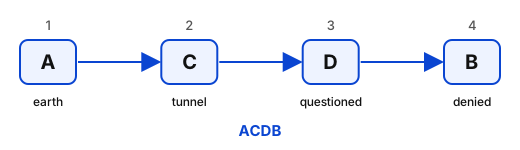
Given below are four jumbled sentences. Select the option that gives their correct order. A. When the convicts were led out to work, the convoy soldier noticed that one of the
prisoners emptied some earth out of his boots.
B. They all denied the knowledge of it.
C. The prison was searched and a tunnel was found.
D. The Governor came and questioned all the prisoners to find out who had dug the tunnel.
  1. AABCD
  2. BACDB
  3. CBCAD
  4. DBADC
Show answer

Concept: Follow the cause-and-effect chain of the escape story: clue → search → questioning → reply.

  1. A: the soldier notices a prisoner emptying earth from his boots – the clue and the opener.
  2. C: the prison was searched and a tunnel found.
  3. D: the Governor questioned all prisoners about the tunnel; B: They all denied – they = the prisoners.

Yaad rakhein: They all denied (B) is a reply, so it comes right after the questioning (D).

Answer: (B) ACDB

अवधारणा: भागने की कहानी की कारण-परिणाम श्रृंखला देखें: सुराग → तलाशी → पूछताछ → उत्तर।

  1. A: सैनिक देखता है कि एक कैदी जूतों से मिट्टी गिरा रहा है – सुराग और आरंभ।
  2. C: जेल की तलाशी हुई और सुरंग मिली।
  3. D: Governor ने सुरंग के बारे में सब कैदियों से पूछा; B: They all denied – they = कैदी।

याद रखें: They all denied (B) उत्तर है, अतः पूछताछ (D) के ठीक बाद।

उत्तर: (B) ACDB

SSC CPO Paper IIEnglish Language and ComprehensionSentence RearrangementSSC CPO Paper II 2021 · 8 Nov Shift 1 →
Q550.
Select the most appropriate indirect form of the given sentence.
Frank said to Albert, “ How is your search for a new house coming along?”
  1. AFrank asked Albert how his search for a new house was coming along.
  2. BFrank asked Albert how was your search for a new house coming along.
  3. CFrank asked Albert how is your search for a new house coming along.
  4. DFrank wanted to know how was Albert’s search for a new house coming along.
Show answer

Concept: A wh-question becomes asked + wh-word + subject + verb; your → his, is → was.

  1. said to → asked; How is your search → how his search … was.
  2. Statement order: subject (his search for a new house) before verb (was coming).
  3. (B), (C), (D) keep question order; (B) and (C) also keep your/is.

Yaad rakhein: In indirect questions the verb goes after the subject.

Answer: (A) Frank asked Albert how his search for a new house was coming along.

अवधारणा: wh-प्रश्न का indirect: asked + wh-शब्द + कर्ता + क्रिया; your → his, is → was।

  1. said to → asked; How is your search → how his search … was।
  2. कथन-क्रम: कर्ता (his search for a new house) क्रिया (was coming) से पहले।
  3. (B), (C), (D) में प्रश्न-क्रम है; (B) और (C) में your/is भी रह गए।

याद रखें: Indirect प्रश्न में क्रिया कर्ता के बाद आती है।

उत्तर: (A) Frank asked Albert how his search for a new house was coming along.

SSC CPO Paper IIEnglish Language and ComprehensionDirect and Indirect SpeechSSC CPO Paper II 2021 · 8 Nov Shift 1 →
Q551.
Select the correct active form of the given sentence.
Why does homework have to be done daily?
  1. AWhy are we doing homework daily?
  2. BWhy do we have to do homework daily?
  3. CWhy did we do homework daily?
  4. DWhy should we do homework daily?
Show answer

Concept: A passive question with a modal-like verb 'have to be + V3' becomes active as 'do/does + subject + have to + V1 + object'. The tense (simple present) must stay the same.

  1. Passive: Why does homework have to be done daily? – present tense, obligation (have to).
  2. The doer is not given, so we use a general subject 'we'.
  3. Active: Why do we have to do homework daily?
  4. (A) and (C) change the tense; (D) changes 'have to' into 'should', which changes the meaning.

Trick: Keep the helping verb family the same: 'does…have to be done' → 'do…have to do'.

Answer: (B) Why do we have to do homework daily?

अवधारणा: Passive प्रश्न 'have to be + V3' को active में 'do/does + subject + have to + V1 + object' बनाते हैं। Tense (simple present) वही रहता है।

  1. Passive: Why does homework have to be done daily? – present tense, मजबूरी (have to)।
  2. कर्ता (doer) नहीं दिया है, इसलिए सामान्य subject 'we' लेते हैं।
  3. Active: Why do we have to do homework daily?
  4. (A) और (C) में tense बदल गया; (D) में 'should' से अर्थ बदल गया।

ट्रिक: Helping verb का परिवार वही रखें: 'does…have to be done' → 'do…have to do'।

उत्तर: (B) Why do we have to do homework daily?

SSC CPO Paper IIEnglish Language and ComprehensionActive and Passive VoiceSSC CPO Paper II 2021 · 8 Nov Shift 1 →
Q552.
Select the most appropriate direct form of the given sentence.
Veena informed me that there would be an online art class for the children at 4 o’clock that day.
  1. AVeena said to me, “There was an online art class for the children at 4 o’clock today.”
  2. BVeena said to me, “There is an online art class for the children at 4 o’clock that day.”
  3. CVeena said to me, “There will be an online art class for the children at 4 o’clock
    today.”
  4. DVeena said to me, “There will be an online art class for the children at 4 o’clock that day.”
Show answer

Concept: Indirect → direct: reverse the changes – 'informed' → 'said to', 'would' → 'will', 'that day' → 'today'; put the words in inverted commas.

  1. Reporting verb: informed me → said to me.
  2. 'would be' was the backshifted form of 'will be'.
  3. 'that day' in indirect speech comes from 'today' in direct speech.
  4. So: Veena said to me, “There will be an online art class for the children at 4 o’clock today.” (B) and (D) keep 'that day'; (A) uses 'was'.

Trick: In direct speech the time words are 'near' words: that day → today, then → now, the previous day → yesterday.

Answer: (C) Veena said to me, “There will be an online art class … at 4 o’clock today.”

अवधारणा: Indirect से direct बनाते समय बदलाव उलट दें – 'informed' → 'said to', 'would' → 'will', 'that day' → 'today'; शब्द inverted commas में लिखें।

  1. Reporting verb: informed me → said to me।
  2. 'would be' असल में 'will be' का बदला हुआ रूप है।
  3. Indirect का 'that day' direct में 'today' बनता है।
  4. अतः: “There will be … at 4 o’clock today.” (B), (D) में 'that day' रह गया; (A) में 'was' गलत है।

ट्रिक: Direct speech में समय-सूचक शब्द पास वाले होते हैं: that day → today, the previous day → yesterday।

उत्तर: (C) Veena said to me, “There will be … at 4 o’clock today.”

SSC CPO Paper IIEnglish Language and ComprehensionDirect and Indirect SpeechSSC CPO Paper II 2021 · 8 Nov Shift 1 →
Q553.
Select the most appropriate direct form of the given sentence.
I asked him where he had lost the pen I had brought for him the previous day.
  1. AI said to him, “Where do you lose the pen I had brought for him yesterday?”
  2. BI said to him, “Where he had lost the pen I brought for him yesterday?”
  3. CI said to him, “Where have you lost the pen I brought for you the previous day?”
  4. DI said to him, “Where have you lost the pen I brought for you yesterday?”
Show answer

Concept: Indirect question → direct question: 'asked' → 'said to', past perfect 'had lost' → present perfect 'have lost', 'he' → 'you', 'the previous day' → 'yesterday', and use question order with a question mark.

  1. where he had lost → “Where have you lost …?”
  2. the pen I had brought for him → the pen I brought for you.
  3. the previous day → yesterday.
  4. (A) has wrong tense and 'him'; (B) keeps indirect word order; (C) keeps 'the previous day'.

Trick: Check three things in direct speech: pronoun (you), tense (one step forward), time word (yesterday).

Answer: (D) I said to him, “Where have you lost the pen I brought for you yesterday?”

अवधारणा: Indirect प्रश्न को direct में बदलें: 'asked' → 'said to', 'had lost' → 'have lost', 'he' → 'you', 'the previous day' → 'yesterday', और प्रश्नवाचक क्रम व प्रश्नचिह्न लगाएँ।

  1. where he had lost → “Where have you lost …?”
  2. the pen I had brought for him → the pen I brought for you।
  3. the previous day → yesterday।
  4. (A) में tense और 'him' गलत; (B) में indirect क्रम; (C) में 'the previous day' रह गया।

ट्रिक: Direct speech में तीन चीज़ें जाँचें: pronoun (you), tense, समय-शब्द (yesterday)।

उत्तर: (D) I said to him, “Where have you lost the pen I brought for you yesterday?”

SSC CPO Paper IIEnglish Language and ComprehensionDirect and Indirect SpeechSSC CPO Paper II 2021 · 8 Nov Shift 1 →
Q554.
Select the most appropriate option to substitute the underlined segment in the given
sentence. If there is no need to substitute it, select ‘No substitution required’.
The children here are encouraging to have examined all the aspects before forming an
opinion on any matter.
  1. Aare encouraged to have examining
  2. BNo substitution required
  3. Care encouraging to examine
  4. Dare encouraged to examine
Show answer

Concept: The children receive the action (others encourage them), so the passive 'are encouraged' is needed, followed by 'to + V1' (to examine).

  1. 'are encouraging' is active – it would mean the children encourage someone; wrong sense.
  2. Passive: are encouraged + infinitive to examine.
  3. 'to have examining' (A) is ungrammatical; 'to have examined' adds an unnecessary perfect sense.
  4. Correct: The children here are encouraged to examine all the aspects …

Trick: encourage someone to do → passive: someone is encouraged to do.

Answer: (D) are encouraged to examine

अवधारणा: बच्चों पर क्रिया हो रही है (उन्हें प्रोत्साहित किया जाता है), इसलिए passive 'are encouraged' चाहिए, और उसके बाद 'to + V1' (to examine)।

  1. 'are encouraging' active है – अर्थ होगा कि बच्चे किसी को प्रोत्साहित कर रहे हैं; गलत।
  2. Passive: are encouraged + to examine।
  3. (A) 'to have examining' व्याकरण की दृष्टि से गलत है।
  4. सही: The children here are encouraged to examine all the aspects …

ट्रिक: encourage someone to do → passive: is/are encouraged to do।

उत्तर: (D) are encouraged to examine

SSC CPO Paper IIEnglish Language and ComprehensionSentence ImprovementSSC CPO Paper II 2021 · 8 Nov Shift 1 →
Q555.
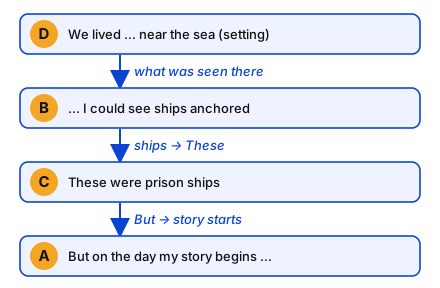
Given below are four jumbled sentences. Select the option that gives their correct order. A. But on the day when my story begins, it was a winter evening, icy-cold and misty.
B. Sometimes when the weather was clear, I could see ships anchored a little way out from the shore.
C. These were prison ships, full of convicts and their guards.
D. We lived on the edge of the marshes, near the sea.
  1. ADACB
  2. BDBCA
  3. CCABD
  4. DCADB
Show answer

Concept: Start with the sentence that sets the scene, then follow the logical and pronoun links.

  1. D introduces the setting: We lived on the edge of the marshes, near the sea.
  2. B continues with what could be seen from there – ships anchored … from the shore.
  3. C explains These ships – they were prison ships (pronoun link B → C).
  4. A begins the story with 'But on the day when my story begins …' – a turn from background to action, so it comes last.

Trick: 'These were prison ships' must come right after the sentence that mentions 'ships' – only B does that.

Answer: (B) DBCA

अवधारणा: पहले वह वाक्य लें जो पृष्ठभूमि (setting) बताता है, फिर तार्किक और pronoun के संबंध देखें।

  1. D स्थान बताता है: We lived on the edge of the marshes, near the sea.
  2. B बताता है कि वहाँ से क्या दिखता था – किनारे पर खड़े ships।
  3. C में These उन्हीं ships के लिए है – prison ships (B → C)।
  4. A 'But on the day when my story begins …' से कहानी शुरू होती है – पृष्ठभूमि के बाद, इसलिए अंत में।

ट्रिक: 'These were prison ships' उसी वाक्य के बाद आएगा जिसमें 'ships' हो – यानी B।

उत्तर: (B) DBCA

SSC CPO Paper IIEnglish Language and ComprehensionPara JumblesSSC CPO Paper II 2021 · 8 Nov Shift 1 →
Q556.
Select the correct passive form of the given sentence.
His father had already bought the train tickets.
  1. AThe train tickets had already been bought by his father.
  2. BThe train tickets have already bought his father.
  3. CThe train tickets were already bought by his father.
  4. DThe train tickets are already being bought his father.
Show answer

Concept: Past perfect active 'had + V3' becomes passive 'had been + V3' with the object as the new subject and 'by + agent'.

  1. Object the train tickets becomes the subject.
  2. had already bought → had already been bought.
  3. Add by his father.
  4. (B) has no 'been'/'by'; (C) changes to simple past; (D) changes tense and drops 'by'.

Trick: Past perfect: had + V3 → had been + V3.

Answer: (A) The train tickets had already been bought by his father.

अवधारणा: Past perfect active 'had + V3' का passive 'had been + V3' बनता है; object subject बनता है और 'by + कर्ता' लगता है।

  1. Object the train tickets subject बनेगा।
  2. had already bought → had already been bought।
  3. अंत में by his father।
  4. (B) में 'been'/'by' नहीं; (C) में simple past; (D) में tense बदला और 'by' नहीं।

ट्रिक: Past perfect: had + V3 → had been + V3।

उत्तर: (A) The train tickets had already been bought by his father.

SSC CPO Paper IIEnglish Language and ComprehensionActive and Passive VoiceSSC CPO Paper II 2021 · 8 Nov Shift 1 →
Q557.
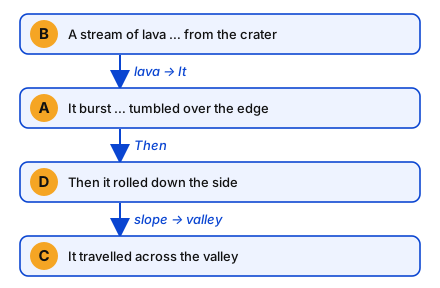
Given below are four jumbled sentences. Select the option that gives their correct order. A. It burst from the inside of the earth and tumbled over the edge.
B. A stream of lava began to rush from the crater of the volcano.
C. It travelled slowly across the valley destroying everything that came in its way.
D. Then it rolled down the side of the volcano in a heavy stream, 20 feet thick and 200 feet wide.
  1. AACDB
  2. BBADC
  3. CBCAD
  4. DABCD
Show answer

Concept: Find the sentence that introduces the noun (lava); the others use 'It' and describe its movement in time order.

  1. B introduces 'a stream of lava' from the crater – the opening sentence.
  2. A: It burst from the inside … and tumbled over the edge – first movement.
  3. D: Then it rolled down the side of the volcano – 'Then' shows the next step.
  4. C: It travelled slowly across the valley – the final stage at the bottom.

Trick: Sentences starting with 'It' cannot open a paragraph; follow the path of the lava: crater → edge → slope → valley.

Answer: (B) BADC

अवधारणा: वह वाक्य खोजें जो noun (lava) का परिचय देता है; बाकी वाक्य 'It' से उसकी गति को समय-क्रम में बताते हैं।

  1. B में 'a stream of lava' का परिचय – पहला वाक्य।
  2. A: It burst … and tumbled over the edge – पहली गति।
  3. D: Then it rolled down the side … – 'Then' अगला चरण बताता है।
  4. C: It travelled slowly across the valley – अंतिम चरण (घाटी)।

ट्रिक: 'It' से शुरू होने वाला वाक्य पहला नहीं हो सकता; lava का रास्ता देखें: crater → edge → slope → valley।

उत्तर: (B) BADC

SSC CPO Paper IIEnglish Language and ComprehensionPara JumblesSSC CPO Paper II 2021 · 8 Nov Shift 1 →
Q558.
Select the most appropriate word for the given group of words.
Branch of science that studies structure, classification and genetics of plants
  1. Ageology
  2. Bbotany
  3. Czoology
  4. Dbiology
Show answer

Concept: The science of plants (their structure, classification, genetics) is called botany.

  1. Botany – scientific study of plants.
  2. Geology – study of the earth, rocks and minerals.
  3. Zoology – study of animals; Biology – study of all living things (too broad).

Yaad rakhein: Bot-any → 'plants'; Zoo-logy → 'animals'; Geo-logy → 'earth'.

Answer: (B) botany

अवधारणा: पौधों (उनकी संरचना, वर्गीकरण, आनुवंशिकी) का विज्ञान botany (वनस्पति विज्ञान) कहलाता है।

  1. Botany – पौधों का अध्ययन।
  2. Geology – पृथ्वी, चट्टानों का अध्ययन (भूविज्ञान)।
  3. Zoology – जंतुओं का अध्ययन; Biology – सभी जीवों का अध्ययन (बहुत व्यापक)।

याद रखें: Zoo → जानवर (zoology), Geo → पृथ्वी (geology), plants → botany।

उत्तर: (B) botany

SSC CPO Paper IIEnglish Language and ComprehensionOne Word SubstitutionSSC CPO Paper II 2021 · 8 Nov Shift 1 →
Q559.
Select the correct active form of the given sentence.
A statement had already been issued to the press on the lockdown by the authorities.
  1. AThe authorities had already issued a statement to the press on the lockdown.
  2. BThe authorities have already issued a statement to the press on the lockdown.
  3. CA statement had already issued the authorities to the press on the lockdown.
  4. DThe authorities are already issuing a statement to the press on the lockdown.
Show answer

Concept: Passive 'had been + V3' (past perfect) becomes active 'had + V3'; the agent after 'by' becomes the subject.

  1. Agent the authorities becomes the subject.
  2. had been issued → had issued; 'already' stays before the main verb.
  3. Active: The authorities had already issued a statement to the press on the lockdown.
  4. (B) is present perfect, (D) present continuous, (C) makes 'statement' the doer – all wrong.

Trick: had been + V3 ↔ had + V3 – the tense word 'had' never disappears.

Answer: (A) The authorities had already issued a statement to the press on the lockdown.

अवधारणा: Passive 'had been + V3' (past perfect) का active 'had + V3' बनता है; 'by' के बाद वाला कर्ता subject बनता है।

  1. the authorities subject बनेगा।
  2. had been issued → had issued; 'already' मुख्य क्रिया से पहले।
  3. Active: The authorities had already issued a statement …
  4. (B) present perfect, (D) present continuous, (C) में statement को कर्ता बना दिया – सब गलत।

ट्रिक: had been + V3 ↔ had + V3 – 'had' बना रहता है।

उत्तर: (A) The authorities had already issued a statement to the press on the lockdown.

SSC CPO Paper IIEnglish Language and ComprehensionActive and Passive VoiceSSC CPO Paper II 2021 · 8 Nov Shift 1 →
Q560.
Select the most appropriate option to substitute the underlined segment in the given
sentence. If there is no need to substitute it, select ‘No substitution required’.
Unless she doesn’t study French carefully, she cannot get the highest marks in the class.
  1. ANo substitution required
  2. BUnless she is not studying
  3. CIf she studies
  4. DUnless she studies
Show answer

Concept: 'Unless' already means 'if … not', so it must not be followed by another negative (doesn't / not).

  1. Unless she doesn't study = a double negative → wrong.
  2. Unless she studies French carefully, she cannot get the highest marks = If she does not study, she cannot top.
  3. 'If she studies … she cannot get' (C) reverses the meaning; (B) still has 'not'.

Trick: Unless = if not → never write 'unless … not'.

Answer: (D) Unless she studies

अवधारणा: 'Unless' का अर्थ पहले से ही 'if … not' है, इसलिए इसके बाद दूसरा नकारात्मक शब्द (doesn't/not) नहीं आता।

  1. Unless she doesn't study = दोहरा नकार → गलत।
  2. Unless she studies French carefully, she cannot get the highest marks = अगर वह ध्यान से नहीं पढ़ेगी तो top नहीं कर पाएगी।
  3. (C) 'If she studies … cannot' अर्थ उलट देता है; (B) में फिर 'not' है।

ट्रिक: Unless = if not → 'unless … not' कभी न लिखें।

उत्तर: (D) Unless she studies

SSC CPO Paper IIEnglish Language and ComprehensionSentence ImprovementSSC CPO Paper II 2021 · 8 Nov Shift 1 →