Question bank

Q&A: practice questions with answers

Search questions on any topic. Filter by exam category, exam, subject and topic, try the question, then open the answer and explanation.

Courses – airGurukul

600 questions found.

Q161.
Select the most appropriate option to fill in the blanks. He looked around _____ his friend _____ the bustling crowd.
  1. Ato; between
  2. Bfor; at
  3. Cby; about
  4. Dfor; among
Show answer

Concept: 'Look around for' means to search for something; 'among' is used for a position within a group of many people or things.

  1. 'He looked around for his friend' = he searched for his friend.
  2. A crowd has many people, so 'among the bustling crowd' fits.
  3. 'between' is used for two; 'at', 'by', 'about' do not fit the sense.

Trick: between → two; among → more than two (crowd, group).

Answer: (D) for; among

अवधारणा: 'Look around for' = किसी को खोजना; 'among' = बहुत से लोगों/वस्तुओं के बीच।

  1. 'He looked around for his friend' = वह अपने मित्र को खोज रहा था।
  2. भीड़ में बहुत लोग होते हैं, अतः 'among the bustling crowd' सही।
  3. 'between' दो के लिए; 'at', 'by', 'about' अर्थ में फिट नहीं।

ट्रिक: between → दो के बीच; among → दो से अधिक के बीच।

उत्तर: (D) for; among
SSC CPO Paper IIEnglish Language and ComprehensionPrepositionsSSC CPO Paper II 2025 · 30 Apr Shift 3 →
Q162.
Select the option that can be used as a one-word substitute for the given group of words.
A fellow worker or associate in an office
  1. AColleague
  2. BConsort
  3. CContemporary
  4. DConvict
Show answer

Concept: 'Colleague' means a fellow worker or associate in an office or profession.

  1. The given phrase exactly describes 'Colleague'.
  2. Consort = a wife or husband, especially of a ruler.
  3. Contemporary = a person living at the same time.
  4. Convict = a person found guilty of a crime.

Yaad rakhein: Colleague = co-worker (col- = together).

Answer: (A) Colleague

अवधारणा: 'Colleague' का अर्थ है एक ही कार्यालय/व्यवसाय में साथ काम करने वाला (सहकर्मी)।

  1. दिया गया वाक्यांश ठीक 'Colleague' का ही वर्णन करता है।
  2. Consort = विशेषकर शासक की पत्नी/पति।
  3. Contemporary = समकालीन व्यक्ति।
  4. Convict = दोषसिद्ध अपराधी।

याद रखें: Colleague = सहकर्मी (col- = साथ)।

उत्तर: (A) Colleague

SSC CPO Paper IIEnglish Language and ComprehensionOne Word SubstitutionSSC CPO Paper II 2025 · 30 Apr Shift 3 →
Q163.
Select the option that can be used as a one-word substitute for the given group of words.
Showing careful and persistent effort or work
  1. ADiligent
  2. BCogent
  3. CIntelligent
  4. DIndulgent
Show answer

Concept: 'Diligent' means showing careful and persistent effort in work.

  1. The given phrase exactly describes 'Diligent'.
  2. Cogent = clear, logical and convincing (argument).
  3. Intelligent = having high mental ability.
  4. Indulgent = too generous or lenient.

Yaad rakhein: Diligent student = hard-working, careful student.

Answer: (A) Diligent

अवधारणा: 'Diligent' का अर्थ है सावधानी और लगन से लगातार परिश्रम करने वाला (परिश्रमी)।

  1. दिया गया वाक्यांश ठीक 'Diligent' का ही वर्णन करता है।
  2. Cogent = तर्कसंगत, विश्वसनीय (तर्क)।
  3. Intelligent = बुद्धिमान।
  4. Indulgent = अत्यधिक छूट देने वाला।

याद रखें: Diligent = मेहनती; diligence = परिश्रम।

उत्तर: (A) Diligent

SSC CPO Paper IIEnglish Language and ComprehensionOne Word SubstitutionSSC CPO Paper II 2025 · 30 Apr Shift 3 →
Q164.
Select the most appropriate option to fill in the blanks. ______ History Club of our college is organising ________ tour to Aurangabad.
  1. AThe; the
  2. BA; a
  3. CA; the
  4. DThe; a
Show answer

Concept: 'The' is used for a particular, specified thing; 'a' is used for one unspecified thing mentioned for the first time.

  1. 'History Club of our college' is a specific club → 'The History Club'.
  2. 'tour' is one unspecified tour mentioned for the first time → 'a tour'.
  3. So: 'The History Club of our college is organising a tour to Aurangabad.'

Trick: Specified by 'of ...' → the; one among many, first mention → a/an.

Answer: (D) The; a

अवधारणा: 'The' विशेष/निश्चित वस्तु के लिए; 'a' किसी अनिश्चित एक वस्तु के लिए जो पहली बार आई हो।

  1. 'History Club of our college' एक निश्चित क्लब है → 'The History Club'।
  2. 'tour' पहली बार आया, अनिश्चित → 'a tour'।
  3. अतः: 'The History Club of our college is organising a tour to Aurangabad.'

ट्रिक: 'of ...' से निश्चित → the; पहली बार/अनिश्चित → a/an।

उत्तर: (D) The; a

SSC CPO Paper IIEnglish Language and ComprehensionArticlesSSC CPO Paper II 2025 · 30 Apr Shift 3 →
Q165.
Select the most appropriate option to complete the given idiom. Actions speak louder than _______.
  1. Anoises
  2. Bpictures
  3. Cwords
  4. Dthings
Show answer

Concept: The proverb is 'Actions speak louder than words'.

  1. It means what a person does shows his real intentions more than what he says.
  2. 'words' contrasts with 'actions'; noises, pictures and things do not complete the proverb.

Yaad rakhein: Actions ↔ words: deeds matter more than promises.

Answer: (C) words

अवधारणा: सही लोकोक्ति है 'Actions speak louder than words'।

  1. अर्थ: व्यक्ति के कर्म उसकी बातों से अधिक प्रभावी होते हैं।
  2. 'actions' के विपरीत 'words' आता है; noises, pictures, things उचित नहीं।

याद रखें: कथनी से करनी बड़ी — Actions speak louder than words।

उत्तर: (C) words

SSC CPO Paper IIEnglish Language and ComprehensionIdioms and ProverbsSSC CPO Paper II 2025 · 30 Apr Shift 3 →
Q166.
Select the option that expresses the given sentence in passive voice. Bhawna cannot do anything unless someone gives her instructions.
  1. ANothing can be done unless Bhawna is given instructions.
  2. BNothing is done unless Bhawna is given instructions.
  3. CNothing has been done unless Bhawna can give instructions.
  4. DNothing is done unless Bhawna has given instructions.
Show answer

Concept: With a modal, passive = modal + be + V3. In a complex sentence each clause is changed; 'anything' with a negative becomes 'nothing' in passive.

  1. 'Bhawna cannot do anything' → 'Nothing can be done' (modal 'can' kept).
  2. 'someone gives her instructions' → 'Bhawna is given instructions' (simple present passive).
  3. Full: 'Nothing can be done unless Bhawna is given instructions.'
  4. B and D drop 'can'; C changes the meaning.

Trick: Modal stays: can + V1 → can be + V3.

Answer: (A) Nothing can be done unless Bhawna is given instructions.

अवधारणा: Modal के साथ passive = modal + be + V3। Complex sentence में दोनों clauses बदलते हैं; negative के साथ 'anything' → 'nothing'।

  1. 'Bhawna cannot do anything' → 'Nothing can be done' (modal 'can' बना रहता है)।
  2. 'someone gives her instructions' → 'Bhawna is given instructions'।
  3. पूरा: 'Nothing can be done unless Bhawna is given instructions.'
  4. B और D में 'can' गायब है; C का अर्थ बदल गया।

ट्रिक: Modal वही रहता है: can + V1 → can be + V3।

उत्तर: (A) Nothing can be done unless Bhawna is given instructions.

SSC CPO Paper IIEnglish Language and ComprehensionActive and Passive VoiceSSC CPO Paper II 2025 · 30 Apr Shift 3 →
Q167.
Select the INCORRECTLY spelt word.
  1. AMetamorphsis
  2. BMezzanine
  3. CMeteorology
  4. DMeticulous
Show answer

Concept: The correct spelling is 'Metamorphosis' (meta-mor-pho-sis) — the letter 'o' after 'ph' is missing in option A.

  1. Metamorphsis ✗ → Metamorphosis ✓ (a complete change of form).
  2. Mezzanine ✓ (a low storey between two floors).
  3. Meteorology ✓ (science of weather); Meticulous ✓ (very careful).

Trick: Break it: meta + morph + osis.

Answer: (A) Metamorphsis

अवधारणा: सही वर्तनी 'Metamorphosis' है — option A में 'ph' के बाद 'o' छूट गया है।

  1. Metamorphsis ✗ → Metamorphosis ✓ (रूपांतरण)।
  2. Mezzanine ✓ (दो मंज़िलों के बीच की छोटी मंज़िल)।
  3. Meteorology ✓ (मौसम विज्ञान); Meticulous ✓ (अत्यंत सावधान)।

ट्रिक: तोड़कर याद करें: meta + morph + osis।

उत्तर: (A) Metamorphsis

SSC CPO Paper IIEnglish Language and ComprehensionSpellingSSC CPO Paper II 2025 · 30 Apr Shift 3 →
Q168.
Select the most appropriate option to fill in the blanks. _________ silver bangle was discovered in _____ ancient temple complex where the archaeologists were carrying out excavations.
  1. ANo word required; the
  2. BA; an
  3. CThe; a
  4. DA; no word required
Show answer

Concept: 'A' is used before a consonant sound and 'an' before a vowel sound when a singular countable noun is mentioned for the first time.

  1. 'silver bangle' — one bangle, first mention, 's' is a consonant sound → 'A silver bangle'.
  2. 'ancient temple complex' — first mention, 'a' of 'ancient' is a vowel sound → 'an ancient temple complex'.
  3. So: 'A silver bangle was discovered in an ancient temple complex ...'.

Trick: Choose a/an by sound, not by spelling.

Answer: (B) A; an

अवधारणा: Singular countable noun पहली बार आए तो consonant sound से पहले 'a' और vowel sound से पहले 'an' लगता है।

  1. 'silver bangle' — एक कंगन, पहली बार, 's' consonant sound → 'A silver bangle'।
  2. 'ancient' vowel sound से शुरू → 'an ancient temple complex'।
  3. अतः: 'A silver bangle was discovered in an ancient temple complex ...'।

ट्रिक: a/an उच्चारण (sound) से तय होता है, spelling से नहीं।

उत्तर: (B) A; an

SSC CPO Paper IIEnglish Language and ComprehensionArticlesSSC CPO Paper II 2025 · 30 Apr Shift 3 →
Q169.
Select the most appropriate ANTONYM of the given word. Amiable
  1. AAesthetical
  2. BExemplary
  3. CHostile
  4. DCordial
Show answer

Concept: 'Amiable' means friendly and pleasant in manner.

  1. Its opposite is 'Hostile' = unfriendly, aggressive.
  2. 'Cordial' is a synonym (warm, friendly).
  3. 'Aesthetical' relates to beauty; 'Exemplary' means serving as a good example.

Yaad rakhein: Amiable ≈ amicable ≈ cordial; opposite → hostile.

Answer: (C) Hostile

अवधारणा: 'Amiable' का अर्थ है मिलनसार, मैत्रीपूर्ण।

  1. इसका विलोम 'Hostile' = शत्रुतापूर्ण।
  2. 'Cordial' समानार्थी है (स्नेहपूर्ण)।
  3. 'Aesthetical' = सौंदर्य से संबंधित; 'Exemplary' = अनुकरणीय।

याद रखें: Amiable ≈ amicable ≈ cordial; विलोम → hostile।

उत्तर: (C) Hostile

SSC CPO Paper IIEnglish Language and ComprehensionAntonymsSSC CPO Paper II 2025 · 30 Apr Shift 3 →
Q170.
Select the option that expresses the given sentence in direct speech. The judge asked the lawyer whether he was ready to question the witness.
  1. AThe judge said to the lawyer, “Will you be ready to question the witness?”
  2. BThe judge said to the lawyer, “Why don’t you question the witness?”
  3. CThe judge said to the lawyer, “Are you ready to question the witness?”
  4. DThe judge said to the lawyer, “Do you want to question the witness?”
Show answer

Concept: An indirect yes/no question 'asked ... whether + past tense' becomes a direct question beginning with a helping verb in the present tense.

  1. 'asked the lawyer' → 'said to the lawyer'.
  2. 'whether he was ready' → '“Are you ready ...?”' (was → are; he → you).
  3. 'to question the witness' stays unchanged.
  4. 'Will you be', 'Why don't you', 'Do you want' change the meaning.

Trick: whether/if → yes-no question; past → present in direct speech.

Answer: (C) The judge said to the lawyer, “Are you ready to question the witness?”

अवधारणा: Indirect yes/no प्रश्न 'asked ... whether + past tense' का direct रूप present tense के helping verb से शुरू होता है।

  1. 'asked the lawyer' → 'said to the lawyer'।
  2. 'whether he was ready' → '“Are you ready ...?”' (was → are; he → you)।
  3. 'to question the witness' वैसा ही रहता है।
  4. 'Will you be', 'Why don’t you', 'Do you want' अर्थ बदल देते हैं।

ट्रिक: whether/if → yes-no प्रश्न; direct में past → present।

उत्तर: (C) The judge said to the lawyer, “Are you ready to question the witness?”

SSC CPO Paper IIEnglish Language and ComprehensionDirect and Indirect SpeechSSC CPO Paper II 2025 · 30 Apr Shift 3 →
Q171.
Select the option that expresses the given sentence in active voice. The film was being watched by the family.
  1. AThe family was watching the film.
  2. BThe family has been watching the film.
  3. CThe film was watching the family.
  4. DThe family is watching the film.
Show answer

Concept: Past continuous passive 'was/were being + V3' becomes active 'was/were + V-ing'.

  1. Doer 'the family' becomes the subject.
  2. 'was being watched' → 'was watching'.
  3. Object 'the film' → 'The family was watching the film.'
  4. B and D change the tense; C reverses the roles.

Trick: being + V3 → V-ing (continuous tense).

Answer: (A) The family was watching the film.

अवधारणा: Past continuous passive 'was/were being + V3' का active 'was/were + V-ing' होता है।

  1. कर्ता 'the family' subject बनता है।
  2. 'was being watched' → 'was watching'।
  3. 'The family was watching the film.'
  4. B और D tense बदलते हैं; C में भूमिकाएँ उलट गईं।

ट्रिक: being + V3 → V-ing।

उत्तर: (A) The family was watching the film.

SSC CPO Paper IIEnglish Language and ComprehensionActive and Passive VoiceSSC CPO Paper II 2025 · 30 Apr Shift 3 →
Q172.
Parts of the following sentence have been given as options. One of them may contain an error. Select the part that contains the error from the given options. If you don’t find any error, mark ‘No error’ as your answer. We have not received some information from our coast guards yet.
  1. AWe have not received
  2. BNo error
  3. Cour coast guards yet
  4. Dsome information from
Show answer

Concept: In negative and interrogative sentences 'any' is used; 'some' is used in affirmative sentences.

  1. The sentence is negative: 'We have not received ...'.
  2. So 'some information' must be 'any information'.
  3. Correct: 'We have not received any information from our coast guards yet.'

Trick: not / never / hardly + any; affirmative + some.

Answer: (D) some information from

अवधारणा: नकारात्मक और प्रश्नवाचक वाक्यों में 'any' तथा सकारात्मक वाक्यों में 'some' प्रयोग होता है।

  1. वाक्य नकारात्मक है: 'We have not received ...'।
  2. अतः 'some information' की जगह 'any information' होगा।
  3. सही: 'We have not received any information from our coast guards yet.'

ट्रिक: not / never / hardly के साथ any; सकारात्मक में some।

उत्तर: (D) some information from

SSC CPO Paper IIEnglish Language and ComprehensionSpotting Errors – Some/AnySSC CPO Paper II 2025 · 30 Apr Shift 3 →
Q173.
Select the option that can be used as a one-word substitute for the given group of words.
Having a harmful effect, especially in a gradual or subtle way
  1. APretentious
  2. BPenurious
  3. CPerfidious
  4. DPernicious
Show answer

Concept: 'Pernicious' means having a harmful effect, especially in a gradual or subtle way.

  1. The given phrase exactly describes 'Pernicious'.
  2. Pretentious = trying to appear more important than one is.
  3. Penurious = extremely poor or mean.
  4. Perfidious = deceitful, disloyal.

Yaad rakhein: Pernicious → think 'per-nicious' ≈ 'noxious' (harmful).

Answer: (D) Pernicious

अवधारणा: 'Pernicious' का अर्थ है धीरे-धीरे या छिपे रूप से हानि पहुँचाने वाला (घातक)।

  1. दिया गया वाक्यांश ठीक 'Pernicious' का ही वर्णन करता है।
  2. Pretentious = दिखावटी।
  3. Penurious = अत्यंत गरीब/कंजूस।
  4. Perfidious = विश्वासघाती।

याद रखें: Pernicious ≈ noxious = हानिकारक।

उत्तर: (D) Pernicious

SSC CPO Paper IIEnglish Language and ComprehensionOne Word SubstitutionSSC CPO Paper II 2025 · 30 Apr Shift 3 →
Q174.
Parts of the following sentence have been given as options. Select the option that contains an error.
It will take us five and a half hours to reach Jaipur, is it?
  1. Ato reach Jaipur
  2. Bis it?
  3. Cfive and a half hours
  4. DIt will take us
Show answer

Concept: A question tag repeats the auxiliary of the main clause with the opposite polarity and the pronoun of the subject.

  1. The main clause is positive with auxiliary 'will' and subject 'It'.
  2. So the tag must be negative: 'won't it?'
  3. 'is it?' is wrong. Correct: '..., won't it?'

Trick: Positive statement → negative tag with the same auxiliary.

Answer: (B) is it?

अवधारणा: Question tag में मुख्य clause का auxiliary विपरीत रूप में और subject का pronoun आता है।

  1. मुख्य clause सकारात्मक है, auxiliary 'will', subject 'It'।
  2. अतः tag नकारात्मक होगा: 'won’t it?'
  3. 'is it?' गलत है। सही: '..., won’t it?'

ट्रिक: सकारात्मक वाक्य → नकारात्मक tag, वही auxiliary।

उत्तर: (B) is it?

SSC CPO Paper IIEnglish Language and ComprehensionSpotting Errors – Question TagSSC CPO Paper II 2025 · 30 Apr Shift 3 →
Q175.
Select the option that expresses the given sentence in direct speech. My cousin said that he was good at drawing landscapes.
  1. AMy cousin said, “I am good at drawing landscapes.”
  2. BMy cousin told, “I was good at drawing landscapes.”
  3. CMy cousin said, “I was good at drawing landscapes.”
  4. DMy cousin said, “He was good at drawing landscapes.”
Show answer

Concept: Converting to direct speech: 'said that' → 'said, “...”', past tense → present, and third-person pronoun of the speaker → 'I'.

  1. 'he was good' → '“I am good ...”' (was → am; he → I).
  2. Reporting verb 'said' remains 'said' (no object).
  3. B uses 'told' without an object; C keeps 'was'; D keeps 'He'.

Trick: In direct speech the speaker talks about himself → 'I'.

Answer: (A) My cousin said, “I am good at drawing landscapes.”

अवधारणा: Direct में बदलते समय 'said that' → 'said, “...”', past → present और वक्ता का he/she → 'I'।

  1. 'he was good' → '“I am good ...”' (was → am; he → I)।
  2. 'said' वैसा ही रहता है।
  3. B में 'told' बिना object; C में 'was'; D में 'He' — सब गलत।

ट्रिक: Direct speech में वक्ता अपने बारे में → 'I'।

उत्तर: (A) My cousin said, “I am good at drawing landscapes.”

SSC CPO Paper IIEnglish Language and ComprehensionDirect and Indirect SpeechSSC CPO Paper II 2025 · 30 Apr Shift 3 →
Q176.
Select the option that will improve the underlined part of the given sentence. In case no improvement is needed, select ‘No improvement required’. The construction of the trans-harbour link have shorten a travel time between Mumbai and Navi Mumbai.
  1. Ahas shortened the travel time
  2. Bhave shorten the traveling time
  3. Chas shorten a travel time
  4. DNo improvement required
Show answer

Concept: The verb agrees with the head noun of the subject; the present perfect needs 'has/have + V3'.

  1. Head noun 'The construction' is singular → 'has', not 'have'.
  2. After 'has' we need V3 'shortened', not 'shorten'.
  3. A specific travel time (between Mumbai and Navi Mumbai) → 'the travel time'.
  4. So: 'has shortened the travel time'.

Trick: Ignore 'of the trans-harbour link'; the subject is 'construction'.

Answer: (A) has shortened the travel time

अवधारणा: Verb subject के मुख्य noun से मेल खाती है; present perfect = has/have + V3।

  1. मुख्य noun 'The construction' एकवचन → 'has', 'have' नहीं।
  2. 'has' के बाद V3 'shortened' आएगा।
  3. विशेष travel time → 'the travel time'।
  4. अतः: 'has shortened the travel time'।

ट्रिक: 'of the trans-harbour link' को छोड़ दें; subject 'construction' है।

उत्तर: (A) has shortened the travel time

SSC CPO Paper IIEnglish Language and ComprehensionSubject–verb agreementSSC CPO Paper II 2025 · 30 Apr Shift 3 →
Q177.
Select the option that expresses the given sentence in direct speech. The MLA said that they planned to make that area a safe place to live in.
  1. AThe MLA said, “We are planning to make this area a safe place to live in.”
  2. BThe MLA said, “We plan to make this area a safe place to live in.”
  3. CThe MLA said, “They have planned to make this area a safe place to live in.”
  4. DThe MLA said, “They planned to make this area a safe place to live in.”
Show answer

Concept: Indirect → direct: simple past → simple present, 'that' (demonstrative) → 'this', and 'they' (the MLA's group) → 'we'.

  1. 'they planned' → '“We plan ...”' (past → present; they → we).
  2. 'that area' → 'this area'.
  3. A changes to continuous; C and D keep 'They' and the past tense.

Trick: V2 → V1 and that → this when going back to direct speech.

Answer: (B) The MLA said, “We plan to make this area a safe place to live in.”

अवधारणा: Indirect → direct: simple past → simple present, 'that' → 'this', और 'they' (MLA का समूह) → 'we'।

  1. 'they planned' → '“We plan ...”' (past → present; they → we)।
  2. 'that area' → 'this area'।
  3. A continuous बना देता है; C और D में 'They' और past tense बचा है।

ट्रिक: Direct में वापस: V2 → V1, that → this।

उत्तर: (B) The MLA said, “We plan to make this area a safe place to live in.”

SSC CPO Paper IIEnglish Language and ComprehensionDirect and Indirect SpeechSSC CPO Paper II 2025 · 30 Apr Shift 3 →
Q178.
Select the option that will improve the underlined part of the given sentence. In case no improvement is needed, select ‘No improvement required’. The Trans-Siberian Railway in Russia is the faster railway line in the world.
  1. Athe fast
  2. BNo improvement required
  3. Cthe fastest
  4. Da fastest
Show answer

Concept: When one thing is compared with all others ('in the world'), the superlative degree with 'the' is used.

  1. 'in the world' shows comparison with all railway lines.
  2. Comparative 'faster' needs 'than'; it does not fit here.
  3. Superlative: 'the fastest railway line in the world'. 'a fastest' is wrong — superlatives take 'the'.

Trick: in the world / of all → the + superlative.

Answer: (C) the fastest

अवधारणा: जब एक वस्तु की तुलना सभी से हो ('in the world'), तो 'the' के साथ superlative degree आती है।

  1. 'in the world' = सभी रेल लाइनों से तुलना।
  2. Comparative 'faster' के साथ 'than' चाहिए, यहाँ उचित नहीं।
  3. सही: 'the fastest railway line in the world'; 'a fastest' गलत है।

ट्रिक: in the world / of all → the + superlative।

उत्तर: (C) the fastest

SSC CPO Paper IIEnglish Language and ComprehensionDegrees of comparisonSSC CPO Paper II 2025 · 30 Apr Shift 3 →
Q179.
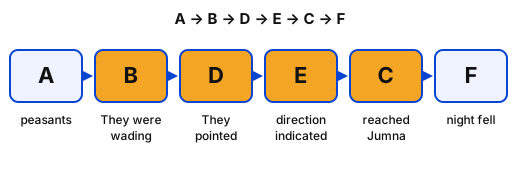
Sentences of a paragraph are given below. While the first and the last sentences (A and F) are in the correct order, the sentences in between are jumbled up. Arrange the sentences in the correct order to form a meaningful and coherent paragraph.
A. On this evening we set out before it was dark, but soon had to rue our haste, for crossing a slope, we found ourselves in the presence of a number of peasants planting rice.
B. They were wading half-naked in the muddy water and stared in astonishment at the sight of two men carrying packs on their backs. C. After hours of climbing and descending, we at last reached the river Jumna. D. They pointed to the slope high up on which one could see a village, which seemed to mean that this was the only way out of the ravine. E. To avoid awkward questions, we walked straight on, as fast as possible in the direction indicated.
F. Meanwhile, night had fallen.
  1. AECDB
  2. BCBED
  3. CBDEC
  4. DBCED
Show answer

Concept: Link pronouns to their nouns and follow the time order of events.

  1. A ends with 'peasants planting rice'; B's 'They were wading ... in the muddy water' describes those peasants → A–B.
  2. D 'They pointed to the slope ...' — the peasants show the way → B–D.
  3. E 'walked straight on ... in the direction indicated' follows the pointing → D–E.
  4. C 'After hours of climbing ... reached the river' comes next, and F 'Meanwhile, night had fallen' closes → BDEC.

Trick: Pronoun 'They' + 'direction indicated' give the chain B → D → E.

Answer: (C) BDEC

अवधारणा: सर्वनामों को उनके संज्ञा से जोड़ें और घटनाओं के समय-क्रम का पालन करें।

  1. A 'peasants planting rice' पर खत्म; B 'They were wading in the muddy water' उन्हीं किसानों का वर्णन → A–B।
  2. D 'They pointed to the slope' — किसान रास्ता दिखाते हैं → B–D।
  3. E 'in the direction indicated' इशारे के बाद → D–E।
  4. फिर C 'reached the river Jumna', और F 'Meanwhile, night had fallen' → BDEC।

ट्रिक: 'They' और 'direction indicated' से कड़ी B → D → E बनती है।

उत्तर: (C) BDEC

SSC CPO Paper IIEnglish Language and ComprehensionPara JumblesSSC CPO Paper II 2025 · 30 Apr Shift 3 →
Q180.
Select the option that can be used as a one-word substitute for the given group of words.
Present, appearing or found everywhere
  1. AOmnibus
  2. BOmnipotent
  3. COmnipresent
  4. DOmniscient
Show answer

Concept: 'Omnipresent' means present, appearing or found everywhere.

  1. The given phrase exactly describes 'Omnipresent'.
  2. Omnibus = a volume containing several works / a bus.
  3. Omnipotent = all-powerful.
  4. Omniscient = all-knowing.

Yaad rakhein: Omni = all: present → everywhere, potent → power, scient → knowledge.

Answer: (C) Omnipresent

अवधारणा: 'Omnipresent' का अर्थ है हर जगह विद्यमान (सर्वव्यापी)।

  1. दिया गया वाक्यांश ठीक 'Omnipresent' का ही वर्णन करता है।
  2. Omnibus = कई रचनाओं का संग्रह / बस।
  3. Omnipotent = सर्वशक्तिमान।
  4. Omniscient = सर्वज्ञ।

याद रखें: Omni = सब: present → सर्वव्यापी, potent → सर्वशक्तिमान, scient → सर्वज्ञ।

उत्तर: (C) Omnipresent

SSC CPO Paper IIEnglish Language and ComprehensionOne Word SubstitutionSSC CPO Paper II 2025 · 30 Apr Shift 3 →