Question bank

Q&A: practice questions with answers

Search questions on any topic. Filter by exam category, exam, subject and topic, try the question, then open the answer and explanation.

Courses – airGurukul

4,200 questions found.

Q2601.
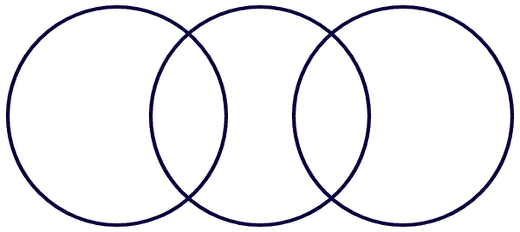
Select the Venn diagram that best illustrates the relationship between the following classes.
Males, Fathers, Females
निम्नलिखित वर्गों के बीच के संबंध को सर्वोत्तम रूप से दर्शाने वाले वेन आरेख का चयन कीजिए।
पुरुष, पिता, महिलाएँ
  1. Afigure
  2. Bfigure
  3. Cfigure
  4. Dfigure
Show answer

Concept: Check which class lies inside another and which has nothing in common with the others.
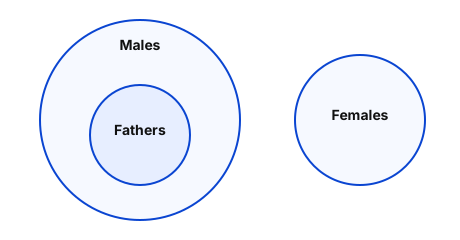
  1. Fathers ⊂ Males: every father is a male → small circle inside a big circle.
  2. Females share nothing with Males or Fathers → a separate, non-touching circle.
  3. Required shape: one circle inside another + one detached circle.

Trick: Think of each pair: 'Is every X a Y?' (inside), 'Can X be Y?' (no → apart). Two checks fix the diagram.

Answer: (A) Figure (a): Fathers inside Males, Females separate

अवधारणा: देखें कौन-सा वर्ग दूसरे के अंदर है और कौन-सा बिल्कुल अलग है।

हल:

  1. हर पिता पुरुष होता है → 'पिता' का वृत्त 'पुरुष' के वृत्त के अंदर।
  2. महिला न पुरुष है, न पिता → उसका वृत्त अलग रहेगा।
  3. अतः एक वृत्त दूसरे के भीतर और तीसरा वृत्त अलग।

ट्रिक: हर जोड़े पर पूछें – 'क्या हर X, Y है?' (अंदर) या 'क्या X कभी Y हो सकता है?' (नहीं → अलग)।

उत्तर: (A) चित्र (a): पिता, पुरुष के अंदर; महिला अलग
SSC GDGeneral Intelligence & ReasoningVenn diagram – subset and separate classSSC GD 2025 · 11 Feb Shift 1 →
Q2602.
Read the given statements and conclusions carefully. Assuming that the information given in the statements is true, even if it appears to be at variance with commonly known facts, decide which of the given conclusions logically follow(s) from the statements.
Statements:
No almond is a date.
No date is a raisin.
No date is a cherry.
Conclusions:
(I): No almond is a raisin.
(II): Some cherries are raisins.
दिए गए कथनों और निष्कर्षों को ध्यानपूर्वक पढ़िए। यह मानते हुए कि कथनों में दी गई जानकारी सत्य है, चाहे वह सर्वज्ञात तथ्यों से भिन्न प्रतीत होती हो, निर्णय कीजिए कि दिए गए निष्कर्षों में से कौन-सा/से कथनों का तार्किक रूप से अनुसरण करता है/करते हैं।
कथन:
कोई भी बादाम खजूर नहीं है।
कोई भी खजूर किशमिश नहीं है।
कोई भी खजूर चेरी नहीं है।
निष्कर्ष:
(I): कोई भी बादाम किशमिश नहीं है।
(II): कुछ चेरी किशमिश हैं।
  1. AOnly conclusion (I) follows.केवल निष्कर्ष (I) अनुसरण करता है।
  2. BNeither conclusion (I) nor (II) follows.न तो निष्कर्ष (I) और न ही (II) अनुसरण करता है।
  3. CBoth conclusions (I) and (II) follow.निष्कर्ष (I) और (II) दोनों अनुसरण करते हैं।
  4. DOnly conclusion (II) follows.केवल निष्कर्ष (II) अनुसरण करता है।
Show answer

Concept: From only negative ('No') statements, no definite relation between two other classes can be drawn.

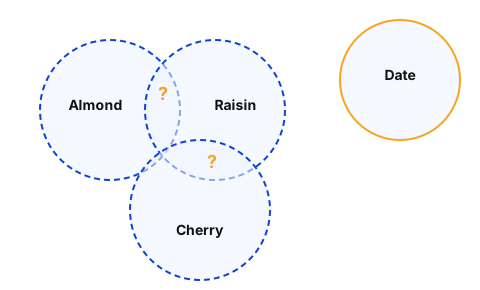
  1. Dates are kept away from almonds, raisins and cherries – but almonds, raisins and cherries are never linked to each other.
  2. (I) 'No almond is a raisin' – almonds and raisins may or may not overlap → not certain.
  3. (II) 'Some cherries are raisins' – again only a possibility → not certain.

Trick: Two negative premises → no conclusion. If every statement starts with 'No', definite conclusions about other pairs fail.

Answer: (B) Neither conclusion (I) nor (II) follows.

अवधारणा: केवल 'कोई नहीं' वाले कथनों से दो अन्य वर्गों के बीच कोई निश्चित संबंध नहीं निकलता।

हल:

  1. खजूर (date) को बादाम, किशमिश और चेरी से अलग बताया गया है, पर इन तीनों का आपस में कोई संबंध नहीं दिया।
  2. (I) 'कोई बादाम किशमिश नहीं' – दोनों मिल भी सकते हैं, इसलिए निश्चित नहीं।
  3. (II) 'कुछ चेरी किशमिश हैं' – यह भी केवल संभावना है, निश्चित नहीं।

ट्रिक: दो नकारात्मक कथन → कोई निष्कर्ष नहीं। सभी कथन 'कोई नहीं' वाले हों तो बाकी जोड़ों पर निश्चित निष्कर्ष नहीं बनता।

उत्तर: (B) न तो निष्कर्ष (I) और न ही (II) अनुसरण करता है।

SSC GDGeneral Intelligence & ReasoningSyllogism – all negative statementsSSC GD 2025 · 11 Feb Shift 1 →
Q2603.
What will come in place of the question mark '(?)' in the following equation, if '÷' and '×' are interchanged and '+' and '−' are interchanged?
27 − 6 ÷ 4 + 24 × 3 = ?
निम्नलिखित समीकरण में प्रश्न-चिह्न '(?)' के स्थान पर क्या आएगा, यदि '÷' और '×' को आपस में बदल दिया जाए तथा '+' और '−' को आपस में बदल दिया जाए?
27 − 6 ÷ 4 + 24 × 3 = ?
  1. A46
  2. B44
  3. C45
  4. D43
Show answer

Concept: Swap the signs as told, then solve using BODMAS (÷, × before +, −).

  1. After swapping: 27+6×4−24÷3
  2. 6×4=24; 24÷3=8
  3. 27+24−8=43

Trick: Rewrite the full expression first on paper; most errors come from swapping only one pair of signs.

Answer: (D) 43

अवधारणा: बताए अनुसार चिह्न बदलें, फिर BODMAS से हल करें (पहले ÷, ×, फिर +, −)।

हल:

  1. चिह्न बदलने पर: 27+6×4−24÷3
  2. 6×4=24 और 24÷3=8
  3. 27+24−8=43

ट्रिक: पहले पूरा नया व्यंजक लिख लें – गलती अक्सर एक जोड़ी चिह्न बदलना भूलने से होती है।

उत्तर: (D) 43

SSC GDGeneral Intelligence & ReasoningSign interchange – BODMASSSC GD 2025 · 11 Feb Shift 1 →
Q2604.
In a certain code language, 'we like trees' is coded as 'bv mn fd' and 'trees like water' is coded as 'bv cx fd'. How is 'we' coded in the given language ?
एक निश्चित कूट भाषा में, 'we like trees' को 'bv mn fd' लिखा जाता है और 'trees like water' को 'bv cx fd' लिखा जाता है। इस कूट भाषा में 'we' को किस प्रकार लिखा जाएगा?
  1. Abv
  2. Bcx
  3. Cmn
  4. Dfd
Show answer

Concept: A word repeated in two sentences gets the code repeated in both codes.

  1. Common words: 'like', 'trees'; common codes: bv, fd.
  2. In 'we like trees' → 'bv mn fd', the leftover word is 'we' and the leftover code is mn.
  3. So we = mn.

Trick: Strike out common words and common codes; the single leftover pair is your answer.

Answer: (C) mn

अवधारणा: दो वाक्यों में दोहराए गए शब्द का कोड भी दोनों कोड में दोहराया जाता है।

हल:

  1. उभयनिष्ठ शब्द: like, trees; उभयनिष्ठ कोड: bv, fd
  2. 'we like trees' में बचा शब्द 'we' और बचा कोड 'mn' है।
  3. अतः we = mn

ट्रिक: समान शब्द और समान कोड काट दें – जो अकेला जोड़ा बचे वही उत्तर।

उत्तर: (C) mn

SSC GDGeneral Intelligence & ReasoningCoding-decoding – common word methodSSC GD 2025 · 11 Feb Shift 1 →
Q2605.
What should come in place of (?) in the given series based on the English alphabetical order ?
OAS, QCU, SEW, UGY, ?
अंग्रेज़ी वर्णमाला क्रम पर आधारित दी गई शृंखला में (?) के स्थान पर क्या आना चाहिए?
OAS, QCU, SEW, UGY, ?
  1. AWHB
  2. BWIA
  3. CVJB
  4. DVHZ
Show answer

Concept: Each position of the 3-letter group moves forward by a fixed step.

  1. 1st letters: O → Q → S → U → W (+2)
  2. 2nd letters: A → C → E → G → I (+2)
  3. 3rd letters: S → U → W → Y → A (+2, wrapping after Z)

Trick: After Z count again from A: Y + 2 = A (25 + 2 = 27 → 27 − 26 = 1).

Answer: (B) WIA

अवधारणा: तीन अक्षरों के समूह का हर स्थान एक निश्चित अंतर से आगे बढ़ता है।

हल:

  1. पहला अक्षर: O → Q → S → U → W (+2)
  2. दूसरा अक्षर: A → C → E → G → I (+2)
  3. तीसरा अक्षर: S → U → W → Y → A (+2, Z के बाद फिर A)

ट्रिक: 26 से बड़ा आए तो 26 घटाएँ: Y(25) + 2 = 27 → 1 = A।

उत्तर: (B) WIA

SSC GDGeneral Intelligence & ReasoningLetter series – +2 patternSSC GD 2025 · 11 Feb Shift 1 →
Q2606.
What should come in place of the question mark (?) in the given series?
195, 175, 150, 120, 85, ?
दी गई शृंखला में प्रश्न-चिह्न (?) के स्थान पर क्या आना चाहिए?
195, 175, 150, 120, 85, ?
  1. A45
  2. B30
  3. C36
  4. D40
Show answer

Concept: The amount subtracted grows by a constant value each time.

  1. Successive drops: 20, 25, 30, 35.
  2. Gap rises by 5, so next gap = −40.
  3. 85 − 40 = 45

Trick: When a series falls faster and faster, check differences of differences – here a constant 5.

Answer: (A) 45

अवधारणा: हर बार घटाई जाने वाली संख्या एक समान मात्रा से बढ़ रही है।

हल:

  1. अंतर: −20, −25, −30, −35
  2. अंतर 5-5 बढ़ रहा है, अगला अंतर −40
  3. 85 − 40 = 45

ट्रिक: श्रृंखला तेजी से घटे तो 'अंतर का अंतर' देखें – यहाँ स्थिर 5 है।

उत्तर: (A) 45

SSC GDGeneral Intelligence & ReasoningNumber series – increasing differencesSSC GD 2025 · 11 Feb Shift 1 →
Q2607.
Each letter in the word HARMFUL is arranged in the English alphabetical order. How many letters are there in the English alphabetical order between the letter which is third from the left end and the one which is third from the right end in the new letter-cluster thus formed ?
शब्द HARMFUL के प्रत्येक अक्षर को अंग्रेज़ी वर्णमाला क्रम में व्यवस्थित किया जाता है। इस प्रकार बने नए अक्षर-समूह में बाएँ छोर से तीसरे अक्षर और दाएँ छोर से तीसरे अक्षर के बीच अंग्रेज़ी वर्णमाला क्रम में कितने अक्षर आते हैं?
  1. A4
  2. B5
  3. C7
  4. D3
Show answer

Concept: Rearrange the word alphabetically, pick the asked positions, count letters between them.

  1. HARMFUL in order: A F H L M R U
  2. 3rd from left = H, 3rd from right = M
  3. Between H (8) and M (13): I, J, K, L → 13 − 8 − 1 = 4

Trick: Letters between two letters = difference of positions − 1.

Answer: (A) 4

अवधारणा: शब्द को वर्णक्रम में लगाएँ, माँगे गए स्थान चुनें और बीच के अक्षर गिनें।

हल:

  1. HARMFUL वर्णक्रम में: A F H L M R U
  2. बाएँ से तीसरा = H, दाएँ से तीसरा = M
  3. H(8) और M(13) के बीच: 13 − 8 − 1 = 4 (I, J, K, L)

ट्रिक: दो अक्षरों के बीच अक्षर = स्थानों का अंतर − 1।

उत्तर: (A) 4

SSC GDGeneral Intelligence & ReasoningLetter arrangement – letters betweenSSC GD 2025 · 11 Feb Shift 1 →
Q2608.
Select the combination of letters that when sequentially placed in the blanks of the given series will complete the series.
E _ _ M X E G L _ _ _ G L M _ E _ _ M X
उस अक्षर-संयोजन का चयन कीजिए, जिसे दी गई शृंखला के रिक्त स्थानों में क्रमानुसार रखने पर शृंखला पूर्ण हो जाएगी।
E _ _ M X E G L _ _ _ G L M _ E _ _ M X
  1. AGLMXEXGL
  2. BGMLXEXGL
  3. CGLMXEGXL
  4. DMGLXEXGL
Show answer

Concept: Total length 20 → look for a 5-letter block repeated 4 times.

  1. The block is EGLMX.
  2. Write it 4 times: EGLMX EGLMX EGLMX EGLMX.
  3. Fill blanks in order: G, L, M, X, E, X, G, L

Trick: Divide total letters by a small number (4, 5, 6) to guess block length, then test with given letters.

Answer: (A) GLMXEXGL

अवधारणा: कुल 20 अक्षर → 5 अक्षरों का एक खंड 4 बार दोहराया गया है।

हल:

  1. खंड है: EGLMX
  2. चार बार लिखें: EGLMX EGLMX EGLMX EGLMX
  3. रिक्त स्थान क्रम से: G, L, M, X, E, X, G, L

ट्रिक: कुल अक्षरों को 4, 5, 6 से भाग देकर खंड की लंबाई अनुमानित करें, फिर जाँचें।

उत्तर: (A) GLMXEXGL

SSC GDGeneral Intelligence & ReasoningLetter series – repeating blockSSC GD 2025 · 11 Feb Shift 1 →
Q2609.
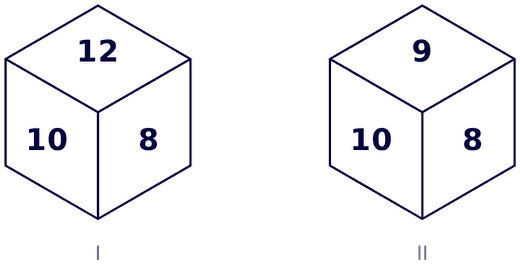
Two different positions of the same dice are given below. Which is the number on the face opposite to the face containing 12?
figure
नीचे एक ही पासे की दो अलग-अलग स्थितियाँ दी गई हैं। 12 अंक वाले फलक के विपरीत फलक पर कौन-सी संख्या है?
figure
  1. A11
  2. B9
  3. C8
  4. D7
Show answer

Concept: If two faces are common in both positions (same places), the remaining faces are opposite each other.

  1. Common faces in both views: 10 and 8.
  2. Remaining top faces: 12 (view I) and 9 (view II).
  3. So 12 is opposite 9.

Trick: Two common faces in the same position → the third faces are opposite. 10-second check.

Answer: (B) 9

अवधारणा: दोनों स्थितियों में दो फलक समान (और उसी जगह) हों तो बचे हुए फलक आमने-सामने होते हैं।

हल:

  1. दोनों चित्रों में 10 और 8 समान हैं।
  2. बचे फलक: पहले में 12, दूसरे में 9
  3. अतः 12 के विपरीत 9 है।

ट्रिक: दो समान फलक एक ही स्थान पर → तीसरे फलक एक-दूसरे के विपरीत।

उत्तर: (B) 9

SSC GDGeneral Intelligence & ReasoningDice – two common facesSSC GD 2025 · 11 Feb Shift 1 →
Q2610.
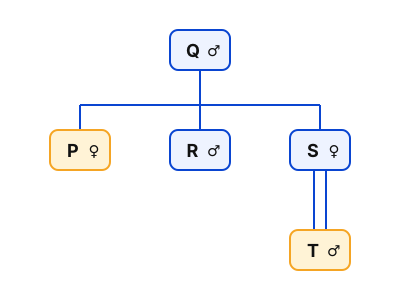
In a certain code language, 'A + B' means 'A is the daughter of B', 'A − B' means 'A is the brother of B', 'A × B' means 'A is the wife of B' and 'A ÷ B' means 'A is the father of B'. Based on the above, how is P related to T if 'P + Q ÷ R − S × T'?
एक निश्चित कूट भाषा में, 'A + B' का अर्थ है 'A, B की पुत्री है', 'A − B' का अर्थ है 'A, B का भाई है', 'A × B' का अर्थ है 'A, B की पत्नी है' तथा 'A ÷ B' का अर्थ है 'A, B का पिता है'। उपर्युक्त के आधार पर, यदि 'P + Q ÷ R − S × T' है, तो P का T से क्या संबंध है?
  1. AWife's sisterपत्नी की बहन
  2. BSisterबहन
  3. CWife's motherपत्नी की माता
  4. DMotherमाता
Show answer

Concept: Decode each symbol and build the family chain step by step.

  1. P + Q: P is Q's daughter.
  2. Q ÷ R: Q is R's father; R − S: R is S's brother → P and S are both Q's daughters (sisters).
  3. S × T: S is T's wife → P is the sister of T's wife.

Trick: Mark gender (+ male, − female) while decoding; the final link usually decides between 'sister' and 'wife's sister'.

Answer: (A) Wife's sister

अवधारणा: हर चिह्न का अर्थ लगाकर परिवार की कड़ी बनाएँ।

हल:

  1. P + Q: P, Q की बेटी है।
  2. Q ÷ R: Q, R का पिता; R − S: R, S का भाई → P और S दोनों Q की बेटियाँ (बहनें)।
  3. S × T: S, T की पत्नी → P, T की पत्नी की बहन (साली) है।

ट्रिक: डिकोड करते समय लिंग (पुरुष/स्त्री) लिखते चलें; आखिरी कड़ी से उत्तर तय होता है।

उत्तर: (A) पत्नी की बहन

SSC GDGeneral Intelligence & ReasoningCoded blood relationsSSC GD 2025 · 11 Feb Shift 1 →
Q2611.
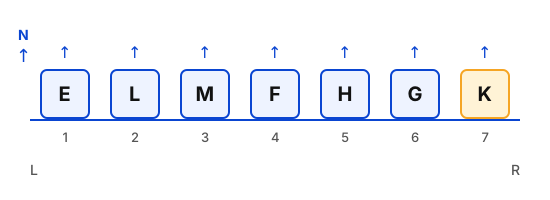
Seven people, E, F, G, H, K, L and M are sitting in a row, facing north (but not necessarily in the same order) .No one sits to the left of E. Only four people sit between E and G. Only three people sit to the right of F. L sits to the immediate left of M. K is not an immediate neighbour of F. Who sits at the rightmost end of the line?
सात व्यक्ति E, F, G, H, K, L और M एक पंक्ति में उत्तर की ओर मुख करके बैठे हैं (आवश्यक नहीं कि इसी क्रम में)। E के बाईं ओर कोई नहीं बैठा है। E और G के बीच केवल चार व्यक्ति बैठे हैं। F के दाईं ओर केवल तीन व्यक्ति बैठे हैं। L, M के ठीक बाईं ओर बैठा है। K, F का निकटतम पड़ोसी नहीं है। पंक्ति के सबसे दाएँ छोर पर कौन बैठा है?
  1. AM
  2. BG
  3. CK
  4. DE
Show answer

Concept: Fix definite positions first (ends, exact counts), then place the rest.

  1. E at seat 1 (no one to its left); G at seat 6 (four between).
  2. Three to the right of F → F at seat 4.
  3. L–M together → seats 2, 3. K not next to F → K at seat 7, H at seat 5.
  4. Order: E L M F H G K → rightmost is K.

Trick: Number seats 1–7 left to right and convert every clue into a seat number.

Answer: (C) K

अवधारणा: पहले निश्चित स्थान (किनारा, सटीक गिनती) तय करें, फिर बाकी लोग बैठाएँ।

हल:

  1. E के बाएँ कोई नहीं → E स्थान 1; E और G के बीच चार → G स्थान 6
  2. F के दाएँ तीन → F स्थान 4
  3. L, M के ठीक बाएँ → L-M स्थान 2, 3; K, F का पड़ोसी नहीं → K स्थान 7, H स्थान 5
  4. स्थान 1 से 7: E, L, M, F, H, G, K → सबसे दाएँ K बैठा है

ट्रिक: स्थानों को 1 से 7 तक नंबर दें और हर शर्त को नंबर में बदलें।

उत्तर: (C) K

SSC GDGeneral Intelligence & ReasoningLinear seating – row facing northSSC GD 2025 · 11 Feb Shift 1 →
Q2612.
NAVI is related to QCYK in a certain way based on the English alphabetical order. In the same way, ZIHQ is related to CKKS. To which of the given options is IOQW related, following the same logic?
अंग्रेज़ी वर्णमाला क्रम के आधार पर NAVI, QCYK से एक निश्चित प्रकार से संबंधित है। उसी प्रकार, ZIHQ, CKKS से संबंधित है। इसी तर्क का अनुसरण करते हुए, IOQW दिए गए विकल्पों में से किससे संबंधित है?
  1. ALTYQ
  2. BLOIU
  3. CLQTY
  4. DLQYT
Show answer

Concept: Find the shift for each letter position and apply it to the new word.

  1. NAVI → QCYK: +3, +2, +3, +2 (ZIHQ → CKKS confirms).
  2. IOQW with the same +3/+2 steps gives L, Q, T, Y in turn.
  3. Result: LQTY

Trick: Once the first two letters give L and Q, only (c) and (d) remain; the 3rd letter T decides.

Answer: (C) LQTY

अवधारणा: हर स्थान के अक्षर का अंतर निकालें और नए शब्द पर लगाएँ।

हल:

  1. NAVI → QCYK: +3, +2, +3, +2 (ZIHQ → CKKS भी यही)
  2. IOQW पर वही +3/+2 लगाने से क्रमशः L, Q, T, Y मिलते हैं
  3. उत्तर: LQTY

ट्रिक: पहले दो अक्षर L, Q से विकल्प (c), (d) बचते हैं; तीसरा अक्षर T से तय।

उत्तर: (C) LQTY

SSC GDGeneral Intelligence & ReasoningLetter analogy – alternate +3, +2SSC GD 2025 · 11 Feb Shift 1 →
Q2613.
Select the figure from among the given options that can replace the question mark (?) in the following series.
figure
दिए गए विकल्पों में से उस आकृति का चयन कीजिए, जो निम्नलिखित शृंखला में प्रश्न-चिह्न (?) के स्थान पर आ सकती है।
figure
  1. Afigure
  2. Bfigure
  3. Cfigure
  4. Dfigure
Show answer

Concept: The series alternates between two designs.

  1. Figures 1 and 3 are the same; figures 2 and 4 are the same (dot shifted to the bottom-left).
  2. Figure 5 is an odd position → it must match figures 1 and 3.
  3. Only option (c) has that design.

Trick: In figure series always compare 1st with 3rd and 2nd with 4th – alternate repetition is very common.

Answer: (C) Figure (c)

अवधारणा: श्रृंखला में दो डिज़ाइन बारी-बारी से आते हैं।

हल:

  1. चित्र 1 और 3 समान हैं; चित्र 2 और 4 समान हैं (बिंदु नीचे-बाएँ)।
  2. पाँचवाँ स्थान विषम है → चित्र 1 और 3 जैसा होगा।
  3. केवल विकल्प (c) में वही डिज़ाइन है।

ट्रिक: आकृति श्रृंखला में पहले 1-3 और 2-4 की तुलना करें – एकांतर दोहराव बहुत आम है।

उत्तर: (C) चित्र (c)

SSC GDGeneral Intelligence & ReasoningFigure series – alternating designSSC GD 2025 · 11 Feb Shift 1 →
Q2614.
Based on the English alphabetical order, three of the following four letter-clusters are alike in a certain way and thus form a group. Which letter-cluster DOES NOT belong to that group?
(Note: The odd man out is not based on the number of consonants/vowels or their position in the letter-cluster.)
अंग्रेज़ी वर्णमाला क्रम के आधार पर, निम्नलिखित चार अक्षर-समूहों में से तीन एक निश्चित प्रकार से समान हैं और इस प्रकार एक समूह बनाते हैं। कौन-सा अक्षर-समूह उस समूह से संबंधित नहीं है?
(नोट: विषम अक्षर-समूह का चयन स्वर/व्यंजन की संख्या अथवा अक्षर-समूह में उनके स्थान के आधार पर नहीं करना है।)
  1. AHEI
  2. BQNR
  3. CDBE
  4. DGDH
Show answer

Concept: Convert letters to positions and compare the internal steps.

  1. HEI = 8, 5, 9 → −3, +4
  2. QNR = 17, 14, 18 → −3, +4; GDH = 7, 4, 8 → −3, +4
  3. DBE = 4, 2, 5 → −2, +3 → odd one.

Trick: Another quick view: 3rd letter is always 1st letter + 1 (H→I, Q→R, G→H, D→E); then the middle letter decides.

Answer: (C) DBE

अवधारणा: अक्षरों को स्थान संख्या में बदलें और अंतर की तुलना करें।

हल:

  1. HEI = 8, 5, 9 → −3, +4
  2. QNR और GDH में भी −3, +4
  3. DBE = 4, 2, 5 → −2, +3 → अलग

ट्रिक: तीसरा अक्षर हमेशा पहले +1 है; इसलिए बीच वाला अक्षर देखकर तुरंत अलग वाला पकड़ें।

उत्तर: (C) DBE

SSC GDGeneral Intelligence & ReasoningOdd one out – letter gapsSSC GD 2025 · 11 Feb Shift 1 →
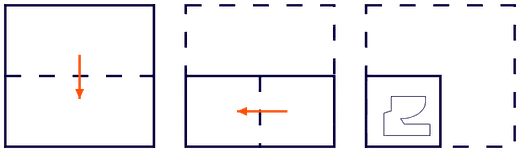
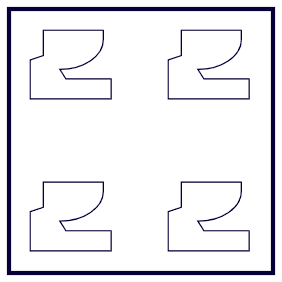
Q2615.
A paper is folded and punched as shown below. How will it appear when unfolded?
figure
नीचे दर्शाए अनुसार एक कागज़ को मोड़कर उसमें छेद किया जाता है। खोलने पर वह कैसा दिखाई देगा?
figure
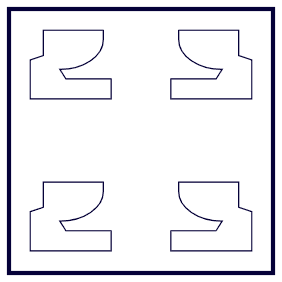
  1. Afigure
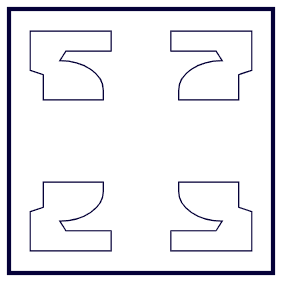
  2. Bfigure
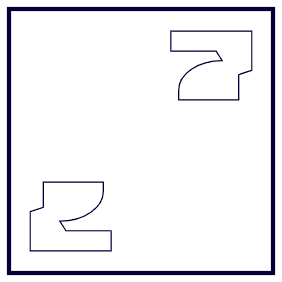
  3. Cfigure
  4. Dfigure
Show answer

Concept: Unfold step by step; each opening creates a mirror image of the holes across the fold line.

  1. Two folds → 4 layers → the punch gives 4 holes.
  2. Open the second (vertical) fold: hole mirrored left ↔ right.
  3. Open the first (horizontal) fold: both holes mirrored top ↔ bottom → option (b).

Trick: Count first: holes = punches × 2number of folds; eliminate options with the wrong count, then check mirror symmetry.

Answer: (B) Figure (b)

अवधारणा: उल्टे क्रम में खोलें; हर बार मोड़ की रेखा पर छेद का दर्पण प्रतिबिंब बनता है।

हल:

  1. दो मोड़ → 4 परतें → कुल 4 छेद
  2. पहले खड़ा मोड़ खोलें: छेद बाएँ-दाएँ प्रतिबिंबित
  3. फिर आड़ा मोड़ खोलें: दोनों छेद ऊपर-नीचे प्रतिबिंबित → विकल्प (b)

ट्रिक: पहले छेदों की संख्या गिनें = छेद × 2मोड़ों की संख्या; गलत संख्या वाले विकल्प हटाएँ।

उत्तर: (B) चित्र (b)

SSC GDGeneral Intelligence & ReasoningPaper folding and punchingSSC GD 2025 · 11 Feb Shift 1 →
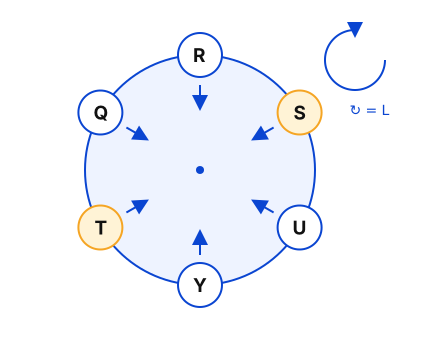
Q2616.
Six people, Q, R, S, T, U and Y, are sitting around a circular table facing the centre (but not necessarily in the same order). Only one person sits between Q and Y when counted from the left of Y. Y sits third to the left of R. U sits to the immediate right of Y. S is not an immediate neighbour of Y. How many people sit between S and T when counted from the right of S?
छह व्यक्ति Q, R, S, T, U और Y एक वृत्ताकार मेज़ के चारों ओर केंद्र की ओर मुख करके बैठे हैं (आवश्यक नहीं कि इसी क्रम में)। Y के बाईं ओर से गिनने पर Q और Y के बीच केवल एक व्यक्ति बैठा है। Y, R के बाईं ओर तीसरे स्थान पर बैठा है। U, Y के ठीक दाईं ओर बैठा है। S, Y का निकटतम पड़ोसी नहीं है। S के दाईं ओर से गिनने पर S और T के बीच कितने व्यक्ति बैठे हैं?
  1. ATwoदो
  2. BThreeतीन
  3. COneएक
  4. DFourचार
Show answer

Concept: Facing the centre: left = clockwise, right = anticlockwise.

  1. Seat Y; U immediately anticlockwise of Y.
  2. R three places clockwise of Y; Q two places clockwise of Y.
  3. Empty seats: next to Y (clockwise) and between R and U. S not next to Y → S between R and U; T next to Y.
  4. From S going right (anticlockwise): R, Q, then T → two people between.

Trick: Draw 6 dots, fix one person, and turn every 'left/right' into clockwise/anticlockwise before placing.

Answer: (A) Two

अवधारणा: केंद्र की ओर मुख हो तो बायाँ = दक्षिणावर्त, दायाँ = वामावर्त।

हल:

  1. Y को रखें; U, Y के ठीक दाएँ (वामावर्त)
  2. R, Y से तीन स्थान बाएँ; Q, Y से दो स्थान बाएँ
  3. S, Y का पड़ोसी नहीं → S, R और U के बीच; T, Y के बगल में
  4. S के दाएँ से गिनें: R, Q, फिर T → बीच में दो व्यक्ति

ट्रिक: 6 बिंदु बनाकर एक व्यक्ति स्थिर करें, फिर हर बायाँ/दायाँ को दिशा में बदलें।

उत्तर: (A) दो

SSC GDGeneral Intelligence & ReasoningCircular seating – facing centreSSC GD 2025 · 11 Feb Shift 1 →
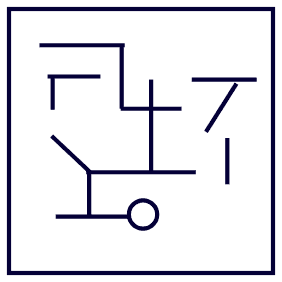
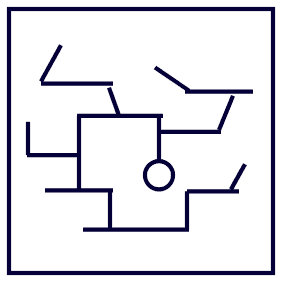
Q2617.
Select the option figure in which the given figure is embedded as its part (rotation is NOT allowed).
figure
उस विकल्प आकृति का चयन कीजिए, जिसमें दी गई आकृति उसके एक भाग के रूप में सन्निहित है (घूर्णन की अनुमति नहीं है)।
figure
  1. Afigure
  2. Bfigure
  3. Cfigure
  4. Dfigure
Show answer

Concept: Look for the exact figure – same size, same direction – hidden inside an option.

  1. Key parts: a vertical line, a right-then-up slanting branch from its middle, and a base line ending in a small circle.
  2. Options (a), (b), (c) have the circle but not the full joined shape in this orientation.
  3. Option (d) contains all three parts exactly.

Trick: Pick the most unusual part (here the slanting branch) and scan options for it first – fastest elimination.

Answer: (D) Figure (d)

अवधारणा: दी गई आकृति हूबहू (उसी दिशा में) किस विकल्प में छिपी है, देखें।

हल:

  1. मुख्य भाग: खड़ी रेखा, बीच से दाएँ-ऊपर तिरछी शाखा, और नीचे की रेखा जिसके सिरे पर छोटा वृत्त
  2. (a), (b), (c) में वृत्त है, पर पूरी जुड़ी आकृति इसी दिशा में नहीं
  3. (d) में तीनों भाग ठीक वैसे ही हैं

ट्रिक: सबसे अलग भाग (तिरछी शाखा) पहले खोजें – जल्दी विकल्प कटते हैं।

उत्तर: (D) चित्र (d)

SSC GDGeneral Intelligence & ReasoningEmbedded figureSSC GD 2025 · 11 Feb Shift 1 →
Q2618.
EWHO is related to HZKR in a certain way based on the English alphabetical order. In the same way, OPQM is related to RSTP. To which of the given options is LTOG related, following the same logic?
अंग्रेज़ी वर्णमाला क्रम के आधार पर EWHO, HZKR से एक निश्चित प्रकार से संबंधित है। उसी प्रकार, OPQM, RSTP से संबंधित है। इसी तर्क का अनुसरण करते हुए, LTOG दिए गए विकल्पों में से किससे संबंधित है?
  1. AOWRJ
  2. BOQRD
  3. CIQLD
  4. DIWLJ
Show answer

Concept: Every letter moves forward by the same number.

  1. E→H, W→Z, H→K, O→R: each +3 (OPQM → RSTP also +3).
  2. LTOG: L→O, T→W, O→R, G→J
  3. Result: OWRJ

Trick: First letter L+3 = O leaves (a) and (b); second letter T+3 = W picks (a).

Answer: (A) OWRJ

अवधारणा: हर अक्षर समान संख्या से आगे बढ़ता है।

हल:

  1. E→H, W→Z, H→K, O→R: सभी +3 (OPQM → RSTP भी)
  2. LTOG: L→O, T→W, O→R, G→J
  3. उत्तर: OWRJ

ट्रिक: पहला अक्षर O से (a), (b) बचे; दूसरा अक्षर W से (a) तय।

उत्तर: (A) OWRJ

SSC GDGeneral Intelligence & ReasoningLetter analogy – uniform +3SSC GD 2025 · 11 Feb Shift 1 →
Q2619.
What should come in place of the question mark (?) in the given series?
901, 888, 902, 887, 903, 886, 904, ?
दी गई शृंखला में प्रश्न-चिह्न (?) के स्थान पर क्या आना चाहिए?
901, 888, 902, 887, 903, 886, 904, ?
  1. A885
  2. B884
  3. C886
  4. D905
Show answer

Concept: Two series are mixed: odd places and even places follow separate rules.

  1. Odd places: 901, 902, 903, 904 (+1 each).
  2. Even places: 888, 887, 886 (−1 each).
  3. 8th term is in the even series: 886 − 1 = 885

Trick: Numbers jumping up and down around a value usually mean two interleaved series.

Answer: (A) 885

अवधारणा: दो श्रृंखलाएँ मिली हैं – विषम और सम स्थानों के अलग नियम हैं।

हल:

  1. विषम स्थान: 901, 902, 903, 904 (+1)
  2. सम स्थान: 888, 887, 886 (−1)
  3. 8वाँ पद सम श्रृंखला में: 886 − 1 = 885

ट्रिक: संख्याएँ ऊपर-नीचे कूदें तो दो मिली-जुली श्रृंखलाएँ देखें।

उत्तर: (A) 885

SSC GDGeneral Intelligence & ReasoningAlternate number seriesSSC GD 2025 · 11 Feb Shift 1 →
Q2620.
In a certain code language 'XEKP' is coded as '6-25-19-14' and 'UBHW' is coded as '9-28-22-7'. What is the code for 'QCJR' in the given language ?
एक निश्चित कूट भाषा में 'XEKP' को '6-25-19-14' लिखा जाता है और 'UBHW' को '9-28-22-7' लिखा जाता है। इस कूट भाषा में 'QCJR' का कूट क्या होगा?
  1. A12-25-19-11
  2. B14-28-22-10
  3. C13-27-20-12
  4. D10-23-19-9
Show answer

Concept: Each letter's code = 30 − its alphabet position.

  1. X (24) + 6 = 30, E (5) + 25 = 30 → code = 30 − position (UBHW fits too).
  2. Q is 17 → 13; C is 3 → 27
  3. J is 10 → 20; R is 18 → 12 → code 13-27-20-12

Trick: Add a letter's position to its code; if every sum is the same (30), use subtraction directly.

Answer: (C) 13-27-20-12

अवधारणा: हर अक्षर का कोड = 30 − उसका स्थान मान।

हल:

  1. X(24) + 6 = 30, E(5) + 25 = 30 → कोड = 30 − स्थान (UBHW पर भी सही)
  2. Q का स्थान 17 → 13; C का 3 → 27
  3. J का 10 → 20; R का 18 → 12 → कोड 13-27-20-12

ट्रिक: अक्षर का स्थान + कोड जोड़कर देखें; योग हर बार समान हो तो सीधा घटाएँ।

उत्तर: (C) 13-27-20-12

SSC GDGeneral Intelligence & ReasoningCoding – letter value from 30SSC GD 2025 · 11 Feb Shift 1 →