Question bank

Q&A: practice questions with answers

Search questions on any topic. Filter by exam category, exam, subject and topic, try the question, then open the answer and explanation.

Courses – airGurukul

4,200 questions found.

Q2641.
The price (per litre) of petrol increases by 85%. By what percent should its consumption be reduced such that the expenditure on it increases by 11% only ?
पेट्रोल की कीमत (प्रति लीटर) में 85% की वृद्धि हो जाती है। इस पर होने वाला व्यय केवल 11% बढ़े, इसके लिए इसकी खपत में कितने प्रतिशत की कमी की जानी चाहिए?
  1. A46%
  2. B60%
  3. C40%
  4. D53%
Show answer

Concept: Expenditure=Price×Consumption, so new consumption=new expenditure÷new price.

  1. Price factor: 185100; required expenditure factor: 111100.
  2. Consumption factor = 111185=35=0.6
  3. Consumption falls from 1 to 0.6 → reduction = 40%.

Trick: Spot that 111=37×3 and 185=37×5 → ratio 3 : 5 at once, so cut = 25=40%.

Answer: (C) 40%

अवधारणा: व्यय=मूल्य×खपत, इसलिए नई खपत=नया व्यय÷नया मूल्य।

हल:

  1. मूल्य गुणक 185100, व्यय गुणक 111100
  2. खपत गुणक = 111185=35
  3. खपत 5 से 3 हुई → कमी = 25=40%

ट्रिक: 111=37×3 और 185=37×5 – अनुपात 3 : 5 तुरंत, कमी 40%।

उत्तर: (C) 40%
SSC GDElementary MathematicsPrice–consumption – expenditure changeSSC GD 2025 · 11 Feb Shift 1 →
Q2642.
The LCM of 30, 13, 180 and 234 is:
30, 13, 180 और 234 का लघुत्तम समापवर्त्य (LCM) है:
  1. A2409
  2. B2340
  3. C2379
  4. D2291
Show answer

Concept: LCM = product of the highest power of every prime present.

  1. 180=22×32×5 already covers 30.
  2. 234=2×32×13 also covers 13; it adds only the prime 13.
  3. LCM=180×13=2340

Trick: Drop numbers that divide another (30 | 180, 13 | 234); then LCM(180,234)=180×234÷HCF 18=2340.

Answer: (B) 2340

अवधारणा: LCM = हर अभाज्य संख्या की सबसे बड़ी घात का गुणनफल।

हल:

  1. 180=22×32×5 में 30 शामिल है
  2. 234=2×32×13 में 13 शामिल; नया अभाज्य केवल 13
  3. LCM=180×13=2340

ट्रिक: जो संख्या दूसरी को विभाजित करे उसे हटा दें (30, 13); फिर केवल 180 और 234 का LCM लें।

उत्तर: (B) 2340

SSC GDElementary MathematicsLCM by prime factorisationSSC GD 2025 · 11 Feb Shift 1 →
Q2643.
Gopal invests a sum of ₹5400 and Akshay invests a sum of ₹10200 at the same rate of simple interest per annum. If, at the end of 4 years, Akshay gets ₹720 more interest than Gopal, then find the rate of interest per annum (in percentage).
गोपाल ₹5400 की राशि निवेश करता है और अक्षय ₹10200 की राशि समान वार्षिक साधारण ब्याज दर पर निवेश करता है। यदि 4 वर्ष के अंत में अक्षय को गोपाल की तुलना में ₹720 अधिक ब्याज मिलता है, तो वार्षिक ब्याज दर (प्रतिशत में) ज्ञात कीजिए।
  1. A3.75
  2. B5.75
  3. C2.75
  4. D1.75
Show answer

Concept: With equal rate and time, the interest difference comes only from the principal difference.

  1. Principal difference = ₹10200 − ₹5400 = ₹4800
  2. SI on ₹4800 for 4 years = ₹720 → 4800×4×R100=720
  3. 192R=720 → R=3.75%

Trick: Interest per year on the extra money = 720÷4= ₹180; rate = 1804800×100=3.75%.

Answer: (A) 3.75

अवधारणा: दर और समय समान हों तो ब्याज का अंतर केवल मूलधन के अंतर से आता है।

हल:

  1. मूलधन का अंतर = ₹4800
  2. ₹4800 पर 4 वर्ष का SI = ₹720 → 192R=720
  3. R=3.75%

ट्रिक: एक वर्ष का अतिरिक्त ब्याज = 720÷4= ₹180; दर = 1804800×100=3.75%।

उत्तर: (A) 3.75

SSC GDElementary MathematicsSimple interest – rate from interest differenceSSC GD 2025 · 11 Feb Shift 1 →
Q2644.
When difference between compound and simple interest for three years is ₹93 at 10% interest per annum, the principal is ₹ ______.
जब 10% वार्षिक ब्याज दर पर तीन वर्षों के चक्रवृद्धि ब्याज और साधारण ब्याज का अंतर ₹93 है, तो मूलधन ₹ ______ है।
  1. A3000
  2. B2425
  3. C3420
  4. D4200
Show answer

Concept: For 3 years: CI−SI=P×(R100)2×(3+R100).

  1. R=10%→(110)2×(3+0.1)=0.031
  2. P×0.031=93
  3. P=93÷0.031= ₹3000

Trick: At 10%, 3-year difference = 3.1% of P; for 2 years it is 1% of P – memorise both.

Answer: (A) 3000

अवधारणा: 3 वर्ष के लिए: CI−SI=P×(R100)2×(3+R100)।

हल:

  1. R=10%→(110)2×3.1=0.031
  2. P×0.031=93
  3. P = ₹3000

ट्रिक: 10% पर 3 वर्ष का अंतर = P का 3.1%, 2 वर्ष का = P का 1%।

उत्तर: (A) 3000

SSC GDElementary MathematicsCI – SI difference for 3 yearsSSC GD 2025 · 11 Feb Shift 1 →
Q2645.
A man goes to Chennai from Hyderabad at a speed of 56 km/hr and returns to Hyderabad at a speed of 72 km/hr, through the same route. What is his average speed (in km/hr) of the entire journey?
एक व्यक्ति हैदराबाद से चेन्नई 56 km/hr की चाल से जाता है और उसी मार्ग से 72 km/hr की चाल से हैदराबाद लौटता है। संपूर्ण यात्रा की उसकी औसत चाल (km/hr में) क्या है?
  1. A60
  2. B62
  3. C61
  4. D63
Show answer

Concept: For equal distances at speeds x and y, average speed = 2xyx+y.

  1. 2×56×72=8064
  2. 56+72=128
  3. 8064÷128=63 km/h

Trick: Average speed is always a bit below the simple average (64 here) – only 63 fits.

Answer: (D) 63

अवधारणा: समान दूरी, चाल x और y → औसत चाल = 2xyx+y।

हल:

  1. 2×56×72=8064
  2. 56+72=128
  3. 8064÷128=63 km/h

ट्रिक: औसत चाल साधारण औसत (64) से थोड़ी कम होती है – केवल 63 बैठता है।

उत्तर: (D) 63

SSC GDElementary MathematicsAverage speed – equal distancesSSC GD 2025 · 11 Feb Shift 1 →
Q2646.
The LCM of 75, 45, 180 and 110 is:
75, 45, 180 और 110 का लघुत्तम समापवर्त्य (LCM) है:
  1. A9817
  2. B9856
  3. C9946
  4. D9900
Show answer

Concept: Take each prime at its highest power across all numbers.

  1. Highest powers: 22 (from 180), 32 (45, 180), 52 (75), 11 (110).
  2. 4×9=36; 36×25=900
  3. 900×11=9900

Trick: LCM must be divisible by 11 and 25 → it ends in 00 or 25/50/75; only 9900 qualifies.

Answer: (D) 9900

अवधारणा: सभी संख्याओं में हर अभाज्य की सबसे बड़ी घात लें।

हल:

  1. सबसे बड़ी घातें: 22, 32, 52, 11
  2. 4×9×25=900
  3. 900×11=9900

ट्रिक: LCM, 25 और 11 दोनों से विभाज्य होना चाहिए – विकल्पों में केवल 9900।

उत्तर: (D) 9900

SSC GDElementary MathematicsLCM of four numbersSSC GD 2025 · 11 Feb Shift 1 →
Q2647.
A person travels by a motorcycle to a place at an average speed of 60 km/h and returns at an average speed of 30 km/h. Find his average speed (in km/h) for the whole journey.
एक व्यक्ति मोटरसाइकिल से किसी स्थान तक 60 km/h की औसत चाल से जाता है और 30 km/h की औसत चाल से लौटता है। संपूर्ण यात्रा के लिए उसकी औसत चाल (km/h में) ज्ञात कीजिए।
  1. A40
  2. B55
  3. C45
  4. D50
Show answer

Concept: Same distance both ways → average speed = 2xyx+y.

  1. 2×60×30=3600
  2. 60+30=90
  3. 3600÷90=40 km/h

Trick: Ratio method: speeds 2 : 1 → times 1 : 2; take distance 60 → total 120 km in 1+2=3 h → 40 km/h.

Answer: (A) 40

अवधारणा: दोनों ओर समान दूरी → औसत चाल = 2xyx+y।

हल:

  1. 2×60×30=3600
  2. 60+30=90
  3. 3600÷90=40 km/h

ट्रिक: दूरी 60 km मानें: जाने में 1 घंटा, आने में 2 घंटे → 120÷3=40।

उत्तर: (A) 40

SSC GDElementary MathematicsAverage speed – to and froSSC GD 2025 · 11 Feb Shift 1 →
Q2648.
A shopkeeper marks a table at 40% above the cost price and gives a discount of 25%. If he still makes a profit of ₹450, what is the cost price (in ₹) of the table ?
एक दुकानदार एक मेज़ का अंकित मूल्य क्रय मूल्य से 40% अधिक रखता है और 25% की छूट देता है। यदि उसे फिर भी ₹450 का लाभ होता है, तो मेज़ का क्रय मूल्य (₹ में) क्या है?
  1. A8,500
  2. B8,000
  3. C9,500
  4. D9,000
Show answer

Concept: Net effect of +40% mark-up and −25% discount gives the profit %.

  1. Net % = 40−25−40×25100=+5%
  2. 5% of CP = ₹450
  3. CP = 450×20= ₹9000

Trick: Successive % formula a+b+ab100 (use b=−25) gives profit % in one line.

Answer: (D) 9,000

अवधारणा: +40% अंकन और −25% छूट का कुल प्रभाव = लाभ %।

हल:

  1. कुल % = 40−25−10=+5%
  2. CP का 5% = ₹450
  3. CP = 450×20= ₹9000

ट्रिक: क्रमिक प्रतिशत सूत्र a+b+ab100 (b=−25) से एक पंक्ति में लाभ%।

उत्तर: (D) 9,000

SSC GDElementary MathematicsMarked price, discount and profitSSC GD 2025 · 11 Feb Shift 1 →
Q2649.
The cost of painting a spherical vessel of radius 7 cm is ₹ 18,480 . What is the cost of painting per square centimetre ? (Use π=227 )
7 cm त्रिज्या वाले एक गोलाकार बर्तन को रंगने की लागत ₹18,480 है। प्रति वर्ग सेंटीमीटर रंगने की लागत क्या है? ($π=\frac{22}{7}$ का प्रयोग कीजिए)
  1. A₹33
  2. B₹32
  3. C₹30
  4. D₹31
Show answer

Concept: Painting covers the surface: area of sphere = 4πr2.

  1. Area=4×227×49=88×7=616cm2
  2. Rate = ₹18480÷616
  3. = ₹30 per cm²

Trick: With r=7 and π=227, 4πr2=616 – a value worth remembering.

Answer: (C) ₹30

अवधारणा: रंगाई पूरी सतह पर होती है: गोले का क्षेत्रफल = 4πr2।

हल:

  1. क्षेत्रफल=4×227×49=616cm2
  2. दर = 18480÷616
  3. = ₹30 प्रति cm²

ट्रिक: r=7 पर 4πr2=616 – यह मान याद रखें।

उत्तर: (C) ₹30

SSC GDElementary MathematicsSphere – surface area and costSSC GD 2025 · 11 Feb Shift 1 →
Q2650.
LCM and HCF of two numbers are 144 and 8 respectively. If one of the numbers is 16 , then find the other number.
दो संख्याओं के लघुत्तम समापवर्त्य (LCM) और महत्तम समापवर्तक (HCF) क्रमशः 144 और 8 हैं। यदि उनमें से एक संख्या 16 है, तो दूसरी संख्या ज्ञात कीजिए।
  1. A73
  2. B74
  3. C72
  4. D70
Show answer

Concept: For two numbers: first×second=HCF×LCM.

  1. 16×other=8×144=1152
  2. Other = 1152÷16=72
  3. Check: HCF(16,72)=8 ✓

Trick: Other number = LCM × HCF ÷ given = 144×(816)=144÷2=72 – mental.

Answer: (C) 72

अवधारणा: दो संख्याओं के लिए: पहली×दूसरी=HCF×LCM।

हल:

  1. 16×दूसरी=8×144=1152
  2. दूसरी = 1152÷16=72
  3. जाँच: HCF(16,72)=8 ✓

ट्रिक: 144×8÷16=144÷2=72 – मन में।

उत्तर: (C) 72

SSC GDElementary MathematicsHCF × LCM = productSSC GD 2025 · 11 Feb Shift 1 →
Q2651.
Determine the number that must be subtracted from both terms of the ratio 43 : 91 to make the ratio 3 : 7 .
वह संख्या ज्ञात कीजिए जिसे अनुपात 43 : 91 के दोनों पदों में से घटाने पर अनुपात 3 : 7 हो जाए।
  1. A4
  2. B6
  3. C7
  4. D5
Show answer

Concept: Set a−xb−x equal to the new ratio and solve.

  1. (43−x):(91−x)=3:7
  2. Difference of terms stays 48 = 4 parts → 1 part = 12
  3. 3 parts = 36 → x=43−36=7

Trick: Subtracting the same number keeps the difference fixed: match the difference (48) with the ratio difference (4).

Answer: (C) 7

अवधारणा: a−xb−x को नए अनुपात के बराबर रखें।

हल:

  1. (43−x):(91−x)=3:7
  2. दोनों पदों का अंतर 48 ही रहता है = 4 भाग → 1 भाग = 12
  3. 3 भाग = 36 → x=43−36=7

ट्रिक: समान संख्या घटाने पर अंतर नहीं बदलता – अंतर 48 को 7−3=4 भागों से मिलाएँ।

उत्तर: (C) 7

SSC GDElementary MathematicsRatio – subtracting a numberSSC GD 2025 · 11 Feb Shift 1 →
Q2652.
Ashok has ₹1612 with him. He divided it amongst his sons Raj and Varun and asked them to invest it at 8% rate of interest compounded annually. It was seen that Raj and Varun got same amount after 14 and 15 years respectively. How much (in ₹) did Ashok give to Raj ?
अशोक के पास ₹1612 हैं। उसने इसे अपने पुत्रों राज और वरुण में बाँट दिया और उनसे कहा कि वे इसे 8% वार्षिक चक्रवृद्धि ब्याज दर पर निवेश करें। यह देखा गया कि राज और वरुण को क्रमशः 14 और 15 वर्ष बाद समान राशि प्राप्त हुई। अशोक ने राज को कितनी राशि (₹ में) दी?
  1. A687
  2. B837
  3. C775
  4. D875
Show answer

Concept: Equal amounts after n and n+1 years → shares are in the ratio (1+r100):1.

  1. 8% → growth factor 2725.
  2. Raj (14 yrs) : Varun (15 yrs) = 27 : 25
  3. 1612÷52=31 → Raj = 27×31= ₹837

Trick: The person whose money grows for fewer years must get the bigger share – rule out answers below half (₹806).

Answer: (B) 837

अवधारणा: n और n+1 वर्ष बाद समान राशि → हिस्सों का अनुपात (1+r100):1।

हल:

  1. 8% → गुणक 2725
  2. राज (14 वर्ष) : वरुण (15 वर्ष) = 27 : 25
  3. 1612÷52=31 → राज = 27×31= ₹837

ट्रिक: कम वर्ष वाले को बड़ा हिस्सा मिलता है – आधे (₹806) से कम वाले विकल्प हटाएँ।

उत्तर: (B) 837

SSC GDElementary MathematicsCompound interest – dividing a sumSSC GD 2025 · 11 Feb Shift 1 →
Q2653.
Find the fourth proportional of 5√24, 3√10 and 3√15.
5√24, 3√10 और 3√15 का चतुर्थानुपाती ज्ञात कीजिए।
  1. A4.5
  2. B3
  3. C3.5
  4. D4
Show answer

Concept: Fourth proportional of a, b, c = b×ca.

  1. 24=26, so a=106.
  2. b×c=9×150=9×56=456
  3. d=456÷106=4.5

Trick: Simplify all surds to the same root (6) first; they cancel and only plain numbers remain.

Answer: (A) 4.5

अवधारणा: a, b, c का चतुर्थानुपाती = b×ca।

हल:

  1. 24=26 → a=106
  2. b×c=9150=456
  3. d=456÷106=4.5

ट्रिक: सभी करणियों को एक ही मूल (6) में बदलें – वे कट जाती हैं।

उत्तर: (A) 4.5

SSC GDElementary MathematicsFourth proportional with surdsSSC GD 2025 · 11 Feb Shift 1 →
Q2654.
The average age of 22 students of a class is 47 years. If the age of the teacher is also included, the average age of the whole group becomes 48 years. The age (in years) of the teacher is:
एक कक्षा के 22 विद्यार्थियों की औसत आयु 47 वर्ष है। यदि शिक्षक की आयु भी सम्मिलित कर ली जाए, तो पूरे समूह की औसत आयु 48 वर्ष हो जाती है। शिक्षक की आयु (वर्षों में) है:
  1. A71
  2. B67
  3. C70
  4. D69
Show answer

Concept: New member's value=new average+(old count×rise in average).

  1. Average rises by 1 year when the teacher joins.
  2. Teacher gives 1 year extra to each of 22 students = 22 years.
  3. Teacher = 48+22=70 years

Trick: Avoid big totals: new value=new avg+n×change. Check: 23×48−22×47=70.

Answer: (C) 70

अवधारणा: नए सदस्य का मान=नया औसत+(पुरानी संख्या×औसत में वृद्धि)।

हल:

  1. शिक्षक के आने से औसत 1 वर्ष बढ़ा
  2. 22 छात्रों को 1-1 वर्ष = 22 वर्ष अतिरिक्त
  3. शिक्षक = 48+22=70 वर्ष

ट्रिक: बड़े योग से बचें: नया मान=नया औसत+n×बदलाव।

उत्तर: (C) 70

SSC GDElementary MathematicsAverage – including a new memberSSC GD 2025 · 11 Feb Shift 1 →
Q2655.
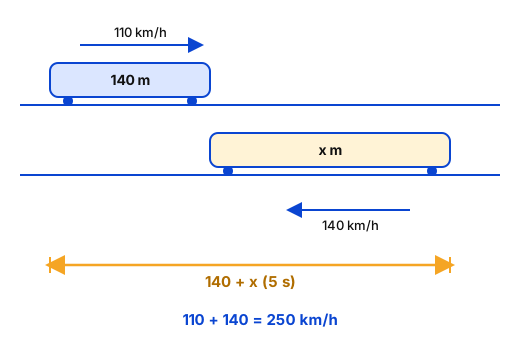
Two trains are moving in opposite directions at speeds of 110 km/h and 140 km/h. The length of one train is 140 m. The time taken by them to cross each other is 5 seconds.
The length (in m) of the other train, correct to 2 decimal places, is:
दो रेलगाड़ियाँ विपरीत दिशाओं में क्रमशः 110 km/h और 140 km/h की चाल से चल रही हैं। एक रेलगाड़ी की लंबाई 140 m है। उन्हें एक-दूसरे को पार करने में लगा समय 5 सेकंड है।
दूसरी रेलगाड़ी की लंबाई (m में), 2 दशमलव स्थानों तक सही, है:
  1. A208.21
  2. B209.67
  3. C205.65
  4. D207.22
Show answer

Concept: Opposite directions → add speeds; distance covered = sum of lengths.

  1. Relative speed = 250 km/h, i.e. 6259 m/s.
  2. Combined length covered in 5 s ≈ 347.22 m.
  3. Removing the known 140 m leaves 207.22 m for the second train.

Trick: Options differ only in decimals – the '.22' from ÷9 (29=0.22) points straight to 207.22.

Answer: (D) 207.22

अवधारणा: विपरीत दिशा → चालें जोड़ें; तय दूरी = दोनों लंबाइयों का योग।

हल:

  1. सापेक्ष चाल = 250 km/h = 6259 m/s
  2. 5 सेकंड में: 31259≈347.22 m
  3. दूसरी ट्रेन = 347.22−140=207.22 m

ट्रिक: ÷9 से दशमलव .22 आता है – इसी से 207.22 तुरंत पहचानें।

उत्तर: (D) 207.22

SSC GDElementary MathematicsTrains – crossing in opposite directionsSSC GD 2025 · 11 Feb Shift 1 →
Q2656.
The product of two numbers is 1,48,176 and their LCM is 3,528. What is their HCF ?
दो संख्याओं का गुणनफल 1,48,176 है और उनका लघुत्तम समापवर्त्य (LCM) 3,528 है। उनका महत्तम समापवर्तक (HCF) क्या है?
  1. A42
  2. B51
  3. C32
  4. D36
Show answer

Concept: Product of two numbers=HCF×LCM.

  1. HCF=148176÷3528
  2. 3528×40=141120; remainder 7056=3528×2
  3. HCF = 42

Trick: HCF must divide LCM: 3528=42×84, while 51, 32, 36 fail on quick checks.

Answer: (A) 42

अवधारणा: दो संख्याओं का गुणनफल=HCF×LCM।

हल:

  1. HCF=148176÷3528
  2. 3528×40=141120; बाकी 7056=3528×2
  3. HCF = 42

ट्रिक: HCF हमेशा LCM को विभाजित करता है: 3528=42×84।

उत्तर: (A) 42

SSC GDElementary MathematicsHCF from product and LCMSSC GD 2025 · 11 Feb Shift 1 →
Q2657.
The value of an ornament depreciates every year by 5%. If the present value of the ornament is ₹12,500, what will be its value after 2 years ?
एक आभूषण का मूल्य प्रत्येक वर्ष 5% कम हो जाता है। यदि आभूषण का वर्तमान मूल्य ₹12,500 है, तो 2 वर्ष बाद उसका मूल्य क्या होगा?
  1. A₹11,315.50
  2. B₹11,250
  3. C₹11,325
  4. D₹11,281.25
Show answer

Concept: Value after n years = P×(1−R100)n.

  1. After year 1: 12500−5%(625)=11875
  2. After year 2: 11875−5%(593.75)
  3. = ₹11,281.25

Trick: Two successive −5% = −9.75% net; 9.75% of 12500 = 1218.75 → 12500−1218.75=11281.25.

Answer: (D) ₹11,281.25

अवधारणा: n वर्ष बाद मूल्य = P×(1−R100)n।

हल:

  1. पहले वर्ष बाद: 12500−625=11875
  2. दूसरे वर्ष बाद: 11875−593.75
  3. = ₹11,281.25

ट्रिक: दो बार −5% = कुल −9.75%; 12500 का 9.75% = 1218.75 घटाएँ।

उत्तर: (D) ₹11,281.25

SSC GDElementary MathematicsDepreciation – compoundSSC GD 2025 · 11 Feb Shift 1 →
Q2658.
By selling an article for ₹4,824, a man gains 20%. What will be his profit percentage (rounded off to the nearest integer) if he sells it for ₹6,000 ?
एक वस्तु को ₹4,824 में बेचने पर एक व्यक्ति को 20% का लाभ होता है। यदि वह उसे ₹6,000 में बेचे, तो उसका लाभ प्रतिशत (निकटतम पूर्णांक तक पूर्णांकित) क्या होगा?
  1. A49%
  2. B53%
  3. C40%
  4. D32%
Show answer

Concept: Find CP from the first sale, then use it for the second.

  1. CP = 4824÷1.2= ₹4020
  2. New profit = 6000−4020= ₹1980
  3. Profit % = 19804020×100≈49.25%≈49%

Trick: 1980 is just under half of 4020 → answer just under 50% → 49%.

Answer: (A) 49%

अवधारणा: पहली बिक्री से CP निकालें, फिर दूसरी पर लगाएँ।

हल:

  1. CP = 4824÷1.2= ₹4020
  2. नया लाभ = ₹1980
  3. लाभ % = 19804020×100≈49%

ट्रिक: 1980, 4020 के आधे से थोड़ा कम → उत्तर 50% से थोड़ा कम।

उत्तर: (A) 49%

SSC GDElementary MathematicsProfit % – new selling priceSSC GD 2025 · 11 Feb Shift 1 →
Q2659.
Kanchan sold 153 chairs and had a gain equal to the selling price of 78 chairs. What is his profit percentage?
कंचन ने 153 कुर्सियाँ बेचीं और उसे 78 कुर्सियों के विक्रय मूल्य के बराबर लाभ हुआ। उसका लाभ प्रतिशत क्या है?
  1. A104%
  2. B114%
  3. C109%
  4. D99%
Show answer

Concept: If gain on n articles = SP of m articles, then CP of n = SP of (n − m).

  1. CP of 153 chairs = SP of 153−78=75 chairs
  2. Profit = SP of 78 chairs on cost of 75 chairs' SP
  3. Profit % = 7875×100=104%

Trick: Profit % = mn−m×100 – one step.

Answer: (A) 104%

अवधारणा: n वस्तुओं पर लाभ = m वस्तुओं का SP हो तो n का CP = (n − m) का SP।

हल:

  1. 153 का CP = 75 कुर्सियों का SP
  2. लाभ = 78 कुर्सियों का SP
  3. लाभ % = 7875×100=104%

ट्रिक: लाभ % = mn−m×100 – एक ही चरण।

उत्तर: (A) 104%

SSC GDElementary MathematicsProfit as SP of some articlesSSC GD 2025 · 11 Feb Shift 1 →
Q2660.
Ram, Ravi and Reena can do a piece of work in 16, 20 and 24 days, respectively. They began the work together but Ravi left the work 5 days before the completion of the work. In how much time did they finish the work together ?
राम, रवि और रीना किसी कार्य को क्रमशः 16, 20 और 24 दिनों में कर सकते हैं। उन्होंने कार्य एक साथ आरंभ किया, परंतु रवि ने कार्य पूरा होने से 5 दिन पहले कार्य छोड़ दिया। उन्होंने मिलकर कार्य को कितने समय में समाप्त किया?
  1. A10534 days$10\frac{5}{34}$ दिन
  2. B11637 days$11\frac{6}{37}$ दिन
  3. C8437 days$8\frac{4}{37}$ दिन
  4. D12548 days$12\frac{5}{48}$ दिन
Show answer

Concept: Take total work = LCM of days; the one who leaves works (T − 5) days.

  1. Work = 240 units; per day: Ram 15, Ravi 12, Reena 10.
  2. Pretend Ravi stays: extra work = 12×5=60 → 240+60=300
  3. All three together do 37/day → T = 30037=8437 days

Trick: Add the leaver's missing work to the total, then divide by everyone's combined rate.

Answer: (C) 8437 days

अवधारणा: कुल कार्य = दिनों का LCM; छोड़ने वाला (T − 5) दिन काम करता है।

हल:

  1. कार्य = 240 इकाई; प्रतिदिन: राम 15, रवि 12, रीना 10
  2. मान लें रवि अंत तक रहा: 12×5=60 अतिरिक्त → 300
  3. तीनों मिलकर 37 प्रतिदिन → T = 30037=8437 दिन

ट्रिक: छोड़ने वाले का बचा काम कुल में जोड़ें, फिर सबकी संयुक्त दर से भाग दें।

उत्तर: (C) $8\frac{4}{37}$ दिन

SSC GDElementary MathematicsTime and work – one person leaves earlySSC GD 2025 · 11 Feb Shift 1 →