Question bank

Q&A: practice questions with answers

Search questions on any topic. Filter by exam category, exam, subject and topic, try the question, then open the answer and explanation.

Courses – airGurukul

4,200 questions found.

Q2701.
ERHT is related to BLEN in a certain way based on the English alphabetical order. In the same way, XSNR is related to UMKL. To which of the given options is DIOQ related, following the same logic?
अंग्रेजी वर्णमाला क्रम के आधार पर ERHT एक निश्चित प्रकार से BLEN से संबंधित है। उसी प्रकार, XSNR, UMKL से संबंधित है। उसी तर्क का अनुसरण करते हुए, DIOQ दिए गए विकल्पों में से किससे संबंधित है?
  1. AVHMY
  2. BGHPR
  3. CHBGP
  4. DACLK
Show answer

Concept: Each letter of the first word is moved back by a fixed pattern of places.

  1. ERHT → BLEN: E−3=B, R−6=L, H−3=E, T−6=N. Pattern: −3, −6, −3, −6.
  2. The pair XSNR → UMKL obeys the same rule ✔.
  3. DIOQ → D(4)−3=A(1), I(9)−6=C(3), O(15)−3=L(12), Q(17)−6=K(11).

Trick: Find only the first letter: D−3 = A. Only option (D) starts with A.

Answer: (D) ACLK

अवधारणा: पहले शब्द के हर अक्षर को एक तय क्रम में पीछे खिसकाया गया है।

  1. ERHT → BLEN: E−3=B, R−6=L, H−3=E, T−6=N; यानी −3, −6, −3, −6.
  2. जाँच: XSNR → U, M, K, L = UMKL ✔.
  3. DIOQ → D−3=A, I−6=C, O−3=L, Q−6=K.

ट्रिक: सिर्फ पहला अक्षर निकालें: D−3 = A; A से शुरू होने वाला एक ही विकल्प (D) है।

उत्तर: (D) ACLK
SSC GDGeneral Intelligence & ReasoningLetter analogy – alternate shiftsSSC GD 2025 · 10 Feb Shift 3 →
Q2702.
Each letter in the word KNIFERS is arranged in the English alphabetical order. How many letters are there in the English alphabetical order between the letter which is second from the left end and the one which is third from the right end in the new letter-cluster thus formed?
शब्द KNIFERS के प्रत्येक अक्षर को अंग्रेजी वर्णमाला क्रम में व्यवस्थित किया जाता है। इस प्रकार बने नए अक्षर-समूह में बाएँ छोर से दूसरे अक्षर तथा दाएँ छोर से तीसरे अक्षर के बीच अंग्रेजी वर्णमाला क्रम में कितने अक्षर हैं?
  1. A7
  2. B6
  3. C8
  4. D10
Show answer

Concept: Sort the letters A→Z, pick the two positions, then count the alphabet letters strictly between them.

  1. KNIFERS in order: E F I K N R S.
  2. 2nd from left = F (6); 3rd from right = N (14).
  3. Letters between = 14 − 6 − 1 = 7 (G up to M).

Trick: Letters strictly between two letters = difference of positions − 1.

Answer: (A) 7

अवधारणा: अक्षरों को A→Z क्रम में लगाकर दो स्थान चुनें, फिर वर्णमाला में उनके बीच के अक्षर गिनें।

  1. क्रम: E F I K N R S.
  2. बाएँ से दूसरा = F (6), दाएँ से तीसरा = N (14).
  3. बीच के अक्षर = 14 − 6 − 1 = 7.

ट्रिक: दो अक्षरों के बीच के अक्षर = स्थानों का अंतर − 1.

उत्तर: (A) 7

SSC GDGeneral Intelligence & ReasoningLetter arrangement – letters betweenSSC GD 2025 · 10 Feb Shift 3 →
Q2703.
What will come in the place of the question mark (?) in the following equation, if '+' and '÷' are interchanged and '-' and '×' are interchanged? 9 - 4 × 58 + 2 ÷ 22 = ?
निम्नलिखित समीकरण में प्रश्नवाचक चिह्न (?) के स्थान पर क्या आएगा, यदि '+' और '÷' को आपस में बदल दिया जाए तथा '-' और '×' को आपस में बदल दिया जाए? 9 - 4 × 58 + 2 ÷ 22 = ?
  1. A29
  2. B32
  3. C25
  4. D35
Show answer

Concept: Swap the signs first, then solve with BODMAS.

  1. Swap: +↔÷ and −↔×.
  2. 9−4×58+2÷22 becomes 9×4−58÷2+22.
  3. =36−29+22=29.

Trick: Rewrite the whole expression once with new signs before calculating — most mistakes come from swapping in your head.

Answer: (A) 29

अवधारणा: पहले चिह्न बदलें, फिर BODMAS से हल करें।

  1. +↔÷ और −↔×.
  2. नया व्यंजक: 9×4−58÷2+22.
  3. =36−29+22=29.

ट्रिक: चिह्न बदलकर पूरा व्यंजक दोबारा लिख लें, फिर गणना करें — गलती नहीं होगी।

उत्तर: (A) 29

SSC GDGeneral Intelligence & ReasoningSign interchange – BODMASSSC GD 2025 · 10 Feb Shift 3 →
Q2704.
What should come in place of the question mark (?) in the given series based on the English alphabetical order ? RFG THI VJK XLM ?
अंग्रेजी वर्णमाला क्रम पर आधारित दी गई शृंखला में प्रश्नवाचक चिह्न (?) के स्थान पर क्या आना चाहिए? RFG THI VJK XLM ?
  1. AZNP
  2. BYNO
  3. CZMO
  4. DZNO
Show answer

Concept: Treat 1st, 2nd and 3rd letters of each group as three separate series.

  1. 1st letters: R, T, V, X → +2 → Z.
  2. 2nd letters: F, H, J, L → +2 → N.
  3. 3rd letters: G, I, K, M → +2 → O. Next group = ZNO.

Trick: In every group the last two letters are consecutive (FG, HI…). So after N must come O — only ZNO fits.

Answer: (D) ZNO

अवधारणा: हर समूह के पहले, दूसरे, तीसरे अक्षर को अलग-अलग श्रृंखला मानें।

  1. पहले अक्षर: R, T, V, X → +2 → Z.
  2. दूसरे: F, H, J, L → N; तीसरे: G, I, K, M → O.
  3. अगला समूह = ZNO.

ट्रिक: हर समूह के अंतिम दो अक्षर लगातार हैं (FG, HI…); N के बाद O — सिर्फ ZNO सही बैठता है।

उत्तर: (D) ZNO

SSC GDGeneral Intelligence & ReasoningLetter series – three columnsSSC GD 2025 · 10 Feb Shift 3 →
Q2705.
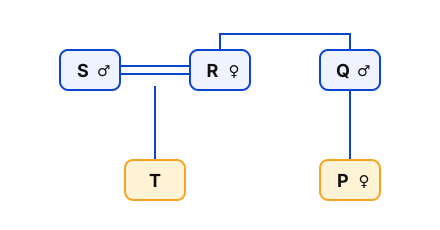
In a certain code language, 'A + B' means 'A is the daughter of B', 'A - B' means 'A is the brother of B', 'A × B' means 'A is the wife of B' and 'A ÷ B' means 'A is the father of B'. Based on the above, how is P related to T if 'P + Q - R × S ÷ T'?
एक निश्चित कूट भाषा में, 'A + B' का अर्थ है 'A, B की पुत्री है', 'A - B' का अर्थ है 'A, B का भाई है', 'A × B' का अर्थ है 'A, B की पत्नी है' तथा 'A ÷ B' का अर्थ है 'A, B का पिता है'। उपर्युक्त के आधार पर, यदि 'P + Q - R × S ÷ T' है, तो P, T से किस प्रकार संबंधित है?
  1. AMother's brother's wifeमाता के भाई की पत्नी
  2. BMother's brother's daughterमाता के भाई की पुत्री
  3. CBrother's wifeभाई की पत्नी
  4. DBrother's daughterभाई की पुत्री
Show answer

Concept: Decode each symbol and move from T back to P.

  1. S ÷ T: S is father of T.
  2. R × S: R is wife of S → R is T's mother.
  3. Q − R: Q is brother of R → Q is T's maternal uncle (mother's brother).
  4. P + Q: P is daughter of Q → P is T's mother's brother's daughter.

Trick: Read the chain from the end (T) towards P; each link adds one word to the relation.

Answer: (B) Mother's brother's daughter

अवधारणा: हर चिह्न का अर्थ लगाकर T से P तक पहुँचें।

  1. S ÷ T → T के पिता S.
  2. R × S → S की पत्नी R, यानी T की माँ R.
  3. Q − R → माँ R का भाई Q, यानी T का मामा।
  4. P + Q → मामा Q की बेटी P.

ट्रिक: शृंखला को अंत (T) से P की ओर पढ़ें; हर कड़ी संबंध में एक शब्द जोड़ती है।

उत्तर: (B) माता के भाई की पुत्री

SSC GDGeneral Intelligence & ReasoningCoded blood relationSSC GD 2025 · 10 Feb Shift 3 →
Q2706.
Based on the English alphabetical order, three of the following four letter -clusters are alike in a certain way and thus form a group. Which letter -cluster DOES NOT belong to that group? (Note: The odd one out is not based on the number of consonants/vowels or their position in the letter-cluster.)
अंग्रेजी वर्णमाला क्रम के आधार पर, निम्नलिखित चार अक्षर-समूहों में से तीन एक निश्चित प्रकार से समान हैं और इस प्रकार एक समूह बनाते हैं। कौन-सा अक्षर-समूह उस समूह से संबंधित नहीं है? (नोट: विषम अक्षर-समूह, समूह में व्यंजनों/स्वरों की संख्या या उनकी स्थिति पर आधारित नहीं है।)
  1. ACEF
  2. BUWY
  3. CRTU
  4. DGIJ
Show answer

Concept: Find the gap pattern between consecutive letters of each cluster.

  1. CEF: +2, +1; RTU: +2, +1; GIJ: +2, +1.
  2. UWY: U→W +2, W→Y +2 (not +1).
  3. So UWY breaks the pattern.

Trick: In three clusters the last two letters are neighbours (EF, TU, IJ). Not so in WY.

Answer: (B) UWY

अवधारणा: हर समूह में लगातार अक्षरों का अंतर देखें।

  1. CEF, RTU, GIJ: +2, +1.
  2. UWY: +2, +2 — पैटर्न अलग।

ट्रिक: तीन समूहों के अंतिम दो अक्षर पड़ोसी हैं (EF, TU, IJ); WY नहीं।

उत्तर: (B) UWY

SSC GDGeneral Intelligence & ReasoningOdd one out – letter gapsSSC GD 2025 · 10 Feb Shift 3 →
Q2707.
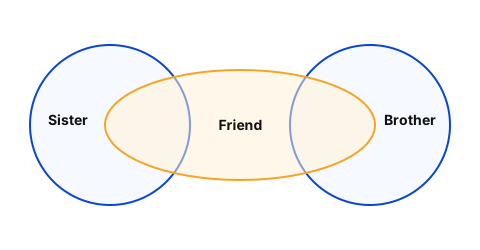
Select the Venn diagram that best illustrates the relationship between the following classes.
Sister, Brother, Friend
निम्नलिखित वर्गों के बीच के संबंध को सर्वोत्तम रूप से दर्शाने वाले वेन आरेख का चयन कीजिए।
बहन, भाई, मित्र
  1. Afigure
  2. Bfigure
  3. Cfigure
  4. Dfigure
Show answer

Concept: Decide which pairs can share members and which cannot.

  1. Sister and Brother: no person is both → two separate circles.
  2. Friend: some friends are sisters, some are brothers → Friend overlaps both.
  3. Required figure: one circle cutting two separate circles — option (C).

Trick: Gender-based classes (sister/brother) never overlap; a role like 'friend' crosses both.

Answer: (C)The figure where Friend overlaps both separate circles

अवधारणा: देखें कौन-से वर्ग साझा सदस्य रख सकते हैं।

  1. बहन और भाई: कोई व्यक्ति दोनों नहीं → अलग-अलग वृत्त।
  2. मित्र: कोई बहन, कोई भाई मित्र हो सकता है → दोनों से आंशिक जुड़ाव।
  3. अतः बीच का वृत्त दोनों अलग वृत्तों को काटे — विकल्प (C).

ट्रिक: लिंग आधारित वर्ग (बहन/भाई) कभी नहीं मिलते; 'मित्र' जैसा वर्ग दोनों को काटता है।

उत्तर: (C)जिसमें मित्र दोनों अलग वृत्तों को काटता है

SSC GDGeneral Intelligence & ReasoningVenn diagram – Sister, Brother, FriendSSC GD 2025 · 10 Feb Shift 3 →
Q2708.
What should come in place of the question mark (?) in the given series? 879 880 883 888 895 ?
दी गई शृंखला में प्रश्नवाचक चिह्न (?) के स्थान पर क्या आना चाहिए? 879 880 883 888 895 ?
  1. A903
  2. B902
  3. C904
  4. D901
Show answer

Concept: Check the differences between terms.

  1. Differences: 1, 3, 5, 7 (odd numbers).
  2. Next difference = 9.
  3. 895+9=904.

Trick: Differences 1, 3, 5, 7 ⇒ terms are 879+n2 (0, 1, 4, 9, 16, 25) → 879+25=904.

Answer: (C) 904

अवधारणा: पदों के बीच अंतर देखें।

  1. अंतर: 1, 3, 5, 7 (विषम संख्याएँ)।
  2. अगला अंतर 9 → 895+9=904.

ट्रिक: विषम अंतर का मतलब 879+n2: 879+25=904.

उत्तर: (C) 904

SSC GDGeneral Intelligence & ReasoningNumber series – odd differencesSSC GD 2025 · 10 Feb Shift 3 →
Q2709.
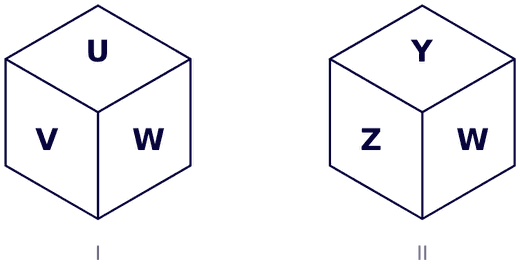
A dice has its faces marked by letters U, V, W, X, Y and Z. Two different positions of the same dice are shown. Select the letter that will be on the face opposite to the one having X.
figure
एक पासे के फलकों पर U, V, W, X, Y और Z अक्षर अंकित हैं। एक ही पासे की दो अलग-अलग स्थितियाँ दर्शाई गई हैं। उस अक्षर का चयन कीजिए जो X वाले फलक के विपरीत फलक पर होगा।
figure
  1. AW
  2. BY
  3. CU
  4. DV
Show answer

Concept: A face touches four faces; the sixth one is its opposite.

  1. View 1: W is beside U and V.
  2. View 2: W is beside Y and Z.
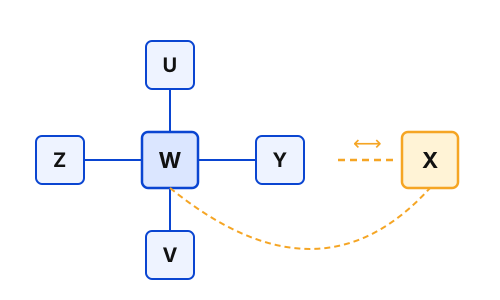
  3. W touches U, V, Y, Z → the remaining letter X is opposite W.

Trick: Common face in both views → list its four neighbours; the leftover letter is opposite.

Answer: (A) W

अवधारणा: एक फलक चार फलकों से जुड़ा होता है; बचा हुआ छठा उसका विपरीत है।

  1. पहली स्थिति: W के साथ U, V.
  2. दूसरी स्थिति: W के साथ Y, Z.
  3. W के चार पड़ोसी U, V, Y, Z → बचा X, W के विपरीत।

ट्रिक: दोनों चित्रों में साझा फलक के चार पड़ोसी लिखें; बचा अक्षर विपरीत होता है।

उत्तर: (A) W

SSC GDGeneral Intelligence & ReasoningDice – opposite face by eliminationSSC GD 2025 · 10 Feb Shift 3 →
Q2710.
In a certain code language, 'here I come' is coded as 'Is rc tp' and 'I am going' is coded as 'rc as bo'. How is 'I' coded in the given language?
एक निश्चित कूट भाषा में, 'here I come' को 'Is rc tp' के रूप में कूटबद्ध किया जाता है तथा 'I am going' को 'rc as bo' के रूप में कूटबद्ध किया जाता है। उसी भाषा में 'I' को किस प्रकार कूटबद्ध किया जाएगा?
  1. Arc
  2. BIs
  3. Cbo
  4. Das
Show answer

Concept: A word appearing in two sentences gets the code appearing in both codes.

  1. Common word in 'here I come' and 'I am going' = I.
  2. Common code in 'Is rc tp' and 'rc as bo' = rc.
  3. So I = rc.

Trick: Don't be fooled by 'Is' looking like 'I' — codes need not resemble words.

Answer: (A) rc

अवधारणा: दोनों वाक्यों में समान शब्द का कोड दोनों कोडों में समान होगा।

  1. समान शब्द: I.
  2. समान कोड: rc → I = rc.

ट्रिक: 'Is' देखकर 'I' मत समझिए — कोड का शब्द से मिलना ज़रूरी नहीं।

उत्तर: (A) rc

SSC GDGeneral Intelligence & ReasoningCoding – common word, common codeSSC GD 2025 · 10 Feb Shift 3 →
Q2711.
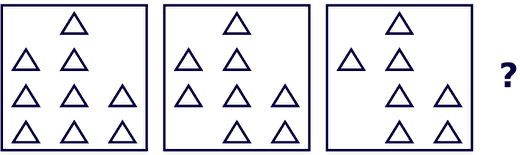
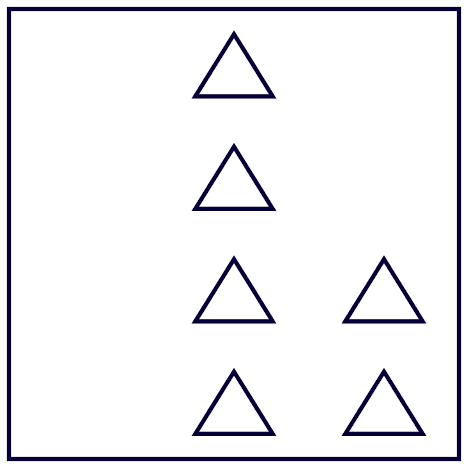
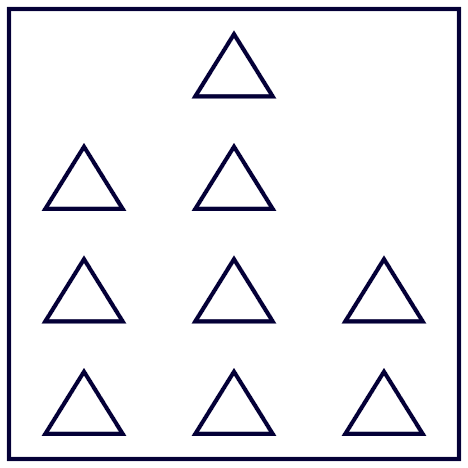
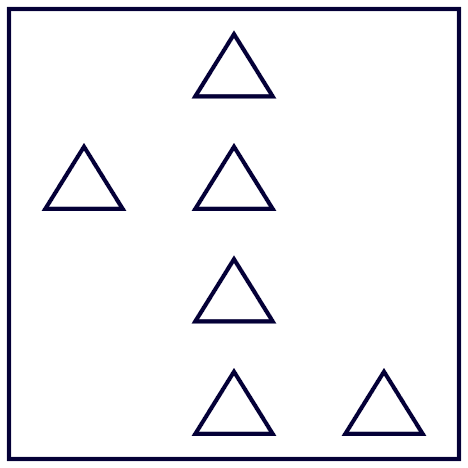
Identify the figure given in the options which when put in place of the question mark (?) will logically complete the series.
figure
उस आकृति की पहचान कीजिए जो विकल्पों में दी गई है और जिसे प्रश्नवाचक चिह्न (?) के स्थान पर रखने पर शृंखला तार्किक रूप से पूर्ण हो जाएगी।
figure
  1. Afigure
  2. Bfigure
  3. Cfigure
  4. Dfigure
Show answer

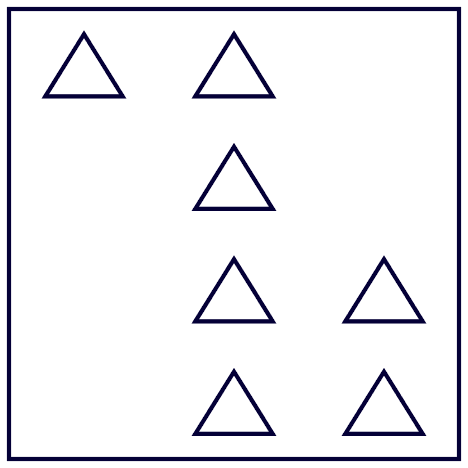
Concept: Count the triangles and see which one disappears each step.

  1. Triangles: 9 → 8 → 7, so next figure has 6.
  2. Right and middle columns stay the same; the left column loses its lowest triangle each time.
  3. Only the row-2 left triangle remains; it disappears next — figure (A).

Trick: First count shapes (9, 8, 7 → 6) and reject options with a wrong count.

Answer: (A)Figure (a)

अवधारणा: त्रिभुज गिनें और देखें हर बार कौन-सा हटता है।

  1. त्रिभुज: 9 → 8 → 7, अगली आकृति में 6.
  2. बीच और दाएँ स्तंभ वही रहते हैं; बाएँ स्तंभ का सबसे नीचे का त्रिभुज हर बार हटता है।
  3. अब पंक्ति-2 का बायाँ त्रिभुज हटेगा — आकृति (A).

ट्रिक: पहले गिनती (9, 8, 7 → 6) से गलत विकल्प हटाएँ।

उत्तर: (A)आकृति (a)

SSC GDGeneral Intelligence & ReasoningFigure series – one triangle removedSSC GD 2025 · 10 Feb Shift 3 →
Q2712.
NSBX is related to QQZA in a certain way based on the English alphabetical order. In the same way, OKIR is related to RIGU. To which of the given options is DTAF related, following the same logic?
अंग्रेजी वर्णमाला क्रम के आधार पर NSBX एक निश्चित प्रकार से QQZA से संबंधित है। उसी प्रकार, OKIR, RIGU से संबंधित है। उसी तर्क का अनुसरण करते हुए, DTAF दिए गए विकल्पों में से किससे संबंधित है?
  1. AHSZJ
  2. BFUZH
  3. CHSBG
  4. DGRYI
Show answer

Concept: Find the shift for each position and apply it to the new word.

  1. NSBX → QQZA: N+3=Q, S−2=Q, B−2=Z, X+3=A (wrap around).
  2. OKIR → RIGU confirms +3, −2, −2, +3.
  3. DTAF → D+3=G, T−2=R, A−2=Y, F+3=I = GRYI.

Trick: Use wrap-around: after Z comes A, before A comes Z.

Answer: (D) GRYI

अवधारणा: हर स्थान का खिसकाव निकालकर नए शब्द पर लगाएँ।

  1. NSBX → QQZA: +3, −2, −2, +3 (Z के बाद A).
  2. OKIR → RIGU से पुष्टि।
  3. DTAF → G, R, Y, I = GRYI.

ट्रिक: A से पहले Z और Z के बाद A आता है — चक्र याद रखें।

उत्तर: (D) GRYI

SSC GDGeneral Intelligence & ReasoningLetter analogy – +3, −2, −2, +3SSC GD 2025 · 10 Feb Shift 3 →
Q2713.
Read the given statements and conclusions carefully. Assuming that the information given in the statements is true, even if it appears to be at variance with commonly known facts, decide which of the given conclusions logically follow(s) from the statements.
Statements:
All actors are writers.
Some writers are dancers.
Some dancers are stars.
Conclusions:
(I): Some stars are actors.
(II): Some dancers are actors.
दिए गए कथनों और निष्कर्षों को ध्यानपूर्वक पढ़िए। यह मानते हुए कि कथनों में दी गई जानकारी सत्य है, चाहे वह सर्वज्ञात तथ्यों से भिन्न प्रतीत होती हो, निर्णय कीजिए कि दिए गए निष्कर्षों में से कौन-सा/से कथनों का तार्किक रूप से अनुसरण करता है/करते हैं।
कथन:
सभी अभिनेता लेखक हैं।
कुछ लेखक नर्तक हैं।
कुछ नर्तक सितारे हैं।
निष्कर्ष:
(I): कुछ सितारे अभिनेता हैं।
(II): कुछ नर्तक अभिनेता हैं।
  1. ABoth conclusions (I) and (II) follow.निष्कर्ष (I) और (II) दोनों अनुसरण करते हैं।
  2. BNeither conclusion (I) nor (II) follows.न तो निष्कर्ष (I) और न ही निष्कर्ष (II) अनुसरण करता है।
  3. COnly conclusion (I) follows.केवल निष्कर्ष (I) अनुसरण करता है।
  4. DOnly conclusion (II) follows.केवल निष्कर्ष (II) अनुसरण करता है।
Show answer

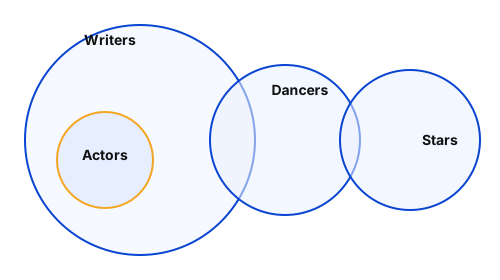
Concept: Two 'some' statements in a chain never give a definite link between the end classes.

  1. Actors are inside Writers; Writers–Dancers and Dancers–Stars are only partial overlaps.
  2. Dancers may overlap only the non-actor part of Writers → 'Some dancers are actors' not certain.
  3. Stars link only to Dancers → 'Some stars are actors' not certain.

Trick: Some + Some = no conclusion. Draw the possible diagram where conclusions fail.

Answer: (B) Neither conclusion (I) nor (II) follows.

अवधारणा: दो 'कुछ' कथन मिलकर कोई निश्चित निष्कर्ष नहीं देते।

  1. सभी अभिनेता लेखक हैं; लेखक–नर्तक और नर्तक–सितारे केवल आंशिक जुड़े।
  2. नर्तक, लेखक के उस भाग से जुड़ सकते हैं जहाँ अभिनेता नहीं → II निश्चित नहीं।
  3. सितारे केवल नर्तकों से जुड़े → I भी निश्चित नहीं।

ट्रिक: कुछ + कुछ = कोई निष्कर्ष नहीं।

उत्तर: (B) न तो निष्कर्ष (I) और न ही निष्कर्ष (II) अनुसरण करता है।

SSC GDGeneral Intelligence & ReasoningSyllogism – 'some' chainsSSC GD 2025 · 10 Feb Shift 3 →
Q2714.
Select the combination of letters that when sequentially placed in the blanks of the given series will make the series logically complete.
_GCE G_FH JM_K MPL_ PSO_
उस अक्षर-संयोजन का चयन कीजिए जिसे दी गई शृंखला के रिक्त स्थानों में क्रमिक रूप से रखने पर शृंखला तार्किक रूप से पूर्ण हो जाएगी।
_GCE G_FH JM_K MPL_ PSO_
  1. ADKIMQ
  2. BCJHNQ
  3. CDJINQ
  4. DCKHMR
Show answer

Concept: Split into 4-letter groups; each position moves +3 from group to group.

  1. Groups: _GCE, G_FH, JM_K, MPL_, PSO_.
  2. 1st letters: D, G, J, M, P; 2nd: G, J, M, P, S; 3rd: C, F, I, L, O; 4th: E, H, K, N, Q.
  3. Blanks: D, J, I, N, Q → DJINQ.

Trick: First blank must be G−3 = D → options (A) or (C); second blank G+3 = J → only (C).

Answer: (C) DJINQ

अवधारणा: 4-4 अक्षरों के समूह बनाएँ; हर स्थान पर अगले समूह में +3.

  1. समूह: _GCE, G_FH, JM_K, MPL_, PSO_.
  2. पहला स्थान D, G, J, M, P; चौथा E, H, K, N, Q.
  3. रिक्त: D, J, I, N, Q.

ट्रिक: पहला रिक्त D → (A) या (C); दूसरा J → केवल (C).

उत्तर: (C) DJINQ

SSC GDGeneral Intelligence & ReasoningLetter series – fill the blanksSSC GD 2025 · 10 Feb Shift 3 →
Q2715.
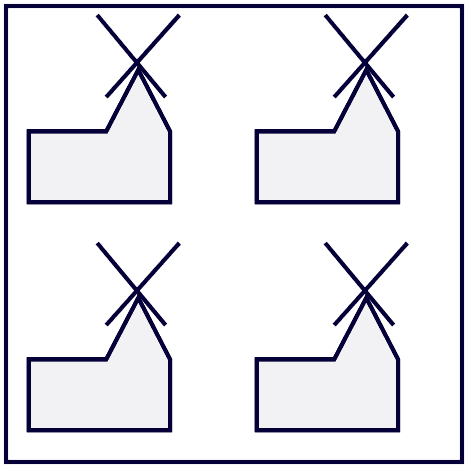
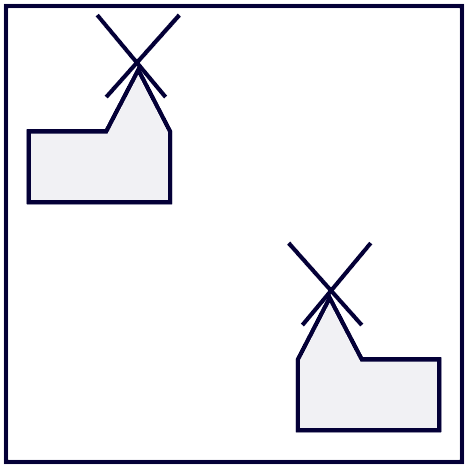
A paper is folded and punched as shown below. How will it appear when unfolded?
figure
एक कागज़ को नीचे दर्शाए अनुसार मोड़ा और छेदा जाता है। खोलने पर वह कैसा दिखाई देगा?
figure
  1. Afigure
  2. Bfigure
  3. Cfigure
  4. Dfigure
Show answer

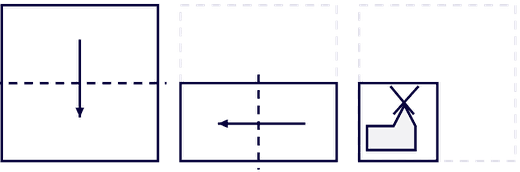
Concept: Unfold in reverse order; each unfold mirrors the cut across the fold line.

  1. Fold 1: top half down. Fold 2: right half onto left. Cut made in the final quarter.
  2. Open fold 2 → cut copied left–right into the other bottom quarter.
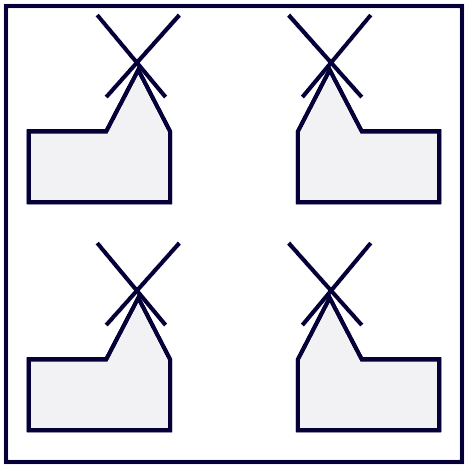
  3. Open fold 1 → both cuts mirrored up–down → 4 cuts, one per quarter, mirror pairs — figure (A).

Trick: 2 folds = 4 copies of the cut; each pair across a fold line is a mirror image.

Answer: (A)Figure (a)

अवधारणा: उल्टे क्रम में खोलें; हर बार कट मोड़ रेखा पर दर्पण-प्रतिबिंब बनता है।

  1. पहले ऊपर का आधा नीचे, फिर दायाँ आधा बाएँ मोड़ा गया।
  2. दूसरा मोड़ खोलने पर कट दाएँ-बाएँ दोहराया जाता है।
  3. पहला मोड़ खोलने पर ऊपर-नीचे दोहराव → चारों भागों में एक-एक कट — आकृति (A).

ट्रिक: 2 मोड़ = कट की 4 प्रतियाँ; मोड़ रेखा के दोनों ओर दर्पण-छवि।

उत्तर: (A)आकृति (a)

SSC GDGeneral Intelligence & ReasoningPaper folding and punchingSSC GD 2025 · 10 Feb Shift 3 →
Q2716.
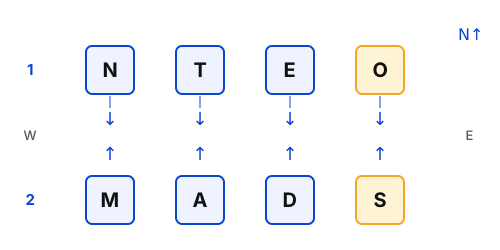
Eight people are sitting in two parallel rows containing 4 people each, in such a way that there is equal distance between adjacent persons.
In row 1 - N, O, T and E are seated and all of them are facing south.
In row 2 - D, A, M and S are seated and all of them are facing north.
Thus each person faces another person from the other row.
No one sits to the right of S. No one sits to the right of N. Only one person sits between S and A. O sits second to the left of T. M doesn't face E.
Which of the following options represents both people facing each other?
आठ व्यक्ति दो समानांतर पंक्तियों में इस प्रकार बैठे हैं कि प्रत्येक पंक्ति में 4 व्यक्ति हैं और आसन्न व्यक्तियों के बीच समान दूरी है।
पंक्ति 1 में - N, O, T तथा E बैठे हैं और वे सभी दक्षिण की ओर उन्मुख हैं।
पंक्ति 2 में - D, A, M तथा S बैठे हैं और वे सभी उत्तर की ओर उन्मुख हैं।
इस प्रकार प्रत्येक व्यक्ति दूसरी पंक्ति के किसी एक व्यक्ति के सम्मुख है।
S के दाईं ओर कोई नहीं बैठा है। N के दाईं ओर कोई नहीं बैठा है। S और A के बीच केवल एक व्यक्ति बैठा है। O, T के बाईं ओर दूसरे स्थान पर बैठा है। M, E के सम्मुख नहीं है।
निम्नलिखित में से कौन-सा विकल्प आमने-सामने बैठे दोनों व्यक्तियों को दर्शाता है?
  1. AE and AE और A
  2. BT and MT और M
  3. CN and DN और D
  4. DO and SO और S
Show answer

Concept: Fix the end persons first; remember south-facing people's right is towards the viewer's left.

  1. Number seats 1–4. Row 2 (north): S at extreme right = seat 4; A two seats away = seat 2.
  2. Row 1 (south): N at its extreme right = seat 1; O second to left of T → T seat 2, O seat 4; E seat 3.
  3. M should not face E (seat 3) → M seat 1, D seat 3.
  4. Seat 4: O faces S.

Trick: Ends first: 'No one to the right of X' always puts X at an end — place S and N first.

Answer: (D) O and S

अवधारणा: पहले किनारे वाले व्यक्ति तय करें; दक्षिणमुखी का दायाँ हमारी बाईं ओर होता है।

  1. स्थान 1–4. पंक्ति 2 (उत्तरमुखी): S दाएँ छोर = 4, A = 2.
  2. पंक्ति 1 (दक्षिणमुखी): N = 1; T = 2, O = 4, E = 3.
  3. M, E के सामने नहीं → M = 1, D = 3.
  4. स्थान 4 पर O और S आमने-सामने।

ट्रिक: 'X के दाएँ कोई नहीं' मतलब X छोर पर — पहले S और N बैठाएँ।

उत्तर: (D) O और S

SSC GDGeneral Intelligence & ReasoningSeating – two facing rowsSSC GD 2025 · 10 Feb Shift 3 →
Q2717.
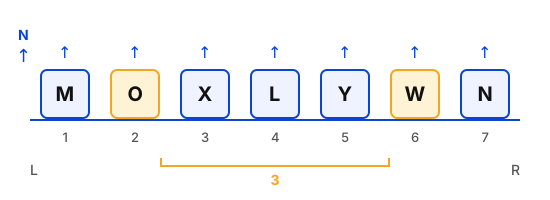
Seven people, L, M, N, O, W, X and Y, are sitting in a row, facing north (but not necessarily in the same order). No one sits to the right of N . Only three people sit between N and X . Only two people sit between X and W. M sits third to the left of L. Y sits to the immediate right of L. How many people sit between O and W ?
सात व्यक्ति L, M, N, O, W, X और Y एक पंक्ति में उत्तर की ओर उन्मुख होकर बैठे हैं (आवश्यक नहीं कि इसी क्रम में)। N के दाईं ओर कोई नहीं बैठा है। N और X के बीच केवल तीन व्यक्ति बैठे हैं। X और W के बीच केवल दो व्यक्ति बैठे हैं। M, L के बाईं ओर तीसरे स्थान पर बैठा है। Y, L के ठीक दाईं ओर बैठा है। O और W के बीच कितने व्यक्ति बैठे हैं?
  1. ATwoदो
  2. BThreeतीन
  3. COneएक
  4. DFourचार
Show answer

Concept: Number seats 1–7 left to right and fix fixed positions first.

  1. N at seat 7 (right end). Three between N and X → X at 3.
  2. Two between X and W → W at 6.
  3. M third left of L, Y just right of L → M 1, L 4, Y 5; O gets 2.
  4. Between O (2) and W (6): X, L, Y = 3.

Trick: People between seats a and b = |a − b| − 1 = 6 − 2 − 1 = 3.

Answer: (B) Three

अवधारणा: स्थान 1–7 (बाएँ से दाएँ) लिखकर निश्चित स्थान पहले भरें।

  1. N = 7, X = 3, W = 6.
  2. M, L से तीसरा बाएँ, Y ठीक दाएँ → M 1, L 4, Y 5; O = 2.
  3. O (2) और W (6) के बीच: X, L, Y = 3.

ट्रिक: बीच के व्यक्ति = स्थानों का अंतर − 1 = 6 − 2 − 1 = 3.

उत्तर: (B) तीन

SSC GDGeneral Intelligence & ReasoningLinear seating – people betweenSSC GD 2025 · 10 Feb Shift 3 →
Q2718.
What should come in place of the question mark (?) in the given series? 28 34 44 58 76 ?
दी गई शृंखला में प्रश्नवाचक चिह्न (?) के स्थान पर क्या आना चाहिए? 28 34 44 58 76 ?
  1. A114
  2. B91
  3. C107
  4. D98
Show answer

Concept: If differences grow by a fixed amount, add the next difference.

  1. Differences: 6, 10, 14, 18 (each +4).
  2. Next difference = 22.
  3. 76 + 22 = 98.

Trick: Next term = last term + last difference + 4 = 76 + 18 + 4 = 98 — one line, no table needed.

Answer: (D) 98

अवधारणा: अंतर में समान वृद्धि हो तो अगला अंतर जोड़ें।

  1. अंतर: 6, 10, 14, 18 (हर बार +4).
  2. अगला अंतर 22 → 76 + 22 = 98.

ट्रिक: अगला पद = अंतिम पद + अंतिम अंतर + 4 = 76 + 18 + 4 = 98.

उत्तर: (D) 98

SSC GDGeneral Intelligence & ReasoningNumber series – second differencesSSC GD 2025 · 10 Feb Shift 3 →
Q2719.
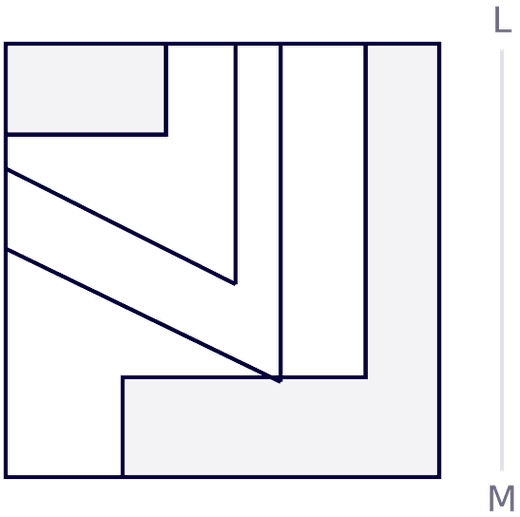
Select the correct mirror image of the given figure when the mirror is placed at LM as shown below.
figure
उस विकल्प का चयन कीजिए जो दी गई आकृति का सही दर्पण प्रतिबिंब है, जब दर्पण को नीचे दर्शाए अनुसार LM पर रखा जाए।
figure
  1. Afigure
  2. Bfigure
  3. Cfigure
  4. Dfigure
Show answer

Concept: A vertical mirror swaps left and right; top and bottom stay as they are.

  1. Thick shaded strip on the right edge → moves to the left edge.
  2. Shaded block at top-left → goes to top-right; bottom shaded strip now starts from the left.
  3. Slanting lines that drop from left to right now drop from right to left — matches figure (B).

Trick: Pick one corner feature (top-left box) and check it lands at top-right without moving up or down.

Answer: (B)Figure (b)

अवधारणा: ऊर्ध्वाधर दर्पण में बायाँ-दायाँ बदलता है, ऊपर-नीचे वही रहता है।

  1. दाएँ किनारे की मोटी छायांकित पट्टी → बाएँ किनारे पर।
  2. ऊपर-बाएँ का छायांकित भाग → ऊपर-दाएँ।
  3. तिरछी रेखाएँ अब दाएँ से बाएँ नीचे आती हैं — आकृति (B).

ट्रिक: किसी एक कोने का भाग (ऊपर-बायाँ बॉक्स) देखें — वह ऊपर-दाएँ ही जाना चाहिए।

उत्तर: (B)आकृति (b)

SSC GDGeneral Intelligence & ReasoningMirror image – vertical mirrorSSC GD 2025 · 10 Feb Shift 3 →
Q2720.
In a certain code language, 'FILE' is coded as '6312' and 'LIVE' is coded as '3241'. How is 'V' coded in the given language?
एक निश्चित कूट भाषा में, 'FILE' को '6312' के रूप में तथा 'LIVE' को '3241' के रूप में कूटबद्ध किया जाता है। उसी भाषा में 'V' को किस प्रकार कूटबद्ध किया जाएगा?
  1. A4
  2. B1
  3. C3
  4. D6
Show answer

Concept: Letters common to both words use the digits common to both codes; the leftovers pair up.

  1. FILE = 6312, LIVE = 3241.
  2. Common letters I, L, E ↔ common digits 3, 1, 2.
  3. Leftover in LIVE = V; leftover digit in 3241 = 4 → V = 4.

Trick: Strike out what is common; the one letter and one digit left over belong together.

Answer: (A) 4

अवधारणा: दोनों शब्दों के समान अक्षर, दोनों कोडों के समान अंक लेते हैं; बचे हुए आपस में जुड़ते हैं।

  1. FILE = 6312, LIVE = 3241.
  2. समान अक्षर I, L, E ↔ समान अंक 3, 1, 2.
  3. LIVE में बचा V, 3241 में बचा 4 → V = 4.

ट्रिक: समान चीज़ें काट दें; बचा अक्षर और बचा अंक एक-दूसरे के हैं।

उत्तर: (A) 4

SSC GDGeneral Intelligence & ReasoningCoding – digit for a letterSSC GD 2025 · 10 Feb Shift 3 →