Question bank

Q&A: practice questions with answers

Search questions on any topic. Filter by exam category, exam, subject and topic, try the question, then open the answer and explanation.

Courses – airGurukul

4,200 questions found.

Q3301.
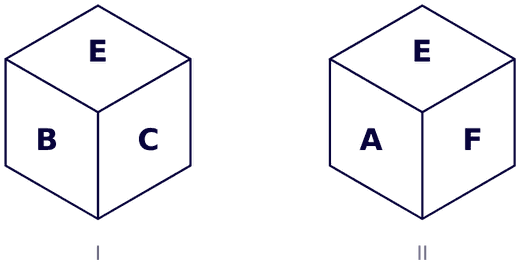
A dice has its faces marked by letters A, B, C, D, E and F. Two different positions of the same dice are shown. Select the letter that will be on the face opposite to the one having D ?
figure
एक पासे के फलकों पर अक्षर A, B, C, D, E और F अंकित हैं। एक ही पासे की दो अलग-अलग स्थितियाँ दर्शाई गई हैं। उस अक्षर का चयन कीजिए जो $D$ वाले फलक के विपरीत फलक पर होगा?
figure
  1. AF
  2. BA
  3. CB
  4. DE
Show answer

Concept: Letters seen adjacent to a common face can never be opposite to it.
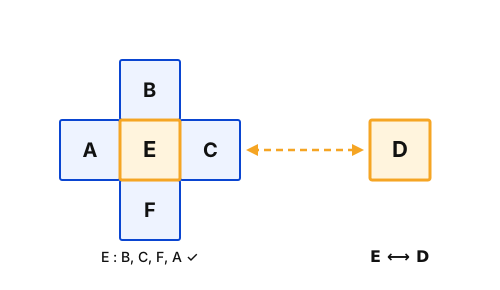
  1. E is the top face in both positions.
  2. Side faces around E: B, C (view 1) and A, F (view 2) – four letters touching E.
  3. Only D is left, so D must be the bottom face, i.e. opposite E.

Trick: When one letter repeats in the same spot in both views, the letter missing from all its neighbours is its opposite.

Answer: (D) E

अवधारणा: एक ही फलक के आस-पास दिखने वाले अक्षर उसके विपरीत नहीं हो सकते।

  1. दोनों स्थितियों में ऊपर E है।
  2. E के चारों ओर B, C (पहली) और A, F (दूसरी) दिखते हैं।
  3. बचा अक्षर D है, इसलिए D, E के ठीक नीचे यानी विपरीत है।

ट्रिक: जो अक्षर दोनों चित्रों में एक ही जगह हो, उसके किसी भी पड़ोसी में न दिखने वाला अक्षर उसका विपरीत होता है।

उत्तर: (D) E

SSC GDGeneral Intelligence & ReasoningDice – opposite face from two viewsSSC GD 2025 · 6 Feb Shift 3 →
Q3302.
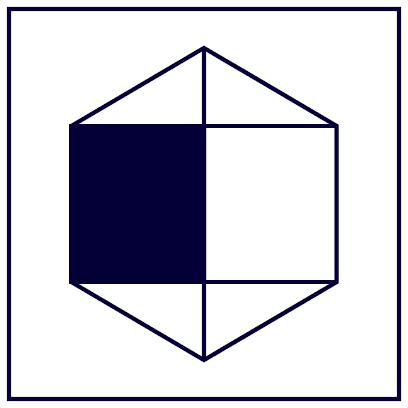
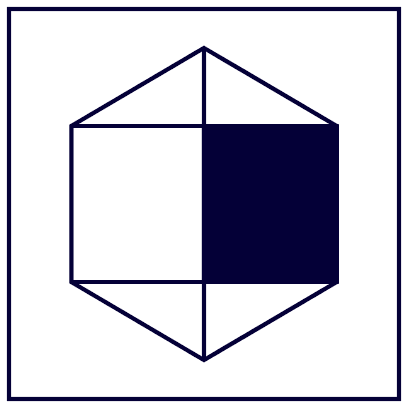
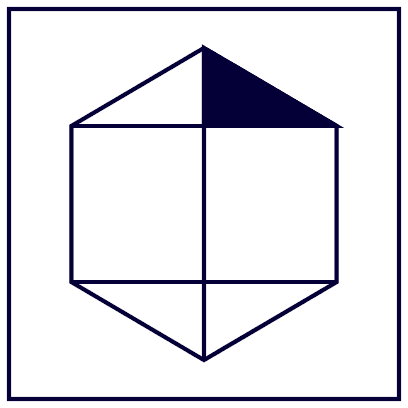
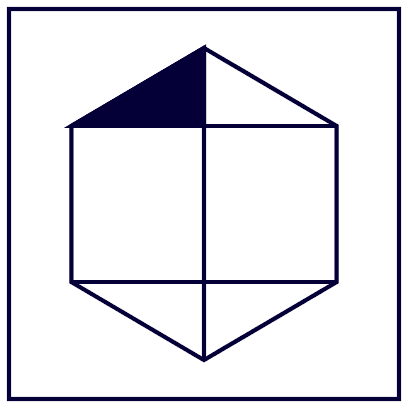
Identify the figure given in the options which when put in place of the question mark (?) will logically complete the series.
figure
उस आकृति की पहचान कीजिए जिसे प्रश्नवाचक चिह्न (?) के स्थान पर रखने पर शृंखला तार्किक रूप से पूर्ण हो जाएगी।
figure
  1. Afigure
  2. Bfigure
  3. Cfigure
  4. Dfigure
Show answer

Concept: The shaded segment of the hexagon shifts one part clockwise per step.

  1. Hexagon has 6 parts: 2 top triangles, 2 side rectangles, 2 bottom triangles.
  2. Shading path: top-right → right side → bottom-right → bottom-left.
  3. Next clockwise part = left rectangle; only option (a) shows it shaded.

Trick: Track just one moving part and its direction – ignore the rest of the figure.

Answer: (A)

अवधारणा: षट्भुज का छायांकित भाग हर चरण में एक खाना दक्षिणावर्त (clockwise) खिसकता है।

  1. षट्भुज के 6 भाग हैं – ऊपर 2 त्रिभुज, बगल में 2 आयत, नीचे 2 त्रिभुज।
  2. छाया का क्रम: ऊपर-दायाँ → दायाँ आयत → नीचे-दायाँ → नीचे-बायाँ।
  3. अगला भाग बायाँ आयत होगा – यह केवल विकल्प (a) में है।

ट्रिक: केवल चलने वाले भाग और उसकी दिशा पर ध्यान दें।

उत्तर: (A)

SSC GDGeneral Intelligence & ReasoningFigure series – shading rotates clockwiseSSC GD 2025 · 6 Feb Shift 3 →
Q3303.
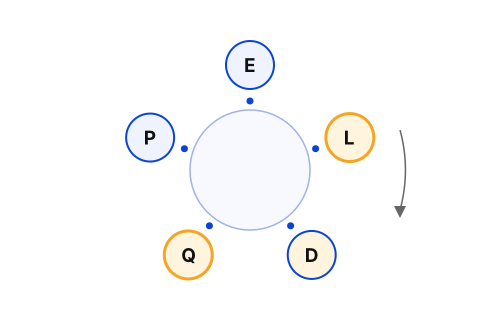
D, L, P, Q, and E are sitting in a circular table facing the centre (but not necessarily in the same order). P is an immediate neighbour of both Q and E. L is sitting to the immediate left of E. Q is an immediate neighbour of both P and D. Who are the immediate neighbours of D ?
D, L, P, Q और E एक वृत्ताकार मेज़ के चारों ओर केंद्र की ओर मुख करके बैठे हैं (आवश्यक नहीं कि इसी क्रम में)। P, Q और E दोनों का निकटतम पड़ोसी है। L, E के ठीक बाएँ बैठा है। Q, P और D दोनों का निकटतम पड़ोसी है। D के निकटतम पड़ोसी कौन हैं?
  1. AP and EP और E
  2. BE and LE और L
  3. CQ and LQ और L
  4. DQ and PQ और P
Show answer

Concept: Join the fixed neighbour pairs into a chain, then close the circle.

  1. P is next to Q and E → Q–P–E.
  2. Q is also next to D → D–Q–P–E.
  3. Five seats: the last gap (between E and D) goes to L, which also satisfies 'L is immediate left of E'.
  4. So D sits between Q and L.

Trick: In a 5-person circle, once a 4-person chain is made, the fifth person automatically closes the ring between the two ends.

Answer: (C) Q and L

अवधारणा: तय पड़ोसियों को जोड़कर एक कड़ी बनाइए, फिर वृत्त पूरा कीजिए।

  1. P के दोनों ओर Q और E → Q–P–E।
  2. Q का पड़ोसी D भी है → D–Q–P–E।
  3. 5 सीटें हैं, बची जगह (E और D के बीच) L की होगी; यह 'L, E के ठीक बाएँ' शर्त भी पूरी करता है।
  4. अतः D के पड़ोसी Q और L हैं।

ट्रिक: 5 लोगों के वृत्त में 4 की कड़ी बनते ही पाँचवाँ व्यक्ति दोनों सिरों के बीच बैठता है।

उत्तर: (C) Q और L

SSC GDGeneral Intelligence & ReasoningCircular seating – neighboursSSC GD 2025 · 6 Feb Shift 3 →
Q3304.
MC 5 is related to PF 10 in a certain way. In the same way, HQ 20 is related to KT 25. To which of the following is JW 30 related, following the same logic ?
MC 5 एक निश्चित प्रकार से PF 10 से संबंधित है। उसी प्रकार, HQ 20, KT 25 से संबंधित है। उसी तर्क का अनुसरण करते हुए, JW 30 निम्नलिखित में से किससे संबंधित है?
  1. AKX 30
  2. BMZ 35
  3. CLY 35
  4. DMV 35
Show answer

Concept: Each letter moves +3 and the number increases by 5.

  1. MC 5 → PF 10: M+3=P, C+3=F, 5+5=10.
  2. Check HQ 20 → KT 25: H+3=K, Q+3=T, 20+5=25 ✓
  3. JW 30: J+3=M, W+3=Z, 30+5=35 → MZ 35.

Trick: Check the number first: only options with 35 survive (b, c, d); then J+3=M leaves (b) or (d), and W+3=Z gives (b).

Answer: (B) MZ 35

अवधारणा: हर अक्षर में +3 और संख्या में +5 जुड़ता है।

  1. MC 5 → PF 10: M+3=P, C+3=F, 5+5=10।
  2. HQ 20 → KT 25 भी यही नियम मानता है।
  3. JW 30: J+3=M, W+3=Z, 30+5=35 → MZ 35।

ट्रिक: पहले संख्या देखें – 35 वाले विकल्प बचते हैं; फिर J+3=M और W+3=Z से सीधे (b)।

उत्तर: (B) MZ 35

SSC GDGeneral Intelligence & ReasoningLetter-number analogySSC GD 2025 · 6 Feb Shift 3 →
Q3305.
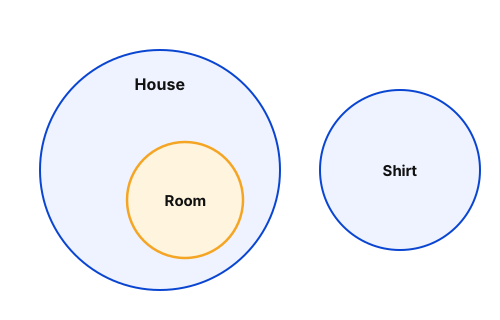
Select the Venn diagram that best illustrates the relationship between the following classes.
Room, House, Shirt
उस वेन आरेख का चयन कीजिए जो निम्नलिखित वर्गों के बीच के संबंध को सर्वोत्तम रूप से दर्शाता है।
कमरा, मकान, कमीज़
  1. Afigure
  2. Bfigure
  3. Cfigure
  4. Dfigure
Show answer

Concept: Show part-whole as a circle inside a circle; an unrelated item as a separate circle.

  1. A room is a part of a house → Room circle inside House circle.
  2. A shirt is clothing, unrelated to both → separate circle.
  3. Option (b) has exactly this arrangement.

Trick: Ask 'is X a part/type of Y?' for every pair – 'yes' means inside, 'no link at all' means apart.

Answer: (B)

अवधारणा: भाग-पूर्ण संबंध = वृत्त के अंदर वृत्त; असंबंधित वस्तु = अलग वृत्त।

  1. कमरा घर का भाग है → कमरा, घर के वृत्त के अंदर।
  2. कमीज़ एक कपड़ा है, दोनों से अलग → अलग वृत्त।
  3. यह आकृति विकल्प (b) में है।

ट्रिक: हर जोड़ी के लिए पूछें – 'क्या X, Y का भाग/प्रकार है?' हाँ = अंदर, कोई संबंध नहीं = अलग।

उत्तर: (B)

SSC GDGeneral Intelligence & ReasoningVenn diagram – Room, House, ShirtSSC GD 2025 · 6 Feb Shift 3 →
Q3306.
Select the option that represents the letters that, when sequentially placed from left to right in the blanks below, will complete the letter series.
V _ _ Y Z V W X _ _ _ _ X Y Z V _ X _ Z
उस विकल्प का चयन कीजिए जो उन अक्षरों को निरूपित करता है जिन्हें नीचे दिए गए रिक्त स्थानों में बाएँ से दाएँ क्रमिक रूप से रखने पर अक्षर-शृंखला पूर्ण हो जाएगी।
V _ _ Y Z V W X _ _ _ _ X Y Z V _ X _ Z
  1. AWXYZVWWY
  2. BWXZYVWYW
  3. CXWYZWVYW
  4. DXWZYWVWY
Show answer

Concept: The series is the block VWXYZ written four times.

  1. Break into groups of 5: V__YZ | VWX__ | __XYZ | V_X_Z.
  2. Fill using VWXYZ: (W,X) | (Y,Z) | (V,W) | (W,Y).
  3. Blanks in order: W X Y Z V W W Y.

Trick: Total letters ÷ visible repeating length (20 ÷ 5) tells you the group size instantly.

Answer: (A) WXYZVWWY

अवधारणा: पूरी श्रृंखला VWXYZ खंड को चार बार लिखकर बनी है।

  1. 5-5 के समूह बनाइए: V__YZ | VWX__ | __XYZ | V_X_Z।
  2. VWXYZ से भरें: (W,X) | (Y,Z) | (V,W) | (W,Y)।
  3. क्रम से: W X Y Z V W W Y।

ट्रिक: कुल अक्षर (20) ÷ खंड की लंबाई (5) से तुरंत समूह मिल जाते हैं।

उत्तर: (A) WXYZVWWY

SSC GDGeneral Intelligence & ReasoningLetter series – repeating blockSSC GD 2025 · 6 Feb Shift 3 →
Q3307.
Select the option in which the given figure (X) is embedded (rotation is NOT allowed).
figure
(X)
उस विकल्प का चयन कीजिए जिसमें दी गई आकृति (X) अंतर्निहित है (घुमाने की अनुमति नहीं है)।
figure
(X)
  1. Afigure
  2. Bfigure
  3. Cfigure
  4. Dfigure
Show answer

Concept: Find figure (X) inside an option in the same orientation and proportions.

  1. (X): one vertical line with two arms to the right – a long free arm at the top and a shorter arm ending in a dot below, with the line continuing downward.
  2. Option (d) contains this exact pattern.
  3. In (b) the arm lengths/dot position are swapped; (a) and (c) lack such a pair of arms.

Trick: Pick the most distinctive feature (here the dot-ended arm) and scan only for it first.

Answer: (D)

अवधारणा: आकृति (X) को उसी दिशा और अनुपात में विकल्पों में खोजें।

  1. (X): एक लंबवत रेखा, उसके दाहिने तरफ़ दो शाखाएँ – सबसे ऊपर लंबी खुली शाखा, नीचे बिंदु-युक्त छोटी शाखा, और रेखा उसके नीचे तक बढ़ती है।
  2. यही ढाँचा विकल्प (d) में है।
  3. (b) में भुजाओं की लंबाई/बिंदु उलटे हैं; (a), (c) में ऐसी जोड़ी नहीं है।

ट्रिक: सबसे अलग पहचान (बिंदु वाली भुजा) को पहले खोजें।

उत्तर: (D)

SSC GDGeneral Intelligence & ReasoningEmbedded figureSSC GD 2025 · 6 Feb Shift 3 →
Q3308.
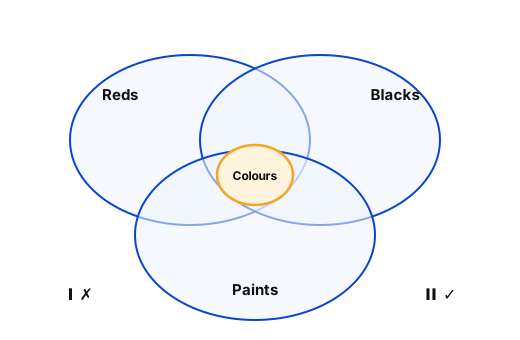
Read the given statements and conclusions carefully. Assuming that the information given in the statements is true, even if it appears to be at variance with commonly known facts, decide which of the given conclusions logically follow(s) from the statements.
Statements:
All colours are reds.
All colours are blacks.
All colours are paints.
Conclusions:
(I) All reds are paints.
(II) Some paints are blacks.
दिए गए कथनों और निष्कर्षों को ध्यानपूर्वक पढ़िए। कथनों में दी गई जानकारी को सत्य मानते हुए, भले ही वह सर्वज्ञात तथ्यों से भिन्न प्रतीत होती हो, निर्णय कीजिए कि दिए गए निष्कर्षों में से कौन-सा/से कथनों का तार्किक रूप से अनुसरण करता है/करते हैं।
कथन:
सभी रंग लाल हैं।
सभी रंग काले हैं।
सभी रंग पेंट हैं।
निष्कर्ष:
(I) सभी लाल पेंट हैं।
(II) कुछ पेंट काले हैं।
  1. AOnly conclusion (II) followsकेवल निष्कर्ष (II) अनुसरण करता है
  2. BBoth conclusions (I) and (II) followनिष्कर्ष (I) और (II) दोनों अनुसरण करते हैं
  3. CNeither conclusion (I) nor (II) followsन तो निष्कर्ष (I) और न ही निष्कर्ष (II) अनुसरण करता है
  4. DOnly conclusion (I) followsकेवल निष्कर्ष (I) अनुसरण करता है
Show answer

Concept: 'All A are B' does not make 'All B are C'; common subset gives 'Some'.

  1. Colours lie inside Reds, Blacks and Paints.
  2. I: All reds are paints – reds may extend outside paints → not certain.
  3. II: Colours are both paints and blacks → some paints are blacks ✓

Trick: If two classes contain the same subset, 'Some X are Y' between them is always true.

Answer: (A) Only conclusion (II) follows

अवधारणा: 'सभी A, B हैं' से 'सभी B, C हैं' नहीं निकलता; साझा उपसमूह से 'कुछ' निकलता है।

  1. रंग – लाल, काले और पेंट तीनों के अंदर हैं।
  2. I: लाल वर्ग का कुछ हिस्सा पेंट वर्ग से बाहर संभव है → पक्का नहीं।
  3. II: 'रंग' वाला भाग पेंट और काला दोनों में शामिल → यह निष्कर्ष पक्का ✓

ट्रिक: जिन दो वर्गों में एक ही उपसमूह हो, उनमें 'कुछ X, Y हैं' हमेशा सही होता है।

उत्तर: (A) केवल निष्कर्ष (II) अनुसरण करता है

SSC GDGeneral Intelligence & ReasoningSyllogism – All statementsSSC GD 2025 · 6 Feb Shift 3 →
Q3309.
MQTR is related to SWZX in a certain way based on the English alphabetical order. In the same way, QUXV is related to WADB. To which of the given options is TXAY related, following the same logic?
MQTR अंग्रेज़ी वर्णमाला क्रम के आधार पर एक निश्चित प्रकार से SWZX से संबंधित है। उसी प्रकार, QUXV, WADB से संबंधित है। उसी तर्क का अनुसरण करते हुए, TXAY दिए गए विकल्पों में से किससे संबंधित है?
  1. AZDFE
  2. BZEFN
  3. CZCFE
  4. DZDGE
Show answer

Concept: Each letter is shifted forward by 6 (Z wraps to A).

  1. MQTR → SWZX: every letter +6.
  2. QUXV → WADB: +6 with wrap (U→A, X→D, V→B).
  3. TXAY: T→Z, X→D, A→G, Y→E = ZDGE.

Trick: All options start Z and end E; just check A+6 = G → only (d).

Answer: (D) ZDGE

अवधारणा: हर अक्षर 6 स्थान आगे बढ़ता है (Z के बाद फिर A)।

  1. MQTR → SWZX: हर अक्षर +6।
  2. QUXV → WADB भी +6 (U→A, X→D, V→B)।
  3. TXAY: T→Z, X→D, A→G, Y→E = ZDGE।

ट्रिक: सभी विकल्प Z से शुरू, E पर खत्म; केवल A+6 = G देखें → (d)।

उत्तर: (D) ZDGE

SSC GDGeneral Intelligence & ReasoningLetter coding analogy (+6)SSC GD 2025 · 6 Feb Shift 3 →
Q3310.
What should come in place of the question mark (?) in the given series based on the English alphabetical order ? DGC HKG LOK PSO ?
अंग्रेज़ी वर्णमाला क्रम के आधार पर दी गई शृंखला में प्रश्नवाचक चिह्न (?) के स्थान पर क्या आना चाहिए? DGC HKG LOK PSO ?
  1. AYXS
  2. BTWS
  3. CZYS
  4. DUWS
Show answer

Concept: Each position of the cluster moves +4 letters.

  1. 1st letters: D, H, L, P → T.
  2. 2nd letters: G, K, O, S → W.
  3. 3rd letters: C, G, K, O → S.

Trick: Check only the first letter: P+4 = T leaves (b) instantly.

Answer: (B) TWS

अवधारणा: समूह के हर स्थान का अक्षर +4 बढ़ता है।

  1. पहले अक्षर: D, H, L, P → T।
  2. दूसरे अक्षर: G, K, O, S → W।
  3. तीसरे अक्षर: C, G, K, O → S।

ट्रिक: सिर्फ पहला अक्षर देखें: P+4 = T → केवल (b)।

उत्तर: (B) TWS

SSC GDGeneral Intelligence & ReasoningLetter cluster series (+4)SSC GD 2025 · 6 Feb Shift 3 →
Q3311.
The position(s) of how many letters will remain unchanged if each of the letters in the word ELECTRIC is arranged in reverse English alphabetical order ?
यदि शब्द ELECTRIC के प्रत्येक अक्षर को विपरीत अंग्रेज़ी वर्णमाला क्रम में व्यवस्थित किया जाए, तो कितने अक्षरों की स्थिति अपरिवर्तित रहेगी?
  1. AFourचार
  2. BThreeतीन
  3. CTwoदो
  4. DOneएक
Show answer

Concept: Write the word and its reverse-alphabetical arrangement and compare position by position.

  1. ELECTRIC
  2. Reverse order: TRLIEECC
  3. Matches: only 8th place (C) is the same.

Trick: Reverse order always ends with the smallest letter – check whether the word ends with it (C here) for a quick first match.

Answer: (D) One

अवधारणा: शब्द और उसकी उलटी वर्णक्रम व्यवस्था लिखकर स्थान-दर-स्थान मिलाएँ।

  1. ELECTRIC
  2. उल्टा क्रम: TRLIEECC
  3. केवल 8वाँ अक्षर (C) समान है।

ट्रिक: उल्टे क्रम में अंत में सबसे छोटा अक्षर आता है – शब्द का अंतिम अक्षर वही है तो एक मेल तुरंत मिल जाता है।

उत्तर: (D) एक

SSC GDGeneral Intelligence & ReasoningLetter positions after rearrangingSSC GD 2025 · 6 Feb Shift 3 →
Q3312.
If 'P' stands for '×', 'Q' stands for '÷', 'R' stands for '-' and 'S' stands for '+', what will come in place of the question mark '?' in the following equation ?
(35 P 2) Q 5 S (86 Q 2) R (3 P 15) S 90 = ?
यदि 'P' का अर्थ '×' है, 'Q' का अर्थ '÷' है, 'R' का अर्थ '-' है और 'S' का अर्थ '+' है, तो निम्नलिखित समीकरण में प्रश्नवाचक चिह्न '?' के स्थान पर क्या आएगा?
(35 P 2) Q 5 S (86 Q 2) R (3 P 15) S 90 = ?
  1. A102
  2. B126
  3. C98
  4. D114
Show answer

Concept: Replace letters by signs, then apply BODMAS.

  1. (35×2)÷5+(86÷2)−(3×15)+90
  2. =70÷5+43−45+90
  3. =14+43−45+90=102

Trick: Group the + and − terms: 14+90=104, and 43−45=−2 → 102.

Answer: (A) 102

अवधारणा: अक्षरों को चिह्नों से बदलें, फिर BODMAS लगाएँ।

  1. (35×2)÷5+(86÷2)−(3×15)+90
  2. =70÷5+43−45+90
  3. =14+43−45+90=102

ट्रिक: 14+90=104 और 43−45=−2 → 102।

उत्तर: (A) 102

SSC GDGeneral Intelligence & ReasoningSymbol substitution & BODMASSSC GD 2025 · 6 Feb Shift 3 →
Q3313.
What should come in place of the question mark (?) in the given series ?
22 27 37 52 72 ?
दी गई शृंखला में प्रश्नवाचक चिह्न (?) के स्थान पर क्या आना चाहिए?
22 27 37 52 72 ?
  1. A100
  2. B94
  3. C98
  4. D97
Show answer

Concept: The differences increase by 5 each time.

  1. Differences: 5, 10, 15, 20.
  2. Next difference = 25.
  3. 72+25=97.

Trick: Differences 5, 10, 15… are multiples of 5 – next is simply 5×5.

Answer: (D) 97

अवधारणा: क्रमागत पदों का अंतर हर बार 5 बढ़ता है।

  1. अंतर: 5, 10, 15, 20।
  2. अगला अंतर = 25।
  3. 72+25=97।

ट्रिक: अंतर 5 के पहाड़े में हैं – अगला 5×5=25।

उत्तर: (D) 97

SSC GDGeneral Intelligence & ReasoningNumber series – differences in APSSC GD 2025 · 6 Feb Shift 3 →
Q3314.
In a certain code language, 'GELS' is coded as '9872' and 'SELF' is coded as '8276'. What is the code for ' F ' in the given code language ?
एक निश्चित कूट भाषा में 'GELS' को '9872' तथा 'SELF' को '8276' लिखा जाता है। उसी कूट भाषा में ' $F$ ' का कूट क्या है?
  1. A8
  2. B2
  3. C7
  4. D6
Show answer

Concept: Common letters share common digits; the unshared letter takes the unshared digit.

  1. GELS = 9872, SELF = 8276.
  2. Common letters E, L, S ↔ common digits 8, 2, 7.
  3. Extra letter F in SELF ↔ extra digit 6.

Trick: Strike out common letters and common digits – what remains pairs up directly.

Answer: (D) 6

अवधारणा: साझा अक्षरों के कूट भी साझा अंक होते हैं; बचा अक्षर बचे अंक से जुड़ता है।

  1. GELS = 9872, SELF = 8276।
  2. साझा अक्षर E, L, S ↔ साझा अंक 8, 2, 7।
  3. SELF में अतिरिक्त अक्षर F ↔ अतिरिक्त अंक 6।

ट्रिक: दोनों ओर साझा चीज़ें काटें – जो बचे वही जोड़ी है।

उत्तर: (D) 6

SSC GDGeneral Intelligence & ReasoningCoding – find code of a letterSSC GD 2025 · 6 Feb Shift 3 →
Q3315.
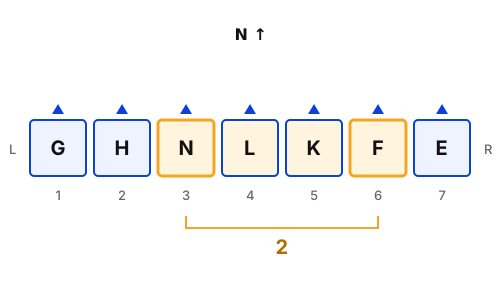
Seven people, E, F, G, H, K, L and N, are sitting in a row facing north (but not necessarily in the same order). Only three people sit between G and K. L sits to the immediate left of K. No one sits to the right of E. Only two people sit between E and L. N sits to the immediate right of H . How many people sit between F and N?
सात व्यक्ति E, F, G, H, K, L और N उत्तर की ओर मुख करके एक पंक्ति में बैठे हैं (आवश्यक नहीं कि इसी क्रम में)। G और K के बीच केवल तीन व्यक्ति बैठे हैं। L, K के ठीक बाएँ बैठा है। E के दाईं ओर कोई नहीं बैठा है। E और L के बीच केवल दो व्यक्ति बैठे हैं। N, H के ठीक दाएँ बैठा है। F और N के बीच कितने व्यक्ति बैठे हैं?
  1. AThreeतीन
  2. BOneएक
  3. CTwoदो
  4. DFourचार
Show answer

Concept: Fix the end person first, then place others by gaps.

  1. No one right of E → E at seat 7 (from left).
  2. Two between E and L → L at 4; K right of L → K at 5.
  3. Three between G and K → G at 1.
  4. H, N adjacent (N right of H) → H 2, N 3; F at 6.
  5. Between N (3) and F (6): L, K = 2 persons.

Trick: People between = |difference of seat numbers| − 1 = 6 − 3 − 1 = 2.

Answer: (C) Two

अवधारणा: पहले छोर वाले व्यक्ति को तय करें, फिर अंतर के आधार पर बाकी को।

  1. E के दाएँ कोई नहीं → E बाएँ से 7वें स्थान पर।
  2. E और L के बीच दो → L 4 पर; K, L के दाएँ → K 5 पर।
  3. G और K के बीच तीन → G 1 पर।
  4. N, H के ठीक दाएँ → H 2, N 3; F 6 पर।
  5. N (3) और F (6) के बीच L, K = 2 व्यक्ति।

ट्रिक: बीच के व्यक्ति = स्थानों का अंतर − 1 = 6 − 3 − 1 = 2।

उत्तर: (C) दो

SSC GDGeneral Intelligence & ReasoningLinear seating – row facing northSSC GD 2025 · 6 Feb Shift 3 →
Q3316.
In a certain code language, 'HALF' is coded as '1059' and 'LATH' is coded as '9750'. What is the code for 'T' in the given code language ?
एक निश्चित कूट भाषा में 'HALF' को '1059' तथा 'LATH' को '9750' लिखा जाता है। उसी कूट भाषा में 'T' का कूट क्या है?
  1. A5
  2. B7
  3. C0
  4. D9
Show answer

Concept: Common letters ↔ common digits; the leftover letter gets the leftover digit.

  1. HALF = 1059, LATH = 9750.
  2. Common H, A, L ↔ common 0, 5, 9.
  3. Extra letter T in LATH ↔ extra digit 7.

Trick: Cancel the shared items on both sides – the leftovers match.

Answer: (B) 7

अवधारणा: साझा अक्षर ↔ साझा अंक; बचा अक्षर ↔ बचा अंक।

  1. HALF = 1059, LATH = 9750।
  2. साझा H, A, L ↔ साझा 0, 5, 9।
  3. LATH में अतिरिक्त T ↔ अतिरिक्त अंक 7।

ट्रिक: दोनों ओर साझा चीज़ें हटाएँ, बची चीज़ें मिल जाती हैं।

उत्तर: (B) 7

SSC GDGeneral Intelligence & ReasoningCoding – find code of a letterSSC GD 2025 · 6 Feb Shift 3 →
Q3317.
Based on the English alphabetical order, three of the following four letter-clusters are alike in a certain way and thus form a group. Which letter-cluster DOES NOT belong to that group?
(Note: The odd one out is not based on the number of consonants/vowels or their position in the letter-cluster.)
अंग्रेज़ी वर्णमाला क्रम के आधार पर, निम्नलिखित चार अक्षर-समूहों में से तीन एक निश्चित प्रकार से समान हैं और इस प्रकार एक समूह बनाते हैं। कौन-सा अक्षर-समूह उस समूह से संबंधित नहीं है?
(नोट: विषम पद व्यंजनों/स्वरों की संख्या अथवा अक्षर-समूह में उनकी स्थिति पर आधारित नहीं है।)
  1. ANRV
  2. BJNP
  3. CTXZ
  4. DHLN
Show answer

Concept: Compare the gaps between consecutive letters of each cluster.

  1. JNP: +4, +2; TXZ: +4, +2; HLN: +4, +2.
  2. NRV: +4, +4 – different pattern.

Trick: Check only the second gap: three clusters show +2, the odd one shows +4.

Answer: (A) NRV

अवधारणा: हर समूह में क्रमागत अक्षरों का अंतर देखें।

  1. JNP: +4, +2; TXZ: +4, +2; HLN: +4, +2।
  2. NRV: +4, +4 – पैटर्न अलग है।

ट्रिक: केवल दूसरा अंतर देखें: तीन में +2, एक में +4।

उत्तर: (A) NRV

SSC GDGeneral Intelligence & ReasoningOdd one out – letter gapsSSC GD 2025 · 6 Feb Shift 3 →
Q3318.
What should come in place of the question mark (?) in the given series ? 789 790 780 782 772 775 765 ?
दी गई शृंखला में प्रश्नवाचक चिह्न (?) के स्थान पर क्या आना चाहिए? 789 790 780 782 772 775 765 ?
  1. A770
  2. B755
  3. C769
  4. D768
Show answer

Concept: Two series run alternately.

  1. Odd terms: 789, 780, 772, 765 (−9, −8, −7).
  2. Even terms: 790, 782, 775 (−8, −7) → next −6.
  3. 775 − 6 = 769.

Trick: When a series zig-zags (up, down, up…), split it into odd and even positions.

Answer: (C) 769

अवधारणा: दो श्रृंखलाएँ बारी-बारी से चल रही हैं।

  1. विषम पद: 789, 780, 772, 765 (−9, −8, −7)।
  2. सम पद: 790, 782, 775 (−8, −7) → अगला −6।
  3. 775 − 6 = 769।

ट्रिक: जब श्रृंखला ऊपर-नीचे झूले, तो विषम और सम स्थान अलग करें।

उत्तर: (C) 769

SSC GDGeneral Intelligence & ReasoningAlternate number seriesSSC GD 2025 · 6 Feb Shift 3 →
Q3319.
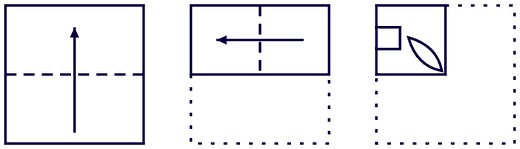
The sequence of folding a piece of paper and the manner in which the folded paper is cut is shown in the following figures. How would this paper look when unfolded?
figure
कागज़ के एक टुकड़े को मोड़ने का क्रम तथा मुड़े हुए कागज़ को काटने का तरीका निम्नलिखित आकृतियों में दर्शाया गया है। खोलने पर यह कागज़ कैसा दिखाई देगा?
figure
  1. Afigure
  2. Bfigure
  3. Cfigure
  4. Dfigure
Show answer

Concept: Each unfold mirrors the cuts across the fold line.

  1. Bottom half folded up, then right half folded left → one quarter (top-left) remains.
  2. A notch on the left edge and a cut at the crease corner are made.
  3. Unfolding twice mirrors these across both creases: notches on both side edges (top and bottom) and four cuts meeting at the centre – option (a).

Trick: Two folds = every cut appears 4 times (22) unless it lies on a fold line.

Answer: (A)

अवधारणा: हर बार खोलने पर कट मोड़ की रेखा के सापेक्ष दर्पण-प्रतिबिंब बनाता है।

  1. नीचे का आधा ऊपर, फिर दायाँ आधा बाएँ मोड़ा → ऊपर-बायाँ चौथाई बचा।
  2. बाएँ किनारे पर खाँचा और मोड़ों के कोने पर कट लगाया गया।
  3. दो बार खोलने पर दोनों किनारों पर खाँचे और बीच में चार कट मिलते हैं – विकल्प (a)।

ट्रिक: दो मोड़ = हर कट 4 बार (22) दिखेगा, यदि वह मोड़ रेखा पर न हो।

उत्तर: (A)

SSC GDGeneral Intelligence & ReasoningPaper folding and cuttingSSC GD 2025 · 6 Feb Shift 3 →
Q3320.
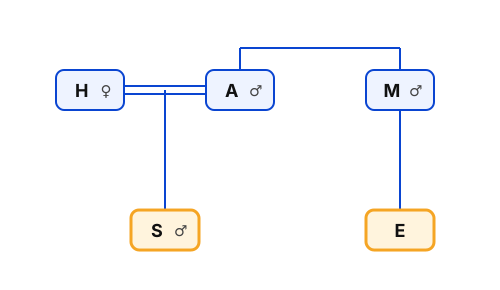
In a certain code language, ' A : B ' means ' A is the wife of B ', ' A!B ' means ' A is the brother of B ', ' A<B ' means ' A is the son of B ' and ' A/B ' means ' A is the father of B '. How is S related to E if 'S<H:A!M/E'?
एक निश्चित कूट भाषा में, ' $A$ : $B$ ' का अर्थ है ' $A$, $B$ की पत्नी है ', ' $A!B$ ' का अर्थ है ' $A$, $B$ का भाई है ', ' $A<B$ ' का अर्थ है ' $A$, $B$ का पुत्र है ' तथा ' $A/B$ ' का अर्थ है ' $A$, $B$ का पिता है '। यदि 'S<H:A!M/E' है, तो S का E से क्या संबंध है?
  1. AFather's brother's brotherपिता का भाई का भाई
  2. BFather's brother's motherपिता के भाई की माँ
  3. CFather's brother's daughterपिता के भाई की पुत्री
  4. DFather's brother's sonपिता के भाई का पुत्र
Show answer

Concept: Decode each symbol step by step and build the family tree.

  1. S < H: S is son of H; H : A: H is wife of A → A is S's father.
  2. A ! M: A is brother of M.
  3. M / E: M is father of E.
  4. So S = son of A = son of E's father's brother.

Trick: Read the chain from E back to S: father (M) → brother (A) → son (S).

Answer: (D) Father's brother's son

अवधारणा: हर चिह्न का अर्थ लगाकर परिवार वृक्ष बनाएँ।

  1. S < H: S, H का पुत्र; H : A: H, A की पत्नी → A, S के पिता।
  2. A ! M: A, M का भाई।
  3. M / E: M, E के पिता।
  4. यानी S, E के चाचा (A) का बेटा है।

ट्रिक: E से S तक पढ़ें: पिता (M) → भाई (A) → पुत्र (S)।

उत्तर: (D) पिता के भाई का पुत्र

SSC GDGeneral Intelligence & ReasoningCoded blood relationSSC GD 2025 · 6 Feb Shift 3 →