Question bank

Q&A: practice questions with answers

Search questions on any topic. Filter by exam category, exam, subject and topic, try the question, then open the answer and explanation.

Courses – airGurukul

4,200 questions found.

Q3601.
AMBUSH is related to FPIWTH in a certain way based on the English alphabetical order. In the same way, LYPASE is related to QBWCTE. To which of the given options is OCTANE related, following the same logic?
अंग्रेजी वर्णमाला क्रम के आधार पर AMBUSH एक निश्चित प्रकार से FPIWTH से संबंधित है। उसी प्रकार, LYPASE, QBWCTE से संबंधित है। समान तर्क का अनुसरण करते हुए, OCTANE दिए गए विकल्पों में से किससे संबंधित है?
  1. ATFBDME
  2. BTFBCOF
  3. CTFADME
  4. DTFACOE
Show answer

Concept: Each letter moves by a fixed amount that depends on its place in the word.

  1. AMBUSH → FPIWTH: shifts are +5, +3, +7, +2, +1, 0.
  2. LYPASE → QBWCTE gives the same set: +5, +3, +7, +2, +1, 0 (Y+3 wraps to B).
  3. Apply to OCTANE → O→T (+5), C→F (+3), T→A (+7, wraps past Z), A→C (+2), N→O (+1), E stays → TFACOE.

Trick: Check just the 3rd letter: T+7 wraps to A, so only (C) and (D) survive; 4th letter A+2=C picks (D).

Answer: (D) TFACOE

अवधारणा: हर अक्षर अपने स्थान के अनुसार तय अंक आगे खिसकता है।

  1. AMBUSH → FPIWTH में खिसकाव: +5, +3, +7, +2, +1, 0।
  2. LYPASE → QBWCTE में भी यही क्रम है (Y+3 घूमकर B बनता है)।
  3. OCTANE पर लगाएँ → O→T (+5), C→F (+3), T→A (+7, Z के बाद घूमकर), A→C (+2), N→O (+1), E वही → TFACOE।

ट्रिक: सिर्फ तीसरा अक्षर देखें: T+7=A, तो (C) व (D) बचे; चौथा A+2=C से (D) तय।

उत्तर: (D) TFACOE
SSC GDGeneral Intelligence & ReasoningLetter coding – position-wise shiftsSSC GD 2025 · 5 Feb Shift 3 →
Q3602.
In a certain code language 'USJI' is coded as '49' and 'DPTQ' is coded as '51'. What is the code for 'FAUL' in the given language ?
एक निश्चित कूट भाषा में 'USJI' को '49' के रूप में तथा 'DPTQ' को '51' के रूप में कूटबद्ध किया जाता है। उसी भाषा में 'FAUL' का कूट क्या है?
  1. A62
  2. B57
  3. C68
  4. D59
Show answer

Concept: Code = sum of reverse alphabet values (reverse value = 27 − position).

  1. USJI: 6+8+17+18=49 ✓; DPTQ: 23+11+7+10=51 ✓.
  2. FAUL: F=21, A=26, U=6, L=15.
  3. Sum = 21+26+6+15=68.

Trick: Shortcut: reverse sum = 4×27−(normalsum). FAUL normal sum = 6+1+21+12=40 → 108−40=68.

Answer: (C) 68

अवधारणा: कोड = अक्षरों के उल्टे क्रम मानों का योग (उल्टा मान = 27 − स्थान)।

  1. USJI: 6+8+17+18=49 ✓; DPTQ: 23+11+7+10=51 ✓।
  2. FAUL: F=21, A=26, U=6, L=15।
  3. योग = 21+26+6+15=68।

ट्रिक: शॉर्टकट: उल्टा योग = 4×27−सीधा योग=108−40=68।

उत्तर: (C) 68

SSC GDGeneral Intelligence & ReasoningLetter coding – reverse-position sumSSC GD 2025 · 5 Feb Shift 3 →
Q3603.
What should come in place of the question mark (?) in the given series?
19, 19, 20, 24, 33, ?
दी गई शृंखला में प्रश्नवाचक चिह्न (?) के स्थान पर क्या आना चाहिए?
19, 19, 20, 24, 33, ?
  1. A51
  2. B48
  3. C50
  4. D49
Show answer

Concept: Differences between terms are consecutive perfect squares.

  1. Differences: 0,1,4,9=02,12,22,32.
  2. Next difference = 42=16.
  3. ? = 33+16=49.

Trick: When differences look like 0, 1, 4, 9… just add the next square.

Answer: (D) 49

अवधारणा: पदों के बीच का अंतर क्रमागत पूर्ण वर्ग है।

  1. अंतर: 0,1,4,9=02,12,22,32।
  2. अगला अंतर = 42=16।
  3. ? = 33+16=49।

ट्रिक: अंतर 0, 1, 4, 9 दिखें तो अगला वर्ग जोड़ दें।

उत्तर: (D) 49

SSC GDGeneral Intelligence & ReasoningNumber series – square differencesSSC GD 2025 · 5 Feb Shift 3 →
Q3604.
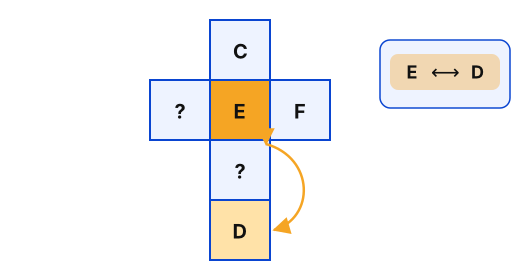
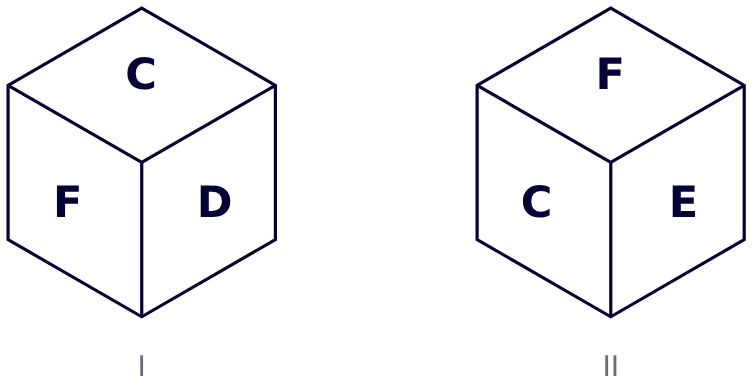
A dice has its faces marked by letters A, B, C, D, E and F. Two different positions of the same dice are shown. Select the letter that will be on the face opposite to the one having E ?
figure
एक पासे के फलकों पर A, B, C, D, E और F अक्षर अंकित हैं। उसी पासे की दो भिन्न स्थितियाँ दर्शाई गई हैं। उस अक्षर का चयन कीजिए जो E वाले फलक के विपरीत फलक पर होगा।
figure
  1. AB
  2. BD
  3. CA
  4. DC
Show answer

Concept: When two views share two faces, the remaining unshared faces are opposite each other.

  1. View 1 shows C, F, D; view 2 shows C, F, E.
  2. C and F are common to both views.
  3. The leftover faces D and E never appear together → they are opposite.

Trick: Two common faces in the same spots → odd ones out are opposite pairs.

Answer: (B) D

अवधारणा: दो स्थितियों में दो फलक समान हों तो बचे हुए असमान फलक आमने-सामने होते हैं।

  1. पहली स्थिति: C, F, D; दूसरी: C, F, E।
  2. C और F दोनों में समान हैं।
  3. बचे D और E कभी साथ नहीं दिखते → ये विपरीत हैं।

ट्रिक: दो समान फलक हों तो बाकी दो असमान फलक विपरीत होते हैं।

उत्तर: (B) D

SSC GDGeneral Intelligence & ReasoningDice – opposite face from two viewsSSC GD 2025 · 5 Feb Shift 3 →
Q3605.
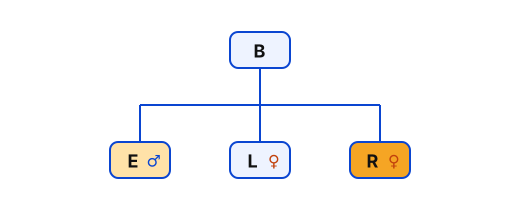
In a certain code language, 'Z + H' means 'Z is the daughter of H', 'Z # H' means 'Z is the sister of H', 'Z @ H' means 'Z is the mother of H' and 'Z % H' means 'Z is the brother of H'.
Based on the above, how is R related to E if 'E % L # R + B'?
एक निश्चित कूट भाषा में, 'Z + H' का अर्थ है 'Z, H की पुत्री है', 'Z # H' का अर्थ है 'Z, H की बहन है', 'Z @ H' का अर्थ है 'Z, H की माता है' तथा 'Z % H' का अर्थ है 'Z, H का भाई है'।
उपर्युक्त के आधार पर, यदि 'E % L # R + B' है, तो R का E से क्या संबंध है?
  1. ASisterबहन
  2. BMotherमाता
  3. CBrotherभाई
  4. DDaughterपुत्री
Show answer

Concept: Decode each symbol pair one by one and note genders.

  1. E % L: E is L's brother (E male).
  2. L # R: L is R's sister.
  3. R + B: R is B's daughter → R is female.
  4. E, L, R are siblings; R is female → R is E's sister.

Trick: Gender of R comes from '+ (daughter)'; siblings chain gives the relation instantly.

Answer: (A) Sister

अवधारणा: हर चिह्न को क्रम से खोलें और लिंग नोट करें।

  1. E % L: E, L का भाई (E पुरुष)।
  2. L # R: L, R की बहन।
  3. R + B: R, B की बेटी → R स्त्री।
  4. E, L, R भाई-बहन हैं; R स्त्री है → R, E की बहन।

ट्रिक: '+' (बेटी) से R का लिंग मिलता है; भाई-बहन की कड़ी से संबंध तुरंत निकलता है।

उत्तर: (A) बहन

SSC GDGeneral Intelligence & ReasoningCoded blood relationSSC GD 2025 · 5 Feb Shift 3 →
Q3606.
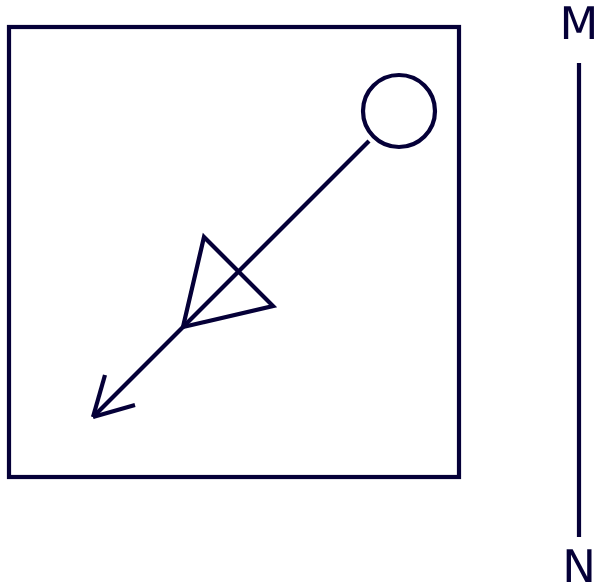
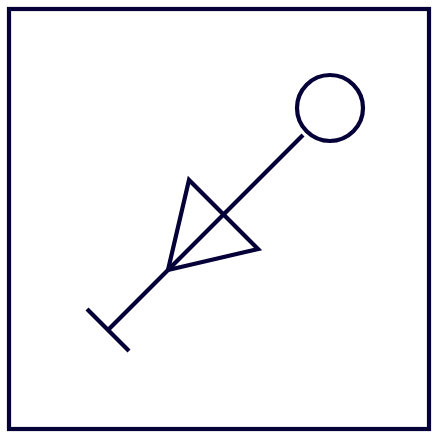
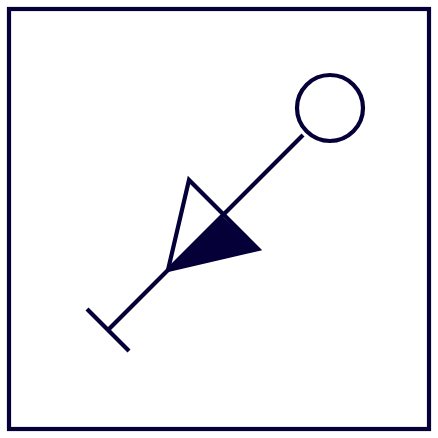
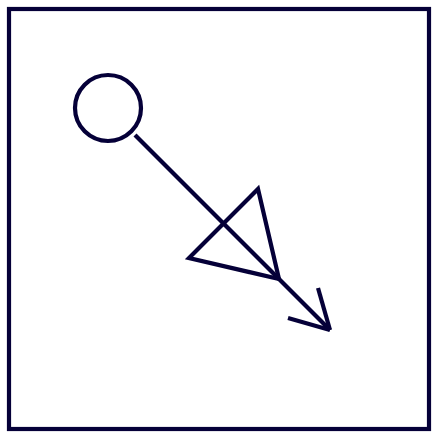
Select the correct mirror image of the given figure when the mirror is placed at MN as shown below.
figure
नीचे दर्शाए अनुसार जब दर्पण MN पर रखा जाता है, तो दी गई आकृति का सही दर्पण प्रतिबिंब चुनिए।
figure
  1. Afigure
  2. Bfigure
  3. Cfigure
  4. Dfigure
Show answer

Concept: A vertical mirror swaps left and right; top and bottom stay the same.

  1. The circle at the top-right of the figure must shift to the top-left.
  2. Options (a) and (b) keep it at the right – rejected.
  3. Option (c) changes the arrowhead shading – rejected; (d) matches fully.

Trick: Track one key part (the small circle) first; it eliminates most options in seconds.

Answer: (D) Figure (d)

अवधारणा: ऊर्ध्वाधर दर्पण में बायाँ-दायाँ बदलता है; ऊपर-नीचे वही रहता है।

  1. ऊपर-दाईं ओर का छोटा वृत्त प्रतिबिंब में ऊपर-बाईं ओर जाएगा।
  2. (a) और (b) में वृत्त दाईं ओर ही है – गलत।
  3. (c) में तीर की छायांकन बदल गई – गलत; (d) पूरा मेल खाता है।

ट्रिक: पहले एक खास हिस्से (छोटा वृत्त) को ट्रैक करें – अधिकतर विकल्प तुरंत हट जाते हैं।

उत्तर: (D) आकृति (d)

SSC GDGeneral Intelligence & ReasoningMirror image – vertical mirrorSSC GD 2025 · 5 Feb Shift 3 →
Q3607.
What should come in place of the question mark (?) in the given series?
419, 424, 430, 437, 445, ?
दी गई शृंखला में प्रश्नवाचक चिह्न (?) के स्थान पर क्या आना चाहिए?
419, 424, 430, 437, 445, ?
  1. A453
  2. B454
  3. C456
  4. D455
Show answer

Concept: Differences increase by 1 each time.

  1. Differences: +5, +6, +7, +8.
  2. Next difference = +9.
  3. ? = 445 + 9 = 454.

Trick: Consecutive-number differences: just add the next integer.

Answer: (B) 454

अवधारणा: अंतर हर बार 1 बढ़ता है।

  1. अंतर: +5, +6, +7, +8।
  2. अगला अंतर = +9।
  3. ? = 445 + 9 = 454।

ट्रिक: अंतर क्रमागत संख्याएँ हों तो अगली संख्या जोड़ दें।

उत्तर: (B) 454

SSC GDGeneral Intelligence & ReasoningNumber series – increasing differencesSSC GD 2025 · 5 Feb Shift 3 →
Q3608.
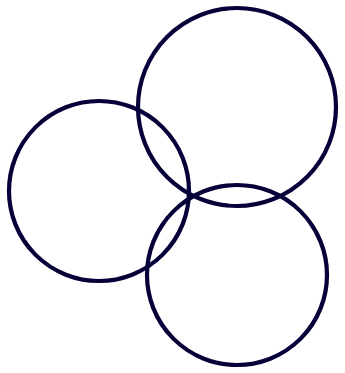
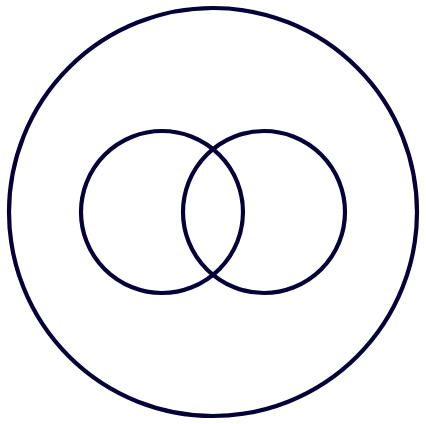
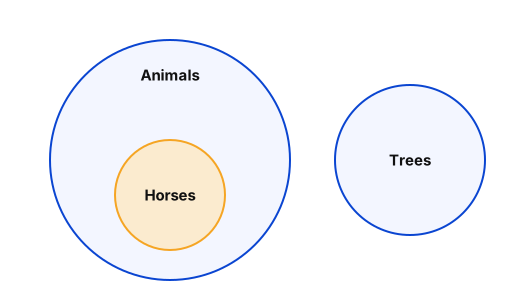
Select the Venn diagram that best illustrates the relationship between the following classes.
Animals, Horses, Trees
उस वेन आरेख का चयन कीजिए जो निम्नलिखित वर्गों के बीच के संबंध को सर्वोत्तम रूप से दर्शाता है।
जानवर, घोड़े, पेड़
  1. Afigure
  2. Bfigure
  3. Cfigure
  4. Dfigure
Show answer

Concept: Show subset as a circle inside another; unrelated class as a separate circle.

  1. Horses ⊂ Animals → small circle inside the bigger one.
  2. Trees have nothing in common with animals → separate circle.
  3. Option (d) shows exactly this.

Trick: Ask two questions: 'Is X a kind of Y?' (inside) and 'Any common member?' (overlap or separate).

Answer: (D) Figure (d)

अवधारणा: उपसमुच्चय को बड़े वृत्त के अंदर और असंबंधित वर्ग को अलग वृत्त में दिखाएँ।

  1. घोड़े ⊂ जानवर → छोटा वृत्त बड़े वृत्त के अंदर।
  2. पेड़ जानवर नहीं हैं → अलग वृत्त।
  3. विकल्प (d) यही दिखाता है।

ट्रिक: दो सवाल पूछें: 'क्या X, Y का प्रकार है?' (अंदर) और 'कोई सदस्य साझा?' (प्रतिच्छेद या अलग)।

उत्तर: (D) आकृति (d)

SSC GDGeneral Intelligence & ReasoningVenn diagram – classesSSC GD 2025 · 5 Feb Shift 3 →
Q3609.
Select the option that represents the letters that, when sequentially placed from left to right in the blanks below, will complete the letter series.
_O_KR__JK_E
उस विकल्प का चयन कीजिए जो उन अक्षरों को निरूपित करता है, जिन्हें नीचे दिए गए रिक्त स्थानों में बाएँ से दाएँ क्रमिक रूप से रखने पर अक्षर-शृंखला पूर्ण हो जाएगी।
_O_KR__JK_E
  1. ARJEOO
  2. BEJEOR
  3. COERJE
  4. DJEORE
Show answer

Concept: The series is a 5-letter block written again and again.

  1. K appears at places 4 and 9 → block length 5.
  2. Block = E O J K R; series: EOJKR EOJKR E.
  3. Blanks (places 1, 3, 6, 7, 10) = E, J, E, O, R.

Trick: Find the gap between two equal letters – that is usually the block length.

Answer: (B) EJEOR

अवधारणा: श्रृंखला 5 अक्षरों का एक खंड है जो बार-बार दोहराया गया है।

  1. K स्थान 4 और 9 पर है → खंड की लंबाई 5।
  2. खंड = E O J K R; श्रृंखला: EOJKR EOJKR E।
  3. रिक्त स्थान (1, 3, 6, 7, 10) = E, J, E, O, R।

ट्रिक: दो समान अक्षरों के बीच की दूरी = प्रायः खंड की लंबाई।

उत्तर: (B) EJEOR

SSC GDGeneral Intelligence & ReasoningLetter series – repeating blockSSC GD 2025 · 5 Feb Shift 3 →
Q3610.
Based on the English alphabetical order, three of the following four letter-clusters are alike in a certain way and thus form a group. Which letter-cluster DOES NOT belong to that group?
(Note: The odd one out is not based on the number of consonants/vowels or their position in the letter-cluster.)
अंग्रेजी वर्णमाला क्रम के आधार पर, निम्नलिखित चार अक्षर-समूहों में से तीन एक निश्चित प्रकार से समान हैं और इस प्रकार एक समूह बनाते हैं। कौन-सा अक्षर-समूह उस समूह से संबंधित नहीं है?
(नोट: विषम अक्षर-समूह, समूह में व्यंजनों/स्वरों की संख्या या उनकी स्थिति पर आधारित नहीं है।)
  1. ALOU
  2. BBEK
  3. CHKQ
  4. DOIG
Show answer

Concept: Find the gaps between letter positions in each cluster.

  1. LOU: 12→15→21 = +3, +6.
  2. BEK: 2→5→11 = +3, +6; HKQ: 8→11→17 = +3, +6.
  3. OIG: 15→9→7 = −6, −2 → different.

Trick: Only OIG runs backward in the alphabet – the odd one is visible at a glance.

Answer: (D) OIG

अवधारणा: हर समूह के अक्षरों के स्थानों का अंतर देखें।

  1. LOU: 12→15→21 = +3, +6।
  2. BEK: 2→5→11 = +3, +6; HKQ: 8→11→17 = +3, +6।
  3. OIG: 15→9→7 = −6, −2 → अलग।

ट्रिक: सिर्फ OIG वर्णमाला में पीछे जाता है – एक नज़र में विषम।

उत्तर: (D) OIG

SSC GDGeneral Intelligence & ReasoningOdd one out – letter gapsSSC GD 2025 · 5 Feb Shift 3 →
Q3611.
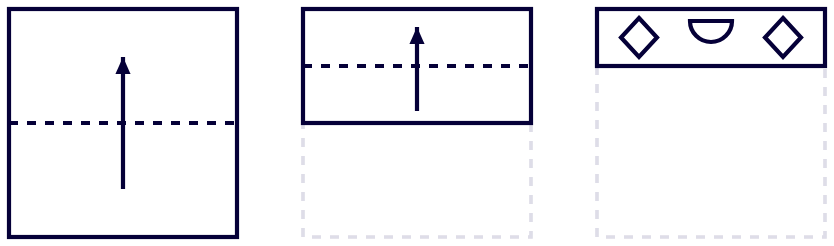
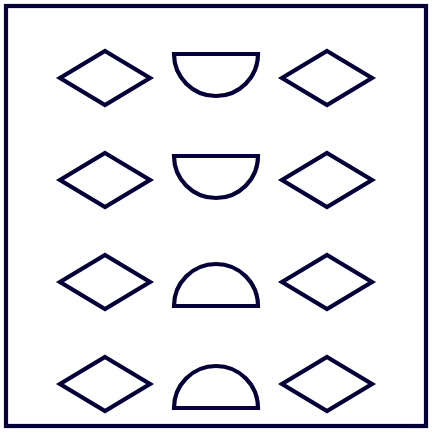
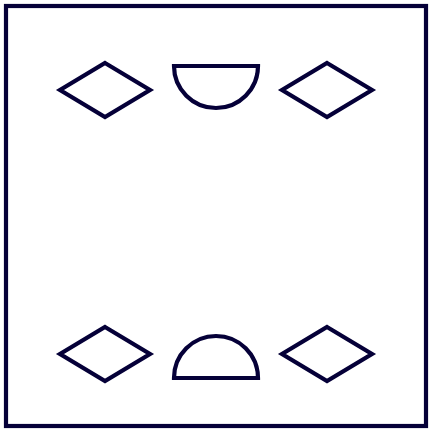
A paper is folded and cut as shown below. How will it appear when unfolded?
figure
एक कागज को नीचे दर्शाए अनुसार मोड़ा और काटा जाता है। खोले जाने पर वह कैसा दिखाई देगा?
figure
  1. Afigure
  2. Bfigure
  3. Cfigure
  4. Dfigure
Show answer

Concept: Each fold doubles the layers; on unfolding, a cut is reflected across every crease.

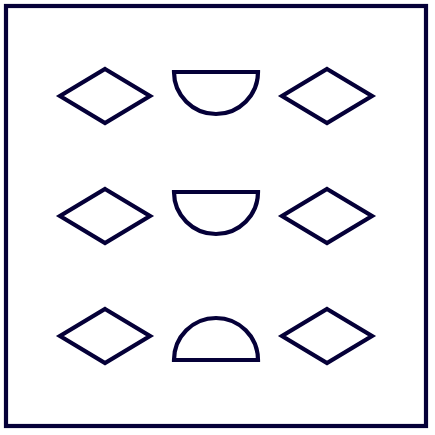
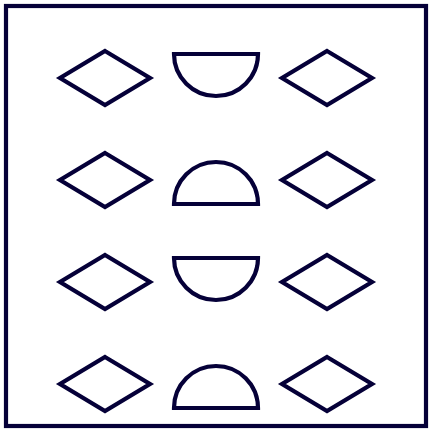
  1. Two folds → 4 layers → each cut shape appears in 4 rows; (a) and (d) are rejected.
  2. A diamond looks the same after reflection, but the half-circle flips at each crease.
  3. So half-circles must alternate: flat-up, flat-down, flat-up, flat-down → only (b).

Trick: Use a non-symmetric cut (half-circle) to decide – it must flip at every fold line.

Answer: (B) Figure (b)

अवधारणा: हर मोड़ से परतें दोगुनी होती हैं; खोलने पर कटाव हर मोड़-रेखा पर दर्पण की तरह उलटता है।

  1. दो मोड़ → 4 परतें → हर कटाव 4 पंक्तियों में; (a) और (d) गलत।
  2. हीरा (diamond) उलटने पर भी वैसा ही दिखता है, पर अर्धवृत्त हर मोड़ पर उलट जाता है।
  3. अर्धवृत्त बारी-बारी उलटे-सीधे होने चाहिए → केवल (b)।

ट्रिक: असममित कटाव (अर्धवृत्त) से फैसला करें – वह हर मोड़ पर उलटता है।

उत्तर: (B) आकृति (b)

SSC GDGeneral Intelligence & ReasoningPaper folding and cuttingSSC GD 2025 · 5 Feb Shift 3 →
Q3612.
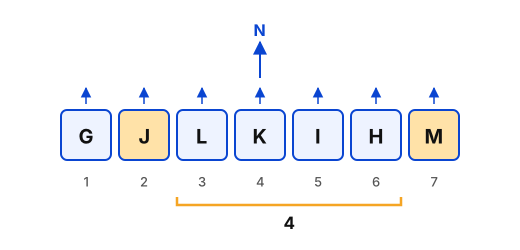
Seven people, G, H, I, J, K, L and M, are sitting in a row, facing north(but not necessarily in the same order) . Only G sits to the left of J. Only four people sit between G and H. Only K sits between L and I, and L is not an immediate neighbour of H .
How many people sit between M and J ?
सात व्यक्ति G, H, I, J, K, L और M एक पंक्ति में उत्तर की ओर मुख करके बैठे हैं (आवश्यक नहीं कि इसी क्रम में)। J के बाईं ओर केवल G बैठा है। G और H के बीच केवल चार व्यक्ति बैठे हैं। L और I के बीच केवल K बैठा है, तथा L, H का निकटतम पड़ोसी नहीं है।
M और J के बीच कितने व्यक्ति बैठे हैं?
  1. AFourचार
  2. BTwoदो
  3. COneएक
  4. DThreeतीन
Show answer

Concept: Fix the seats that are certain first, then place the blocks.

  1. Only G is left of J → G = seat 1, J = seat 2.
  2. Four between G and H → H = seat 6.
  3. L-K-I block fits only in 3, 4, 5; L not next to H → L=3, K=4, I=5; M = 7.
  4. Between M (7) and J (2): L, K, I, H = 4.

Trick: 'Only X is left of Y' instantly fixes X at the end and Y second.

Answer: (A) Four

अवधारणा: पहले निश्चित स्थान तय करें, फिर बाकी समूह रखें।

  1. केवल G, J के बाएँ → G = 1, J = 2।
  2. G और H के बीच चार → H = 6।
  3. L-K-I का समूह 3, 4, 5 में ही आएगा; L, H के पास नहीं → L=3, K=4, I=5; M = 7।
  4. M (7) और J (2) के बीच: L, K, I, H = 4।

ट्रिक: 'केवल X, Y के बाएँ' का अर्थ – X पहले स्थान पर, Y दूसरे पर।

उत्तर: (A) चार

SSC GDGeneral Intelligence & ReasoningLinear seating arrangementSSC GD 2025 · 5 Feb Shift 3 →
Q3613.
In a certain code language, 'LTRH' is coded as '58' and 'NBZW' is coded as '65'. How is 'GSCE' coded in the given language?
एक निश्चित कूट भाषा में, 'LTRH' को '58' के रूप में तथा 'NBZW' को '65' के रूप में कूटबद्ध किया जाता है। उसी भाषा में 'GSCE' को किस प्रकार कूटबद्ध किया जाएगा?
  1. A34
  2. B40
  3. C31
  4. D39
Show answer

Concept: Code = sum of the alphabet positions of the letters.

  1. LTRH: 12+20+18+8 = 58 ✓; NBZW: 14+2+26+23 = 65 ✓.
  2. GSCE: 7+19+3+5 = 34.

Trick: Remember EJOTY (5, 10, 15, 20, 25) to get positions quickly.

Answer: (A) 34

अवधारणा: हर अक्षर का क्रमांक (A=1 … Z=26) जोड़ दें, वही कोड है।

  1. जाँच: LTRH → 12+20+18+8 = 58 ✓, NBZW → 14+2+26+23 = 65 ✓।
  2. GSCE: 7+19+3+5 = 34।

ट्रिक: स्थान जल्दी निकालने के लिए EJOTY (5, 10, 15, 20, 25) याद रखें।

उत्तर: (A) 34

SSC GDGeneral Intelligence & ReasoningLetter coding – sum of positionsSSC GD 2025 · 5 Feb Shift 3 →
Q3614.
What will come in the place of the question mark (?) in the following equation, if ' + ' and ' × ' are interchanged and ' − ' and ' ÷ ' are interchanged?
28 − 4 × 12 ÷ 5 + 3 = ?
निम्नलिखित समीकरण में प्रश्नवाचक चिह्न (?) के स्थान पर क्या आएगा, यदि ' + ' और ' × ' को आपस में बदल दिया जाए तथा ' − ' और ' ÷ ' को आपस में बदल दिया जाए?
28 − 4 × 12 ÷ 5 + 3 = ?
  1. A4
  2. B1
  3. C14
  4. D9
Show answer

Concept: Swap the signs as told, then solve with BODMAS.

  1. After swapping: 28÷4+12−5×3.
  2. 28÷4=7; 5×3=15.
  3. 7+12−15=4.

Trick: Rewrite the whole expression first, then calculate – avoids sign mistakes.

Answer: (A) 4

अवधारणा: बताए अनुसार चिह्न बदलें, फिर BODMAS से हल करें।

  1. बदलने के बाद: 28÷4+12−5×3।
  2. 28÷4=7; 5×3=15।
  3. 7+12−15=4।

ट्रिक: पहले पूरा व्यंजक नए चिह्नों से लिख लें, फिर गणना करें।

उत्तर: (A) 4

SSC GDGeneral Intelligence & ReasoningMathematical operations – interchangeSSC GD 2025 · 5 Feb Shift 3 →
Q3615.
What should come in place of the question mark (?) in the given series based on the English alphabetical order ? MAN, OAP, QAR, ? , UAV
अंग्रेजी वर्णमाला क्रम के आधार पर दी गई शृंखला में प्रश्नवाचक चिह्न (?) के स्थान पर क्या आना चाहिए? MAN, OAP, QAR, ? , UAV
  1. AAST
  2. BSTA
  3. CSAT
  4. DSBT
Show answer

Concept: Study each letter position as its own series.

  1. 1st letters: M, O, Q, ?, U → +2 each → S.
  2. Middle letter is always A.
  3. 3rd letters: N, P, R, ?, V → +2 each → T. Term = SAT.

Trick: Middle A is fixed – that alone removes (a), (b) and (d).

Answer: (C) SAT

अवधारणा: हर स्थान के अक्षर को अलग श्रृंखला मानें।

  1. पहला अक्षर: M, O, Q, ?, U → +2 → S।
  2. बीच का अक्षर हमेशा A।
  3. तीसरा अक्षर: N, P, R, ?, V → +2 → T। पद = SAT।

ट्रिक: बीच में A स्थिर है – इससे ही (a), (b), (d) हट जाते हैं।

उत्तर: (C) SAT

SSC GDGeneral Intelligence & ReasoningLetter series – three-letter termsSSC GD 2025 · 5 Feb Shift 3 →
Q3616.
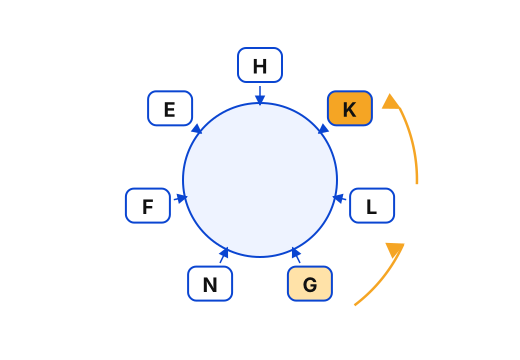
E, F, G, H, K, L and N are sitting around a circular table facing the centre (but not necessarily in the same order) .Only three people sit between H and N when counted from the left of H . Only three people sit between L and E when counted from the right of E. K sits to the immediate right of L. F is an immediate neighbour of E as well as N .
Who sits second to the right of G ?
E, F, G, H, K, L और N एक वृत्ताकार मेज के चारों ओर केंद्र की ओर मुख करके बैठे हैं (आवश्यक नहीं कि इसी क्रम में)। H के बाएँ से गिनने पर H और N के बीच केवल तीन व्यक्ति बैठे हैं। E के दाएँ से गिनने पर L और E के बीच केवल तीन व्यक्ति बैठे हैं। K, L के ठीक दाएँ बैठा है। F, E तथा N दोनों का निकटतम पड़ोसी है।
G के दाएँ दूसरे स्थान पर कौन बैठा है?
  1. AN
  2. BE
  3. CL
  4. DK
Show answer

Concept: Facing the centre: left = clockwise, right = anticlockwise.

  1. N is 4th seat clockwise from H; L is 4th seat anticlockwise from E.
  2. K is immediately right (anticlockwise) of L; F sits between E and N.
  3. Clockwise order: H, K, L, G, N, F, E.
  4. Second to the right of G (anticlockwise 2 steps): L, then K.

Trick: Draw 7 dots first and place the person with most clues (H, N) before others.

Answer: (D) K

अवधारणा: केंद्र की ओर मुख: बायाँ = दक्षिणावर्त, दायाँ = वामावर्त।

  1. H से गिनती बाएँ ओर: बीच में तीन लोग, फिर N। E से दाएँ ओर: बीच में तीन, फिर L।
  2. K ठीक L के दाहिने हाथ पर; F दोनों – E व N – को छूता है।
  3. घड़ी की दिशा में बैठक: HKLGNFE।
  4. G से दाहिनी ओर दो सीट चलें: पहली L, दूसरी K।

ट्रिक: पहले 7 बिंदु बनाएँ और सबसे अधिक सूचना वाले (H, N) को पहले बैठाएँ।

उत्तर: (D) K

SSC GDGeneral Intelligence & ReasoningCircular seating arrangementSSC GD 2025 · 5 Feb Shift 3 →
Q3617.
The position(s) of how many letters will remain unchanged if each of the letters in the word REVERSAL is arranged in the reverse English alphabetical order ?
यदि शब्द REVERSAL के प्रत्येक अक्षर को अंग्रेजी वर्णमाला के विपरीत क्रम में व्यवस्थित किया जाए, तो कितने अक्षरों की स्थिति अपरिवर्तित रहेगी?
  1. AZeroशून्य
  2. BThreeतीन
  3. CTwoदो
  4. DOneएक
Show answer

Concept: Rearrange the letters as asked and compare place by place.

  1. Original: REVERSAL.
  2. Sorted Z→A: VSRRLEEA.
  3. Place-wise no letter matches → 0.

Trick: V must come first and A last – once 1st and last differ, check the middle quickly.

Answer: (A) Zero

अवधारणा: अक्षरों को बताए क्रम में लगाकर स्थान-दर-स्थान मिलाएँ।

  1. मूल शब्द: REVERSAL।
  2. Z→A क्रम में: VSRRLEEA।
  3. दोनों पंक्तियों में एक भी स्थान पर एक-सा अक्षर नहीं → 0।

ट्रिक: V सबसे पहले और A सबसे अंत में आएगा – फिर बीच के स्थान जल्दी जाँच लें।

उत्तर: (A) शून्य

SSC GDGeneral Intelligence & ReasoningLetter arrangement – unchanged positionsSSC GD 2025 · 5 Feb Shift 3 →
Q3618.
Read the given statements and conclusions carefully. Assuming that the information given in the statements is true, even if it appears to be at variance with commonly known facts, decide which of the given conclusions logically follow(s) from the statements.
Statements:
All salads are appetizers.
All salads are food.
All food are rice.
Conclusions:
(I): All salads are rice.
(II): Some foods are appetizers.
दिए गए कथनों और निष्कर्षों को ध्यानपूर्वक पढ़िए। यह मानते हुए कि कथनों में दी गई जानकारी सत्य है, भले ही वह सर्वज्ञात तथ्यों से भिन्न प्रतीत होती हो, निर्णय कीजिए कि दिए गए निष्कर्षों में से कौन-सा/से निष्कर्ष कथनों का तार्किक रूप से अनुसरण करता है/करते हैं।
कथन:
सभी सलाद क्षुधावर्धक हैं।
सभी सलाद भोजन हैं।
सभी भोजन चावल हैं।
निष्कर्ष:
(I): सभी सलाद चावल हैं।
(II): कुछ भोजन क्षुधावर्धक हैं।
  1. ABoth conclusions (I) and (II) follow.निष्कर्ष (I) और (II) दोनों अनुसरण करते हैं।
  2. BOnly conclusion (I) follows.केवल निष्कर्ष (I) अनुसरण करता है।
  3. COnly conclusion (II) follows.केवल निष्कर्ष (II) अनुसरण करता है।
  4. DNeither conclusion (I) nor (II) follows.न तो निष्कर्ष (I) और न ही निष्कर्ष (II) अनुसरण करता है।
Show answer

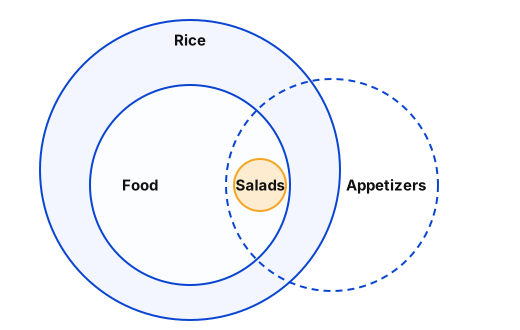
Concept: Use 'All' chains and common subsets to test conclusions.

  1. All salads → food → rice, so 'All salads are rice' (I) follows.
  2. Salads are inside both food and appetizers, so some food are appetizers – (II) follows.
  3. Both follow.

Trick: If one set (salads) sits inside two sets, those two sets surely overlap ('Some').

Answer: (A) Both conclusions (I) and (II) follow.

अवधारणा: 'सभी' की कड़ी और साझा उपसमुच्चय से निष्कर्ष जाँचें।

  1. सभी सलाद → भोजन → चावल, अतः (I) 'सभी सलाद चावल हैं' सही।
  2. सलाद, भोजन और ऐपेटाइज़र दोनों के अंदर है → कुछ भोजन ऐपेटाइज़र हैं – (II) सही।
  3. दोनों निष्कर्ष सही।

ट्रिक: एक समुच्चय दो समुच्चयों के अंदर हो, तो वे दोनों अवश्य आंशिक रूप से मिलते हैं ('कुछ')।

उत्तर: (A) निष्कर्ष (I) और (II) दोनों अनुसरण करते हैं।

SSC GDGeneral Intelligence & ReasoningSyllogismSSC GD 2025 · 5 Feb Shift 3 →
Q3619.
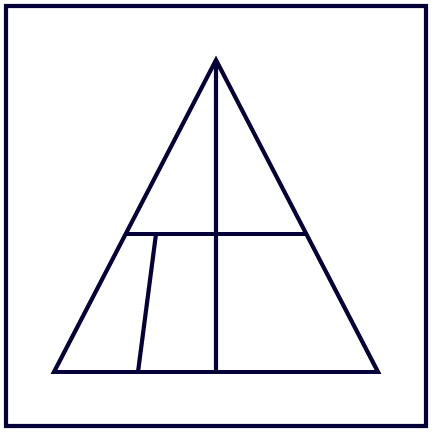
Identify the figure given in the options which when put in place of the question mark (?) will logically complete the series.
figure
उस आकृति की पहचान कीजिए जो विकल्पों में दी गई है और जिसे प्रश्नवाचक चिह्न (?) के स्थान पर रखने पर शृंखला तार्किक रूप से पूर्ण हो जाएगी।
figure
  1. Afigure
  2. Bfigure
  3. Cfigure
  4. Dfigure
Show answer

Concept: All figures are divided into the same number of parts in the same way.

  1. Hexagon, trapezium, circle, square: each split into 5 parts.
  2. Pattern: vertical + horizontal middle line and one extra line in the lower-left quarter.
  3. Only the triangle in (b) is cut this way into 5 parts.

Trick: Count regions in each figure – when shapes keep changing, the rule is usually the division.

Answer: (B) Figure (b)

अवधारणा: हर आकृति एक ही तरीके से समान भागों में बँटी है।

  1. दी गई चारों आकृतियों में से हर एक के कुल पाँच हिस्से बनते हैं।
  2. बँटवारा: एक खड़ी + एक आड़ी रेखा, और नीचे बाईं ओर वाले चौथाई में एक रेखा और।
  3. विकल्प (b) का त्रिभुज ठीक इसी ढंग से पाँच हिस्सों में कटा है।

ट्रिक: आकृतियाँ बदलती रहें तो भागों की गिनती करें – नियम प्रायः बँटवारे में होता है।

उत्तर: (B) आकृति (b)

SSC GDGeneral Intelligence & ReasoningFigure series – number of partsSSC GD 2025 · 5 Feb Shift 3 →
Q3620.
GD 34 is related to HE 24 in a certain way. In the same way, CJ 12 is related to DK 2. To which of the given options is XV 56 related, following the same logic ?
GD 34 एक निश्चित प्रकार से HE 24 से संबंधित है। उसी प्रकार, CJ 12, DK 2 से संबंधित है। समान तर्क का अनुसरण करते हुए, XV 56 दिए गए विकल्पों में से किससे संबंधित है?
  1. AYX 46
  2. BYW 46
  3. CXW 46
  4. DYW 47
Show answer

Concept: Treat letters and number separately.

  1. Letters: each moves +1 (G→H, D→E; C→D, J→K).
  2. Number: −10 (34→24; 12→2).
  3. XV 56 → YW 46.

Trick: Number rule alone (56−10=46) leaves (a), (b), (c); letter X+1=Y, V+1=W picks (b).

Answer: (B) YW 46

अवधारणा: अक्षरों का नियम और संख्या का नियम अलग से निकालें।

  1. अक्षर: हर अक्षर +1 (G→H, D→E; C→D, J→K)।
  2. संख्या: −10 (34→24; 12→2)।
  3. XV 56 → YW 46।

ट्रिक: संख्या नियम (56−10=46) से (d) हटता है; X+1=Y, V+1=W से (b) तय।

उत्तर: (B) YW 46

SSC GDGeneral Intelligence & ReasoningAlphanumeric analogySSC GD 2025 · 5 Feb Shift 3 →