Question bank

Q&A: practice questions with answers

Search questions on any topic. Filter by exam category, exam, subject and topic, try the question, then open the answer and explanation.

Courses – airGurukul

4,200 questions found.

Q4001.
Three of the following four letter - clusters are alike in a certain way and thus form a group. Which is the letter-cluster that does NOT belong to that group? (Note: The odd one out is not based on the number of consonants / vowels or their positions in the letter -cluster.)
निम्नलिखित चार अक्षर-समूहों में से तीन एक निश्चित प्रकार से समान हैं और इस प्रकार एक समूह बनाते हैं। कौन-सा अक्षर-समूह उस समूह से संबंधित नहीं है? (नोट: विषम अक्षर-समूह का आधार अक्षर-समूह में व्यंजनों/स्वरों की संख्या अथवा उनकी स्थिति नहीं है।)
  1. APTV
  2. BCGI
  3. CEIK
  4. DGLM
Show answer

Concept: Convert letters to place values and compare the jumps inside each cluster.

  1. PTV = 16, 20, 22 → jumps +4, +2.
  2. CGI = 3, 7, 9 → +4, +2; EIK = 5, 9, 11 → +4, +2.
  3. GLM = 7, 12, 13 → +5, +1, a different pattern.

Trick: Check only the last two letters: in PTV, CGI, EIK they are 2 apart (T_V, G_I, I_K); in GLM they are adjacent – odd one spotted in 5 seconds.

Answer: (D) GLM

अवधारणा: अक्षरों को स्थान-मान में बदलकर हर समूह के अंदर का अंतर देखें।

  1. PTV = 16, 20, 22 → अंतर +4, +2।
  2. CGI = 3, 7, 9 और EIK = 5, 9, 11 → दोनों में +4, +2।
  3. GLM = 7, 12, 13 → अंतर +5, +1, यानी पैटर्न अलग।

ट्रिक: सिर्फ़ आख़िरी दो अक्षर देखें – बाकी तीनों में बीच में एक अक्षर छूटा है, GLM में L-M सटे हुए हैं।

उत्तर: (D) GLM
SSC GDGeneral Intelligence & ReasoningOdd one out – letter gapsSSC GD 2025 · 4 Feb Shift 2 →
Q4002.
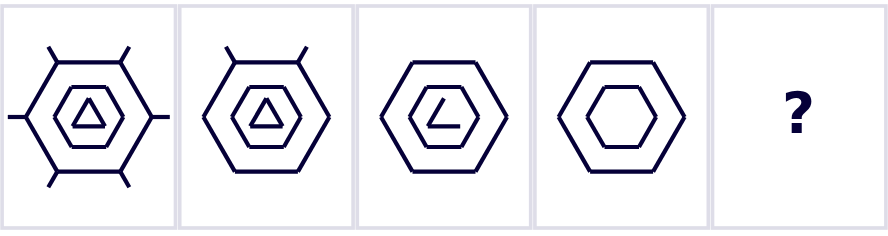
Identify the figure given in the options which when put in place of the question mark (?) will logically complete the series.
figure
विकल्पों में दी गई उस आकृति की पहचान कीजिए, जिसे प्रश्न चिह्न (?) के स्थान पर रखने से शृंखला तार्किक रूप से पूर्ण हो जाएगी।
figure
  1. Afigure
  2. Bfigure
  3. Cfigure
  4. Dfigure
Show answer

Concept: When parts disappear step by step, count the lines in each figure and track how many vanish.

  1. Line counts: 21 → 17 → 14 → 12 (two hexagons + spokes/triangle).
  2. Lines removed each step: 4, 3, 2 – a falling pattern.
  3. Next removal = 1, so the 5th figure has 12 − 1 = 11 lines: full outer hexagon, inner hexagon missing one side.
  4. Only option (C) shows this.

Trick: In “disappearing parts” series, write the line-count differences; they usually form a simple decreasing sequence (4, 3, 2, 1).

Answer: (C) Figure (c)

अवधारणा: जब आकृति के भाग धीरे-धीरे हटते हैं, तो हर आकृति की रेखाएँ गिनें और देखें कितनी घट रही हैं।

  1. रेखाओं की संख्या: 21 → 17 → 14 → 12।
  2. हर बार घटी रेखाएँ: 4, 3, 2।
  3. अगली बार 1 घटेगी, यानी 12 − 1 = 11 रेखाएँ – बाहरी षट्भुज पूरा, अंदर वाले की एक भुजा गायब।
  4. ऐसी आकृति केवल विकल्प (C) में है।

ट्रिक: ऐसे प्रश्नों में रेखाओं का अंतर लिखें – अक्सर 4, 3, 2, 1 जैसा घटता क्रम मिलता है।

उत्तर: (C) आकृति (c)

SSC GDGeneral Intelligence & ReasoningFigure series – counting line segmentsSSC GD 2025 · 4 Feb Shift 2 →
Q4003.
REMY is related to VHOZ in a certain way based on the English alphabetical order. In the same way, ZFHU is related to DIJV. To which of the given options is LBSO related, following the same logic?
अंग्रेजी वर्णमाला क्रम के आधार पर, REMY एक निश्चित प्रकार से VHOZ से संबंधित है। उसी प्रकार, ZFHU, DIJV से संबंधित है। समान तर्क का अनुसरण करते हुए, LBSO दिए गए विकल्पों में से किससे संबंधित है?
  1. AQDWR
  2. BOFVQ
  3. CPEUP
  4. DRDWP
Show answer

Concept: Find the forward shift for each letter position and apply the same to the new word.

  1. REMY → VHOZ: +4, +3, +2, +1.
  2. ZFHU → DIJV: Z+4 = D (wrap), F+3 = I, H+2 = J, U+1 = V – same rule.
  3. Apply to LBSO: L moves 4 to reach P, B moves 3 to reach E, S moves 2 to reach U, O moves 1 to reach P → PEUP.

Trick: The last letter moves just +1: O → P. First letter L+4 = P and last letter O+1 = P; only PEUP starts and ends with P.

Answer: (C) PEUP

अवधारणा: हर स्थान के अक्षर का आगे खिसकाव निकालें और वही नियम नए शब्द पर लगाएँ।

  1. REMY → VHOZ: +4, +3, +2, +1।
  2. ZFHU → DIJV में भी यही (Z+4 = D, घूमकर)।
  3. LBSO पर लगाएँ: L से 4 आगे P, B से 3 आगे E, S से 2 आगे U, O से 1 आगे P → PEUP।

ट्रिक: पहला अक्षर L+4 = P और आख़िरी O+1 = P – दोनों शर्तें सिर्फ़ PEUP पूरी करता है।

उत्तर: (C) PEUP

SSC GDGeneral Intelligence & ReasoningLetter analogy – decreasing shiftsSSC GD 2025 · 4 Feb Shift 2 →
Q4004.
Read the given statements and conclusions carefully. Assuming that the information given in the statements is true, even if it appears to be at variance with commonly known facts, decide which of the given conclusions logically follow(s) from the statements.
Statements:
All wires are cables.
All wires are ropes.
Some ropes are steels.
Conclusions:
(I) Some steels are wires.
(II) Some ropes are cables.
दिए गए कथनों और निष्कर्षों को ध्यानपूर्वक पढ़िए। यह मानते हुए कि कथनों में दी गई जानकारी सत्य है, चाहे वह सर्वज्ञात तथ्यों से भिन्न प्रतीत होती हो, निर्णय कीजिए कि दिए गए निष्कर्षों में से कौन-सा/से कथनों का तार्किक रूप से अनुसरण करता है/करते हैं।
कथन:
सभी तार, केबल हैं।
सभी तार, रस्सियाँ हैं।
कुछ रस्सियाँ, स्टील हैं।
निष्कर्ष:
(I) कुछ स्टील, तार हैं।
(II) कुछ रस्सियाँ, केबल हैं।
  1. AOnly conclusion (I) followsकेवल निष्कर्ष (I) अनुसरण करता है
  2. BOnly conclusion (II) followsकेवल निष्कर्ष (II) अनुसरण करता है
  3. CNeither conclusion (I) nor (II) followsन तो निष्कर्ष (I) और न ही (II) अनुसरण करता है
  4. DBoth conclusions (I) and (II) followनिष्कर्ष (I) और (II) दोनों अनुसरण करते हैं
Show answer

Concept: A conclusion follows only if it is true in every possible diagram.

  1. Wires sit fully inside both Cables and Ropes.
  2. (I) Steels touch Ropes somewhere, not necessarily the Wires part → only a possibility, does not follow.
  3. (II) Every wire is both a rope and a cable, so those ropes are cables → “Some ropes are cables” is certain.

Trick: “All A are B” + “All A are C” always gives “Some B are C” (and “Some C are B”).

Answer: (B) Only conclusion (II) follows

अवधारणा: निष्कर्ष तभी मान्य है जब वह हर संभव वेन आरेख में सही हो।

  1. Wires पूरी तरह Cables और Ropes दोनों के अंदर है।
  2. (I) Steels का Ropes से संबंध है, Wires से ज़रूरी नहीं → सिर्फ़ संभावना, इसलिए गलत।
  3. (II) हर wire एक rope भी है और cable भी → ropes और cables का कुछ भाग साझा है – पक्का।

ट्रिक: “सभी A, B हैं” + “सभी A, C हैं” से हमेशा “कुछ B, C हैं” निकलता है।

उत्तर: (B) सिर्फ़ दूसरा निष्कर्ष (II) सही है

SSC GDGeneral Intelligence & ReasoningSyllogism – all/someSSC GD 2025 · 4 Feb Shift 2 →
Q4005.
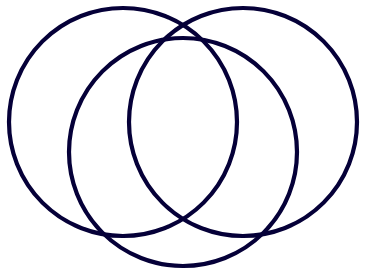
Select the Venn diagram that best illustrates the relationship between the following classes.
Transport, Bus, Airplane
उस वेन आरेख का चयन कीजिए जो निम्नलिखित वर्गों के बीच के संबंध को सर्वोत्तम रूप से दर्शाता है।
परिवहन, बस, वायुयान
  1. Afigure
  2. Bfigure
  3. Cfigure
  4. Dfigure
Show answer

Concept: Show a class containing two separate sub-classes.

  1. Bus ⊂ Transport and Airplane ⊂ Transport.
  2. A bus can never be an airplane → the two small circles do not overlap.
  3. Required shape: one big circle with two separate circles inside – option (A).

Yaad rakhein: Same pattern fits pairs like Vehicle–Car–Truck or Fruit–Apple–Mango.

Answer: (A) Two separate circles inside one large circle

अवधारणा: एक बड़े वर्ग के अंदर दो अलग-अलग उपवर्ग दिखाने हैं।

  1. बस और हवाई जहाज़ दोनों परिवहन के साधन हैं → दोनों Transport के अंदर।
  2. कोई बस हवाई जहाज़ नहीं हो सकती → दोनों छोटे वृत्त अलग रहेंगे।
  3. यानी एक बड़े वृत्त में दो अलग वृत्त – विकल्प (A)।

याद रखें: फल–सेब–आम, वाहन–कार–ट्रक जैसे प्रश्नों में भी यही आरेख आता है।

उत्तर: (A) बड़े वृत्त में दो अलग वृत्त

SSC GDGeneral Intelligence & ReasoningVenn diagram – whole and two partsSSC GD 2025 · 4 Feb Shift 2 →
Q4006.
In a certain code language 'PGMS' is coded as '9-18-12-6' and 'TBRX' is coded as '5-23-7-1'. What is the code for 'KAVO' in the given language ?
एक निश्चित कूट भाषा में 'PGMS' को '9-18-12-6' के रूप में कूटबद्ध किया जाता है तथा 'TBRX' को '5-23-7-1' के रूप में कूटबद्ध किया जाता है। उसी कूट भाषा में 'KAVO' का कूट क्या होगा?
  1. A14-24-3-10
  2. B13-25-6-12
  3. C11-21-2-9
  4. D15-26 - 4-11
Show answer

Concept: Compare each letter's position with its code number.

  1. P(16) → 9, G(7) → 18, M(13) → 12, S(19) → 6: each pair adds to 25.
  2. T(20) → 5, X(24) → 1 confirm code = 25 − position.
  3. KAVO = 11, 1, 22, 15 → 14, 24, 3, 10.

Trick: Just test the first letter: K = 11, 25 − 11 = 14 – only option (A) starts with 14.

Answer: (A) 14-24-3-10

अवधारणा: हर अक्षर के स्थान-मान और उसके कोड की तुलना करें।

  1. P(16)+9 = 25, G(7)+18 = 25, M(13)+12 = 25, S(19)+6 = 25।
  2. नियम: कोड = 25 − स्थान-मान (TBRX से भी पुष्टि)।
  3. KAVO = 11, 1, 22, 15 → 14, 24, 3, 10।

ट्रिक: केवल पहला अक्षर जाँचें: K = 11, 25 − 11 = 14 – सिर्फ़ विकल्प (A) 14 से शुरू होता है।

उत्तर: (A) 14-24-3-10

SSC GDGeneral Intelligence & ReasoningCoding – 25 minus positionSSC GD 2025 · 4 Feb Shift 2 →
Q4007.
In a certain code language, ' A+B′ means ' A is the sister of B ', ' A−B ' means ' A is the father of B ', ' A×B ' means ' A is the brother of B ' and ' A÷B ' means ' A is the mother of B '. How is A related to D if 'A÷ B+C × D-E'?
एक निश्चित कूट भाषा में, ' A+B′ का अर्थ है ' A, B की बहन है ', ' A−B ' का अर्थ है ' A, B का पिता है ', ' A×B ' का अर्थ है ' A, B का भाई है ' तथा ' A÷B ' का अर्थ है ' A, B की माता है '। यदि 'A÷ B+C × D-E' है, तो A, D से किस प्रकार संबंधित है?
  1. ASister's daughterबहन की पुत्री
  2. BMotherमाता
  3. CFather's motherपिता की माता
  4. DDaughter's sisterपुत्री की बहन
Show answer

Concept: Decode each symbol pair and link the people.

  1. A ÷ B: A is B's mother.
  2. B + C: B is C's sister; C × D: C is D's brother → B, C, D are siblings.
  3. D − E: D is E's father (only tells D is male).
  4. The mother of B is also the mother of D.

Trick: Ignore the last link (D − E) – the question asks A to D, and A → B → C → D is a sibling chain from A's child.

Answer: (B) Mother

अवधारणा: हर चिह्न का अर्थ लगाकर लोगों को जोड़ें।

  1. A ÷ B: A, B की माँ है।
  2. B + C: B, C की बहन; C × D: C, D का भाई → B, C, D भाई-बहन हैं।
  3. D − E: D, E का पिता (केवल D पुरुष है, यह बताता है)।
  4. जो B की माँ है, वही D की माँ है।

ट्रिक: पूछा A और D का संबंध है, इसलिए D − E वाला हिस्सा छोड़ दें।

उत्तर: (B) माँ

SSC GDGeneral Intelligence & ReasoningCoded blood relationSSC GD 2025 · 4 Feb Shift 2 →
Q4008.
What will come in the place of the question mark (?) in the following equation, if ' + ' and ' - ' are interchanged and ' x ' and ' ÷ ' are interchanged ? 18÷5+26−45×5= ?
यदि ' + ' तथा ' - ' को आपस में बदल दिया जाए और ' x ' तथा ' ÷ ' को आपस में बदल दिया जाए, तो निम्नलिखित समीकरण में प्रश्न चिह्न (?) के स्थान पर क्या आएगा ? 18÷5+26−45×5= ?
  1. A75
  2. B73
  3. C80
  4. D68
Show answer

Concept: Swap the signs first, then solve with BODMAS.

  1. 18 ÷ 5 + 26 − 45 × 5 becomes 18 × 5 − 26 + 45 ÷ 5.
  2. 18 × 5 = 90, 45 ÷ 5 = 9.
  3. 90 − 26 + 9 = 73.

Trick: 45 must be divided by 5 after the swap (45 ÷ 5 = 9 is neat) – a quick hint you swapped correctly.

Answer: (B) 73

अवधारणा: पहले चिह्न बदलें, फिर BODMAS से हल करें।

  1. 18 ÷ 5 + 26 − 45 × 5 → 18 × 5 − 26 + 45 ÷ 5।
  2. 18 × 5 = 90, 45 ÷ 5 = 9।
  3. 90 − 26 + 9 = 73।

ट्रिक: बदलने के बाद 45 ÷ 5 = 9 पूरा भाग जाता है – इससे पता चलता है कि चिह्न सही बदले गए।

उत्तर: (B) 73

SSC GDGeneral Intelligence & ReasoningSign interchange – BODMASSSC GD 2025 · 4 Feb Shift 2 →
Q4009.
What should come in place of the question mark (?) in the given series?
79 72 58 37 9 ?
दी गई शृंखला में प्रश्न-चिह्न (?) के स्थान पर क्या आना चाहिए?
79 72 58 37 9 ?
  1. A-26
  2. B-24
  3. C-27
  4. D-25
Show answer

Concept: Check the gaps between consecutive terms.

  1. 79 − 72 = 7, 72 − 58 = 14, 58 − 37 = 21, 37 − 9 = 28.
  2. Gaps are 7×1, 7×2, 7×3, 7×4 → next gap 7×5 = 35.
  3. 9 − 35 = −26.

Trick: All terms from 79 drop by 7k; 79 − 7(1+2+3+4+5) = 79 − 105 = −26.

Answer: (A) −26

अवधारणा: लगातार पदों के बीच का अंतर देखें।

  1. अंतर: 7, 14, 21, 28 (घटाते हुए)।
  2. ये 7 के गुणज हैं, अगला अंतर 35।
  3. 9 − 35 = −26।

ट्रिक: 79 − 7 × (1+2+3+4+5) = 79 − 105 = −26, सीधे उत्तर।

उत्तर: (A) −26

SSC GDGeneral Intelligence & ReasoningNumber series – multiples of 7SSC GD 2025 · 4 Feb Shift 2 →
Q4010.
In a certain code language, 'TEDI' is coded as '11' and 'SUCBVO' is coded as '13'. How is 'YXJIAZL' coded in the given language?
एक निश्चित कूट भाषा में, 'TEDI' को '11' के रूप में कूटबद्ध किया जाता है तथा 'SUCBVO' को '13' के रूप में कूटबद्ध किया जाता है। उसी कूट भाषा में 'YXJIAZL' को किस प्रकार कूटबद्ध किया जाएगा?
  1. A9
  2. B10
  3. C14
  4. D12
Show answer

Concept: When the code is a single number, link it to the number of letters.

  1. TEDI: 4 letters → 11 = 4 + 7.
  2. SUCBVO: 6 letters → 13 = 6 + 7.
  3. YXJIAZL: 7 letters → 7 + 7 = 14.

Trick: Two words differ by 2 letters and codes differ by 2 → code moves with length, so just add the constant.

Answer: (C) 14

अवधारणा: जब कोड एक ही संख्या हो, तो उसे शब्द के अक्षरों की गिनती से जोड़कर देखें।

  1. TEDI में 4 अक्षर → 4 + 7 = 11।
  2. SUCBVO में 6 अक्षर → 6 + 7 = 13।
  3. YXJIAZL में 7 अक्षर → 7 + 7 = 14।

ट्रिक: अक्षर 2 बढ़े तो कोड भी 2 बढ़ा – यानी कोड = अक्षर + स्थिर संख्या।

उत्तर: (C) 14

SSC GDGeneral Intelligence & ReasoningCoding – letter count basedSSC GD 2025 · 4 Feb Shift 2 →
Q4011.
Eight people are sitting in two parallel rows containing 4 people each, in such a way that there is equal distance between adjacent persons.
In row 1 - I, N, K and S are seated and all of them are facing south.
In row 2 - P, A, R and T are seated and all of them are facing north.
Thus, each person faces another person from the other row.
R sits to the immediate right of A. Only two people sit between K and S. A faces K. The one who faces N sits to the immediate left of P. T doesn't sit at any of the extreme ends.
Which of the following options represents both people facing each other?
आठ व्यक्ति दो समानांतर पंक्तियों में इस प्रकार बैठे हैं कि प्रत्येक पंक्ति में 4 व्यक्ति हैं तथा आसन्न व्यक्तियों के बीच समान दूरी है।
पंक्ति 1 में - I, N, K और S बैठे हैं तथा ये सभी दक्षिण की ओर उन्मुख हैं।
पंक्ति 2 में - P, A, R और T बैठे हैं तथा ये सभी उत्तर की ओर उन्मुख हैं।
इस प्रकार, प्रत्येक व्यक्ति दूसरी पंक्ति के किसी एक व्यक्ति के सम्मुख है।
R, A के ठीक दाएँ बैठा है। K और S के बीच केवल दो व्यक्ति बैठे हैं। A, K के सम्मुख है। जो N के सम्मुख है, वह P के ठीक बाएँ बैठा है। T किसी भी अंतिम छोर पर नहीं बैठा है।
निम्नलिखित में से कौन-सा विकल्प उन दो व्यक्तियों को दर्शाता है जो एक-दूसरे के सम्मुख हैं?
  1. AI and RI और R
  2. BN and PN और P
  3. CS and RS और R
  4. DK and TK और T
Show answer

Concept: Fix the north-facing row first, then match faces.

  1. R is immediate right of A and T is not at an end → Row 2 (left to right for north-facers): A, R, T, P.
  2. A faces K; K and S have two people between them → K and S occupy the two ends, S faces P.
  3. Person facing N is immediate left of P = T → N faces T.
  4. Remaining I faces R.

Trick: “Only two between” in a row of 4 means both are at the ends – place them first.

Answer: (A) I and R

अवधारणा: पहले उत्तर की ओर मुख वाली पंक्ति तय करें, फिर आमने-सामने मिलाएँ।

  1. R, A के ठीक दाएँ और T किनारे पर नहीं → पंक्ति 2: A, R, T, P।
  2. A के सामने K; K और S के बीच दो लोग → दोनों किनारों पर, S के सामने P।
  3. N के सामने वाला P के ठीक बाएँ = T → N के सामने T।
  4. बचा I, जो R के सामने है।

ट्रिक: 4 की पंक्ति में “बीच में केवल दो” का अर्थ है दोनों किनारों पर।

उत्तर: (A) I और R

SSC GDGeneral Intelligence & ReasoningSeating – two parallel rowsSSC GD 2025 · 4 Feb Shift 2 →
Q4012.
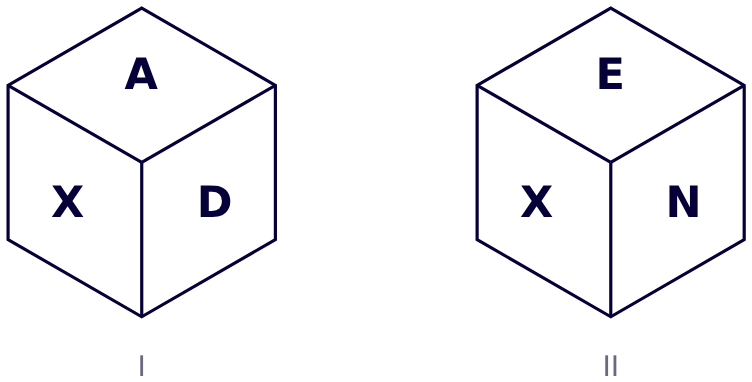
A dice has its faces marked by letters D, X, A, N, R and E. Two positions of the same dice are given below. Which face is opposite to face A?
figure
एक पासे के फलकों पर अक्षर D, X, A, N, R और E अंकित हैं। इसी पासे की दो स्थितियाँ नीचे दी गई हैं। फलक A के विपरीत कौन-सा फलक है?
figure
  1. AR
  2. BD
  3. CE
  4. DN
Show answer

Concept: With one common face in the same place, compare the remaining faces directly.

  1. X is fixed in both views; the cube is rotated about X.
  2. Top changes A → E and right changes D → N (a half turn), so A–E and D–N are opposite pairs.
  3. Leftover pair: X–R.

Trick: Common face at same position → the faces sitting in the same spots in both views are opposite (A↔E, D↔N).

Answer: (C) E

अवधारणा: उभयनिष्ठ फलक एक ही जगह हो तो बाकी फलकों की सीधी तुलना करें।

  1. दोनों चित्रों में X एक ही स्थान पर है।
  2. ऊपर A की जगह E, दाएँ D की जगह N → A–E और D–N विपरीत।
  3. बचा जोड़ा X–R।

ट्रिक: उभयनिष्ठ फलक समान स्थान पर हो, तो समान स्थानों के फलक आपस में विपरीत होते हैं।

उत्तर: (C) E

SSC GDGeneral Intelligence & ReasoningDice – two positionsSSC GD 2025 · 4 Feb Shift 2 →
Q4013.
What should come in place of the question mark (?) in the given series based on the English alphabetical order? WUY KIM YWA MKO ?
अंग्रेजी वर्णानुक्रम के आधार पर दी गई शृंखला में प्रश्नवाचक चिह्न (?) के स्थान पर क्या आना चाहिए? WUY KIM YWA MKO ?
  1. ACYC
  2. BZYC
  3. CAYC
  4. DBYC
Show answer

Concept: Each group is built as (first − 2, first + 2); find the first letters' pattern.

  1. WUY, KIM, YWA, MKO: middle = first − 2, last = first + 2.
  2. First letters W(23), K(11), Y(25), M(13): −12, +14 alternately.
  3. Next: 13 + 14 = 27 → 27 − 26 = 1 = A.
  4. Group: A, A − 2 = Y, A + 2 = C → AYC.

Trick: Groups 1 & 3 and 2 & 4 each move +2 (W→Y, K→M); so 5th = 3rd + 2 = Y+2 → A → AYC.

Answer: (C) AYC

अवधारणा: हर समूह = (पहला, पहला − 2, पहला + 2); पहले अक्षरों का क्रम खोजें।

  1. WUY, KIM, YWA, MKO – सब इसी नियम पर।
  2. पहले अक्षर: 23, 11, 25, 13 → −12, +14 बारी-बारी।
  3. अगला: 13 + 14 = 27 → 1 = A।
  4. समूह: A, Y, C → AYC।

ट्रिक: एक छोड़कर समूह +2 बढ़ते हैं (W→Y, K→M), इसलिए Y + 2 = A, समूह AYC।

उत्तर: (C) AYC

SSC GDGeneral Intelligence & ReasoningLetter series – groups of threeSSC GD 2025 · 4 Feb Shift 2 →
Q4014.
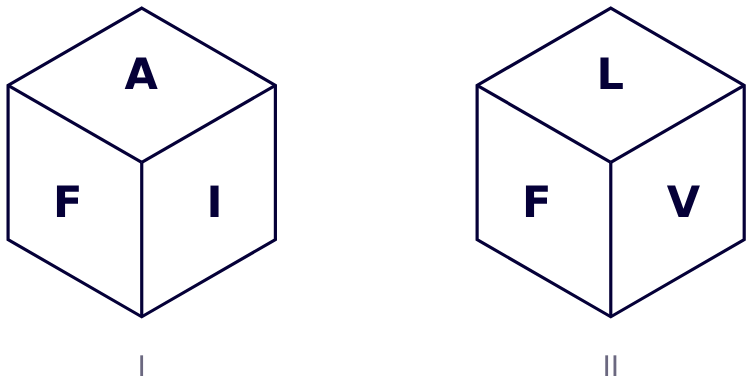
A dice has its faces marked by letters I, L, O, V, A and F. Two positions of the same dice are given below. Which face is opposite to face O ?
figure
एक पासे के फलकों पर अक्षर I, L, O, V, A और F अंकित हैं। इसी पासे की दो स्थितियाँ नीचे दी गई हैं। O फलक के विपरीत कौन-सा फलक है?
figure
  1. AA
  2. BF
  3. CL
  4. DV
Show answer

Concept: A face fixed in the same place lets you pair the others directly.

  1. F is in the same place in both views.
  2. Top A → L and right I → V, so A–L and I–V are opposite.
  3. Remaining faces F and O must be opposite.

Trick: After pairing two sets, the last two faces left automatically form the third pair.

Answer: (B) F

अवधारणा: जो फलक दोनों स्थितियों में एक ही जगह हो, उसके आधार पर बाकी जोड़े बनते हैं।

  1. दोनों चित्रों में F एक ही स्थान पर है।
  2. ऊपर A की जगह L, दाएँ I की जगह V → A–L, I–V विपरीत।
  3. बचे F और O एक-दूसरे के विपरीत।

ट्रिक: दो जोड़े तय होते ही बचे दो फलक अपने-आप तीसरा जोड़ा बनाते हैं।

उत्तर: (B) F

SSC GDGeneral Intelligence & ReasoningDice – opposite facesSSC GD 2025 · 4 Feb Shift 2 →
Q4015.
What should come in place of the question mark (?) in the given series ? 14234271110 ?
दी गई शृंखला में प्रश्नवाचक चिह्न (?) के स्थान पर क्या आना चाहिए? 14234271110 ?
  1. A180
  2. B164
  3. C172
  4. D159
Show answer

Concept: Split the run-on digits into terms and check differences.

  1. Terms: 14, 23, 42, 71, 110.
  2. Differences: 9, 19, 29, 39 – each rises by 10.
  3. Next difference 49 → 110 + 49 = 159.

Trick: Differences all end in 9, so the answer's unit digit = 0 + 9 = 9 → only 159 fits.

Answer: (D) 159

अवधारणा: अंकों को पदों में बाँटें और अंतर देखें।

  1. पद: 14, 23, 42, 71, 110।
  2. अंतर: 9, 19, 29, 39 – हर बार 10 अधिक।
  3. अगला अंतर 49 → 110 + 49 = 159।

ट्रिक: हर अंतर का इकाई अंक 9 है, तो उत्तर का इकाई अंक 0 + 9 = 9 – केवल 159।

उत्तर: (D) 159

SSC GDGeneral Intelligence & ReasoningNumber series – second differencesSSC GD 2025 · 4 Feb Shift 2 →
Q4016.
Seven people P,Q,R,S,T,U and V are sitting in a straight line facing the north (but not necessarily in the same order). V is sitting to the immediate right of Q and the immediate left of R.P is sitting to the immediate right of R and the immediate left of S. U is sitting second to the right of S. U is sitting at one of the ends of the line. Who is sitting between S and U ?
सात व्यक्ति P,Q,R,S,T,U और V एक सीधी रेखा में उत्तर की ओर मुख करके बैठे हैं (आवश्यक नहीं कि इसी क्रम में)। V, Q के ठीक दाएँ बैठा है और R.P के ठीक बाएँ, R के ठीक दाएँ तथा S के ठीक बाएँ बैठा है। U, S के दाएँ से दूसरे स्थान पर बैठा है। U पंक्ति के किसी एक छोर पर बैठा है। S और U के बीच कौन बैठा है?
  1. AT
  2. BP
  3. CV
  4. DR
Show answer

Concept: Join the given “immediate” blocks into one line.

  1. Q V R (V right of Q, left of R).
  2. R P S (P right of R, left of S) → Q V R P S.
  3. U is 2nd right of S and at an end → Q V R P S _ U.
  4. Remaining T fills the gap: Q V R P S T U.

Trick: “Second to the right” always leaves exactly one seat between – and only one person (T) is unplaced.

Answer: (A) T

अवधारणा: “ठीक दाएँ/बाएँ” वाले टुकड़ों को जोड़कर एक पंक्ति बनाएँ।

  1. Q V R (V, Q के दाएँ और R के बाएँ)।
  2. R P S → मिलाकर Q V R P S।
  3. U, S के दाएँ दूसरे स्थान पर और किनारे पर → Q V R P S _ U।
  4. बचा T खाली जगह पर: Q V R P S T U।

ट्रिक: “दाएँ दूसरा” = बीच में ठीक एक व्यक्ति; और बचा भी केवल T है।

उत्तर: (A) T

SSC GDGeneral Intelligence & ReasoningLinear seating – facing northSSC GD 2025 · 4 Feb Shift 2 →
Q4017.
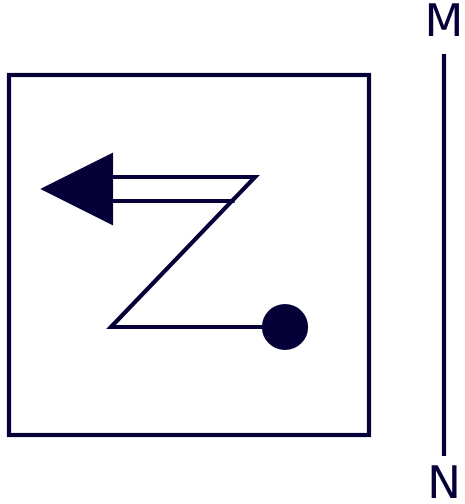
Select the correct mirror image of the given figure when the mirror is placed at MN as shown below.
figure
उस विकल्प का चयन कीजिए जो दी गई आकृति का सही दर्पण प्रतिबिंब दर्शाता है, जब दर्पण को नीचे दर्शाए अनुसार MN पर रखा जाए।
figure
  1. Afigure
  2. Bfigure
  3. Cfigure
  4. Dfigure
Show answer

Concept: A vertical mirror swaps left and right; top and bottom stay the same.

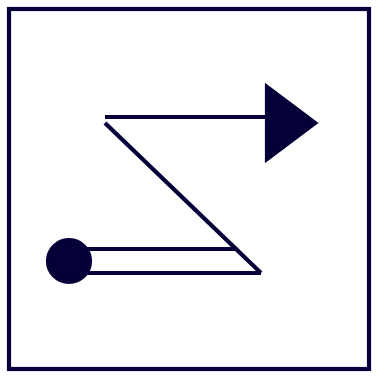
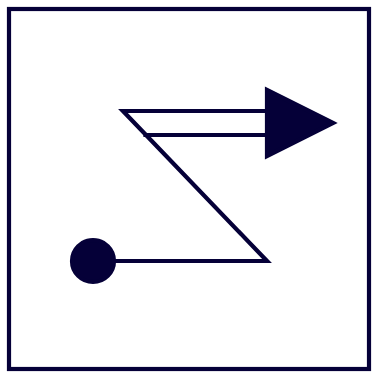
  1. Arrow head on the top-left must point to the right in the image, still at the top.
  2. The dot at the bottom-right moves to the bottom-left.
  3. (B), (C) are not flipped; (A) moves the double stroke to the bottom. Only (D) matches.

Trick: Pick one top element and one bottom element; check they stay at the same height but switch sides.

Answer: (D) Figure (d)

अवधारणा: खड़े (ऊर्ध्वाधर) दर्पण में बायाँ-दायाँ बदलता है, ऊपर-नीचे वही रहता है।

  1. ऊपर बाईं ओर का तीर प्रतिबिंब में दाईं ओर इशारा करेगा, ऊपर ही रहेगा।
  2. नीचे दाईं ओर का बिंदु नीचे बाईं ओर जाएगा।
  3. (B), (C) उलटे ही नहीं; (A) में दोहरी रेखा नीचे चली गई। सही केवल (D)।

ट्रिक: ऊपर और नीचे का एक-एक चिह्न चुनें – ऊँचाई वही, बस दिशा उलटी।

उत्तर: (D) आकृति (d)

SSC GDGeneral Intelligence & ReasoningMirror image – vertical mirrorSSC GD 2025 · 4 Feb Shift 2 →
Q4018.
Select the option that represents the letters that, when sequentially placed from left to right in the blanks below, will complete the letter series.
_ K _ U T O _ L _ T O _ _ U T O K L _ _
उस विकल्प का चयन कीजिए, जो उन अक्षरों को दर्शाता है जिन्हें नीचे दिए गए रिक्त स्थानों में बाएँ से दाएँ क्रमिक रूप से रखने पर अक्षर-शृंखला पूर्ण हो जाएगी।
_ K _ U T O _ L _ T O _ _ U T O K L _ _
  1. AOKLUKULT
  2. BOLKUKLUT
  3. COLKUKUTL
  4. DLOKUKTUL
Show answer

Concept: 20 places = a 5-letter block repeated 4 times.

  1. Visible letters give the block OKLUT.
  2. Fill: OKLUT | OKLUT | OKLUT | OKLUT.
  3. Blanks in order: O L K U K L U T.

Trick: First two blanks are O, L and last two are U, T; only (B) has OL… at the start and …UT at the end.

Answer: (B) OLKUKLUT

अवधारणा: 20 स्थान = 5 अक्षरों का समूह 4 बार।

  1. दिखे अक्षरों से समूह बनता है: OKLUT।
  2. भरें: OKLUT | OKLUT | OKLUT | OKLUT।
  3. रिक्त स्थान क्रम से: O L K U K L U T।

ट्रिक: पहले दो रिक्त O, L और आख़िरी दो U, T – यह केवल विकल्प (B) में है।

उत्तर: (B) OLKUKLUT

SSC GDGeneral Intelligence & ReasoningLetter series – repeating blockSSC GD 2025 · 4 Feb Shift 2 →
Q4019.
The position(s) of how many letters will remain unchanged if each letter in the word JOSTLED is arranged in the English alphabetical order ?
यदि शब्द JOSTLED के प्रत्येक अक्षर को अंग्रेजी वर्णानुक्रम में व्यवस्थित किया जाए, तो कितने अक्षरों की स्थिति अपरिवर्तित रहेगी?
  1. A2
  2. B3
  3. C0
  4. D1
Show answer

Concept: Sort the letters A→Z and compare position by position.

  1. JOSTLED sorted: D E J L O S T.
  2. 1st: J vs D; 2nd: O vs E; 3rd: S vs J; 4th: T vs L; 5th: L vs O; 6th: E vs S; 7th: D vs T.
  3. No position has the same letter.

Trick: The word's first letter J is not the smallest (D is) and the last letter D is not the largest (T is) – start checking from the middle only; here none match.

Answer: (C) 0

अवधारणा: अक्षरों को A से Z क्रम में लगाकर हर स्थान की तुलना करें।

  1. JOSTLED → D E J L O S T।
  2. पहला: J बनाम D; दूसरा: O बनाम E; तीसरा: S बनाम J; चौथा: T बनाम L; पाँचवाँ: L बनाम O; छठा: E बनाम S; सातवाँ: D बनाम T।
  3. किसी भी स्थान पर अक्षर समान नहीं।

ट्रिक: पहला अक्षर सबसे छोटा नहीं (J) और आख़िरी सबसे बड़ा नहीं (D) – किनारे तुरंत बाहर, बस बीच के जाँचें।

उत्तर: (C) 0

SSC GDGeneral Intelligence & ReasoningAlphabetical rearrangementSSC GD 2025 · 4 Feb Shift 2 →
Q4020.
PSPN is related to OROM in a certain way based on the English alphabetical order. In the same way, YBYW is related to XAXV. To which of the given options is QTQO related, following the same logic ?
अंग्रेजी वर्णानुक्रम के आधार पर PSPN एक निश्चित प्रकार से OROM से संबंधित है। उसी प्रकार, YBYW, XAXV से संबंधित है। समान तर्क का अनुसरण करते हुए QTQO दिए गए विकल्पों में से किससे संबंधित है?
  1. APRON
  2. BPSON
  3. CPTOQ
  4. DPSPN
Show answer

Concept: Find the uniform shift between the pairs.

  1. PSPN → OROM: each letter one step back.
  2. YBYW → XAXV: again −1.
  3. QTQO − 1 each → PSPN.

Trick: Pattern of repeats: QTQO has 1st = 3rd letter, so answer must too – PSPN (P_P) fits; PRON, PSON fail.

Answer: (D) PSPN

अवधारणा: जोड़ों के बीच समान खिसकाव खोजें।

  1. PSPN → OROM: हर अक्षर एक पीछे।
  2. YBYW → XAXV: फिर से −1।
  3. QTQO में हर अक्षर −1 → PSPN।

ट्रिक: QTQO में पहला और तीसरा अक्षर समान है, तो उत्तर में भी होगा – केवल PSPN।

उत्तर: (D) PSPN

SSC GDGeneral Intelligence & ReasoningLetter analogy – each letter −1SSC GD 2025 · 4 Feb Shift 2 →