Question bank

Q&A: practice questions with answers

Search questions on any topic. Filter by exam category, exam, subject and topic, try the question, then open the answer and explanation.

Courses – airGurukul

4,200 questions found.

Q1401.
Seven people, A, B, L, M, N, S and T, are sitting in a row, facing north(but not necessarily in the same order).
No one sits to the left of B. Only four people sit between B and N. Only three people sit to the right of L. M sits to the immediate left of S. A is not an immediate neighbour of L. Who sits third to the left of A ?
सात व्यक्ति A, B, L, M, N, S और T एक पंक्ति में उत्तर की ओर मुख करके बैठे हैं (आवश्यक नहीं कि इसी क्रम में)।
B के बाईं ओर कोई नहीं बैठा है। B और N के बीच केवल चार व्यक्ति बैठे हैं। L के दाईं ओर केवल तीन व्यक्ति बैठे हैं। M, S के ठीक बाईं ओर बैठा है। A, L का निकटतम पड़ोसी नहीं है। A के बाईं ओर तीसरे स्थान पर कौन बैठा है?
  1. AT
  2. BS
  3. CL
  4. DN
Show answer

Concept: Facing north, left = start of the row. Fix the sure seats first, then fill gaps.
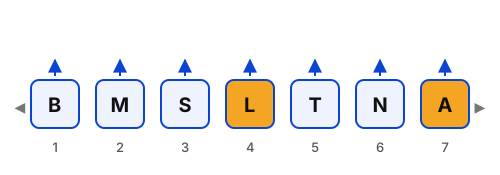
  1. Nobody left of B → B at seat 1. Four between B and N → N at seat 6.
  2. Three to the right of L → L at seat 4.
  3. M–S need two adjacent empty seats → only 2–3 free: M=2, S=3.
  4. Seats 5, 7 left; A can't touch L (seat 4) → A=7, T=5. Row: B M S L T N A.
  5. Count 3 to the left of A (7): seat 4 = L.

Trick: Number seats 1–7 from the left; "x to the left of seat k" is simply seat k − x → 7 − 3 = 4.

Answer: (C) L

अवधारणा: उत्तर की ओर मुख हो तो बायाँ सिरा = पंक्ति की शुरुआत। पहले पक्की सीटें भरें।

हल:

  1. B के बाएँ कोई नहीं → B सीट 1 पर; B–N के बीच 4 → N सीट 6 पर।
  2. L के दाएँ तीन → L सीट 4 पर।
  3. M, S के ठीक बाएँ → खाली जोड़ी केवल 2–3 → M=2, S=3।
  4. A, L का पड़ोसी नहीं → A=7, T=5. क्रम: B M S L T N A।
  5. A (7) के बाएँ तीसरा = सीट 4 = L।

ट्रिक: सीटों को 1–7 नंबर दें; "बाएँ से x-वाँ" = k − x → 7 − 3 = 4।

उत्तर: (C) L
SSC GDGeneral Intelligence & ReasoningLinear seating – third to the leftSSC GD 2025 · 18 Feb Shift 1 →
Q1402.
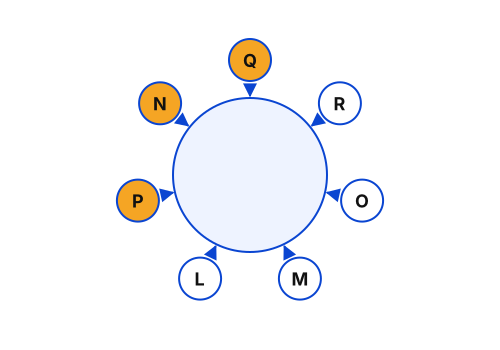
L, M, N, O, P, Q and R are sitting around a circular table facing the centre (but not necessarily in the same order). R is sitting to the immediate left of Q and immediate right of O. M is sitting to the immediate left of O and immediate right of L. P is sitting to the immediate left of L and immediate right of N. Who is the immediate neighbour of both Q and P ?
L, M, N, O, P, Q और R एक वृत्ताकार मेज़ के चारों ओर केंद्र की ओर मुख करके बैठे हैं (आवश्यक नहीं कि इसी क्रम में)। R, Q के ठीक बाईं ओर तथा O के ठीक दाईं ओर बैठा है। M, O के ठीक बाईं ओर तथा L के ठीक दाईं ओर बैठा है। P, L के ठीक बाईं ओर तथा N के ठीक दाईं ओर बैठा है। Q और P दोनों का निकटतम पड़ोसी कौन है?
  1. AM
  2. BL
  3. CR
  4. DN
Show answer

Concept: Facing the centre: a person's left is the clockwise seat, right is the anticlockwise seat.

  1. R is left of Q, right of O → clockwise: Q, R, O.
  2. M is left of O, right of L → O, M, L.
  3. P is left of L, right of N → L, P, N.
  4. Join: Q–R–O–M–L–P–N–(Q). Q's neighbours: R, N; P's neighbours: L, N.

Trick: Chain each "X left of Y, right of Z" as Y→X→Z clockwise and just link the chains end to end.

Answer: (D) N

अवधारणा: केंद्र की ओर मुख हो तो बायाँ = घड़ी की दिशा वाली अगली सीट, दायाँ = उल्टी दिशा वाली।

हल:

  1. R, Q के बाएँ और O के दाएँ → दक्षिणावर्त: Q, R, O।
  2. M: O, M, L. P: L, P, N।
  3. जोड़ने पर: Q–R–O–M–L–P–N–(Q)।
  4. Q के पड़ोसी R, N; P के पड़ोसी L, N → साझा = N।

ट्रिक: हर कथन को तीन अक्षरों की कड़ी बनाइए और कड़ियाँ सिरे से सिरा जोड़ दीजिए।

उत्तर: (D) N

SSC GDGeneral Intelligence & ReasoningCircular seating – common neighbourSSC GD 2025 · 18 Feb Shift 1 →
Q1403.
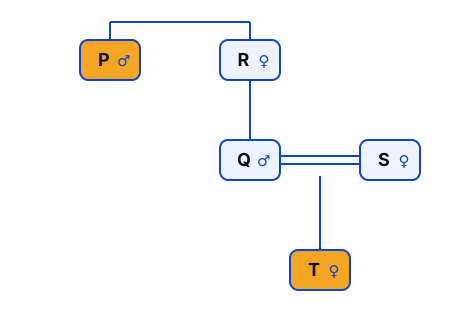
P is the brother of R. R is the mother of Q. S is the wife of Q. T is the daughter of S. How is P related to T ?
P, R का भाई है। R, Q की माता है। S, Q की पत्नी है। T, S की पुत्री है। P, T से किस प्रकार संबंधित है?
  1. AMother's brotherमाता का भाई
  2. BFather's mother's brotherपिता की माता का भाई
  3. CFather's father's brotherपिता के पिता का भाई
  4. DFather's brotherपिता का भाई
Show answer

Concept: Trace the path from T back to P one link at a time.

  1. T is daughter of S; S is wife of Q → Q is T's father.
  2. R is mother of Q → R is T's father's mother.
  3. P is brother of R → P = father's mother's brother.

Trick: Start from the person asked about (T) and walk upward: father → his mother → her brother.

Answer: (B) Father's mother's brother

अवधारणा: T से शुरू करके एक-एक कड़ी ऊपर जाएँ।

हल:

  1. T, S की बेटी; S, Q की पत्नी → Q = T के पिता।
  2. R, Q की माँ → R = पिता की माँ (दादी)।
  3. P, R का भाई → पिता की माँ का भाई।

ट्रिक: जिससे संबंध पूछा है (T), वहीं से ऊपर चलें: पिता → उनकी माँ → उनका भाई।

उत्तर: (B) पिता की माता का भाई

SSC GDGeneral Intelligence & ReasoningBlood relation – chainSSC GD 2025 · 18 Feb Shift 1 →
Q1404.
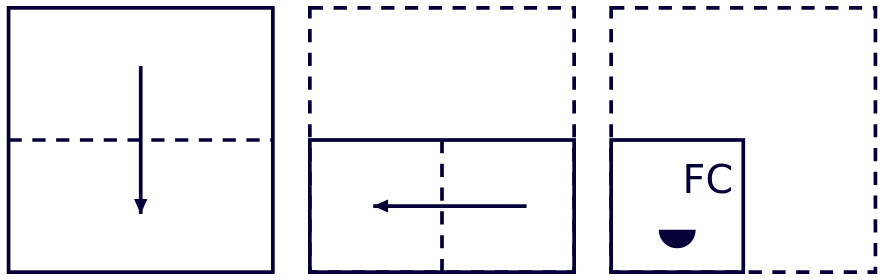
A paper is folded and punched as shown below. How will it appear when unfolded?
figure
एक कागज़ को नीचे दर्शाए अनुसार मोड़ा और छेदा जाता है। खोलने पर वह कैसा दिखाई देगा?
figure
  1. Afigure
  2. Bfigure
  3. Cfigure
  4. Dfigure
Show answer

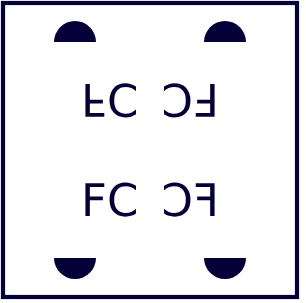
Concept: Each fold acts like a mirror; unfold in reverse order and reflect the marks across each fold line.

  1. Folds: top half down, then right half to the left → only the bottom-left quarter is punched.
  2. Undo the vertical fold: bottom-right quarter = left–right mirror of the punched quarter.
  3. Undo the horizontal fold: whole top half = upside-down copy of the bottom half.
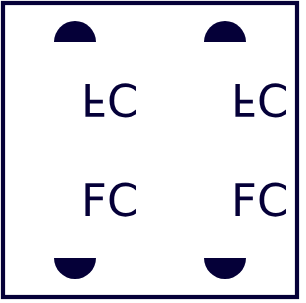
  4. So the top-right part must be flipped both ways – only option (a) shows this.

Trick: Check one diagonal quarter: it must be rotated 180° compared to the punched quarter.

Answer: (A)Figure (a)

अवधारणा: हर मोड़ दर्पण की तरह काम करता है; उल्टे क्रम में खोलें और हर मोड़-रेखा पर प्रतिबिंब बनाएँ।

हल:

  1. पहले ऊपरी आधा नीचे, फिर दायाँ आधा बाएँ मुड़ा → केवल नीचे-बायाँ चौथाई कटा।
  2. खड़ा मोड़ खोलें: नीचे-दायाँ भाग बाएँ-दाएँ उलटा।
  3. पड़ा मोड़ खोलें: ऊपर का पूरा आधा, नीचे के आधे का उल्टा (ऊपर-नीचे) रूप।
  4. ऊपर-दायाँ भाग दोनों तरह उलटा होगा – यह केवल (a) में है।

ट्रिक: तिरछे सामने वाले चौथाई को देखें – वह कटे चौथाई का 180° घुमा रूप होना चाहिए।

उत्तर: (A)आकृति (a)

SSC GDGeneral Intelligence & ReasoningPaper folding – punched designSSC GD 2025 · 18 Feb Shift 1 →
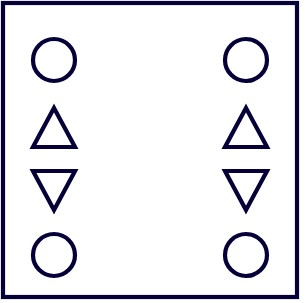
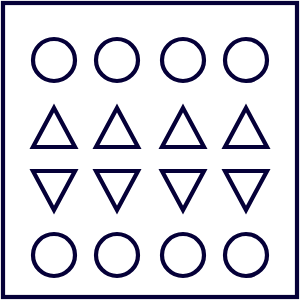
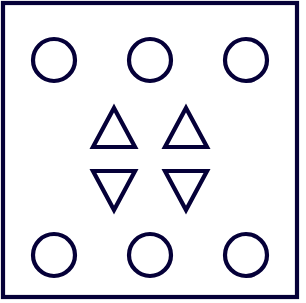
Q1405.
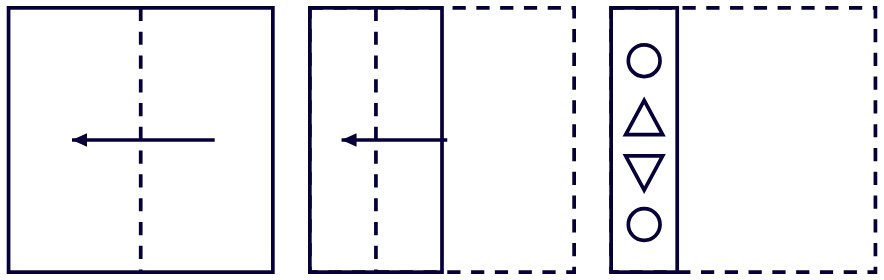
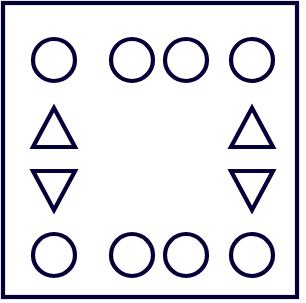
A paper is folded and cut as shown below. How will it appear when unfolded?
figure
एक कागज़ को नीचे दर्शाए अनुसार मोड़ा और काटा जाता है। खोलने पर वह कैसा दिखाई देगा?
figure
  1. Afigure
  2. Bfigure
  3. Cfigure
  4. Dfigure
Show answer

Concept: Two vertical folds make 4 layers side by side; every cut appears once in each of the 4 strips.

  1. Folded piece = 14 width, full height, 4 layers.
  2. Cuts (top→bottom): circle, up-triangle, down-triangle, circle.
  3. Unfolded: 4 columns×4 cuts=16 marks, each row having 4 identical shapes.
  4. Option (c) alone has all 4 columns; (b) has only 2.

Trick: Number of copies = 2number of folds=22=4 – count columns in options first.

Answer: (C)Figure (c)

अवधारणा: दो खड़े मोड़ = 4 परतें; हर कटाव चारों पट्टियों में दिखेगा।

हल:

  1. मुड़ा टुकड़ा = चौड़ाई का 14, पूरी ऊँचाई।
  2. कटाव: वृत्त, ऊपर त्रिभुज, नीचे त्रिभुज, वृत्त।
  3. खोलने पर 4 स्तंभ×4=16 निशान, हर पंक्ति में एक जैसे 4 आकार।
  4. केवल (c) में चारों स्तंभ हैं; (b) में सिर्फ 2।

ट्रिक: प्रतियाँ = 2मोड़ों की संख्या=4 – पहले विकल्पों में स्तंभ गिनें।

उत्तर: (C)आकृति (c)

SSC GDGeneral Intelligence & ReasoningPaper folding – cuts on a stripSSC GD 2025 · 18 Feb Shift 1 →
Q1406.
The position(s) of how many letters will remain unchanged if each letter in the word HOSTILE is arranged in the English alphabetical order ?
यदि शब्द HOSTILE के प्रत्येक अक्षर को अंग्रेज़ी वर्णमाला क्रम में व्यवस्थित किया जाए, तो कितने अक्षरों का स्थान अपरिवर्तित रहेगा?
  1. A0
  2. B1
  3. C3
  4. D2
Show answer

Concept: Sort the letters A→Z and compare position by position.

  1. HOSTILE → sorted: E H I L O S T.
  2. Write EHILOST under HOSTILE: the 1st letter changes H→E, the last E→T, and each middle letter also changes.
  3. No position has the same letter.

Trick: If the smallest letter (E) is at the end of the word, the whole order shifts, so matches are rare – verify quickly.

Answer: (A) 0

अवधारणा: अक्षरों को A→Z क्रम में लगाकर हर स्थान की तुलना करें।

हल:

  1. HOSTILE → क्रम में: E H I L O S T।
  2. EHILOST को HOSTILE के नीचे लिखें: पहला अक्षर H से E, अंतिम E से T – बीच वाले भी सब बदल गए।
  3. किसी भी स्थान पर अक्षर समान नहीं।

ट्रिक: मूल और नए शब्द को एक के नीचे एक लिखें – एक नज़र में मिलान दिख जाता है।

उत्तर: (A) 0

SSC GDGeneral Intelligence & ReasoningLetter positions after alphabetical arrangementSSC GD 2025 · 18 Feb Shift 1 →
Q1407.
What will come in the place of the question mark (?) in the following equation if '÷' and '−' are interchanged and '×' and '+' are interchanged? 97 + 70 − 35 × 5 ÷ 4 = ?
निम्नलिखित समीकरण में प्रश्नवाचक चिह्न (?) के स्थान पर क्या आएगा, यदि '÷' और '−' को आपस में बदल दिया जाए तथा '×' और '+' को आपस में बदल दिया जाए? 97 + 70 − 35 × 5 ÷ 4 = ?
  1. A196
  2. B194
  3. C195
  4. D193
Show answer

Concept: Swap ÷↔− and ×↔+, then solve with BODMAS.

  1. 97+70−35×5÷4 → 97×70÷35+5−4.
  2. 70÷35=2, so 97×2=194.
  3. 194+5−4=195.

Trick: Divide first where possible (70÷35=2) – avoids the big product 6790.

Answer: (C) 195

अवधारणा: ÷ और − तथा × और + को आपस में बदलें, फिर BODMAS लगाएँ।

हल:

  1. नया व्यंजक: 97×70÷35+5−4।
  2. 70÷35=2 → 97×2=194।
  3. 194+5−4=195।

ट्रिक: पहले छोटा भाग (70÷35=2) करें, बड़ा गुणा बच जाता है।

उत्तर: (C) 195

SSC GDGeneral Intelligence & ReasoningSign interchange – BODMASSSC GD 2025 · 18 Feb Shift 1 →
Q1408.
What should come in place of the question mark (?) in the given series? 201 200 197 192 185 ?
दी गई शृंखला में प्रश्नवाचक चिह्न (?) के स्थान पर क्या आना चाहिए? 201 200 197 192 185 ?
  1. A176
  2. B175
  3. C177
  4. D174
Show answer

Concept: Differences form a simple pattern.

  1. 201→200→197→192→185: −1, −3, −5, −7.
  2. Next: −9 → 185−9=176.

Trick: Terms are 201−n2 (n=0,1,2,…) → 201−25=176.

Answer: (A) 176

अवधारणा: क्रमागत पदों का अंतर देखें।

हल:

  1. अंतर: −1, −3, −5, −7 (विषम संख्याएँ)।
  2. अगला −9 → 185−9=176।

ट्रिक: पद =201−n2 → 201−52=176।

उत्तर: (A) 176

SSC GDGeneral Intelligence & ReasoningNumber series – odd differencesSSC GD 2025 · 18 Feb Shift 1 →
Q1409.
Find the correct alternative that when filled in the blanks in the same sequence will make the series logically complete.
_DGCE_JFHJ_IKMP_NPS_
सही विकल्प ज्ञात कीजिए जो रिक्त स्थानों में उसी क्रम में भरने पर शृंखला को तार्किक रूप से पूर्ण करे।
_DGCE_JFHJ_IKMP_NPS_
  1. ACGNLP
  2. BCHNKP
  3. CBHMKO
  4. DBGMLO
Show answer

Concept: Split the 20 places into 5 blocks of 4; each column of blocks moves +3.

  1. Blocks: _DGC | E_JF | HJ_I | KMP_ | NPS_.
  2. Column 1: _, E, H, K, N (+3) → B.
  3. Column 2: D, _, J, M, P → G. Column 3: G, J, _, P, S → M.
  4. Column 4: C, F, I, _, _ → L, O. Blanks: B G M L O.

Trick: Fill just the first blank (B) and second (G): only option (d) starts with BG.

Answer: (D) BGMLO

अवधारणा: 20 स्थानों को 4-4 के 5 समूहों में बाँटें; हर स्तंभ +3 से बढ़ता है।

हल:

  1. समूह: _DGC | E_JF | HJ_I | KMP_ | NPS_।
  2. पहला स्तंभ: _, E, H, K, N → B।
  3. दूसरा: D, _, J → G; तीसरा: G, J, _, P → M।
  4. चौथा: C, F, I, _, _ → L, O. उत्तर: B G M L O।

ट्रिक: पहले दो रिक्त (B, G) भरते ही केवल (d) बचता है।

उत्तर: (D) BGMLO

SSC GDGeneral Intelligence & ReasoningLetter series – blanks in groupsSSC GD 2025 · 18 Feb Shift 1 →
Q1410.
In a certain code language, 'POLE' is coded as '6431' and 'PLOT' is coded as '4635'. How is 'T' coded in the given language?
एक निश्चित कूट भाषा में 'POLE' को '6431' के रूप में तथा 'PLOT' को '4635' के रूप में कूटबद्ध किया जाता है। उसी भाषा में 'T' को किस प्रकार कूटबद्ध किया जाएगा?
  1. A5
  2. B3
  3. C1
  4. D4
Show answer

Concept: Letters common to two words share the digits common to their codes.

  1. POLE = 6431, PLOT = 4635.
  2. Common letters P, O, L ↔ common digits 6, 4, 3.
  3. Leftover in PLOT is T; leftover digit in 4635 is 5 → T = 5.

Trick: Cancel the shared letters and shared digits – the leftovers pair up directly.

Answer: (A) 5

अवधारणा: दो शब्दों के समान अक्षरों के कोड भी दोनों कोडों में समान अंक होंगे।

हल:

  1. POLE = 6431, PLOT = 4635।
  2. समान अक्षर P, O, L ↔ समान अंक 6, 4, 3।
  3. PLOT में बचा T, 4635 में बचा 5 → T = 5।

ट्रिक: समान अक्षर और समान अंक काट दें – बचे हुए आपस में जोड़ी बनाते हैं।

उत्तर: (A) 5

SSC GDGeneral Intelligence & ReasoningCoding – common letters methodSSC GD 2025 · 18 Feb Shift 1 →
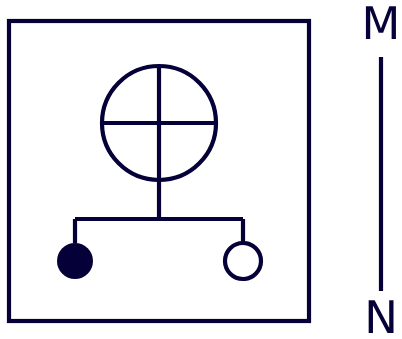
Q1411.
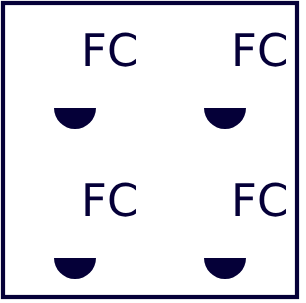
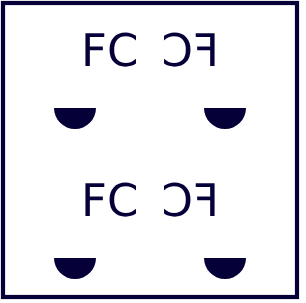
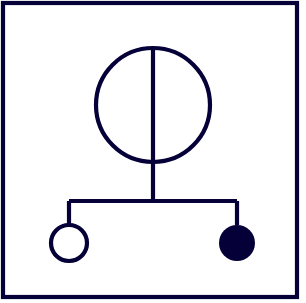
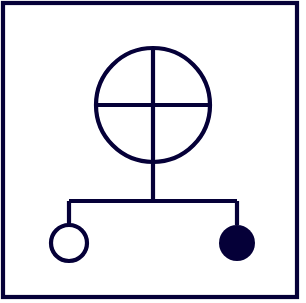
Select the correct mirror image of the given figure when the mirror is placed at MN as shown below.
figure
दी गई आकृति का सही दर्पण प्रतिबिंब चुनिए जब दर्पण को नीचे दर्शाए अनुसार MN पर रखा जाए।
figure
  1. Afigure
  2. Bfigure
  3. Cfigure
  4. Dfigure
Show answer

Concept: A vertical mirror swaps left and right only; top/bottom stay the same.

  1. Circle with both diameters (+) is left–right symmetric → unchanged.
  2. Hanger: solid dot on left, hollow on right → in mirror solid dot goes right.
  3. Option (c) keeps the full + and puts the solid dot on the right.

Trick: Look only at the asymmetric part (the dots) – symmetric parts never change in a vertical mirror.

Answer: (C)Figure (c)

अवधारणा: खड़ा दर्पण केवल बाएँ-दाएँ बदलता है; ऊपर-नीचे वही रहता है।

हल:

  1. दोनों व्यास वाला वृत्त सममित है → वैसा ही रहेगा।
  2. काला बिंदु बाएँ, खाली दाएँ → प्रतिबिंब में काला दाएँ।
  3. यह स्थिति केवल (c) में है।

ट्रिक: केवल असममित हिस्से (बिंदु) पर ध्यान दें।

उत्तर: (C)आकृति (c)

SSC GDGeneral Intelligence & ReasoningMirror image – vertical mirrorSSC GD 2025 · 18 Feb Shift 1 →
Q1412.
Based on the English alphabetical order, three of the following four letter-clusters are alike in a certain way and thus form a group. Which letter-cluster DOES NOT belong to that group?
(Note: The odd one out is not based on the number of consonants/vowels or their position in the letter-cluster.)
अंग्रेज़ी वर्णमाला क्रम के आधार पर, निम्नलिखित चार अक्षर-समूहों में से तीन एक निश्चित प्रकार से समान हैं और इस प्रकार एक समूह बनाते हैं। कौन-सा अक्षर-समूह उस समूह से संबंधित नहीं है?
(नोट: विषम पद अक्षर-समूह में व्यंजनों/स्वरों की संख्या या उनकी स्थिति पर आधारित नहीं है।)
  1. ATYV
  2. BRWT
  3. CXCA
  4. DLQN
Show answer

Concept: Find the jumps between letters using alphabet positions.

  1. TYV: +5, −3. RWT: +5, −3. LQN: +5, −3.
  2. XCA: X→C is +5 (wrapping), but C→A is −2.
  3. So XCA breaks the pattern.

Trick: Check only the 1st and 3rd letters: gap +2 in TYV (T→V), RWT, LQN, but X→A is +3.

Answer: (C) XCA

अवधारणा: अक्षरों की स्थिति संख्या से अंतर निकालें।

हल:

  1. TYV, RWT, LQN: +5, −3।
  2. XCA: X→C = +5, पर C→A = −2।
  3. इसलिए XCA अलग है।

ट्रिक: सिर्फ पहला और तीसरा अक्षर देखें: बाकी में +2 का अंतर, XCA में +3।

उत्तर: (C) XCA

SSC GDGeneral Intelligence & ReasoningOdd one out – letter gapsSSC GD 2025 · 18 Feb Shift 1 →
Q1413.
Read the given statements and conclusions carefully. Assuming that the information given in the statements is true, even if it appears to be at variance with commonly known facts, decide which of the given conclusions logically follow(s) from the statements.
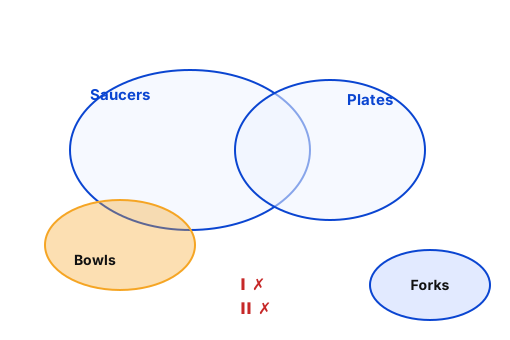
Statements:
Some saucers are plates.
No plate is a bowl.
No plate is a fork.
Conclusions:
(I): No saucer is a bowl.
(II): Some forks are bowls.
दिए गए कथनों और निष्कर्षों को ध्यानपूर्वक पढ़िए। यह मानते हुए कि कथनों में दी गई जानकारी सत्य है, चाहे वह सर्वज्ञात तथ्यों से भिन्न प्रतीत होती हो, निर्णय कीजिए कि दिए गए निष्कर्षों में से कौन-सा/से निष्कर्ष कथनों का तार्किक रूप से अनुसरण करता है/करते हैं।
कथन:
कुछ तश्तरियाँ प्लेट हैं।
कोई प्लेट कटोरा नहीं है।
कोई प्लेट काँटा नहीं है।
निष्कर्ष:
(I): कोई तश्तरी कटोरा नहीं है।
(II): कुछ काँटे कटोरे हैं।
  1. AOnly conclusion (II) follows.केवल निष्कर्ष (II) अनुसरण करता है।
  2. BNeither conclusion (I) nor (II) follows.न तो निष्कर्ष (I) और न ही (II) अनुसरण करता है।
  3. COnly conclusion (I) follows.केवल निष्कर्ष (I) अनुसरण करता है।
  4. DBoth conclusions (I) and (II) followनिष्कर्ष (I) और (II) दोनों अनुसरण करते हैं।
Show answer

Concept: Accept a conclusion only when no valid diagram can make it false.

  1. Saucers overlap plates; bowls and forks are both kept away from plates.
  2. Bowls can still touch the non-plate part of saucers → "No saucer is a bowl" is not certain.
  3. Forks and bowls are unrelated to each other → "Some forks are bowls" is not certain.

Trick: Two "No" statements about the same middle class (plate) never connect the other two classes.

Answer: (B) Neither conclusion (I) nor (II) follows.

अवधारणा: निष्कर्ष तभी सही है जब हर संभव आरेख में सही हो।

हल:

  1. कुछ सॉसर प्लेट हैं; कटोरी और काँटा दोनों प्लेट से अलग।
  2. कटोरी, सॉसर के प्लेट-रहित भाग को छू सकती है → (I) निश्चित नहीं।
  3. काँटे और कटोरी के बीच कोई संबंध नहीं दिया → (II) भी निश्चित नहीं।

ट्रिक: एक ही मध्य वर्ग से जुड़े दो "कोई नहीं" कथन बाकी दो वर्गों को नहीं जोड़ते।

उत्तर: (B) न तो निष्कर्ष (I) और न ही (II) अनुसरण करता है।

SSC GDGeneral Intelligence & ReasoningSyllogism – some/noSSC GD 2025 · 18 Feb Shift 1 →
Q1414.
YE 12 is related to WG 3 in a certain way. In the same way, CS 44 is related to AU 11. To which of the following is DH 36 related, following the same logic ?
YE 12 एक निश्चित प्रकार से WG 3 से संबंधित है। उसी प्रकार, CS 44 का संबंध AU 11 से है। उसी तर्क का अनुसरण करते हुए, DH 36 निम्नलिखित में से किससे संबंधित है?
  1. ABJ 8
  2. BBH 8
  3. CBJ 9
  4. DBH 9
Show answer

Concept: Treat letters and number separately.

  1. YE→WG: first letter −2, second +2. CS→AU: same.
  2. Number: 12→3, 44→11 → ÷4.
  3. Apply to DH 36: B (D−2), J (H+2), 9 (36÷4) → BJ 9.

Trick: Number part alone gives 9 → (C) or (D); H+2 = J picks (C).

Answer: (C) BJ 9

अवधारणा: पहले अक्षरों का नियम, फिर संख्या का नियम निकालें।

हल:

  1. पहला अक्षर −2, दूसरा +2 (Y→W, E→G)।
  2. संख्या ÷ 4: 12→3, 44→11।
  3. DH 36 → B, J, 9 → BJ 9।

ट्रिक: संख्या 9 से विकल्प (C)/(D) बचे; H+2 = J से (C)।

उत्तर: (C) BJ 9

SSC GDGeneral Intelligence & ReasoningAnalogy – letters and numberSSC GD 2025 · 18 Feb Shift 1 →
Q1415.
What should come in place of the question mark (?) in the given series based on the English alphabetical order? ACK DFN GIQ JLT ?
अंग्रेज़ी वर्णमाला क्रम पर आधारित दी गई शृंखला में प्रश्नवाचक चिह्न (?) के स्थान पर क्या आना चाहिए? ACK DFN GIQ JLT ?
  1. AMOW
  2. BKOW
  3. CKMU
  4. DMNU
Show answer

Concept: Each letter position moves +3.

  1. 1st letters: A, D, G, J → M.
  2. 2nd: C, F, I, L → O.
  3. 3rd: K, N, Q, T → W.

Trick: Only option (a) starts with M and has O after it – no need to check the third letter.

Answer: (A) MOW

अवधारणा: हर स्थान का अक्षर +3 बढ़ता है।

हल:

  1. पहला: A, D, G, J → M।
  2. दूसरा: C, F, I, L → O।
  3. तीसरा: K, N, Q, T → W।

ट्रिक: M और O से शुरू होने वाला एक ही विकल्प है।

उत्तर: (A) MOW

SSC GDGeneral Intelligence & ReasoningLetter cluster series – +3SSC GD 2025 · 18 Feb Shift 1 →
Q1416.
Select the Venn diagram that best illustrates the relationship between the following classes.
Cats, Animals, Boxes
उस वेन आरेख का चयन कीजिए जो निम्नलिखित वर्गों के बीच के संबंध को सर्वोत्तम रूप से दर्शाता है।
बिल्लियाँ, जानवर, बक्से
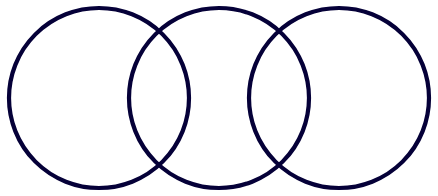
  1. Afigure
  2. Bfigure
  3. Cfigure
  4. Dfigure
Show answer

Concept: Ask: is one class inside another, overlapping, or totally separate?

  1. All cats are animals → Cats circle inside Animals circle.
  2. Boxes are not animals → a separate circle touching neither.
  3. Option (b) shows exactly this.

Trick: Non-living item + living group → always a stand-alone circle.

Answer: (B)Figure (b)

अवधारणा: देखें कि वर्ग एक-दूसरे के भीतर, आंशिक साझा या पूरी तरह अलग हैं।

हल:

  1. हर बिल्ली जानवर है → बिल्ली का वृत्त जानवर के अंदर।
  2. डिब्बा जानवर नहीं → अलग वृत्त।
  3. ऐसा चित्र विकल्प (b) में है।

ट्रिक: निर्जीव वस्तु + जीव वर्ग → हमेशा अलग वृत्त।

उत्तर: (B)आकृति (b)

SSC GDGeneral Intelligence & ReasoningVenn diagram – subset and separate classSSC GD 2025 · 18 Feb Shift 1 →
Q1417.
What should come in place of the question mark (?) in the given series? 911 921 930 938 945 ?
दी गई शृंखला में प्रश्नवाचक चिह्न (?) के स्थान पर क्या आना चाहिए? 911 921 930 938 945 ?
  1. A950
  2. B952
  3. C951
  4. D953
Show answer

Concept: Look at the differences.

  1. +10, +9, +8, +7 between terms.
  2. Next +6 → 945 + 6 = 951.

Trick: When differences fall by 1 each time, just keep counting down.

Answer: (C) 951

अवधारणा: क्रमागत अंतर देखें।

हल:

  1. अंतर: +10, +9, +8, +7।
  2. अगला +6 → 945 + 6 = 951।

ट्रिक: अंतर हर बार 1 घटे तो गिनती नीचे बढ़ाते जाएँ।

उत्तर: (C) 951

SSC GDGeneral Intelligence & ReasoningNumber series – decreasing additionsSSC GD 2025 · 18 Feb Shift 1 →
Q1418.
In a coded language 'FLAG' is coded as '1764' and 'GOLF' is coded as '4726'. What is the code for A in the same code language?
एक कूट भाषा में 'FLAG' को '1764' तथा 'GOLF' को '4726' के रूप में कूटबद्ध किया जाता है। उसी कूट भाषा में A का कूट क्या है?
  1. A1
  2. B7
  3. C4
  4. D2
Show answer

Concept: Shared letters ↔ shared digits; the leftovers match.

  1. FLAG = 1764, GOLF = 4726.
  2. Shared F, L, G ↔ shared 7, 6, 4.
  3. FLAG leftover A ↔ 1764 leftover 1 → A = 1.

Trick: Strike out common letters/digits; what remains in the same word-code pair is the answer.

Answer: (A) 1

अवधारणा: समान अक्षरों के कोड = समान अंक; बचे हुए आपस में मिलते हैं।

हल:

  1. FLAG = 1764, GOLF = 4726।
  2. समान F, L, G ↔ 7, 6, 4।
  3. FLAG में बचा A ↔ बचा 1 → A = 1।

ट्रिक: समान अक्षर/अंक काटें; जो बचे वही उत्तर।

उत्तर: (A) 1

SSC GDGeneral Intelligence & ReasoningCoding – common letters methodSSC GD 2025 · 18 Feb Shift 1 →
Q1419.
TFIM is related to VEKL in a certain way based on the English alphabetical order. In the same way, YADS is related to AZFR. To which of the given options is JFQZ related, following the same logic?
TFIM, अंग्रेज़ी वर्णमाला क्रम के आधार पर एक निश्चित प्रकार से VEKL से संबंधित है। उसी प्रकार, YADS का संबंध AZFR से है। उसी तर्क का अनुसरण करते हुए, JFQZ दिए गए विकल्पों में से किससे संबंधित है?
  1. ANCTY
  2. BLESY
  3. CIEPY
  4. DMDUX
Show answer

Concept: Compare the pairs letter by letter.

  1. T→V (+2), F→E (−1), I→K (+2), M→L (−1).
  2. Check YADS→AZFR: same +2, −1, +2, −1 (Y+2 wraps to A).
  3. JFQZ → L, E, S, Y.

Trick: Z−1 = Y fixes the last letter; then J+2 = L leaves only LESY.

Answer: (B) LESY

अवधारणा: दोनों जोड़ों में अक्षर-दर-अक्षर बदलाव देखें।

हल:

  1. T→V (+2), F→E (−1), I→K (+2), M→L (−1)।
  2. YADS→AZFR में भी यही नियम।
  3. JFQZ → L, E, S, Y।

ट्रिक: J+2 = L से ही उत्तर LESY मिल जाता है।

उत्तर: (B) LESY

SSC GDGeneral Intelligence & ReasoningLetter analogy – +2/−1 patternSSC GD 2025 · 18 Feb Shift 1 →
Q1420.
Identify the figure given in the options which when put in place of the question mark (?) will logically complete the series.
figure
उस आकृति की पहचान कीजिए जो विकल्पों में दी गई है और जिसे प्रश्नवाचक चिह्न (?) के स्थान पर रखने पर शृंखला तार्किक रूप से पूर्ण हो जाएगी।
figure
  1. Afigure
  2. Bfigure
  3. Cfigure
  4. Dfigure
Show answer

Concept: Count the sides of each closed figure instead of judging its shape.

  1. Each figure in the series, though shaped differently, has 5 sides.
  2. So the next figure must also have 5 sides.
  3. Option (a) has 5 sides; (b) and (c) have 6, (d) has 7.

Trick: When shapes look random, count sides/corners – a hidden constant is common.

Answer: (A)Figure (a)

अवधारणा: आकृति का रूप नहीं, उसकी भुजाएँ गिनें।

हल:

  1. श्रेणी की हर आकृति अलग दिखती है पर सबकी 5 भुजाएँ हैं।
  2. अगली आकृति भी 5 भुजाओं वाली होगी।
  3. (a) में 5; (b), (c) में 6 और (d) में 7 भुजाएँ।

ट्रिक: आकृतियाँ बेतरतीब लगें तो भुजाएँ/कोने गिनें।

उत्तर: (A)आकृति (a)

SSC GDGeneral Intelligence & ReasoningFigure series – number of sidesSSC GD 2025 · 18 Feb Shift 1 →