Question bank

Q&A: practice questions with answers

Search questions on any topic. Filter by exam category, exam, subject and topic, try the question, then open the answer and explanation.

Courses – airGurukul

53,050 questions in the question bank.

Q3541.
The capacitance of a parallel plate capacitor with air as medium is 6 μF. With the introduction of a dielectric medium, the capacitance becomes 30 μF. The permittivity of the medium is : (ε0=8.85×10⁻¹² C2N−1m−2)
वायु माध्यम वाले एक समांतर पट्टिका संधारित्र की धारिता 6 μF है। एक परावैद्युत माध्यम डालने पर धारिता 30 μF हो जाती है। माध्यम की विद्युतशीलता (permittivity) है : (ε0=8.85×10⁻¹² C2N−1m−2)
  1. A0.44×10−10 C2N−1m−2
  2. B5.00 C2N−1m−2
  3. C0.44×10−13 C2N−1m−2
  4. D1.77×10−12 C2N−1m−2
Show answer

Concept: C=KC0 and ε=Kε0.

  1. K=306=5
  2. ε=5×8.85×10−12=44.25×10⁻¹²≈0.44×10⁻¹⁰ C2N−1m−2

Short trick: (B) is just K (dimensionless) with wrong units – a classic trap. 5×8.85≈44 → 44×10−12=0.44×10⁻¹⁰.

Answer: (A) 0.44×10⁻¹⁰ C2N−1m−2

अवधारणा: C=KC0 तथा ε=Kε0।

  1. K=306=5
  2. ε=5×8.85×10−12=44.25×10⁻¹²≈0.44×10⁻¹⁰ C2N−1m−2

शॉर्ट ट्रिक: (B) केवल K (विमाहीन) है जिसके साथ गलत मात्रक लगे हैं – एक सामान्य जाल। 5×8.85≈44 → 44×10−12=0.44×10⁻¹⁰।

उत्तर: (A) 0.44×10⁻¹⁰ C2N−1m−2

NEET UGPhysicsCapacitance – dielectricNEET UG 2020 · 13 Sep Shift 1 →
Q3542.
The solids which have the negative temperature coefficient of resistance are :
वे ठोस जिनका प्रतिरोध ताप गुणांक ऋणात्मक होता है, हैं :
  1. Asemiconductors onlyकेवल अर्धचालक
  2. Binsulators and semiconductorsविद्युतरोधी और अर्धचालक
  3. Cmetalsधातुएँ
  4. Dinsulators onlyकेवल विद्युतरोधी
Show answer

Concept: Negative α means resistance falls as temperature rises – happens when heating frees more charge carriers.

  1. Semiconductors: more electron–hole pairs are created on heating ⇒ ρ decreases ⇒ α negative.
  2. Insulators: the very large band gap is crossed by a few more electrons on heating ⇒ ρ also decreases ⇒ α negative.
  3. Metals: carrier number is fixed, collisions increase ⇒ ρ increases ⇒ α positive (so (C) is wrong).
  4. (A) and (D) are incomplete – both classes show negative α.

Short trick: Metals: α positive. Everything with a band gap (semiconductors and insulators): α negative.

Answer: (B) insulators and semiconductors

अवधारणा: ऋणात्मक α का अर्थ है ताप बढ़ने पर प्रतिरोध घटना – यह तब होता है जब गर्म करने पर अधिक आवेश वाहक मुक्त होते हैं।

  1. अर्धचालक: गर्म करने पर अधिक इलेक्ट्रॉन–होल युग्म बनते हैं ⇒ ρ घटता है ⇒ α ऋणात्मक।
  2. विद्युतरोधी: गर्म करने पर कुछ और इलेक्ट्रॉन बहुत बड़े ऊर्जा अंतराल को पार करते हैं ⇒ ρ घटता है ⇒ α ऋणात्मक।
  3. धातुएँ: वाहकों की संख्या नियत, टक्करें बढ़ती हैं ⇒ ρ बढ़ता है ⇒ α धनात्मक (अतः (C) गलत)।
  4. (A) और (D) अधूरे हैं – दोनों वर्गों में α ऋणात्मक होता है।

शॉर्ट ट्रिक: धातु: α धनात्मक। ऊर्जा अंतराल (band gap) वाले सभी (अर्धचालक तथा विद्युतरोधी): α ऋणात्मक।

उत्तर: (B) विद्युतरोधी और अर्धचालक

NEET UGPhysicsCurrent electricity – temperature coefficient of resistanceNEET UG 2020 · 13 Sep Shift 1 →
Q3543.
For transistor action, which of the following statements is correct?
ट्रांजिस्टर क्रिया के लिए, निम्नलिखित में से कौन-सा कथन सही है?
  1. ABoth emitter junction as well as the collector junction are forward biased.उत्सर्जक संधि तथा संग्राहक संधि दोनों अग्र अभिनत होती हैं।
  2. BThe base region must be very thin and lightly doped.आधार क्षेत्र बहुत पतला और अल्प मादित (lightly doped) होना चाहिए।
  3. CBase, emitter and collector regions should have same doping concentrations.आधार, उत्सर्जक और संग्राहक क्षेत्रों की मादन सांद्रता समान होनी चाहिए।
  4. DBase, emitter and collector regions should have same size.आधार, उत्सर्जक और संग्राहक क्षेत्रों का आकार समान होना चाहिए।
Show answer

Concept: In the active mode, the emitter injects carriers that must cross the base to the collector with very little recombination.

  1. Thin, lightly doped base ⇒ few recombinations ⇒ most emitter current reaches the collector – (B) correct.
  2. (A) wrong: for amplification the emitter–base junction is forward biased and the collector–base junction is reverse biased.
  3. (C) wrong: emitter is heavily doped, base lightly, collector moderately.
  4. (D) wrong: collector is largest, base is thinnest.

Short trick: NCERT line: “Emitter – heavily doped, Base – very thin and lightly doped, Collector – moderately doped and large.”

Answer: (B) The base region must be very thin and lightly doped.

अवधारणा: सक्रिय अवस्था में उत्सर्जक वाहकों को अंतःक्षेपित करता है जिन्हें बहुत कम पुनर्संयोजन के साथ आधार पार कर संग्राहक तक पहुँचना होता है।

  1. पतला, अल्प मादित आधार ⇒ कम पुनर्संयोजन ⇒ उत्सर्जक धारा का अधिकांश भाग संग्राहक तक पहुँचता है – (B) सही।
  2. (A) गलत: प्रवर्धन के लिए उत्सर्जक–आधार संधि अग्र अभिनत तथा संग्राहक–आधार संधि पश्च अभिनत होती है।
  3. (C) गलत: उत्सर्जक अधिक मादित, आधार अल्प मादित, संग्राहक मध्यम मादित होता है।
  4. (D) गलत: संग्राहक सबसे बड़ा तथा आधार सबसे पतला होता है।

शॉर्ट ट्रिक: NCERT पंक्ति: “उत्सर्जक – अधिक मादित, आधार – बहुत पतला व अल्प मादित, संग्राहक – मध्यम मादित व बड़ा।”

उत्तर: (B) आधार क्षेत्र बहुत पतला और अल्प मादित होना चाहिए।

NEET UGPhysicsSemiconductors – transistor actionNEET UG 2020 · 13 Sep Shift 1 →
Q3544.
A screw gauge has least count of 0.01 mm and there are 50 divisions in its circular scale. The pitch of the screw gauge is :
एक स्क्रू गेज का अल्पतमांक 0.01 mm है और इसके वृत्तीय पैमाने पर 50 भाग हैं। स्क्रू गेज का चूड़ी अंतराल (pitch) है :
  1. A0.5 mm
  2. B1.0 mm
  3. C0.01 mm
  4. D0.25 mm
Show answer

Concept: Least count = pitch ÷ number of circular-scale divisions.

  1. Pitch = LC × N = 0.01 mm × 50
  2. Pitch = 0.5 mm

Short trick: Pitch is always LC × divisions; it must be larger than LC, so (C) is impossible.

Answer: (A) 0.5 mm

अवधारणा: अल्पतमांक = चूड़ी अंतराल ÷ वृत्तीय पैमाने के भागों की संख्या।

  1. चूड़ी अंतराल = LC × N = 0.01 mm × 50
  2. चूड़ी अंतराल = 0.5 mm

शॉर्ट ट्रिक: चूड़ी अंतराल सदैव LC × भाग; यह LC से बड़ा होना चाहिए, अतः (C) असंभव।

उत्तर: (A) 0.5 mm

NEET UGPhysicsUnits and measurement – screw gaugeNEET UG 2020 · 13 Sep Shift 1 →
Q3545.
The phase difference between displacement and acceleration of a particle in a simple harmonic motion is :
सरल आवर्त गति करते किसी कण के विस्थापन और त्वरण के बीच कलान्तर है :
  1. Aπ2 rad
  2. Bzeroशून्य
  3. Cπ rad
  4. D3π2 rad
Show answer

Concept: In SHM a=−ω2x.

  1. x=Asin⁡ωt, a=−ω2Asin⁡ωt=ω2Asin⁡(ωt+π)
  2. So acceleration leads displacement by π rad.

Short trick: Minus sign = opposite direction = phase difference π. (Velocity is π2 ahead of x.)

Answer: (C) π rad

अवधारणा: सरल आवर्त गति में a=−ω2x।

  1. x=Asin⁡ωt, a=−ω2Asin⁡ωt=ω2Asin⁡(ωt+π)
  2. अतः त्वरण विस्थापन से π rad आगे है।

शॉर्ट ट्रिक: ऋण चिह्न = विपरीत दिशा = कलान्तर π। (वेग, x से π2 आगे होता है।)

उत्तर: (C) π rad

NEET UGPhysicsOscillations – SHM phase relationsNEET UG 2020 · 13 Sep Shift 1 →
Q3546.
A long solenoid of 50 cm length having 100 turns carries a current of 2.5 A. The magnetic field at the centre of the solenoid is : (μ0=4π×10−7 T m A−1)
100 फेरों वाली 50 cm लंबी एक लंबी परिनालिका में 2.5 A धारा प्रवाहित हो रही है। परिनालिका के केंद्र पर चुंबकीय क्षेत्र है : (μ0=4π×10−7 T m A−1)
  1. A6.28×10−5 T
  2. B3.14×10−5 T
  3. C6.28×10−4 T
  4. D3.14×10−4 T
Show answer

Concept: Inside a long solenoid B=μ0nI, n = turns per metre.

  1. n=1000.5=200 m−1
  2. B=4π×10−7×200×2.5=2π×10−4
  3. B=6.28×10⁻⁴ T

Short trick: nI=500; 4π×10−7×500=2π×10−4. Watch the cm → m conversion (l = 0.5 m); a slip in the power of ten leads to (A) or (B).

Answer: (C) 6.28×10⁻⁴ T

अवधारणा: लंबी परिनालिका के अंदर B=μ0nI, जहाँ n = प्रति मीटर फेरे।

  1. n=1000.5=200 m−1
  2. B=4π×10−7×200×2.5=2π×10−4
  3. B=6.28×10⁻⁴ T

शॉर्ट ट्रिक: nI=500; 4π×10−7×500=2π×10−4। cm → m रूपांतरण पर ध्यान दें (l = 0.5 m); 10 की घात में त्रुटि से (A) या (B) आता है।

उत्तर: (C) 6.28×10⁻⁴ T

NEET UGPhysicsMoving charges and magnetism – solenoidNEET UG 2020 · 13 Sep Shift 1 →
Q3547.
A ball is thrown vertically downward with a velocity of 20 m/s from the top of a tower. It hits the ground after some time with a velocity of 80 m/s. The height of the tower is : (g=10 m/s2)
एक मीनार के शिखर से एक गेंद को 20 m/s के वेग से ऊर्ध्वाधर नीचे की ओर फेंका जाता है। कुछ समय पश्चात यह 80 m/s के वेग से भूमि से टकराती है। मीनार की ऊँचाई है : (g=10 m/s2)
  1. A320 m
  2. B300 m
  3. C360 m
  4. D340 m
Show answer

Concept: Take downward positive: v2=u2+2gh.

  1. 802=202+2(10)h
  2. 6400−400=20h ⇒ h=600020=300 m

Short trick: h=v2−u22g=(80−20)(80+20)20=60×10020=300 m. Forgetting u gives 320 m (A).

Answer: (B) 300 m

अवधारणा: नीचे की दिशा धनात्मक लें: v2=u2+2gh।

  1. 802=202+2(10)h
  2. 6400−400=20h ⇒ h=600020=300 m

शॉर्ट ट्रिक: h=v2−u22g=(80−20)(80+20)20=60×10020=300 m। u को भूलने पर 320 m (A) आता है।

उत्तर: (B) 300 m

NEET UGPhysicsKinematics – motion under gravityNEET UG 2020 · 13 Sep Shift 1 →
Q3548.
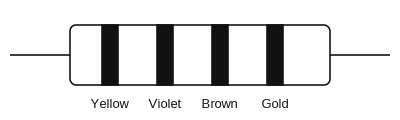
The color code of a resistance is given below :

The values of resistance and tolerance, respectively, are :
एक प्रतिरोध का वर्ण कोड नीचे दिया गया है :

प्रतिरोध और सह्यता (tolerance) के मान क्रमशः हैं :
  1. A4.7 kΩ, 5%
  2. B470 Ω, 5%
  3. C470 kΩ, 5%
  4. D47 kΩ, 10%
Show answer

Concept: Bands: 1st digit, 2nd digit, multiplier (power of 10), tolerance. B B R O Y G B V G W ↔ 0–9; gold = 5%, silver = 10%.

  1. Yellow = 4, Violet = 7 ⇒ 47
  2. Brown multiplier = 101 ⇒ 47×10=470 Ω
  3. Gold = ±5%

Short trick: Mnemonic “B B ROY of Great Britain has a Very Good Wife” (0–9). Brown as third band just adds one zero.

Answer: (B) 470 Ω, 5%

अवधारणा: पट्टियाँ: पहला अंक, दूसरा अंक, गुणक (10 की घात), सह्यता। B B R O Y G B V G W ↔ 0–9; सुनहरा (gold) = 5%, रजत (silver) = 10%।

  1. पीला (Yellow) = 4, बैंगनी (Violet) = 7 ⇒ 47
  2. भूरा (Brown) गुणक = 101 ⇒ 47×10=470 Ω
  3. सुनहरा (Gold) = ±5%

शॉर्ट ट्रिक: स्मृति-सूत्र “B B ROY of Great Britain has a Very Good Wife” (0–9)। तीसरी पट्टी भूरी हो तो केवल एक शून्य जुड़ता है।

उत्तर: (B) 470 Ω, 5%

NEET UGPhysicsCurrent electricity – colour code of resistorsNEET UG 2020 · 13 Sep Shift 1 →
Q3549.
The Brewster's angle ib for an interface should be :
किसी अंतरापृष्ठ के लिए ब्रूस्टर कोण ib होना चाहिए :
  1. A45∘<ib<90∘
  2. Bib=90∘
  3. C0∘<ib<30∘
  4. D30∘<ib<45∘
Show answer

Concept: Brewster's law: tan⁡ib=μ (light going from rarer to denser medium, μ>1).

  1. μ>1 ⇒ tan⁡ib>1=tan⁡45∘ ⇒ ib>45∘.
  2. tan⁡ib is finite ⇒ ib<90∘.
  3. So 45∘<ib<90∘ (e.g. glass, μ = 1.5 ⇒ ib≈56.3∘).

Short trick: Glass ≈ 56°, water ≈ 53° – both lie between 45° and 90°.

Answer: (A) 45∘<ib<90∘

अवधारणा: ब्रूस्टर नियम: tan⁡ib=μ (प्रकाश विरल से सघन माध्यम में जाते हुए, μ>1)।

  1. μ>1 ⇒ tan⁡ib>1=tan⁡45∘ ⇒ ib>45∘।
  2. tan⁡ib परिमित है ⇒ ib<90∘।
  3. अतः 45∘<ib<90∘ (उदा. काँच, μ = 1.5 ⇒ ib≈56.3∘)।

शॉर्ट ट्रिक: काँच ≈ 56°, जल ≈ 53° – दोनों 45° और 90° के बीच।

उत्तर: (A) 45∘<ib<90∘

NEET UGPhysicsWave optics – polarisation, Brewster's angleNEET UG 2020 · 13 Sep Shift 1 →
Q3550.
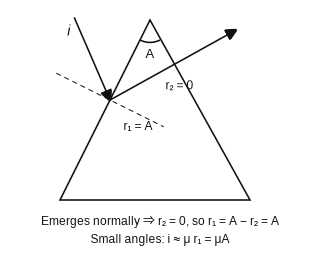
A ray is incident at an angle of incidence i on one surface of a small angle prism (with angle of prism A) and emerges normally from the opposite surface. If the refractive index of the material of the prism is μ, then the angle of incidence is nearly equal to :
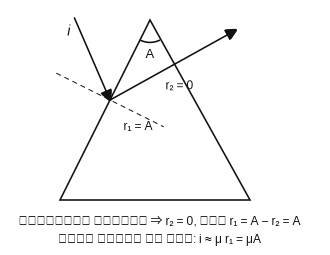
एक किरण किसी लघु कोण प्रिज़्म (प्रिज़्म कोण A) के एक पृष्ठ पर आपतन कोण i पर आपतित होती है और विपरीत पृष्ठ से अभिलंबवत निर्गत होती है। यदि प्रिज़्म के पदार्थ का अपवर्तनांक μ है, तो आपतन कोण लगभग बराबर है :
  1. AμA
  2. BμA2
  3. CA2μ
  4. D2Aμ
Show answer

Concept: In a prism r1+r2=A; Snell’s law at the first face sin⁡i=μsin⁡r1.

  1. Emerges normally ⇒ r2=0 ⇒ r1=A.
  2. sin⁡i=μsin⁡A; for small angles i≈μA.

Short trick: Normal emergence ⇒ whole prism angle is used up at the first face ⇒ i=μA.

Answer: (A) μA

अवधारणा: प्रिज़्म में r1+r2=A; पहले पृष्ठ पर स्नेल नियम sin⁡i=μsin⁡r1।

  1. अभिलंबवत निर्गत ⇒ r2=0 ⇒ r1=A।
  2. sin⁡i=μsin⁡A; लघु कोणों के लिए i≈μA।

शॉर्ट ट्रिक: अभिलंबवत निर्गमन ⇒ पूरा प्रिज़्म कोण पहले पृष्ठ पर ही अपवर्तन कोण बन जाता है ⇒ i=μA।

उत्तर: (A) μA

NEET UGPhysicsRay optics – thin prismNEET UG 2020 · 13 Sep Shift 1 →
Q3551.
Two cylinders A and B of equal capacity are connected to each other via a stop cock. A contains an ideal gas at standard temperature and pressure. B is completely evacuated. The entire system is thermally insulated. The stop cock is suddenly opened. The process is :
समान धारिता के दो सिलिंडर A और B एक स्टॉप कॉक द्वारा परस्पर जुड़े हैं। A में मानक ताप और दाब पर एक आदर्श गैस भरी है। B पूर्णतः निर्वातित है। पूरा निकाय ऊष्मीय रूप से विलगित है। स्टॉप कॉक को अचानक खोल दिया जाता है। यह प्रक्रम है :
  1. Aisochoricसमआयतनिक
  2. Bisobaricसमदाबी
  3. Cisothermalसमतापी
  4. Dadiabaticरुद्धोष्म
Show answer

Concept: A sudden expansion into vacuum inside an insulated system is a free expansion: no heat exchange.

  1. Thermally insulated ⇒ Q = 0 ⇒ the process is adiabatic.
  2. Volume doubles ⇒ not isochoric (A); pressure halves ⇒ not isobaric (B).
  3. For an ideal gas W = 0 and ΔU = 0, so the initial and final temperatures are equal, but the sudden process is not a quasi-static isothermal process (C) – it is classified as adiabatic.

Short trick: Insulated + sudden ⇒ adiabatic. (Free expansion: Q = 0, W = 0, ΔU = 0.)

Answer: (D) adiabatic

अवधारणा: विलगित निकाय में निर्वात की ओर अचानक प्रसार मुक्त प्रसार है: कोई ऊष्मा विनिमय नहीं।

  1. ऊष्मीय रूप से विलगित ⇒ Q = 0 ⇒ प्रक्रम रुद्धोष्म है।
  2. आयतन दोगुना ⇒ समआयतनिक नहीं (A); दाब आधा ⇒ समदाबी नहीं (B)।
  3. आदर्श गैस के लिए W = 0 तथा ΔU = 0, अतः प्रारंभिक व अंतिम ताप समान हैं, परंतु यह अचानक प्रक्रम स्थैतिककल्प समतापी प्रक्रम (C) नहीं है – इसे रुद्धोष्म माना जाता है।

शॉर्ट ट्रिक: विलगित + अचानक ⇒ रुद्धोष्म। (मुक्त प्रसार: Q = 0, W = 0, ΔU = 0।)

उत्तर: (D) रुद्धोष्म

NEET UGPhysicsThermodynamics – free expansionNEET UG 2020 · 13 Sep Shift 1 →
Q3552.
For which one of the following, Bohr model is not valid?
निम्नलिखित में से किसके लिए बोर मॉडल मान्य नहीं है?
  1. ADeuteron atomड्यूटेरॉन परमाणु
  2. BSingly ionised neon atom (Ne+)एकधा आयनित नियॉन परमाणु (Ne+)
  3. CHydrogen atomहाइड्रोजन परमाणु
  4. DSingly ionised helium atom (He+)एकधा आयनित हीलियम परमाणु (He+)
Show answer

Concept: Bohr model works only for hydrogen-like (single-electron) species.

  1. Deuterium atom: 1 electron – valid.
  2. Hydrogen atom: 1 electron – valid.
  3. He+: 2 − 1 = 1 electron – valid.
  4. Ne+: 10 − 1 = 9 electrons – electron–electron interaction ⇒ Bohr model fails.

Short trick: Count electrons: only “one-electron” systems obey Bohr. Ne+ still has 9.

Answer: (B) Singly ionised neon atom (Ne+)

अवधारणा: बोर मॉडल केवल हाइड्रोजन-सम (एक-इलेक्ट्रॉन) स्पीशीज़ के लिए मान्य है।

  1. ड्यूटीरियम परमाणु: 1 इलेक्ट्रॉन – मान्य।
  2. हाइड्रोजन परमाणु: 1 इलेक्ट्रॉन – मान्य।
  3. He+: 2 − 1 = 1 इलेक्ट्रॉन – मान्य।
  4. Ne+: 10 − 1 = 9 इलेक्ट्रॉन – इलेक्ट्रॉन–इलेक्ट्रॉन अन्योन्यक्रिया ⇒ बोर मॉडल विफल।

शॉर्ट ट्रिक: इलेक्ट्रॉन गिनें: केवल “एक-इलेक्ट्रॉन” निकाय बोर मॉडल का पालन करते हैं। Ne+ में अभी भी 9 हैं।

उत्तर: (B) एकधा आयनित नियॉन परमाणु (Ne+)

NEET UGPhysicsAtoms – Bohr model validityNEET UG 2020 · 13 Sep Shift 1 →
Q3553.
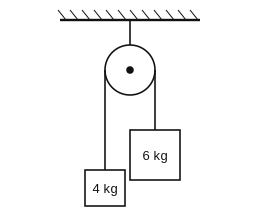
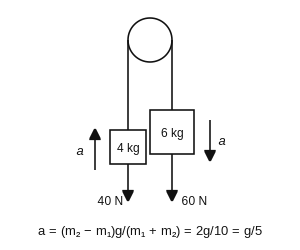
Two bodies of mass 4 kg and 6 kg are tied to the ends of a massless string. The string passes over a pulley which is frictionless (see figure). The acceleration of the system in terms of acceleration due to gravity (g) is :
4 kg और 6 kg द्रव्यमान के दो पिंड एक द्रव्यमानरहित डोरी के सिरों से बंधे हैं। डोरी एक घर्षणरहित घिरनी के ऊपर से गुजरती है (चित्र देखिए)। गुरुत्वीय त्वरण (g) के पदों में निकाय का त्वरण है :
  1. Ag5
  2. Bg10
  3. Cg
  4. Dg2
Show answer

Concept: For two masses over a frictionless pulley, a=(m2−m1)gm1+m2.

  1. 6 kg: 60−T=6a; 4 kg: T−40=4a
  2. Adding: 20=10a ⇒ a=2 m/s2=g5

Short trick: Net pulling force / total mass = (6−4)g10=g5.

Answer: (A) g5

अवधारणा: घर्षणरहित घिरनी पर दो द्रव्यमानों के लिए a=(m2−m1)gm1+m2।

  1. 6 kg: 60−T=6a; 4 kg: T−40=4a
  2. जोड़ने पर: 20=10a ⇒ a=2 m/s2=g5

शॉर्ट ट्रिक: नेट खींचने वाला बल / कुल द्रव्यमान = (6−4)g10=g5।

उत्तर: (A) g5

NEET UGPhysicsLaws of motion – Atwood machineNEET UG 2020 · 13 Sep Shift 1 →
Q3554.
In a certain region of space with volume 0.2 m3, the electric potential is found to be 5 V throughout. The magnitude of electric field in this region is :
0.2 m3 आयतन वाले आकाश के किसी क्षेत्र में विद्युत विभव सर्वत्र 5 V पाया जाता है। इस क्षेत्र में विद्युत क्षेत्र का परिमाण है :
  1. A1 N/C
  2. B5 N/C
  3. Czeroशून्य
  4. D0.5 N/C
Show answer

Concept: E=−dVdr: the field depends on the change of potential, not its value.

  1. V = 5 V everywhere ⇒ dV/dr = 0.
  2. Hence E = 0 throughout the region.
  3. The volume 0.2 m3 is extra data (5/0.2 or 0.2 × 5 give distractors).

Short trick: Constant potential ⇒ zero field (like inside a charged conductor).

Answer: (C) zero

अवधारणा: E=−dVdr: क्षेत्र विभव के परिवर्तन पर निर्भर करता है, उसके मान पर नहीं।

  1. V = 5 V सर्वत्र ⇒ dV/dr = 0।
  2. अतः पूरे क्षेत्र में E = 0।
  3. आयतन 0.2 m3 अतिरिक्त आँकड़ा है (5/0.2 या 0.2 × 5 से भ्रामक विकल्प बनते हैं)।

शॉर्ट ट्रिक: नियत विभव ⇒ शून्य क्षेत्र (जैसे आवेशित चालक के भीतर)।

उत्तर: (C) शून्य

NEET UGPhysicsElectrostatics – field and potentialNEET UG 2020 · 13 Sep Shift 1 →
Q3555.
When a uranium isotope 92235U is bombarded with a neutron, it generates 3689Kr, three neutrons and :
जब यूरेनियम समस्थानिक 92235U पर एक न्यूट्रॉन की बमबारी की जाती है, तो यह 3689Kr, तीन न्यूट्रॉन तथा निम्नलिखित में से कौन-सा नाभिक उत्पन्न करता है :
  1. A36101Kr
  2. B36103Kr
  3. C56144Ba
  4. D4091Zr
Show answer

Concept: Mass number and atomic number are conserved in a nuclear reaction.

  1. 92235U+01n→3689Kr+301n+ZAX
  2. A: 236=89+3+A ⇒ A=144
  3. Z: 92=36+Z ⇒ Z=56 ⇒ barium, 56144Ba

Short trick: Z alone decides it: 92 − 36 = 56 = Ba. Options with Z = 36 or 40 are out instantly.

Answer: (C) 56144Ba

अवधारणा: नाभिकीय अभिक्रिया में द्रव्यमान संख्या तथा परमाणु क्रमांक संरक्षित रहते हैं।

  1. 92235U+01n→3689Kr+301n+ZAX
  2. A: 236=89+3+A ⇒ A=144
  3. Z: 92=36+Z ⇒ Z=56 ⇒ बेरियम, 56144Ba

शॉर्ट ट्रिक: केवल Z से निर्णय: 92 − 36 = 56 = Ba। Z = 36 या 40 वाले विकल्प तुरंत बाहर।

उत्तर: (C) 56144Ba

NEET UGPhysicsNuclei – nuclear fissionNEET UG 2020 · 13 Sep Shift 1 →
Q3556.
The energy equivalent of 0.5 g of a substance is :
किसी पदार्थ के 0.5 g का ऊर्जा तुल्यांक है :
  1. A1.5×1013 J
  2. B0.5×1013 J
  3. C4.5×1016 J
  4. D4.5×1013 J
Show answer

Concept: Einstein relation E=mc2 (m in kg).

  1. m=0.5 g=5×10⁻⁴ kg
  2. E=5×10−4×(3×108)2=5×10−4×9×1016=4.5×10¹³ J

Short trick: Using 0.5 kg instead of 0.5 g gives 4.5×10¹⁶ J (C) – always convert to kg.

Answer: (D) 4.5×10¹³ J

अवधारणा: आइंस्टाइन संबंध E=mc2 (m kg में)।

  1. m=0.5 g=5×10⁻⁴ kg
  2. E=5×10−4×(3×108)2=5×10−4×9×1016=4.5×10¹³ J

शॉर्ट ट्रिक: 0.5 g के स्थान पर 0.5 kg लेने से 4.5×10¹⁶ J (C) आता है – सदैव kg में बदलें।

उत्तर: (D) 4.5×10¹³ J

NEET UGPhysicsNuclei – mass–energy equivalenceNEET UG 2020 · 13 Sep Shift 1 →
Q3557.
The mean free path for a gas, with molecular diameter d and number density n can be expressed as :
आण्विक व्यास d तथा संख्या घनत्व n वाली किसी गैस के लिए माध्य मुक्त पथ को व्यक्त किया जा सकता है :
  1. A12n2πd2
  2. B12n2π2d2
  3. C12nπd
  4. D12nπd2
Show answer

Concept: A molecule sweeps a collision cylinder of cross-section πd2; accounting for relative motion of all molecules adds the factor 2.

  1. Collisions per unit length =2nπd2
  2. λ=12nπd2

Short trick: Dimension check: λ is a length; n is [L−3], so 1nd2 = [L]. Only (D) has the right dimensions.

Answer: (D) 12nπd2

अवधारणा: एक अणु πd2 अनुप्रस्थ काट का संघट्ट-बेलन बनाता है; सभी अणुओं की आपेक्षिक गति को सम्मिलित करने पर गुणक 2 आता है।

  1. प्रति एकांक लंबाई संघट्ट =2nπd2
  2. λ=12nπd2

शॉर्ट ट्रिक: विमा जाँच: λ एक लंबाई है; n की विमा [L−3] है, अतः 1nd2 = [L]। केवल (D) की विमा सही है।

उत्तर: (D) 12nπd2

NEET UGPhysicsKinetic theory – mean free pathNEET UG 2020 · 13 Sep Shift 1 →
Q3558.
A wire of length L, area of cross section A is hanging from a fixed support. The length of the wire changes to L1 when mass M is suspended from its free end. The expression for Young's modulus is :
लंबाई L तथा अनुप्रस्थ काट क्षेत्रफल A का एक तार एक दृढ़ आधार से लटका है। इसके मुक्त सिरे से द्रव्यमान M लटकाने पर तार की लंबाई बदलकर L1 हो जाती है। यंग गुणांक का व्यंजक है :
  1. AMgLAL1
  2. BMgLA(L1−L)
  3. CMgL1AL
  4. DMg(L1−L)AL
Show answer

Concept: Y=stressstrain=F/AΔL/L.

  1. Stress =MgA; strain =L1−LL
  2. Y=MgA×LL1−L=MgLA(L1−L)

Short trick: Y must contain the extension (L1−L) in the denominator – only (B) does.

Answer: (B) MgLA(L1−L)

अवधारणा: Y=प्रतिबलविकृति=F/AΔL/L।

  1. प्रतिबल =MgA; विकृति =L1−LL
  2. Y=MgA×LL1−L=MgLA(L1−L)

शॉर्ट ट्रिक: Y के हर में प्रसार (L1−L) होना चाहिए – यह केवल (B) में है।

उत्तर: (B) MgLA(L1−L)

NEET UGPhysicsMechanical properties of solids – Young's modulusNEET UG 2020 · 13 Sep Shift 1 →
Q3559.
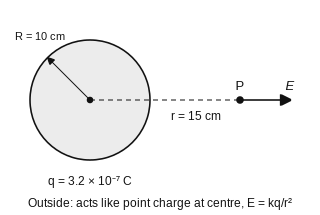
A spherical conductor of radius 10 cm has a charge of 3.2×10⁻⁷ C distributed uniformly. What is the magnitude of electric field at a point 15 cm from the centre of the sphere? (14πε0=9×10⁹ N m2/C2)
10 cm त्रिज्या के एक गोलीय चालक पर 3.2×10⁻⁷ C आवेश एकसमान रूप से वितरित है। गोले के केंद्र से 15 cm दूरी पर स्थित बिंदु पर विद्युत क्षेत्र का परिमाण क्या है? (14πε0=9×10⁹ N m2/C2)
  1. A1.28×106 N/C
  2. B1.28×107 N/C
  3. C1.28×104 N/C
  4. D1.28×105 N/C
Show answer

Concept: Outside a charged spherical conductor (r>R) the field is as if all charge were at the centre: E=kqr2.

  1. E=9×109×3.2×10−7(0.15)2=28800.0225
  2. E=1.28×10⁵ N/C

Short trick: kq=2880; dividing by 0.0225≈144.4 ⇒ ≈1.28×10⁵. The radius 10 cm only tells you the point is outside.

Answer: (D) 1.28×10⁵ N/C

अवधारणा: आवेशित गोलीय चालक के बाहर (r>R) क्षेत्र ऐसा होता है मानो सारा आवेश केंद्र पर हो: E=kqr2।

  1. E=9×109×3.2×10−7(0.15)2=28800.0225
  2. E=1.28×10⁵ N/C

शॉर्ट ट्रिक: kq=2880; 0.0225≈144.4 से भाग ⇒ ≈1.28×10⁵। त्रिज्या 10 cm केवल यह बताती है कि बिंदु बाहर है।

उत्तर: (D) 1.28×10⁵ N/C

NEET UGPhysicsElectrostatics – Gauss's law, charged sphereNEET UG 2020 · 13 Sep Shift 1 →
Q3560.
The energy required to break one bond in DNA is 10−20 J. This value in eV is nearly :
DNA में एक आबंध को तोड़ने के लिए आवश्यक ऊर्जा 10−20 J है। eV में यह मान लगभग है :
  1. A0.06
  2. B0.006
  3. C6
  4. D0.6
Show answer

Concept: 1 eV=1.6×10⁻¹⁹ J.

  1. E=10−201.6×10⁻¹⁹ eV
  2. =116=0.0625≈0.06 eV

Short trick: 10−20 J is one-tenth of 10−19; 11.6≈0.6, then ÷10 → 0.06.

Answer: (A) 0.06

अवधारणा: 1 eV=1.6×10⁻¹⁹ J।

  1. E=10−201.6×10⁻¹⁹ eV
  2. =116=0.0625≈0.06 eV

शॉर्ट ट्रिक: 10−20 J, 10−19 का दसवाँ भाग है; 11.6≈0.6, फिर ÷10 → 0.06।

उत्तर: (A) 0.06

NEET UGPhysicsUnits – electron volt conversionNEET UG 2020 · 13 Sep Shift 1 →