Q11201.
During the chlor-alkali process, which of the following statements is correct regarding the products formed at different electrodes?
क्लोर-क्षार प्रक्रिया के दौरान, विभिन्न इलेक्ट्रोडों पर बनने वाले उत्पादों के संबंध में निम्नलिखित में से कौन-सा कथन सही है?
- AHydrogen gas is released at the cathode and chlorine gas at the anode.कैथोड पर हाइड्रोजन गैस और एनोड पर क्लोरीन गैस मुक्त होती है।
- BChlorine gas is released at the cathode and hydrogen gas at the anode.कैथोड पर क्लोरीन गैस और एनोड पर हाइड्रोजन गैस मुक्त होती है।
- CSodium hydroxide is formed at the anode and chlorine gas at the cathode.एनोड पर सोडियम हाइड्रॉक्साइड और कैथोड पर क्लोरीन गैस बनती है।
- DSodium hydroxide and hydrogen gas both form at the anode.सोडियम हाइड्रॉक्साइड और हाइड्रोजन गैस दोनों एनोड पर बनते हैं।
Show answer
Concept: Electrolysis of brine (aq. NaCl): .
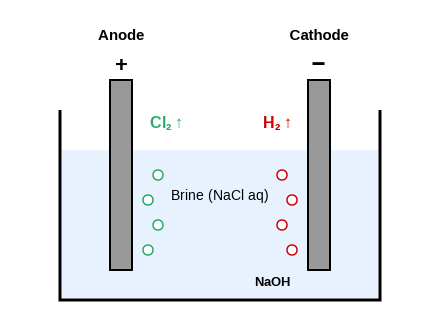
- Anode (+) attracts Cl⁻ ions → oxidised to Cl₂ gas.
- Cathode (−) reduces water → H₂ gas; OH⁻ left there combines with Na⁺ → NaOH forms near the cathode.
- So H₂ at cathode, Cl₂ at anode.
Short trick: Name = products: Chlor (Cl₂, at anode) + Alkali (NaOH, at cathode) with H₂ at cathode. Mnemonic: “Cl₂ at Anode, H₂ at Cathode”.
Answer: (A) Hydrogen gas is released at the cathode and chlorine gas at the anode.
अवधारणा: ब्राइन (NaCl का जलीय विलयन) का विद्युत अपघटन: ।
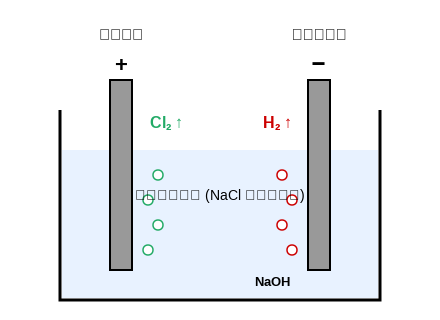
- एनोड (+) Cl⁻ आयनों को आकर्षित करता है → ये Cl₂ गैस में ऑक्सीकृत होते हैं।
- कैथोड (−) पर जल का अपचयन → H₂ गैस; वहाँ बचे OH⁻, Na⁺ से मिलकर कैथोड के पास NaOH बनाते हैं।
- अतः कैथोड पर H₂ और एनोड पर Cl₂।
शॉर्ट ट्रिक: नाम ही उत्पाद बताता है: क्लोर (Cl₂, एनोड पर) + क्षार (NaOH, कैथोड पर), साथ में कैथोड पर H₂।
उत्तर: (A) कैथोड पर हाइड्रोजन गैस और एनोड पर क्लोरीन गैस मुक्त होती है।