Question bank

Q&A: practice questions with answers

Search questions on any topic. Filter by exam category, exam, subject and topic, try the question, then open the answer and explanation.

Courses – airGurukul

53,050 questions in the question bank.

Q1421.

The total number of unpaired electrons present in the d3, d4 (low spin) d5 (high spin), d6 (high spin) and d7 (low spin) octahedral complex systems is __________.

d3, d4 (निम्न चक्रण) d5 (उच्च चक्रण), d6 (उच्च चक्रण) तथा d7 (निम्न चक्रण) अष्टफलकीय संकुल निकायों में उपस्थित अयुग्मित इलेक्ट्रॉनों की कुल संख्या __________ है।

Show answer

Concept: Octahedral field: low spin fills t2g first (Δo > P); high spin spreads electrons over t2g and eg (Δo < P).

  1. d3: t2g3 → 3 unpaired.
  2. d4 (low spin): t2g4eg0 → 2 unpaired.
  3. d5 (high spin): t2g3eg2 → 5 unpaired.
  4. d6 (high spin): t2g4eg2 → 4 unpaired.
  5. d7 (low spin): t2g6eg1 → 1 unpaired.
  6. Total = 3 + 2 + 5 + 4 + 1 = 15.

Answer: 15

अवधारणा: अष्टफलकीय क्षेत्र: निम्न चक्रण में पहले t2g भरता है (Δo > P); उच्च चक्रण में इलेक्ट्रॉन t2g तथा eg में फैल जाते हैं (Δo < P)।

  1. d3: t2g3 → 3 अयुग्मित।
  2. d4 (निम्न चक्रण): t2g4eg0 → 2 अयुग्मित।
  3. d5 (उच्च चक्रण): t2g3eg2 → 5 अयुग्मित।
  4. d6 (उच्च चक्रण): t2g4eg2 → 4 अयुग्मित।
  5. d7 (निम्न चक्रण): t2g6eg1 → 1 अयुग्मित।
  6. कुल = 3 + 2 + 5 + 4 + 1 = 15।

उत्तर: 15
JEE Main 2026 (April) – Paper 1 (B.E./B.Tech)ChemistryCoordination Compounds – CFT and unpaired electronsJEE Main 2026 (April) – Paper 1 (B.E./B.Tech) 2026 · 5 Apr Shift 2 →
Q1422.

RMgI when treated with ice cold water liberated a gas which occupied 1.4 dm3/g at STP. The gas produced is further reacted with iodine in presence of HIO3 to give compound (X). Compound (X) in presence of Na and dry ether produced compound (Y). Molar mass of compound (Y) is __________ g mol−1. (Nearest integer)

RMgI को बर्फ़ीले ठंडे जल से उपचारित करने पर एक गैस मुक्त हुई जिसने STP पर 1.4 dm3/g आयतन घेरा। उत्पन्न गैस की आगे HIO3 की उपस्थिति में आयोडीन से अभिक्रिया कराने पर यौगिक (X) प्राप्त होता है। यौगिक (X), Na तथा शुष्क ईथर की उपस्थिति में यौगिक (Y) देता है। यौगिक (Y) का मोलर द्रव्यमान __________ g mol−1 है। (निकटतम पूर्णांक)

Show answer

Concept: RMgX + H2O → RH (alkane); iodination of alkane needs HIO3 to remove HI; Wurtz reaction doubles the alkyl group.

  1. 1 g of gas occupies 1.4 dm3 at STP → molar mass = 22.41.4=16 g mol−1 → gas is CH4 (R = CH3).
  2. CH4 + I2 ⇌ CH3I + HI; HIO3 oxidises HI (5HI + HIO3 → 3I2 + 3H2O) and drives the reaction → X = CH3I.
  3. Wurtz: 2CH3I + 2Na → CH3–CH3 + 2NaI → Y = ethane.
  4. Molar mass of C2H6 = 2(12) + 6(1) = 30 g mol−1.

Answer: 30

अवधारणा: RMgX + H2O → RH (ऐल्केन); ऐल्केन के आयोडीनन में HI हटाने हेतु HIO3 आवश्यक है; वुर्ट्ज़ अभिक्रिया ऐल्किल समूह को दोगुना करती है।

  1. 1 g गैस STP पर 1.4 dm3 घेरती है → मोलर द्रव्यमान = 22.41.4=16 g mol−1 → गैस CH4 है (R = CH3)।
  2. CH4 + I2 ⇌ CH3I + HI; HIO3, HI का ऑक्सीकरण करता है (5HI + HIO3 → 3I2 + 3H2O) तथा अभिक्रिया को आगे बढ़ाता है → X = CH3I।
  3. वुर्ट्ज़: 2CH3I + 2Na → CH3–CH3 + 2NaI → Y = एथेन।
  4. C2H6 का मोलर द्रव्यमान = 2(12) + 6(1) = 30 g mol−1।

उत्तर: 30

JEE Main 2026 (April) – Paper 1 (B.E./B.Tech)ChemistryHaloalkanes – Grignard reagent and Wurtz reactionJEE Main 2026 (April) – Paper 1 (B.E./B.Tech) 2026 · 5 Apr Shift 2 →
Q1423.

20 g hemoglobin in a 1 L aqueous solution (A) at 300 K is separated from pure water by semi permeable membrane. At equilibrium the height of solution in a tube dipped in a solution (A) is found to be 80.0 mm higher than the tube dipped in water.

The molar mass of hemoglobin is __________ kg mol−1. (Nearest integer)

(Given : g = 10 m s−2, R = 8.3 kPa dm3 K−1mol−1, density of solution = 1000 kg m−3)

300 K पर 1 L जलीय विलयन (A) में 20 g हीमोग्लोबिन को अर्धपारगम्य झिल्ली द्वारा शुद्ध जल से पृथक किया गया है। साम्य पर विलयन (A) में डूबी नली में विलयन की ऊँचाई, जल में डूबी नली की तुलना में 80.0 mm अधिक पाई गई।

हीमोग्लोबिन का मोलर द्रव्यमान __________ kg mol−1 है। (निकटतम पूर्णांक)

(दिया है : g = 10 m s−2, R = 8.3 kPa dm3 K−1mol−1, विलयन का घनत्व = 1000 kg m−3)

Show answer

Concept: At osmotic equilibrium the hydrostatic pressure of the extra column equals the osmotic pressure: π = hρg = wMRTV.

  1. π = hρg = 0.080 m × 1000 kg m−3 × 10 m s−2 = 800 Pa = 0.8 kPa.
  2. M=wRTπV=20×8.3×3000.8×1 g mol−1 (R in kPa dm3, V = 1 dm3).
  3. M = 62250 g mol−1 = 62.25 kg mol−1 ≈ 62 kg mol−1.

Answer: 62

अवधारणा: परासरण साम्य पर अतिरिक्त स्तंभ का द्रवस्थैतिक दाब परासरण दाब के बराबर होता है: π = hρg = wMRTV।

  1. π = hρg = 0.080 m × 1000 kg m−3 × 10 m s−2 = 800 Pa = 0.8 kPa।
  2. M=wRTπV=20×8.3×3000.8×1 g mol−1 (R, kPa dm3 में; V = 1 dm3)।
  3. M = 62250 g mol−1 = 62.25 kg mol−1 ≈ 62 kg mol−1।

उत्तर: 62

JEE Main 2026 (April) – Paper 1 (B.E./B.Tech)ChemistrySolutions – osmotic pressure and molar massJEE Main 2026 (April) – Paper 1 (B.E./B.Tech) 2026 · 5 Apr Shift 2 →
Q1424.

At 298 K, the molar conductivity of x% (w/w) MX solution (aqueous) is 123.5 S cm2 mol−1. The conductance of same solution is 1.9 × 10⁻³ S. The value of x is __________ × 10−2.

(Given : cell constant = 1.3 cm−1; molar mass of MX is 75 g mol−1, density of aqueous solution of MX at 298 K is 1.0 g mL−1)

298 K पर x% (w/w) MX विलयन (जलीय) की मोलर चालकता 123.5 S cm2 mol−1 है। उसी विलयन का चालकत्व 1.9 × 10⁻³ S है। x का मान __________ × 10−2 है।

(दिया है : सेल स्थिरांक = 1.3 cm−1; MX का मोलर द्रव्यमान 75 g mol−1 है, 298 K पर MX के जलीय विलयन का घनत्व 1.0 g mL−1 है)

Show answer

Concept: κ = G × G*; Λm = 1000κC (C in mol L−1); then convert molarity to % (w/w) using density.

  1. κ = 1.9 × 10−3 S × 1.3 cm−1 = 2.47 × 10⁻³ S cm−1.
  2. C=1000κΛm=1000×2.47×10−3123.5=0.02 mol L−1.
  3. 1 L solution = 1000 g (density 1.0 g mL−1) contains 0.02 × 75 = 1.5 g MX.
  4. % (w/w) = 1.51000×100=0.15=15×10−2.

Answer: 15

अवधारणा: κ = G × G*; Λm = 1000κC (C, mol L−1 में); फिर घनत्व की सहायता से मोलरता को % (w/w) में बदलिए।

  1. κ = 1.9 × 10−3 S × 1.3 cm−1 = 2.47 × 10⁻³ S cm−1।
  2. C=1000κΛm=1000×2.47×10−3123.5=0.02 mol L−1।
  3. 1 L विलयन = 1000 g (घनत्व 1.0 g mL−1) में 0.02 × 75 = 1.5 g MX है।
  4. % (w/w) = 1.51000×100=0.15=15×10−2।

उत्तर: 15

JEE Main 2026 (April) – Paper 1 (B.E./B.Tech)ChemistryElectrochemistry – conductance and molar conductivityJEE Main 2026 (April) – Paper 1 (B.E./B.Tech) 2026 · 5 Apr Shift 2 →
Q1425.

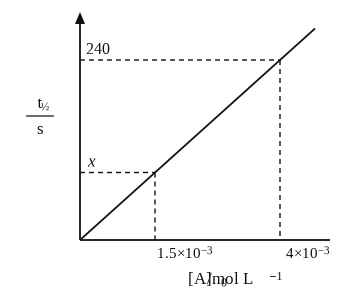
For a reaction A → P at T K, the half life (t½) is plotted as a function of initial concentration [A]0 of A as given below.

The value of x in the given figure is __________ s (Nearest integer)

T K पर अभिक्रिया A → P के लिए अर्धायु (t½) को A की प्रारम्भिक सांद्रता [A]0 के फलन के रूप में नीचे दिए अनुसार आलेखित किया गया है।

दिए गए चित्र में x का मान __________ s है (निकटतम पूर्णांक)

Show answer

Concept: A straight line through the origin means t½ ∝ [A]0, i.e. a zero-order reaction: t½ = [A]02k.

  1. From the graph: t½ = 240 s at [A]0 = 4 × 10⁻³ mol L−1.
  2. Since t½ ∝ [A]0: x=240×1.5×10−34×10−3=90 s.
  3. (Check: k = 4×10−32×240=8.33×10⁻⁶ mol L−1 s−1; 1.5×10⁻³²k=90 s.)

Answer: 90

अवधारणा: मूलबिंदु से गुजरती सीधी रेखा का अर्थ है t½ ∝ [A]0, अर्थात् शून्य कोटि अभिक्रिया: t½ = [A]02k।

  1. आलेख से: [A]0 = 4 × 10⁻³ mol L−1 पर t½ = 240 s।
  2. चूँकि t½ ∝ [A]0: x=240×1.5×10−34×10−3=90 s।
  3. (जाँच: k = 4×10−32×240=8.33×10⁻⁶ mol L−1 s−1; 1.5×10⁻³²k=90 s।)

उत्तर: 90

JEE Main 2026 (April) – Paper 1 (B.E./B.Tech)ChemistryChemical Kinetics – zero order half-lifeJEE Main 2026 (April) – Paper 1 (B.E./B.Tech) 2026 · 5 Apr Shift 2 →
Q1426.
Let α,β be the roots of the equation x2−3x+r=0, and α2,2β be the roots of the equation x2+3x+r=0. If the roots of the equation x2+6x=m are 2α+β+2r and α−2β−r2, then m is equal to :
माना समीकरण x2−3x+r=0 के मूल α,β हैं तथा समीकरण x2+3x+r=0 के मूल α2,2β हैं। यदि समीकरण x2+6x=m के मूल 2α+β+2r तथा α−2β−r2 हैं, तो m बराबर है :
  1. A−135
  2. B−567
  3. C135
  4. D567
Show answer

Concept: For x2+bx+c=0, sum of roots =−b and product of roots =c.

  1. From the first equation: α+β=3 and αβ=r.
  2. From the second equation: α2+2β=−3, i.e. α+4β=−6 (the product α2⋅2β=αβ=r is automatically consistent).
  3. Subtracting: 3β=−9⇒β=−3, α=6, r=αβ=−18.
  4. Roots of x2+6x−m=0: 2α+β+2r=12−3−36=−27 and α−2β−r2=6+6+9=21.
  5. Sum =−27+21=−6 ✓ matches −6. Product =−m⇒(−27)(21)=−567=−m⇒m=567.

Short trick: Use the sum of the new roots (−6) only as a check; the product directly gives m.

Answer: (D) 567

अवधारणा: x2+bx+c=0 के लिए मूलों का योग =−b तथा गुणनफल =c.

  1. पहले समीकरण से: α+β=3 तथा αβ=r.
  2. दूसरे समीकरण से: α2+2β=−3, अर्थात α+4β=−6 (गुणनफल α2⋅2β=αβ=r स्वतः संगत है)।
  3. घटाने पर: 3β=−9⇒β=−3, α=6, r=αβ=−18.
  4. x2+6x−m=0 के मूल: 2α+β+2r=12−3−36=−27 तथा α−2β−r2=6+6+9=21.
  5. योग =−27+21=−6 ✓. गुणनफल =−m⇒(−27)(21)=−567=−m⇒m=567.

शॉर्ट ट्रिक: नये मूलों का योग (−6) केवल जाँच के लिए प्रयोग करें; गुणनफल सीधे m दे देता है।

उत्तर: (D) 567

JEE Main 2026 (April) – Paper 1 (B.E./B.Tech)MathematicsQuadratic equations – relation between rootsJEE Main 2026 (April) – Paper 1 (B.E./B.Tech) 2026 · 2 Apr Shift 2 →
Q1427.
Let the circles C1:|z|=r and C2:|z−3−4i|=5, z∈C, be such that C2 lies within C1. If z1 moves on C1, z2 moves on C2 and min|z1−z2|=2, then max|z1−z2| is equal to :
माना वृत्त C1:|z|=r तथा C2:|z−3−4i|=5, z∈C, इस प्रकार हैं कि C2, C1 के भीतर स्थित है। यदि z1, C1 पर तथा z2, C2 पर चलते हैं और min|z1−z2|=2 है, तो max|z1−z2| बराबर है :
  1. A12
  2. B17
  3. C22
  4. D24
Show answer

Concept: If a circle of radius r2 (centre distance d from O) lies inside a circle of radius r1, then for points on the two circles the minimum distance is r1−d−r2 and the maximum is r1+d+r2.

  1. C1: centre O(0,0), radius r; C2: centre (3,4), radius 5; distance between centres d=32+42=5.
  2. min|z1−z2|=r−d−5=r−10=2⇒r=12.
  3. max|z1−z2|=r+d+5=12+5+5=22.

Short trick: max−min=2(d+r2)=2(10)=20, so max =2+20=22.

Answer: (C) 22

अवधारणा: यदि त्रिज्या r2 का वृत्त (केन्द्र की O से दूरी d) त्रिज्या r1 के वृत्त के भीतर हो, तो दोनों वृत्तों के बिंदुओं के बीच न्यूनतम दूरी r1−d−r2 तथा अधिकतम दूरी r1+d+r2 होती है।

  1. C1: केन्द्र O(0,0), त्रिज्या r; C2: केन्द्र (3,4), त्रिज्या 5; केन्द्रों के बीच दूरी d=32+42=5.
  2. min|z1−z2|=r−d−5=r−10=2⇒r=12.
  3. max|z1−z2|=r+d+5=12+5+5=22.

शॉर्ट ट्रिक: max−min=2(d+r2)=2(10)=20, अतः अधिकतम =2+20=22.

उत्तर: (C) 22

JEE Main 2026 (April) – Paper 1 (B.E./B.Tech)MathematicsComplex numbers – circles in the Argand planeJEE Main 2026 (April) – Paper 1 (B.E./B.Tech) 2026 · 2 Apr Shift 2 →
Q1428.
If the system of equations
x+5y+6z=4,
2x+3y+4z=7,
x+6y+az=b
has infinitely many solutions, then the point (a, b) lies on the line
यदि समीकरण निकाय
x+5y+6z=4,
2x+3y+4z=7,
x+6y+az=b
के अपरिमित रूप से अनेक हल हैं, तो बिंदु (a, b) जिस रेखा पर स्थित है, वह है
  1. Ay−x=3
  2. Bx−y=3
  3. Cx+y=11
  4. Dx+y=12
Show answer

Concept: Infinitely many solutions ⇒Δ=0 and the system is consistent.

  1. Δ=|15623416a|=(3a−24)−5(2a−4)+6(9)=−7a+50=0⇒a=507.
  2. E2−2E1: −7y−8z=−1⇒7y+8z=1.
  3. E3−E1: y+(a−6)z=b−4, i.e. 7y+(7a−42)z=7(b−4). With a=507: 7a−42=8, so 7y+8z=7b−28.
  4. Consistency with step 2: 7b−28=1⇒b=297.
  5. a−b=50−297=3, so (a,b) satisfies x−y=3. (Check: y−x=−3≠3; a+b=797≠11,12.)

Answer: (B) x−y=3

अवधारणा: अपरिमित रूप से अनेक हल ⇒Δ=0 तथा निकाय संगत (consistent) हो।

  1. Δ=|15623416a|=(3a−24)−5(2a−4)+6(9)=−7a+50=0⇒a=507.
  2. E2−2E1: −7y−8z=−1⇒7y+8z=1.
  3. E3−E1: y+(a−6)z=b−4, अर्थात 7y+(7a−42)z=7(b−4). a=507 रखने पर 7a−42=8, अतः 7y+8z=7b−28.
  4. चरण 2 से संगति हेतु: 7b−28=1⇒b=297.
  5. a−b=50−297=3, अतः (a,b) रेखा x−y=3 पर स्थित है। (जाँच: y−x=−3≠3; a+b=797≠11,12.)

उत्तर: (B) x−y=3

JEE Main 2026 (April) – Paper 1 (B.E./B.Tech)MathematicsSystem of linear equations – infinitely many solutionsJEE Main 2026 (April) – Paper 1 (B.E./B.Tech) 2026 · 2 Apr Shift 2 →
Q1429.
Let a1,a2,a3,… be an A.P. and g1=a1,g2,g3,… be an increasing G.P. If a1=a2+g2=1 and a3+g3=4, then a10+g5 is equal to :
माना a1,a2,a3,… एक समांतर श्रेढ़ी (A.P.) है तथा g1=a1,g2,g3,… एक वर्धमान गुणोत्तर श्रेढ़ी (G.P.) है। यदि a1=a2+g2=1 तथा a3+g3=4 हैं, तो a10+g5 बराबर है :
  1. A81
  2. B76
  3. C62
  4. D55
Show answer

Concept: A.P.: an=a1+(n−1)d; G.P.: gn=g1rn−1.

  1. a1=g1=1. a2+g2=1⇒(1+d)+r=1⇒d=−r.
  2. a3+g3=4⇒(1+2d)+r2=4⇒1−2r+r2=4⇒r2−2r−3=0⇒r=3 or −1.
  3. Increasing G.P. (with g1=1) ⇒r=3, so d=−3.
  4. a10=1+9(−3)=−26 and g5=34=81, so a10+g5=55.

Answer: (D) 55

अवधारणा: A.P.: an=a1+(n−1)d; G.P.: gn=g1rn−1.

  1. a1=g1=1. a2+g2=1⇒(1+d)+r=1⇒d=−r.
  2. a3+g3=4⇒(1+2d)+r2=4⇒1−2r+r2=4⇒r2−2r−3=0⇒r=3 या −1.
  3. वर्धमान G.P. (g1=1 के साथ) ⇒r=3, अतः d=−3.
  4. a10=1+9(−3)=−26 तथा g5=34=81, अतः a10+g5=55.

उत्तर: (D) 55

JEE Main 2026 (April) – Paper 1 (B.E./B.Tech)MathematicsSequences and series – A.P. and G.P.JEE Main 2026 (April) – Paper 1 (B.E./B.Tech) 2026 · 2 Apr Shift 2 →
Q1430.
The sum 131+13+231+3+13+23+331+3+5+⋯ up to 8 terms, is :
योग 131+13+231+3+13+23+331+3+5+⋯ का 8 पदों तक मान है :
  1. A70
  2. B71
  3. C72
  4. D73
Show answer

Concept: ∑i=1ki3=k2(k+1)24 and 1+3+5+⋯+(2k−1)=k2.

  1. k-th term Tk=k2(k+1)2/4k2=(k+1)24.
  2. Sum =14∑k=18(k+1)2=14(22+32+⋯+92)=285−14=2844=71.

Short trick: ∑19k2=9⋅10⋅196=285; subtract 12 and divide by 4.

Answer: (B) 71

अवधारणा: ∑i=1ki3=k2(k+1)24 तथा 1+3+5+⋯+(2k−1)=k2.

  1. k-वाँ पद Tk=k2(k+1)2/4k2=(k+1)24.
  2. योग =14∑k=18(k+1)2=14(22+32+⋯+92)=285−14=2844=71.

शॉर्ट ट्रिक: ∑19k2=9⋅10⋅196=285; इसमें से 12 घटाकर 4 से भाग दें।

उत्तर: (B) 71

JEE Main 2026 (April) – Paper 1 (B.E./B.Tech)MathematicsSequences and series – sum of special seriesJEE Main 2026 (April) – Paper 1 (B.E./B.Tech) 2026 · 2 Apr Shift 2 →
Q1431.
If for 3≤r≤30, (3030−r)+3(3031−r)+3(3032−r)+(3033−r)=(mr), then m equals :
यदि 3≤r≤30 के लिए, (3030−r)+3(3031−r)+3(3032−r)+(3033−r)=(mr) है, तो m बराबर है :
  1. A31
  2. B32
  3. C33
  4. D34
Show answer

Concept: Pascal's rule (nk−1)+(nk)=(n+1k); the coefficients 1,3,3,1 are (3k) (Vandermonde pattern).

  1. Write the sum as ∑k=03(3k)(30(33−r)−k).
  2. By Vandermonde's identity this equals (3333−r).
  3. (3333−r)=(33r), so m=33.

Short trick: Coefficients 1,3,3,1 mean Pascal's rule applied three times: 30→33 in the upper index.

Answer: (C) 33

अवधारणा: पास्कल नियम (nk−1)+(nk)=(n+1k); गुणांक 1,3,3,1 वस्तुतः (3k) हैं (वाण्डरमोंड सर्वसमिका)।

  1. योग को ∑k=03(3k)(30(33−r)−k) के रूप में लिखें।
  2. वाण्डरमोंड सर्वसमिका से यह (3333−r) के बराबर है।
  3. (3333−r)=(33r), अतः m=33.

शॉर्ट ट्रिक: गुणांक 1,3,3,1 का अर्थ है पास्कल नियम तीन बार लागू होना: ऊपरी सूचकांक 30→33.

उत्तर: (C) 33

JEE Main 2026 (April) – Paper 1 (B.E./B.Tech)MathematicsBinomial theorem – identities of binomial coefficientsJEE Main 2026 (April) – Paper 1 (B.E./B.Tech) 2026 · 2 Apr Shift 2 →
Q1432.
Let pn denote the total number of triangles formed by joining the vertices of an n-side regular polygon. If pn+1−pn=66, then the sum of all distinct prime divisors of n is :
माना एक n भुजाओं वाले सम बहुभुज के शीर्षों को मिलाकर बनने वाले त्रिभुजों की कुल संख्या pn है। यदि pn+1−pn=66 है, तो n के सभी भिन्न-भिन्न अभाज्य भाजकों (prime divisors) का योग है :
  1. A7
  2. B8
  3. C5
  4. D6
Show answer

Concept: pn=(n3) and (n+13)−(n3)=(n2) (Pascal's rule).

  1. pn+1−pn=(n2)=n(n−1)2=66⇒n2−n−132=0.
  2. (n−12)(n+11)=0⇒n=12.
  3. 12=22×3; distinct prime divisors are 2 and 3, sum =5.

Answer: (C) 5

अवधारणा: pn=(n3) तथा (n+13)−(n3)=(n2) (पास्कल नियम)।

  1. pn+1−pn=(n2)=n(n−1)2=66⇒n2−n−132=0.
  2. (n−12)(n+11)=0⇒n=12.
  3. 12=22×3; भिन्न-भिन्न अभाज्य भाजक 2 तथा 3 हैं, योग =5.

उत्तर: (C) 5

JEE Main 2026 (April) – Paper 1 (B.E./B.Tech)MathematicsPermutations and combinationsJEE Main 2026 (April) – Paper 1 (B.E./B.Tech) 2026 · 2 Apr Shift 2 →
Q1433.
A man throws a fair coin repeatedly. He gets 10 points for each head he throws and 5 points for each tail he throws. If the probability that he gets exactly 30 points is mn, gcd (m, n) = 1, then m + n is equal to :
एक व्यक्ति एक अनभिनत (fair) सिक्के को बार-बार उछालता है। प्रत्येक चित (head) पर उसे 10 अंक तथा प्रत्येक पट (tail) पर 5 अंक मिलते हैं। यदि उसके ठीक 30 अंक प्राप्त करने की प्रायिकता mn है, जहाँ gcd (m, n) = 1, तो m + n बराबर है :
  1. A53
  2. B55
  3. C107
  4. D105
Show answer

Concept: In units of 5 points, each throw adds 1 (tail) or 2 (head), each with probability 12. Let pk = probability that the running total ever equals k; then pk=12pk−1+12pk−2.

  1. Scoring exactly 30 points means the running total visits k=6 (units of 5).
  2. p0=1, p1=12 (first throw must be a tail).
  3. p2=34, p3=58, p4=1116, p5=2132, p6=12(2132+1116)=4364.
  4. gcd(43,64)=1⇒m+n=43+64=107.

Short trick: pk=23+13(−12)k; at k=6: 23+1192=4364.

Answer: (C) 107

अवधारणा: 5 अंकों की इकाई में प्रत्येक उछाल 1 (पट) या 2 (चित) जोड़ती है, प्रत्येक की प्रायिकता 12. माना pk = चालू योग के कभी k होने की प्रायिकता; तब pk=12pk−1+12pk−2.

  1. ठीक 30 अंक प्राप्त करने का अर्थ है चालू योग k=6 (5 की इकाइयों में) से होकर गुजरे।
  2. p0=1, p1=12 (पहली उछाल पट होनी चाहिए)।
  3. p2=34, p3=58, p4=1116, p5=2132, p6=12(2132+1116)=4364.
  4. gcd(43,64)=1⇒m+n=43+64=107.

शॉर्ट ट्रिक: pk=23+13(−12)k; k=6 पर: 23+1192=4364.

उत्तर: (C) 107

JEE Main 2026 (April) – Paper 1 (B.E./B.Tech)MathematicsProbability – recurrence on reaching a scoreJEE Main 2026 (April) – Paper 1 (B.E./B.Tech) 2026 · 2 Apr Shift 2 →
Q1434.
The mean and variance of n observations are 8 and 16, respectively. If the sum of the first (n−1) observations is 48 and the sum of squares of the first (n−1) observations is 496, then the value of n is :
n प्रेक्षणों के माध्य तथा प्रसरण क्रमशः 8 तथा 16 हैं। यदि प्रथम (n−1) प्रेक्षणों का योग 48 तथा प्रथम (n−1) प्रेक्षणों के वर्गों का योग 496 है, तो n का मान है :
  1. A21
  2. B16
  3. C13
  4. D7
Show answer

Concept: Mean =∑xin, variance =∑xi2n−(mean)2.

  1. ∑xi=8n and ∑xi2=n(16+64)=80n.
  2. Last observation: xn=8n−48 and xn2=80n−496.
  3. (8n−48)2=80n−496⇒64n2−768n+2304=80n−496⇒4n2−53n+175=0.
  4. n=53±2809−28008=53±38=7 or 254; n must be a natural number, so n=7.
  5. Check: x7=8, x72=64=80(7)−496 ✓.

Answer: (D) 7

अवधारणा: माध्य =∑xin, प्रसरण =∑xi2n−(माध्य)2.

  1. ∑xi=8n तथा ∑xi2=n(16+64)=80n.
  2. अंतिम प्रेक्षण: xn=8n−48 तथा xn2=80n−496.
  3. (8n−48)2=80n−496⇒64n2−768n+2304=80n−496⇒4n2−53n+175=0.
  4. n=53±2809−28008=53±38=7 या 254; n प्राकृत संख्या है, अतः n=7.
  5. जाँच: x7=8, x72=64=80(7)−496 ✓.

उत्तर: (D) 7

JEE Main 2026 (April) – Paper 1 (B.E./B.Tech)MathematicsStatistics – mean and varianceJEE Main 2026 (April) – Paper 1 (B.E./B.Tech) 2026 · 2 Apr Shift 2 →
Q1435.
Let a circle pass through the origin and its centre be the point of intersection of two mutually perpendicular lines x+(k−1)y+3=0 and 2x+k2y−4=0. If the line x−y+2=0 intersects the circle at the points A and B, then (AB)2 is equal to :
माना एक वृत्त मूलबिंदु से होकर जाता है तथा इसका केन्द्र दो परस्पर लंबवत रेखाओं x+(k−1)y+3=0 तथा 2x+k2y−4=0 का प्रतिच्छेद बिंदु है। यदि रेखा x−y+2=0 वृत्त को बिंदुओं A तथा B पर काटती है, तो (AB)2 बराबर है :
  1. A10
  2. B27
  3. C18
  4. D34
Show answer

Concept: Lines a1x+b1y+c1=0, a2x+b2y+c2=0 are perpendicular iff a1a2+b1b2=0; chord length: (AB2)2=r2−d2.

  1. Perpendicularity: 1⋅2+(k−1)k2=0⇒k3−k2+2=0⇒(k+1)(k2−2k+2)=0⇒k=−1.
  2. Lines become x−2y+3=0 and 2x+y−4=0; solving, centre =(1,2).
  3. Circle through origin: r2=12+22=5.
  4. Distance of (1,2) from x−y+2=0: d=|1−2+2|2=12.
  5. (AB)2=4(r2−d2)=4(5−12)=18.

Answer: (C) 18

अवधारणा: रेखाएँ a1x+b1y+c1=0, a2x+b2y+c2=0 लंबवत हैं यदि और केवल यदि a1a2+b1b2=0; जीवा की लंबाई: (AB2)2=r2−d2.

  1. लंबवतता: 1⋅2+(k−1)k2=0⇒k3−k2+2=0⇒(k+1)(k2−2k+2)=0⇒k=−1.
  2. रेखाएँ x−2y+3=0 तथा 2x+y−4=0 बनती हैं; हल करने पर केन्द्र =(1,2).
  3. वृत्त मूलबिंदु से गुजरता है: r2=12+22=5.
  4. (1,2) की x−y+2=0 से दूरी: d=|1−2+2|2=12.
  5. (AB)2=4(r2−d2)=4(5−12)=18.

उत्तर: (C) 18

JEE Main 2026 (April) – Paper 1 (B.E./B.Tech)MathematicsCircle – chord intercepted by a lineJEE Main 2026 (April) – Paper 1 (B.E./B.Tech) 2026 · 2 Apr Shift 2 →
Q1436.
Let O be the origin, and P and Q be two points on the rectangular hyperbola xy=12 such that the mid point of the line segment PQ is (12,−12). Then the area of the triangle OPQ equals :
माना O मूलबिंदु है तथा P और Q आयताकार अतिपरवलय xy=12 पर दो बिंदु इस प्रकार हैं कि रेखाखंड PQ का मध्य-बिंदु (12,−12) है। तब त्रिभुज OPQ का क्षेत्रफल बराबर है :
  1. A32
  2. B52
  3. C72
  4. D92
Show answer

Concept: Area of triangle with vertices O, (x1,y1), (x2,y2) is 12|x1y2−x2y1|.

  1. Let P=(p,12p), Q=(q,12q).
  2. Midpoint: p+q=1 and 12p+12q=−1⇒12(p+q)pq=−1⇒pq=−12.
  3. Area =12|p⋅12q−q⋅12p|=6|p2−q2||pq|=6|p+q||p−q|12=|p−q|2.
  4. (p−q)2=(p+q)2−4pq=1+48=49⇒|p−q|=7.
  5. Area =72.

Answer: (C) 72

अवधारणा: शीर्षों O, (x1,y1), (x2,y2) वाले त्रिभुज का क्षेत्रफल 12|x1y2−x2y1| होता है।

  1. माना P=(p,12p), Q=(q,12q).
  2. मध्य-बिंदु से: p+q=1 तथा 12p+12q=−1⇒12(p+q)pq=−1⇒pq=−12.
  3. क्षेत्रफल =12|p⋅12q−q⋅12p|=6|p2−q2||pq|=6|p+q||p−q|12=|p−q|2.
  4. (p−q)2=(p+q)2−4pq=1+48=49⇒|p−q|=7.
  5. क्षेत्रफल =72.

उत्तर: (C) 72

JEE Main 2026 (April) – Paper 1 (B.E./B.Tech)MathematicsHyperbola – rectangular hyperbola and area of triangleJEE Main 2026 (April) – Paper 1 (B.E./B.Tech) 2026 · 2 Apr Shift 2 →
Q1437.
Let the parabola y=x2+px+q passing through the point (1,−1) be such that the distance between its vertex and the x-axis is minimum. Then the value of p2+q2 is :
माना बिंदु (1,−1) से गुजरने वाला परवलय y=x2+px+q इस प्रकार है कि इसके शीर्ष तथा x-अक्ष के बीच की दूरी न्यूनतम है। तब p2+q2 का मान है :
  1. A2
  2. B4
  3. C5
  4. D8
Show answer

Concept: Vertex of y=x2+px+q is at y=q−p24; its distance from the x-axis is |q−p24|.

  1. Through (1,−1): 1+p+q=−1⇒q=−2−p.
  2. Distance =|q−p24|=|−2−p−p24|=(p2+1)2+1.
  3. This is minimum (equal to 1) when p2+1=0⇒p=−2, giving q=0.
  4. p2+q2=4+0=4.

Answer: (B) 4

अवधारणा: y=x2+px+q का शीर्ष y=q−p24 पर होता है; x-अक्ष से इसकी दूरी |q−p24| है।

  1. (1,−1) से गुजरने पर: 1+p+q=−1⇒q=−2−p.
  2. दूरी =|q−p24|=|−2−p−p24|=(p2+1)2+1.
  3. यह न्यूनतम (1 के बराबर) तब है जब p2+1=0⇒p=−2, जिससे q=0.
  4. p2+q2=4+0=4.

उत्तर: (B) 4

JEE Main 2026 (April) – Paper 1 (B.E./B.Tech)MathematicsParabola – vertex and minimum distanceJEE Main 2026 (April) – Paper 1 (B.E./B.Tech) 2026 · 2 Apr Shift 2 →
Q1438.
Let P={θ∈[0,4π]:tan2⁡θ≠1} and S={a∈Z:2(cos8⁡θ−sin8⁡θ)sec⁡2θ=a2, θ∈P}. Then n(S) is :
माना P={θ∈[0,4π]:tan2⁡θ≠1} तथा S={a∈Z:2(cos8⁡θ−sin8⁡θ)sec⁡2θ=a2, θ∈P} हैं। तब n(S) है :
  1. A0
  2. B1
  3. C2
  4. D3
Show answer

Concept: cos8⁡θ−sin8⁡θ=(cos4⁡θ−sin4⁡θ)(cos4⁡θ+sin4⁡θ)=cos⁡2θ(1−12sin2⁡2θ).

  1. 2(cos8⁡θ−sin8⁡θ)sec⁡2θ=2(1−12sin2⁡2θ)=2−sin2⁡2θ.
  2. tan2⁡θ≠1⇔cos⁡2θ≠0⇔sin2⁡2θ≠1. So for θ∈P, sin2⁡2θ∈[0,1).
  3. Hence the expression takes values in (1,2].
  4. We need a2∈(1,2] with a∈Z: a2=2 has no integer solution, and a2=1 is excluded. So no integer a works.
  5. S=∅⇒n(S)=0.

Short trick: The expression simplifies to 2−sin2⁡2θ; the only perfect squares near (1,2] are 1 and 4, both outside the range.

Answer: (A) 0

अवधारणा: cos8⁡θ−sin8⁡θ=(cos4⁡θ−sin4⁡θ)(cos4⁡θ+sin4⁡θ)=cos⁡2θ(1−12sin2⁡2θ).

  1. 2(cos8⁡θ−sin8⁡θ)sec⁡2θ=2(1−12sin2⁡2θ)=2−sin2⁡2θ.
  2. tan2⁡θ≠1⇔cos⁡2θ≠0⇔sin2⁡2θ≠1. अतः θ∈P के लिए sin2⁡2θ∈[0,1).
  3. इसलिए व्यंजक के मान (1,2] में हैं।
  4. हमें a2∈(1,2], a∈Z चाहिए: a2=2 का कोई पूर्णांक हल नहीं और a2=1 परिसर से बाहर है। अतः कोई पूर्णांक a संभव नहीं।
  5. S=∅⇒n(S)=0.

शॉर्ट ट्रिक: व्यंजक 2−sin2⁡2θ में सरल हो जाता है; (1,2] के निकट पूर्ण वर्ग केवल 1 और 4 हैं, दोनों परिसर से बाहर।

उत्तर: (A) 0

JEE Main 2026 (April) – Paper 1 (B.E./B.Tech)MathematicsTrigonometry – identities and rangeJEE Main 2026 (April) – Paper 1 (B.E./B.Tech) 2026 · 2 Apr Shift 2 →
Q1439.
Let the vectors a→=−i^+j^+3k^ and b→=i^+3j^+k^. For some λ,μ∈R, let c→=λa→+μb→. If c→⋅(3i^−6j^+2k^)=10 and c→⋅(i^+j^+k^)=−2, then |c→|2 is equal to :
माना सदिश a→=−i^+j^+3k^ तथा b→=i^+3j^+k^ हैं। किन्हीं λ,μ∈R के लिए, माना c→=λa→+μb→ है। यदि c→⋅(3i^−6j^+2k^)=10 तथा c→⋅(i^+j^+k^)=−2 हैं, तो |c→|2 बराबर है :
  1. A8
  2. B12
  3. C14
  4. D15
Show answer

Concept: Dot product is linear: c→⋅u→=λ(a→⋅u→)+μ(b→⋅u→).

  1. a→⋅(3,−6,2)=−3−6+6=−3; b→⋅(3,−6,2)=3−18+2=−13. So −3λ−13μ=10.
  2. a→⋅(1,1,1)=3; b→⋅(1,1,1)=5. So 3λ+5μ=−2.
  3. Adding: −8μ=8⇒μ=−1; then 3λ−5=−2⇒λ=1.
  4. c→=a→−b→=−2i^−2j^+2k^, so |c→|2=4+4+4=12.

Answer: (B) 12

अवधारणा: अदिश गुणनफल रैखिक होता है: c→⋅u→=λ(a→⋅u→)+μ(b→⋅u→).

  1. a→⋅(3,−6,2)=−3−6+6=−3; b→⋅(3,−6,2)=3−18+2=−13. अतः −3λ−13μ=10.
  2. a→⋅(1,1,1)=3; b→⋅(1,1,1)=5. अतः 3λ+5μ=−2.
  3. जोड़ने पर: −8μ=8⇒μ=−1; तब 3λ−5=−2⇒λ=1.
  4. c→=a→−b→=−2i^−2j^+2k^, अतः |c→|2=4+4+4=12.

उत्तर: (B) 12

JEE Main 2026 (April) – Paper 1 (B.E./B.Tech)MathematicsVector algebra – linear combination and dot productJEE Main 2026 (April) – Paper 1 (B.E./B.Tech) 2026 · 2 Apr Shift 2 →
Q1440.
Let the point A be the foot of perpendicular drawn from the point P(a, b, 0) on the line x−12=y−21=z−α3. If the midpoint of the line segment PA is (0,34,−14), then the value of a2+b2+α2 is equal to :
माना बिंदु P(a, b, 0) से रेखा x−12=y−21=z−α3 पर डाले गए लंब का पाद बिंदु A है। यदि रेखाखंड PA का मध्य-बिंदु (0,34,−14) है, तो a2+b2+α2 का मान बराबर है :
  1. A1
  2. B2
  3. C6
  4. D9
Show answer

Concept: A general point of the line is A(1+2t,2+t,α+3t); PA→ must be perpendicular to the direction (2,1,3).

  1. Midpoint of PA: a+1+2t2=0, b+2+t2=34, 0+α+3t2=−14, giving a=−1−2t, b=−12−t, α=−12−3t.
  2. PA→=(2+4t, 52+2t, −12).
  3. PA→⋅(2,1,3)=0: 2(2+4t)+(52+2t)−32=10t+5=0⇒t=−12.
  4. Then a=0, b=0, α=1.
  5. a2+b2+α2=0+0+1=1.

Answer: (A) 1

अवधारणा: रेखा का व्यापक बिंदु A(1+2t,2+t,α+3t) है; PA→ दिक्-अनुपात (2,1,3) के लंबवत होना चाहिए।

  1. PA का मध्य-बिंदु: a+1+2t2=0, b+2+t2=34, 0+α+3t2=−14, जिससे a=−1−2t, b=−12−t, α=−12−3t.
  2. PA→=(2+4t, 52+2t, −12).
  3. PA→⋅(2,1,3)=0: 2(2+4t)+(52+2t)−32=10t+5=0⇒t=−12.
  4. तब a=0, b=0, α=1.
  5. a2+b2+α2=0+0+1=1.

उत्तर: (A) 1

JEE Main 2026 (April) – Paper 1 (B.E./B.Tech)MathematicsThree-dimensional geometry – foot of perpendicularJEE Main 2026 (April) – Paper 1 (B.E./B.Tech) 2026 · 2 Apr Shift 2 →