JEE Main 2025 (January) – Paper 1 (B.E./B.Tech) 2025 · Shift 1

JEE Main 2025 (January) – Paper 1 (B.E./B.Tech) 23 Jan 2025 Shift 1 – Question Paper

75 questions · 300 marks · 180 minutes · +4 for a correct answer, −1 for a wrong one. Free PDF with answer key.

Library – airGurukul

Paper pattern

SectionQuestionsMarks
Mathematics25100
Physics25100
Chemistry25100

Sample questions from this paper

Q1.
If the first term of an A.P. is 3 and the sum of its first four terms is equal to one-fifth of the sum of the next four terms, then the sum of the first 20 terms is equal to
यदि किसी समान्तर श्रेढ़ी (A.P.) का प्रथम पद 3 है तथा इसके प्रथम चार पदों का योग, अगले चार पदों के योग के पाँचवें भाग के बराबर है, तो प्रथम 20 पदों का योग बराबर है
  1. A−1080
  2. B−1020
  3. C−1200
  4. D−120
Show answer

Concept: For an A.P., Sn=n2[2a+(n−1)d]; the sum of the next four terms after the first four is S8−S4.

  1. Given S4=15(S8−S4)⇒6S4=S8.
  2. With a=3: S4=2(6+3d)=12+6d and S8=4(6+7d)=24+28d.
  3. 6(12+6d)=24+28d⇒72+36d=24+28d⇒8d=−48⇒d=−6.
  4. S20=10[2(3)+19(−6)]=10(6−114)=−1080.

Answer: (A) −1080

अवधारणा: समान्तर श्रेढ़ी में Sn=n2[2a+(n−1)d]; प्रथम चार पदों के बाद के अगले चार पदों का योग S8−S4 होता है।

  1. दिया है S4=15(S8−S4)⇒6S4=S8।
  2. a=3 लेने पर: S4=2(6+3d)=12+6d तथा S8=4(6+7d)=24+28d।
  3. 6(12+6d)=24+28d⇒72+36d=24+28d⇒8d=−48⇒d=−6।
  4. S20=10[2(3)+19(−6)]=10(6−114)=−1080।

उत्तर: (A) −1080

JEE Main 2025 (January) – Paper 1 (B.E./B.Tech)MathematicsSequences & Series – A.P.
Q26.
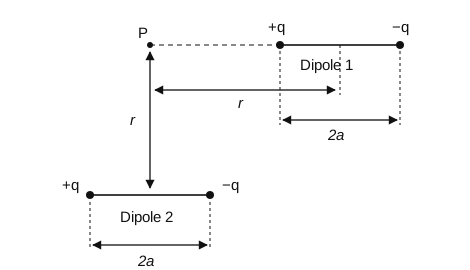
A point particle of charge Q is located at P along the axis of an electric dipole 1 at a distance r as shown in the figure. The point P is also on the equatorial plane of a second electric dipole 2 at a distance r. The dipoles are made of opposite charge q separated by a distance 2a. For the charge particle at P not to experience any net force, which of the following correctly describes the situation?
चित्र में दर्शाए अनुसार एक बिंदु कण, जिस पर आवेश Q है, विद्युत द्विध्रुव 1 के अक्ष (axis) पर दूरी r पर बिंदु P पर स्थित है। बिंदु P एक दूसरे विद्युत द्विध्रुव 2 के निरक्षीय तल (equatorial plane) पर भी दूरी r पर है। द्विध्रुव, दूरी 2a से पृथक विपरीत आवेशों q से बने हैं। P पर स्थित आवेशित कण पर कोई नेट बल न लगे, इसके लिए निम्नलिखित में से कौन-सा कथन स्थिति का सही वर्णन करता है?
  1. Aar∼10
  2. Bar∼20
  3. Car∼0.5
  4. Dar∼3
Show answer

Concept: Exact (not small-a) dipole fields. Axial field: Eax=14πε02pr(r2−a2)2; equatorial field: Eeq=14πε0p(r2+a2)3/2, with p=q(2a). The two fields at P are oppositely directed, so the net force on Q vanishes when their magnitudes are equal.

  1. Equate the magnitudes: 2pr(r2−a2)2=p(r2+a2)3/2.
  2. So 2r(r2+a2)3/2=(r2−a2)2. Put x=ar and divide by r4: 2(1+x2)3/2=(1−x2)2.
  3. Test the options. For x=3: LHS =2(10)3/2≈63.2, RHS =(1−9)2=64 — nearly equal. For x=0.5, 10, 20 the two sides differ by orders of magnitude.
  4. Hence the force balances when ar∼3.

Short trick: For a≪r the axial field (2kp/r3) is always double the equatorial field (kp/r3) — they can never cancel. So the answer must be a large a/r; checking x=3 works at once.

Answer: (D) ar∼3

अवधारणा: द्विध्रुव के यथार्थ (बिना a≪r सन्निकटन) क्षेत्र। अक्षीय क्षेत्र: Eax=14πε02pr(r2−a2)2; निरक्षीय क्षेत्र: Eeq=14πε0p(r2+a2)3/2, जहाँ p=q(2a)। P पर दोनों क्षेत्र विपरीत दिशा में हैं, अतः परिमाण बराबर होने पर Q पर नेट बल शून्य होगा।

  1. परिमाण बराबर रखें: 2pr(r2−a2)2=p(r2+a2)3/2।
  2. अतः 2r(r2+a2)3/2=(r2−a2)2। x=ar रखकर r4 से भाग दें: 2(1+x2)3/2=(1−x2)2।
  3. विकल्प जाँचें। x=3 के लिए: बायाँ पक्ष =2(10)3/2≈63.2, दायाँ पक्ष =(1−9)2=64 — लगभग बराबर। x=0.5, 10, 20 के लिए दोनों पक्ष बहुत भिन्न हैं।
  4. अतः बल संतुलन ar∼3 पर होता है।

शॉर्ट ट्रिक: a≪r के लिए अक्षीय क्षेत्र (2kp/r3) सदैव निरक्षीय क्षेत्र (kp/r3) का दुगुना होता है — वे कभी निरस्त नहीं हो सकते। अतः उत्तर बड़ा a/r ही होगा; x=3 रखते ही संतुलन मिल जाता है।

उत्तर: (D) ar∼3

JEE Main 2025 (January) – Paper 1 (B.E./B.Tech)PhysicsElectrostatics – electric dipole
Q51.
Given below are two statements:
Statement I: Fructose does not contain an aldehydic group but still reduces Tollen's reagent
Statement II: In the presence of base, fructose undergoes rearrangement to give glucose.
In the light of the above statements, choose the correct answer from the options given below
नीचे दो कथन दिए गए हैं:
कथन I: फ्रक्टोस में ऐल्डिहाइडिक समूह नहीं होता, फिर भी यह टॉलेन अभिकर्मक (Tollen's reagent) को अपचयित करता है।
कथन II: क्षार की उपस्थिति में फ्रक्टोस पुनर्विन्यास (rearrangement) द्वारा ग्लूकोस देता है।
उपर्युक्त कथनों के आलोक में, नीचे दिए गए विकल्पों में से सही उत्तर चुनिए
  1. ABoth Statement I and Statement II are trueकथन I और कथन II दोनों सत्य हैं
  2. BBoth Statement I and Statement II are falseकथन I और कथन II दोनों असत्य हैं
  3. CStatement I is true but Statement II is falseकथन I सत्य है परन्तु कथन II असत्य है
  4. DStatement I is false but Statement II is trueकथन I असत्य है परन्तु कथन II सत्य है
Show answer

Concept: Tollen's test is done in an alkaline medium; in base, ketoses isomerise to aldoses (Lobry de Bruyn–van Ekenstein rearrangement).

  1. Fructose is a ketohexose – it has a ketonic C=O, no –CHO group.
  2. In the basic medium of Tollen's reagent, fructose tautomerises through an enediol intermediate to glucose (and mannose), which contain the –CHO group.
  3. The aldose so formed reduces Ag(NH3)2+ to a silver mirror, so fructose is a reducing sugar.
  4. Hence Statement I is true, and Statement II correctly explains it – both are true.

Short trick: All monosaccharides (even ketoses) are reducing sugars – base converts ketose → aldose.

Answer: (A)

अवधारणा: टॉलेन परीक्षण क्षारीय माध्यम में होता है; क्षार में कीटोस, ऐल्डोस में समावयवित हो जाते हैं (लोब्री डी ब्रुइन–वान एकेन्स्टाइन पुनर्विन्यास)।

  1. फ्रक्टोस एक कीटोहेक्सोस है – इसमें कीटोनिक C=O है, –CHO समूह नहीं।
  2. टॉलेन अभिकर्मक के क्षारीय माध्यम में फ्रक्टोस ईनडाइऑल (enediol) मध्यवर्ती से होकर ग्लूकोस (तथा मैनोस) में बदल जाता है, जिनमें –CHO समूह होता है।
  3. इस प्रकार बना ऐल्डोस Ag(NH3)2+ को रजत दर्पण में अपचयित करता है, अतः फ्रक्टोस अपचायक शर्करा है।
  4. अतः कथन I सत्य है और कथन II उसकी सही व्याख्या करता है – दोनों सत्य हैं।

शॉर्ट ट्रिक: सभी मोनोसैकेराइड (कीटोस भी) अपचायक शर्कराएँ हैं – क्षार कीटोस → ऐल्डोस बदल देता है।

उत्तर: (A)

JEE Main 2025 (January) – Paper 1 (B.E./B.Tech)ChemistryBiomolecules – carbohydrates (fructose)

See all 75 solutions

More JEE Main 2025 (January) – Paper 1 (B.E./B.Tech) papers