JEE Main 2025 (January) – Paper 1 (B.E./B.Tech) 2025 · Shift 2

JEE Main 2025 (January) – Paper 1 (B.E./B.Tech) 23 Jan 2025 Shift 2 – Question Paper

75 questions · 300 marks · 180 minutes · +4 for a correct answer, −1 for a wrong one. Free PDF with answer key.

Library – airGurukul

Paper pattern

SectionQuestionsMarks
Mathematics25100
Physics25100
Chemistry25100

Sample questions from this paper

Q1.
The distance of the line x−22=y−63=z−34 from the point (1,4,0) along the line x1=y−22=z+33 is :
बिंदु (1,4,0) से, रेखा x1=y−22=z+33 के अनुदिश, रेखा x−22=y−63=z−34 की दूरी है :
  1. A17
  2. B15
  3. C14
  4. D13
Show answer

Concept: Walk from the point along the given direction and find where this ray meets the given line; the distance travelled is the required distance.

  1. Points along the direction (1,2,3) from (1,4,0): (1+t, 4+2t, 3t).
  2. Substituting in x−22=y−63=z−34: t−12=2t−23=3t−34. Every ratio vanishes at t=1, so the ray meets the line at (2,6,3).
  3. Distance =(2−1)2+(6−4)2+(3−0)2=1+4+9=14.

Short trick: Each numerator is a multiple of (t−1), so t=1 can be spotted at sight — no equations to solve.

Answer: (C) 14

अवधारणा: बिंदु से दी गई दिशा के अनुदिश चलकर देखें कि यह किरण दी गई रेखा से कहाँ मिलती है; तय की गई दूरी ही अभीष्ट दूरी है।

  1. (1,4,0) से दिशा (1,2,3) के अनुदिश बिंदु: (1+t, 4+2t, 3t)।
  2. x−22=y−63=z−34 में रखने पर: t−12=2t−23=3t−34। t=1 पर प्रत्येक अनुपात शून्य हो जाता है, अतः किरण रेखा से (2,6,3) पर मिलती है।
  3. दूरी =(2−1)2+(6−4)2+(3−0)2=1+4+9=14।

शॉर्ट ट्रिक: प्रत्येक अंश (t−1) का गुणज है, अतः t=1 देखते ही मिल जाता है — कोई समीकरण हल करने की आवश्यकता नहीं।

उत्तर: (C) 14
JEE Main 2025 (January) – Paper 1 (B.E./B.Tech)Mathematics3D Geometry – distance along a given line
Q26.
A galvanometer having a coil of resistance 30 Ω need 20 mA of current for full-scale deflection. If a maximum current of 3 A is to be measured using this galvanometer, the resistance of the shunt to be added to the galvanometer should be 30X Ω, where X is
एक गैल्वेनोमीटर की कुंडली का प्रतिरोध 30 Ω है तथा पूर्ण स्केल विक्षेप के लिए इसमें 20 mA धारा चाहिए। यदि इस गैल्वेनोमीटर द्वारा अधिकतम 3 A धारा मापनी हो, तो गैल्वेनोमीटर के साथ जोड़े जाने वाले शंट (shunt) का प्रतिरोध 30X Ω होना चाहिए, जहाँ X है
  1. A596
  2. B149
  3. C298
  4. D447
Show answer

Concept: To convert a galvanometer into an ammeter, a shunt S=IgGI−Ig is connected in parallel with it.

  1. Ig=20 mA=0.02 A, G=30 Ω, I=3 A.
  2. S=IgGI−Ig=0.02×303−0.02=0.62.98 Ω.
  3. S=0.62.98=60298=30149 Ω, so comparing with 30X, X=149.

Short trick: S=G(I/Ig)−1=30150−1=30149 — the shunt divides G by (n−1) where n=I/Ig=150.

Answer: (B)

अवधारणा: गैल्वेनोमीटर को अमीटर में बदलने के लिए उसके समान्तर में शंट S=IgGI−Ig जोड़ा जाता है।

  1. Ig=20 mA=0.02 A, G=30 Ω, I=3 A।
  2. S=IgGI−Ig=0.02×303−0.02=0.62.98 Ω।
  3. S=0.62.98=60298=30149 Ω, अतः 30X से तुलना करने पर X=149।

शॉर्ट ट्रिक: S=G(I/Ig)−1=30150−1=30149 — जहाँ n=I/Ig=150, शंट G को (n−1) से भाग देता है।

उत्तर: (B)

JEE Main 2025 (January) – Paper 1 (B.E./B.Tech)PhysicsCurrent Electricity – galvanometer and shunt
Q51.
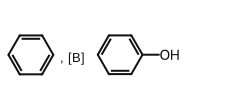
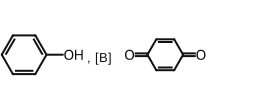
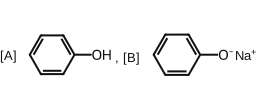
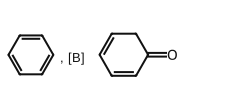
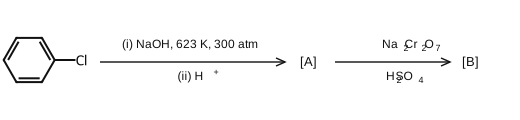
Identify the products [A] and [B], respectively in the following reaction :
निम्नलिखित अभिक्रिया में उत्पाद [A] तथा [B] को क्रमशः पहचानिए :
  1. A
  2. B
  3. C
  4. D
Show answer

Concept: Chlorobenzene gives phenol by the Dow process (NaOH, 623 K, 300 atm, then H+); phenol on oxidation with Na2Cr2O7/H2SO4 gives 1,4-benzoquinone.

  1. C6H5Cl + NaOH (623 K, 300 atm) → sodium phenoxide; acidification with H+ gives phenol, so [A] = phenol.
  2. Phenol is easily oxidised: with Na2Cr2O7/H2SO4 it gives the conjugated 1,4-benzoquinone, so [B] = p-benzoquinone.
  3. (A) and (D) show benzene as [A] – the C–Cl bond is replaced by –OH, not by –H; (C) stops at phenoxide and ignores the oxidation step.

Short trick: Phenol + acidified dichromate → p-benzoquinone is a standard NCERT reaction.

Answer: (B)

अवधारणा: क्लोरोबेंज़ीन डाउ प्रक्रम (NaOH, 623 K, 300 atm, फिर H+) द्वारा फ़िनॉल देता है; फ़िनॉल Na2Cr2O7/H2SO4 से ऑक्सीकरण पर 1,4-बेंज़ोक्विनोन देता है।

  1. C6H5Cl + NaOH (623 K, 300 atm) → सोडियम फ़िनॉक्साइड; H+ से अम्लीकरण पर फ़िनॉल बनता है, अतः [A] = फ़िनॉल।
  2. फ़िनॉल आसानी से ऑक्सीकृत होता है: Na2Cr2O7/H2SO4 से संयुग्मित 1,4-बेंज़ोक्विनोन बनता है, अतः [B] = p-बेंज़ोक्विनोन।
  3. (A) व (D) में [A] बेंज़ीन दिखाया गया है – C–Cl बंध –OH से प्रतिस्थापित होता है, –H से नहीं; (C) फ़िनॉक्साइड पर ही रुक जाता है और ऑक्सीकरण चरण छोड़ देता है।

शॉर्ट ट्रिक: फ़िनॉल + अम्लीय डाइक्रोमेट → p-बेंज़ोक्विनोन NCERT की मानक अभिक्रिया है।

उत्तर: (B)

JEE Main 2025 (January) – Paper 1 (B.E./B.Tech)ChemistryAlcohols, Phenols & Ethers – preparation and oxidation of phenol

See all 75 solutions

More JEE Main 2025 (January) – Paper 1 (B.E./B.Tech) papers

JEE Main 2025 (January) – Paper 1 (B.E./B.Tech) 23 Jan 2025 Shift 2 Question Paper PDF with Answer Key | airGurukul