Q1.A new unit () of length is chosen such that it is equal to the speed of light in vacuum. What is the distance between Venus and Earth in terms of units if light takes 6 min. 40 s to cover this distance ?
लंबाई का एक नया मात्रक () इस प्रकार चुना जाता है कि यह निर्वात में प्रकाश की चाल के बराबर है। यदि प्रकाश को शुक्र (Venus) और पृथ्वी के बीच की दूरी तय करने में 6 मिनट 40 s लगते हैं, तो यह दूरी मात्रकों में कितनी है?
- A
- B
- C
- D
Show answer
Concept: = distance light travels in 1 s ( s). So distance in units = travel time in seconds.
- Time s.
- Distance s .
Short trick: Just convert the time to seconds: 6 min 40 s = 400 s → .
Answer: (B)
अवधारणा: = प्रकाश द्वारा 1 s में तय दूरी ( s)। अतः मात्रकों में दूरी = सेकंड में लगा समय।
- समय s।
- दूरी s ।
शॉर्ट ट्रिक: केवल समय को सेकंड में बदलें: 6 मिनट 40 s = 400 s → ।
उत्तर: (B)
JEE Main 2026 (April) – Paper 1 (B.E./B.Tech)PhysicsUnits & Measurements – new unit of lengthJEE Main 2026 (April) – Paper 1 (B.E./B.Tech) 2026 · 8 Apr Shift 2
Q2.Consider the equation
Where = magnetic field; = electric field, = permittivity, = distance, = time
The values of , , and respectively are :
समीकरण पर विचार कीजिए
जहाँ = चुंबकीय क्षेत्र; = विद्युत क्षेत्र, = विद्युतशीलता (permittivity), = दूरी, = समय
, , तथा के मान क्रमशः हैं :
- A1, 1, 1, 1
- B−1, 1, 2, 1
- C1, −1, −2, 1
- D−1, −2, −2, 1
Show answer
Concept: (magnetising field) has unit A/m: . Also , . Equate powers of M, L, T, A.
- M: ; A: ⇒ .
- L: ⇒ ⇒ .
- T: ⇒ ⇒ .
- So . Options (B), (C), (D) fail the M and A balances (e.g. (C) gives M-power ).
Short trick: Ampere–Maxwell: ⇒ → all powers 1.
Answer: (A) 1, 1, 1, 1
अवधारणा: (चुंबकन क्षेत्र) का मात्रक A/m है: । साथ ही , । M, L, T, A की घातों की तुलना करें।
- M: ; A: ⇒ ।
- L: ⇒ ⇒ ।
- T: ⇒ ⇒ ।
- अतः । विकल्प (B), (C), (D) M तथा A की घातों का संतुलन नहीं करते (जैसे (C) में M की घात )।
शॉर्ट ट्रिक: ऐम्पियर–मैक्सवेल नियम: ⇒ → सभी घातें 1।
उत्तर: (A) 1, 1, 1, 1
JEE Main 2026 (April) – Paper 1 (B.E./B.Tech)PhysicsUnits & Dimensions – dimensional analysis of magnetic fieldJEE Main 2026 (April) – Paper 1 (B.E./B.Tech) 2026 · 8 Apr Shift 2
Q3.A car moving with a speed of 54 km/h takes a turn of radius 20 m. A simple pendulum is suspended from the ceiling of the car. Determine the angle made by the string of the pendulum with the vertical during the turning. (Take m/s2)
54 km/h की चाल से गतिमान एक कार 20 m त्रिज्या का मोड़ लेती है। कार की छत से एक सरल लोलक लटका हुआ है। मुड़ते समय लोलक की डोरी द्वारा ऊर्ध्वाधर से बनाया गया कोण ज्ञात कीजिए। ( m/s2 लीजिए)
- A
- B
- C
- D
Show answer
Concept: In the car frame the bob feels down and centrifugal outward; the string lies along their resultant, so .
- m/s.
- .
- .
Short trick: Same as banking angle: .
Answer: (C)
अवधारणा: कार के निर्देश तंत्र में गोलक पर नीचे की ओर तथा अपकेंद्री बल बाहर की ओर लगता है; डोरी इनके परिणामी के अनुदिश होती है, अतः ।
- m/s।
- ।
- ।
शॉर्ट ट्रिक: यह बैंकिंग कोण जैसा ही है: ।
उत्तर: (C)
JEE Main 2026 (April) – Paper 1 (B.E./B.Tech)PhysicsCircular motion – pendulum in a turning carJEE Main 2026 (April) – Paper 1 (B.E./B.Tech) 2026 · 8 Apr Shift 2
Q4.A gas balloon is going up with a constant velocity of 10 m/s. When this balloon reached a height of 75 m, a stone is dropped from it and balloon keeps moving up with the same velocity. The height of the balloon when the stone hits the ground is _________ m. (Take m/s2)
एक गैस गुब्बारा 10 m/s के नियत वेग से ऊपर जा रहा है। जब यह गुब्बारा 75 m की ऊँचाई पर पहुँचता है, तब इससे एक पत्थर गिराया जाता है और गुब्बारा उसी वेग से ऊपर जाता रहता है। जब पत्थर भूमि से टकराता है, तब गुब्बारे की ऊँचाई _________ m है। ( m/s2 लीजिए)
- A85
- B150
- C129
- D125
Show answer
Concept: A stone "dropped" from a moving balloon starts with the balloon's velocity (10 m/s upward).
- Taking up as positive: ⇒ ⇒ ⇒ s.
- Balloon rises m in this time.
- Height of balloon m.
Short trick: Relative to the balloon the stone simply falls with ; time from → 5 s → .
Answer: (D) 125 m
अवधारणा: गतिमान गुब्बारे से "गिराया" गया पत्थर गुब्बारे के वेग (10 m/s ऊपर) से ही गति आरंभ करता है।
- ऊपर को धनात्मक लेने पर: ⇒ ⇒ ⇒ s।
- इस समय में गुब्बारा m ऊपर जाता है।
- गुब्बारे की ऊँचाई m।
शॉर्ट ट्रिक: से समय 5 s → ऊँचाई ।
उत्तर: (D) 125 m
JEE Main 2026 (April) – Paper 1 (B.E./B.Tech)PhysicsKinematics – stone dropped from a rising balloonJEE Main 2026 (April) – Paper 1 (B.E./B.Tech) 2026 · 8 Apr Shift 2
Q5.A thin biconvex lens is prepared from the glass () both curved surfaces of which have equal radii of 20 cm each. Left side surface of the lens is silvered from outside to make it reflecting. To have the position of image and object at the same place, the object should be placed, from the lens at a distance of ________ cm.
काँच () से एक पतला उभयोत्तल लेंस बनाया गया है, जिसके दोनों वक्र पृष्ठों की त्रिज्याएँ 20 cm के बराबर हैं। लेंस के बाएँ पृष्ठ को बाहर से रजतित (silvered) करके परावर्तक बना दिया गया है। प्रतिबिंब और वस्तु की स्थिति एक ही स्थान पर हो, इसके लिए वस्तु को लेंस से ________ cm की दूरी पर रखना चाहिए।
- A10
- B12.5
- C13
- D13.5
Show answer
Concept: A lens silvered on one face acts as a mirror of power . Image coincides with object when the object is at the centre of curvature of this equivalent mirror, i.e. at .
- Lens: ⇒ cm.
- Silvered surface (concave mirror seen from inside): cm.
- ⇒ cm (concave).
- Object at cm from the lens.
Short trick: For equiconvex lens silvered on one face: cm → object at 10 cm.
Answer: (A) 10 cm
अवधारणा: एक पृष्ठ पर रजतित लेंस क्षमता वाले दर्पण की तरह कार्य करता है। प्रतिबिंब वस्तु पर तब बनता है जब वस्तु इस तुल्य दर्पण के वक्रता केंद्र अर्थात पर हो।
- लेंस: ⇒ cm।
- रजतित पृष्ठ (अंदर से देखने पर अवतल दर्पण): cm।
- ⇒ cm (अवतल)।
- वस्तु लेंस से cm पर।
शॉर्ट ट्रिक: एक पृष्ठ रजतित समोत्तल लेंस के लिए: cm → वस्तु 10 cm पर।
उत्तर: (A) 10 cm
JEE Main 2026 (April) – Paper 1 (B.E./B.Tech)PhysicsRay Optics – silvered biconvex lensJEE Main 2026 (April) – Paper 1 (B.E./B.Tech) 2026 · 8 Apr Shift 2
Q6.Two identical bodies, projected with the same speed at two different angles cover the same horizontal range . If the time of flight of these bodies are 5 s and 10 s, respectively, then the value of is _________ m. (Take m/s2)
दो सर्वसम पिंड समान चाल से दो भिन्न कोणों पर प्रक्षेपित किए जाते हैं और समान क्षैतिज परास तय करते हैं। यदि इन पिंडों के उड्डयन काल क्रमशः 5 s और 10 s हैं, तो का मान _________ m है। ( m/s2 लीजिए)
- A250
- B25
- C500
- D125
Show answer
Concept: Equal range ⇒ complementary angles and . Then .
- s2.
- m.
Short trick: Remember .
Answer: (A) 250 m
अवधारणा: समान परास ⇒ पूरक कोण तथा । तब ।
- s2।
- m।
शॉर्ट ट्रिक: याद रखें ।
उत्तर: (A) 250 m
JEE Main 2026 (April) – Paper 1 (B.E./B.Tech)PhysicsKinematics – projectiles with equal rangeJEE Main 2026 (April) – Paper 1 (B.E./B.Tech) 2026 · 8 Apr Shift 2
Q7.A solid cylinder having radius and length is slipping on a rough horizontal plane. At time the cylinder has a translational velocity m/s, perpendicular to its axis and a rotational velocity about the centre. The time taken by the cylinder to start rolling is _________ seconds. (coefficient of kinetic friction and m/s2)
त्रिज्या और लंबाई का एक ठोस बेलन एक खुरदरे क्षैतिज तल पर फिसल रहा है। समय पर बेलन का स्थानांतरीय वेग m/s (उसकी अक्ष के लंबवत) है तथा केंद्र के परितः घूर्णी वेग है। बेलन को लोटन (rolling) आरंभ करने में लगा समय _________ सेकंड है। (गतिज घर्षण गुणांक तथा m/s2)
- A15
- B5
- C10
- D7.5
Show answer
Concept: Since , kinetic friction acts backward: it decelerates translation and speeds up rotation until . For a solid cylinder .
- .
- ⇒ .
- Rolling: ⇒ ⇒ .
- s.
Short trick: Gap closes at rate : s.
Answer: (B) 5 s
अवधारणा: चूँकि , गतिज घर्षण पीछे की ओर लगता है: यह स्थानांतरीय गति को घटाता है और घूर्णन को बढ़ाता है जब तक न हो जाए। ठोस बेलन के लिए ।
- ।
- ⇒ ।
- लोटन की शर्त: ⇒ ⇒ ।
- s।
शॉर्ट ट्रिक: अंतर की घटने की दर : s।
उत्तर: (B) 5 s
JEE Main 2026 (April) – Paper 1 (B.E./B.Tech)PhysicsRotational motion – slipping to pure rollingJEE Main 2026 (April) – Paper 1 (B.E./B.Tech) 2026 · 8 Apr Shift 2
Q8.A liquid of density 600 kg/m3 flowing steadily in a tube of varying cross-section. The cross-section at a point is 1.0 cm2 and that at is 20 mm2. Both the points and are in same horizontal plane, the speed of the liquid at is 10 cm/s. The difference in pressures at and points is ________ Pa.
600 kg/m3 घनत्व का एक द्रव परिवर्ती अनुप्रस्थ काट वाली नली में स्थायी रूप से प्रवाहित हो रहा है। बिंदु पर अनुप्रस्थ काट 1.0 cm2 तथा पर 20 mm2 है। दोनों बिंदु और एक ही क्षैतिज तल में हैं, पर द्रव की चाल 10 cm/s है। बिंदुओं और पर दाबों का अंतर ________ Pa है।
- A18
- B144
- C36
- D72
Show answer
Concept: Continuity ; Bernoulli for the same level: .
- cm2 mm2, mm2 ⇒ m/s.
- Pa.
Short trick: Area ratio 5 ⇒ ⇒ Pa.
Answer: (D) 72 Pa
अवधारणा: सांतत्य समीकरण ; समान तल के लिए बर्नूली: ।
- cm2 mm2, mm2 ⇒ m/s।
- Pa।
शॉर्ट ट्रिक: क्षेत्रफल अनुपात 5 ⇒ ⇒ Pa।
उत्तर: (D) 72 Pa
JEE Main 2026 (April) – Paper 1 (B.E./B.Tech)PhysicsFluid mechanics – continuity and BernoulliJEE Main 2026 (April) – Paper 1 (B.E./B.Tech) 2026 · 8 Apr Shift 2
Q9.A spherical liquid drop of radius acquires the terminal velocity when falls through a gas of viscosity . Now the drop is broken into 64 identical droplets and each droplet acquires terminal velocity falling through the same gas. The ratio of terminal velocities is _________.
त्रिज्या की एक गोलीय द्रव बूँद श्यानता वाली गैस में गिरते हुए सीमांत वेग प्राप्त करती है। अब बूँद को 64 सर्वसम छोटी बूँदों में तोड़ा जाता है और प्रत्येक छोटी बूँद उसी गैस में गिरते हुए सीमांत वेग प्राप्त करती है। सीमांत वेगों का अनुपात _________ है।
- A4
- B0.25
- C32
- D16
Show answer
Concept: Terminal velocity .
- Volume conserved: ⇒ .
- .
Short trick: drops ⇒ ⇒ ratio .
Answer: (D) 16
अवधारणा: सीमांत वेग ।
- आयतन संरक्षित: ⇒ ।
- ।
शॉर्ट ट्रिक: बूँदें ⇒ ⇒ अनुपात ।
उत्तर: (D) 16
JEE Main 2026 (April) – Paper 1 (B.E./B.Tech)PhysicsFluid mechanics – terminal velocity (Stokes law)JEE Main 2026 (April) – Paper 1 (B.E./B.Tech) 2026 · 8 Apr Shift 2
Q10.One mole of diatomic gas having rotational modes only is kept in a cylinder with a piston system. The cross-section area of the cylinder is 4 cm2. The gas is heated slowly to raise the temperature by 1.2 °C during which the piston moves by 25 mm. The amount of heat supplied to the gas is _________ J. (Atmospheric pressure = 100 kPa, = 8.3 J/mol. K) (Neglect mass of the piston)
केवल घूर्णी विधाओं (rotational modes) वाली एक मोल द्विपरमाणुक गैस पिस्टन युक्त एक सिलिंडर में रखी है। सिलिंडर का अनुप्रस्थ काट क्षेत्रफल 4 cm2 है। गैस को धीरे-धीरे गर्म करके उसका ताप 1.2 °C बढ़ाया जाता है, जिसके दौरान पिस्टन 25 mm खिसकता है। गैस को दी गई ऊष्मा की मात्रा _________ J है। (वायुमंडलीय दाब = 100 kPa, = 8.3 J/mol. K) (पिस्टन का द्रव्यमान नगण्य मानिए)
- A24.8
- B25
- C15.04
- D29.98
Show answer
Concept: First law: , with ( for a diatomic gas with translational + rotational modes) and (massless piston, slow process).
- J.
- J.
- J.
- This matches none of the options. (The data are also mutually inconsistent: for 1 mol at constant pressure, should equal J, not 1 J; and J is not an option either.) The listed 25 J in (B) results only if the work is taken as 0.1 J.
Short trick: J alone already exceeds (A); adding the correct J gives 25.9 J, not 25 J.
Answer: Bonus – the correctly computed heat 25.9 J is not among the options; the two nearest values, (A) 24.8 J and (B) 25 J, are both accepted as correct.
अवधारणा: प्रथम नियम: , जहाँ (स्थानांतरीय + घूर्णी विधाओं वाली द्विपरमाणुक गैस के लिए ) तथा (द्रव्यमानरहित पिस्टन, धीमा प्रक्रम)।
- J।
- J।
- J।
- यह किसी भी विकल्प से मेल नहीं खाता। (आँकड़े आपस में भी असंगत हैं: नियत दाब पर 1 मोल के लिए J होना चाहिए, 1 J नहीं; और J भी विकल्प में नहीं है।) (B) का 25 J केवल तभी आता है जब कार्य 0.1 J लिया जाए।
शॉर्ट ट्रिक: केवल J ही (A) से अधिक है; सही J जोड़ने पर 25.9 J आता है, 25 J नहीं।
उत्तर: बोनस – सही गणना से ऊष्मा 25.9 J आती है जो किसी विकल्प में नहीं है; दो निकटतम मान, (A) 24.8 J तथा (B) 25 J, दोनों सही माने गए हैं।
JEE Main 2026 (April) – Paper 1 (B.E./B.Tech)PhysicsThermodynamics – first law, heating at constant pressureJEE Main 2026 (April) – Paper 1 (B.E./B.Tech) 2026 · 8 Apr Shift 2
Q11.Initial pressure and volume of a monoatomic ideal gas are and . The change in internal energy of this gas in adiabatic expansion to volume is _________ J.
एक एकपरमाणुक आदर्श गैस का प्रारंभिक दाब और आयतन तथा हैं। आयतन तक रुद्धोष्म प्रसार में इस गैस की आंतरिक ऊर्जा में परिवर्तन _________ J है।
- A
- B
- C
- D
Show answer
Concept: Adiabatic: = constant, . .
- .
- .
- .
- Expansion without heat lowers , so the positive options (B), (D) are impossible; (A) uses a wrong exponent.
Short trick: const ⇒ ⇒ .
Answer: (C)
अवधारणा: रुद्धोष्म: = नियत, । ।
- ।
- ।
- ।
- ऊष्मा के बिना प्रसार में घटती है, अतः धनात्मक विकल्प (B), (D) असंभव हैं; (A) में गलत घातांक प्रयुक्त है।
शॉर्ट ट्रिक: नियत ⇒ ⇒ ।
उत्तर: (C)
JEE Main 2026 (April) – Paper 1 (B.E./B.Tech)PhysicsThermodynamics – internal energy change in adiabatic expansionJEE Main 2026 (April) – Paper 1 (B.E./B.Tech) 2026 · 8 Apr Shift 2
Q12.The frequency of oscillation of a mass suspended by a spring is . If the length of the spring is cut to half, the same mass oscillates with frequency . The value of is ________.
एक स्प्रिंग से लटके द्रव्यमान के दोलन की आवृत्ति है। यदि स्प्रिंग की लंबाई काटकर आधी कर दी जाए, तो वही द्रव्यमान आवृत्ति से दोलन करता है। का मान ________ है।
- A1
- B2
- C
- D
Show answer
Concept: Spring constant and frequency .
- Half length ⇒ .
- .
Short trick: ⇒ halving multiplies by .
Answer: (C)
अवधारणा: स्प्रिंग नियतांक तथा आवृत्ति ।
- आधी लंबाई ⇒ ।
- ।
शॉर्ट ट्रिक: ⇒ आधी करने पर का गुना।
उत्तर: (C)
JEE Main 2026 (April) – Paper 1 (B.E./B.Tech)PhysicsOscillations – spring cut into halfJEE Main 2026 (April) – Paper 1 (B.E./B.Tech) 2026 · 8 Apr Shift 2
Q13.A monochromatic source of light operating at 15 kW emits photons/s. The region of an electromagnetic spectrum to which the emitted electromagnetic radiation belongs to ________. (Take J.s and m/s).
15 kW पर कार्यरत एक एकवर्णी प्रकाश स्रोत फोटॉन/s उत्सर्जित करता है। उत्सर्जित विद्युतचुंबकीय विकिरण विद्युतचुंबकीय स्पेक्ट्रम के जिस क्षेत्र से संबंधित है, वह ________ है। ( J.s तथा m/s लीजिए)।
- AMicrowaveसूक्ष्मतरंग (Microwave)
- BInfraredअवरक्त (Infrared)
- CVisibleदृश्य (Visible)
- DUltravioletपराबैंगनी (Ultraviolet)
Show answer
Concept: Power ⇒ energy per photon , then .
- J ( eV).
- m nm.
- 330 nm is below 400 nm ⇒ ultraviolet (visible is 400–700 nm; IR and microwave are longer still).
Short trick: Photon energy 3.75 eV > 3.1 eV (violet edge) ⇒ UV.
Answer: (D) Ultraviolet
अवधारणा: शक्ति ⇒ प्रति फोटॉन ऊर्जा , फिर ।
- J ( eV)।
- m nm।
- 330 nm, 400 nm से कम है ⇒ पराबैंगनी (दृश्य 400–700 nm; अवरक्त व सूक्ष्मतरंग इससे भी लंबी)।
शॉर्ट ट्रिक: फोटॉन ऊर्जा 3.75 eV > 3.1 eV (बैंगनी सीमा) ⇒ पराबैंगनी।
उत्तर: (D) पराबैंगनी
JEE Main 2026 (April) – Paper 1 (B.E./B.Tech)PhysicsDual nature – photon energy and EM spectrumJEE Main 2026 (April) – Paper 1 (B.E./B.Tech) 2026 · 8 Apr Shift 2
Q14.A current carrying circular loop of radius 2 cm with unit normal is placed in a magnetic field, . If T and current A, the torque experienced by the loop is _______ Wb.A. ()
2 cm त्रिज्या का एक धारावाही वृत्ताकार लूप, जिसका एकांक अभिलंब है, चुंबकीय क्षेत्र में रखा है। यदि T तथा धारा A है, तो लूप द्वारा अनुभव किया गया बल-आघूर्ण _______ Wb.A है। ()
- A
- B
- C
- D
Show answer
Concept: with .
- m2.
- A m2.
- .
- .
Short trick: Both and lie in the x–z plane, so the torque must be along – only (D) qualifies.
Answer: (D)
अवधारणा: जहाँ ।
- m2।
- A m2।
- ।
- ।
शॉर्ट ट्रिक: तथा दोनों x–z तल में हैं, अतः बल-आघूर्ण के अनुदिश होगा – केवल (D) उपयुक्त है।
उत्तर: (D)
JEE Main 2026 (April) – Paper 1 (B.E./B.Tech)PhysicsMagnetism – torque on a current loopJEE Main 2026 (April) – Paper 1 (B.E./B.Tech) 2026 · 8 Apr Shift 2
Q15.A 30 cm long solenoid has 10 turns per cm and area of 5 cm2. The current through the solenoid coil varies from 2 A to 4 A in 3.14 s. The e.m.f. induced in the coil is V. The value is _________.
30 cm लंबी एक परिनालिका में 10 फेरे प्रति cm हैं तथा उसका क्षेत्रफल 5 cm2 है। परिनालिका कुंडली में धारा 3.14 s में 2 A से 4 A तक बदलती है। कुंडली में प्रेरित वि.वा.ब. (e.m.f.) V है। का मान _________ है।
- A60
- B12
- C120
- D34
Show answer
Concept: and .
- per cm m−1, m2, m.
- H.
- A/s.
- V ⇒ .
Short trick: The in cancels the 3.14 s: V.
Answer: (B) 12
अवधारणा: तथा ।
- प्रति cm m−1, m2, m।
- H।
- A/s।
- V ⇒ ।
शॉर्ट ट्रिक: का , 3.14 s से कट जाता है: V।
उत्तर: (B) 12
JEE Main 2026 (April) – Paper 1 (B.E./B.Tech)PhysicsEMI – self-induced emf in a solenoidJEE Main 2026 (April) – Paper 1 (B.E./B.Tech) 2026 · 8 Apr Shift 2
Q16.Two point charges and are placed at points and respectively. Force on charge is _________ N.
दो बिंदु आवेश तथा क्रमशः बिंदुओं और पर रखे हैं। आवेश पर बल _________ N है।
- A
- B
- C
- D
Show answer
Concept: . Opposite charges attract, so points from towards .
- , m.
- .
- N.
- (D) is the force on (opposite direction); (A), (C) have the wrong magnitude.
Short trick: Magnitude N along unit vector (towards ).
Answer: (B) N
अवधारणा: । विपरीत आवेश आकर्षित करते हैं, अतः की दिशा से की ओर है।
- , m।
- ।
- N।
- (D) पर बल है (विपरीत दिशा); (A), (C) का परिमाण गलत है।
शॉर्ट ट्रिक: परिमाण N, एकांक सदिश (q1 की ओर) के अनुदिश।
उत्तर: (B) N
JEE Main 2026 (April) – Paper 1 (B.E./B.Tech)PhysicsElectrostatics – Coulomb force in vector formJEE Main 2026 (April) – Paper 1 (B.E./B.Tech) 2026 · 8 Apr Shift 2
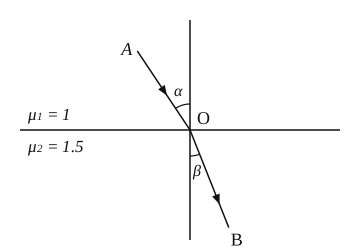
Q17.Light ray incident along a vector
emerges out along vector
as shown in the figure below. The value of
is _________.
सदिश
के अनुदिश आपतित प्रकाश किरण, सदिश
के अनुदिश निर्गत होती है, जैसा नीचे चित्र में दर्शाया गया है।
का मान _________ है।
- A1.6
- B0.16
- C11.6
- D16
Show answer
Concept: The normal is along (vertical). Angle with the normal: . Apply .
- ; .
- ⇒ .
- ⇒ ⇒ .
Short trick: Ray bends towards the normal, so ⇒ ; of the options only 1.6 and 0.16 fit, and 0.16 is far too small.
Answer: (A) 1.6
अवधारणा: अभिलंब (ऊर्ध्वाधर) के अनुदिश है। अभिलंब से कोण: । लगाएँ।
- ; ।
- ⇒ ।
- ⇒ ⇒ ।
शॉर्ट ट्रिक: किरण अभिलंब की ओर मुड़ती है, अतः ⇒ ; विकल्पों में केवल 1.6 और 0.16 उपयुक्त हैं, और 0.16 बहुत छोटा है।
उत्तर: (A) 1.6
JEE Main 2026 (April) – Paper 1 (B.E./B.Tech)PhysicsRay Optics – Snell's law in vector formJEE Main 2026 (April) – Paper 1 (B.E./B.Tech) 2026 · 8 Apr Shift 2
Q18. and be the maximum kinetic energies of photoelectrons emitted from a surface of a given material for the light of wavelength and , respectively. If then the work function of material is given by :
किसी दिए गए पदार्थ के पृष्ठ से तरंगदैर्ध्य और के प्रकाश के लिए उत्सर्जित प्रकाश-इलेक्ट्रॉनों की अधिकतम गतिज ऊर्जाएँ क्रमशः और हैं। यदि है, तो पदार्थ का कार्य फलन है :
- A
- B
- C
- D
Show answer
Concept: Einstein: .
- ⇒ .
- .
- .
Short trick: Photon energy doubles: ⇒ .
Answer: (D)
अवधारणा: आइंस्टीन समीकरण: ।
- ⇒ ।
- ।
- ।
शॉर्ट ट्रिक: फोटॉन ऊर्जा दोगुनी: ⇒ ।
उत्तर: (D)
JEE Main 2026 (April) – Paper 1 (B.E./B.Tech)PhysicsDual nature – photoelectric equationJEE Main 2026 (April) – Paper 1 (B.E./B.Tech) 2026 · 8 Apr Shift 2
Q19.Two radioactive substances A and B of mass numbers 200 and 212 respectively, shows spontaneous -decay with same value of 1 MeV. The ratio of energies of -rays produced by A and B is __________.
द्रव्यमान संख्याओं 200 और 212 वाले दो रेडियोऐक्टिव पदार्थ A और B क्रमशः, समान मान 1 MeV के साथ स्वतः -क्षय दर्शाते हैं। A और B द्वारा उत्पन्न -किरणों की ऊर्जाओं का अनुपात __________ है।
- A
- B
- C
- D
Show answer
Concept: Momentum conservation in -decay of a nucleus at rest: .
- , .
- .
- Dividing by 16: .
Short trick: Ratio is just below 1 (lighter parent gives slightly less KE to ); only (C) fits.
Answer: (C)
अवधारणा: विरामावस्था वाले नाभिक के -क्षय में संवेग संरक्षण से: ।
- , ।
- ।
- 16 से भाग देने पर: ।
शॉर्ट ट्रिक: अनुपात 1 से थोड़ा कम है (हल्का जनक नाभिक को थोड़ी कम गतिज ऊर्जा देता है); केवल (C) उपयुक्त है।
उत्तर: (C)
JEE Main 2026 (April) – Paper 1 (B.E./B.Tech)PhysicsNuclei – kinetic energy of alpha particleJEE Main 2026 (April) – Paper 1 (B.E./B.Tech) 2026 · 8 Apr Shift 2
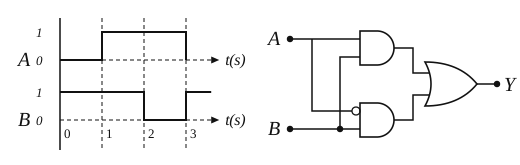
Q20.The output
for the given inputs
and
to the circuit is :
परिपथ में दिए गए निवेशों
और
के लिए निर्गत
है :
- A
- B
- C
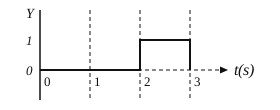
- D
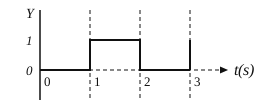
Show answer
Concept: Upper AND gate receives and ; lower AND gate receives (bubble) and ; the OR gate adds them.
- .
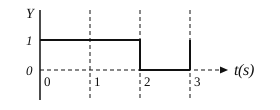
- So simply copies : for s, for s, rising to 1 at s.
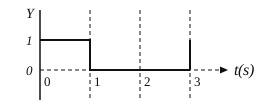
- (A) is high only for 0–1 s, (C) is , (D) is high only for 1–2 s – none equal .
Short trick: Factor out → output waveform = waveform.
Answer: (B) the waveform that is 1 from 0 to 2 s, 0 from 2 to 3 s
अवधारणा: ऊपरी AND गेट को और मिलते हैं; निचले AND गेट को (बबल) और मिलते हैं; OR गेट इन्हें जोड़ता है।
- ।
- अतः केवल की नकल है: s में , s में , तथा s पर पुनः 1।
- (A) केवल 0–1 s में उच्च है, (C) है, (D) केवल 1–2 s में उच्च है – इनमें से कोई के बराबर नहीं।
शॉर्ट ट्रिक: उभयनिष्ठ लें → निर्गत तरंगरूप = का तरंगरूप।
उत्तर: (B) वह तरंगरूप जो 0 से 2 s तक 1 और 2 से 3 s तक 0 है
JEE Main 2026 (April) – Paper 1 (B.E./B.Tech)PhysicsSemiconductors – logic gate circuit with waveformsJEE Main 2026 (April) – Paper 1 (B.E./B.Tech) 2026 · 8 Apr Shift 2

