Q21.Number of paramagnetic complexes among the following is ________.
[MnBr4]2−, [NiCl4]2−, [Ni(CN)4]2−, [Ni(CO)4], [CoF6]3−, [Fe(CN)6]4−, [Mn(CN)6]3−, [Ti(CN)6]3−, [Cu(H2O)6]2+, [Co(C2O4)3]3−
निम्नलिखित में से अनुचुंबकीय (paramagnetic) संकुलों की संख्या ________ है।
[MnBr4]2−, [NiCl4]2−, [Ni(CN)4]2−, [Ni(CO)4], [CoF6]3−, [Fe(CN)6]4−, [Mn(CN)6]3−, [Ti(CN)6]3−, [Cu(H2O)6]2+, [Co(C2O4)3]3−
Show answer
Concept: Find the d-electron count and spin state (weak-field ligands: Br−, Cl−, F−, H2O → high spin; CN−, CO, C2O42− with Co3+ → low spin).
- [MnBr4]2−: Mn2+ d5, tetrahedral → 5 unpaired → para.
- [NiCl4]2−: Ni2+ d8, tetrahedral (sp3) → 2 unpaired → para.
- [Ni(CN)4]2−: d8, dsp2 square planar → dia.
- [Ni(CO)4]: Ni(0) 3d10 → dia.
- [CoF6]3−: Co3+ d6 high spin → 4 unpaired → para.
- [Fe(CN)6]4−: Fe2+ d6 low spin t2g6 → dia.
- [Mn(CN)6]3−: Mn3+ d4 low spin t2g4 → 2 unpaired → para.
- [Ti(CN)6]3−: Ti3+ d1 → 1 unpaired → para.
- [Cu(H2O)6]2+: Cu2+ d9 → 1 unpaired → para.
- [Co(C2O4)3]3−: Co3+ d6 low spin → dia.
- Paramagnetic: MnBr42−, NiCl42−, CoF63−, Mn(CN)63−, Ti(CN)63−, Cu(H2O)62+ = 6.
Short trick: Odd number of d electrons (d1, d5, d9) is always paramagnetic; then check only the d4, d6, d8 cases for spin state/geometry.
Answer: 6
अवधारणा: d-इलेक्ट्रॉन संख्या तथा प्रचक्रण अवस्था ज्ञात करें (दुर्बल क्षेत्र लिगन्ड: Br−, Cl−, F−, H2O → उच्च प्रचक्रण; CN−, CO, तथा Co3+ के साथ C2O42− → निम्न प्रचक्रण)।
- [MnBr4]2−: Mn2+ d5, चतुष्फलकीय → 5 अयुग्मित → अनुचुंबकीय।
- [NiCl4]2−: Ni2+ d8, चतुष्फलकीय (sp3) → 2 अयुग्मित → अनुचुंबकीय।
- [Ni(CN)4]2−: d8, dsp2 वर्ग समतलीय → प्रतिचुंबकीय।
- [Ni(CO)4]: Ni(0) 3d10 → प्रतिचुंबकीय।
- [CoF6]3−: Co3+ d6 उच्च प्रचक्रण → 4 अयुग्मित → अनुचुंबकीय।
- [Fe(CN)6]4−: Fe2+ d6 निम्न प्रचक्रण t2g6 → प्रतिचुंबकीय।
- [Mn(CN)6]3−: Mn3+ d4 निम्न प्रचक्रण t2g4 → 2 अयुग्मित → अनुचुंबकीय।
- [Ti(CN)6]3−: Ti3+ d1 → 1 अयुग्मित → अनुचुंबकीय।
- [Cu(H2O)6]2+: Cu2+ d9 → 1 अयुग्मित → अनुचुंबकीय।
- [Co(C2O4)3]3−: Co3+ d6 निम्न प्रचक्रण → प्रतिचुंबकीय।
- अनुचुंबकीय: MnBr42−, NiCl42−, CoF63−, Mn(CN)63−, Ti(CN)63−, Cu(H2O)62+ = 6।
शॉर्ट ट्रिक: विषम d इलेक्ट्रॉन (d1, d5, d9) सदैव अनुचुंबकीय; फिर केवल d4, d6, d8 में प्रचक्रण/ज्यामिति जाँचें।
उत्तर: 6
JEE Main 2026 (April) – Paper 1 (B.E./B.Tech)ChemistryCoordination Compounds – magnetic behaviourJEE Main 2026 (April) – Paper 1 (B.E./B.Tech) 2026 · 8 Apr Shift 2
Q22.‘x’ is the product which is obtained from benzene by reacting it with carbon monoxide and hydrogen chloride in the presence of cuprous chloride. ‘y’ is the major product obtained from the benzene by reacting it with ethanoyl chloride in the presence of anhydrous AlCl3. Product (major) obtained by heating x and y in the presence of alkali is z. Total number of π (pi) electrons in z is ________.
‘x’ वह उत्पाद है जो बेन्ज़ीन की क्यूप्रस क्लोराइड की उपस्थिति में कार्बन मोनोक्साइड तथा हाइड्रोजन क्लोराइड से अभिक्रिया द्वारा प्राप्त होता है। ‘y’ वह मुख्य उत्पाद है जो बेन्ज़ीन की निर्जल AlCl3 की उपस्थिति में एथेनॉयल क्लोराइड से अभिक्रिया द्वारा प्राप्त होता है। क्षार की उपस्थिति में x तथा y को गर्म करने पर प्राप्त (मुख्य) उत्पाद z है। z में π (पाई) इलेक्ट्रॉनों की कुल संख्या ________ है।
Show answer
Concept: Gattermann–Koch gives benzaldehyde, Friedel–Crafts acylation gives acetophenone, and their crossed aldol (Claisen–Schmidt) condensation gives chalcone.
- x = C6H5CHO (benzaldehyde).
- y = C6H5COCH3 (acetophenone).
- Alkali, heat: C6H5CHO + CH3COC6H5 → C6H5CH=CH–CO–C6H5 (z, benzalacetophenone) + H2O.
- π electrons: 2 benzene rings = 2 × 6 = 12; C=C = 2; C=O = 2 → total 16.
Short trick: Count π bonds: 3 + 3 (rings) + 1 (C=C) + 1 (C=O) = 8 π bonds → 16 π electrons.
Answer: 16
अवधारणा: गाटरमान–कोख से बेन्ज़ैल्डिहाइड, फ्रीडेल–क्राफ्ट्स ऐसिलन से ऐसीटोफ़ीनोन, तथा इनके क्रॉस ऐल्डोल (क्लेजन–श्मिट) संघनन से चाल्कोन बनता है।
- x = C6H5CHO (बेन्ज़ैल्डिहाइड)।
- y = C6H5COCH3 (ऐसीटोफ़ीनोन)।
- क्षार, ताप: C6H5CHO + CH3COC6H5 → C6H5CH=CH–CO–C6H5 (z, बेन्ज़ैल-ऐसीटोफ़ीनोन) + H2O।
- π इलेक्ट्रॉन: 2 बेन्ज़ीन वलय = 2 × 6 = 12; C=C = 2; C=O = 2 → कुल 16।
शॉर्ट ट्रिक: π आबंध गिनें: 3 + 3 (वलय) + 1 (C=C) + 1 (C=O) = 8 π आबंध → 16 π इलेक्ट्रॉन।
उत्तर: 16
JEE Main 2026 (April) – Paper 1 (B.E./B.Tech)ChemistryAldehydes and Ketones – Gattermann–Koch, Friedel–Crafts, Claisen–SchmidtJEE Main 2026 (April) – Paper 1 (B.E./B.Tech) 2026 · 8 Apr Shift 2
Q23.Consider two radiations of wavelengths
1. λ1 = 2000 Å
2. λ2 = 6000 Å
The ratio of the energies of these two radiations is ________ (Nearest integer).
दो विकिरणों के तरंगदैर्घ्य पर विचार कीजिए
1. λ1 = 2000 Å
2. λ2 = 6000 Å
इन दोनों विकिरणों की ऊर्जाओं का अनुपात ________ है (निकटतम पूर्णांक)।
Show answer
Concept: Photon energy , so .
- .
Short trick: Shorter wavelength → proportionally higher energy; 3 times shorter → 3 times the energy.
Answer: 3
अवधारणा: फोटॉन ऊर्जा , अतः ।
- ।
शॉर्ट ट्रिक: छोटा तरंगदैर्घ्य → अनुपाती रूप से अधिक ऊर्जा; 3 गुना छोटा → 3 गुना ऊर्जा।
उत्तर: 3
JEE Main 2026 (April) – Paper 1 (B.E./B.Tech)ChemistryStructure of Atom – photon energyJEE Main 2026 (April) – Paper 1 (B.E./B.Tech) 2026 · 8 Apr Shift 2
Q24.Consider the reaction
2H2S(g) + 3O2(g) → 2H2O(l) + 2SO2(g)
The magnitude of enthalpy change for the reaction in kJ mol−1 is ________. (Nearest integer)
Given : ΔfH⊖ (H2S) = −20.1 kJ mol−1
ΔfH⊖ (H2O) = −286.0 kJ mol−1
ΔfH⊖ (SO2) = −297.0 kJ mol−1
अभिक्रिया पर विचार कीजिए
2H2S(g) + 3O2(g) → 2H2O(l) + 2SO2(g)
अभिक्रिया के लिए एन्थैल्पी परिवर्तन का परिमाण kJ mol−1 में ________ है। (निकटतम पूर्णांक)
दिया है : ΔfH⊖ (H2S) = −20.1 kJ mol−1
ΔfH⊖ (H2O) = −286.0 kJ mol−1
ΔfH⊖ (SO2) = −297.0 kJ mol−1
Show answer
Concept: ΔrH° = ΣΔfH°(products) − ΣΔfH°(reactants); ΔfH°(O2) = 0.
- Products: 2(−286.0) + 2(−297.0) = −572.0 − 594.0 = −1166.0 kJ.
- Reactants: 2(−20.1) + 3(0) = −40.2 kJ.
- ΔrH° = −1166.0 − (−40.2) = −1125.8 kJ mol−1; magnitude ≈ 1126.
Short trick: 2 × [(−286) + (−297) − (−20.1)] = 2 × (−562.9) = −1125.8.
Answer: 1126
अवधारणा: ΔrH° = ΣΔfH°(उत्पाद) − ΣΔfH°(अभिकारक); ΔfH°(O2) = 0।
- उत्पाद: 2(−286.0) + 2(−297.0) = −572.0 − 594.0 = −1166.0 kJ।
- अभिकारक: 2(−20.1) + 3(0) = −40.2 kJ।
- ΔrH° = −1166.0 − (−40.2) = −1125.8 kJ mol−1; परिमाण ≈ 1126।
शॉर्ट ट्रिक: 2 × [(−286) + (−297) − (−20.1)] = 2 × (−562.9) = −1125.8।
उत्तर: 1126
JEE Main 2026 (April) – Paper 1 (B.E./B.Tech)ChemistryThermodynamics – enthalpy of reaction from enthalpies of formationJEE Main 2026 (April) – Paper 1 (B.E./B.Tech) 2026 · 8 Apr Shift 2
Q25.Solid carbon, CaO and CaCO3 are mixed and allowed to attain equilibrium at T K.
CaCO3(s) ⇌ CaO(s) + CO2(g) Kp1 = 0.08 atm
C(s) + CO2(g) ⇌ 2CO(g) Kp2 = 2 atm
The partial pressure of CO is ________ × 10−1 atm
ठोस कार्बन, CaO तथा CaCO3 को मिलाकर T K पर साम्य प्राप्त करने दिया जाता है।
CaCO3(s) ⇌ CaO(s) + CO2(g) Kp1 = 0.08 atm
C(s) + CO2(g) ⇌ 2CO(g) Kp2 = 2 atm
CO का आंशिक दाब ________ × 10−1 atm है
Show answer
Concept: With all three solids present, pCO2 is fixed by the first equilibrium (Kp1 = pCO2) and must also satisfy the second.
- pCO2 = Kp1 = 0.08 atm.
- Kp2 = → .
- pCO = 0.4 atm = 4 × 10⁻¹ atm.
Short trick: atm.
Answer: 4
अवधारणा: तीनों ठोस उपस्थित होने पर pCO2 प्रथम साम्य द्वारा निश्चित होता है (Kp1 = pCO2) तथा उसे दूसरे साम्य को भी संतुष्ट करना होता है।
- pCO2 = Kp1 = 0.08 atm।
- Kp2 = → ।
- pCO = 0.4 atm = 4 × 10⁻¹ atm।
शॉर्ट ट्रिक: atm।
उत्तर: 4
JEE Main 2026 (April) – Paper 1 (B.E./B.Tech)ChemistryChemical Equilibrium – simultaneous heterogeneous equilibriaJEE Main 2026 (April) – Paper 1 (B.E./B.Tech) 2026 · 8 Apr Shift 2
Q26.Which of the following contain the same number of atoms ?
(Given : Molar mass in g mol−1 of H, He, O and S are 1, 4, 16 and 32 respectively)
A. 2 g of O2 gas
B. 4 g of SO2 gas
C. 1400 mL of O2 at STP
D. 0.05 L of He at STP
E. 0.0625 mol of H2 gas
Choose the correct answer from the options given below :
निम्नलिखित में से किनमें परमाणुओं की संख्या समान है ?
(दिया है : H, He, O तथा S के मोलर द्रव्यमान g mol−1 में क्रमशः 1, 4, 16 तथा 32 हैं)
A. 2 g O2 गैस
B. 4 g SO2 गैस
C. STP पर 1400 mL O2
D. STP पर 0.05 L He
E. 0.0625 mol H2 गैस
नीचे दिए गए विकल्पों में से सही उत्तर चुनिए :
- AA and B onlyकेवल A और B
- BB and C onlyकेवल B और C
- CC and D onlyकेवल C और D
- DA, C and E onlyकेवल A, C और E
Show answer
Concept: Moles of atoms = moles of molecules × atomicity; at STP 1 mol gas = 22.4 L.
- A: 2 g O2 = 2/32 = 0.0625 mol → atoms = 0.0625 × 2 = 0.125 mol.
- B: 4 g SO2 = 4/64 = 0.0625 mol → atoms = 0.0625 × 3 = 0.1875 mol.
- C: 1.4 L O2 = 1.4/22.4 = 0.0625 mol → atoms = 0.125 mol.
- D: 0.05 L He = 0.05/22.4 = 0.00223 mol atoms (monoatomic).
- E: 0.0625 mol H2 → atoms = 0.125 mol.
- A, C and E each contain 0.125 mol (= 0.125 NA) atoms; B and D differ, so (A), (B), (C) are wrong.
Short trick: A, C, E are all 0.0625 mol of a diatomic gas → same atoms.
Answer: (D) A, C and E only
अवधारणा: परमाणुओं के मोल = अणुओं के मोल × परमाणुकता; STP पर 1 mol गैस = 22.4 L।
- A: 2 g O2 = 2/32 = 0.0625 mol → परमाणु = 0.0625 × 2 = 0.125 mol।
- B: 4 g SO2 = 4/64 = 0.0625 mol → परमाणु = 0.0625 × 3 = 0.1875 mol।
- C: 1.4 L O2 = 1.4/22.4 = 0.0625 mol → परमाणु = 0.125 mol।
- D: 0.05 L He = 0.05/22.4 = 0.00223 mol परमाणु (एकपरमाणुक)।
- E: 0.0625 mol H2 → परमाणु = 0.125 mol।
- A, C तथा E प्रत्येक में 0.125 mol (= 0.125 NA) परमाणु हैं; B और D भिन्न हैं, अतः (A), (B), (C) गलत हैं।
शॉर्ट ट्रिक: A, C, E तीनों किसी द्विपरमाणुक गैस के 0.0625 mol हैं → परमाणु समान।
उत्तर: (D) केवल A, C और E
JEE Main 2026 (April) – Paper 1 (B.E./B.Tech)ChemistryMole Concept – number of atomsJEE Main 2026 (April) – Paper 1 (B.E./B.Tech) 2026 · 6 Apr Shift 2
Q27.The Bohr radius of a hydrogen like species is 70.53 pm. The species and the stationary state (n) are respectively
(Given : Hydrogen atom Bohr radius is 52.9 pm)
किसी हाइड्रोजन सदृश स्पीशीज़ की बोर त्रिज्या 70.53 pm है। स्पीशीज़ तथा स्थिर अवस्था (n) क्रमशः हैं
(दिया है : हाइड्रोजन परमाणु की बोर त्रिज्या 52.9 pm है)
- ALi2+, 3
- BHe+, 3
- CHe+, 2
- DLi2+, 2
Show answer
Concept: For a hydrogen-like species pm.
- .
- n = 2, Z = 3 → Li2+ in n = 2.
- Check others: Li2+, n = 3 → 158.7 pm; He+, n = 3 → 238.05 pm; He+, n = 2 → 105.8 pm – none equals 70.53 pm.
Short trick: 70.53/52.9 = 4/3 → n² = 4, Z = 3.
Answer: (D) Li2+, 2
अवधारणा: हाइड्रोजन सदृश स्पीशीज़ के लिए pm।
- ।
- n = 2, Z = 3 → Li2+, n = 2 में।
- अन्य की जाँच: Li2+, n = 3 → 158.7 pm; He+, n = 3 → 238.05 pm; He+, n = 2 → 105.8 pm – कोई भी 70.53 pm नहीं।
शॉर्ट ट्रिक: 70.53/52.9 = 4/3 → n² = 4, Z = 3।
उत्तर: (D) Li2+, 2
JEE Main 2026 (April) – Paper 1 (B.E./B.Tech)ChemistryAtomic Structure – Bohr radiusJEE Main 2026 (April) – Paper 1 (B.E./B.Tech) 2026 · 6 Apr Shift 2
Q28.Given below are two statements :
Statement I : The number of compounds among SO2, SO3, SF4, SF6 and H2S in which sulphur does not obey the Octet rule is 3.
Statement II : Among [H2O, ClF3, SF4], [NH3, BrF5, SF4], [BrF5, ClF3, XeF4] and [XeF4, ClF3, H2O], the number of sets in which all the molecules have one lone pair of electrons on the central atom is 1.
In the light of the above statements, choose the correct answer from the options given below :
नीचे दो कथन दिए गए हैं :
कथन I : SO2, SO3, SF4, SF6 तथा H2S में से उन यौगिकों की संख्या जिनमें सल्फर अष्टक नियम का पालन नहीं करता, 3 है।
कथन II : [H2O, ClF3, SF4], [NH3, BrF5, SF4], [BrF5, ClF3, XeF4] तथा [XeF4, ClF3, H2O] में से उन समुच्चयों की संख्या जिनमें सभी अणुओं के केंद्रीय परमाणु पर एक एकाकी इलेक्ट्रॉन युग्म है, 1 है।
उपर्युक्त कथनों के आलोक में, नीचे दिए गए विकल्पों में से सही उत्तर चुनिए :
- ABoth Statement I and Statement II are trueकथन I और कथन II दोनों सत्य हैं
- BBoth Statement I and Statement II are falseकथन I और कथन II दोनों असत्य हैं
- CStatement I is true but Statement II is falseकथन I सत्य है परंतु कथन II असत्य है
- DStatement I is false but Statement II is trueकथन I असत्य है परंतु कथन II सत्य है
Show answer
Concept: Count electrons around S in the Lewis structures; count lone pairs on the central atom by VSEPR.
- Statement I: SO2 (O=S=O, 10 e− around S), SO3 (12 e−), SF4 (10 e−), SF6 (12 e−) all have an expanded octet; only H2S (8 e−) obeys the octet. Number = 4, not 3 → Statement I is false.
- Lone pairs on central atom: H2O 2, ClF3 2, SF4 1, NH3 1, BrF5 1, XeF4 2.
- Only [NH3, BrF5, SF4] has one lone pair on every central atom (the set [XeF4, ClF3, H2O] has two lone pairs on each). Number of sets = 1 → Statement II is true.
- Hence (A), (B), (C) are wrong.
Short trick: Every S–O/S–F compound of S(IV) and S(VI) is hypervalent; only H2S keeps an octet.
Answer: (D) Statement I is false but Statement II is true
अवधारणा: लूइस संरचना में S के चारों ओर इलेक्ट्रॉन गिनिए; VSEPR से केंद्रीय परमाणु पर एकाकी युग्म गिनिए।
- कथन I: SO2 (O=S=O, S के चारों ओर 10 e−), SO3 (12 e−), SF4 (10 e−), SF6 (12 e−) सभी में अष्टक का विस्तार है; केवल H2S (8 e−) अष्टक का पालन करता है। संख्या = 4, 3 नहीं → कथन I असत्य है।
- केंद्रीय परमाणु पर एकाकी युग्म: H2O 2, ClF3 2, SF4 1, NH3 1, BrF5 1, XeF4 2।
- केवल [NH3, BrF5, SF4] में प्रत्येक केंद्रीय परमाणु पर एक एकाकी युग्म है ([XeF4, ClF3, H2O] में प्रत्येक पर दो हैं)। समुच्चयों की संख्या = 1 → कथन II सत्य है।
- अतः (A), (B), (C) गलत हैं।
शॉर्ट ट्रिक: S(IV) और S(VI) के सभी S–O/S–F यौगिक अतिसंयोजी (hypervalent) हैं; केवल H2S अष्टक रखता है।
उत्तर: (D) कथन I असत्य है परंतु कथन II सत्य है
JEE Main 2026 (April) – Paper 1 (B.E./B.Tech)ChemistryChemical Bonding – octet rule and lone pairs (VSEPR)JEE Main 2026 (April) – Paper 1 (B.E./B.Tech) 2026 · 6 Apr Shift 2
Q29.Match List - I with List - II.
Given V1 and V2 are initial and final volumes respectively.
| List - I
(Isothermal process) | | List - II
(Expression) |
|---|
| A. | Reversible expansion | I. | |
| B. | Free expansion | II. | |
| C. | Irreversible Compression | III. | |
| D. | Cyclic reversible | IV. | |
Choose the correct answer from the options given below :
सूची - I का सूची - II से मिलान कीजिए।
दिया है V1 तथा V2 क्रमशः प्रारंभिक तथा अंतिम आयतन हैं।
| सूची - I
(समतापी प्रक्रम) | | सूची - II
(व्यंजक) |
|---|
| A. | उत्क्रमणीय प्रसार | I. | |
| B. | मुक्त प्रसार | II. | |
| C. | अनुत्क्रमणीय संपीडन | III. | |
| D. | चक्रीय उत्क्रमणीय | IV. | |
नीचे दिए गए विकल्पों में से सही उत्तर चुनिए :
- AA-II, B-III, C-I, D-IV
- BA-II, B-I, C-IV, D-III
- CA-II, B-I, C-III, D-IV
- DA-I, B-II, C-III, D-IV
Show answer
Concept: For an ideal gas at constant T, ΔU = 0, so q = −w.
- A. Reversible isothermal expansion: , so → II.
- B. Free expansion (pext = 0): w = 0 and ΔU = 0, so q = 0 → I.
- C. Irreversible compression against constant external pressure: work is given by the pextΔV expression (magnitude pext|V1 − V2|) → III.
- D. Cyclic reversible process: entropy is a state function, so the sum of qrev/T over the cycle is zero → IV.
- A-II, B-I, C-III, D-IV; (A) and (B) wrongly match free expansion/irreversible compression, (D) gives q = 0 to reversible expansion.
Short trick: Free expansion → q = w = 0 locks B-I; only (B) and (C) have B-I, and C must take the pext expression.
Answer: (C) A-II, B-I, C-III, D-IV
अवधारणा: स्थिर T पर आदर्श गैस के लिए ΔU = 0, अतः q = −w।
- A. उत्क्रमणीय समतापी प्रसार: , अतः → II।
- B. मुक्त प्रसार (pext = 0): w = 0 तथा ΔU = 0, अतः q = 0 → I।
- C. स्थिर बाह्य दाब के विरुद्ध अनुत्क्रमणीय संपीडन: कार्य pextΔV व्यंजक से (परिमाण pext|V1 − V2|) → III।
- D. चक्रीय उत्क्रमणीय प्रक्रम: एन्ट्रॉपी अवस्था फलन है, अतः पूरे चक्र में qrev/T का योग शून्य → IV।
- A-II, B-I, C-III, D-IV; (A) और (B) मुक्त प्रसार/अनुत्क्रमणीय संपीडन का गलत मिलान करते हैं, (D) उत्क्रमणीय प्रसार को q = 0 देता है।
शॉर्ट ट्रिक: मुक्त प्रसार → q = w = 0 से B-I तय; केवल (B) और (C) में B-I है, और C को pext व्यंजक ही मिलेगा।
उत्तर: (C) A-II, B-I, C-III, D-IV
JEE Main 2026 (April) – Paper 1 (B.E./B.Tech)ChemistryThermodynamics – isothermal processesJEE Main 2026 (April) – Paper 1 (B.E./B.Tech) 2026 · 6 Apr Shift 2
Q30.Given below are two statements :
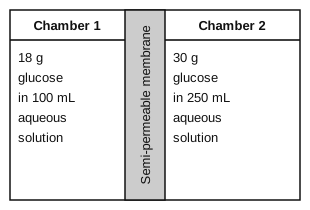
Statement I : H2O molecules move from the chamber 1 to chamber 2.
Statement II : The osmotic pressure of a solution prepared by dissolving 50 mg of potassium sulphate (molar mass = 174 g/mol) in 2 L of water (at 27 °C) is 0.0107 bar. (Given: R = 0.083 dm3 bar K−1 mol−1 and assume complete dissociation of electrolyte)
In the light of the above statements, choose the correct answer from the options given below :
नीचे दो कथन दिए गए हैं :
कथन I : H2O अणु कक्ष 1 (chamber 1) से कक्ष 2 (chamber 2) की ओर गति करते हैं।
कथन II : 50 mg पोटैशियम सल्फेट (मोलर द्रव्यमान = 174 g/mol) को 2 L जल में (27 °C पर) घोलकर बनाए गए विलयन का परासरण दाब 0.0107 bar है। (दिया है: R = 0.083 dm3 bar K−1 mol−1 तथा विद्युत-अपघट्य का पूर्ण वियोजन मानिए)
उपर्युक्त कथनों के आलोक में, नीचे दिए गए विकल्पों में से सही उत्तर चुनिए :
- ABoth Statement I and Statement II are trueकथन I और कथन II दोनों सत्य हैं
- BBoth Statement I and Statement II are falseकथन I और कथन II दोनों असत्य हैं
- CStatement I is true but Statement II is falseकथन I सत्य है परंतु कथन II असत्य है
- DStatement I is false but Statement II is trueकथन I असत्य है परंतु कथन II सत्य है
Show answer
Concept: In osmosis solvent flows from the lower-concentration (lower π) side to the higher-concentration side; π = iCRT.
- Chamber 1: M; Chamber 2: M.
- Water moves from chamber 2 (dilute) to chamber 1 (concentrated) → Statement I is false.
- K2SO4: n = mol; C = M; i = 3.
- π = 3 × 1.437 × 10−4 × 0.083 × 300 = 0.0107 bar → Statement II is true.
Short trick: 18/100 > 30/250 (g per mL), so chamber 1 is stronger; water goes into it.
Answer: (D) Statement I is false but Statement II is true
अवधारणा: परासरण में विलायक कम सांद्रता (कम π) वाली ओर से अधिक सांद्रता वाली ओर बहता है; π = iCRT।
- कक्ष 1: M; कक्ष 2: M।
- जल कक्ष 2 (तनु) से कक्ष 1 (सांद्र) की ओर जाता है → कथन I असत्य है।
- K2SO4: n = mol; C = M; i = 3।
- π = 3 × 1.437 × 10−4 × 0.083 × 300 = 0.0107 bar → कथन II सत्य है।
शॉर्ट ट्रिक: 18/100 > 30/250 (g प्रति mL), अतः कक्ष 1 अधिक सांद्र है; जल उसी में जाता है।
उत्तर: (D) कथन I असत्य है परंतु कथन II सत्य है
JEE Main 2026 (April) – Paper 1 (B.E./B.Tech)ChemistrySolutions – osmosis and osmotic pressureJEE Main 2026 (April) – Paper 1 (B.E./B.Tech) 2026 · 6 Apr Shift 2
Q31.Given is a concentrated solution of a weak electrolyte AxBy of concentration ‘c’ and dissociation constant ‘K’. The degree of dissociation is given by :
सांद्रता ‘c’ तथा वियोजन स्थिरांक ‘K’ वाले एक दुर्बल विद्युत-अपघट्य AxBy का सांद्र विलयन दिया गया है। वियोजन की मात्रा (degree of dissociation) है :
- A
- B
- C
- D
Show answer
Concept: For a weak electrolyte α ≪ 1, so 1 − α ≈ 1.
- AxBy ⇌ xAy+ + yBx−; at equilibrium: c(1 − α), xcα, ycα.
- .
- .
- (A) and (C) have the wrong power (x + y instead of 1/(x + y)); (D) is the reciprocal of the correct ratio.
Short trick: Check with x = y = 1: α = √(K/c) – only (B) gives this.
Answer: (B)
अवधारणा: दुर्बल विद्युत-अपघट्य के लिए α ≪ 1, अतः 1 − α ≈ 1।
- AxBy ⇌ xAy+ + yBx−; साम्य पर: c(1 − α), xcα, ycα।
- ।
- ।
- (A) और (C) में घात गलत है (1/(x + y) के स्थान पर x + y); (D) सही अनुपात का व्युत्क्रम है।
शॉर्ट ट्रिक: x = y = 1 रखकर जाँचिए: α = √(K/c) – केवल (B) यह देता है।
उत्तर: (B)
JEE Main 2026 (April) – Paper 1 (B.E./B.Tech)ChemistryIonic Equilibrium – Ostwald dilution lawJEE Main 2026 (April) – Paper 1 (B.E./B.Tech) 2026 · 6 Apr Shift 2
Q32.For a general redox reaction
Anode
Cathode
Which of the following statement is incorrect ?
एक सामान्य रेडॉक्स अभिक्रिया के लिए
ऐनोड
कैथोड
निम्नलिखित में से कौन-सा कथन गलत है ?
- AThe overall reaction can be written as समग्र अभिक्रिया को के रूप में लिखा जा सकता है
- BThe electrons do not appear in the overall reaction because electrons produced at the anode are consumed at the cathode.समग्र अभिक्रिया में इलेक्ट्रॉन प्रकट नहीं होते क्योंकि ऐनोड पर उत्पन्न इलेक्ट्रॉन कैथोड पर उपभुक्त हो जाते हैं।
- C
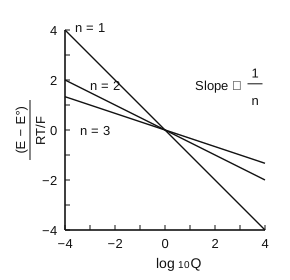
Here n is the number of electrons transferred in redox reaction.
यहाँ n रेडॉक्स अभिक्रिया में स्थानांतरित इलेक्ट्रॉनों की संख्या है। - DIf the reaction is carried out reversibly, the electrical work done is equal to the ratio of charge and potential difference through which charge is moved.यदि अभिक्रिया उत्क्रमणीय रूप से की जाए, तो किया गया विद्युत कार्य, आवेश तथा उस विभवांतर (जिससे होकर आवेश गति करता है) के अनुपात के बराबर होता है।
Show answer
Concept: Electrical work = charge × potential difference (W = QE = nFE); Nernst: .
- (A) Multiplying anode reaction by n2 and cathode by n1 cancels n1n2 electrons → the overall equation is correct.
- (B) Electrons released at the anode are taken up at the cathode, so they cancel – correct.
- (C) : straight lines through the origin with negative slope whose magnitude ∝ 1/n – correct.
- (D) Work is the product of charge and potential difference, not their ratio → incorrect.
Short trick: Joule = coulomb × volt, never coulomb/volt.
Answer: (D) The electrical work is not the ratio of charge and potential difference
अवधारणा: विद्युत कार्य = आवेश × विभवांतर (W = QE = nFE); नेर्न्स्ट: ।
- (A) ऐनोड अभिक्रिया को n2 से तथा कैथोड को n1 से गुणा करने पर n1n2 इलेक्ट्रॉन कट जाते हैं → समग्र समीकरण सही है।
- (B) ऐनोड पर मुक्त इलेक्ट्रॉन कैथोड पर ग्रहण हो जाते हैं, अतः कट जाते हैं – सही।
- (C) : मूलबिंदु से जाने वाली सीधी रेखाएँ जिनकी ऋणात्मक ढाल का परिमाण ∝ 1/n – सही।
- (D) कार्य, आवेश और विभवांतर का गुणनफल है, अनुपात नहीं → गलत।
शॉर्ट ट्रिक: जूल = कूलॉम × वोल्ट, कभी कूलॉम/वोल्ट नहीं।
उत्तर: (D) विद्युत कार्य आवेश और विभवांतर का अनुपात नहीं है
JEE Main 2026 (April) – Paper 1 (B.E./B.Tech)ChemistryElectrochemistry – redox cell and Nernst equationJEE Main 2026 (April) – Paper 1 (B.E./B.Tech) 2026 · 6 Apr Shift 2
Q33.In a period, the first ionisation enthalpy of the element at extreme left and the negative electron gain enthalpy of the extreme right element, except noble gases, are respectively.
किसी आवर्त में, बिल्कुल बाईं ओर के तत्व की प्रथम आयनन एन्थैल्पी तथा उत्कृष्ट गैसों को छोड़कर बिल्कुल दाईं ओर के तत्व की ऋणात्मक इलेक्ट्रॉन लब्धि एन्थैल्पी क्रमशः होती हैं।
- Alowest and lowestन्यूनतम और न्यूनतम
- Bhighest and lowestउच्चतम और न्यूनतम
- Clowest and highestन्यूनतम और उच्चतम
- Dhighest and highestउच्चतम और उच्चतम
Show answer
Concept: Across a period Zeff increases and size decreases.
- The extreme-left element (alkali metal, ns1) loses its electron most easily → lowest first ionisation enthalpy.
- The extreme-right element other than the noble gas (halogen, ns2np5) needs one electron to reach a noble-gas configuration → highest negative electron gain enthalpy.
- So lowest and highest; (A), (B), (D) contradict one or both trends.
Short trick: Alkali metals lose, halogens gain – most easily of all.
Answer: (C) lowest and highest
अवधारणा: आवर्त में बाएँ से दाएँ Zeff बढ़ता है और आकार घटता है।
- बिल्कुल बाईं ओर का तत्व (क्षार धातु, ns1) अपना इलेक्ट्रॉन सबसे आसानी से खोता है → न्यूनतम प्रथम आयनन एन्थैल्पी।
- उत्कृष्ट गैस के अतिरिक्त बिल्कुल दाईं ओर का तत्व (हैलोजन, ns2np5) एक इलेक्ट्रॉन लेकर उत्कृष्ट गैस विन्यास पाता है → उच्चतम ऋणात्मक इलेक्ट्रॉन लब्धि एन्थैल्पी।
- अतः न्यूनतम और उच्चतम; (A), (B), (D) एक या दोनों प्रवृत्तियों के विपरीत हैं।
शॉर्ट ट्रिक: क्षार धातुएँ खोती हैं, हैलोजन ग्रहण करते हैं – सबसे आसानी से।
उत्तर: (C) न्यूनतम और उच्चतम
JEE Main 2026 (April) – Paper 1 (B.E./B.Tech)ChemistryPeriodic Properties – ionisation and electron gain enthalpyJEE Main 2026 (April) – Paper 1 (B.E./B.Tech) 2026 · 6 Apr Shift 2
Q34.Given below are two statements :
Statement I : F2O < H2O < Cl2O is the correct trend in terms of bond angle.
Statement II : SiF4, SnF4 and PbF4 are ionic in nature.
In the light of the above statements, choose the correct answer from the options given below :
नीचे दो कथन दिए गए हैं :
कथन I : आबंध कोण के संदर्भ में F2O < H2O < Cl2O सही क्रम है।
कथन II : SiF4, SnF4 तथा PbF4 प्रकृति में आयनिक हैं।
उपर्युक्त कथनों के आलोक में, नीचे दिए गए विकल्पों में से सही उत्तर चुनिए :
- ABoth Statement I and Statement II are trueकथन I और कथन II दोनों सत्य हैं
- BBoth Statement I and Statement II are falseकथन I और कथन II दोनों असत्य हैं
- CStatement I is true but Statement II is falseकथन I सत्य है परंतु कथन II असत्य है
- DStatement I is false but Statement II is trueकथन I असत्य है परंतु कथन II सत्य है
Show answer
Concept: Bond angle at O depends on the electronegativity and size of the attached atoms; ionic character of MF4 rises down group 14.
- F2O ≈ 103° (bond pairs pulled towards F), H2O ≈ 104.5°, Cl2O ≈ 111° (large Cl atoms repel; bond pairs closer to O) → F2O < H2O < Cl2O: Statement I is true.
- SnF4 and PbF4 are ionic, but SiF4 is a covalent, volatile tetrahedral gas → Statement II is false.
- Hence (A), (B), (D) are wrong.
Short trick: SiF4 is a gas – no ionic solid is a gas.
Answer: (C) Statement I is true but Statement II is false
अवधारणा: O पर आबंध कोण संलग्न परमाणुओं की विद्युत-ऋणात्मकता तथा आकार पर निर्भर है; वर्ग 14 में नीचे जाने पर MF4 का आयनिक लक्षण बढ़ता है।
- F2O ≈ 103° (आबंध युग्म F की ओर खिंचते हैं), H2O ≈ 104.5°, Cl2O ≈ 111° (बड़े Cl परमाणुओं का प्रतिकर्षण; आबंध युग्म O के निकट) → F2O < H2O < Cl2O: कथन I सत्य है।
- SnF4 तथा PbF4 आयनिक हैं, परंतु SiF4 एक सहसंयोजक, वाष्पशील चतुष्फलकीय गैस है → कथन II असत्य है।
- अतः (A), (B), (D) गलत हैं।
शॉर्ट ट्रिक: SiF4 गैस है – कोई आयनिक ठोस गैस नहीं होता।
उत्तर: (C) कथन I सत्य है परंतु कथन II असत्य है
JEE Main 2026 (April) – Paper 1 (B.E./B.Tech)ChemistryChemical Bonding – bond angle; p-Block – tetrafluoridesJEE Main 2026 (April) – Paper 1 (B.E./B.Tech) 2026 · 6 Apr Shift 2
Q35.The correct order of first (ΔiH1) and second (ΔiH2) ionisation enthalpy values of Cr and Mn are :
A. ΔiH1 : Cr > Mn
B. ΔiH2 : Cr > Mn
C. ΔiH1 : Mn > Cr
D. ΔiH2 : Mn > Cr
Choose the correct answer from the options given below :
Cr तथा Mn की प्रथम (ΔiH1) एवं द्वितीय (ΔiH2) आयनन एन्थैल्पी मानों का सही क्रम है :
A. ΔiH1 : Cr > Mn
B. ΔiH2 : Cr > Mn
C. ΔiH1 : Mn > Cr
D. ΔiH2 : Mn > Cr
नीचे दिए गए विकल्पों में से सही उत्तर चुनिए :
- AA and B onlyकेवल A और B
- BB and C onlyकेवल B और C
- CA and D onlyकेवल A और D
- DC and D onlyकेवल C और D
Show answer
Concept: Stability of half-filled d5 and filled 4s2 configurations.
- ΔiH1: Cr (3d54s1) loses the single 4s electron easily, 653 kJ mol−1; Mn (3d54s2) removes a paired 4s electron from a stable 4s2, 717 kJ mol−1 → Mn > Cr (C true, A false).
- ΔiH2: Cr+ is 3d5 (stable half-filled), 1592 kJ mol−1; Mn+ (3d54s1) loses 4s1 to become 3d5, 1509 kJ mol−1 → Cr > Mn (B true, D false).
- B and C are correct; (A), (C), (D) each contain a false statement.
Short trick: Whoever has to break d5 pays more – Cr on the 2nd IE.
Answer: (B) B and C only
अवधारणा: अर्धपूरित d5 तथा पूरित 4s2 विन्यासों का स्थायित्व।
- ΔiH1: Cr (3d54s1) अपना एकल 4s इलेक्ट्रॉन आसानी से खोता है, 653 kJ mol−1; Mn (3d54s2) में स्थायी 4s2 से युग्मित इलेक्ट्रॉन हटाना पड़ता है, 717 kJ mol−1 → Mn > Cr (C सत्य, A असत्य)।
- ΔiH2: Cr+ 3d5 (स्थायी अर्धपूरित) है, 1592 kJ mol−1; Mn+ (3d54s1) 4s1 खोकर 3d5 बनता है, 1509 kJ mol−1 → Cr > Mn (B सत्य, D असत्य)।
- B और C सही हैं; (A), (C), (D) प्रत्येक में एक असत्य कथन है।
शॉर्ट ट्रिक: जिसे d5 तोड़ना पड़े वह अधिक ऊर्जा देता है – द्वितीय IE में Cr।
उत्तर: (B) केवल B और C
JEE Main 2026 (April) – Paper 1 (B.E./B.Tech)Chemistryd-Block – ionisation enthalpies of Cr and MnJEE Main 2026 (April) – Paper 1 (B.E./B.Tech) 2026 · 6 Apr Shift 2
Q36.Which of the following sequences of hybridisation, geometry and magnetic nature are correct for the given coordination compounds ?
A. [NiCl4]2− – sp3, tetrahedral, paramagnetic
B. [Ni(NH3)6]2+ – sp3d2, octahedral, paramagnetic
C. [Ni(CO)4] – sp3, tetrahedral, paramagnetic
D. [Ni(CN)4]2− – dsp2, square planar, diamagnetic
Choose the correct answer from the options given below :
दिए गए उपसहसंयोजन यौगिकों के लिए संकरण, ज्यामिति तथा चुंबकीय प्रकृति के निम्नलिखित में से कौन-से अनुक्रम सही हैं ?
A. [NiCl4]2− – sp3, चतुष्फलकीय, अनुचुंबकीय
B. [Ni(NH3)6]2+ – sp3d2, अष्टफलकीय, अनुचुंबकीय
C. [Ni(CO)4] – sp3, चतुष्फलकीय, अनुचुंबकीय
D. [Ni(CN)4]2− – dsp2, वर्ग समतलीय, प्रतिचुंबकीय
नीचे दिए गए विकल्पों में से सही उत्तर चुनिए :
- AA, B, C and DA, B, C और D
- BB, C and D onlyकेवल B, C और D
- CA, C and D onlyकेवल A, C और D
- DA, B and D onlyकेवल A, B और D
Show answer
Concept: Strong-field ligands (CN−, CO) pair up d electrons; weak-field ligands do not.
- A: Ni2+ (3d8), Cl− weak → no pairing, sp3, tetrahedral, 2 unpaired e− → paramagnetic. Correct.
- B: Ni2+ 3d8 with 6 ligands; two 3d orbitals cannot be vacated, so inner-orbital d2sp3 is impossible → outer-orbital sp3d2, octahedral, 2 unpaired e− → paramagnetic. Correct.
- C: Ni(0) 3d84s2; CO pushes 4s electrons into 3d → 3d10, sp3, tetrahedral, diamagnetic. “Paramagnetic” is wrong.
- D: Ni2+ with CN− → pairing, dsp2, square planar, diamagnetic. Correct.
- A, B, D correct; (A), (B), (C) include the wrong statement C.
Short trick: Ni(CO)4 is d10 – always diamagnetic.
Answer: (D) A, B and D only
अवधारणा: प्रबल क्षेत्र लिगंड (CN−, CO) d इलेक्ट्रॉनों का युग्मन कराते हैं; दुर्बल क्षेत्र लिगंड नहीं।
- A: Ni2+ (3d8), Cl− दुर्बल → युग्मन नहीं, sp3, चतुष्फलकीय, 2 अयुग्मित e− → अनुचुंबकीय। सही।
- B: Ni2+ 3d8 तथा 6 लिगंड; d2sp3 के लिए दो 3d कक्षक रिक्त नहीं हो सकते, अतः बाह्य कक्षक sp3d2, अष्टफलकीय, 2 अयुग्मित e− → अनुचुंबकीय। सही।
- C: Ni(0) 3d84s2; CO, 4s इलेक्ट्रॉनों को 3d में भेज देता है → 3d10, sp3, चतुष्फलकीय, प्रतिचुंबकीय। “अनुचुंबकीय” गलत है।
- D: Ni2+ तथा CN− → युग्मन, dsp2, वर्ग समतलीय, प्रतिचुंबकीय। सही।
- A, B, D सही; (A), (B), (C) में गलत कथन C शामिल है।
शॉर्ट ट्रिक: Ni(CO)4 d10 है – सदैव प्रतिचुंबकीय।
उत्तर: (D) केवल A, B और D
JEE Main 2026 (April) – Paper 1 (B.E./B.Tech)ChemistryCoordination Compounds – VBT of Ni complexesJEE Main 2026 (April) – Paper 1 (B.E./B.Tech) 2026 · 6 Apr Shift 2
Q37.Given below are two statements :
Statement I : A mixture of C12H22O11 (sugar) and NaCl can be separated by dissolving sugar in alcohol, due to differential solubility.
Statement II : Rose essence from rose petals is seperated by steam distillation due to its high volatility and insolubility in H2O.
In the light of the above statements, choose the correct answer from the options given below :
नीचे दो कथन दिए गए हैं :
कथन I : C12H22O11 (शर्करा) तथा NaCl के मिश्रण को विभेदी विलेयता (differential solubility) के कारण शर्करा को ऐल्कोहॉल में घोलकर पृथक किया जा सकता है।
कथन II : गुलाब की पंखुड़ियों से गुलाब का सत (rose essence) अपनी उच्च वाष्पशीलता तथा H2O में अविलेयता के कारण भाप आसवन (steam distillation) द्वारा पृथक किया जाता है।
उपर्युक्त कथनों के आलोक में, नीचे दिए गए विकल्पों में से सही उत्तर चुनिए :
- ABoth Statement I and Statement II are trueकथन I और कथन II दोनों सत्य हैं
- BBoth Statement I and Statement II are falseकथन I और कथन II दोनों असत्य हैं
- CStatement I is true but Statement II is falseकथन I सत्य है परंतु कथन II असत्य है
- DStatement I is false but Statement II is trueकथन I असत्य है परंतु कथन II सत्य है
Show answer
Concept: Separation exploits a property in which the components differ – solubility, volatility.
- Sugar (a polar organic compound) dissolves in (hot) alcohol whereas ionic NaCl is practically insoluble in it; filter off NaCl and evaporate the alcohol to recover sugar → Statement I is true.
- Essential oils such as rose essence are steam-volatile and immiscible with water; in steam distillation they distil below their boiling point along with steam and separate from the water layer → Statement II is true.
- Hence (B), (C), (D) are wrong.
Short trick: Essential oils (rose, lemongrass) → steam distillation is the textbook example.
Answer: (A) Both Statement I and Statement II are true
अवधारणा: पृथक्करण उस गुण पर आधारित होता है जिसमें घटक भिन्न हों – विलेयता, वाष्पशीलता।
- शर्करा (एक ध्रुवीय कार्बनिक यौगिक) (गर्म) ऐल्कोहॉल में घुल जाती है जबकि आयनिक NaCl उसमें लगभग अविलेय है; NaCl को छानकर अलग कीजिए तथा ऐल्कोहॉल वाष्पित कर शर्करा प्राप्त कीजिए → कथन I सत्य है।
- गुलाब के सत जैसे सगंध तेल भाप-वाष्पशील तथा जल के साथ अमिश्रणीय होते हैं; भाप आसवन में वे अपने क्वथनांक से कम ताप पर भाप के साथ आसवित होकर जल की परत से अलग हो जाते हैं → कथन II सत्य है।
- अतः (B), (C), (D) गलत हैं।
शॉर्ट ट्रिक: सगंध तेल (गुलाब, लेमनग्रास) → भाप आसवन का मानक उदाहरण।
उत्तर: (A) कथन I और कथन II दोनों सत्य हैं
JEE Main 2026 (April) – Paper 1 (B.E./B.Tech)ChemistryPurification of Organic Compounds – separation methodsJEE Main 2026 (April) – Paper 1 (B.E./B.Tech) 2026 · 6 Apr Shift 2
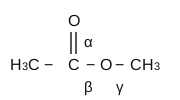
Q38.Shown below is the structure of methyl acetate with three different α, β and γ carbon - oxygen bonds.
The correct order of bond lengths of these bonds is :
नीचे मेथिल ऐसीटेट की संरचना दर्शाई गई है जिसमें तीन भिन्न α, β तथा γ कार्बन - ऑक्सीजन आबंध हैं।
इन आबंधों की आबंध लंबाइयों का सही क्रम है :
- Aα > β > γ
- Bα < β < γ
- Cα = β = γ
- Dα < β = γ
Show answer
Concept: Ester resonance: lone pair of the alkoxy O delocalises into C=O, CH3C(O−)=O+CH3.
- α (C=O): a double bond with only slight single-bond character → shortest (~1.20 Å).
- β (acyl C–O): partial double-bond character from resonance → intermediate (~1.34 Å).
- γ (O–CH3): pure single bond to an sp3 carbon → longest (~1.43 Å).
- Order α < β < γ; (A) reverses it, (C) and (D) ignore the resonance difference.
Short trick: More double-bond character → shorter bond: 2 > 1.x > 1.
Answer: (B) α < β < γ
अवधारणा: एस्टर अनुनाद: ऐल्कॉक्सी O का एकाकी युग्म C=O में विस्थानित होता है, CH3C(O−)=O+CH3।
- α (C=O): द्विआबंध जिसमें बहुत कम एकल-आबंध लक्षण → सबसे छोटा (~1.20 Å)।
- β (ऐसिल C–O): अनुनाद से आंशिक द्विआबंध लक्षण → मध्यम (~1.34 Å)।
- γ (O–CH3): sp3 कार्बन से शुद्ध एकल आबंध → सबसे लंबा (~1.43 Å)।
- क्रम α < β < γ; (A) इसे उलट देता है, (C) और (D) अनुनाद के अंतर की उपेक्षा करते हैं।
शॉर्ट ट्रिक: अधिक द्विआबंध लक्षण → छोटा आबंध: 2 > 1.x > 1।
उत्तर: (B) α < β < γ
JEE Main 2026 (April) – Paper 1 (B.E./B.Tech)ChemistryOrganic Chemistry – resonance and bond lengthJEE Main 2026 (April) – Paper 1 (B.E./B.Tech) 2026 · 6 Apr Shift 2
Q39.‘x’ is the product which is obtained by the hydrolysis of prop-1-yne in the presence of mercuric sulphate under dilute acidic medium at 333 K. ‘y’ is the product which is obtained by the reaction of ethane nitrile with methyl magnesium bromide in dry ether followed by hydrolysis. IUPAC name of product obtained from ‘x’ and ‘y’ in the presence of barium hydroxide followed by heating is :
‘x’ वह उत्पाद है जो 333 K पर तनु अम्लीय माध्यम में मर्क्यूरिक सल्फेट की उपस्थिति में प्रोप-1-आइन के जल-अपघटन से प्राप्त होता है। ‘y’ वह उत्पाद है जो एथेननाइट्राइल की शुष्क ईथर में मेथिल मैग्नीशियम ब्रोमाइड से अभिक्रिया तथा उसके पश्चात जल-अपघटन से प्राप्त होता है। बेरियम हाइड्रॉक्साइड की उपस्थिति में ‘x’ तथा ‘y’ से प्राप्त उत्पाद को गर्म करने पर बने उत्पाद का IUPAC नाम है :
- A2 - Methylpent-4-en-3-one2 - मेथिलपेन्ट-4-ईन-3-ओन
- B4 - Methylpent-3-en-2-one4 - मेथिलपेन्ट-3-ईन-2-ओन
- C4 - Methylpent-1-ene4 - मेथिलपेन्ट-1-ईन
- D2 - Methylpent-3-one2 - मेथिलपेन्ट-3-ओन
Show answer
Concept: Markovnikov hydration of alkynes and Grignard addition to nitriles both give ketones; Ba(OH)2 brings about aldol condensation.
- x: CH3C≡CH + H2O (HgSO4/H2SO4, 333 K) → CH3COCH3 (acetone).
- y: CH3C≡N + CH3MgBr → (CH3)2C=NMgBr CH3COCH3 (acetone).
- Aldol: 2CH3COCH3 (CH3)2C(OH)CH2COCH3 (diacetone alcohol) (CH3)2C=CHCOCH3 (mesityl oxide).
- Numbering from the C=O end: 4-methylpent-3-en-2-one. (A) is an incorrectly numbered/different skeleton, (C) has no C=O, (D) is a saturated ketone.
Short trick: Both reagents give acetone → aldol + heat → mesityl oxide.
Answer: (B) 4 - Methylpent-3-en-2-one
अवधारणा: ऐल्काइनों का मार्कोनीकॉफ जलयोजन तथा नाइट्राइलों पर ग्रिन्यार योग दोनों कीटोन देते हैं; Ba(OH)2 ऐल्डॉल संघनन कराता है।
- x: CH3C≡CH + H2O (HgSO4/H2SO4, 333 K) → CH3COCH3 (ऐसीटोन)।
- y: CH3C≡N + CH3MgBr → (CH3)2C=NMgBr CH3COCH3 (ऐसीटोन)।
- ऐल्डॉल: 2CH3COCH3 (CH3)2C(OH)CH2COCH3 (डाइऐसीटोन ऐल्कोहॉल) (CH3)2C=CHCOCH3 (मेसिटिल ऑक्साइड)।
- C=O वाले सिरे से क्रमांकन: 4-मेथिलपेन्ट-3-ईन-2-ओन। (A) गलत क्रमांकित/भिन्न कंकाल है, (C) में C=O नहीं है, (D) संतृप्त कीटोन है।
शॉर्ट ट्रिक: दोनों अभिकर्मक ऐसीटोन देते हैं → ऐल्डॉल + ऊष्मा → मेसिटिल ऑक्साइड।
उत्तर: (B) 4 - मेथिलपेन्ट-3-ईन-2-ओन
JEE Main 2026 (April) – Paper 1 (B.E./B.Tech)ChemistryAldehydes and Ketones – aldol condensation of acetoneJEE Main 2026 (April) – Paper 1 (B.E./B.Tech) 2026 · 6 Apr Shift 2
Q40.An optically active alkyl bromide C4H9Br, reacts with ethanolic KOH to form major compound [A] which reacts with bromine to give compound [B]. Compound [B] reacts with ethanolic KOH and sodamide to give compound [C]. One molecule of water adds to compound [C] on warming with mercuric sulphate and dilute sulphuric acid at 333 K to form compound [D]. The functional group in compound D will be confirmed by :
एक ध्रुवण घूर्णक (optically active) ऐल्किल ब्रोमाइड C4H9Br, एथेनॉलिक KOH से अभिक्रिया कर मुख्य यौगिक [A] बनाता है जो ब्रोमीन से अभिक्रिया कर यौगिक [B] देता है। यौगिक [B] एथेनॉलिक KOH तथा सोडामाइड से अभिक्रिया कर यौगिक [C] देता है। 333 K पर मर्क्यूरिक सल्फेट तथा तनु सल्फ्यूरिक अम्ल के साथ गर्म करने पर यौगिक [C] में जल का एक अणु जुड़कर यौगिक [D] बनाता है। यौगिक D में उपस्थित क्रियात्मक समूह की पुष्टि किसके द्वारा होगी :
- AHaloform testहैलोफॉर्म परीक्षण
- BLucas testलूकास परीक्षण
- CSilver mirror testरजत दर्पण परीक्षण
- DBenedict testबेनेडिक्ट परीक्षण
Show answer
Concept: Only 2-bromobutane among C4H9Br isomers is chiral; Saytzeff elimination, then dibromination–double dehydrohalogenation gives an alkyne.
- CH3CHBrCH2CH3 CH3CH=CHCH3 [A] (Saytzeff product).
- [A] + Br2 → CH3CHBrCHBrCH3 [B].
- [B] CH3C≡CCH3 [C] (but-2-yne).
- Hydration (Hg2+/H+, 333 K) → CH3COCH2CH3 [D] (butan-2-one), a methyl ketone.
- CH3CO– group gives the iodoform (haloform) test. Lucas test is for alcohols; silver mirror and Benedict tests need an aldehyde – (B), (C), (D) fail.
Short trick: Any CH3C≡C–R hydrates to a methyl ketone → haloform.
Answer: (A) Haloform test
अवधारणा: C4H9Br समावयवों में केवल 2-ब्रोमोब्यूटेन किरेल है; सेत्सेफ विलोपन, फिर द्विब्रोमीनन–द्वि विहाइड्रोहैलोजनन से ऐल्काइन बनता है।
- CH3CHBrCH2CH3 CH3CH=CHCH3 [A] (सेत्सेफ उत्पाद)।
- [A] + Br2 → CH3CHBrCHBrCH3 [B]।
- [B] CH3C≡CCH3 [C] (ब्यूट-2-आइन)।
- जलयोजन (Hg2+/H+, 333 K) → CH3COCH2CH3 [D] (ब्यूटेन-2-ओन), एक मेथिल कीटोन।
- CH3CO– समूह आयडोफॉर्म (हैलोफॉर्म) परीक्षण देता है। लूकास परीक्षण ऐल्कोहॉलों के लिए है; रजत दर्पण तथा बेनेडिक्ट परीक्षणों के लिए ऐल्डिहाइड चाहिए – (B), (C), (D) असफल।
शॉर्ट ट्रिक: कोई भी CH3C≡C–R जलयोजन पर मेथिल कीटोन देता है → हैलोफॉर्म।
उत्तर: (A) हैलोफॉर्म परीक्षण
JEE Main 2026 (April) – Paper 1 (B.E./B.Tech)ChemistryHydrocarbons – alkyne hydration and haloform testJEE Main 2026 (April) – Paper 1 (B.E./B.Tech) 2026 · 6 Apr Shift 2

