Q81.The reaction A(g) ⇌ B(g) + C(g) was initiated with the amount ‘a’ of A(g). At equilibrium it is found that the amount of A(g) remaining is (a − x) at a total pressure of p.
The equilibrium constant Kp of the reaction can be calculated from the expression :
अभिक्रिया A(g) ⇌ B(g) + C(g) को A(g) की ‘a’ मात्रा से प्रारम्भ किया गया। साम्य पर यह पाया गया कि p कुल दाब पर A(g) की शेष मात्रा (a − x) है।
अभिक्रिया का साम्य स्थिरांक Kp किस व्यंजक से परिकलित किया जा सकता है :
- A
- B
- C
- D
Show answer
Concept: Use partial pressure = mole fraction × total pressure.
- At equilibrium: A = a − x, B = x, C = x; total moles = a + x.
- pA = , pB = pC = .
- .
Short trick: For A ⇌ B + C, Kp = α²p/(1 − α²) with α = x/a; multiply top and bottom by a².
Answer: (B)
अवधारणा: आंशिक दाब = मोल-अंश × कुल दाब।
- साम्य पर: A = a − x, B = x, C = x; कुल मोल = a + x।
- pA = , pB = pC = ।
- ।
शॉर्ट ट्रिक: A ⇌ B + C के लिए Kp = α²p/(1 − α²), जहाँ α = x/a; अंश व हर को a² से गुणा कीजिए।
उत्तर: (B)
JEE Main 2026 (April) – Paper 1 (B.E./B.Tech)ChemistryChemical Equilibrium – Kp and degree of dissociationJEE Main 2026 (April) – Paper 1 (B.E./B.Tech) 2026 · 5 Apr Shift 2
Q82.One half cell in a voltaic cell is constructed by dipping silver rod in AgNO3 solution of unknown concentration, other half cell is Zn rod dipped in 1 molar solution of ZnSO4.
A voltage of 1.60 V is measured at 298 K for this cell. What is the concentration of Ag+ ions used in terms of log x (x = [Ag+]) ?
, ,
एक वोल्टीय सेल का एक अर्ध-सेल अज्ञात सांद्रता के AgNO3 विलयन में सिल्वर की छड़ डुबोकर बनाया गया है, दूसरा अर्ध-सेल ZnSO4 के 1 मोलर विलयन में डूबी Zn छड़ है।
298 K पर इस सेल का वोल्टेज 1.60 V मापा गया। प्रयुक्त Ag+ आयनों की सांद्रता log x (x = [Ag+]) के रूप में क्या है ?
, ,
- A
- B
- C
- D
Show answer
Concept: Cell: Zn | Zn2+(1 M) || Ag+(x) | Ag; reaction Zn + 2Ag+ → Zn2+ + 2Ag (n = 2).
- V.
- .
- .
Short trick: With [Zn2+] = 1, E − E° = 0.059 log[Ag+] directly.
Answer: (B)
अवधारणा: सेल: Zn | Zn2+(1 M) || Ag+(x) | Ag; अभिक्रिया Zn + 2Ag+ → Zn2+ + 2Ag (n = 2)।
- V।
- ।
- ।
शॉर्ट ट्रिक: [Zn2+] = 1 होने पर, E − E° = 0.059 log[Ag+] सीधे।
उत्तर: (B)
JEE Main 2026 (April) – Paper 1 (B.E./B.Tech)ChemistryElectrochemistry – Nernst equationJEE Main 2026 (April) – Paper 1 (B.E./B.Tech) 2026 · 5 Apr Shift 2
Q83.Given below are two statements :
Statement I : The number of pairs among [Al2O3, Cr2O3], [Cl2O7, Mn2O7], [Na2O, V2O3] and [CO, N2O] that contain oxides of same nature (acidic, basic, neutral or amphoteric) is 4.
Statement II : Among Na2O, Al2O3, CO and Cl2O7, the most basic and acidic oxides are Na2O and Cl2O7, respectively.
In the light of the above statements, choose the correct answer from the options given below :
नीचे दो कथन दिए गए हैं :
कथन I : [Al2O3, Cr2O3], [Cl2O7, Mn2O7], [Na2O, V2O3] तथा [CO, N2O] में से ऐसे युग्मों की संख्या, जिनमें समान प्रकृति (अम्लीय, क्षारीय, उदासीन या उभयधर्मी) के ऑक्साइड हैं, 4 है।
कथन II : Na2O, Al2O3, CO तथा Cl2O7 में से सर्वाधिक क्षारीय तथा सर्वाधिक अम्लीय ऑक्साइड क्रमशः Na2O तथा Cl2O7 हैं।
उपरोक्त कथनों के आलोक में, नीचे दिए गए विकल्पों में से सही उत्तर चुनिए :
- ABoth Statement I and Statement II are trueकथन I और कथन II दोनों सत्य हैं
- BBoth Statement I and Statement II are falseकथन I और कथन II दोनों असत्य हैं
- CStatement I is true but Statement II is falseकथन I सत्य है परन्तु कथन II असत्य है
- DStatement I is false but Statement II is trueकथन I असत्य है परन्तु कथन II सत्य है
Show answer
Concept: Oxide character: ionic metal oxides basic, intermediate amphoteric, non-metal / high-oxidation-state oxides acidic; CO, N2O, NO neutral.
- [Al2O3, Cr2O3]: both amphoteric – same.
- [Cl2O7, Mn2O7]: both acidic (Mn in +7) – same.
- [Na2O, V2O3]: both basic (V in low +3 state gives basic V2O3) – same.
- [CO, N2O]: both neutral – same. So 4 pairs → Statement I true.
- Statement II: Na2O (strongly basic) and Cl2O7 (strongly acidic, anhydride of HClO4) – true.
Short trick: Vanadium oxides: V2O3 basic → V2O4 less basic → V2O5 amphoteric.
Answer: (A) Both Statement I and Statement II are true
अवधारणा: ऑक्साइड प्रकृति: आयनिक धातु ऑक्साइड क्षारीय, मध्यवर्ती उभयधर्मी, अधातु / उच्च ऑक्सीकरण अवस्था वाले ऑक्साइड अम्लीय; CO, N2O, NO उदासीन।
- [Al2O3, Cr2O3]: दोनों उभयधर्मी – समान।
- [Cl2O7, Mn2O7]: दोनों अम्लीय (Mn +7 अवस्था में) – समान।
- [Na2O, V2O3]: दोनों क्षारीय (निम्न +3 अवस्था में V का V2O3 क्षारीय) – समान।
- [CO, N2O]: दोनों उदासीन – समान। अतः 4 युग्म → कथन I सत्य।
- कथन II: Na2O (प्रबल क्षारीय) तथा Cl2O7 (प्रबल अम्लीय, HClO4 का एनहाइड्राइड) – सत्य।
शॉर्ट ट्रिक: वैनेडियम ऑक्साइड: V2O3 क्षारीय → V2O4 कम क्षारीय → V2O5 उभयधर्मी।
उत्तर: (A) कथन I और कथन II दोनों सत्य हैं
JEE Main 2026 (April) – Paper 1 (B.E./B.Tech)Chemistryp-Block / d-Block – nature of oxidesJEE Main 2026 (April) – Paper 1 (B.E./B.Tech) 2026 · 5 Apr Shift 2
Q84.Given below are two statements :
Statement I : Aluminium upon reaction with NaOH forms [Al(OH)6]3− ion.
Statement II : The geometry of ICl4−, ClO3− and IBr2− is square planar, pyramidal and linear respectively.
In the light of the above statements, choose the correct answer from the options given below :
नीचे दो कथन दिए गए हैं :
कथन I : ऐलुमिनियम NaOH से अभिक्रिया करके [Al(OH)6]3− आयन बनाता है।
कथन II : ICl4−, ClO3− तथा IBr2− की ज्यामिति क्रमशः वर्ग समतलीय, पिरामिडी तथा रैखिक है।
उपरोक्त कथनों के आलोक में, नीचे दिए गए विकल्पों में से सही उत्तर चुनिए :
- ABoth Statement I and Statement II are trueकथन I और कथन II दोनों सत्य हैं
- BBoth Statement I and Statement II are falseकथन I और कथन II दोनों असत्य हैं
- CStatement I is true but Statement II is falseकथन I सत्य है परन्तु कथन II असत्य है
- DStatement I is false but Statement II is trueकथन I असत्य है परन्तु कथन II सत्य है
Show answer
Concept: Amphoteric Al dissolves in alkali as tetrahydroxidoaluminate; VSEPR from bond pairs + lone pairs.
- Statement I – false: 2Al + 2NaOH + 6H2O → 2Na+[Al(OH)4]− + 3H2; the product is [Al(OH)4]− (sodium tetrahydroxidoaluminate), not [Al(OH)6]3−.
- ICl4−: 4 bp + 2 lp (sp3d2) → square planar.
- ClO3−: 3 bp + 1 lp (sp3) → pyramidal.
- IBr2−: 2 bp + 3 lp (sp3d) → linear. Statement II true.
Short trick: AX4E2 square planar, AX3E pyramidal, AX2E3 linear.
Answer: (D) Statement I is false but Statement II is true
अवधारणा: उभयधर्मी Al क्षार में टेट्राहाइड्रॉक्सिडोऐलुमिनेट के रूप में घुलता है; VSEPR में आबंधी युग्म + एकाकी युग्म।
- कथन I – असत्य: 2Al + 2NaOH + 6H2O → 2Na+[Al(OH)4]− + 3H2; उत्पाद [Al(OH)4]− (सोडियम टेट्राहाइड्रॉक्सिडोऐलुमिनेट) है, [Al(OH)6]3− नहीं।
- ICl4−: 4 bp + 2 lp (sp3d2) → वर्ग समतलीय।
- ClO3−: 3 bp + 1 lp (sp3) → पिरामिडी।
- IBr2−: 2 bp + 3 lp (sp3d) → रैखिक। कथन II सत्य।
शॉर्ट ट्रिक: AX4E2 वर्ग समतलीय, AX3E पिरामिडी, AX2E3 रैखिक।
उत्तर: (D) कथन I असत्य है परन्तु कथन II सत्य है
JEE Main 2026 (April) – Paper 1 (B.E./B.Tech)Chemistryp-Block – aluminium and interhalogen ions (VSEPR)JEE Main 2026 (April) – Paper 1 (B.E./B.Tech) 2026 · 5 Apr Shift 2
Q85.Given below are two statements :
Statement I : Presence of large number of unpaired electrons in transition metal atoms results in higher enthalpies of their atomisation.
Statement II : dxy = dxz = dyz < dx2−y2 = dz2 and dx2−y2 = dz2 < dxy = dxz = dyz are the d-orbital splittings in [Fe(H2O)6]3+ and [Ni(Cl)4]2− complex ions respectively.
In the light of the above statements, choose the correct answer from the options given below :
नीचे दो कथन दिए गए हैं :
कथन I : संक्रमण धातु परमाणुओं में बड़ी संख्या में अयुग्मित इलेक्ट्रॉनों की उपस्थिति के फलस्वरूप उनकी परमाणुकरण एन्थैल्पी उच्च होती है।
कथन II : dxy = dxz = dyz < dx2−y2 = dz2 तथा dx2−y2 = dz2 < dxy = dxz = dyz क्रमशः [Fe(H2O)6]3+ तथा [Ni(Cl)4]2− संकुल आयनों में d-कक्षक विपाटन हैं।
उपरोक्त कथनों के आलोक में, नीचे दिए गए विकल्पों में से सही उत्तर चुनिए :
- ABoth Statement I and Statement II are correctकथन I और कथन II दोनों सही हैं
- BBoth Statement I and Statement II are incorrectकथन I और कथन II दोनों गलत हैं
- CStatement I is correct but Statement II is incorrectकथन I सही है परन्तु कथन II गलत है
- DStatement I is incorrect but Statement II is correctकथन I गलत है परन्तु कथन II सही है
Show answer
Concept: More unpaired d-electrons → stronger metallic bonding; octahedral vs tetrahedral crystal-field splitting.
- Statement I – correct: a larger number of unpaired electrons gives stronger interatomic (metallic) bonding, hence higher enthalpy of atomisation (maxima near the middle of each series).
- [Fe(H2O)6]3+ is octahedral: t2g (dxy, dxz, dyz) lie below eg (dx²−y², dz²) – correct.
- [NiCl4]2− is tetrahedral (sp3, weak-field Cl−): e (dx²−y², dz²) lie below t2 (dxy, dxz, dyz) – correct. So Statement II is correct.
Short trick: Tetrahedral splitting is the inverted octahedral pattern.
Answer: (A) Both Statement I and Statement II are correct
अवधारणा: अधिक अयुग्मित d-इलेक्ट्रॉन → प्रबल धात्विक आबंधन; अष्टफलकीय बनाम चतुष्फलकीय क्रिस्टल क्षेत्र विपाटन।
- कथन I – सही: अयुग्मित इलेक्ट्रॉनों की अधिक संख्या प्रबल अंतरापरमाणुक (धात्विक) आबंधन देती है, अतः परमाणुकरण एन्थैल्पी अधिक होती है (प्रत्येक श्रेणी के मध्य के निकट अधिकतम)।
- [Fe(H2O)6]3+ अष्टफलकीय है: t2g (dxy, dxz, dyz), eg (dx²−y², dz²) से नीचे होते हैं – सही।
- [NiCl4]2− चतुष्फलकीय है (sp3, दुर्बल क्षेत्र Cl−): e (dx²−y², dz²), t2 (dxy, dxz, dyz) से नीचे होते हैं – सही। अतः कथन II सही है।
शॉर्ट ट्रिक: चतुष्फलकीय विपाटन, अष्टफलकीय पैटर्न का उल्टा होता है।
उत्तर: (A) कथन I और कथन II दोनों सही हैं
JEE Main 2026 (April) – Paper 1 (B.E./B.Tech)Chemistryd-Block & Coordination – atomisation enthalpy, crystal field splittingJEE Main 2026 (April) – Paper 1 (B.E./B.Tech) 2026 · 5 Apr Shift 2
Q86.Identify the correct statements from the following
A. [Fe(C2O4)3]3− is the most stable complex among [Fe(OH)6]3−, [Fe(C2O4)3]3− and [Fe(SCN)6]3−
B. The stability of [Cu(NH3)4]2+ is greater than that of [Cu(en)2]2+
C. The hybridization of Fe in K4[Fe(CN)6] is d2sp3
D. [Fe(NO2)3Cl3]3− exhibits linkage isomerism
E. NO2− and SCN− ligands are NOT ambidentate ligands
Choose the correct answer from the options given below :
निम्नलिखित में से सही कथनों को पहचानिए
A. [Fe(OH)6]3−, [Fe(C2O4)3]3− तथा [Fe(SCN)6]3− में से [Fe(C2O4)3]3− सर्वाधिक स्थायी संकुल है
B. [Cu(NH3)4]2+ का स्थायित्व [Cu(en)2]2+ से अधिक है
C. K4[Fe(CN)6] में Fe का संकरण d2sp3 है
D. [Fe(NO2)3Cl3]3− बंधनी समावयवता (linkage isomerism) प्रदर्शित करता है
E. NO2− तथा SCN− लिगन्ड उभयदंती (ambidentate) लिगन्ड नहीं हैं
नीचे दिए गए विकल्पों में से सही उत्तर चुनिए :
- AA, B, C, D and EA, B, C, D तथा E
- BB, C and D onlyकेवल B, C तथा D
- CA, C and D onlyकेवल A, C तथा D
- DA, C and E onlyकेवल A, C तथा E
Show answer
Concept: Chelate effect; low-spin inner-orbital complexes with CN−; ambidentate ligands give linkage isomers.
- A – correct: oxalate is a bidentate chelating ligand, so [Fe(C2O4)3]3− is the most stable (chelate effect).
- B – incorrect: en is a chelating ligand, so [Cu(en)2]2+ is more stable than [Cu(NH3)4]2+.
- C – correct: Fe2+ (3d6) with strong-field CN− pairs up → inner-orbital d2sp3.
- D – correct: NO2− can bind through N (nitrito-N) or O (nitrito-O), so linkage isomers exist.
- E – incorrect: NO2− and SCN− are classic ambidentate ligands.
- Correct set: A, C, D. (A) and (B) include false B; (D) includes false E.
Short trick: Chelate > non-chelate always; E contradicts D, so they cannot both be true.
Answer: (C) A, C and D only
अवधारणा: कीलेट प्रभाव; CN− के साथ निम्न-चक्रण आंतरिक कक्षक संकुल; उभयदंती लिगन्ड बंधनी समावयवी देते हैं।
- A – सही: ऑक्सैलेट द्विदंती कीलेटकारी लिगन्ड है, अतः [Fe(C2O4)3]3− सर्वाधिक स्थायी है (कीलेट प्रभाव)।
- B – गलत: en कीलेटकारी लिगन्ड है, अतः [Cu(en)2]2+, [Cu(NH3)4]2+ से अधिक स्थायी है।
- C – सही: प्रबल क्षेत्र CN− के साथ Fe2+ (3d6) के इलेक्ट्रॉन युग्मित होते हैं → आंतरिक कक्षक d2sp3।
- D – सही: NO2−, N (नाइट्रिटो-N) या O (नाइट्रिटो-O) से जुड़ सकता है, अतः बंधनी समावयवी संभव हैं।
- E – गलत: NO2− तथा SCN− विशिष्ट उभयदंती लिगन्ड हैं।
- सही समुच्चय: A, C, D। (A) तथा (B) में गलत B है; (D) में गलत E है।
शॉर्ट ट्रिक: कीलेट हमेशा अकीलेट से अधिक स्थायी; E, D का विरोधी है, दोनों सत्य नहीं हो सकते।
उत्तर: (C) केवल A, C तथा D
JEE Main 2026 (April) – Paper 1 (B.E./B.Tech)ChemistryCoordination Compounds – stability, hybridisation, isomerismJEE Main 2026 (April) – Paper 1 (B.E./B.Tech) 2026 · 5 Apr Shift 2
Q87.Match List - I with List - II.
| List - I
Purification technique | | List - II
Used to separate |
|---|
| A. | Simple distillation | I. | Steam volatile compound |
| B. | Fractional distillation | II. | Two liquids with large difference in boiling points |
| C. | Steam distillation | III. | Liquid decomposing at its boiling point |
| D. | Distillation under reduced pressure | IV. | Two liquids with close boiling points |
Choose the correct answer from the options given below :
सूची - I का सूची - II से मिलान कीजिए।
| सूची - I
शोधन तकनीक | | सूची - II
पृथक्करण हेतु प्रयुक्त |
|---|
| A. | सरल आसवन | I. | भाप वाष्पशील यौगिक |
| B. | प्रभाजी आसवन | II. | क्वथनांकों में अधिक अंतर वाले दो द्रव |
| C. | भाप आसवन | III. | अपने क्वथनांक पर अपघटित होने वाला द्रव |
| D. | न्यून दाब पर आसवन | IV. | निकट क्वथनांकों वाले दो द्रव |
नीचे दिए गए विकल्पों में से सही उत्तर चुनिए :
- AA-II, B-III, C-I, D-IV
- BA-II, B-IV, C-I, D-III
- CA-II, B-IV, C-III, D-I
- DA-IV, B-III, C-II, D-I
Show answer
Concept: Choose the distillation method according to the boiling-point gap and thermal stability.
- A. Simple distillation – liquids whose boiling points differ widely → II.
- B. Fractional distillation – liquids with close boiling points (fractionating column) → IV.
- C. Steam distillation – steam-volatile, water-immiscible compounds (e.g. aniline) → I.
- D. Distillation under reduced pressure – liquids that decompose at their boiling point (e.g. glycerol) → III.
- (A) and (C) mismatch B/D; (D) puts simple distillation with close-boiling liquids.
Short trick: “Reduced pressure → lower b.p. → no decomposition.”
Answer: (B) A-II, B-IV, C-I, D-III
अवधारणा: क्वथनांक-अंतर तथा ऊष्मीय स्थायित्व के अनुसार आसवन विधि चुनी जाती है।
- A. सरल आसवन – क्वथनांकों में अधिक अंतर वाले द्रव → II।
- B. प्रभाजी आसवन – निकट क्वथनांक वाले द्रव (प्रभाजी स्तंभ) → IV।
- C. भाप आसवन – भाप-वाष्पशील, जल-अमिश्रणीय यौगिक (जैसे ऐनिलीन) → I।
- D. न्यून दाब पर आसवन – अपने क्वथनांक पर अपघटित होने वाले द्रव (जैसे ग्लिसरॉल) → III।
- (A) तथा (C) में B/D का मिलान गलत है; (D) सरल आसवन को निकट क्वथनांक वाले द्रवों से जोड़ता है।
शॉर्ट ट्रिक: “न्यून दाब → कम क्वथनांक → अपघटन नहीं।”
उत्तर: (B) A-II, B-IV, C-I, D-III
JEE Main 2026 (April) – Paper 1 (B.E./B.Tech)ChemistryOrganic Chemistry – purification techniquesJEE Main 2026 (April) – Paper 1 (B.E./B.Tech) 2026 · 5 Apr Shift 2
Q88.IUPAC name of the some alkenes are given below.
Find out the correct stability order.
A. 2-Methylbut-2-ene
B. cis-But-2-ene
C. 2, 3-Dimethylbut-2-ene
D. Prop-1-ene
Choose the correct answer from the options given below :
कुछ ऐल्कीनों के IUPAC नाम नीचे दिए गए हैं।
सही स्थायित्व क्रम ज्ञात कीजिए।
A. 2-Methylbut-2-ene
B. cis-But-2-ene
C. 2, 3-Dimethylbut-2-ene
D. Prop-1-ene
नीचे दिए गए विकल्पों में से सही उत्तर चुनिए :
- AC > A > B > D
- BC > A > D > B
- CB > D > A > C
- DA > B > C > D
Show answer
Concept: Alkene stability increases with the number of alkyl groups on the C=C (more hyperconjugation, lower heat of hydrogenation).
- C. 2,3-Dimethylbut-2-ene: tetrasubstituted.
- A. 2-Methylbut-2-ene: trisubstituted.
- B. cis-But-2-ene: disubstituted.
- D. Prop-1-ene: monosubstituted.
- Order: C > A > B > D. (B) puts mono above di, (C) and (D) ignore the substitution trend.
Short trick: Count α-H's: C (12) > A (9) > B (6) > D (3).
Answer: (A) C > A > B > D
अवधारणा: C=C पर ऐल्किल समूहों की संख्या बढ़ने पर ऐल्कीन का स्थायित्व बढ़ता है (अधिक अतिसंयुग्मन, हाइड्रोजनन की कम ऊष्मा)।
- C. 2,3-Dimethylbut-2-ene: चतुःप्रतिस्थापित।
- A. 2-Methylbut-2-ene: त्रिप्रतिस्थापित।
- B. cis-But-2-ene: द्विप्रतिस्थापित।
- D. Prop-1-ene: एकप्रतिस्थापित।
- क्रम: C > A > B > D। (B) एकप्रतिस्थापित को द्विप्रतिस्थापित से ऊपर रखता है, (C) तथा (D) प्रतिस्थापन प्रवृत्ति की उपेक्षा करते हैं।
शॉर्ट ट्रिक: α-H गिनिए: C (12) > A (9) > B (6) > D (3)।
उत्तर: (A) C > A > B > D
JEE Main 2026 (April) – Paper 1 (B.E./B.Tech)ChemistryHydrocarbons – stability of alkenesJEE Main 2026 (April) – Paper 1 (B.E./B.Tech) 2026 · 5 Apr Shift 2
Q89.Identify the correct IUPAC name of hydrocarbon (x) containing three primary carbon atoms and with molar mass 72 g mol−1.
तीन प्राथमिक कार्बन परमाणुओं वाले तथा 72 g mol−1 मोलर द्रव्यमान वाले हाइड्रोकार्बन (x) का सही IUPAC नाम पहचानिए।
- A1, 1 - Dimethylcyclopropane
- B2, 2 - Dimethylpropane
- C2 - Methylbutane
- Dn-pentane
Show answer
Concept: Molar mass 72 → C5H12 (pentane isomers); a primary carbon is bonded to only one other carbon.
- 12n + 2n + 2 = 72 → n = 5, so x is C5H12. 1,1-Dimethylcyclopropane is C5H10 (70 g mol−1) – rejected.
- n-Pentane CH3(CH2)3CH3: 2 primary C.
- 2,2-Dimethylpropane C(CH3)4: 4 primary C.
- 2-Methylbutane (CH3)2CH–CH2–CH3: 3 primary C ✔.
Short trick: Number of CH3 groups = number of primary carbons: 2, 3, 4 for the three pentanes.
Answer: (C) 2 - Methylbutane
अवधारणा: मोलर द्रव्यमान 72 → C5H12 (पेन्टेन समावयवी); प्राथमिक कार्बन केवल एक अन्य कार्बन से जुड़ा होता है।
- 12n + 2n + 2 = 72 → n = 5, अतः x, C5H12 है। 1,1-Dimethylcyclopropane, C5H10 (70 g mol−1) है – अस्वीकृत।
- n-पेन्टेन CH3(CH2)3CH3: 2 प्राथमिक C।
- 2,2-Dimethylpropane C(CH3)4: 4 प्राथमिक C।
- 2-Methylbutane (CH3)2CH–CH2–CH3: 3 प्राथमिक C ✔।
शॉर्ट ट्रिक: CH3 समूहों की संख्या = प्राथमिक कार्बनों की संख्या: तीनों पेन्टेनों के लिए 2, 3, 4।
उत्तर: (C) 2 - Methylbutane
JEE Main 2026 (April) – Paper 1 (B.E./B.Tech)ChemistryOrganic Chemistry – IUPAC nomenclatureJEE Main 2026 (April) – Paper 1 (B.E./B.Tech) 2026 · 5 Apr Shift 2
Q90.Complete the following reaction sequence and give the name of major product ‘P’.
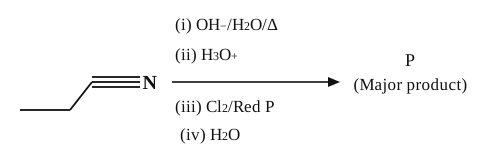
निम्नलिखित अभिक्रिया अनुक्रम को पूर्ण कीजिए तथा मुख्य उत्पाद ‘P’ का नाम बताइए।
- A2-Chloropropanoic acid
- B3-Chloropropanoic acid
- C1-Chloropropane
- D2-Chloropropane
Show answer
Concept: Nitrile → carboxylic acid on hydrolysis; Hell–Volhard–Zelinsky (Cl2/red P) halogenates the α-carbon.
- Starting nitrile: CH3CH2C≡N (propanenitrile).
- (i) OH−/H2O/Δ, (ii) H3O+ → CH3CH2COOH (propanoic acid).
- (iii) Cl2/red P, (iv) H2O → α-chlorination: CH3CH(Cl)COOH = 2-chloropropanoic acid.
- (B) is β-chlorination (not HVZ); (C) and (D) lose the COOH group, which does not happen.
Short trick: HVZ always puts the halogen next to COOH (C-2).
Answer: (A) 2-Chloropropanoic acid
अवधारणा: जल-अपघटन पर नाइट्राइल → कार्बोक्सिलिक अम्ल; हेल–फोलार्ड–ज़ेलिंस्की (Cl2/लाल P) α-कार्बन का हैलोजनन करता है।
- प्रारम्भिक नाइट्राइल: CH3CH2C≡N (प्रोपेननाइट्राइल)।
- (i) OH−/H2O/Δ, (ii) H3O+ → CH3CH2COOH (प्रोपेनोइक अम्ल)।
- (iii) Cl2/लाल P, (iv) H2O → α-क्लोरीनन: CH3CH(Cl)COOH = 2-क्लोरोप्रोपेनोइक अम्ल।
- (B) β-क्लोरीनन है (HVZ नहीं); (C) तथा (D) में COOH समूह हट जाता है, जो नहीं होता।
शॉर्ट ट्रिक: HVZ में हैलोजन सदैव COOH के आगे वाले कार्बन (C-2) पर जाता है।
उत्तर: (A) 2-Chloropropanoic acid
JEE Main 2026 (April) – Paper 1 (B.E./B.Tech)ChemistryCarboxylic Acids – nitrile hydrolysis and HVZ reactionJEE Main 2026 (April) – Paper 1 (B.E./B.Tech) 2026 · 5 Apr Shift 2
Q91.Given below are two statements :
Statement I : The condensation reaction between CH3−CH=O and H2N−N(H)−C(=O)−NH2 under optimum pH will produce CH3−CH=N−C(=O)−N(H)−NH2
Statement II : The molecule, Ph−CH(O−H)(O−CH3) will generate Ph−CH=O in the presence of dilute acid.
In the light of the above statements, choose the correct answer from the options given below :
नीचे दो कथन दिए गए हैं :
कथन I : इष्टतम pH पर CH3−CH=O तथा H2N−N(H)−C(=O)−NH2 के बीच संघनन अभिक्रिया से CH3−CH=N−C(=O)−N(H)−NH2 बनेगा।
कथन II : अणु Ph−CH(O−H)(O−CH3) तनु अम्ल की उपस्थिति में Ph−CH=O उत्पन्न करेगा।
उपरोक्त कथनों के आलोक में, नीचे दिए गए विकल्पों में से सही उत्तर चुनिए :
- ABoth Statement I and Statement II are trueकथन I और कथन II दोनों सत्य हैं
- BBoth Statement I and Statement II are falseकथन I और कथन II दोनों असत्य हैं
- CStatement I is true but Statement II is falseकथन I सत्य है परन्तु कथन II असत्य है
- DStatement I is false but Statement II is trueकथन I असत्य है परन्तु कथन II सत्य है
Show answer
Concept: In semicarbazide H2N–NH–CO–NH2, only the hydrazine-type –NH2 is nucleophilic; the amide –NH2 is deactivated by resonance with C=O. Hemiacetals are unstable in acid.
- Statement I – false: CH3CHO condenses with the terminal NH2 of the –NH–NH2 end, giving the semicarbazone CH3−CH=N−NH−C(=O)−NH2. The given product (C=O bonded directly to the imine N, with –NH–NH2 left free) would need the amide nitrogen to react, which does not happen.
- Statement II – true: Ph−CH(OH)(OCH3) is a hemiacetal; dilute acid reverses its formation: Ph−CH(OH)OCH3 ⇌ Ph−CHO + CH3OH.
Short trick: Semicarbazone = R2C=N–NH–CO–NH2; the C=O is never next to the C=N nitrogen.
Answer: (D) Statement I is false but Statement II is true
अवधारणा: सेमीकार्बेज़ाइड H2N–NH–CO–NH2 में केवल हाइड्रैज़ीन वाला –NH2 नाभिकरागी है; ऐमाइड –NH2, C=O के साथ अनुनाद के कारण निष्क्रिय होता है। हेमीऐसीटैल अम्ल में अस्थायी होते हैं।
- कथन I – असत्य: CH3CHO, –NH–NH2 सिरे के अंतस्थ NH2 से संघनित होकर सेमीकार्बेज़ोन CH3−CH=N−NH−C(=O)−NH2 बनाता है। दिए गए उत्पाद (C=O सीधे इमीन N से जुड़ा तथा –NH–NH2 मुक्त) के लिए ऐमाइड नाइट्रोजन की अभिक्रिया आवश्यक होगी, जो नहीं होती।
- कथन II – सत्य: Ph−CH(OH)(OCH3) एक हेमीऐसीटैल है; तनु अम्ल इसके निर्माण को उत्क्रमित करता है: Ph−CH(OH)OCH3 ⇌ Ph−CHO + CH3OH।
शॉर्ट ट्रिक: सेमीकार्बेज़ोन = R2C=N–NH–CO–NH2; C=O कभी भी C=N वाले नाइट्रोजन के ठीक बगल में नहीं होता।
उत्तर: (D) कथन I असत्य है परन्तु कथन II सत्य है
JEE Main 2026 (April) – Paper 1 (B.E./B.Tech)ChemistryAldehydes – semicarbazone formation and hemiacetal hydrolysisJEE Main 2026 (April) – Paper 1 (B.E./B.Tech) 2026 · 5 Apr Shift 2
Q92.Given below are two statements :
Statement I : Heating benzamide with bromine in an ethanolic solution of sodium hydroxide will give benzylamine.
Statement II : Nitration of aniline with HNO3/H2SO4 at 288 K produces m-nitroaniline in higher amount than o-nitroaniline (pH adjusted).
In the light of the above statements, choose the correct answer from the options given below :
नीचे दो कथन दिए गए हैं :
कथन I : बेन्ज़ैमाइड को सोडियम हाइड्रॉक्साइड के एथेनॉलीय विलयन में ब्रोमीन के साथ गर्म करने पर बेन्ज़िलऐमीन प्राप्त होगी।
कथन II : 288 K पर HNO3/H2SO4 द्वारा ऐनिलीन का नाइट्रीकरण o-नाइट्रोऐनिलीन की तुलना में m-नाइट्रोऐनिलीन अधिक मात्रा में देता है (pH समायोजित)।
उपरोक्त कथनों के आलोक में, नीचे दिए गए विकल्पों में से सही उत्तर चुनिए :
- ABoth Statement I and Statement II are trueकथन I और कथन II दोनों सत्य हैं
- BBoth Statement I and Statement II are falseकथन I और कथन II दोनों असत्य हैं
- CStatement I is true but Statement II is falseकथन I सत्य है परन्तु कथन II असत्य है
- DStatement I is false but Statement II is trueकथन I असत्य है परन्तु कथन II सत्य है
Show answer
Concept: Hofmann bromamide degradation removes one carbon; in strong acid aniline is protonated to the meta-directing anilinium ion.
- Statement I – false: C6H5CONH2 + Br2 + 4NaOH → C6H5NH2 (aniline) + Na2CO3 + 2NaBr + 2H2O. The product has one carbon less – aniline, not benzylamine (C6H5CH2NH2).
- Statement II – true: in HNO3/H2SO4 a large part of aniline becomes C6H5NH3+ (meta-directing). Products at 288 K: p-nitroaniline ≈ 51%, m-nitroaniline ≈ 47%, o-nitroaniline ≈ 2%; so meta > ortho.
Short trick: Hofmann: amide → amine with one C less. Direct nitration: 51 : 47 : 2 (p : m : o).
Answer: (D) Statement I is false but Statement II is true
अवधारणा: हॉफमान ब्रोमैमाइड निम्नीकरण में एक कार्बन घट जाता है; प्रबल अम्ल में ऐनिलीन प्रोटॉनित होकर मेटा-निर्देशी ऐनिलिनियम आयन बनाती है।
- कथन I – असत्य: C6H5CONH2 + Br2 + 4NaOH → C6H5NH2 (ऐनिलीन) + Na2CO3 + 2NaBr + 2H2O। उत्पाद में एक कार्बन कम होता है – ऐनिलीन, बेन्ज़िलऐमीन (C6H5CH2NH2) नहीं।
- कथन II – सत्य: HNO3/H2SO4 में ऐनिलीन का बड़ा भाग C6H5NH3+ (मेटा-निर्देशी) बन जाता है। 288 K पर उत्पाद: p-नाइट्रोऐनिलीन ≈ 51%, m-नाइट्रोऐनिलीन ≈ 47%, o-नाइट्रोऐनिलीन ≈ 2%; अतः मेटा > ऑर्थो।
शॉर्ट ट्रिक: हॉफमान: ऐमाइड → एक C कम वाली ऐमीन। सीधा नाइट्रीकरण: 51 : 47 : 2 (p : m : o)।
उत्तर: (D) कथन I असत्य है परन्तु कथन II सत्य है
JEE Main 2026 (April) – Paper 1 (B.E./B.Tech)ChemistryAmines – Hofmann bromamide reaction and nitration of anilineJEE Main 2026 (April) – Paper 1 (B.E./B.Tech) 2026 · 5 Apr Shift 2
Q93.Identify the incorrect statement about tertiary structure of proteins.
प्रोटीन की तृतीयक संरचना के विषय में गलत कथन पहचानिए।
- AThey can be fibrous or globular in structure.ये संरचना में रेशेदार (fibrous) या गोलिकाकार (globular) हो सकती हैं।
- BThe main forces that stabilize the structure are hydrogen bonding, disulphide links, van der Waals and electrostatic forces of attraction.संरचना को स्थायित्व प्रदान करने वाले मुख्य बल हाइड्रोजन आबंधन, डाइसल्फाइड बंध, वान्डरवाल्स तथा स्थिरवैद्युत आकर्षण बल हैं।
- CThe structure remains intact when exposed to pH changes.pH परिवर्तन के संपर्क में आने पर संरचना अक्षुण्ण बनी रहती है।
- DA linear polypeptide chain will convert to a secondary structure and then further folding of the secondary structure will convert to tertiary structure.एक रैखिक पॉलिपेप्टाइड शृंखला द्वितीयक संरचना में परिवर्तित होगी तथा फिर द्वितीयक संरचना का और अधिक वलन तृतीयक संरचना में परिवर्तित होगा।
Show answer
Concept: Tertiary structure is the overall folding of the polypeptide, held by weak interactions that are disrupted by heat or pH change (denaturation).
- (A) correct – tertiary folding gives the two overall shapes, fibrous and globular.
- (B) correct – hydrogen bonds, disulphide links, van der Waals and electrostatic attractions stabilise it.
- (C) incorrect – a change in pH breaks hydrogen bonds/salt bridges, the protein unfolds and loses its tertiary structure (denaturation, e.g. curdling of milk).
- (D) correct – primary chain folds into secondary (α-helix/β-sheet), which folds further into tertiary structure.
Short trick: Denaturation by heat or pH destroys 2° and 3° structure; only 1° survives.
Answer: (C) The structure remains intact when exposed to pH changes.
अवधारणा: तृतीयक संरचना पॉलिपेप्टाइड का समग्र वलन है, जो दुर्बल अन्योन्यक्रियाओं से टिकी रहती है; ऊष्मा या pH परिवर्तन से ये टूट जाती हैं (विकृतीकरण)।
- (A) सही – तृतीयक वलन से दो समग्र आकृतियाँ, रेशेदार तथा गोलिकाकार, बनती हैं।
- (B) सही – हाइड्रोजन आबंध, डाइसल्फाइड बंध, वान्डरवाल्स तथा स्थिरवैद्युत आकर्षण इसे स्थायी बनाते हैं।
- (C) गलत – pH परिवर्तन से हाइड्रोजन आबंध/लवण सेतु टूट जाते हैं, प्रोटीन खुल जाता है तथा अपनी तृतीयक संरचना खो देता है (विकृतीकरण, जैसे दूध का फटना)।
- (D) सही – प्राथमिक शृंखला द्वितीयक (α-हेलिक्स/β-शीट) में वलित होती है, जो आगे वलित होकर तृतीयक संरचना बनाती है।
शॉर्ट ट्रिक: ऊष्मा या pH द्वारा विकृतीकरण 2° तथा 3° संरचना नष्ट करता है; केवल 1° बची रहती है।
उत्तर: (C) pH परिवर्तन के संपर्क में आने पर संरचना अक्षुण्ण बनी रहती है।
JEE Main 2026 (April) – Paper 1 (B.E./B.Tech)ChemistryBiomolecules – tertiary structure of proteinsJEE Main 2026 (April) – Paper 1 (B.E./B.Tech) 2026 · 5 Apr Shift 2
Q94.Given below are two statements :
Statement I :
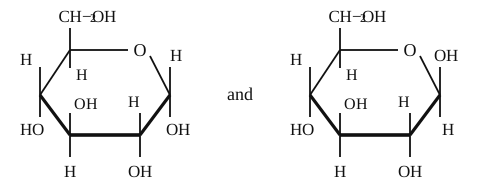
are two anomers of D-(+)-glucose.
Statement II : The open chain forms of D-glucose and D- fructose contain three similar chiral carbons at C3, C4 and C5.
In the light of the above statements, choose the correct answer from the options given below :
नीचे दो कथन दिए गए हैं :
कथन I :
D-(+)-ग्लूकोस के दो ऐनोमर हैं।
कथन II : D-ग्लूकोस तथा D-फ्रक्टोस के खुली शृंखला रूपों में C3, C4 तथा C5 पर तीन समान काइरल कार्बन होते हैं।
उपरोक्त कथनों के आलोक में, नीचे दिए गए विकल्पों में से सही उत्तर चुनिए :
- ABoth Statement I and Statement II are trueकथन I और कथन II दोनों सत्य हैं
- BBoth Statement I and Statement II are falseकथन I और कथन II दोनों असत्य हैं
- CStatement I is true but Statement II is falseकथन I सत्य है परन्तु कथन II असत्य है
- DStatement I is false but Statement II is trueकथन I असत्य है परन्तु कथन II सत्य है
Show answer
Concept: Anomers differ only in configuration at C-1 of the cyclic hemiacetal; glucose (aldose) and fructose (ketose) share the configuration of C-3 to C-5.
- In both Haworth structures: C-2 OH down, C-3 OH up, C-4 OH down, CH2OH (C-6) up → D-glucopyranose pattern.
- They differ only at C-1: first has OH down (α), second has OH up (β). So they are α- and β-D-glucopyranose, the two anomers of D-(+)-glucose → Statement I true.
- Open-chain D-glucose: chiral C-2, C-3, C-4, C-5. D-Fructose (C-2 is C=O): chiral C-3, C-4, C-5, with the same configuration as in glucose (C-3 OH left, C-4 and C-5 OH right in Fischer projection) → Statement II true.
Short trick: Glucose and fructose give the same osazone precisely because C-3 to C-6 are identical.
Answer: (A) Both Statement I and Statement II are true
अवधारणा: ऐनोमर चक्रीय हेमीऐसीटैल के केवल C-1 पर विन्यास में भिन्न होते हैं; ग्लूकोस (ऐल्डोस) तथा फ्रक्टोस (कीटोस) में C-3 से C-5 का विन्यास समान होता है।
- दोनों हॉवर्थ संरचनाओं में: C-2 OH नीचे, C-3 OH ऊपर, C-4 OH नीचे, CH2OH (C-6) ऊपर → D-ग्लूकोपाइरेनोस पैटर्न।
- ये केवल C-1 पर भिन्न हैं: पहली में OH नीचे (α), दूसरी में OH ऊपर (β)। अतः ये α- तथा β-D-ग्लूकोपाइरेनोस हैं, D-(+)-ग्लूकोस के दो ऐनोमर → कथन I सत्य।
- खुली शृंखला D-ग्लूकोस: काइरल C-2, C-3, C-4, C-5। D-फ्रक्टोस (C-2 पर C=O): काइरल C-3, C-4, C-5, जिनका विन्यास ग्लूकोस के समान है (फिशर प्रक्षेप में C-3 OH बाएँ, C-4 तथा C-5 OH दाएँ) → कथन II सत्य।
शॉर्ट ट्रिक: ग्लूकोस तथा फ्रक्टोस इसीलिए समान ओसाज़ोन देते हैं क्योंकि C-3 से C-6 समान हैं।
उत्तर: (A) कथन I और कथन II दोनों सत्य हैं
JEE Main 2026 (April) – Paper 1 (B.E./B.Tech)ChemistryBiomolecules – anomers of glucose; glucose vs fructoseJEE Main 2026 (April) – Paper 1 (B.E./B.Tech) 2026 · 5 Apr Shift 2
Q95.A paper dipped in a dil. H2SO4 solution of ‘X’ upon treatment with SO2 gas turns into green. The compound ‘X’ is :
‘X’ के तनु H2SO4 विलयन में डुबोया गया कागज़ SO2 गैस से उपचारित करने पर हरा हो जाता है। यौगिक ‘X’ है :
- AKI-starchKI-स्टार्च
- BKMnO4
- CPb(CH3COO)2
- DK2Cr2O7
Show answer
Concept: SO2 is a reducing agent; it reduces orange dichromate to green Cr3+.
- K2Cr2O7 + H2SO4 + 3SO2 → K2SO4 + Cr2(SO4)3 (green) + H2O.
- Acidified KMnO4 is decolourised (pink → colourless), not turned green.
- KI-starch paper is used for oxidising gases (turns blue); lead acetate paper detects H2S (turns black).
Short trick: Orange → green = Cr2O72− → Cr3+.
Answer: (D) K2Cr2O7
अवधारणा: SO2 एक अपचायक है; यह नारंगी डाइक्रोमेट को हरे Cr3+ में अपचयित करता है।
- K2Cr2O7 + H2SO4 + 3SO2 → K2SO4 + Cr2(SO4)3 (हरा) + H2O।
- अम्लीकृत KMnO4 रंगहीन हो जाता है (गुलाबी → रंगहीन), हरा नहीं होता।
- KI-स्टार्च पत्र ऑक्सीकारक गैसों के लिए प्रयुक्त होता है (नीला होता है); लेड ऐसीटेट पत्र H2S का परीक्षण करता है (काला होता है)।
शॉर्ट ट्रिक: नारंगी → हरा = Cr2O72− → Cr3+।
उत्तर: (D) K2Cr2O7
JEE Main 2026 (April) – Paper 1 (B.E./B.Tech)Chemistryp-Block – test for SO₂JEE Main 2026 (April) – Paper 1 (B.E./B.Tech) 2026 · 5 Apr Shift 2
Q96.The total number of unpaired electrons present in the d3, d4 (low spin) d5 (high spin), d6 (high spin) and d7 (low spin) octahedral complex systems is __________.
d3, d4 (निम्न चक्रण) d5 (उच्च चक्रण), d6 (उच्च चक्रण) तथा d7 (निम्न चक्रण) अष्टफलकीय संकुल निकायों में उपस्थित अयुग्मित इलेक्ट्रॉनों की कुल संख्या __________ है।
Show answer
Concept: Octahedral field: low spin fills t2g first (Δo > P); high spin spreads electrons over t2g and eg (Δo < P).
- d3: t2g3 → 3 unpaired.
- d4 (low spin): t2g4eg0 → 2 unpaired.
- d5 (high spin): t2g3eg2 → 5 unpaired.
- d6 (high spin): t2g4eg2 → 4 unpaired.
- d7 (low spin): t2g6eg1 → 1 unpaired.
- Total = 3 + 2 + 5 + 4 + 1 = 15.
Answer: 15
अवधारणा: अष्टफलकीय क्षेत्र: निम्न चक्रण में पहले t2g भरता है (Δo > P); उच्च चक्रण में इलेक्ट्रॉन t2g तथा eg में फैल जाते हैं (Δo < P)।
- d3: t2g3 → 3 अयुग्मित।
- d4 (निम्न चक्रण): t2g4eg0 → 2 अयुग्मित।
- d5 (उच्च चक्रण): t2g3eg2 → 5 अयुग्मित।
- d6 (उच्च चक्रण): t2g4eg2 → 4 अयुग्मित।
- d7 (निम्न चक्रण): t2g6eg1 → 1 अयुग्मित।
- कुल = 3 + 2 + 5 + 4 + 1 = 15।
उत्तर: 15
JEE Main 2026 (April) – Paper 1 (B.E./B.Tech)ChemistryCoordination Compounds – CFT and unpaired electronsJEE Main 2026 (April) – Paper 1 (B.E./B.Tech) 2026 · 5 Apr Shift 2
Q97.RMgI when treated with ice cold water liberated a gas which occupied 1.4 dm3/g at STP. The gas produced is further reacted with iodine in presence of HIO3 to give compound (X). Compound (X) in presence of Na and dry ether produced compound (Y). Molar mass of compound (Y) is __________ g mol−1. (Nearest integer)
RMgI को बर्फ़ीले ठंडे जल से उपचारित करने पर एक गैस मुक्त हुई जिसने STP पर 1.4 dm3/g आयतन घेरा। उत्पन्न गैस की आगे HIO3 की उपस्थिति में आयोडीन से अभिक्रिया कराने पर यौगिक (X) प्राप्त होता है। यौगिक (X), Na तथा शुष्क ईथर की उपस्थिति में यौगिक (Y) देता है। यौगिक (Y) का मोलर द्रव्यमान __________ g mol−1 है। (निकटतम पूर्णांक)
Show answer
Concept: RMgX + H2O → RH (alkane); iodination of alkane needs HIO3 to remove HI; Wurtz reaction doubles the alkyl group.
- 1 g of gas occupies 1.4 dm3 at STP → molar mass = g mol−1 → gas is CH4 (R = CH3).
- CH4 + I2 ⇌ CH3I + HI; HIO3 oxidises HI (5HI + HIO3 → 3I2 + 3H2O) and drives the reaction → X = CH3I.
- Wurtz: 2CH3I + 2Na → CH3–CH3 + 2NaI → Y = ethane.
- Molar mass of C2H6 = 2(12) + 6(1) = 30 g mol−1.
Answer: 30
अवधारणा: RMgX + H2O → RH (ऐल्केन); ऐल्केन के आयोडीनन में HI हटाने हेतु HIO3 आवश्यक है; वुर्ट्ज़ अभिक्रिया ऐल्किल समूह को दोगुना करती है।
- 1 g गैस STP पर 1.4 dm3 घेरती है → मोलर द्रव्यमान = g mol−1 → गैस CH4 है (R = CH3)।
- CH4 + I2 ⇌ CH3I + HI; HIO3, HI का ऑक्सीकरण करता है (5HI + HIO3 → 3I2 + 3H2O) तथा अभिक्रिया को आगे बढ़ाता है → X = CH3I।
- वुर्ट्ज़: 2CH3I + 2Na → CH3–CH3 + 2NaI → Y = एथेन।
- C2H6 का मोलर द्रव्यमान = 2(12) + 6(1) = 30 g mol−1।
उत्तर: 30
JEE Main 2026 (April) – Paper 1 (B.E./B.Tech)ChemistryHaloalkanes – Grignard reagent and Wurtz reactionJEE Main 2026 (April) – Paper 1 (B.E./B.Tech) 2026 · 5 Apr Shift 2
Q98.20 g hemoglobin in a 1 L aqueous solution (A) at 300 K is separated from pure water by semi permeable membrane. At equilibrium the height of solution in a tube dipped in a solution (A) is found to be 80.0 mm higher than the tube dipped in water.
The molar mass of hemoglobin is __________ kg mol−1. (Nearest integer)
(Given : g = 10 m s−2, R = 8.3 kPa dm3 K−1mol−1, density of solution = 1000 kg m−3)
300 K पर 1 L जलीय विलयन (A) में 20 g हीमोग्लोबिन को अर्धपारगम्य झिल्ली द्वारा शुद्ध जल से पृथक किया गया है। साम्य पर विलयन (A) में डूबी नली में विलयन की ऊँचाई, जल में डूबी नली की तुलना में 80.0 mm अधिक पाई गई।
हीमोग्लोबिन का मोलर द्रव्यमान __________ kg mol−1 है। (निकटतम पूर्णांक)
(दिया है : g = 10 m s−2, R = 8.3 kPa dm3 K−1mol−1, विलयन का घनत्व = 1000 kg m−3)
Show answer
Concept: At osmotic equilibrium the hydrostatic pressure of the extra column equals the osmotic pressure: π = hρg = .
- π = hρg = 0.080 m × 1000 kg m−3 × 10 m s−2 = 800 Pa = 0.8 kPa.
- g mol−1 (R in kPa dm3, V = 1 dm3).
- M = 62250 g mol−1 = 62.25 kg mol−1 ≈ 62 kg mol−1.
Answer: 62
अवधारणा: परासरण साम्य पर अतिरिक्त स्तंभ का द्रवस्थैतिक दाब परासरण दाब के बराबर होता है: π = hρg = ।
- π = hρg = 0.080 m × 1000 kg m−3 × 10 m s−2 = 800 Pa = 0.8 kPa।
- g mol−1 (R, kPa dm3 में; V = 1 dm3)।
- M = 62250 g mol−1 = 62.25 kg mol−1 ≈ 62 kg mol−1।
उत्तर: 62
JEE Main 2026 (April) – Paper 1 (B.E./B.Tech)ChemistrySolutions – osmotic pressure and molar massJEE Main 2026 (April) – Paper 1 (B.E./B.Tech) 2026 · 5 Apr Shift 2
Q99.At 298 K, the molar conductivity of x% (w/w) MX solution (aqueous) is 123.5 S cm2 mol−1. The conductance of same solution is 1.9 × 10⁻³ S. The value of x is __________ × 10−2.
(Given : cell constant = 1.3 cm−1; molar mass of MX is 75 g mol−1, density of aqueous solution of MX at 298 K is 1.0 g mL−1)
298 K पर x% (w/w) MX विलयन (जलीय) की मोलर चालकता 123.5 S cm2 mol−1 है। उसी विलयन का चालकत्व 1.9 × 10⁻³ S है। x का मान __________ × 10−2 है।
(दिया है : सेल स्थिरांक = 1.3 cm−1; MX का मोलर द्रव्यमान 75 g mol−1 है, 298 K पर MX के जलीय विलयन का घनत्व 1.0 g mL−1 है)
Show answer
Concept: κ = G × G*; Λm = (C in mol L−1); then convert molarity to % (w/w) using density.
- κ = 1.9 × 10−3 S × 1.3 cm−1 = 2.47 × 10⁻³ S cm−1.
- mol L−1.
- 1 L solution = 1000 g (density 1.0 g mL−1) contains 0.02 × 75 = 1.5 g MX.
- % (w/w) = .
Answer: 15
अवधारणा: κ = G × G*; Λm = (C, mol L−1 में); फिर घनत्व की सहायता से मोलरता को % (w/w) में बदलिए।
- κ = 1.9 × 10−3 S × 1.3 cm−1 = 2.47 × 10⁻³ S cm−1।
- mol L−1।
- 1 L विलयन = 1000 g (घनत्व 1.0 g mL−1) में 0.02 × 75 = 1.5 g MX है।
- % (w/w) = ।
उत्तर: 15
JEE Main 2026 (April) – Paper 1 (B.E./B.Tech)ChemistryElectrochemistry – conductance and molar conductivityJEE Main 2026 (April) – Paper 1 (B.E./B.Tech) 2026 · 5 Apr Shift 2
Q100.For a reaction A → P at T K, the half life (t½) is plotted as a function of initial concentration [A]0 of A as given below.
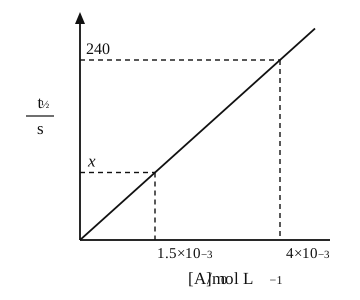
The value of x in the given figure is __________ s (Nearest integer)
T K पर अभिक्रिया A → P के लिए अर्धायु (t½) को A की प्रारम्भिक सांद्रता [A]0 के फलन के रूप में नीचे दिए अनुसार आलेखित किया गया है।
दिए गए चित्र में x का मान __________ s है (निकटतम पूर्णांक)
Show answer
Concept: A straight line through the origin means t½ ∝ [A]0, i.e. a zero-order reaction: t½ = .
- From the graph: t½ = 240 s at [A]0 = 4 × 10⁻³ mol L−1.
- Since t½ ∝ [A]0: s.
- (Check: k = mol L−1 s−1; s.)
Answer: 90
अवधारणा: मूलबिंदु से गुजरती सीधी रेखा का अर्थ है t½ ∝ [A]0, अर्थात् शून्य कोटि अभिक्रिया: t½ = ।
- आलेख से: [A]0 = 4 × 10⁻³ mol L−1 पर t½ = 240 s।
- चूँकि t½ ∝ [A]0: s।
- (जाँच: k = mol L−1 s−1; s।)
उत्तर: 90
JEE Main 2026 (April) – Paper 1 (B.E./B.Tech)ChemistryChemical Kinetics – zero order half-lifeJEE Main 2026 (April) – Paper 1 (B.E./B.Tech) 2026 · 5 Apr Shift 2

