Q81.An object of uniform density rolls up the curved path with the initial velocity
as shown in the figure. If the maximum height attained by an object is
(
= acceleration due to gravity), the object is a ________.
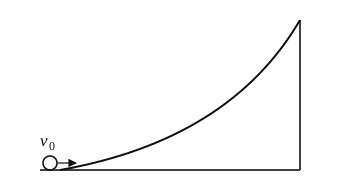
एकसमान घनत्व की एक वस्तु चित्र में दर्शाए अनुसार प्रारम्भिक वेग
से वक्र पथ पर ऊपर की ओर लुढ़कती है। यदि वस्तु द्वारा प्राप्त अधिकतम ऊँचाई
(
= गुरुत्वीय त्वरण) है, तो वस्तु एक ________ है।
- Asolid cylinderठोस बेलन
- Bringवलय
- Cdiscचकती
- Dsolid sphereठोस गोला
Show answer
Concept: Rolling without slipping all the way up: total KE becomes .
- .
- ⇒ .
- is a solid sphere. (Ring: 1 → ; disc / solid cylinder: → .)
Short trick: , and is the solid-sphere factor.
Answer: (D) solid sphere
अवधारणा: पूरे रास्ते बिना फिसले लुढ़कने पर कुल गतिज ऊर्जा , में बदल जाती है।
- ।
- ⇒ ।
- ठोस गोले का होता है। (वलय: 1 → ; चकती / ठोस बेलन: → ।)
शॉर्ट ट्रिक: , और ठोस गोले का गुणक है।
उत्तर: (D) ठोस गोला
JEE Main 2026 (April) – Paper 1 (B.E./B.Tech)PhysicsRotational Motion – rolling up a curveJEE Main 2026 (April) – Paper 1 (B.E./B.Tech) 2026 · 5 Apr Shift 2
Q82.A body of mass is taken from the surface of earth to a height equal to twice the radius of earth (). The increase in potential energy will be ________.
( is acceleration due to gravity at the surface of earth)
द्रव्यमान की एक वस्तु को पृथ्वी की सतह से पृथ्वी की त्रिज्या () के दोगुने के बराबर ऊँचाई तक ले जाया जाता है। स्थितिज ऊर्जा में वृद्धि ________ होगी।
( पृथ्वी की सतह पर गुरुत्वीय त्वरण है)
- A
- B
- C
- D
Show answer
Concept: , using .
- .
- .
Short trick: for ; ⇒ .
Answer: (D)
अवधारणा: , जहाँ ।
- ।
- ।
शॉर्ट ट्रिक: के लिए ; ⇒ ।
उत्तर: (D)
JEE Main 2026 (April) – Paper 1 (B.E./B.Tech)PhysicsGravitation – potential energyJEE Main 2026 (April) – Paper 1 (B.E./B.Tech) 2026 · 5 Apr Shift 2
Q83.Eight mercury drops, each of radius , coalesce to form a bigger drop. The surface energy released in this process is ________. ( is the surface tension of mercury).
पारे की आठ बूँदें, जिनमें से प्रत्येक की त्रिज्या है, मिलकर एक बड़ी बूँद बनाती हैं। इस प्रक्रम में मुक्त पृष्ठ ऊर्जा ________ है। ( पारे का पृष्ठ तनाव है)।
- A
- B
- C
- D
Show answer
Concept: Volume is conserved; energy released (decrease in surface area).
- ⇒ .
- Initial area ; final area .
- Energy released .
Short trick: .
Answer: (B)
अवधारणा: आयतन संरक्षित रहता है; मुक्त ऊर्जा (पृष्ठ क्षेत्रफल में कमी)।
- ⇒ ।
- प्रारम्भिक क्षेत्रफल ; अन्तिम क्षेत्रफल ।
- मुक्त ऊर्जा ।
शॉर्ट ट्रिक: ।
उत्तर: (B)
JEE Main 2026 (April) – Paper 1 (B.E./B.Tech)PhysicsMechanical Properties of Fluids – surface energyJEE Main 2026 (April) – Paper 1 (B.E./B.Tech) 2026 · 5 Apr Shift 2
Q84.An ideal gas at pressure and temperature is expanding such that = constant. The coefficient of volume expansion of the gas is ________.
दाब तथा ताप पर एक आदर्श गैस इस प्रकार प्रसारित हो रही है कि = नियतांक। गैस का आयतन प्रसार गुणांक ________ है।
- A
- B
- C
- D
Show answer
Concept: ; combine with the given process.
- , so .
- ⇒ .
- .
Short trick: If then ; here .
Answer: (C)
अवधारणा: ; को दिए गए प्रक्रम से जोड़िए।
- , अतः ।
- ⇒ ।
- ।
शॉर्ट ट्रिक: यदि तो ; यहाँ ।
उत्तर: (C)
JEE Main 2026 (April) – Paper 1 (B.E./B.Tech)PhysicsThermal Properties – volume expansion of gasJEE Main 2026 (April) – Paper 1 (B.E./B.Tech) 2026 · 5 Apr Shift 2
Q85.Match List - I with List - II.
| List - I | | List - II |
|---|
| A. | | I. | Periodic with time period but not simple harmonic motion (SHM) |
| B. | | II. | Periodic with time period but Not SHM |
| C. | | III. | Periodic with time period and SHM |
| D. | | IV. | Non-periodic |
Choose the
correct answer from the options given below :
सूची-I का सूची-II से मिलान कीजिए।
| सूची - I | | सूची - II |
|---|
| A. | | I. | आवर्तकाल के साथ आवर्ती, परन्तु सरल आवर्त गति (SHM) नहीं |
| B. | | II. | आवर्तकाल के साथ आवर्ती, परन्तु SHM नहीं |
| C. | | III. | आवर्तकाल के साथ आवर्ती तथा SHM |
| D. | | IV. | अनावर्ती |
नीचे दिए गए विकल्पों में से
सही उत्तर चुनिए :
- AA-III, B-I, C-IV, D-II
- BA-II, B-I, C-III, D-IV
- CA-III, B-II, C-IV, D-I
- DA-II, B-I, C-IV, D-III
Show answer
Concept: A motion is SHM only if it is a single sinusoid (plus a constant) about a mean position; a sum of sinusoids is periodic only if the ratio of their angular frequencies is rational.
- A: — a single sinusoid of angular frequency about mean ⇒ SHM with → III.
- B: — two frequencies ⇒ not SHM; period → I.
- C: frequencies and have irrational ratio ⇒ non-periodic → IV.
- D: frequencies and ⇒ periodic with , not SHM → II.
- So A-III, B-I, C-IV, D-II. (B) and (D) call non-SHM; (C) gives D a period — all wrong.
Short trick: Spot C first (π inside ⇒ non-periodic → IV) and A ( is SHM about → III): only (A) has both.
Answer: (A) A-III, B-I, C-IV, D-II
अवधारणा: कोई गति SHM तभी है जब वह माध्य स्थिति के परितः एक ही ज्यावक्रीय फलन (+ नियतांक) हो; ज्यावक्रों का योग तभी आवर्ती होता है जब उनकी कोणीय आवृत्तियों का अनुपात परिमेय हो।
- A: — माध्य के परितः कोणीय आवृत्ति का एक ज्यावक्र ⇒ SHM, → III।
- B: — दो आवृत्तियाँ ⇒ SHM नहीं; आवर्तकाल → I।
- C: आवृत्तियाँ तथा का अनुपात अपरिमेय ⇒ अनावर्ती → IV।
- D: आवृत्तियाँ तथा ⇒ आवर्ती, , SHM नहीं → II।
- अतः A-III, B-I, C-IV, D-II। (B) तथा (D) में को SHM नहीं माना गया; (C) में D का आवर्तकाल दिया गया — सभी गलत।
शॉर्ट ट्रिक: पहले C पहचानिए (π अन्दर ⇒ अनावर्ती → IV) तथा A (, के परितः SHM → III): दोनों केवल (A) में हैं।
उत्तर: (A) A-III, B-I, C-IV, D-II
JEE Main 2026 (April) – Paper 1 (B.E./B.Tech)PhysicsOscillations – periodic motion & SHMJEE Main 2026 (April) – Paper 1 (B.E./B.Tech) 2026 · 5 Apr Shift 2
Q86.A metal rod of length rotates about one end at origin with a uniform angular velocity . The magnetic field radially falls off as ; being a positive constant. The emf induced (neglecting the centripetal force on electrons in the rod) is :
लम्बाई की एक धातु की छड़ मूल बिन्दु पर स्थित अपने एक सिरे के परितः एकसमान कोणीय वेग से घूमती है। चुम्बकीय क्षेत्र त्रिज्यतः के अनुसार घटता है; एक धनात्मक नियतांक है। प्रेरित विद्युत वाहक बल (छड़ में इलेक्ट्रॉनों पर अभिकेन्द्र बल की उपेक्षा करते हुए) है :
- A
- B
- C
- D
Show answer
Concept: An element at distance moves with speed , so ; integrate from 0 to .
- .
- By parts: .
- .
- Check: must give ; (A) does, (B) blows up, (C) and (D) do not reduce correctly.
Short trick: At the emf must be zero — only (A) gives .
Answer: (A)
अवधारणा: दूरी पर अल्पांश की चाल है, अतः ; 0 से तक समाकलन कीजिए।
- ।
- खण्डशः समाकलन: ।
- ।
- जाँच: पर आना चाहिए; (A) से आता है, (B) अनन्त हो जाता है, (C) तथा (D) सही रूप में नहीं घटते।
शॉर्ट ट्रिक: पर विद्युत वाहक बल शून्य होना चाहिए — केवल (A) में आता है।
उत्तर: (A)
JEE Main 2026 (April) – Paper 1 (B.E./B.Tech)PhysicsElectromagnetic Induction – motional emf in rotating rodJEE Main 2026 (April) – Paper 1 (B.E./B.Tech) 2026 · 5 Apr Shift 2
Q87.Under steady state condition the potential difference across the capacitor in the circuit is ________ V.
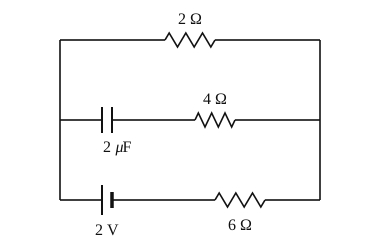
स्थायी अवस्था में परिपथ में संधारित्र के सिरों पर विभवान्तर ________ V है।
- A0.5
- B1.5
- C0
- D2
Show answer
Concept: In steady state no current flows through the capacitor branch, so the 4 Ω carries no current and the capacitor has the full potential difference between the two vertical (junction) wires.
- Current flows only in the loop: 2 V cell → 6 Ω → 2 Ω. A.
- P.d. between the junctions = p.d. across 2 Ω V.
- No drop across 4 Ω ⇒ V.
Short trick: Remove the capacitor branch; the 2 Ω and 6 Ω form a divider: V.
Answer: (A) 0.5
अवधारणा: स्थायी अवस्था में संधारित्र वाली शाखा में धारा नहीं बहती, अतः 4 Ω में धारा शून्य है और संधारित्र पर दोनों ऊर्ध्वाधर (संधि) तारों के बीच का पूरा विभवान्तर होता है।
- धारा केवल लूप में बहती है: 2 V सेल → 6 Ω → 2 Ω। A।
- संधियों के बीच विभवान्तर = 2 Ω पर विभवान्तर V।
- 4 Ω पर कोई विभव पतन नहीं ⇒ V।
शॉर्ट ट्रिक: संधारित्र शाखा हटा दीजिए; 2 Ω तथा 6 Ω विभव विभाजक बनाते हैं: V।
उत्तर: (A) 0.5
JEE Main 2026 (April) – Paper 1 (B.E./B.Tech)PhysicsCapacitance – RC circuit in steady stateJEE Main 2026 (April) – Paper 1 (B.E./B.Tech) 2026 · 5 Apr Shift 2
Q88.A particle of charge and mass is projected from origin with an initial velocity . There exists a uniform magnetic field and a space varying electric field within the region . After travelling a distance such that -coordinate has changed from to , the change in the kinetic energy is ________.
आवेश तथा द्रव्यमान का एक कण मूल बिन्दु से प्रारम्भिक वेग से प्रक्षेपित किया जाता है। क्षेत्र में एकसमान चुम्बकीय क्षेत्र तथा स्थान के साथ परिवर्ती विद्युत क्षेत्र विद्यमान है। इतनी दूरी तय करने के बाद कि -निर्देशांक से तक बदल जाए, गतिज ऊर्जा में परिवर्तन ________ है।
- A
- B
- C
- D
Show answer
Concept: The magnetic force is always perpendicular to velocity and does no work; only the electric field changes KE (work-energy theorem).
- .
- .
- (B) and (D) contain , but the magnetic field cannot change KE; (C) has the wrong sign (it does not vanish at ).
Short trick: Ignore completely; (potential drop) .
Answer: (A)
अवधारणा: चुम्बकीय बल सदैव वेग के लम्बवत् होता है और कोई कार्य नहीं करता; केवल विद्युत क्षेत्र गतिज ऊर्जा बदलता है (कार्य-ऊर्जा प्रमेय)।
- ।
- ।
- (B) तथा (D) में है, परन्तु चुम्बकीय क्षेत्र गतिज ऊर्जा नहीं बदल सकता; (C) में चिह्न गलत है ( पर यह शून्य नहीं होता)।
शॉर्ट ट्रिक: को पूरी तरह छोड़ दीजिए; (विभव पतन) ।
उत्तर: (A)
JEE Main 2026 (April) – Paper 1 (B.E./B.Tech)PhysicsMoving Charges – work-energy in E and B fieldsJEE Main 2026 (April) – Paper 1 (B.E./B.Tech) 2026 · 5 Apr Shift 2
Q89.Given below are two statements : one is labelled as Assertion (A) and the other is labelled as Reason (R).
Assertion (A) : The electromagnetic wave exerts pressure on the surface on which they are allowed to fall.
Reason (R) : There is no mass associated with the electromagnetic waves.
In the light of the above statements, choose the correct answer from the options given below :
नीचे दो कथन दिए गए हैं : एक को अभिकथन (A) तथा दूसरे को कारण (R) के रूप में चिह्नित किया गया है।
अभिकथन (A) : विद्युत चुम्बकीय तरंगें जिस पृष्ठ पर आपतित होती हैं, उस पर दाब आरोपित करती हैं।
कारण (R) : विद्युत चुम्बकीय तरंगों के साथ कोई द्रव्यमान सम्बद्ध नहीं होता।
उपर्युक्त कथनों के आलोक में, नीचे दिए गए विकल्पों में से सही उत्तर चुनिए :
- ABoth (A) and (R) are true and (R) is the correct explanation of (A)(A) तथा (R) दोनों सत्य हैं और (R), (A) की सही व्याख्या है
- BBoth (A) and (R) are true but (R) is not the correct explanation of (A)(A) तथा (R) दोनों सत्य हैं परन्तु (R), (A) की सही व्याख्या नहीं है
- C(A) is true but (R) is false(A) सत्य है परन्तु (R) असत्य है
- D(A) is false but (R) is true(A) असत्य है परन्तु (R) सत्य है
Show answer
Concept: EM waves carry energy and momentum ; transfer of this momentum to a surface gives radiation pressure.
- (A) is true: intensity falling normally on an absorbing surface exerts pressure (and on a perfect reflector).
- (R) is true: EM waves (photons) have zero rest mass.
- But the pressure arises from the momentum carried by the wave, not from the absence of mass — so (R) does not explain (A). Hence option (A) is wrong (wrong explanation), and options (C), (D) are wrong because both statements are true.
Short trick: Pressure ⇐ momentum; "no mass" is a true fact but not the cause.
Answer: (B) Both (A) and (R) are true but (R) is not the correct explanation of (A)
अवधारणा: विद्युत चुम्बकीय तरंगें ऊर्जा तथा संवेग ले जाती हैं; पृष्ठ को यह संवेग स्थानान्तरित होने से विकिरण दाब उत्पन्न होता है।
- (A) सत्य है: अवशोषक पृष्ठ पर लम्बवत् आपतित तीव्रता , दाब लगाती है (पूर्ण परावर्तक पर )।
- (R) सत्य है: विद्युत चुम्बकीय तरंगों (फोटॉन) का विराम द्रव्यमान शून्य होता है।
- परन्तु दाब तरंग द्वारा ले जाए गए संवेग के कारण होता है, द्रव्यमान न होने के कारण नहीं — अतः (R), (A) की व्याख्या नहीं करता। इसलिए (A) विकल्प गलत (गलत व्याख्या), तथा (C), (D) गलत क्योंकि दोनों कथन सत्य हैं।
शॉर्ट ट्रिक: दाब ⇐ संवेग; "कोई द्रव्यमान नहीं" सत्य तथ्य है, परन्तु कारण नहीं।
उत्तर: (B) (A) तथा (R) दोनों सत्य हैं परन्तु (R), (A) की सही व्याख्या नहीं है
JEE Main 2026 (April) – Paper 1 (B.E./B.Tech)PhysicsElectromagnetic Waves – radiation pressureJEE Main 2026 (April) – Paper 1 (B.E./B.Tech) 2026 · 5 Apr Shift 2
Q90.A thin convex lens and a thin concave lens are kept in contact and are co-axial. Which of the following statements is correct for this combination of two lenses ?
एक पतला उत्तल लेंस तथा एक पतला अवतल लेंस सम्पर्क में तथा समाक्षीय रखे गए हैं। दो लेंसों के इस संयोजन के लिए निम्नलिखित में से कौन-सा कथन सही है ?
- Abehaves as concave lens if अवतल लेंस की भाँति व्यवहार करता है यदि
- Bbehaves as concave lens if अवतल लेंस की भाँति व्यवहार करता है यदि
- Cbehaves as convex lens if उत्तल लेंस की भाँति व्यवहार करता है यदि
- DFocal length of the lens system will change if the positions of two lenses are interchangedयदि दोनों लेंसों की स्थितियाँ आपस में बदल दी जाएँ तो लेंस निकाय की फोकस दूरी बदल जाएगी
Show answer
Concept: For thin lenses in contact, , i.e. .
- If , then ⇒ ⇒ the combination is diverging (concave). (A) is correct.
- (B): gives ⇒ convex, not concave — wrong.
- (C): same condition as (A) gives a concave lens, not convex — wrong.
- (D): is symmetric, so interchanging the thin lenses in contact does not change — wrong.
Short trick: The lens with the shorter focal length (stronger power) wins.
Answer: (A) behaves as concave lens if
अवधारणा: सम्पर्क में रखे पतले लेंसों के लिए , अर्थात् ।
- यदि , तो ⇒ ⇒ संयोजन अपसारी (अवतल) है। (A) सही है।
- (B): से ⇒ उत्तल, अवतल नहीं — गलत।
- (C): (A) वाली ही शर्त से अवतल लेंस बनता है, उत्तल नहीं — गलत।
- (D): सममित है, अतः सम्पर्क में रखे पतले लेंसों को आपस में बदलने से नहीं बदलती — गलत।
शॉर्ट ट्रिक: छोटी फोकस दूरी (अधिक क्षमता) वाला लेंस "जीतता" है।
उत्तर: (A) अवतल लेंस की भाँति व्यवहार करता है यदि
JEE Main 2026 (April) – Paper 1 (B.E./B.Tech)PhysicsRay Optics – lenses in contactJEE Main 2026 (April) – Paper 1 (B.E./B.Tech) 2026 · 5 Apr Shift 2
Q91.An object AB is placed 15 cm on the left of a convex lens P of focal length 10 cm. Another convex lens Q is now placed 15 cm right of lens P. If the focal length of lens Q is 15 cm, the final image is ________.
एक वस्तु AB, 10 cm फोकस दूरी वाले एक उत्तल लेंस P के बाईं ओर 15 cm पर रखी है। अब एक अन्य उत्तल लेंस Q को लेंस P के 15 cm दाईं ओर रखा जाता है। यदि लेंस Q की फोकस दूरी 15 cm है, तो अन्तिम प्रतिबिम्ब ________ है।
- Avirtual, formed at 7.5 cm right of lens Q, with a size bigger than that of ABआभासी, लेंस Q के 7.5 cm दाईं ओर बनता है, आकार AB से बड़ा
- Breal, formed at 7.5 cm right of lens Q, with a size same as that of ABवास्तविक, लेंस Q के 7.5 cm दाईं ओर बनता है, आकार AB के समान
- Cformed at infinity.अनन्त पर बनता है।
- Dreal, formed at 7 cm right of lens Q, with a size smaller than that of ABवास्तविक, लेंस Q के 7 cm दाईं ओर बनता है, आकार AB से छोटा
Show answer
Concept: Apply lens by lens; the image of acts as the object for ; total magnification .
- Lens : , ⇒ ⇒ cm; .
- This image lies 30 − 15 = 15 cm to the right of ⇒ virtual object for : cm.
- Lens : ⇒ cm (real, right of ); .
- ⇒ real, inverted, same size as . (A) says virtual, (C) says infinity, (D) has wrong distance and size.
Short trick: Converging rays meeting a convex lens at its focal distance beyond it: cm, , cancelling .
Answer: (B) real, formed at 7.5 cm right of lens Q, with a size same as that of AB
अवधारणा: प्रत्येक लेंस पर क्रमशः लगाइए; का प्रतिबिम्ब के लिए वस्तु है; कुल आवर्धन ।
- लेंस : , ⇒ ⇒ cm; ।
- यह प्रतिबिम्ब के 30 − 15 = 15 cm दाईं ओर है ⇒ के लिए आभासी वस्तु: cm।
- लेंस : ⇒ cm ( के दाईं ओर, वास्तविक); ।
- ⇒ वास्तविक, उल्टा, के समान आकार। (A) आभासी कहता है, (C) अनन्त, (D) में दूरी व आकार गलत हैं।
शॉर्ट ट्रिक: उत्तल लेंस पर अभिसारी किरणें जो उसके आगे फोकस दूरी पर मिलतीं: cm, , जो को निरस्त करता है।
उत्तर: (B) वास्तविक, लेंस Q के 7.5 cm दाईं ओर बनता है, आकार AB के समान
JEE Main 2026 (April) – Paper 1 (B.E./B.Tech)PhysicsRay Optics – two-lens systemJEE Main 2026 (April) – Paper 1 (B.E./B.Tech) 2026 · 5 Apr Shift 2
Q92.The maximum intensity in a Young's double slit experiment is . Distance between the slits () is , where is the wavelength of light used. The intensity of the fringe, exactly opposite to one of the slits on the screen, placed at is ________.
यंग के द्विझिरी प्रयोग में अधिकतम तीव्रता है। झिरियों के बीच की दूरी (), है, जहाँ प्रयुक्त प्रकाश की तरंगदैर्ध्य है। पर रखे पर्दे पर किसी एक झिरी के ठीक सामने स्थित फ्रिंज की तीव्रता ________ है।
- A
- B
- C
- D
Show answer
Concept: Path difference ; with .
- Point opposite one slit: .
- .
- .
- .
Short trick: ⇒ quarter-wave ⇒ half intensity.
Answer: (B)
अवधारणा: पथान्तर ; , जहाँ ।
- एक झिरी के सामने का बिन्दु: ।
- ।
- ।
- ।
शॉर्ट ट्रिक: ⇒ चौथाई तरंग ⇒ आधी तीव्रता।
उत्तर: (B)
JEE Main 2026 (April) – Paper 1 (B.E./B.Tech)PhysicsWave Optics – Young's double slitJEE Main 2026 (April) – Paper 1 (B.E./B.Tech) 2026 · 5 Apr Shift 2
Q93.An electron is travelling with a velocity in free space and when it enters a medium, its velocity is reduced by 20%. The de Broglie wavelength of electron in the medium is , where is its de Broglie wavelength in free space. The value of is ________.
एक इलेक्ट्रॉन मुक्त आकाश में वेग से गतिमान है तथा किसी माध्यम में प्रवेश करने पर उसका वेग 20% कम हो जाता है। माध्यम में इलेक्ट्रॉन की दे ब्रॉग्ली तरंगदैर्ध्य है, जहाँ मुक्त आकाश में उसकी दे ब्रॉग्ली तरंगदैर्ध्य है। का मान ________ है।
- A1.20
- B1.0
- C1.25
- D0.75
Show answer
Concept: , so .
- New velocity .
- .
- .
Short trick: 20% less speed ⇒ wavelength × 5/4.
Answer: (C) 1.25
अवधारणा: , अतः ।
- नया वेग ।
- ।
- ।
शॉर्ट ट्रिक: चाल 20% कम ⇒ तरंगदैर्ध्य × 5/4।
उत्तर: (C) 1.25
JEE Main 2026 (April) – Paper 1 (B.E./B.Tech)PhysicsDual Nature – de Broglie wavelengthJEE Main 2026 (April) – Paper 1 (B.E./B.Tech) 2026 · 5 Apr Shift 2
Q94.Assuming the experimental mass of as 12 u, the mass defect of atom is ________ MeV/c2.
(Mass of proton = 1.00727 u, mass of neutron = 1.00866 u, 1 u = 931.5 MeV/c2 and c is the speed of the light in vacuum).
का प्रायोगिक द्रव्यमान 12 u मानते हुए, परमाणु की द्रव्यमान क्षति ________ MeV/c2 है।
(प्रोटॉन का द्रव्यमान = 1.00727 u, न्यूट्रॉन का द्रव्यमान = 1.00866 u, 1 u = 931.5 MeV/c2 तथा c निर्वात में प्रकाश की चाल है)।
- A127.5
- B89.03
- C272.0
- D92.0
Show answer
Concept: , converted with 1 u = 931.5 MeV/c2.
- u; u.
- u.
- MeV/c2.
Short trick: ⇒ excess u ≈ 89 MeV.
Answer: (B) 89.03
अवधारणा: , तथा 1 u = 931.5 MeV/c2 से रूपान्तरण।
- u; u।
- u।
- MeV/c2।
शॉर्ट ट्रिक: ⇒ आधिक्य u ≈ 89 MeV।
उत्तर: (B) 89.03
JEE Main 2026 (April) – Paper 1 (B.E./B.Tech)PhysicsNuclei – mass defectJEE Main 2026 (April) – Paper 1 (B.E./B.Tech) 2026 · 5 Apr Shift 2
Q95.In a semiconductor p-n diode, the doping concentrations on p-side and n-side are 1015 atoms/cm3 and 1018 atoms/cm3, respectively. Which one of the following statements is true ?
एक अर्धचालक p-n डायोड में p-पक्ष तथा n-पक्ष पर अपमिश्रण (doping) सान्द्रताएँ क्रमशः 1015 परमाणु/cm3 तथा 1018 परमाणु/cm3 हैं। निम्नलिखित में से कौन-सा एक कथन सत्य है ?
- AWidths of depletion region on either side of the interface are equalअन्तरापृष्ठ के दोनों ओर अवक्षय क्षेत्र की चौड़ाइयाँ बराबर होती हैं
- BThe depletion region width is more on p-side compared to that in n-siden-पक्ष की तुलना में p-पक्ष में अवक्षय क्षेत्र की चौड़ाई अधिक होती है
- CThe depletion region width is more on n-side compared to that in p-sidep-पक्ष की तुलना में n-पक्ष में अवक्षय क्षेत्र की चौड़ाई अधिक होती है
- DNo depletion region forms because of unequal doping concentrations on p and n-sidesp तथा n-पक्षों पर असमान अपमिश्रण सान्द्रताओं के कारण कोई अवक्षय क्षेत्र नहीं बनता
Show answer
Concept: Charge neutrality of the depletion layer: , so the depletion width is inversely proportional to doping.
- .
- So the depletion region extends much more into the lightly doped p-side.
- (A) wrong — widths equal only for equal doping; (C) is the reverse; (D) wrong — a depletion region always forms at a p-n junction.
Short trick: Depletion region "leans" into the lightly doped side.
Answer: (B) The depletion region width is more on p-side compared to that in n-side
अवधारणा: अवक्षय परत की आवेश उदासीनता: , अतः अवक्षय चौड़ाई अपमिश्रण के व्युत्क्रमानुपाती है।
- ।
- अतः अवक्षय क्षेत्र कम अपमिश्रित p-पक्ष में कहीं अधिक फैलता है।
- (A) गलत — चौड़ाइयाँ केवल समान अपमिश्रण पर बराबर होती हैं; (C) उल्टा है; (D) गलत — p-n सन्धि पर अवक्षय क्षेत्र सदैव बनता है।
शॉर्ट ट्रिक: अवक्षय क्षेत्र कम अपमिश्रित पक्ष की ओर "झुकता" है।
उत्तर: (B) n-पक्ष की तुलना में p-पक्ष में अवक्षय क्षेत्र की चौड़ाई अधिक होती है
JEE Main 2026 (April) – Paper 1 (B.E./B.Tech)PhysicsSemiconductors – depletion regionJEE Main 2026 (April) – Paper 1 (B.E./B.Tech) 2026 · 5 Apr Shift 2
Q96.A copper wire of length 3 m is stretched by 3 mm by applying an external force. The volume of the wire is m3. The elastic potential energy stored in the wire in stretched condition would be ________ J.
(Given Young modulus of copper N/m2)
3 m लम्बाई के एक ताँबे के तार को बाह्य बल लगाकर 3 mm खींचा जाता है। तार का आयतन m3 है। खिंची हुई अवस्था में तार में संचित प्रत्यास्थ स्थितिज ऊर्जा ________ J होगी।
(दिया है ताँबे का यंग प्रत्यास्थता गुणांक N/m2)
Show answer
Concept: Energy stored .
- Strain .
- .
- J.
Short trick: J/m3; × m3 = 33 J.
Answer: 33
अवधारणा: संचित ऊर्जा ।
- विकृति ।
- ।
- J।
शॉर्ट ट्रिक: J/m3; × m3 = 33 J।
उत्तर: 33
JEE Main 2026 (April) – Paper 1 (B.E./B.Tech)PhysicsMechanical Properties of Solids – elastic energyJEE Main 2026 (April) – Paper 1 (B.E./B.Tech) 2026 · 5 Apr Shift 2
Q97.The heat extracted out of gram of water initially at 50 °C to cool it down to 0 °C is sufficient to evaporate gram of water also initially at 50 °C. The value of (closest integer) is ________.
(Take latent heat of water 2256 kJ/kg. K, specific heat capacity of water 4200 J/kg. K)
प्रारम्भ में 50 °C पर स्थित ग्राम जल को 0 °C तक ठण्डा करने के लिए निकाली गई ऊष्मा, प्रारम्भ में 50 °C पर ही स्थित ग्राम जल को वाष्पित करने के लिए पर्याप्त है। का मान (निकटतम पूर्णांक) ________ है।
(जल की गुप्त ऊष्मा 2256 kJ/kg. K, जल की विशिष्ट ऊष्मा धारिता 4200 J/kg. K लीजिए)
Show answer
Concept: Heat lost by g (50 °C → 0 °C) = heat to warm g from 50 °C to 100 °C and then vaporise it.
- Heat released J.
- Heat needed per gram J, so total J.
- ⇒ ⇒ .
- Closest integer: .
Short trick: .
Answer: 922
अवधारणा: g द्वारा दी गई ऊष्मा (50 °C → 0 °C) = g को 50 °C से 100 °C तक गर्म करने तथा फिर वाष्पित करने में लगी ऊष्मा।
- दी गई ऊष्मा J।
- प्रति ग्राम आवश्यक ऊष्मा J, अतः कुल J।
- ⇒ ⇒ ।
- निकटतम पूर्णांक: ।
शॉर्ट ट्रिक: ।
उत्तर: 922
JEE Main 2026 (April) – Paper 1 (B.E./B.Tech)PhysicsThermal Properties – calorimetryJEE Main 2026 (April) – Paper 1 (B.E./B.Tech) 2026 · 5 Apr Shift 2
Q98.A series LCR circuit with , H and is connected to a variable frequency a.c. source. The inductive reactance at resonant frequency is ________ Ω.
, H तथा वाला एक श्रेणी LCR परिपथ एक परिवर्ती आवृत्ति a.c. स्रोत से जुड़ा है। अनुनादी आवृत्ति पर प्रेरणिक प्रतिघात ________ Ω है।
Show answer
Concept: At resonance and .
- s2 ⇒ s.
- rad/s.
- (R plays no role).
Short trick: .
Answer: 200
अवधारणा: अनुनाद पर तथा ।
- s2 ⇒ s।
- rad/s।
- (R की कोई भूमिका नहीं)।
शॉर्ट ट्रिक: ।
उत्तर: 200
JEE Main 2026 (April) – Paper 1 (B.E./B.Tech)PhysicsAlternating Current – resonanceJEE Main 2026 (April) – Paper 1 (B.E./B.Tech) 2026 · 5 Apr Shift 2
Q99.When an external resistance of 5 Ω is connected across terminals of a cell, a current of 0.25 A flows through it. When the 5 Ω resistor is replaced by a 2 Ω resistor, a current of 0.5 A flows through it. The internal resistance of the cell is ________ Ω.
जब किसी सेल के टर्मिनलों के बीच 5 Ω का बाह्य प्रतिरोध जोड़ा जाता है, तो उसमें 0.25 A धारा बहती है। जब 5 Ω प्रतिरोधक को 2 Ω प्रतिरोधक से प्रतिस्थापित किया जाता है, तो उसमें 0.5 A धारा बहती है। सेल का आन्तरिक प्रतिरोध ________ Ω है।
Show answer
Concept: is the same in both cases.
- and .
- ⇒ ⇒ .
- (Check: V ✓)
Short trick: .
Answer: 1
अवधारणा: दोनों स्थितियों में समान है।
- तथा ।
- ⇒ ⇒ ।
- (जाँच: V ✓)
शॉर्ट ट्रिक: ।
उत्तर: 1
JEE Main 2026 (April) – Paper 1 (B.E./B.Tech)PhysicsCurrent Electricity – internal resistanceJEE Main 2026 (April) – Paper 1 (B.E./B.Tech) 2026 · 5 Apr Shift 2
Q100.A circular loop of radius 20 cm and resistance 2 Ω is placed in a time varying magnetic field T. At , for the plane of the loop being perpendicular to the magnetic field and, the induced current in the loop at s is A. The value of is ________.
(Take )
20 cm त्रिज्या तथा 2 Ω प्रतिरोध वाला एक वृत्ताकार लूप समय के साथ परिवर्ती चुम्बकीय क्षेत्र T में रखा है। पर लूप का तल चुम्बकीय क्षेत्र के लम्बवत् है, तथा s पर लूप में प्रेरित धारा A है। का मान ________ है।
( लीजिए)
Show answer
Concept: (field perpendicular to the plane), .
- ; at s: T/s.
- m2.
- V.
- A ⇒ .
Short trick: ; , ⇒ .
Answer: 44
अवधारणा: (क्षेत्र तल के लम्बवत्), ।
- ; s पर: T/s।
- m2।
- V।
- A ⇒ ।
शॉर्ट ट्रिक: ; , ⇒ ।
उत्तर: 44
JEE Main 2026 (April) – Paper 1 (B.E./B.Tech)PhysicsElectromagnetic Induction – Faraday's lawJEE Main 2026 (April) – Paper 1 (B.E./B.Tech) 2026 · 5 Apr Shift 2

