Q141.A convex lens is made from glass material having refractive index of 1.4 with same radius of curvature on both sides. The ratio of its focal length and radius of curvature is ______.
एक उत्तल लेंस 1.4 अपवर्तनांक वाले काँच के पदार्थ का बना है तथा इसके दोनों ओर की वक्रता त्रिज्याएँ समान हैं। इसकी फोकस दूरी तथा वक्रता त्रिज्या का अनुपात ______ है।
- A0.5
- B2.5
- C0.8
- D1.25
Show answer
Concept: Lens maker's formula: with , for an equiconvex lens.
- .
- .
Short trick: Equiconvex: . With : .
Answer: (D) 1.25
अवधारणा: लेंस मेकर सूत्र: , समद्विउत्तल लेंस हेतु , ।
- ।
- ।
शॉर्ट ट्रिक: समद्विउत्तल: । पर: ।
उत्तर: (D) 1.25
JEE Main 2026 (April) – Paper 1 (B.E./B.Tech)PhysicsRay Optics – lens maker's formulaJEE Main 2026 (April) – Paper 1 (B.E./B.Tech) 2026 · 4 Apr Shift 2
Q142.An unpolarized light of certain intensity passes through a combination of two polarizers whose transmission axes are at 30° and 90°, respectively, with respect to the horizontal axis. A third polarizer with its transmission axis at 60° with the horizontal axis is placed between the two existing polarizers. The ratio of the output intensities with and without the third polarizer is ______.
किसी तीव्रता का अध्रुवित प्रकाश दो ध्रुवकों (polarizers) के संयोजन से गुजरता है, जिनके पारगमन अक्ष क्षैतिज अक्ष के सापेक्ष क्रमशः 30° तथा 90° पर हैं। क्षैतिज अक्ष से 60° पर पारगमन अक्ष वाला एक तीसरा ध्रुवक दोनों विद्यमान ध्रुवकों के बीच रखा जाता है। तीसरे ध्रुवक के साथ तथा उसके बिना निर्गत तीव्रताओं का अनुपात ______ है।
- A3/4
- B4/3
- C9/4
- D4/9
Show answer
Concept: Unpolarized light halves at the first polarizer; after that each polarizer transmits (Malus' law), being the angle between successive axes.
- Without the third: .
- With the third (30° → 60° → 90°, each step 30°): .
- Ratio .
Short trick: Splitting 60° into two 30° steps changes into ; ratio .
Answer: (C) 9/4
अवधारणा: अध्रुवित प्रकाश पहले ध्रुवक पर आधा रह जाता है; उसके बाद प्रत्येक ध्रुवक पारगमित करता है (मैलस का नियम), जहाँ क्रमागत अक्षों के बीच का कोण है।
- तीसरे ध्रुवक के बिना: ।
- तीसरे के साथ (30° → 60° → 90°, प्रत्येक चरण 30°): ।
- अनुपात ।
शॉर्ट ट्रिक: 60° को दो 30° चरणों में बाँटने से बदलकर हो जाता है; अनुपात ।
उत्तर: (C) 9/4
JEE Main 2026 (April) – Paper 1 (B.E./B.Tech)PhysicsWave Optics – polarization (Malus' law)JEE Main 2026 (April) – Paper 1 (B.E./B.Tech) 2026 · 4 Apr Shift 2
Q143.In Rutherford's alpha-particle scattering experiment, only a few alpha particles rebound back because
A. The size of gold nucleus is very small as compared to the size of gold atom.
B. Alpha particle and gold nucleus have equal charge.
C. The impact parameter is minimum for a few alpha particles.
D. A few alpha particles have very high kinetic energy.
E. Only a few alpha particles undergo head-on collision with the nuclei.
Choose the correct answer from the options given below:
रदरफोर्ड के ऐल्फा-कण प्रकीर्णन प्रयोग में, केवल कुछ ही ऐल्फा कण वापस लौटते हैं, क्योंकि
A. सोने के परमाणु के आकार की तुलना में सोने के नाभिक का आकार बहुत छोटा होता है।
B. ऐल्फा कण तथा सोने के नाभिक पर समान आवेश होता है।
C. कुछ ही ऐल्फा कणों के लिए संघट्ट प्राचल (impact parameter) न्यूनतम होता है।
D. कुछ ऐल्फा कणों की गतिज ऊर्जा बहुत अधिक होती है।
E. केवल कुछ ही ऐल्फा कण नाभिकों से सम्मुख (head-on) संघट्ट करते हैं।
नीचे दिए गए विकल्पों में से सही उत्तर चुनिए:
- AA, B Onlyकेवल A, B
- BB, E Onlyकेवल B, E
- CC, D Onlyकेवल C, D
- DA, C, E Onlyकेवल A, C, E
Show answer
Concept: Large-angle (backward) scattering happens only for nearly head-on approaches, i.e. an impact parameter close to zero — and the tiny nuclear size makes such approaches rare.
- A — correct: the nucleus occupies m in an atom of m, so very few alphas pass close enough to it.
- B — wrong: charges are (alpha) and (gold) — not equal; equality of charge is also not the cause of rebound.
- C — correct: rebound needs minimum (nearly zero) impact parameter, true only for a few particles.
- D — wrong: all alphas from the source have nearly the same kinetic energy; higher KE would in fact reduce deflection, not cause rebound.
- E — correct: only the rare head-on collisions reverse the alpha particle.
Short trick: Rebound ⇔ head-on ⇔ ⇔ tiny nucleus — statements A, C, E say the same physics three ways.
Answer: (D) A, C, E Only
अवधारणा: बड़े कोण (पीछे की ओर) का प्रकीर्णन केवल लगभग सम्मुख पहुँच पर होता है, अर्थात् शून्य के निकट संघट्ट प्राचल पर — और नाभिक का अति सूक्ष्म आकार ऐसी पहुँच को दुर्लभ बना देता है।
- A — सही: m के परमाणु में नाभिक केवल m घेरता है, अतः बहुत कम ऐल्फा कण ही उसके इतने निकट पहुँचते हैं।
- B — गलत: आवेश (ऐल्फा) तथा (सोना) हैं — समान नहीं; समान आवेश होना वापसी का कारण भी नहीं है।
- C — सही: वापस लौटने हेतु न्यूनतम (लगभग शून्य) संघट्ट प्राचल चाहिए, जो कुछ ही कणों के लिए होता है।
- D — गलत: स्रोत से सभी ऐल्फा कणों की गतिज ऊर्जा लगभग समान होती है; अधिक ऊर्जा विक्षेप घटाती है, वापसी नहीं कराती।
- E — सही: केवल दुर्लभ सम्मुख संघट्ट ही ऐल्फा कण को उलट देते हैं।
शॉर्ट ट्रिक: वापसी ⇔ सम्मुख संघट्ट ⇔ ⇔ सूक्ष्म नाभिक — कथन A, C, E एक ही भौतिकी के तीन रूप हैं।
उत्तर: (D) केवल A, C, E
JEE Main 2026 (April) – Paper 1 (B.E./B.Tech)PhysicsAtoms – Rutherford scatteringJEE Main 2026 (April) – Paper 1 (B.E./B.Tech) 2026 · 4 Apr Shift 2
Q144.The de Broglie wavelength associated with an electron accelerated through a potential difference V is and the de Broglie wavelength associated with a proton accelerated through the same potential difference is . If their corresponding masses are and , respectively, then the ratio of their de Broglie wavelengths is ______.
विभवान्तर V से त्वरित इलेक्ट्रॉन से सम्बद्ध दे ब्रॉग्ली तरंगदैर्घ्य है तथा समान विभवान्तर से त्वरित प्रोटॉन से सम्बद्ध दे ब्रॉग्ली तरंगदैर्घ्य है। यदि इनके संगत द्रव्यमान क्रमशः तथा हैं, तो इनकी दे ब्रॉग्ली तरंगदैर्घ्यों का अनुपात ______ है।
- A
- B
- C
- D
Show answer
Concept: For a charge accelerated through V, kinetic energy and .
- Electron and proton carry the same magnitude of charge and the same V.
- .
Short trick: Same ⇒ — the lighter particle has the longer wavelength, so the ratio must exceed 1: only (A) fits.
Answer: (A)
अवधारणा: V विभवान्तर से त्वरित आवेश हेतु गतिज ऊर्जा तथा ।
- इलेक्ट्रॉन तथा प्रोटॉन पर आवेश का परिमाण समान () है तथा V भी समान है।
- ।
शॉर्ट ट्रिक: समान ⇒ — हल्के कण की तरंगदैर्घ्य बड़ी होती है, अतः अनुपात 1 से बड़ा होना चाहिए: केवल (A) ही सम्भव।
उत्तर: (A)
JEE Main 2026 (April) – Paper 1 (B.E./B.Tech)PhysicsDual Nature – de Broglie wavelengthJEE Main 2026 (April) – Paper 1 (B.E./B.Tech) 2026 · 4 Apr Shift 2
Q145.Given below are two statements: one is labelled as
Assertion A and the other is labelled as
Reason RAssertion A: A diode under reverse-biased condition provides very small current which is nearly independent of voltage until a critical limit at which the current increases drastically.
Reason R: Below the critical voltage limit, only majority charge carriers flow which increases drastically above critical voltage.
choose the correct answer from the options given below
नीचे दो कथन दिए गए हैं: एक को
अभिकथन A तथा दूसरे को
कारण R कहा गया है
अभिकथन A: पश्चदिशिक बायस (reverse-biased) अवस्था में एक डायोड बहुत छोटी धारा देता है, जो एक क्रांतिक सीमा तक वोल्टता से लगभग स्वतंत्र रहती है; इस सीमा पर धारा तीव्रता से बढ़ जाती है।
कारण R: क्रांतिक वोल्टता सीमा से नीचे केवल बहुसंख्यक (majority) आवेश वाहक प्रवाहित होते हैं, जो क्रांतिक वोल्टता के ऊपर तीव्रता से बढ़ जाते हैं।
नीचे दिए गए विकल्पों में से सही उत्तर चुनिए
- ABoth A and R are true and R is the correct explanation of AA तथा R दोनों सत्य हैं तथा R, A की सही व्याख्या है
- BBoth A and R are true but R is NOT the correct explanation of AA तथा R दोनों सत्य हैं परन्तु R, A की सही व्याख्या नहीं है
- CA is true but R is falseA सत्य है परन्तु R असत्य है
- DA is false but R is trueA असत्य है परन्तु R सत्य है
Show answer
Concept: In reverse bias the tiny, voltage-independent saturation current is carried by minority carriers drifting across the junction; at breakdown (Zener/avalanche) the current rises sharply.
- A: True — this is exactly the reverse characteristic of a diode: a nearly constant reverse saturation current, then a drastic rise at the breakdown (critical) voltage.
- R: False — below breakdown the current is due to minority carriers, not majority carriers; majority carriers are blocked by the widened depletion region in reverse bias.
Short trick: Reverse bias ⇒ minority carriers. Any statement crediting majority carriers in reverse bias is false on sight.
Answer: (C) A is true but R is false
अवधारणा: पश्चदिशिक बायस में छोटी, वोल्टता-निरपेक्ष संतृप्ति धारा संधि के पार अपवाहित होते अल्पसंख्यक वाहकों से बनती है; भंजन (ज़ेनर/ऐवलांश) पर धारा तीव्रता से बढ़ती है।
- A: सत्य — यही डायोड का पश्चदिशिक अभिलक्षण है: लगभग अचर पश्च संतृप्ति धारा, फिर भंजन (क्रांतिक) वोल्टता पर तीव्र वृद्धि।
- R: असत्य — भंजन से नीचे धारा अल्पसंख्यक वाहकों के कारण होती है, बहुसंख्यक वाहकों के कारण नहीं; पश्चदिशिक बायस में चौड़ा हुआ ह्रासी क्षेत्र बहुसंख्यक वाहकों को रोक देता है।
शॉर्ट ट्रिक: पश्चदिशिक बायस ⇒ अल्पसंख्यक वाहक। पश्च बायस में बहुसंख्यक वाहकों को श्रेय देने वाला कथन देखते ही असत्य।
उत्तर: (C) A सत्य है परन्तु R असत्य है
JEE Main 2026 (April) – Paper 1 (B.E./B.Tech)PhysicsSemiconductors – reverse-biased diodeJEE Main 2026 (April) – Paper 1 (B.E./B.Tech) 2026 · 4 Apr Shift 2
Q146.A diode has Zener voltage of 10 V and maximum power dissipation of 0.5 W, then the minimum resistance to be used in series with this diode for safety when it is connected to a 25 V power supply is ______ .
एक डायोड की ज़ेनर वोल्टता 10 V तथा अधिकतम शक्ति क्षय (power dissipation) 0.5 W है, तब इसे 25 V की विद्युत आपूर्ति से जोड़ने पर सुरक्षा हेतु इस डायोड के श्रेणीक्रम में लगाया जाने वाला न्यूनतम प्रतिरोध ______ है।
Show answer
Concept: In breakdown the Zener holds across itself; the current through it must not exceed . The series resistor drops the remaining voltage.
- A.
- Voltage across the series resistor: V.
- (a smaller would push the current above 0.05 A).
Short trick: .
Answer: 300
अवधारणा: भंजन (breakdown) अवस्था में ज़ेनर अपने सिरों पर बनाए रखता है; इससे प्रवाहित धारा से अधिक नहीं होनी चाहिए। श्रेणी प्रतिरोध शेष वोल्टता को वहन करता है।
- A.
- श्रेणी प्रतिरोध के सिरों पर वोल्टता: V.
- (इससे कम होने पर धारा 0.05 A से अधिक हो जाएगी)।
शॉर्ट ट्रिक: .
उत्तर: 300
JEE Main 2026 (April) – Paper 1 (B.E./B.Tech)PhysicsSemiconductors – Zener diode (series resistance)JEE Main 2026 (April) – Paper 1 (B.E./B.Tech) 2026 · 4 Apr Shift 2
Q147.A gun mounted on the ground fires bullets in all directions with same speed. The farthest distance the bullets could reach is 6.4 m. The speed of the bullets from the gun is ______ m/s.
(take )
भूमि पर स्थापित एक बन्दूक सभी दिशाओं में समान चाल से गोलियाँ दागती है। गोलियाँ अधिकतम 6.4 m दूरी तक पहुँच सकती हैं। बन्दूक से निकलने वाली गोलियों की चाल ______ m/s है।
( लीजिए)
Show answer
Concept: For a ground-level projectile , which is largest at : .
- m.
- .
- m/s.
Short trick: Farthest reach on level ground = → m/s.
Answer: 8
अवधारणा: भूमि से भूमि तक प्रक्षेप्य के लिए , जो पर अधिकतम होती है: .
- m.
- .
- m/s.
शॉर्ट ट्रिक: समतल भूमि पर अधिकतम दूरी → m/s.
उत्तर: 8
JEE Main 2026 (April) – Paper 1 (B.E./B.Tech)PhysicsKinematics – maximum range of projectileJEE Main 2026 (April) – Paper 1 (B.E./B.Tech) 2026 · 4 Apr Shift 2
Q148.Two identical small bar magnets each of dipole moment
J/T are placed at a center to center separation of 10 cm, with their axes perpendicular to each other as shown in figure. The value of magnetic field at the point P midway between the magnets is
T. The value of
is ______.
( Tm/A)
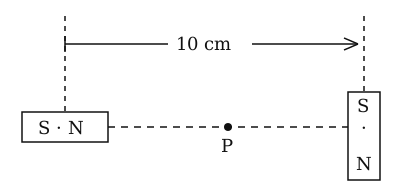
दो सर्वसम छोटे छड़ चुम्बक, प्रत्येक का द्विध्रुव आघूर्ण
J/T, केन्द्र से केन्द्र 10 cm की दूरी पर इस प्रकार रखे हैं कि उनके अक्ष परस्पर लम्बवत् हैं, जैसा कि चित्र में दर्शाया गया है। चुम्बकों के ठीक मध्य बिन्दु P पर चुम्बकीय क्षेत्र का मान
T है।
का मान ______ है।
( Tm/A)
Show answer
Concept: P is 5 cm from each centre. It lies on the axis of the left magnet () and on the equatorial line of the right magnet (). The two fields are perpendicular (horizontal and vertical), so add them as vectors.
- T.
- Axial field (left magnet, horizontal): T.
- Equatorial field (right magnet, vertical): T.
- T.
Short trick: Axial : equatorial at equal distance, so ; the in makes it T.
Answer: 12
अवधारणा: P प्रत्येक केन्द्र से 5 cm दूर है। यह बाएँ चुम्बक के अक्ष पर () तथा दाएँ चुम्बक की निरक्षीय रेखा (equatorial line) पर () स्थित है। दोनों क्षेत्र परस्पर लम्बवत् (क्षैतिज व ऊर्ध्वाधर) हैं, अतः इन्हें सदिश रूप से जोड़ते हैं।
- T.
- अक्षीय क्षेत्र (बायाँ चुम्बक, क्षैतिज): T.
- निरक्षीय क्षेत्र (दायाँ चुम्बक, ऊर्ध्वाधर): T.
- T.
शॉर्ट ट्रिक: समान दूरी पर अक्षीय : निरक्षीय , अतः ; में उपस्थित से यह T हो जाता है।
उत्तर: 12
JEE Main 2026 (April) – Paper 1 (B.E./B.Tech)PhysicsMagnetism – field of bar magnets (axial & equatorial)JEE Main 2026 (April) – Paper 1 (B.E./B.Tech) 2026 · 4 Apr Shift 2
Q149.A circular coil of radius 2 cm and 125 turns carries a current of 1 A. The coil is placed in a uniform magnetic field of magnitude 0.4 T. The axis of the coil makes an angle of 30° with the direction of the magnetic field. The torque acting on the coil is
N.m. The value of
is ______.
()
2 cm त्रिज्या तथा 125 फेरों वाली एक वृत्ताकार कुण्डली में 1 A धारा प्रवाहित हो रही है। कुण्डली को 0.4 T परिमाण के एकसमान चुम्बकीय क्षेत्र में रखा गया है। कुण्डली का अक्ष चुम्बकीय क्षेत्र की दिशा से 30° का कोण बनाता है। कुण्डली पर कार्यरत बल-आघूर्ण
N.m है।
का मान ______ है।
()
Show answer
Concept: , where is the angle between the coil's axis (its magnetic moment) and .
- .
- .
- N m N m.
Short trick: ; .
Answer: 314
अवधारणा: , जहाँ कुण्डली के अक्ष (उसके चुम्बकीय आघूर्ण) तथा के बीच का कोण है।
- .
- .
- N m N m.
शॉर्ट ट्रिक: ; .
उत्तर: 314
JEE Main 2026 (April) – Paper 1 (B.E./B.Tech)PhysicsMoving Charges & Magnetism – torque on a current loopJEE Main 2026 (April) – Paper 1 (B.E./B.Tech) 2026 · 4 Apr Shift 2
Q150.In a double slit experiment, when one of the slits is covered by a transparent mica sheet of refractive index 1.56, the central fringe shifts to the position of 7th bright fringe, obtained with both slits uncovered. If the light source wavelength is 450 nm, the thickness of mica sheet is m. The value of is ______.
एक द्वि-झिरी प्रयोग में, जब एक झिरी को 1.56 अपवर्तनांक वाली पारदर्शी अभ्रक (mica) की शीट से ढक दिया जाता है, तो केन्द्रीय फ्रिंज, दोनों झिरियाँ खुली रहने पर प्राप्त 7वीं दीप्त फ्रिंज की स्थिति पर विस्थापित हो जाती है। यदि प्रकाश स्रोत की तरंगदैर्ध्य 450 nm है, तो अभ्रक शीट की मोटाई m है। का मान ______ है।
Show answer
Concept: A sheet of thickness adds an extra optical path . Shifting the pattern by fringes needs .
- nm.
- nm.
- nm m.
Short trick: nm.
Answer: 5625
अवधारणा: मोटाई की शीट का अतिरिक्त प्रकाशीय पथ जोड़ती है। प्रतिरूप को फ्रिंज खिसकाने के लिए .
- nm.
- nm.
- nm m.
शॉर्ट ट्रिक: nm.
उत्तर: 5625
JEE Main 2026 (April) – Paper 1 (B.E./B.Tech)PhysicsWave Optics – YDSE fringe shift by thin sheetJEE Main 2026 (April) – Paper 1 (B.E./B.Tech) 2026 · 4 Apr Shift 2
Q151.In a screw gauge when the circular scale is given five complete rotations it moves linearly by 2.5 mm. If the circular scale has 100 divisions, the least count of screw gauge is _________ mm.
किसी पेंचमापी (screw gauge) में जब वृत्ताकार पैमाने को पाँच पूर्ण घूर्णन दिए जाते हैं, तो वह रेखीय रूप से 2.5 mm चल जाता है। यदि वृत्ताकार पैमाने पर 100 भाग हों, तो पेंचमापी का अल्पतमांक _________ mm है।
- A
- B
- C
- D
Show answer
Concept: Pitch = linear distance moved in one rotation; least count = .
- Pitch mm per rotation.
- Least count mm mm.
Short trick: LC mm in one shot.
Answer: (D) mm
अवधारणा: चूड़ी अंतराल (pitch) = एक घूर्णन में चली रेखीय दूरी; अल्पतमांक = ।
- पिच mm प्रति घूर्णन।
- अल्पतमांक mm mm।
शॉर्ट ट्रिक: एक ही चरण में LC mm।
उत्तर: (D) mm
JEE Main 2026 (April) – Paper 1 (B.E./B.Tech)PhysicsUnits & Measurements – least count of screw gaugeJEE Main 2026 (April) – Paper 1 (B.E./B.Tech) 2026 · 4 Apr Shift 1
Q152.The increase in the pressure required to decrease the volume () of water is N/m2. The percentage decrease in the volume is _______. (Bulk modulus of water N/m2.)
जल के आयतन में कमी () करने के लिए आवश्यक दाब में वृद्धि N/m2 है। आयतन में प्रतिशत कमी _______ है। (जल का आयतन प्रत्यास्थता गुणांक (bulk modulus) N/m2)
- A2 %
- B3 %
- C6 %
- D4 %
Show answer
Concept: Bulk modulus , so the fractional decrease in volume is .
- .
- Percentage decrease .
Short trick: and → directly 3%.
Answer: (B) 3 %
अवधारणा: आयतन प्रत्यास्थता गुणांक , अतः आयतन में भिन्नात्मक कमी ।
- ।
- प्रतिशत कमी ।
शॉर्ट ट्रिक: तथा → सीधे 3%।
उत्तर: (B) 3 %
JEE Main 2026 (April) – Paper 1 (B.E./B.Tech)PhysicsMechanical Properties of Solids – bulk modulusJEE Main 2026 (April) – Paper 1 (B.E./B.Tech) 2026 · 4 Apr Shift 1
Q153.The time taken by a block of mass to slide down from the highest point to the lowest point on a rough inclined plane is 50 % more compared to the time taken by the same block on identical inclined smooth plane. Both inclined planes are at 45° with the horizontal. The coefficient of kinetic friction between the rough inclined surface and block is _______.
किसी खुरदरे आनत तल पर द्रव्यमान के एक गुटके को उच्चतम बिंदु से निम्नतम बिंदु तक फिसलने में लगा समय, उसी गुटके द्वारा समरूप चिकने आनत तल पर लगे समय से 50 % अधिक है। दोनों आनत तल क्षैतिज से 45° पर हैं। खुरदरे आनत पृष्ठ तथा गुटके के बीच गतिज घर्षण गुणांक _______ है।
- A3/4
- B2/3
- C5/9
- D4/9
Show answer
Concept: For the same length from rest, , so . Smooth: ; rough: .
- .
- At , , so .
- .
Short trick: For , .
Answer: (C) 5/9
अवधारणा: विराम से समान लंबाई के लिए , अतः । चिकना तल: ; खुरदरा तल: ।
- ।
- पर , अतः ।
- ।
शॉर्ट ट्रिक: के लिए ।
उत्तर: (C) 5/9
JEE Main 2026 (April) – Paper 1 (B.E./B.Tech)PhysicsLaws of Motion – friction on an inclineJEE Main 2026 (April) – Paper 1 (B.E./B.Tech) 2026 · 4 Apr Shift 1
Q154.Two nuclei of mass number 3 combine with another nucleus of mass number 4 to yield a nucleus of mass number 10. If the binding energy per nucleon for the mass numbers 3, 4 and 10 are 5.6 MeV, 7.4 MeV and 6.1 MeV, respectively, then in the process, = ______ MeV.
द्रव्यमान संख्या 3 के दो नाभिक, द्रव्यमान संख्या 4 के एक अन्य नाभिक से संयोग कर द्रव्यमान संख्या 10 का एक नाभिक बनाते हैं। यदि द्रव्यमान संख्या 3, 4 तथा 10 के लिए प्रति न्यूक्लिऑन बंधन ऊर्जा क्रमशः 5.6 MeV, 7.4 MeV तथा 6.1 MeV है, तो इस प्रक्रिया में = ______ MeV।
- A6.9
- B7.9
- C2.2
- D4.3
Show answer
Concept: Energy balance of a nuclear reaction: equals the difference between the total binding energies of the final and initial nuclei, BE (BE per nucleon) (mass number).
- Initial BE MeV.
- Final BE MeV.
- MeV (the product is less tightly bound, so this much energy is absorbed).
Answer: (C) 2.2
अवधारणा: नाभिकीय अभिक्रिया का ऊर्जा संतुलन: अंतिम तथा प्रारंभिक नाभिकों की कुल बंधन ऊर्जाओं के अंतर के बराबर होता है, BE (प्रति न्यूक्लिऑन बंधन ऊर्जा) (द्रव्यमान संख्या)।
- प्रारंभिक BE MeV।
- अंतिम BE MeV।
- MeV (उत्पाद नाभिक कम दृढ़ता से बंधा है, अतः इतनी ऊर्जा अवशोषित होती है)।
उत्तर: (C) 2.2
JEE Main 2026 (April) – Paper 1 (B.E./B.Tech)PhysicsNuclei – binding energy and mass defectJEE Main 2026 (April) – Paper 1 (B.E./B.Tech) 2026 · 4 Apr Shift 1
Q155.A solid sphere of mass and radius is divided into two unequal parts. The smaller part having mass is converted into a sphere of radius and the larger part is converted into a circular disc of thickness and radius . If is moment of inertia of a sphere having radius about an axis through its centre and is the moment of inertia of a disc about its diameter, the ratio of their moment of inertia = _____.
द्रव्यमान तथा त्रिज्या के एक ठोस गोले को दो असमान भागों में बाँटा जाता है। द्रव्यमान वाले छोटे भाग को त्रिज्या के गोले में तथा बड़े भाग को मोटाई और त्रिज्या की वृत्ताकार चकती (disc) में बदल दिया जाता है। यदि त्रिज्या वाले गोले का उसके केंद्र से गुजरने वाली अक्ष के परितः जड़त्व आघूर्ण है तथा चकती का उसके व्यास के परितः जड़त्व आघूर्ण है, तो उनके जड़त्व आघूर्णों का अनुपात = _____।
- A35
- B70
- C140
- D210
Show answer
Concept: Same material → same density, so . Sphere: ; disc about diameter: .
- .
- .
- .
Short trick: Once is spotted from the mass, .
Answer: (B) 70
अवधारणा: एक ही पदार्थ → समान घनत्व, अतः । गोला: ; व्यास के परितः चकती: ।
- ।
- ।
- ।
शॉर्ट ट्रिक: द्रव्यमान से पहचानते ही ।
उत्तर: (B) 70
JEE Main 2026 (April) – Paper 1 (B.E./B.Tech)PhysicsRotational Motion – moment of inertiaJEE Main 2026 (April) – Paper 1 (B.E./B.Tech) 2026 · 4 Apr Shift 1
Q156.The two projectiles are projected with the same initial velocities at the 15° and 30° with respect to the horizontal. The ratio of their ranges is 1:. The value of is
दो प्रक्षेप्यों को समान प्रारंभिक वेगों से क्षैतिज के सापेक्ष 15° तथा 30° पर प्रक्षेपित किया जाता है। उनके परासों का अनुपात 1: है। का मान है
- A
- B
- C
- D
Show answer
Concept: Range of a projectile ; for the same speed, .
- .
- So the ratio is .
Short trick: Double the angles and compare sines: .
Answer: (B)
अवधारणा: प्रक्षेप्य का परास ; समान चाल के लिए ।
- ।
- अतः अनुपात ।
शॉर्ट ट्रिक: कोणों को दोगुना कर sine की तुलना कीजिए: ।
उत्तर: (B)
JEE Main 2026 (April) – Paper 1 (B.E./B.Tech)PhysicsKinematics – range of a projectileJEE Main 2026 (April) – Paper 1 (B.E./B.Tech) 2026 · 4 Apr Shift 1
Q157.The graph shows variation of stopping potential
with the frequency
of the incident radiation for three photosensitive metals
,
and
. Which metal will give out electrons with greater kinetic energy, for the same wavelength of incident radiation?
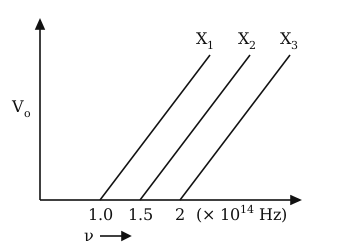
ग्राफ में तीन प्रकाश-सुग्राही धातुओं
,
तथा
के लिए आपतित विकिरण की आवृत्ति
के साथ निरोधी विभव
का परिवर्तन दर्शाया गया है। आपतित विकिरण की समान तरंगदैर्ध्य के लिए कौन-सी धातु अधिक गतिज ऊर्जा वाले इलेक्ट्रॉन उत्सर्जित करेगी?
- A
- B
- C
- DAll the metals will give out photo electrons with same kinetic energies.सभी धातुएँ समान गतिज ऊर्जा वाले प्रकाश-इलेक्ट्रॉन उत्सर्जित करेंगी।
Show answer
Concept: Einstein's equation: . The intercept of each line on the -axis is the threshold frequency of that metal.
- From the graph, is , and Hz for , and respectively.
- For the same incident wavelength, is the same for all three, so is largest for the metal with the smallest .
- has the lowest threshold frequency → maximum kinetic energy. Options (B) and (C) have higher , and (D) is wrong because the work functions differ.
Answer: (A)
अवधारणा: आइंस्टीन समीकरण: । प्रत्येक रेखा का -अक्ष पर अंतःखंड उस धातु की देहली आवृत्ति है।
- ग्राफ से , तथा के लिए क्रमशः , तथा Hz है।
- समान आपतित तरंगदैर्ध्य के लिए तीनों पर समान है, अतः उस धातु के लिए अधिकतम होगी जिसकी न्यूनतम है।
- की देहली आवृत्ति सबसे कम है → अधिकतम गतिज ऊर्जा। विकल्प (B) तथा (C) की अधिक है, और (D) गलत है क्योंकि कार्य-फलन भिन्न हैं।
उत्तर: (A)
JEE Main 2026 (April) – Paper 1 (B.E./B.Tech)PhysicsDual Nature of Radiation – photoelectric effectJEE Main 2026 (April) – Paper 1 (B.E./B.Tech) 2026 · 4 Apr Shift 1
Q158.A slit of width is illuminated by light of wavelength . The linear separation between 1st and 3rd minima in the diffraction pattern produced on a screen placed at a distance from the slit system is _________.
चौड़ाई की एक झिरी को तरंगदैर्ध्य के प्रकाश से प्रदीप्त किया जाता है। झिरी निकाय से दूरी पर रखे पर्दे पर बनने वाले विवर्तन प्रतिरूप में पहली (1st) तथा तीसरी (3rd) निम्निष्ठों के बीच रेखीय दूरी _________ है।
- A
- B
- C
- D
Show answer
Concept: In single-slit diffraction the minimum lies at (small-angle approximation).
- , (same side of the centre).
- Separation .
Short trick: Between the and minima (same side), the gap is → here .
Answer: (C)
अवधारणा: एकल झिरी विवर्तन में वीं निम्निष्ठ पर होती है (लघु-कोण सन्निकटन)।
- , (केंद्र के एक ही ओर)।
- दूरी ।
शॉर्ट ट्रिक: एक ही ओर की वीं तथा वीं निम्निष्ठों के बीच दूरी → यहाँ ।
उत्तर: (C)
JEE Main 2026 (April) – Paper 1 (B.E./B.Tech)PhysicsWave Optics – single slit diffractionJEE Main 2026 (April) – Paper 1 (B.E./B.Tech) 2026 · 4 Apr Shift 1
Q159.A string of length 0.314 m and Young's modulus N/m2 is connected to another string of length and Young's modulus both twice of those of . This series combination of strings is then suspended from a rigid support and its free end is fixed to a load of mass 0.8 kg. The net change in length of the combination is _________ mm.
(radius of both the strings is 0.2 mm and acceleration due to gravity m/s2.)
(Mass of both strings is to be neglected as compared to the mass of load)
0.314 m लंबाई तथा N/m2 यंग गुणांक वाली एक डोरी , एक अन्य डोरी से जुड़ी है जिसकी लंबाई तथा यंग गुणांक दोनों के दोगुने हैं। डोरियों के इस श्रेणी संयोजन को एक दृढ़ आधार से लटकाया जाता है तथा इसके मुक्त सिरे पर 0.8 kg द्रव्यमान का भार बाँधा जाता है। संयोजन की लंबाई में कुल परिवर्तन _________ mm है।
(दोनों डोरियों की त्रिज्या 0.2 mm तथा गुरुत्वीय त्वरण m/s2)
(भार के द्रव्यमान की तुलना में दोनों डोरियों का द्रव्यमान नगण्य माना जाए)
- A3
- B2
- C1.9
- D1
Show answer
Concept: Elongation of a wire ; in series the same force acts in both strings and the elongations add.
- N; .
- String : . Using : mm.
- String : and both double, so mm.
- Net change mm.
Short trick: Doubling and together leaves unchanged → answer is simply .
Answer: (B) 2
अवधारणा: तार का विस्तार ; श्रेणीक्रम में दोनों डोरियों में समान बल लगता है और विस्तार जुड़ते हैं।
- N; ।
- डोरी : । लेने पर: mm।
- डोरी : तथा दोनों दोगुने, अतः mm।
- कुल परिवर्तन mm।
शॉर्ट ट्रिक: और दोनों एक साथ दोगुने करने से अपरिवर्तित रहता है → उत्तर सीधे ।
उत्तर: (B) 2
JEE Main 2026 (April) – Paper 1 (B.E./B.Tech)PhysicsMechanical Properties of Solids – elongation of wires in seriesJEE Main 2026 (April) – Paper 1 (B.E./B.Tech) 2026 · 4 Apr Shift 1
Q160.One gas of mole of molecules at temperature , volume , and pressure , and another gas of mole of molecules at temperature , volume , and pressure , are mixed resulting in pressure and volume of the mixture. The temperature of the mixture is __________.
मोल अणुओं की एक गैस ताप , आयतन तथा दाब पर, और मोल अणुओं की दूसरी गैस ताप , आयतन तथा दाब पर मिश्रित की जाती हैं, जिससे मिश्रण का दाब तथा आयतन हो जाता है। मिश्रण का ताप __________ है।
- A
- B
- C
- D
Show answer
Concept: Mixing conserves the number of moles: . Apply to each gas and to the mixture.
- , , and for the mixture .
- .
- .
- (A) and (D) ignore the amounts of the two gases, and (C) has the dimensions of 1/temperature — all wrong.
Answer: (B)
अवधारणा: मिश्रण में मोलों की कुल संख्या संरक्षित रहती है: । प्रत्येक गैस तथा मिश्रण पर लगाइए।
- , , तथा मिश्रण के लिए ।
- ।
- ।
- (A) तथा (D) दोनों गैसों की मात्राओं की उपेक्षा करते हैं, और (C) की विमा 1/ताप है — सभी गलत।
उत्तर: (B)
JEE Main 2026 (April) – Paper 1 (B.E./B.Tech)PhysicsKinetic Theory – mixing of ideal gasesJEE Main 2026 (April) – Paper 1 (B.E./B.Tech) 2026 · 4 Apr Shift 1

