Q161.Correct statements from the following are
A. Potassium dichromate is an oxidising agent and it oxidises FeSO4 to Fe2(SO4)3 in acidic medium.
B. Sodium dichromate can be used as primary standard in volumetric estimation.
C. CrO42− and Cr2O72− are interconvertible in aqueous solution by varying the pH of the solution.
D. Cr-O-Cr bond angle in Cr2O72− is 126°.
Choose the correct answer from the options given below:
निम्नलिखित में से सही कथन हैं
A. पोटैशियम डाइक्रोमेट एक ऑक्सीकारक है तथा यह अम्लीय माध्यम में FeSO4 को Fe2(SO4)3 में ऑक्सीकृत करता है।
B. आयतनमितीय आकलन में सोडियम डाइक्रोमेट को प्राथमिक मानक के रूप में प्रयुक्त किया जा सकता है।
C. विलयन का pH बदलकर जलीय विलयन में CrO42− तथा Cr2O72− परस्पर परिवर्तनीय हैं।
D. Cr2O72− में Cr-O-Cr बंध कोण 126° है।
नीचे दिए गए विकल्पों में से सही उत्तर चुनिए:
- AA, B and C Onlyकेवल A, B और C
- BA, C and D Onlyकेवल A, C और D
- CA and C Onlyकेवल A और C
- DB and D Onlyकेवल B और D
Show answer
Concept: Properties of K2Cr2O7 and the chromate–dichromate equilibrium.
- A – true: Cr2O72− + 14H+ + 6Fe2+ → 2Cr3+ + 6Fe3+ + 7H2O.
- B – false: sodium dichromate is deliquescent (hygroscopic), so it cannot be weighed accurately; potassium dichromate is the primary standard.
- C – true: 2CrO42− + 2H+ ⇌ Cr2O72− + H2O; acid gives dichromate, alkali gives chromate.
- D – true: the bridging Cr–O–Cr angle is 126°.
- Correct: A, C, D. (A) and (D) include the false statement B; (C) misses D.
Short trick: Na2Cr2O7 absorbs moisture – never a primary standard.
Answer: (B) A, C and D Only
अवधारणा: K2Cr2O7 के गुण तथा क्रोमेट–डाइक्रोमेट साम्य।
- A – सत्य: Cr2O72− + 14H+ + 6Fe2+ → 2Cr3+ + 6Fe3+ + 7H2O।
- B – असत्य: सोडियम डाइक्रोमेट प्रस्वेद्य (आर्द्रताग्राही) है, अतः इसे सही-सही तौला नहीं जा सकता; प्राथमिक मानक पोटैशियम डाइक्रोमेट है।
- C – सत्य: 2CrO42− + 2H+ ⇌ Cr2O72− + H2O; अम्ल में डाइक्रोमेट, क्षार में क्रोमेट।
- D – सत्य: सेतु Cr–O–Cr कोण 126° है।
- सही: A, C, D। (A) और (D) में असत्य कथन B है; (C) में D छूट गया।
शॉर्ट ट्रिक: Na2Cr2O7 नमी सोखता है – कभी प्राथमिक मानक नहीं।
उत्तर: (B) केवल A, C और D
JEE Main 2026 (April) – Paper 1 (B.E./B.Tech)Chemistryd-Block – dichromates and chromatesJEE Main 2026 (April) – Paper 1 (B.E./B.Tech) 2026 · 4 Apr Shift 1
Q162.Match the
LIST-I with
LIST-IIList-I
Complex ion | List-II
Calculated spin only magnetic moment (BM) |
|---|
| A. [Cr(H2O)6]2+ | I. 3.87 |
| B. [Co(H2O)6]2+ | II. 5.92 |
| C. [Cu(H2O)6]2+ | III. 4.90 |
| D. [Mn(H2O)6]2+ | IV. 1.73 |
Choose the
correct answer from the options given below:
सूची-I का
सूची-II से मिलान कीजिए
सूची-I
संकुल आयन | सूची-II
परिकलित प्रचक्रण-मात्र चुंबकीय आघूर्ण (BM) |
|---|
| A. [Cr(H2O)6]2+ | I. 3.87 |
| B. [Co(H2O)6]2+ | II. 5.92 |
| C. [Cu(H2O)6]2+ | III. 4.90 |
| D. [Mn(H2O)6]2+ | IV. 1.73 |
नीचे दिए गए विकल्पों में से
सही उत्तर चुनिए:
- AA-I, B-III, C-IV, D-II
- BA-II, B-I, C-III, D-IV
- CA-IV, B-II, C-I, D-III
- DA-III, B-I, C-IV, D-II
Show answer
Concept: H2O is a weak-field ligand → high spin; BM.
- A: Cr2+ d4, n = 4 → → III
- B: Co2+ d7, n = 3 → → I
- C: Cu2+ d9, n = 1 → → IV
- D: Mn2+ d5, n = 5 → → II
- Only (D) has A-III, B-I, C-IV, D-II; the others mismatch A.
Short trick: 1.73, 2.83, 3.87, 4.90, 5.92 ↔ n = 1, 2, 3, 4, 5.
Answer: (D) A-III, B-I, C-IV, D-II
अवधारणा: H2O दुर्बल क्षेत्र लिगैंड है → उच्च प्रचक्रण; BM।
- A: Cr2+ d4, n = 4 → → III
- B: Co2+ d7, n = 3 → → I
- C: Cu2+ d9, n = 1 → → IV
- D: Mn2+ d5, n = 5 → → II
- केवल (D) में A-III, B-I, C-IV, D-II है; अन्य में A का मिलान गलत है।
शॉर्ट ट्रिक: 1.73, 2.83, 3.87, 4.90, 5.92 ↔ n = 1, 2, 3, 4, 5।
उत्तर: (D) A-III, B-I, C-IV, D-II
JEE Main 2026 (April) – Paper 1 (B.E./B.Tech)ChemistryCoordination compounds – spin-only magnetic momentJEE Main 2026 (April) – Paper 1 (B.E./B.Tech) 2026 · 4 Apr Shift 1
Q163.Increasing order of electron withdrawing power of following functional groups is:
a. − CN
b. − COOH
c. − NO2
d. − I
निम्नलिखित क्रियात्मक समूहों की इलेक्ट्रॉन अपनयन (withdrawing) क्षमता का बढ़ता क्रम है:
a. − CN
b. − COOH
c. − NO2
d. − I
- Ac < b < d < a
- Bc < a < b < d
- Cd < b < a < c
- Da < b < c < d
Show answer
Concept: −I effect order: −NO2 > −CN > −COOH > −F > −Cl > −Br > −I.
- −I is the weakest (low electronegativity of iodine).
- −COOH < −CN < −NO2 (positively polarised N in NO2 is the strongest).
- Increasing order: d < b < a < c. (A), (B) put NO2 lowest; (D) puts I highest – wrong.
Short trick: Remember “NO2 > CN > COOH > halogens”.
Answer: (C) d < b < a < c
अवधारणा: −I प्रभाव का क्रम: −NO2 > −CN > −COOH > −F > −Cl > −Br > −I।
- −I सबसे दुर्बल है (आयोडीन की कम विद्युतऋणात्मकता)।
- −COOH < −CN < −NO2 (NO2 में धनावेशित N सबसे प्रबल)।
- बढ़ता क्रम: d < b < a < c। (A), (B) में NO2 सबसे कम है; (D) में I सबसे अधिक है – गलत।
शॉर्ट ट्रिक: याद रखें “NO2 > CN > COOH > हैलोजन”।
उत्तर: (C) d < b < a < c
JEE Main 2026 (April) – Paper 1 (B.E./B.Tech)ChemistryGOC – electron withdrawing groupsJEE Main 2026 (April) – Paper 1 (B.E./B.Tech) 2026 · 4 Apr Shift 1
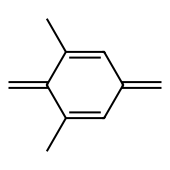
Q164.An alkene (X) on ozonolysis followed by reduction gives following products.
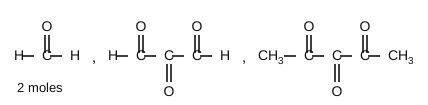
The alkene (X) is:
एक ऐल्कीन (X) ओज़ोनी अपघटन तथा उसके पश्चात् अपचयन पर निम्नलिखित उत्पाद देती है।
ऐल्कीन (X) है:
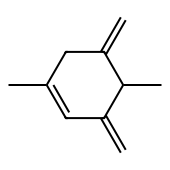
- A
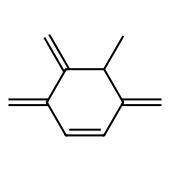
- B
- C
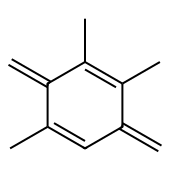
- D
Show answer
Concept: Reductive ozonolysis cuts every C=C into two C=O groups. Join the carbonyl carbons back in pairs.
- Products: 2 HCHO, OHC–CO–CHO and CH3CO–CO–COCH3 → 8 C=O → 4 C=C; 2 + 3 + 5 = 10 C.
- The two HCHO must be exocyclic =CH2 groups; they sit on the central C of each 3-carbon fragment (the C=O flanked by two others).
- The two fragments join end-to-end through two ring C=C bonds: CHO ends pair with C(=O)CH3 ends → CH=C(CH3).
- Ring: C(CH3)=CH–C(=CH2)–CH=C(CH3)–C(=CH2)– (a 6-ring, each methyl-carbon next to an exocyclic carbon) = structure (D).
- (A) has a ring CH2 (would give no glyoxal), (B) has one methyl only (would give 3 HCHO) and (C) has three methyls (11 C) – all wrong.
Short trick: Count: 2 exocyclic =CH2, 2 CH3, 6 ring C, no sp3 ring carbon – only (D) fits.
Answer: (D) (structure D)
अवधारणा: अपचायी ओज़ोनी अपघटन प्रत्येक C=C को दो C=O समूहों में तोड़ देता है। कार्बोनिल कार्बनों को जोड़ों में वापस जोड़ें।
- उत्पाद: 2 HCHO, OHC–CO–CHO तथा CH3CO–CO–COCH3 → 8 C=O → 4 C=C; 2 + 3 + 5 = 10 C।
- दोनों HCHO बाह्यचक्रीय =CH2 समूह होने चाहिए; ये प्रत्येक 3-कार्बन खंड के मध्य C (दो C=O के बीच वाला) पर होते हैं।
- दोनों खंड सिरे-से-सिरा दो वलय C=C बंधों द्वारा जुड़ते हैं: CHO सिरे C(=O)CH3 सिरों से → CH=C(CH3)।
- वलय: C(CH3)=CH–C(=CH2)–CH=C(CH3)–C(=CH2)– (6-वलय, प्रत्येक मेथिल-कार्बन बाह्यचक्रीय कार्बन के बगल में) = संरचना (D)।
- (A) में वलय CH2 है (ग्लाइऑक्सल नहीं बनेगा), (B) में केवल एक मेथिल है (3 HCHO बनेंगे) तथा (C) में तीन मेथिल हैं (11 C) – सभी गलत।
शॉर्ट ट्रिक: गिनें: 2 बाह्यचक्रीय =CH2, 2 CH3, 6 वलय C, कोई sp3 वलय कार्बन नहीं – केवल (D) उपयुक्त।
उत्तर: (D) (संरचना D)
JEE Main 2026 (April) – Paper 1 (B.E./B.Tech)ChemistryHydrocarbons – ozonolysis (reverse)JEE Main 2026 (April) – Paper 1 (B.E./B.Tech) 2026 · 4 Apr Shift 1
Q165.Match the
LIST-I with
LIST-IIList-I
Name of reaction | List-II
Reagent or catalyst used |
|---|
| A. Finkelstein reaction | I. SbF3 |
| B. Swarts reaction | II. Na, dry ether |
| C. Sandmeyer's reaction | III. NaI |
| D. Fittig reaction | IV. Cu2Cl2 |
Choose the
correct answer from the options given below:
सूची-I का
सूची-II से मिलान कीजिए
सूची-I
अभिक्रिया का नाम | सूची-II
प्रयुक्त अभिकर्मक या उत्प्रेरक |
|---|
| A. फिंकेल्स्टाइन अभिक्रिया | I. SbF3 |
| B. स्वार्ट्स अभिक्रिया | II. Na, शुष्क ईथर |
| C. सैन्डमेयर अभिक्रिया | III. NaI |
| D. फिटिग अभिक्रिया | IV. Cu2Cl2 |
नीचे दिए गए विकल्पों में से
सही उत्तर चुनिए:
- AA-I, B-IV, C-III, D-II
- BA-III, B-I, C-IV, D-II
- CA-IV, B-II, C-I, D-III
- DA-I, B-III, C-II, D-IV
Show answer
Concept: Reagents of standard halogen reactions.
- Finkelstein: R–Cl/Br + NaI (acetone) → R–I → III
- Swarts: R–Cl/Br + SbF3 (or AgF, Hg2F2) → R–F → I
- Sandmeyer: ArN2+ + Cu2Cl2/HCl → Ar–Cl → IV
- Fittig: 2Ar–X + 2Na (dry ether) → Ar–Ar → II
- Only (B) matches; (A), (C), (D) mix up Finkelstein/Swarts.
Short trick: FinkelsteIn → I; SwarFs → F.
Answer: (B) A-III, B-I, C-IV, D-II
अवधारणा: मानक हैलोजन अभिक्रियाओं के अभिकर्मक।
- फिंकेल्स्टाइन: R–Cl/Br + NaI (ऐसीटोन) → R–I → III
- स्वार्ट्स: R–Cl/Br + SbF3 (या AgF, Hg2F2) → R–F → I
- सैन्डमेयर: ArN2+ + Cu2Cl2/HCl → Ar–Cl → IV
- फिटिग: 2Ar–X + 2Na (शुष्क ईथर) → Ar–Ar → II
- केवल (B) मेल खाता है; (A), (C), (D) में फिंकेल्स्टाइन/स्वार्ट्स गड़बड़ हैं।
शॉर्ट ट्रिक: फिंकेल्स्टाइन → I (आयोडो); स्वार्ट्स → F (फ्लुओरो)।
उत्तर: (B) A-III, B-I, C-IV, D-II
JEE Main 2026 (April) – Paper 1 (B.E./B.Tech)ChemistryHaloalkanes and haloarenes – named reactionsJEE Main 2026 (April) – Paper 1 (B.E./B.Tech) 2026 · 4 Apr Shift 1
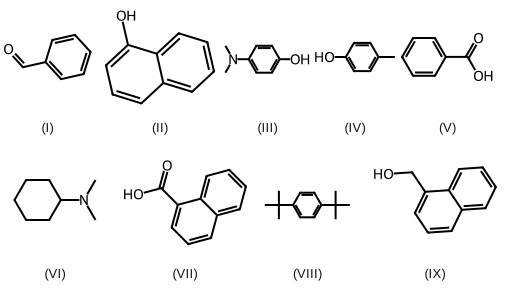
Q166.Amongst the following, the total number of compounds soluble in aqueous NaOH at room temperature is:
निम्नलिखित में से कमरे के ताप पर जलीय NaOH में विलेय यौगिकों की कुल संख्या है:
- A5
- B4
- C6
- D3
Show answer
Concept: NaOH dissolves compounds acidic enough to form salts: carboxylic acids (pKa ≈ 4–5) and phenols (pKa ≈ 10). Aldehydes, amines, hydrocarbons and alcohols (pKa ≈ 16) do not dissolve.
- Soluble: II (1-naphthol), III (4-dimethylaminophenol), IV (p-cresol) – phenols; V (benzoic acid), VII (1-naphthoic acid) – acids.
- Insoluble: I (benzaldehyde), VI (N,N-dimethylcyclohexylamine, basic), VIII (1,4-di-tert-butylbenzene), IX (1-naphthylmethanol – an alcohol, not a phenol).
- Total = 5.
Short trick: Count OH directly on a ring + all COOH: 3 + 2 = 5. CH2OH (IX) is a trap.
Answer: (A) 5
अवधारणा: NaOH उन यौगिकों को घोलता है जो लवण बनाने योग्य अम्लीय हों: कार्बोक्सिलिक अम्ल (pKa ≈ 4–5) तथा फ़ीनॉल (pKa ≈ 10)। ऐल्डिहाइड, ऐमीन, हाइड्रोकार्बन तथा ऐल्कोहॉल (pKa ≈ 16) नहीं घुलते।
- विलेय: II (1-नैफ़्थॉल), III (4-डाइमेथिलऐमीनोफ़ीनॉल), IV (p-क्रीसॉल) – फ़ीनॉल; V (बेन्ज़ोइक अम्ल), VII (1-नैफ़्थोइक अम्ल) – अम्ल।
- अविलेय: I (बेन्ज़ैल्डिहाइड), VI (N,N-डाइमेथिलसाइक्लोहेक्सिलऐमीन, क्षारीय), VIII (1,4-डाइ-tert-ब्यूटिलबेन्ज़ीन), IX (1-नैफ़्थिलमेथेनॉल – ऐल्कोहॉल, फ़ीनॉल नहीं)।
- कुल = 5।
शॉर्ट ट्रिक: वलय पर सीधे जुड़े OH + सभी COOH गिनें: 3 + 2 = 5। CH2OH (IX) एक जाल है।
उत्तर: (A) 5
JEE Main 2026 (April) – Paper 1 (B.E./B.Tech)ChemistryAcidity – solubility in aqueous NaOHJEE Main 2026 (April) – Paper 1 (B.E./B.Tech) 2026 · 4 Apr Shift 1
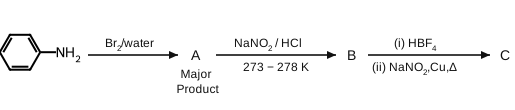
Q167.Product C of the following reaction sequence will be
निम्नलिखित अभिक्रिया अनुक्रम का उत्पाद C होगा
- A1-Bromo-4-nitrobenzene1-ब्रोमो-4-नाइट्रोबेन्ज़ीन
- B1, 3, 5-Tribromo-2-nitrobenzene1, 3, 5-ट्राइब्रोमो-2-नाइट्रोबेन्ज़ीन
- C4-Bromo-1-nitrobenzene4-ब्रोमो-1-नाइट्रोबेन्ज़ीन
- D1, 3, 5-Tribromobenzene1, 3, 5-ट्राइब्रोमोबेन्ज़ीन
Show answer
Concept: –NH2 is strongly activating; diazonium fluoroborate with NaNO2/Cu on heating replaces –N2+ by –NO2.
- Aniline + Br2/water → 2,4,6-tribromoaniline (A).
- NaNO2/HCl, 273–278 K → 2,4,6-tribromobenzenediazonium chloride (B).
- (i) HBF4 → ArN2+BF4−; (ii) NaNO2, Cu, Δ → Ar–NO2.
- C = 2,4,6-tribromonitrobenzene = 1,3,5-tribromo-2-nitrobenzene.
- (A)/(C) keep only one Br (bromine water gives tribromination); (D) is the product of H3PO2 reduction, not of NaNO2/Cu.
Short trick: Bromine water + aniline → always three Br; the N2+ spot becomes NO2.
Answer: (B) 1, 3, 5-Tribromo-2-nitrobenzene
अवधारणा: –NH2 प्रबल सक्रियक है; डाइऐज़ोनियम फ्लुओरोबोरेट को NaNO2/Cu के साथ गर्म करने पर –N2+ का स्थान –NO2 ले लेता है।
- ऐनिलीन + Br2/जल → 2,4,6-ट्राइब्रोमोऐनिलीन (A)।
- NaNO2/HCl, 273–278 K → 2,4,6-ट्राइब्रोमोबेन्ज़ीनडाइऐज़ोनियम क्लोराइड (B)।
- (i) HBF4 → ArN2+BF4−; (ii) NaNO2, Cu, Δ → Ar–NO2।
- C = 2,4,6-ट्राइब्रोमोनाइट्रोबेन्ज़ीन = 1,3,5-ट्राइब्रोमो-2-नाइट्रोबेन्ज़ीन।
- (A)/(C) में केवल एक Br है (ब्रोमीन जल त्रिब्रोमीनन करता है); (D) H3PO2 अपचयन का उत्पाद है, NaNO2/Cu का नहीं।
शॉर्ट ट्रिक: ब्रोमीन जल + ऐनिलीन → सदैव तीन Br; N2+ का स्थान NO2 लेता है।
उत्तर: (B) 1, 3, 5-ट्राइब्रोमो-2-नाइट्रोबेन्ज़ीन
JEE Main 2026 (April) – Paper 1 (B.E./B.Tech)ChemistryAmines – diazonium salt reactionsJEE Main 2026 (April) – Paper 1 (B.E./B.Tech) 2026 · 4 Apr Shift 1
Q168.Given below are two statements:
Statement I: The structure of Maltose is given below:
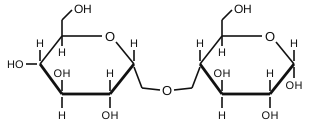
Maltose is a non-reducing sugar.
Statement II: The structure of Lactose is given below:
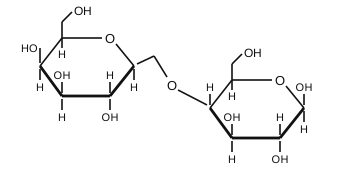
Lactose is a reducing sugar.
In the light of the above statements, choose the
correct answer from the options given below
नीचे दो कथन दिए गए हैं:
कथन I: माल्टोस की संरचना नीचे दी गई है:
माल्टोस एक अनपचायी (non-reducing) शर्करा है।
कथन II: लैक्टोस की संरचना नीचे दी गई है:
लैक्टोस एक अपचायी (reducing) शर्करा है।
उपर्युक्त कथनों के आलोक में, नीचे दिए गए विकल्पों में से
सही उत्तर चुनिए
- ABoth Statement I and Statement II are trueकथन I और कथन II दोनों सत्य हैं
- BBoth Statement I and Statement II are falseकथन I और कथन II दोनों असत्य हैं
- CStatement I is true but Statement II is falseकथन I सत्य है परन्तु कथन II असत्य है
- DStatement I is false but Statement II is trueकथन I असत्य है परन्तु कथन II सत्य है
Show answer
Concept: A disaccharide is reducing if one anomeric carbon (C1) is free (hemiacetal OH), so the ring can open to an aldehyde.
- Maltose = α-D-glucose C1 – O – C4 of a second glucose. The C1 of the second glucose carries a free OH → it is a reducing sugar. Statement I (non-reducing) is false.
- Lactose = β-D-galactose C1 – O – C4 of glucose; C1 of the glucose unit is free → reducing. Statement II is true.
Short trick: Among common disaccharides only sucrose (C1–C2 link) is non-reducing.
Answer: (D) Statement I is false but Statement II is true
अवधारणा: डाइसैकेराइड अपचायी होती है यदि एक ऐनोमरी कार्बन (C1) मुक्त हो (हेमीऐसीटल OH), जिससे वलय खुलकर ऐल्डिहाइड बन सके।
- माल्टोस = α-D-ग्लूकोस का C1 – O – दूसरे ग्लूकोस का C4। दूसरे ग्लूकोस के C1 पर मुक्त OH है → यह अपचायी शर्करा है। कथन I (अनपचायी) असत्य है।
- लैक्टोस = β-D-गैलेक्टोस का C1 – O – ग्लूकोस का C4; ग्लूकोस इकाई का C1 मुक्त है → अपचायी। कथन II सत्य है।
शॉर्ट ट्रिक: सामान्य डाइसैकेराइडों में केवल सुक्रोस (C1–C2 बंध) अनपचायी है।
उत्तर: (D) कथन I असत्य है परन्तु कथन II सत्य है
JEE Main 2026 (April) – Paper 1 (B.E./B.Tech)ChemistryBiomolecules – disaccharidesJEE Main 2026 (April) – Paper 1 (B.E./B.Tech) 2026 · 4 Apr Shift 1
Q169.Match the
LIST-I with
LIST-IIList-I
Name of amino acid | List-II
One letter symbol/type |
|---|
| A. Arginine | I. D/Non-essential |
| B. Aspartic acid | II. R/Essential |
| C. Lysine | III. E/Non-essential |
| D. Glutamic acid | IV. K/Essential |
Choose the
correct answer from the options given below:
सूची-I का
सूची-II से मिलान कीजिए
सूची-I
ऐमीनो अम्ल का नाम | सूची-II
एक अक्षर प्रतीक/प्रकार |
|---|
| A. आर्जिनीन | I. D/अनावश्यक |
| B. ऐस्पार्टिक अम्ल | II. R/आवश्यक |
| C. लाइसीन | III. E/अनावश्यक |
| D. ग्लूटैमिक अम्ल | IV. K/आवश्यक |
नीचे दिए गए विकल्पों में से
सही उत्तर चुनिए:
- AA-II, B-I, C-IV, D-III
- BA-IV, B-III, C-II, D-I
- CA-III, B-IV, C-I, D-II
- DA-II, B-IV, C-I, D-III
Show answer
Concept: One-letter codes and essential/non-essential classification (NCERT table).
- Arginine – R, essential → II
- Aspartic acid – D, non-essential → I
- Lysine – K, essential → IV
- Glutamic acid – E, non-essential → III
- (B), (C), (D) assign K or R to an acid – wrong.
Short trick: Acidic amino acids: AsparDic = D, GlutEmic = E; basic: aRginine = R, lysine = K.
Answer: (A) A-II, B-I, C-IV, D-III
अवधारणा: एक-अक्षर कोड तथा आवश्यक/अनावश्यक वर्गीकरण (NCERT सारणी)।
- आर्जिनीन – R, आवश्यक → II
- ऐस्पार्टिक अम्ल – D, अनावश्यक → I
- लाइसीन – K, आवश्यक → IV
- ग्लूटैमिक अम्ल – E, अनावश्यक → III
- (B), (C), (D) किसी अम्ल को K या R देते हैं – गलत।
शॉर्ट ट्रिक: अम्लीय ऐमीनो अम्ल: ऐस्पार्टिक = D, ग्लूटैमिक = E; क्षारीय: आर्जिनीन = R, लाइसीन = K।
उत्तर: (A) A-II, B-I, C-IV, D-III
JEE Main 2026 (April) – Paper 1 (B.E./B.Tech)ChemistryBiomolecules – amino acidsJEE Main 2026 (April) – Paper 1 (B.E./B.Tech) 2026 · 4 Apr Shift 1
Q170.Identify the colour of compound 'X' in the sequence of the reaction.
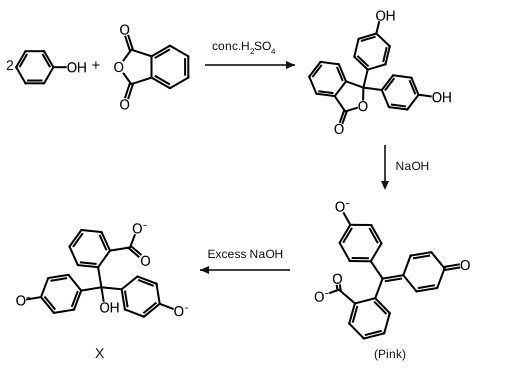
अभिक्रिया के अनुक्रम में यौगिक 'X' का रंग पहचानिए।
- AVioletबैंगनी
- BGreenहरा
- CRedलाल
- DColourlessरंगहीन
Show answer
Concept: Colour of phenolphthalein comes from the extended conjugation of the quinonoid dianion; breaking that conjugation removes colour.
- Phenol + phthalic anhydride (conc. H2SO4) → phenolphthalein (colourless lactone).
- NaOH → quinonoid dianion with C=C conjugated across all rings → pink.
- Excess NaOH: OH− adds to the central carbon → sp3 carbinol trianion X; conjugation is broken → colourless.
Short trick: sp3 central carbon = no extended conjugation = no colour.
Answer: (D) Colourless
अवधारणा: फ़ीनॉल्फ़्थेलीन का रंग क्विनोनॉयड द्विऋणायन के विस्तारित संयुग्मन से आता है; संयुग्मन टूटने पर रंग चला जाता है।
- फ़ीनॉल + थैलिक ऐनहाइड्राइड (सांद्र H2SO4) → फ़ीनॉल्फ़्थेलीन (रंगहीन लैक्टोन)।
- NaOH → क्विनोनॉयड द्विऋणायन जिसमें C=C सभी वलयों में संयुग्मित है → गुलाबी।
- अधिक NaOH: OH− केन्द्रीय कार्बन पर जुड़ता है → sp3 कार्बिनॉल त्रिऋणायन X; संयुग्मन टूट जाता है → रंगहीन।
शॉर्ट ट्रिक: sp3 केन्द्रीय कार्बन = विस्तारित संयुग्मन नहीं = रंग नहीं।
उत्तर: (D) रंगहीन
JEE Main 2026 (April) – Paper 1 (B.E./B.Tech)ChemistryPhenols – phenolphthalein indicatorJEE Main 2026 (April) – Paper 1 (B.E./B.Tech) 2026 · 4 Apr Shift 1
Q171.According to Lewis theory, the total number of σ bond-pairs and lone pair of electrons around the central atom of XeO64− ion is _______.
लूइस सिद्धांत के अनुसार, XeO64− आयन के केन्द्रीय परमाणु के चारों ओर σ आबंध-युग्मों तथा एकाकी इलेक्ट्रॉन युग्मों की कुल संख्या _______ है।
Show answer
Concept: In perxenate XeO64−, Xe is in the +8 state: all 8 valence electrons are used in bonding.
- Oxidation state: x + 6(−2) = −4 → x = +8.
- Xe forms 6 σ bonds to O (two of them additionally π, the other four O carry the 4− charge).
- Lone pairs on Xe = (8 − 8)/2 = 0 (all 8 electrons used: 6 in σ, 2 in π).
- σ bond pairs + lone pairs = 6 + 0 = 6 (octahedral).
Short trick: Xe(+8) has no lone pair; steric number = number of O atoms = 6.
Answer: 6
अवधारणा: परज़ीनेट XeO64− में Xe +8 अवस्था में है: सभी 8 संयोजी इलेक्ट्रॉन आबंधन में प्रयुक्त होते हैं।
- ऑक्सीकरण अवस्था: x + 6(−2) = −4 → x = +8।
- Xe, O से 6 σ बंध बनाता है (इनमें से दो पर अतिरिक्त π, शेष चार O पर 4− आवेश)।
- Xe पर एकाकी युग्म = (8 − 8)/2 = 0 (सभी 8 इलेक्ट्रॉन प्रयुक्त: 6 σ में, 2 π में)।
- σ आबंध युग्म + एकाकी युग्म = 6 + 0 = 6 (अष्टफलकीय)।
शॉर्ट ट्रिक: Xe(+8) पर कोई एकाकी युग्म नहीं; स्टेरिक संख्या = O परमाणुओं की संख्या = 6।
उत्तर: 6
JEE Main 2026 (April) – Paper 1 (B.E./B.Tech)ChemistryChemical bonding – Lewis structure of XeO₆⁴⁻JEE Main 2026 (April) – Paper 1 (B.E./B.Tech) 2026 · 4 Apr Shift 1
Q172.Consider the following sequence of reactions to give the major product (X)
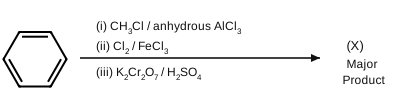
P g of the major product (X) formed is reacted with NaHCO
3 solution to liberate a gas which occupied 11.2 dm
3 at STP.
P = _______ g.
(Given molar mass in g mol
−1 H:1, C:12, O:16, Cl:35.5)
मुख्य उत्पाद (X) देने वाली अभिक्रियाओं के निम्नलिखित अनुक्रम पर विचार कीजिए
बने हुए मुख्य उत्पाद (X) के P g को NaHCO
3 विलयन से अभिक्रिया कराने पर एक गैस मुक्त होती है जो STP पर 11.2 dm
3 आयतन घेरती है।
P = _______ g।
(दिया है, मोलर द्रव्यमान g mol
−1 में H:1, C:12, O:16, Cl:35.5)
Show answer
Concept: –CH3 is o/p-directing (para major); side-chain oxidation turns –CH3 into –COOH; each –COOH releases one CO2 with NaHCO3.
- Benzene + CH3Cl/AlCl3 → toluene.
- Cl2/FeCl3 → 4-chlorotoluene (major).
- K2Cr2O7/H2SO4 → 4-chlorobenzoic acid X, C7H5ClO2, M = 84 + 5 + 35.5 + 32 = 156.5 g mol−1.
- ArCOOH + NaHCO3 → ArCOONa + H2O + CO2; n(CO2) = 11.2/22.4 = 0.5 mol = n(X).
- P = 0.5 × 156.5 = 78.25 g; the integer answer is 78.
Short trick: 11.2 L = ½ mol → P = M/2 = 156.5/2 = 78.25 → 78.
Answer: 78
अवधारणा: –CH3 o/p-निर्देशी है (पैरा मुख्य); पार्श्व-शृंखला ऑक्सीकरण –CH3 को –COOH में बदलता है; प्रत्येक –COOH, NaHCO3 के साथ एक CO2 मुक्त करता है।
- बेन्ज़ीन + CH3Cl/AlCl3 → टॉलूईन।
- Cl2/FeCl3 → 4-क्लोरोटॉलूईन (मुख्य)।
- K2Cr2O7/H2SO4 → 4-क्लोरोबेन्ज़ोइक अम्ल X, C7H5ClO2, M = 84 + 5 + 35.5 + 32 = 156.5 g mol−1।
- ArCOOH + NaHCO3 → ArCOONa + H2O + CO2; n(CO2) = 11.2/22.4 = 0.5 mol = n(X)।
- P = 0.5 × 156.5 = 78.25 g; पूर्णांक उत्तर 78 है।
शॉर्ट ट्रिक: 11.2 L = ½ mol → P = M/2 = 156.5/2 = 78.25 → 78।
उत्तर: 78
JEE Main 2026 (April) – Paper 1 (B.E./B.Tech)ChemistryAromatic compounds – synthesis and stoichiometryJEE Main 2026 (April) – Paper 1 (B.E./B.Tech) 2026 · 4 Apr Shift 1
Q173.2.0 g of a bromo hydrocarbon (X) was subjected to Carius analysis, gave 3.36 g of AgBr. The percentage of carbon in the compound (X) is 26.7%. Total number of carbon atoms in the empirical formula for compound (X) is _______.
(Given molar mass in g mol−1 H:1, C:12, Br : 80, Ag : 108)
एक ब्रोमो हाइड्रोकार्बन (X) के 2.0 g का कैरिअस विश्लेषण करने पर 3.36 g AgBr प्राप्त हुआ। यौगिक (X) में कार्बन का प्रतिशत 26.7% है। यौगिक (X) के मूलानुपाती सूत्र में कार्बन परमाणुओं की कुल संख्या _______ है।
(दिया है, मोलर द्रव्यमान g mol−1 में H:1, C:12, Br : 80, Ag : 108)
Show answer
Concept: Carius: %Br = ; H by difference; then mole ratio.
- %Br
- %H = 100 − 71.49 − 26.7 = 1.81%
- Moles per 100 g: C = 26.7/12 = 2.225; H = 1.81/1 = 1.81; Br = 71.49/80 = 0.894
- Divide by 0.894: C : H : Br = 2.49 : 2.03 : 1 → ×2 → 4.98 : 4.05 : 2 ≈ 5 : 4 : 2
- Empirical formula C5H4Br2 → 5 carbon atoms.
Short trick: C : Br ≈ 2.225 : 0.894 = 2.5 : 1 → double it → C5…Br2.
Answer: 5
अवधारणा: कैरिअस: %Br = ; H अंतर से; फिर मोल अनुपात।
- %Br
- %H = 100 − 71.49 − 26.7 = 1.81%
- प्रति 100 g मोल: C = 26.7/12 = 2.225; H = 1.81/1 = 1.81; Br = 71.49/80 = 0.894
- 0.894 से भाग देने पर: C : H : Br = 2.49 : 2.03 : 1 → ×2 → 4.98 : 4.05 : 2 ≈ 5 : 4 : 2
- मूलानुपाती सूत्र C5H4Br2 → 5 कार्बन परमाणु।
शॉर्ट ट्रिक: C : Br ≈ 2.225 : 0.894 = 2.5 : 1 → दोगुना → C5…Br2।
उत्तर: 5
JEE Main 2026 (April) – Paper 1 (B.E./B.Tech)ChemistryOrganic analysis – Carius method and empirical formulaJEE Main 2026 (April) – Paper 1 (B.E./B.Tech) 2026 · 4 Apr Shift 1
Q174.The pH of a solution obtained by mixing 5 mL of 0.1 M NH4OH solution with 250 mL of 0.1 M NH4Cl solution is _______ × 10−2. (Nearest integer)
Given: pKb (NH4OH) = 4.74
log 2 = 0.30
log 3 = 0.48
log 5 = 0.70
5 mL 0.1 M NH4OH विलयन को 250 mL 0.1 M NH4Cl विलयन के साथ मिलाने पर प्राप्त विलयन का pH _______ × 10−2 है। (निकटतम पूर्णांक)
दिया है: pKb (NH4OH) = 4.74
log 2 = 0.30
log 3 = 0.48
log 5 = 0.70
Show answer
Concept: Basic buffer: pOH = pKb + log (ratio of millimoles, same total volume).
- NH4OH = 5 × 0.1 = 0.5 mmol; NH4Cl = 250 × 0.1 = 25 mmol
- Ratio = 25/0.5 = 50; log 50 = log 5 + 1 = 1.70
- pOH = 4.74 + 1.70 = 6.44
- pH = 14 − 6.44 = 7.56 = 756 × 10−2
Short trick: Salt is 50 × base → pOH rises by 1.70 above pKb.
Answer: 756
अवधारणा: क्षारीय बफ़र: pOH = pKb + log (मिलीमोल का अनुपात, कुल आयतन समान)।
- NH4OH = 5 × 0.1 = 0.5 mmol; NH4Cl = 250 × 0.1 = 25 mmol
- अनुपात = 25/0.5 = 50; log 50 = log 5 + 1 = 1.70
- pOH = 4.74 + 1.70 = 6.44
- pH = 14 − 6.44 = 7.56 = 756 × 10−2
शॉर्ट ट्रिक: लवण = 50 × क्षार → pOH, pKb से 1.70 अधिक।
उत्तर: 756
JEE Main 2026 (April) – Paper 1 (B.E./B.Tech)ChemistryIonic equilibrium – basic bufferJEE Main 2026 (April) – Paper 1 (B.E./B.Tech) 2026 · 4 Apr Shift 1
Q175.A non-volatile, non-electrolyte solid solute when dissolved in 40 g of a solvent, the vapour pressure of the solvent decreased from 760 mm Hg to 750 mm Hg. If the same solution boils at 320 K, then the number of moles of the solvent present in the solution is _______. (Nearest integer)
[Given: boiling point of the pure solvent = 319.5 K,
Kb of the solvent = 0.3 K kg mol−1]
एक अवाष्पशील, अविद्युत-अपघट्य ठोस विलेय को 40 g विलायक में घोलने पर विलायक का वाष्प दाब 760 mm Hg से घटकर 750 mm Hg हो जाता है। यदि यही विलयन 320 K पर उबलता है, तो विलयन में उपस्थित विलायक के मोलों की संख्या _______ है। (निकटतम पूर्णांक)
[दिया है: शुद्ध विलायक का क्वथनांक = 319.5 K,
विलायक का Kb = 0.3 K kg mol−1]
Show answer
Concept: Elevation of boiling point gives moles of solute; relative lowering of vapour pressure (Raoult's law) gives the mole fraction of solute.
- ΔTb = 320 − 319.5 = 0.5 K; m = 0.5/0.3 = 1.667 mol kg−1
- nsolute = 1.667 × 0.040 = 0.0667 mol
- →
- nsolvent = 5.067 − 0.067 = 5.0 mol
Short trick: n1 = n2 × (p/Δp) = 0.0667 × 750/10 = 5.
Answer: 5
अवधारणा: क्वथनांक उन्नयन से विलेय के मोल मिलते हैं; वाष्प दाब का आपेक्षिक अवनमन (राउल्ट नियम) विलेय का मोल अंश देता है।
- ΔTb = 320 − 319.5 = 0.5 K; m = 0.5/0.3 = 1.667 mol kg−1
- nविलेय = 1.667 × 0.040 = 0.0667 mol
- →
- nविलायक = 5.067 − 0.067 = 5.0 mol
शॉर्ट ट्रिक: n1 = n2 × (p/Δp) = 0.0667 × 750/10 = 5।
उत्तर: 5
JEE Main 2026 (April) – Paper 1 (B.E./B.Tech)ChemistrySolutions – colligative propertiesJEE Main 2026 (April) – Paper 1 (B.E./B.Tech) 2026 · 4 Apr Shift 1
Q176.The ratio of mass percentage (w/w) of C : H in a hydrocarbon is 12 : 1. It has two carbon atoms. The weight (in g) of CO2(g) formed when 3.38 g of this hydrocarbon is completely burnt in oxygen is :
(Given : Molar mass in g mol−1 C : 12, H : 1, O : 16)
किसी हाइड्रोकार्बन में C : H के द्रव्यमान प्रतिशत (w/w) का अनुपात 12 : 1 है। इसमें दो कार्बन परमाणु हैं। इस हाइड्रोकार्बन के 3.38 g को ऑक्सीजन में पूर्णतः जलाने पर बनी CO2(g) का भार (g में) है :
(दिया है : मोलर द्रव्यमान g mol−1 में C : 12, H : 1, O : 16)
- A5.68
- B11.44
- C22.74
- D17.05
Show answer
Concept: Mass ratio → mole ratio gives the empirical formula; the given number of C atoms fixes the molecular formula, then use combustion stoichiometry.
- Mole ratio C : H , so the empirical formula is CH.
- With two carbon atoms the hydrocarbon is C2H2 (ethyne), g mol−1.
- Moles burnt mol; each mole gives 2 mol CO2 → mol CO2.
- Mass of CO2 g.
Short trick: Each mole of C2H2 gives 88 g CO2: g.
Answer: (B) 11.44
अवधारणा: द्रव्यमान अनुपात → मोल अनुपात से मूलानुपाती सूत्र मिलता है; दिए गए C परमाणुओं की संख्या से अणुसूत्र निश्चित होता है, फिर दहन रससमीकरणमिति लगाइए।
- मोल अनुपात C : H , अतः मूलानुपाती सूत्र CH है।
- दो कार्बन परमाणुओं के साथ हाइड्रोकार्बन C2H2 (एथाइन) है, g mol−1।
- जले मोल mol; प्रत्येक मोल से 2 mol CO2 → mol CO2।
- CO2 का द्रव्यमान g।
शॉर्ट ट्रिक: C2H2 के प्रत्येक मोल से 88 g CO2 बनती है: g।
उत्तर: (B) 11.44
JEE Main 2026 (April) – Paper 1 (B.E./B.Tech)ChemistryMole concept – combustion stoichiometryJEE Main 2026 (April) – Paper 1 (B.E./B.Tech) 2026 · 2 Apr Shift 2
Q177.The first and second ionization constants of a weak dibasic acid H2A are and respectively. 0.1 mol of H2A was dissolved in 1 L of 0.1 M HCl solution. The concentration of HA− in the resultant solution is :
एक दुर्बल द्विक्षारकीय अम्ल H2A के प्रथम तथा द्वितीय आयनन स्थिरांक क्रमशः तथा हैं। 0.1 mol H2A को 1 L, 0.1 M HCl विलयन में घोला गया। परिणामी विलयन में HA− की सांद्रता है :
- A0.1 M
- B M
- C M
- D M
Show answer
Concept: In presence of the strong acid HCl the ionisation of the weak acid is suppressed (common ion effect), so [H+] comes almost entirely from HCl.
- [H+] ≈ 0.1 M (from HCl); dissociation of H2A is negligible, so [H2A] ≈ 0.1 M.
- → M.
- The second ionisation () is far too small to change this.
Short trick: When acid concentration = [H+] from the strong acid, they cancel and numerically.
Answer: (C) M
अवधारणा: प्रबल अम्ल HCl की उपस्थिति में दुर्बल अम्ल का आयनन दब जाता है (उभयनिष्ठ आयन प्रभाव), अतः [H+] लगभग पूर्णतः HCl से आता है।
- [H+] ≈ 0.1 M (HCl से); H2A का वियोजन नगण्य है, अतः [H2A] ≈ 0.1 M।
- → M।
- द्वितीय आयनन () इतना छोटा है कि इसे बदल नहीं सकता।
शॉर्ट ट्रिक: जब अम्ल की सांद्रता = प्रबल अम्ल से [H+] हो, तो वे कट जाते हैं और संख्यात्मक रूप से ।
उत्तर: (C) M
JEE Main 2026 (April) – Paper 1 (B.E./B.Tech)ChemistryIonic equilibrium – common ion effectJEE Main 2026 (April) – Paper 1 (B.E./B.Tech) 2026 · 2 Apr Shift 2
Q178.SF4 is isostructural with :
A. BrF4⊖
B. CH4
C. IF4⊕
D. XeF4
E. XeO2F2
Choose the correct answer from the options given below :
SF4 किसके साथ समसंरचनात्मक (isostructural) है :
A. BrF4⊖
B. CH4
C. IF4⊕
D. XeF4
E. XeO2F2
नीचे दिए गए विकल्पों में से सही उत्तर चुनिए :
- AC Onlyकेवल C
- BC and E Onlyकेवल C और E
- CA and D Onlyकेवल A और D
- DB and E Onlyकेवल B और E
Show answer
Concept: Isostructural species have the same shape; count bond pairs (bp) and lone pairs (lp) on the central atom. SF4 has 4 bp + 1 lp → see-saw (based on trigonal bipyramid).
- A. BrF4⊖: lp, 4 bp → square planar. Not see-saw.
- B. CH4: 4 bp, 0 lp → tetrahedral. Not see-saw.
- C. IF4⊕: lp, 4 bp → see-saw. Isostructural ✔
- D. XeF4: 4 bp + 2 lp → square planar. Not see-saw.
- E. XeO2F2: 8 − 2×2 (to O) − 2 (to F) = 2 electrons → 1 lp with 4 bp → see-saw. Isostructural ✔
Short trick: Look for AX4E type (4 bp + 1 lp): only IF4+ and XeO2F2 qualify.
Answer: (B) C and E Only
अवधारणा: समसंरचनात्मक स्पीशीज़ की आकृति समान होती है; केंद्रीय परमाणु पर आबंध युग्म (bp) और एकाकी युग्म (lp) गिनिए। SF4 में 4 bp + 1 lp → सी-सॉ (त्रिकोणीय द्विपिरैमिडी पर आधारित)।
- A. BrF4⊖: lp, 4 bp → वर्ग समतलीय। सी-सॉ नहीं।
- B. CH4: 4 bp, 0 lp → चतुष्फलकीय। सी-सॉ नहीं।
- C. IF4⊕: lp, 4 bp → सी-सॉ। समसंरचनात्मक ✔
- D. XeF4: 4 bp + 2 lp → वर्ग समतलीय। सी-सॉ नहीं।
- E. XeO2F2: 8 − 2×2 (O को) − 2 (F को) = 2 इलेक्ट्रॉन → 1 lp तथा 4 bp → सी-सॉ। समसंरचनात्मक ✔
शॉर्ट ट्रिक: AX4E प्रकार (4 bp + 1 lp) खोजिए: केवल IF4+ और XeO2F2 ही ऐसे हैं।
उत्तर: (B) केवल C और E
JEE Main 2026 (April) – Paper 1 (B.E./B.Tech)ChemistryChemical bonding – VSEPR, isostructural speciesJEE Main 2026 (April) – Paper 1 (B.E./B.Tech) 2026 · 2 Apr Shift 2
Q179.Gas 'A' undergoes change from state 'X' to state 'Y'. In this process, the heat absorbed and work done by the gas is 10 J and 18 J respectively. Now gas is brought back to state 'X' by another process during which 6 J of heat is evolved. In the reverse process of 'Y' to 'X',
गैस 'A' अवस्था 'X' से अवस्था 'Y' में परिवर्तित होती है। इस प्रक्रम में गैस द्वारा अवशोषित ऊष्मा तथा किया गया कार्य क्रमशः 10 J और 18 J है। अब गैस को एक अन्य प्रक्रम द्वारा वापस अवस्था 'X' में लाया जाता है जिसके दौरान 6 J ऊष्मा उत्सर्जित होती है। 'Y' से 'X' के विपरीत प्रक्रम में,
- A18 J of the work is done by the gas 'A'.गैस 'A' द्वारा 18 J कार्य किया जाता है।
- B2 J of the work is done by the gas 'A'.गैस 'A' द्वारा 2 J कार्य किया जाता है।
- C12 J of the work is done on the gas 'A' by the surrounding.परिवेश द्वारा गैस 'A' पर 12 J कार्य किया जाता है।
- D14 J of the work is done on the gas 'A' by the surrounding.परिवेश द्वारा गैस 'A' पर 14 J कार्य किया जाता है।
Show answer
Concept: ΔU is a state function: . First law: , where is work done on the gas.
- X → Y: J; work done by gas = 18 J → J → J.
- Y → X: J; heat evolved 6 J → J.
- → J, i.e. 14 J of work is done on the gas by the surroundings.
- Options (A) and (B) wrongly make the gas do work, and (C) has the wrong magnitude.
Short trick: Over the complete cycle , so J; with J, J.
Answer: (D) 14 J of the work is done on the gas 'A' by the surrounding.
अवधारणा: ΔU अवस्था फलन है: । प्रथम नियम: , जहाँ गैस पर किया गया कार्य है।
- X → Y: J; गैस द्वारा किया कार्य = 18 J → J → J।
- Y → X: J; 6 J ऊष्मा उत्सर्जित → J।
- → J, अर्थात परिवेश द्वारा गैस पर 14 J कार्य किया जाता है।
- विकल्प (A) और (B) में गलत रूप से गैस कार्य करती दिखाई गई है, और (C) में परिमाण गलत है।
शॉर्ट ट्रिक: पूर्ण चक्र में , अतः J; चूँकि J, इसलिए J।
उत्तर: (D) परिवेश द्वारा गैस 'A' पर 14 J कार्य किया जाता है।
JEE Main 2026 (April) – Paper 1 (B.E./B.Tech)ChemistryThermodynamics – first lawJEE Main 2026 (April) – Paper 1 (B.E./B.Tech) 2026 · 2 Apr Shift 2
Q180.Solution A is prepared by dissolving 1 g of a protein (molar mass = 50000 g mol−1) in 0.5 L of water at 300 K. Its osmotic pressure is bar. Solution B is made by dissolving 2 g of same protein in 1 L of water at 300 K. Osmotic pressure of solution B is bar. Entire solution of A is mixed with entire solution of B at same temperature. The osmotic pressure of resultant solution is bar. , and respectively are :
(R = 0.083 L bar mol−1 K−1)
300 K पर 0.5 L जल में 1 g प्रोटीन (मोलर द्रव्यमान = 50000 g mol−1) घोलकर विलयन A बनाया जाता है। इसका परासरण दाब bar है। 300 K पर 1 L जल में उसी प्रोटीन के 2 g घोलकर विलयन B बनाया जाता है। विलयन B का परासरण दाब bar है। समान ताप पर A का सम्पूर्ण विलयन B के सम्पूर्ण विलयन में मिलाया जाता है। परिणामी विलयन का परासरण दाब bar है। , तथा क्रमशः हैं :
(R = 0.083 L bar mol−1 K−1)
- A; ;
- B; ;
- C; ;
- D; ;
Show answer
Concept: Osmotic pressure . Both solutions have the same concentration, so mixing changes nothing.
- A: mol in 0.5 L → M → bar.
- B: mol in 1 L → M → bar.
- Mixture: mol in 1.5 L → M → bar.
Short trick: Both solutions are 2 g protein per litre – equal concentrations mixed give the same concentration, so .
Answer: (A) ; ;
अवधारणा: परासरण दाब । दोनों विलयनों की सांद्रता समान है, अतः मिलाने पर कुछ नहीं बदलता।
- A: mol, 0.5 L में → M → bar।
- B: mol, 1 L में → M → bar।
- मिश्रण: mol, 1.5 L में → M → bar।
शॉर्ट ट्रिक: दोनों विलयन 2 g प्रोटीन प्रति लीटर हैं – समान सांद्रता मिलाने पर सांद्रता वही रहती है, अतः ।
उत्तर: (A) ; ;
JEE Main 2026 (April) – Paper 1 (B.E./B.Tech)ChemistrySolutions – osmotic pressureJEE Main 2026 (April) – Paper 1 (B.E./B.Tech) 2026 · 2 Apr Shift 2

