Q161.An ideal gas undergoes a process maintaining relation between pressure () and volume () as , where and are constants. If two samples and (two moles each) with initial volumes and respectively undergo above mentioned process and attain same pressure, then the difference at the temperatures of these samples, is __________.
( = gas constant)
एक आदर्श गैस दाब () तथा आयतन () के बीच संबंध बनाए रखते हुए एक प्रक्रम से गुजरती है, जहाँ तथा नियतांक हैं। यदि दो नमूने तथा (प्रत्येक में दो मोल) क्रमशः प्रारंभिक आयतन तथा के साथ उपर्युक्त प्रक्रम से गुजरते हुए समान दाब प्राप्त करते हैं, तो इन नमूनों के तापों का अंतर __________ है।
( = गैस नियतांक)
- A
- B
- C
- D
Show answer
Concept: On this process curve the temperature at any volume follows from the ideal-gas law: with and .
- Sample (at ): , so .
- Sample (at ): , so .
- .
Short trick: Write ; plugging and gives and at once.
Defect: on this single process curve fixes uniquely ( increases monotonically with ), so two samples that attain the same pressure have the same volume and hence the same temperature, giving , which is not among the options. The options match only the temperature difference of the initial states (), which contradicts the wording.
Answer: Bonus – the printed condition (same final pressure) gives , not any option; the question is ambiguous.
अवधारणा: इस प्रक्रम वक्र पर किसी आयतन पर ताप आदर्श गैस समीकरण से मिलता है: , जहाँ तथा ।
- नमूना ( पर): , अतः ।
- नमूना ( पर): , अतः ।
- ।
शॉर्ट ट्रिक: लिखिए; तथा रखते ही और मिल जाते हैं।
त्रुटि: इस एक ही प्रक्रम वक्र पर से अद्वितीय रूप से निर्धारित होता है ( बढ़ने पर एकदिष्ट रूप से बढ़ता है), अतः समान दाब प्राप्त करने वाले दोनों नमूनों का आयतन समान होगा और इसलिए ताप भी समान होगा, जिससे आता है, जो किसी विकल्प में नहीं है। विकल्प केवल प्रारंभिक अवस्थाओं के तापांतर () से मेल खाते हैं, जो प्रश्न के कथन के विपरीत है।
उत्तर: बोनस – दिए गए प्रतिबंध (समान अंतिम दाब) से आता है, कोई विकल्प नहीं; प्रश्न अस्पष्ट है।
JEE Main 2026 (April) – Paper 1 (B.E./B.Tech)PhysicsThermodynamics – process with given P–V relationJEE Main 2026 (April) – Paper 1 (B.E./B.Tech) 2026 · 4 Apr Shift 1
Q162.A voltmeter with internal resistance of can be used to measure upto 20 V. In order to increase its measuring range to 30 V, the required modification is to____________.
आंतरिक प्रतिरोध वाले एक वोल्टमीटर से 20 V तक मापा जा सकता है। इसकी मापन परास 30 V तक बढ़ाने के लिए आवश्यक परिवर्तन है____________।
- Aconnect resistor of , in series with voltmeter.वोल्टमीटर के श्रेणीक्रम में का प्रतिरोधक जोड़ना।
- Bconnect resistor of , in parallel to voltmeter.वोल्टमीटर के पार्श्वक्रम (समान्तर) में का प्रतिरोधक जोड़ना।
- Cconnect a resistor of in series with voltmeter.वोल्टमीटर के श्रेणीक्रम में का प्रतिरोधक जोड़ना।
- Dconnect resistor of in parallel to voltmeter.वोल्टमीटर के पार्श्वक्रम में का प्रतिरोधक जोड़ना।
Show answer
Concept: To extend a voltmeter's range a resistance is added in series so that the extra voltage drops across it while the full-scale current through the meter stays the same.
- Full-scale current A.
- The extra V must drop across the series resistor : .
- A parallel resistor ((B), (D)) never increases a voltmeter's range, and in series ((C)) would make the range 40 V, not 30 V.
Short trick: .
Answer: (A) connect resistor of in series with voltmeter
अवधारणा: वोल्टमीटर की परास बढ़ाने के लिए प्रतिरोध श्रेणीक्रम में जोड़ा जाता है, ताकि अतिरिक्त वोल्टता उस पर गिरे और मीटर से गुजरने वाली पूर्ण-स्केल धारा वही रहे।
- पूर्ण-स्केल धारा A।
- अतिरिक्त V श्रेणी प्रतिरोधक पर गिरनी चाहिए: ।
- पार्श्वक्रम प्रतिरोधक ((B), (D)) वोल्टमीटर की परास कभी नहीं बढ़ाता, और श्रेणीक्रम में ((C)) से परास 40 V हो जाती, 30 V नहीं।
शॉर्ट ट्रिक: ।
उत्तर: (A) वोल्टमीटर के श्रेणीक्रम में का प्रतिरोधक जोड़ना
JEE Main 2026 (April) – Paper 1 (B.E./B.Tech)PhysicsCurrent Electricity – extending the range of a voltmeterJEE Main 2026 (April) – Paper 1 (B.E./B.Tech) 2026 · 4 Apr Shift 1
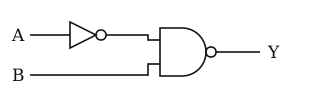
Q163.Two 4 bits binary numbers,
= 1101 and
= 1010 are given in the inputs of a logic circuit shown in figure below. The output (
) will be :
दो 4-बिट द्विआधारी संख्याएँ,
= 1101 तथा
= 1010 नीचे चित्र में दर्शाए गए तर्क परिपथ (logic circuit) के निवेशों पर दी गई हैं। निर्गत (
) होगा :
- A = 1101
- B = 0010
- C = 0111
- D = 1000
Show answer
Concept: passes through a NOT gate; and then feed a NAND gate: (De Morgan).
- .
- (bitwise AND).
- .
Short trick: — bitwise OR gives it instantly.
Answer: (A) = 1101
अवधारणा: एक NOT गेट से गुजरता है; फिर तथा एक NAND गेट में जाते हैं: (डी-मॉर्गन)।
- ।
- (बिटवार AND)।
- ।
शॉर्ट ट्रिक: — बिटवार OR से तुरन्त उत्तर।
उत्तर: (A) = 1101
JEE Main 2026 (April) – Paper 1 (B.E./B.Tech)PhysicsSemiconductors – logic gatesJEE Main 2026 (April) – Paper 1 (B.E./B.Tech) 2026 · 4 Apr Shift 1
Q164.A rod of length 10 cm lies along the principle axis of a concave mirror of focal length 10 cm as shown in figure. The length of the image is _________ cm.
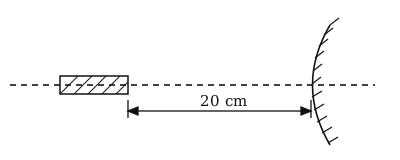
10 cm लंबाई की एक छड़, चित्र में दर्शाए अनुसार 10 cm फोकस दूरी के अवतल दर्पण के मुख्य अक्ष के अनुदिश रखी है। प्रतिबिम्ब की लंबाई _________ cm है।
- A2.5
- B5
- C7.5
- D7
Show answer
Concept: Image each end of the rod separately with the mirror formula (sign convention: , negative for a concave mirror with a real object).
- Near end: cm, cm → , cm.
- Far end: cm → , cm.
- Image length cm.
Short trick: The end at images onto itself ( cm); only the far end moves in to 15 cm → 5 cm.
Answer: (B) 5
अवधारणा: दर्पण सूत्र से छड़ के दोनों सिरों के प्रतिबिम्ब अलग-अलग बनाइए (चिह्न परिपाटी: वास्तविक वस्तु वाले अवतल दर्पण के लिए , ऋणात्मक)।
- निकट सिरा: cm, cm → , cm।
- दूरस्थ सिरा: cm → , cm।
- प्रतिबिम्ब की लंबाई cm।
शॉर्ट ट्रिक: पर स्थित सिरे का प्रतिबिम्ब वहीं बनता है ( cm); केवल दूर वाला सिरा 15 cm पर आता है → 5 cm।
उत्तर: (B) 5
JEE Main 2026 (April) – Paper 1 (B.E./B.Tech)PhysicsRay Optics – image of a rod in a concave mirrorJEE Main 2026 (April) – Paper 1 (B.E./B.Tech) 2026 · 4 Apr Shift 1
Q165.A parallel plate air capacitor is connected to a battery. The plates are pulled apart at uniform speed . If is the separation between the plates at any instant, then the time rate of change of electrostatic energy of the capacitor is proportional to , where is _______.
एक समान्तर पट्टिका वायु संधारित्र एक बैटरी से जुड़ा है। पट्टिकाओं को एकसमान चाल से एक-दूसरे से दूर खींचा जाता है। यदि किसी क्षण पट्टिकाओं के बीच दूरी है, तो संधारित्र की स्थिरवैद्युत ऊर्जा में परिवर्तन की समय-दर के समानुपाती है, जहाँ _______ है।
- A
- B1
- C
- D2
Show answer
Concept: With the battery connected, stays constant, so .
- .
- , , are constants, so .
- Hence . (B) and (D) would need to grow with ; (C) is the power law of itself, not of its rate.
Short trick: at constant ; differentiating w.r.t. time with lowers the power by one → .
Answer: (A)
अवधारणा: बैटरी जुड़ी रहने पर नियत रहता है, अतः ।
- ।
- , , नियत हैं, अतः ।
- अतः । (B) तथा (D) के लिए को के साथ बढ़ना होगा; (C) स्वयं की घात है, उसकी दर की नहीं।
शॉर्ट ट्रिक: नियत पर ; के साथ समय के सापेक्ष अवकलन से घात एक कम हो जाती है → ।
उत्तर: (A)
JEE Main 2026 (April) – Paper 1 (B.E./B.Tech)PhysicsElectrostatics – energy of a capacitor with changing separationJEE Main 2026 (April) – Paper 1 (B.E./B.Tech) 2026 · 4 Apr Shift 1
Q166.An insulated wire is wound so that it forms a flat coil with turns. The radius of the innermost turn is cm, and of the outermost turn cm. If 20 mA current flows in it then the magnetic moment will be A.m2. The value of is_____.
एक विद्युतरोधी तार को इस प्रकार लपेटा जाता है कि वह फेरों वाली एक समतल कुंडली बना ले। सबसे भीतरी फेरे की त्रिज्या cm तथा सबसे बाहरी फेरे की त्रिज्या cm है। यदि इसमें 20 mA धारा प्रवाहित हो, तो चुम्बकीय आघूर्ण A.m2 होगा। का मान_____है।
- A4.4
- B2.64
- C3.25
- D1.2
Show answer
Concept: Turns are spread uniformly from to : number of turns in is , each contributing .
- .
- .
- .
- So .
Short trick: Effective area = ; then that area.
Answer: (B) 2.64
अवधारणा: फेरे से तक एकसमान रूप से फैले हैं: में फेरों की संख्या , और प्रत्येक का योगदान ।
- ।
- ।
- ।
- अतः ।
शॉर्ट ट्रिक: प्रभावी क्षेत्रफल ; फिर यह क्षेत्रफल।
उत्तर: (B) 2.64
JEE Main 2026 (April) – Paper 1 (B.E./B.Tech)PhysicsMagnetism – magnetic moment of a flat spiral coilJEE Main 2026 (April) – Paper 1 (B.E./B.Tech) 2026 · 4 Apr Shift 1
Q167.Consider a circuit consisting of a capacitor (20 μF), resistor (100 Ω) and two identical diodes as shown in figure. The resistance of diode under forward biasing condition is 10 Ω. The time constant of the circuit is
s. The value of
is __________
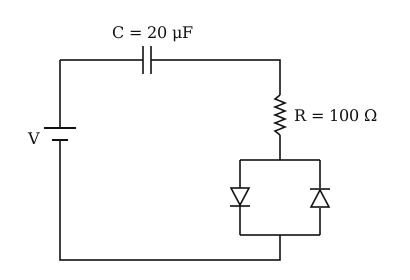
चित्र में दर्शाए अनुसार एक संधारित्र (20 μF), एक प्रतिरोधक (100 Ω) तथा दो सर्वसम डायोडों से बने एक परिपथ पर विचार कीजिए। अग्र अभिनति (forward bias) की स्थिति में डायोड का प्रतिरोध 10 Ω है। परिपथ का समय-नियतांक
s है।
का मान __________ है।
- A2.2
- B2.0
- C2.1
- D2.4
Show answer
Concept: The two diodes are connected in anti-parallel. Whichever way current flows, exactly one diode is forward biased (10 Ω) and the other is reverse biased (open). Time constant .
- (resistor in series with the conducting diode).
- s.
- So . (B) ignores the diode resistance; (C) wrongly puts both diodes in parallel (5 Ω).
Answer: (A) 2.2
अवधारणा: दोनों डायोड प्रति-समान्तर (anti-parallel) जुड़े हैं। धारा किसी भी दिशा में बहे, ठीक एक डायोड अग्र अभिनत (10 Ω) तथा दूसरा पश्च अभिनत (खुला) रहता है। समय-नियतांक ।
- (प्रतिरोधक, चालक डायोड के साथ श्रेणीक्रम में)।
- s।
- अतः । (B) डायोड प्रतिरोध की उपेक्षा करता है; (C) दोनों डायोडों को गलती से समान्तर में (5 Ω) मान लेता है।
उत्तर: (A) 2.2
JEE Main 2026 (April) – Paper 1 (B.E./B.Tech)PhysicsSemiconductors – diodes in an RC circuitJEE Main 2026 (April) – Paper 1 (B.E./B.Tech) 2026 · 4 Apr Shift 1
Q168.The voltage and the current between
and
points shown in the circuit are_____________.
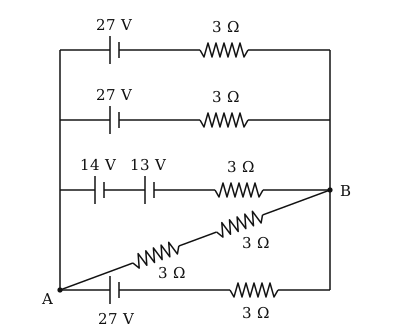
परिपथ में दर्शाए गए बिंदुओं
तथा
के बीच वोल्टता तथा धारा_____________हैं।
- A24 V, 12 A
- B24 V, 4 A
- C18 V, 12 A
- D27 V, 4 A
Show answer
Concept: Between the two vertical rails ( side and side) there are four identical source branches, each of emf 27 V (14 V + 13 V aiding in the third) with 3 Ω internal resistance, and the load = two 3 Ω in series = 6 Ω.
- Four identical branches in parallel: V, .
- Current through : A.
- Voltage across : V.
- (A) and (C) give 12 A, which would need the load to be about 1.5 Ω; (D) ignores the drop across the internal resistance.
Short trick: V, A.
Answer: (B) 24 V, 4 A
अवधारणा: दोनों ऊर्ध्वाधर रेलों ( ओर तथा ओर) के बीच चार सर्वसम स्रोत शाखाएँ हैं, प्रत्येक का विद्युत वाहक बल 27 V (तीसरी में 14 V + 13 V सहायक) तथा 3 Ω प्रतिरोध है; भार = श्रेणीक्रम में दो 3 Ω = 6 Ω।
- समान्तर क्रम में चार सर्वसम शाखाएँ: V, ।
- से धारा: A।
- के सिरों पर वोल्टता: V।
- (A) तथा (C) में 12 A है, जिसके लिए भार लगभग 1.5 Ω होना चाहिए; (D) आंतरिक प्रतिरोध पर विभव-पात की उपेक्षा करता है।
शॉर्ट ट्रिक: V, A।
उत्तर: (B) 24 V, 4 A
JEE Main 2026 (April) – Paper 1 (B.E./B.Tech)PhysicsCurrent Electricity – parallel combination of cellsJEE Main 2026 (April) – Paper 1 (B.E./B.Tech) 2026 · 4 Apr Shift 1
Q169.A telescope with objective diameter is used to observe a distant star emitting light of wavelength 500 nm, at a resolution of radian. The value of is _________ cm.
अभिदृश्यक व्यास वाले एक दूरदर्शी का उपयोग 500 nm तरंगदैर्ध्य का प्रकाश उत्सर्जित करने वाले एक दूरस्थ तारे को रेडियन के विभेदन पर देखने के लिए किया जाता है। का मान _________ cm है।
- A61
- B122
- C244
- D305
Show answer
Concept: Limit of resolution of a telescope (Rayleigh criterion): , where is the objective diameter (here called ).
- .
- m cm.
- (A) and (C) come from wrongly using the factor 0.61 or 2.44 in place of 1.22.
Answer: (B) 122
अवधारणा: दूरदर्शी की विभेदन सीमा (रैले कसौटी): , जहाँ अभिदृश्यक का व्यास है (यहाँ कहा गया है)।
- ।
- m cm।
- (A) तथा (C) 1.22 के स्थान पर गलती से 0.61 या 2.44 गुणांक लेने से आते हैं।
उत्तर: (B) 122
JEE Main 2026 (April) – Paper 1 (B.E./B.Tech)PhysicsWave Optics – resolving power of a telescopeJEE Main 2026 (April) – Paper 1 (B.E./B.Tech) 2026 · 4 Apr Shift 1
Q170.An unpolarized light is incident on the plane interface of air-dielectric medium shown in figure. If the incident angle is equal to Brewster angle, identify the expression representing reflected wave.
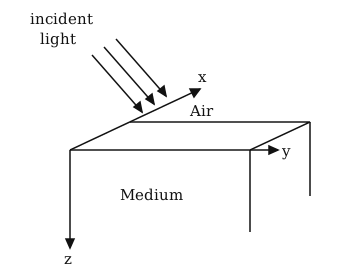
चित्र में दर्शाए गए वायु-परावैद्युत माध्यम के समतल अंतरापृष्ठ पर एक अध्रुवित प्रकाश आपतित होता है। यदि आपतन कोण ब्रूस्टर कोण के बराबर है, तो परावर्तित तरंग को निरूपित करने वाले व्यंजक की पहचान कीजिए।
- A
- B
- C
- D
Show answer
Concept: The interface is the -plane and points into the medium. A reflected wave must travel back into the air (negative -component of ). At the Brewster angle the reflected light is plane polarised with perpendicular to the plane of incidence, i.e. parallel to the interface — so has no -component.
- (B) travels along the surface (no -component) — not a reflected wave.
- (C) travels along , into the medium — that is a transmitted wave.
- (D) travels back into air, but its contains , a component perpendicular to the interface, which is absent in Brewster reflection.
- (A) travels along , i.e. back into the air, and its field lies parallel to the interface — the required reflected wave. (For incidence in the -plane the s-polarised field is along ; the term is that field, and for a transverse wave the term must be zero.)
Short trick: Reflected ⇒ in the phase; Brewster ⇒ no in . Only (A) satisfies both.
Answer: (A)
अवधारणा: अंतरापृष्ठ -तल है तथा माध्यम के भीतर की ओर है। परावर्तित तरंग को वापस वायु में जाना चाहिए ( का -घटक ऋणात्मक)। ब्रूस्टर कोण पर परावर्तित प्रकाश समतल ध्रुवित होता है तथा आपतन तल के लंबवत, अर्थात् अंतरापृष्ठ के समान्तर होता है — अतः का कोई -घटक नहीं होता।
- (B) पृष्ठ के अनुदिश चलती है (-घटक नहीं) — परावर्तित तरंग नहीं।
- (C) दिशा में, अर्थात् माध्यम के भीतर चलती है — यह अपवर्तित (संचरित) तरंग है।
- (D) वायु में वापस जाती है, पर इसके में है, जो अंतरापृष्ठ के लंबवत घटक है और ब्रूस्टर परावर्तन में अनुपस्थित होता है।
- (A) दिशा में, अर्थात् वापस वायु में चलती है, और इसका क्षेत्र अंतरापृष्ठ के समान्तर है — यही अभीष्ट परावर्तित तरंग है। (-तल में आपतन के लिए s-ध्रुवित क्षेत्र के अनुदिश होता है; पद यही क्षेत्र है, तथा अनुप्रस्थ तरंग के लिए पद शून्य होना चाहिए।)
शॉर्ट ट्रिक: परावर्तित ⇒ कला में ; ब्रूस्टर ⇒ में नहीं। केवल (A) दोनों शर्तें पूरी करता है।
उत्तर: (A)
JEE Main 2026 (April) – Paper 1 (B.E./B.Tech)PhysicsWave Optics – Brewster's law and polarisationJEE Main 2026 (April) – Paper 1 (B.E./B.Tech) 2026 · 4 Apr Shift 1
Q171.A 1 kg block subjected to two simultaneous forces N and N is moved a distance of 25 m along direction. The work done in this process is ________J.
1 kg के एक गुटके पर दो बल N तथा N एक साथ लगाए जाते हैं और उसे दिशा के अनुदिश 25 m की दूरी तक चलाया जाता है। इस प्रक्रिया में किया गया कार्य ________J है।
Show answer
Concept: Work by constant forces , where = distance unit vector of the direction.
- N.
- Unit vector along : , so m.
- J.
Short trick: J.
Answer: 35
अवधारणा: नियत बलों द्वारा कार्य , जहाँ = दूरी दिशा का एकांक सदिश।
- N।
- के अनुदिश एकांक सदिश: , अतः m।
- J।
शॉर्ट ट्रिक: J।
उत्तर: 35
JEE Main 2026 (April) – Paper 1 (B.E./B.Tech)PhysicsWork, Energy & Power – work done by constant forcesJEE Main 2026 (April) – Paper 1 (B.E./B.Tech) 2026 · 4 Apr Shift 1
Q172.The surface tension of a soap solution is N/m. The work required to increase the radius of a soap bubble from 1 cm to 2 cm is J. The value of is _______.
()
साबुन के एक विलयन का पृष्ठ तनाव N/m है। साबुन के एक बुलबुले की त्रिज्या 1 cm से 2 cm तक बढ़ाने के लिए आवश्यक कार्य J है। का मान _______ है।
()
Show answer
Concept: Work = surface tension increase in surface area. A soap bubble has two free surfaces (inside and outside), so .
- .
- .
- , so J.
- Hence .
Short trick: ; , so J.
Answer: 264
अवधारणा: कार्य = पृष्ठ तनाव पृष्ठ क्षेत्रफल में वृद्धि। साबुन के बुलबुले के दो मुक्त पृष्ठ (भीतरी तथा बाहरी) होते हैं, अतः ।
- ।
- ।
- , अतः J।
- अतः ।
शॉर्ट ट्रिक: ; , अतः J।
उत्तर: 264
JEE Main 2026 (April) – Paper 1 (B.E./B.Tech)PhysicsMechanical Properties of Fluids – surface energy of a soap bubbleJEE Main 2026 (April) – Paper 1 (B.E./B.Tech) 2026 · 4 Apr Shift 1
Q173.The velocity of a particle executing simple harmonic motion along -axis is described as , where represents displacement. If the time period of motion is s, the value of is ________.
-अक्ष के अनुदिश सरल आवर्त गति करते हुए एक कण का वेग द्वारा व्यक्त किया जाता है, जहाँ विस्थापन को निरूपित करता है। यदि गति का आवर्तकाल s है, तो का मान ________ है।
Show answer
Concept: In SHM, . Comparing coefficients gives , and .
- , rad/s (amplitude m).
- s.
- .
Short trick: Coefficient of is → → .
Answer: 44
अवधारणा: सरल आवर्त गति में । गुणांकों की तुलना से मिलता है, तथा ।
- , rad/s (आयाम m)।
- s।
- ।
शॉर्ट ट्रिक: का गुणांक → → ।
उत्तर: 44
JEE Main 2026 (April) – Paper 1 (B.E./B.Tech)PhysicsOscillations – SHM velocity–displacement relationJEE Main 2026 (April) – Paper 1 (B.E./B.Tech) 2026 · 4 Apr Shift 1
Q174.A body of mass 2 kg begins to move under the influence of time dependent force N, where and are unit vectors along and -axis respectively. The power produced by the force at s is ____W.
2 kg द्रव्यमान की एक वस्तु समय पर निर्भर बल N के प्रभाव में गति प्रारंभ करती है, जहाँ तथा क्रमशः तथा -अक्ष के अनुदिश एकांक सदिश हैं। s पर बल द्वारा उत्पन्न शक्ति ____W है।
Show answer
Concept: The body starts from rest. , integrate to get , then power .
- m/s2.
- ; at s, m/s.
- At s, N.
- W.
Answer: 200
अवधारणा: वस्तु विराम से गति प्रारंभ करती है। , समाकलन से ज्ञात कीजिए, फिर शक्ति ।
- m/s2।
- ; s पर m/s।
- s पर N।
- W।
उत्तर: 200
JEE Main 2026 (April) – Paper 1 (B.E./B.Tech)PhysicsWork, Energy & Power – instantaneous power of a time-varying forceJEE Main 2026 (April) – Paper 1 (B.E./B.Tech) 2026 · 4 Apr Shift 1
Q175.An inductor of 10 mH, capacitor of 0.1 μF and a resistor of 100 Ω are connected in series across an a.c power supply 220 V, 70 Hz. The power factor of the given circuit is 0.5. The difference in the inductive reactance and capacitance reactance is . The value of is ________.
10 mH का एक प्रेरक, 0.1 μF का एक संधारित्र तथा 100 Ω का एक प्रतिरोधक 220 V, 70 Hz की a.c विद्युत आपूर्ति के सिरों पर श्रेणीक्रम में जुड़े हैं। दिए गए परिपथ का शक्ति गुणांक 0.5 है। प्रेरकीय प्रतिघात तथा धारितीय प्रतिघात का अंतर है। का मान ________ है।
Show answer
Concept: In a series LCR circuit, power factor and .
- .
- (equivalently , ).
- .
- Note: the stated power factor fixes the answer; the listed , and frequency are not needed (and are not consistent with ).
Short trick: ⇒ ⇒ ⇒ .
Answer: 100
अवधारणा: श्रेणी LCR परिपथ में शक्ति गुणांक तथा ।
- ।
- (अथवा , )।
- ।
- टिप्पणी: दिया गया शक्ति गुणांक ही उत्तर निर्धारित करता है; दिए गए , तथा आवृत्ति की आवश्यकता नहीं है (और वे से संगत भी नहीं हैं)।
शॉर्ट ट्रिक: ⇒ ⇒ ⇒ ।
उत्तर: 100
JEE Main 2026 (April) – Paper 1 (B.E./B.Tech)PhysicsAlternating Current – power factor of a series LCR circuitJEE Main 2026 (April) – Paper 1 (B.E./B.Tech) 2026 · 4 Apr Shift 1
Q176.Dimensions of universal gravitational constant () in terms of Planck's constant (), distance (), mass () and time () are ________.
प्लांक नियतांक (), दूरी (), द्रव्यमान () तथा समय () के पदों में सार्वत्रिक गुरुत्वाकर्षण नियतांक () की विमाएँ ________ हैं।
- A
- B
- C
- D
Show answer
Concept: Write and equate powers of using and .
- .
- Equate with : , , .
- Every option has except (D); with : , , .
- So .
Short trick: Check option (B) directly: ✓. (A) gives , (C) gives , (D) gives — all wrong.
Answer: (B)
अवधारणा: लिखकर तथा से की घातों की तुलना कीजिए।
- ।
- से तुलना: , , ।
- लेने पर: , , ।
- अतः ।
शॉर्ट ट्रिक: विकल्प (B) को सीधे जाँचिए: ✓। (A) में , (C) में , (D) में आता है — तीनों गलत।
उत्तर: (B)
JEE Main 2026 (April) – Paper 1 (B.E./B.Tech)PhysicsUnits & Dimensions – new base quantitiesJEE Main 2026 (April) – Paper 1 (B.E./B.Tech) 2026 · 2 Apr Shift 2
Q177.A 0.5 kg mass is in contact against the inner wall of a cylindrical drum of radius 4 m rotating about its vertical axis. The minimum rotational speed of the drum to enable the mass to remain stuck to the wall (without falling) is 5 rad/s. The coefficient of friction between the drum's inner wall surface and mass is ________. (Take m/s)
0.5 kg का एक द्रव्यमान, अपने ऊर्ध्वाधर अक्ष के परितः घूर्णन कर रहे 4 m त्रिज्या के बेलनाकार ड्रम की भीतरी दीवार के सम्पर्क में है। द्रव्यमान को दीवार से चिपके रहने (गिरे नहीं) के लिए ड्रम की न्यूनतम घूर्णन चाल 5 rad/s है। ड्रम की भीतरी दीवार की सतह तथा द्रव्यमान के बीच घर्षण गुणांक ________ है। ( m/s लीजिए)
- A0.1
- B0.5
- C0.7
- D0.3
Show answer
Concept: The wall's normal reaction supplies the centripetal force, ; friction balances the weight: at the minimum speed.
- .
- .
Short trick: — mass never matters in a rotor problem.
Answer: (A) 0.1
अवधारणा: दीवार की अभिलम्ब प्रतिक्रिया अभिकेन्द्री बल देती है, ; न्यूनतम चाल पर घर्षण भार को सन्तुलित करता है: ।
- ।
- ।
शॉर्ट ट्रिक: — रोटर के प्रश्न में द्रव्यमान का कोई प्रभाव नहीं होता।
उत्तर: (A) 0.1
JEE Main 2026 (April) – Paper 1 (B.E./B.Tech)PhysicsCircular Motion – rotor (death well)JEE Main 2026 (April) – Paper 1 (B.E./B.Tech) 2026 · 2 Apr Shift 2
Q178.Two blocks of masses 2 kg and 1 kg respectively, are tied to the ends of a string which passes over a light frictionless pulley as shown in the figure below. The masses are held at rest at the same horizontal level and then released. The distance traversed by the centre of mass in 2 s is ________ m. (Take
m/s
)
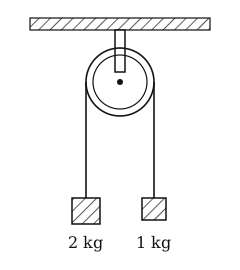
क्रमशः 2 kg तथा 1 kg द्रव्यमान के दो ब्लॉक एक डोरी के सिरों से बँधे हैं, जो नीचे चित्र में दर्शाए अनुसार एक हल्की घर्षणरहित घिरनी के ऊपर से गुजरती है। द्रव्यमानों को एक ही क्षैतिज तल में विरामावस्था में पकड़कर फिर छोड़ दिया जाता है। 2 s में द्रव्यमान केन्द्र द्वारा तय की गई दूरी ________ m है। (
m/s
लीजिए)
- A3.33
- B3.12
- C2.22
- D1.42
Show answer
Concept: In an Atwood machine ; the 2 kg block accelerates down and the 1 kg block up with the same , so (downwards).
- .
- downwards.
- Starting from rest: .
Short trick: , then .
Answer: (C) 2.22
अवधारणा: एटवुड मशीन में ; 2 kg ब्लॉक नीचे तथा 1 kg ब्लॉक ऊपर समान त्वरण से चलता है, अतः (नीचे की ओर)।
- ।
- नीचे की ओर।
- विरामावस्था से: ।
शॉर्ट ट्रिक: , फिर ।
उत्तर: (C) 2.22
JEE Main 2026 (April) – Paper 1 (B.E./B.Tech)PhysicsCentre of Mass – Atwood machineJEE Main 2026 (April) – Paper 1 (B.E./B.Tech) 2026 · 2 Apr Shift 2
Q179.A particle having charge C moving in - plane in fields of N/C and T experiences a force of N. The velocity of the particle at that instant is ________ m/s.
C आवेश का एक कण - तल में N/C तथा T क्षेत्रों में गति करते हुए N बल अनुभव करता है। उस क्षण कण का वेग ________ m/s है।
- A
- B
- C
- D
Show answer
Concept: Lorentz force with , , so .
- N.
- Magnetic part N.
- : : ; : .
- m/s.
Short trick: With along , the -component of magnetic force fixes and the -component fixes — just divide by .
Answer: (A)
अवधारणा: लोरेंज बल , जहाँ , , अतः ।
- N।
- चुम्बकीय भाग N।
- : : ; : ।
- m/s।
शॉर्ट ट्रिक: के के अनुदिश होने पर चुम्बकीय बल का -घटक तथा -घटक निर्धारित करता है — बस से भाग दीजिए।
उत्तर: (A)
JEE Main 2026 (April) – Paper 1 (B.E./B.Tech)PhysicsMoving Charges – Lorentz forceJEE Main 2026 (April) – Paper 1 (B.E./B.Tech) 2026 · 2 Apr Shift 2
Q180.If
and
are the inputs, the given circuit works as ________.
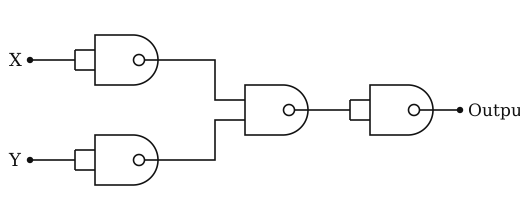
यदि
तथा
निवेशी (inputs) हैं, तो दिया गया परिपथ ________ की भाँति कार्य करता है।
- AOR gateOR गेट
- BAND gateAND गेट
- CNAND gateNAND गेट
- DNOR gateNOR गेट
Show answer
Concept: All four gates are NAND gates. A NAND gate with both inputs tied together works as a NOT gate; and by De Morgan's theorem .
- First two gates (inputs tied): outputs and .
- Middle NAND: (OR of the inputs).
- Last NAND (inputs tied) inverts it: output .
- is the NOR operation.
Short trick: NOT–NOT–NAND makes OR (bubbled-input NAND = OR); one more inverter on an OR gives NOR. Hence (A), (B), (C) are all ruled out.
Answer: (D) NOR gate
अवधारणा: चारों गेट NAND गेट हैं। दोनों निवेश जुड़े NAND गेट NOT गेट की तरह कार्य करता है; तथा डी-मॉर्गन प्रमेय से ।
- पहले दो गेट (निवेश जुड़े): निर्गत तथा ।
- बीच वाला NAND: (निवेशों का OR)।
- अन्तिम NAND (निवेश जुड़े) इसे उलट देता है: निर्गत ।
- ही NOR संक्रिया है।
शॉर्ट ट्रिक: NOT–NOT–NAND मिलकर OR बनाते हैं (बबल-निवेश NAND = OR); OR के बाद एक और इन्वर्टर NOR देता है। अतः (A), (B), (C) तीनों निरस्त।
उत्तर: (D) NOR गेट
JEE Main 2026 (April) – Paper 1 (B.E./B.Tech)PhysicsSemiconductors – logic gatesJEE Main 2026 (April) – Paper 1 (B.E./B.Tech) 2026 · 2 Apr Shift 2

