Q1.Given below are two statements. One is labelled as Assertion (A) and the other is labelled as Reason (R).
 Assertion (A) :
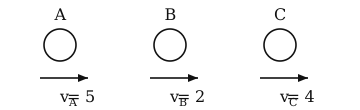
Three identical spheres of same mass undergo one dimensional motion as shown in figure with initial velocities
m/s,
m/s,
m/s. If we wait sufficiently long for elastic collision to happen, then
m/s,
m/s,
m/s will be the final velocities.
Reason (R) : In an elastic collision between identical masses, two objects exchange their velocities.
In the light of the above statements, choose the correct answer from the options given below :
नीचे दो कथन दिए गए हैं। एक को अभिकथन (A) तथा दूसरे को तर्क (R) कहा गया है।
अभिकथन (A) : समान द्रव्यमान के तीन सर्वसम गोले चित्रानुसार प्रारंभिक वेगों
m/s,
m/s,
m/s के साथ एकविमीय गति करते हैं। यदि प्रत्यास्थ संघट्ट (elastic collision) होने के लिए हम पर्याप्त लंबे समय तक प्रतीक्षा करें, तो अंतिम वेग
m/s,
m/s,
m/s होंगे।
तर्क (R) : सर्वसम द्रव्यमानों के बीच प्रत्यास्थ संघट्ट में दोनों वस्तुएँ अपने वेगों का विनिमय कर लेती हैं।
उपर्युक्त कथनों के आलोक में, नीचे दिए गए विकल्पों में से सही उत्तर चुनिए :
- A(A) is false but (R) is true(A) असत्य है परन्तु (R) सत्य है
- BBoth (A) and (R) are true but (R) is NOT the correct explanation of (A)(A) और (R) दोनों सत्य हैं परन्तु (R), (A) की सही व्याख्या नहीं है
- CBoth (A) and (R) are true and (R) is the correct explanation of (A)(A) और (R) दोनों सत्य हैं तथा (R), (A) की सही व्याख्या है
- D(A) is true but (R) is false(A) सत्य है परन्तु (R) असत्य है
Show answer
Concept: In a 1-D elastic collision between equal masses the two bodies simply exchange velocities. Keep applying this until the velocities, read from left to right, are non-decreasing (then no further collision occurs).
- A (5 m/s) catches up with B (2 m/s): exchange → , m/s.
- B (5 m/s) now catches up with C (4 m/s): exchange → , m/s.
- Final set: , , m/s — increasing to the right, so no more collisions.
- Assertion claims , , m/s, which is wrong; the Reason is a correct standard result.
Short trick: With equal-mass elastic chase collisions the final velocities are just the initial set {5, 2, 4} rearranged in increasing order left to right: 2, 4, 5.
Answer: (A)
अवधारणा: समान द्रव्यमानों के एकविमीय प्रत्यास्थ संघट्ट में दोनों पिंड केवल अपने वेगों का विनिमय करते हैं। यह तब तक दोहराएँ जब तक बाएँ से दाएँ पढ़ने पर वेग अह्रासमान (non-decreasing) न हो जाएँ (तब कोई और संघट्ट नहीं होगा)।
- A (5 m/s), B (2 m/s) को पकड़ता है: विनिमय → , m/s।
- अब B (5 m/s), C (4 m/s) को पकड़ता है: विनिमय → , m/s।
- अंतिम वेग: , , m/s — दाईं ओर बढ़ते क्रम में, अतः अब कोई संघट्ट नहीं।
- अभिकथन में , , m/s कहा गया है, जो गलत है; तर्क एक सही मानक परिणाम है।
शॉर्ट ट्रिक: समान द्रव्यमान वाले प्रत्यास्थ पीछा-संघट्टों में अंतिम वेग, प्रारंभिक वेगों {5, 2, 4} को बाएँ से दाएँ बढ़ते क्रम में सजाने से मिलते हैं: 2, 4, 5।
उत्तर: (A)
JEE Main 2025 (January) – Paper 1 (B.E./B.Tech)PhysicsWork, Energy & Collisions – elastic collisionsJEE Main 2025 (January) – Paper 1 (B.E./B.Tech) 2025 · 29 Jan Shift 2
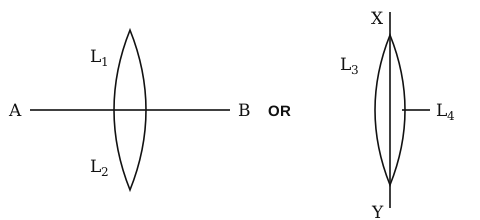
Q2.Two identical symmetric double convex lenses of focal length
are cut into two equal parts
by
plane and
by
plane as shown in figure respectively. The ratio of focal lengths of lenses
and
is
फोकस दूरी के दो सर्वसम सममित उभयोत्तल लेंसों को चित्रानुसार क्रमशः
तल द्वारा दो समान भागों
में तथा
तल द्वारा
में काटा गया है। लेंसों
तथा
की फोकस दूरियों का अनुपात है
- A1:1
- B1:2
- C1:4
- D2:1
Show answer
Concept: Lens maker's formula : the focal length depends only on the radii of the two refracting surfaces, not on the aperture.
- Cutting along the principal axis ( plane): each half keeps both curved surfaces with the same radii, only the aperture is halved → .
- Cutting perpendicular to the axis ( plane): each part is plano-convex, → .
- .
Short trick: Cut along the axis → focal length unchanged; cut across the axis → power halves, focal length doubles.
Answer: (B) 1:2
अवधारणा: लेंस मेकर सूत्र : फोकस दूरी केवल दोनों अपवर्तक पृष्ठों की त्रिज्याओं पर निर्भर करती है, द्वारक (aperture) पर नहीं।
- मुख्य अक्ष के अनुदिश ( तल से) काटने पर: प्रत्येक आधे भाग में दोनों वक्र पृष्ठ समान त्रिज्याओं सहित बने रहते हैं, केवल द्वारक आधा होता है → ।
- अक्ष के लंबवत ( तल से) काटने पर: प्रत्येक भाग समतलोत्तल बनता है, → ।
- ।
शॉर्ट ट्रिक: अक्ष के अनुदिश काटने पर फोकस दूरी अपरिवर्तित; अक्ष के आर-पार काटने पर क्षमता आधी, फोकस दूरी दुगुनी।
उत्तर: (B) 1:2
JEE Main 2025 (January) – Paper 1 (B.E./B.Tech)PhysicsRay Optics – cutting of lensesJEE Main 2025 (January) – Paper 1 (B.E./B.Tech) 2025 · 29 Jan Shift 2
Q3.Two bodies A and B of equal mass are suspended from two massless springs of spring constant and , respectively. If the bodies oscillate vertically such that their amplitudes are equal, the ratio of the maximum velocity of to the maximum velocity of is
समान द्रव्यमान के दो पिंड A तथा B क्रमशः तथा स्प्रिंग नियतांक वाली दो द्रव्यमानहीन स्प्रिंगों से लटकाए गए हैं। यदि दोनों पिंड ऊर्ध्वाधर दिशा में इस प्रकार दोलन करें कि उनके आयाम समान हों, तो के अधिकतम वेग और के अधिकतम वेग का अनुपात है
- A
- B
- C
- D
Show answer
Concept: For SHM, with .
- (equal amplitudes, equal masses).
- .
Answer: (B)
अवधारणा: सरल आवर्त गति में तथा ।
- (समान आयाम, समान द्रव्यमान)।
- ।
उत्तर: (B)
JEE Main 2025 (January) – Paper 1 (B.E./B.Tech)PhysicsOscillations – maximum velocity in SHMJEE Main 2025 (January) – Paper 1 (B.E./B.Tech) 2025 · 29 Jan Shift 2
Q4.Given below are two statements. One is labelled as Assertion (A) and the other is labelled as Reason (R).
Assertion (A) : With the increase in the pressure of an ideal gas, the volume falls off more rapidly in an isothermal process in comparison to the adiabatic process.
Reason (R) : In isothermal process, PV = constant, while in adiabatic process = constant. Here is the ratio of specific heats, P is the pressure and V is the volume of the ideal gas.
In the light of the above statements, choose the correct answer from the options given below :
नीचे दो कथन दिए गए हैं। एक को अभिकथन (A) तथा दूसरे को तर्क (R) कहा गया है।
अभिकथन (A) : आदर्श गैस के दाब में वृद्धि के साथ, रुद्धोष्म प्रक्रम की तुलना में समतापी प्रक्रम में आयतन अधिक तेजी से घटता है।
तर्क (R) : समतापी प्रक्रम में PV = नियतांक, जबकि रुद्धोष्म प्रक्रम में = नियतांक होता है। यहाँ विशिष्ट ऊष्माओं का अनुपात, P दाब तथा V आदर्श गैस का आयतन है।
उपर्युक्त कथनों के आलोक में, नीचे दिए गए विकल्पों में से सही उत्तर चुनिए :
- ABoth (A) and (R) are true and (R) is the correct explanation of (A)(A) और (R) दोनों सत्य हैं तथा (R), (A) की सही व्याख्या है
- BBoth (A) and (R) are true but (R) is NOT the correct explanation of (A)(A) और (R) दोनों सत्य हैं परन्तु (R), (A) की सही व्याख्या नहीं है
- C(A) is true but (R) is false(A) सत्य है परन्तु (R) असत्य है
- D(A) is false but (R) is true(A) असत्य है परन्तु (R) सत्य है
Show answer
Concept: Compare how V depends on P: isothermal ; adiabatic .
- Since , the exponent magnitude , so as P increases, V drops faster in the isothermal process — (A) is true.
- Equivalently, from the two equations, while , which is smaller.
- (R) states exactly these governing equations, from which the comparison follows directly — (R) is true and is the correct explanation of (A).
Answer: (A)
अवधारणा: V की P पर निर्भरता की तुलना करें: समतापी में ; रुद्धोष्म में ।
- चूँकि , घातांक का परिमाण , अतः P बढ़ने पर समतापी प्रक्रम में V अधिक तेजी से घटता है — (A) सत्य है।
- समतुल्य रूप से, दोनों समीकरणों से जबकि , जो छोटा है।
- (R) ठीक यही नियामक समीकरण देता है, जिनसे यह तुलना सीधे निकलती है — (R) सत्य है तथा (A) की सही व्याख्या है।
उत्तर: (A)
JEE Main 2025 (January) – Paper 1 (B.E./B.Tech)PhysicsThermodynamics – isothermal vs adiabaticJEE Main 2025 (January) – Paper 1 (B.E./B.Tech) 2025 · 29 Jan Shift 2
Q5.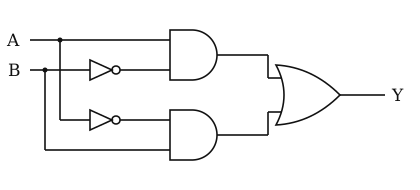
The truth table for the circuit given below is :
नीचे दिए गए परिपथ के लिए सत्यमान सारणी (truth table) है :
- A
- B
- C
- D
Show answer
Concept: The upper AND gate receives A and , the lower AND gate receives and B; their outputs feed an OR gate, so — the XOR combination.
- A = 0, B = 0: .
- A = 0, B = 1: .
- A = 1, B = 0: .
- A = 1, B = 1: .
- Only the table in option (D) matches (output 1 exactly when A ≠ B). Option (A) wrongly gives Y = 0 for A = 1, B = 0; option (B) wrongly gives Y = 1 for A = B = 1; option (C) wrongly gives Y = 0 for A = 0, B = 1.
Short trick: is the XOR gate: Y = 1 only when inputs differ.
Answer: (D)
अवधारणा: ऊपरी AND द्वार को A तथा और निचले AND द्वार को तथा B मिलते हैं; दोनों के निर्गत OR द्वार में जाते हैं, अतः — यह XOR संयोजन है।
- A = 0, B = 0: ।
- A = 0, B = 1: ।
- A = 1, B = 0: ।
- A = 1, B = 1: ।
- केवल विकल्प (D) की सारणी मेल खाती है (A ≠ B होने पर ही निर्गत 1)। विकल्प (A) में A = 1, B = 0 पर Y = 0 गलत है; विकल्प (B) में A = B = 1 पर Y = 1 गलत है; विकल्प (C) में A = 0, B = 1 पर Y = 0 गलत है।
शॉर्ट ट्रिक: XOR द्वार है: निवेश भिन्न होने पर ही Y = 1।
उत्तर: (D)
JEE Main 2025 (January) – Paper 1 (B.E./B.Tech)PhysicsSemiconductors – logic gatesJEE Main 2025 (January) – Paper 1 (B.E./B.Tech) 2025 · 29 Jan Shift 2
Q6.The difference of temperature in a material can convert heat energy into electrical energy. To harvest the heat energy, the material should have
किसी पदार्थ में तापांतर, ऊष्मा ऊर्जा को विद्युत ऊर्जा में परिवर्तित कर सकता है। ऊष्मा ऊर्जा के संचयन (harvest) के लिए पदार्थ में होनी चाहिए
- Ahigh thermal conductivity and high electrical conductivityउच्च ऊष्मा चालकता तथा उच्च विद्युत चालकता
- Blow thermal conductivity and low electrical conductivityनिम्न ऊष्मा चालकता तथा निम्न विद्युत चालकता
- Chigh thermal conductivity and low electrical conductivityउच्च ऊष्मा चालकता तथा निम्न विद्युत चालकता
- Dlow thermal conductivity and high electrical conductivityनिम्न ऊष्मा चालकता तथा उच्च विद्युत चालकता
Show answer
Concept: A thermoelectric (Seebeck) material works on a maintained temperature difference; its merit improves with electrical conductivity and worsens with thermal conductivity (figure of merit ).
- Low thermal conductivity: heat does not leak quickly from hot to cold end, so the temperature difference is sustained.
- High electrical conductivity: the generated current faces little internal resistance, so Joule losses are small and more electrical energy is delivered.
- Hence the material should have low and high .
Answer: (D)
अवधारणा: तापविद्युत (सीबेक) पदार्थ बनाए रखे गए तापांतर पर कार्य करता है; इसकी गुणवत्ता विद्युत चालकता के साथ बढ़ती है और ऊष्मा चालकता के साथ घटती है (गुणता गुणांक )।
- निम्न ऊष्मा चालकता: ऊष्मा गर्म सिरे से ठंडे सिरे तक शीघ्र नहीं बहती, अतः तापांतर बना रहता है।
- उच्च विद्युत चालकता: उत्पन्न धारा को कम आंतरिक प्रतिरोध मिलता है, अतः जूल क्षय कम होता है और अधिक विद्युत ऊर्जा प्राप्त होती है।
- अतः पदार्थ में निम्न तथा उच्च होनी चाहिए।
उत्तर: (D)
JEE Main 2025 (January) – Paper 1 (B.E./B.Tech)PhysicsCurrent Electricity – thermoelectric materialsJEE Main 2025 (January) – Paper 1 (B.E./B.Tech) 2025 · 29 Jan Shift 2
Q7.Match List - I with List - II.
| List - I | List - II |
|---|
| (A) Young’s Modulus | (I) M L−1 T−1 |
| (B) Torque | (II) M L−1 T−2 |
| (C) Coefficient of Viscosity | (III) M−1 L3 T−2 |
| (D) Gravitational Constant | (IV) M L2 T−2 |
Choose the correct answer from the options given below :
सूची - I का सूची - II से मिलान कीजिए।
| सूची - I | सूची - II |
|---|
| (A) यंग प्रत्यास्थता गुणांक | (I) M L−1 T−1 |
| (B) बल आघूर्ण | (II) M L−1 T−2 |
| (C) श्यानता गुणांक | (III) M−1 L3 T−2 |
| (D) गुरुत्वाकर्षण नियतांक | (IV) M L2 T−2 |
नीचे दिए गए विकल्पों में से सही उत्तर चुनिए :
- A(A)-(I), (B)-(III), (C)-(II), (D)-(IV)
- B(A)-(IV), (B)-(II), (C)-(III), (D)-(I)
- C(A)-(II), (B)-(IV), (C)-(I), (D)-(III)
- D(A)-(II), (B)-(I), (C)-(IV), (D)-(III)
Show answer
Concept: Work out each dimension from its defining formula.
- Young's modulus = stress/strain = = = M L−1 T−2 → (II).
- Torque = force × distance = = M L2 T−2 → (IV).
- Viscosity: → = M L−1 T−1 → (I).
- = M−1 L3 T−2 → (III).
Answer: (C) (A)-(II), (B)-(IV), (C)-(I), (D)-(III)
अवधारणा: प्रत्येक राशि की विमा उसके परिभाषा-सूत्र से निकालें।
- यंग प्रत्यास्थता गुणांक = प्रतिबल/विकृति = = = M L−1 T−2 → (II)।
- बल आघूर्ण = बल × दूरी = = M L2 T−2 → (IV)।
- श्यानता: → = M L−1 T−1 → (I)।
- = M−1 L3 T−2 → (III)।
उत्तर: (C) (A)-(II), (B)-(IV), (C)-(I), (D)-(III)
JEE Main 2025 (January) – Paper 1 (B.E./B.Tech)PhysicsUnits & Dimensions – matching dimensionsJEE Main 2025 (January) – Paper 1 (B.E./B.Tech) 2025 · 29 Jan Shift 2
Q8.A sand dropper drops sand of mass on a conveyer belt at a rate proportional to the square root of speed of the belt, i.e. . If P is the power delivered to run the belt at constant speed then which of the following relationship is true?
एक बालू डालने वाला यंत्र (sand dropper) संवाहक पट्टे (conveyer belt) पर द्रव्यमान की बालू, पट्टे की चाल के वर्गमूल के अनुक्रमानुपाती दर से गिराता है, अर्थात् । यदि पट्टे को नियत चाल से चलाने के लिए दी गई शक्ति P हो, तो निम्नलिखित में से कौन-सा संबंध सत्य है?
- A
- B
- C
- D
Show answer
Concept: To keep the belt at constant speed, the motor must supply the force that gives the falling sand the belt's momentum: , and .
- .
- .
- Squaring: .
Answer: (C)
अवधारणा: पट्टे को नियत चाल पर रखने के लिए मोटर को वह बल देना पड़ता है जो गिरती बालू को पट्टे का संवेग प्रदान करे: , तथा ।
- ।
- ।
- वर्ग करने पर: ।
उत्तर: (C)
JEE Main 2025 (January) – Paper 1 (B.E./B.Tech)PhysicsLaws of Motion – variable mass & powerJEE Main 2025 (January) – Paper 1 (B.E./B.Tech) 2025 · 29 Jan Shift 2
Q9.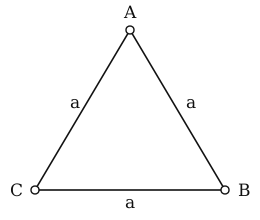
Three equal masses
are kept at vertices (A, B, C) of an equilateral triangle of side a in free space. At
, they are given an initial velocity
,
and
. Here,
,
and
are unit vectors along the edges of the triangle. If the three masses interact gravitationally, then the magnitude of the net angular momentum of the system at the point of collision is :
मुक्त आकाश में a भुजा वाले समबाहु त्रिभुज के शीर्षों (A, B, C) पर
के तीन समान द्रव्यमान रखे हैं।
पर उन्हें प्रारंभिक वेग
,
तथा
दिए जाते हैं। यहाँ
,
तथा
त्रिभुज की भुजाओं के अनुदिश एकांक सदिश हैं। यदि तीनों द्रव्यमान गुरुत्वीय रूप से अन्योन्यक्रिया करें, तो संघट्ट के बिंदु पर निकाय के कुल कोणीय संवेग का परिमाण है :
- A
- B
- C
- D
Show answer
Concept: Gravitational forces are internal, so the angular momentum of the system about the centroid is conserved. Compute it at .
- Each velocity is directed along an edge of the triangle; the line of motion of each mass is that edge itself.
- Perpendicular distance of the centroid from any edge = inradius .
- All three velocities circulate the same way around the centroid (A→C, C→B, B→A), so the contributions add: .
- By conservation, this is also the angular momentum at the point of collision.
Short trick: (inradius) and inradius of an equilateral triangle .
Answer: (C)
अवधारणा: गुरुत्वीय बल आंतरिक हैं, अतः केन्द्रक (centroid) के परितः निकाय का कोणीय संवेग संरक्षित रहता है। इसे पर निकालें।
- प्रत्येक वेग त्रिभुज की किसी भुजा के अनुदिश है; प्रत्येक द्रव्यमान की गति-रेखा वही भुजा है।
- किसी भी भुजा से केन्द्रक की लंबवत दूरी = अंतःत्रिज्या ।
- तीनों वेग केन्द्रक के चारों ओर एक ही दिशा में घूमते हैं (A→C, C→B, B→A), अतः योगदान जुड़ते हैं: ।
- संरक्षण से, संघट्ट के बिंदु पर भी कोणीय संवेग यही है।
शॉर्ट ट्रिक: (अंतःत्रिज्या) तथा समबाहु त्रिभुज की अंतःत्रिज्या ।
उत्तर: (C)
JEE Main 2025 (January) – Paper 1 (B.E./B.Tech)PhysicsRotational Motion – conservation of angular momentumJEE Main 2025 (January) – Paper 1 (B.E./B.Tech) 2025 · 29 Jan Shift 2
Q10.The number of spectral lines emitted by atomic hydrogen that is in the 4th energy level, is
चौथे (4th) ऊर्जा स्तर में स्थित परमाण्विक हाइड्रोजन द्वारा उत्सर्जित स्पेक्ट्रमी रेखाओं की संख्या है
- A3
- B1
- C6
- D0
Show answer
Concept: From level , the maximum number of emission lines is (every pair of levels gives one line).
- : number of lines .
- They are 4→3, 4→2, 4→1, 3→2, 3→1, 2→1.
Answer: (C) 6
अवधारणा: स्तर से उत्सर्जन रेखाओं की अधिकतम संख्या होती है (स्तरों का प्रत्येक युग्म एक रेखा देता है)।
- : रेखाओं की संख्या ।
- ये हैं 4→3, 4→2, 4→1, 3→2, 3→1, 2→1।
उत्तर: (C) 6
JEE Main 2025 (January) – Paper 1 (B.E./B.Tech)PhysicsAtoms – hydrogen spectrumJEE Main 2025 (January) – Paper 1 (B.E./B.Tech) 2025 · 29 Jan Shift 2
Q11.A convex lens made of glass (refractive index = 1.5) has focal length 24 cm in air. When it is totally immersed in water (refractive index = 1.33), its focal length changes to
काँच (अपवर्तनांक = 1.5) से बने एक उत्तल लेंस की वायु में फोकस दूरी 24 cm है। जब इसे जल (अपवर्तनांक = 1.33) में पूर्णतः डुबो दिया जाता है, तो इसकी फोकस दूरी हो जाती है
- A24 cm
- B96 cm
- C48 cm
- D72 cm
Show answer
Concept: , so .
- With , : .
- .
- cm.
Short trick: A glass lens () dipped in water () always becomes 4 times weaker: .
Answer: (B) 96 cm
अवधारणा: , अतः ।
- , के साथ: ।
- ।
- cm।
शॉर्ट ट्रिक: काँच का लेंस () जल () में डुबोने पर सदा 4 गुना कमजोर हो जाता है: ।
उत्तर: (B) 96 cm
JEE Main 2025 (January) – Paper 1 (B.E./B.Tech)PhysicsRay Optics – lens in a mediumJEE Main 2025 (January) – Paper 1 (B.E./B.Tech) 2025 · 29 Jan Shift 2
Q12.In an experiment with photoelectric effect, the stopping potential,
प्रकाश-विद्युत प्रभाव के एक प्रयोग में, निरोधी विभव (stopping potential),
- Aincreases with increase in the intensity of the incident lightआपतित प्रकाश की तीव्रता बढ़ने पर बढ़ता है
- Bdecreases with increase in the intensity of the incident lightआपतित प्रकाश की तीव्रता बढ़ने पर घटता है
- Cincreases with increase in the wavelength of the incident lightआपतित प्रकाश की तरंगदैर्घ्य बढ़ने पर बढ़ता है
- Dis times the maximum kinetic energy of the emitted photoelectronsउत्सर्जित प्रकाश-इलेक्ट्रॉनों की अधिकतम गतिज ऊर्जा का गुना होता है
Show answer
Concept: . The stopping potential depends only on frequency (wavelength) of light and the work function, never on intensity.
- , i.e. times the maximum kinetic energy — option (D) is correct.
- (A), (B) wrong: intensity changes the number of photoelectrons (current), not .
- (C) wrong: increasing wavelength decreases frequency, so decreases.
Answer: (D)
अवधारणा: । निरोधी विभव केवल प्रकाश की आवृत्ति (तरंगदैर्घ्य) तथा कार्य-फलन पर निर्भर करता है, तीव्रता पर कभी नहीं।
- , अर्थात् अधिकतम गतिज ऊर्जा का गुना — विकल्प (D) सही है।
- (A), (B) गलत: तीव्रता से प्रकाश-इलेक्ट्रॉनों की संख्या (धारा) बदलती है, नहीं।
- (C) गलत: तरंगदैर्घ्य बढ़ाने पर आवृत्ति घटती है, अतः घटता है।
उत्तर: (D)
JEE Main 2025 (January) – Paper 1 (B.E./B.Tech)PhysicsDual Nature – photoelectric effectJEE Main 2025 (January) – Paper 1 (B.E./B.Tech) 2025 · 29 Jan Shift 2
Q13.A capacitor,
F is charged to a potential difference of
V using a 5 V battery. The battery is removed and another capacitor,
F is inserted in place of the battery. When the switch 'S' is closed, the charge flows between the capacitors for some time until equilibrium condition is reached. What are the charges (
and
) on the capacitors
and
when equilibrium condition is reached.
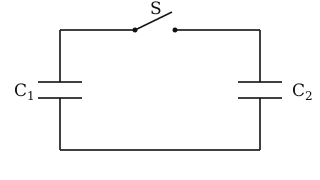
एक संधारित्र
F को 5 V की बैटरी से
V के विभवांतर तक आवेशित किया जाता है। बैटरी हटाकर उसके स्थान पर दूसरा संधारित्र
F जोड़ दिया जाता है। स्विच 'S' बंद करने पर, साम्यावस्था प्राप्त होने तक कुछ समय संधारित्रों के बीच आवेश प्रवाहित होता है। साम्यावस्था प्राप्त होने पर संधारित्रों
तथा
पर आवेश (
तथा
) क्या हैं?
- AC, C
- BC, C
- CC, C
- DC, C
Show answer
Concept: After the switch closes, the two capacitors are in parallel: total charge is shared so that both reach the common potential .
- Initial charge: C.
- Common potential: V.
- C; C.
Short trick: In parallel, charge divides in the ratio of capacitances: of C → 10 and 20 C.
Answer: (A) C, C
अवधारणा: स्विच बंद होने पर दोनों संधारित्र समांतर क्रम में होते हैं: कुल आवेश इस प्रकार बँटता है कि दोनों उभयनिष्ठ विभव पर पहुँच जाएँ।
- प्रारंभिक आवेश: C।
- उभयनिष्ठ विभव: V।
- C; C।
शॉर्ट ट्रिक: समांतर क्रम में आवेश धारिताओं के अनुपात में बँटता है: , C का → 10 तथा 20 C।
उत्तर: (A) C, C
JEE Main 2025 (January) – Paper 1 (B.E./B.Tech)PhysicsCapacitance – common potentialJEE Main 2025 (January) – Paper 1 (B.E./B.Tech) 2025 · 29 Jan Shift 2
Q14.A plane electromagnetic wave propagates along the direction in free space. The components of the electric field, and magnetic field, vectors associated with the wave in Cartesian frame are
मुक्त आकाश में एक समतल विद्युत चुंबकीय तरंग दिशा के अनुदिश संचरित होती है। कार्तीय निर्देश तंत्र में तरंग से संबद्ध विद्युत क्षेत्र तथा चुंबकीय क्षेत्र सदिशों के घटक हैं
- A,
- B,
- C,
- D,
Show answer
Concept: In an EM wave, , and the propagation direction are mutually perpendicular with along the propagation direction.
- Propagation is along , so neither field can have an -component — (A) and (D) are ruled out.
- : taking and gives along . ✔
- (C) fails because , opposite to the propagation.
Answer: (B) ,
अवधारणा: विद्युत चुंबकीय तरंग में , तथा संचरण दिशा परस्पर लंबवत होती हैं और संचरण दिशा के अनुदिश होता है।
- संचरण के अनुदिश है, अतः किसी भी क्षेत्र का -घटक नहीं हो सकता — (A) तथा (D) निरस्त।
- : तथा लेने पर , के अनुदिश मिलता है। ✔
- (C) गलत क्योंकि , संचरण के विपरीत।
उत्तर: (B) ,
JEE Main 2025 (January) – Paper 1 (B.E./B.Tech)PhysicsElectromagnetic Waves – field directionsJEE Main 2025 (January) – Paper 1 (B.E./B.Tech) 2025 · 29 Jan Shift 2
Q15.A cup of coffee cools from C to C in t minutes when the room temperature is C. The time taken by the similar cup of coffee to cool from C to C at the same room temperature is :
कमरे का ताप C होने पर एक कप कॉफी t मिनट में C से C तक ठंडी होती है। उसी कमरे के ताप पर वैसे ही कप कॉफी को C से C तक ठंडा होने में लगा समय है :
- A
- B
- C
- D
Show answer
Concept: Newton's law of cooling (average form): .
- : .
- : .
- Dividing: → .
Answer: (D)
अवधारणा: न्यूटन का शीतलन नियम (औसत रूप): ।
- : ।
- : ।
- भाग देने पर: → ।
उत्तर: (D)
JEE Main 2025 (January) – Paper 1 (B.E./B.Tech)PhysicsThermal Properties – Newton's law of coolingJEE Main 2025 (January) – Paper 1 (B.E./B.Tech) 2025 · 29 Jan Shift 2
Q16.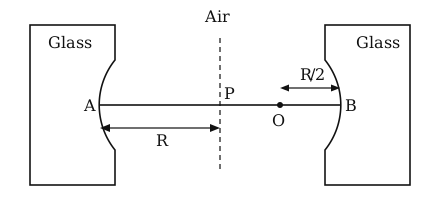
Two concave refracting surfaces of equal radii of curvature and refractive index 1.5 face each other in air as shown in figure. A point object O is placed midway, between P and B. The separation between the images of O, formed by each refracting surface is :
समान वक्रता त्रिज्या तथा 1.5 अपवर्तनांक वाले दो अवतल अपवर्तक पृष्ठ चित्रानुसार वायु में एक-दूसरे के सम्मुख हैं। एक बिंदु वस्तु O को P तथा B के ठीक बीच में रखा गया है। प्रत्येक अपवर्तक पृष्ठ द्वारा बनाए गए O के प्रतिबिंबों के बीच की दूरी है :
- A0.214 R
- B0.411 R
- C0.124 R
- D0.114 R
Show answer
Concept: Refraction at a spherical surface: . From the figure, the poles A and B are apart with P the midpoint (), and O lies midway between P and B, so and . For each surface the centre of curvature is on the object side, so the signed radius is .
- Surface B (): → , i.e. image at from B towards O.
- Surface A (): → , i.e. image at from A towards O.
- Taking A as origin (B at ): at , at .
- Separation .
Answer: (D) 0.114 R
अवधारणा: गोलीय पृष्ठ पर अपवर्तन: । चित्र से, ध्रुव A तथा B परस्पर दूरी पर हैं, P मध्यबिंदु है (), और O, P तथा B के बीचोबीच है, अतः तथा । प्रत्येक पृष्ठ का वक्रता केंद्र वस्तु की ओर है, अतः चिह्न सहित त्रिज्या है।
- पृष्ठ B (): → , अर्थात् प्रतिबिंब , B से O की ओर पर।
- पृष्ठ A (): → , अर्थात् प्रतिबिंब , A से O की ओर पर।
- A को मूलबिंदु लेने पर (B, पर): , पर; , पर।
- दूरी ।
उत्तर: (D) 0.114 R
JEE Main 2025 (January) – Paper 1 (B.E./B.Tech)PhysicsRay Optics – refraction at spherical surfaceJEE Main 2025 (January) – Paper 1 (B.E./B.Tech) 2025 · 29 Jan Shift 2
Q17.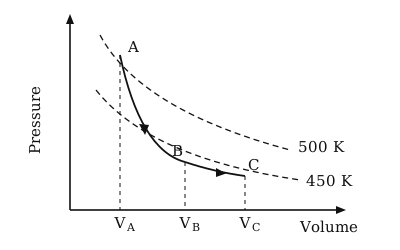
A poly-atomic molecule (
,
, where
is gas constant) goes from phase space point A
to point B
to point C
. A to B is an adiabatic path and B to C is an isothermal path. The net heat absorbed per unit mole by the system is :
एक बहुपरमाणुक अणु (
,
, जहाँ
गैस नियतांक है) कला समष्टि (phase space) बिंदु A
से बिंदु B
होते हुए बिंदु C
तक जाता है। A से B रुद्धोष्म पथ है तथा B से C समतापी पथ है। निकाय द्वारा प्रति मोल अवशोषित नेट ऊष्मा है :
- A
- B
- C
- D
Show answer
Concept: Adiabatic path: . Isothermal path: . From the diagram, B and C lie on the 450 K isotherm.
- (adiabatic).
- per mole .
- Net heat per mole .
Answer: (B)
अवधारणा: रुद्धोष्म पथ: । समतापी पथ: । आरेख से, B तथा C, 450 K समताप रेखा पर हैं।
- (रुद्धोष्म)।
- प्रति मोल ।
- प्रति मोल नेट ऊष्मा ।
उत्तर: (B)
JEE Main 2025 (January) – Paper 1 (B.E./B.Tech)PhysicsThermodynamics – heat in adiabatic & isothermal processesJEE Main 2025 (January) – Paper 1 (B.E./B.Tech) 2025 · 29 Jan Shift 2
Q18.Match List - I with List - II.
| List - I | List - II |
|---|
| (A) Magnetic induction | (I) Ampere meter2 |
| (B) Magnetic intensity | (II) Weber |
| (C) Magnetic flux | (III) Gauss |
| (D) Magnetic moment | (IV) Ampere/meter |
सूची - I का सूची - II से मिलान कीजिए।
| सूची - I | सूची - II |
|---|
| (A) चुंबकीय प्रेरण | (I) ऐम्पियर मीटर2 |
| (B) चुंबकीय तीव्रता | (II) वेबर |
| (C) चुंबकीय फ्लक्स | (III) गाउस |
| (D) चुंबकीय आघूर्ण | (IV) ऐम्पियर/मीटर |
- A(A)-(I), (B)-(II), (C)-(III), (D)-(IV)
- B(A)-(III), (B)-(IV), (C)-(I), (D)-(II)
- C(A)-(III), (B)-(II), (C)-(I), (D)-(IV)
- D(A)-(III), (B)-(IV), (C)-(II), (D)-(I)
Show answer
Concept: Recall the units of B, H, and m.
- Magnetic induction B: SI unit tesla; its CGS unit is the gauss (1 G = T) → (III).
- Magnetic intensity H: from , unit ampere/meter → (IV).
- Magnetic flux : unit weber → (II).
- Magnetic moment : unit ampere meter2 → (I).
Answer: (D) (A)-(III), (B)-(IV), (C)-(II), (D)-(I)
अवधारणा: B, H, तथा m के मात्रक याद करें।
- चुंबकीय प्रेरण B: SI मात्रक टेस्ला; CGS मात्रक गाउस (1 G = T) → (III)।
- चुंबकीय तीव्रता H: से, मात्रक ऐम्पियर/मीटर → (IV)।
- चुंबकीय फ्लक्स : मात्रक वेबर → (II)।
- चुंबकीय आघूर्ण : मात्रक ऐम्पियर मीटर2 → (I)।
उत्तर: (D) (A)-(III), (B)-(IV), (C)-(II), (D)-(I)
JEE Main 2025 (January) – Paper 1 (B.E./B.Tech)PhysicsMagnetism – units of magnetic quantitiesJEE Main 2025 (January) – Paper 1 (B.E./B.Tech) 2025 · 29 Jan Shift 2
Q19.A point charge causes an electric flux of to pass through a spherical Gaussian surface of 8.0 cm radius, centred on the charge. The value of the point charge is : (Given )
एक बिंदु आवेश, अपने पर केंद्रित 8.0 cm त्रिज्या के गोलीय गाउसीय पृष्ठ से का विद्युत फ्लक्स गुजारता है। बिंदु आवेश का मान है : (दिया है )
- A C
- B C
- C C
- D C
Show answer
Concept: Gauss's law: — the flux through a closed surface depends only on the enclosed charge, not on the radius.
- C.
- C.
- The 8.0 cm radius is extra information; negative flux correctly gives a negative charge.
Answer: (D) C
अवधारणा: गाउस का नियम: — बंद पृष्ठ से फ्लक्स केवल परिबद्ध आवेश पर निर्भर करता है, त्रिज्या पर नहीं।
- C।
- C।
- 8.0 cm त्रिज्या अतिरिक्त सूचना है; ऋणात्मक फ्लक्स से आवेश ऋणात्मक ही आता है।
उत्तर: (D) C
JEE Main 2025 (January) – Paper 1 (B.E./B.Tech)PhysicsElectric Charges and Fields – Gauss's lawJEE Main 2025 (January) – Paper 1 (B.E./B.Tech) 2025 · 29 Jan Shift 2
Q20.An electric dipole is placed at a distance of 2 cm from an infinite plane sheet having positive charge density
.
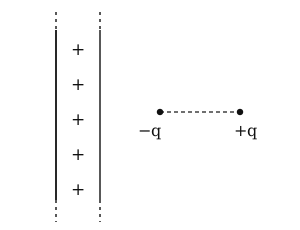
Choose the correct option from the following.
धनात्मक आवेश घनत्व
वाली एक अनंत समतल चादर से 2 cm की दूरी पर एक विद्युत द्विध्रुव रखा गया है।
निम्नलिखित में से सही विकल्प चुनिए।
- APotential energy and torque both are maximum.स्थितिज ऊर्जा तथा बल आघूर्ण दोनों अधिकतम हैं।
- BTorque on dipole is zero and net force is directed away from the sheet.द्विध्रुव पर बल आघूर्ण शून्य है तथा नेट बल चादर से दूर की ओर निर्देशित है।
- CTorque on dipole is zero and net force acts towards the sheet.द्विध्रुव पर बल आघूर्ण शून्य है तथा नेट बल चादर की ओर कार्य करता है।
- DPotential energy of dipole is minimum and torque is zero.द्विध्रुव की स्थितिज ऊर्जा न्यूनतम है तथा बल आघूर्ण शून्य है।
Show answer
Concept: The field of an infinite charged sheet is uniform: , directed away from the positive sheet. For a dipole in a uniform field: , , .
- From the figure, is nearer the sheet and farther, so (from to ) points away from the sheet, parallel to ().
- Torque: ; potential energy: , the minimum value.
- (B) and (C) are wrong because the field is uniform, so the net force on the dipole is zero; (A) is wrong since neither quantity is maximum.
Answer: (D)
अवधारणा: अनंत आवेशित चादर का क्षेत्र एकसमान होता है: , धनात्मक चादर से दूर की ओर। एकसमान क्षेत्र में द्विध्रुव के लिए: , , ।
- चित्र से, चादर के निकट तथा दूर है, अतः ( से की ओर) चादर से दूर, के समांतर है ()।
- बल आघूर्ण: ; स्थितिज ऊर्जा: , न्यूनतम मान।
- (B) तथा (C) गलत हैं क्योंकि क्षेत्र एकसमान है, अतः द्विध्रुव पर नेट बल शून्य है; (A) गलत है क्योंकि कोई भी राशि अधिकतम नहीं है।
उत्तर: (D)
JEE Main 2025 (January) – Paper 1 (B.E./B.Tech)PhysicsElectrostatics – dipole in a uniform fieldJEE Main 2025 (January) – Paper 1 (B.E./B.Tech) 2025 · 29 Jan Shift 2

