Q201.Given below are two statements :
Statement (I) : Nitrogen, sulphur, halogen and phosphorus present in an organic compound are detected by Lassaigne's Test.
Statement (II) : The elements present in the compound are converted from covalent form into ionic form by fusing the compound with Magnesium in Lassaigne's test.
In the light of the above statements, choose the correct answer from the options given below :
नीचे दो कथन दिए गए हैं :
कथन (I) : किसी कार्बनिक यौगिक में उपस्थित नाइट्रोजन, सल्फर, हैलोजन तथा फॉस्फोरस की पहचान लैसें परीक्षण (Lassaigne's Test) द्वारा की जाती है।
कथन (II) : लैसें परीक्षण में यौगिक को मैग्नीशियम के साथ संगलित करके यौगिक में उपस्थित तत्वों को सहसंयोजक रूप से आयनिक रूप में परिवर्तित किया जाता है।
उपर्युक्त कथनों के आलोक में, नीचे दिए गए विकल्पों में से सही उत्तर चुनिए :
- AStatement I is false but Statement II is trueकथन I असत्य है परन्तु कथन II सत्य है
- BBoth Statement I and Statement II are trueकथन I और कथन II दोनों सत्य हैं
- CBoth Statement I and Statement II are falseकथन I और कथन II दोनों असत्य हैं
- DStatement I is true but Statement II is falseकथन I सत्य है परन्तु कथन II असत्य है
Show answer
Concept: In Lassaigne's test the organic compound is fused with sodium metal; N, S, halogens and P are thereby converted from covalent form into ionic form (NaCN, Na2S, NaX, Na3PO4) and then detected in the sodium fusion extract.
- Statement I is true: nitrogen, sulphur, halogens and phosphorus are all detected by Lassaigne's test.
- Statement II is false: the fusion is done with sodium, not magnesium. Sodium is used because it is highly reactive and converts the elements into water-soluble ionic salts.
Short trick: Lassaigne = Na-fusion. Any statement replacing Na by Mg/K is wrong.
Answer: (D)
अवधारणा: लैसें परीक्षण में कार्बनिक यौगिक को सोडियम धातु के साथ संगलित किया जाता है; इससे N, S, हैलोजन तथा P सहसंयोजक रूप से आयनिक रूप (NaCN, Na2S, NaX, Na3PO4) में बदल जाते हैं और सोडियम संगलन निष्कर्ष में उनकी पहचान की जाती है।
- कथन I सत्य है : नाइट्रोजन, सल्फर, हैलोजन तथा फॉस्फोरस सभी की पहचान लैसें परीक्षण से होती है।
- कथन II असत्य है : संगलन सोडियम से किया जाता है, मैग्नीशियम से नहीं। सोडियम अत्यधिक क्रियाशील है और तत्वों को जल में विलेय आयनिक लवणों में बदल देता है।
शॉर्ट ट्रिक: लैसें = Na-संगलन। Na के स्थान पर Mg/K लिखा कथन गलत होता है।
उत्तर: (D)
JEE Main 2025 (January) – Paper 1 (B.E./B.Tech)ChemistryOrganic chemistry – Detection of elements (Lassaigne's test)JEE Main 2025 (January) – Paper 1 (B.E./B.Tech) 2025 · 22 Jan Shift 2
Q202.Density of 3 M NaCl solution is 1.25 g/mL. The molality of the solution is :
3 M NaCl विलयन का घनत्व 1.25 g/mL है। विलयन की मोललता (molality) है :
- A1.79 m
- B2.79 m
- C2 m
- D3 m
Show answer
Concept: Molality . Take 1 L of solution and subtract the mass of solute from the mass of solution.
- In 1 L of solution: moles of NaCl = 3 mol; mass of NaCl = 3 × 58.5 = 175.5 g.
- Mass of 1 L solution = 1000 mL × 1.25 g/mL = 1250 g.
- Mass of water = 1250 − 175.5 = 1074.5 g = 1.0745 kg.
- Molality = = 2.79 m.
Short trick: = ≈ 2.79 m.
Answer: (B) 2.79 m
अवधारणा: मोललता । 1 L विलयन लेकर विलयन के द्रव्यमान में से विलेय का द्रव्यमान घटाइए।
- 1 L विलयन में : NaCl के मोल = 3 mol; NaCl का द्रव्यमान = 3 × 58.5 = 175.5 g।
- 1 L विलयन का द्रव्यमान = 1000 mL × 1.25 g/mL = 1250 g।
- जल का द्रव्यमान = 1250 − 175.5 = 1074.5 g = 1.0745 kg।
- मोललता = = 2.79 m।
शॉर्ट ट्रिक: = ≈ 2.79 m।
उत्तर: (B) 2.79 m
JEE Main 2025 (January) – Paper 1 (B.E./B.Tech)ChemistrySolutions – Molarity and molalityJEE Main 2025 (January) – Paper 1 (B.E./B.Tech) 2025 · 22 Jan Shift 2
Q203.The correct order of the following complexes in terms of their crystal field stabilization energies is :
निम्नलिखित संकुलों का उनकी क्रिस्टल क्षेत्र स्थायीकरण ऊर्जा (crystal field stabilization energy) के पदों में सही क्रम है :
- A[Co(NH3)4]2+ < [Co(NH3)6]2+ < [Co(en)3]3+ < [Co(NH3)6]3+
- B[Co(NH3)6]2+ < [Co(NH3)6]3+ < [Co(NH3)4]2+ < [Co(en)3]3+
- C[Co(en)3]3+ < [Co(NH3)6]3+ < [Co(NH3)6]2+ < [Co(NH3)4]2+
- D[Co(NH3)4]2+ < [Co(NH3)6]2+ < [Co(NH3)6]3+ < [Co(en)3]3+
Show answer
Concept: CFSE increases with (i) octahedral > tetrahedral geometry (), (ii) higher oxidation state of the metal, and (iii) stronger field ligand (en > NH3 in the spectrochemical series).
- [Co(NH3)4]2+ is tetrahedral → smallest splitting, least CFSE.
- [Co(NH3)6]2+ is octahedral but Co is only +2 → moderate CFSE.
- [Co(NH3)6]3+ has Co3+ → larger Δo than the Co2+ complex.
- [Co(en)3]3+ has Co3+ with the stronger chelating ligand en → largest CFSE.
- Hence [Co(NH3)4]2+ < [Co(NH3)6]2+ < [Co(NH3)6]3+ < [Co(en)3]3+.
Short trick: Geometry first (Td < Oh), then oxidation state, then ligand strength.
Answer: (D)
अवधारणा: CFSE बढ़ती है : (i) अष्टफलकीय > चतुष्फलकीय ज्यामिति (), (ii) धातु की उच्च ऑक्सीकरण अवस्था, तथा (iii) प्रबल क्षेत्र लिगन्ड (स्पेक्ट्रोरासायनिक श्रेणी में en > NH3)।
- [Co(NH3)4]2+ चतुष्फलकीय है → सबसे कम विपाटन, न्यूनतम CFSE।
- [Co(NH3)6]2+ अष्टफलकीय है परन्तु Co केवल +2 में है → मध्यम CFSE।
- [Co(NH3)6]3+ में Co3+ है → Co2+ संकुल से बड़ा Δo।
- [Co(en)3]3+ में Co3+ के साथ प्रबल कीलेटी लिगन्ड en है → अधिकतम CFSE।
- अतः [Co(NH3)4]2+ < [Co(NH3)6]2+ < [Co(NH3)6]3+ < [Co(en)3]3+।
शॉर्ट ट्रिक: पहले ज्यामिति (Td < Oh), फिर ऑक्सीकरण अवस्था, फिर लिगन्ड की प्रबलता।
उत्तर: (D)
JEE Main 2025 (January) – Paper 1 (B.E./B.Tech)ChemistryCoordination compounds – Crystal field stabilization energyJEE Main 2025 (January) – Paper 1 (B.E./B.Tech) 2025 · 22 Jan Shift 2
Q204.Given below are two statements :
Statement (I) : Corrosion is an electrochemical phenomenon in which pure metal acts as an anode and impure metal as a cathode.
Statement (II) : The rate of corrosion is more in alkaline medium than in acidic medium.
In the light of the above statements, choose the correct answer from the options given below :
नीचे दो कथन दिए गए हैं :
कथन (I) : संक्षारण (corrosion) एक वैद्युतरासायनिक परिघटना है जिसमें शुद्ध धातु ऐनोड के रूप में तथा अशुद्ध धातु कैथोड के रूप में कार्य करती है।
कथन (II) : क्षारीय माध्यम में संक्षारण की दर अम्लीय माध्यम की अपेक्षा अधिक होती है।
उपर्युक्त कथनों के आलोक में, नीचे दिए गए विकल्पों में से सही उत्तर चुनिए :
- ABoth Statement I and Statement II are trueकथन I और कथन II दोनों सत्य हैं
- BStatement I is false but Statement II is trueकथन I असत्य है परन्तु कथन II सत्य है
- CStatement I is true but Statement II is falseकथन I सत्य है परन्तु कथन II असत्य है
- DBoth Statement I and Statement II are falseकथन I और कथन II दोनों असत्य हैं
Show answer
Concept: Corrosion works like a tiny electrochemical cell on the metal surface: the pure metal portion is oxidised (anode) while the impurity/less active spot serves as the cathode where O2 is reduced. H+ ions accelerate corrosion.
- Statement I is true: at the anodic spot the pure metal loses electrons (M → Mn+ + ne−); the impurity acts as the cathode.
- Statement II is false: corrosion is faster in acidic medium, because the cathodic reaction O2 + 4H+ + 4e− → 2H2O is favoured at high [H+]; in alkaline medium corrosion is suppressed.
Short trick: Rust loves acid rain — more H+, faster corrosion.
Answer: (C)
अवधारणा: संक्षारण धातु की सतह पर बने एक लघु वैद्युतरासायनिक सेल की तरह होता है : शुद्ध धातु वाला भाग ऑक्सीकृत होता है (ऐनोड) जबकि अशुद्धि वाला स्थान कैथोड बनता है जहाँ O2 अपचयित होती है। H+ आयन संक्षारण को तीव्र करते हैं।
- कथन I सत्य है : ऐनोडी स्थल पर शुद्ध धातु इलेक्ट्रॉन त्यागती है (M → Mn+ + ne−); अशुद्धि कैथोड का कार्य करती है।
- कथन II असत्य है : संक्षारण अम्लीय माध्यम में तीव्र होता है, क्योंकि उच्च [H+] पर कैथोडी अभिक्रिया O2 + 4H+ + 4e− → 2H2O अनुकूल होती है; क्षारीय माध्यम में संक्षारण मंद हो जाता है।
शॉर्ट ट्रिक: जंग को अम्ल प्रिय है — जितने अधिक H+, उतना तीव्र संक्षारण।
उत्तर: (C)
JEE Main 2025 (January) – Paper 1 (B.E./B.Tech)ChemistryElectrochemistry – CorrosionJEE Main 2025 (January) – Paper 1 (B.E./B.Tech) 2025 · 22 Jan Shift 2
Q205.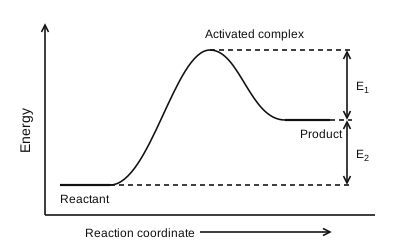
Consider the given figure and choose the correct option :
दिए गए चित्र पर विचार कीजिए तथा सही विकल्प चुनिए :
- AActivation energy of both forward and backward reaction is E1 + E2 and reactant is more stable than product.अग्र तथा प्रतीप दोनों अभिक्रियाओं की सक्रियण ऊर्जा E1 + E2 है तथा अभिकारक, उत्पाद से अधिक स्थायी है।
- BActivation energy of forward reaction is E1 + E2 and product is less stable than reactant.अग्र अभिक्रिया की सक्रियण ऊर्जा E1 + E2 है तथा उत्पाद, अभिकारक से कम स्थायी है।
- CActivation energy of backward reaction is E1 and product is more stable than reactant.प्रतीप अभिक्रिया की सक्रियण ऊर्जा E1 है तथा उत्पाद, अभिकारक से अधिक स्थायी है।
- DActivation energy of forward reaction is E1 + E2 and product is more stable than reactant.अग्र अभिक्रिया की सक्रियण ऊर्जा E1 + E2 है तथा उत्पाद, अभिकारक से अधिक स्थायी है।
Show answer
Concept: Activation energy = energy gap between the starting level and the peak (activated complex); the lower the energy level, the more stable the species.
- From the figure, the product level lies E1 below the peak and the reactant level lies E2 below the product level.
- Forward activation energy (reactant → peak) = E1 + E2; backward activation energy (product → peak) = E1.
- The product lies at higher energy than the reactant → product is less stable than reactant (endothermic reaction).
- (A) is wrong because backward Ea is only E1; (C) and (D) are wrong because the product is less stable, not more stable.
Short trick: Lower level = more stable; Ea is always measured up to the hump.
Answer: (B)
अवधारणा: सक्रियण ऊर्जा = प्रारम्भिक स्तर और शिखर (सक्रियित संकुल) के बीच का ऊर्जा अन्तर; जितना नीचा ऊर्जा स्तर, उतनी अधिक स्थायी स्पीशीज़।
- चित्र से, उत्पाद का स्तर शिखर से E1 नीचे है तथा अभिकारक का स्तर उत्पाद से E2 नीचे है।
- अग्र अभिक्रिया की सक्रियण ऊर्जा (अभिकारक → शिखर) = E1 + E2; प्रतीप अभिक्रिया की सक्रियण ऊर्जा (उत्पाद → शिखर) = E1।
- उत्पाद, अभिकारक से ऊँची ऊर्जा पर है → उत्पाद अभिकारक से कम स्थायी है (ऊष्माशोषी अभिक्रिया)।
- (A) गलत है क्योंकि प्रतीप Ea केवल E1 है; (C) तथा (D) गलत हैं क्योंकि उत्पाद कम स्थायी है, अधिक नहीं।
शॉर्ट ट्रिक: नीचा स्तर = अधिक स्थायी; Ea सदैव शिखर तक मापी जाती है।
उत्तर: (B)
JEE Main 2025 (January) – Paper 1 (B.E./B.Tech)ChemistryChemical kinetics – Energy profile diagramJEE Main 2025 (January) – Paper 1 (B.E./B.Tech) 2025 · 22 Jan Shift 2
Q206.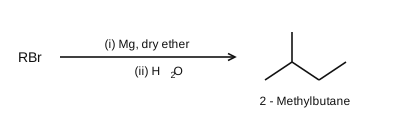
The maximum number of RBr producing 2-methylbutane by above sequence of reactions is ________ (Consider the structural isomers only)
उपरोक्त अभिक्रिया अनुक्रम द्वारा 2-मेथिलब्यूटेन देने वाले RBr की अधिकतम संख्या ________ है। (केवल संरचनात्मक समावयवियों (structural isomers) पर विचार कीजिए)
- A5
- B4
- C3
- D1
Show answer
Concept: RBr + Mg (dry ether) gives RMgBr, which on hydrolysis gives the alkane R–H. So every structurally different monobromide of 2-methylbutane gives 2-methylbutane.
- The carbon skeleton of R must be that of 2-methylbutane (C5H11–Br).
- Distinct positions for Br on the 2-methylbutane skeleton: C-1 (1-bromo-2-methylbutane), C-2 (2-bromo-2-methylbutane), C-3 (2-bromo-3-methylbutane) and C-4 (1-bromo-3-methylbutane).
- Hence 4 structural isomers of RBr give 2-methylbutane.
Short trick: Number of monobromo structural isomers = number of different types of H in 2-methylbutane = 4.
Answer: (B)
अवधारणा: RBr + Mg (शुष्क ईथर) से RMgBr बनता है, जो जल-अपघटन पर ऐल्केन R–H देता है। अतः 2-मेथिलब्यूटेन का प्रत्येक संरचनात्मक रूप से भिन्न मोनोब्रोमाइड 2-मेथिलब्यूटेन देगा।
- R का कार्बन कंकाल 2-मेथिलब्यूटेन का होना चाहिए (C5H11–Br)।
- 2-मेथिलब्यूटेन के कंकाल पर Br की भिन्न स्थितियाँ : C-1 (1-ब्रोमो-2-मेथिलब्यूटेन), C-2 (2-ब्रोमो-2-मेथिलब्यूटेन), C-3 (2-ब्रोमो-3-मेथिलब्यूटेन) तथा C-4 (1-ब्रोमो-3-मेथिलब्यूटेन)।
- अतः RBr के 4 संरचनात्मक समावयवी 2-मेथिलब्यूटेन देते हैं।
शॉर्ट ट्रिक: मोनोब्रोमो संरचनात्मक समावयवियों की संख्या = 2-मेथिलब्यूटेन में भिन्न प्रकार के H की संख्या = 4।
उत्तर: (B)
JEE Main 2025 (January) – Paper 1 (B.E./B.Tech)ChemistryHaloalkanes – Grignard reagentJEE Main 2025 (January) – Paper 1 (B.E./B.Tech) 2025 · 22 Jan Shift 2
Q207.The species which does not undergo disproportionation reaction is :
वह स्पीशीज़ जो विषमानुपातन (disproportionation) अभिक्रिया प्रदर्शित नहीं करती है, है :
- AClO3−
- BClO−
- CClO2−
- DClO4−
Show answer
Concept: Disproportionation needs an element in an intermediate oxidation state, so that it can be simultaneously oxidised and reduced.
- Oxidation state of Cl: ClO− (+1), ClO2− (+3), ClO3− (+5), ClO4− (+7).
- In ClO4−, chlorine is in its highest possible oxidation state (+7); it cannot be oxidised further, so it cannot disproportionate.
- ClO−, ClO2− and ClO3− have Cl in intermediate states and do disproportionate (e.g. 4ClO3− → Cl− + 3ClO4−).
Short trick: Highest oxidation state ⇒ no disproportionation.
Answer: (D)
अवधारणा: विषमानुपातन के लिए तत्व का मध्यवर्ती ऑक्सीकरण अवस्था में होना आवश्यक है, ताकि वह एक साथ ऑक्सीकृत एवं अपचयित हो सके।
- Cl की ऑक्सीकरण अवस्था : ClO− (+1), ClO2− (+3), ClO3− (+5), ClO4− (+7)।
- ClO4− में क्लोरीन अपनी उच्चतम सम्भव ऑक्सीकरण अवस्था (+7) में है; इसका और ऑक्सीकरण सम्भव नहीं, अतः यह विषमानुपातित नहीं हो सकता।
- ClO−, ClO2− तथा ClO3− में Cl मध्यवर्ती अवस्था में है और ये विषमानुपातन दर्शाते हैं (जैसे 4ClO3− → Cl− + 3ClO4−)।
शॉर्ट ट्रिक: उच्चतम ऑक्सीकरण अवस्था ⇒ विषमानुपातन नहीं।
उत्तर: (D)
JEE Main 2025 (January) – Paper 1 (B.E./B.Tech)ChemistryRedox reactions – DisproportionationJEE Main 2025 (January) – Paper 1 (B.E./B.Tech) 2025 · 22 Jan Shift 2
Q208.The molar solubility(s) of zirconium phosphate with molecular formula (Zr4+)3(PO43−)4 is given by relation :
अणुसूत्र (Zr4+)3(PO43−)4 वाले ज़र्कोनियम फॉस्फेट की मोलर विलेयता (s) निम्न सम्बन्ध द्वारा दी जाती है :
- A
- B
- C
- D
Show answer
Concept: For a salt AxBy with molar solubility s, .
- Zr3(PO4)4 ⇌ 3Zr4+ + 4PO43−.
- .
- Therefore .
Short trick: ; here , .
Answer: (B)
अवधारणा: मोलर विलेयता s वाले लवण AxBy के लिए ।
- Zr3(PO4)4 ⇌ 3Zr4+ + 4PO43−।
- ।
- अतः ।
शॉर्ट ट्रिक: ; यहाँ , ।
उत्तर: (B)
JEE Main 2025 (January) – Paper 1 (B.E./B.Tech)ChemistryIonic equilibrium – Solubility productJEE Main 2025 (January) – Paper 1 (B.E./B.Tech) 2025 · 22 Jan Shift 2
Q209.Identify the homoleptic complex(es) that is/are low spin.
(A) [Fe(CN)5NO]2− (B) [CoF6]3− (C) [Fe(CN)6]4− (D) [Co(NH3)6]3+ (E) [Cr(H2O)6]2+
Choose the correct answer from the options given below :
उन समलिगेंडी (homoleptic) संकुल/संकुलों की पहचान कीजिए जो निम्न चक्रण (low spin) है/हैं।
(A) [Fe(CN)5NO]2− (B) [CoF6]3− (C) [Fe(CN)6]4− (D) [Co(NH3)6]3+ (E) [Cr(H2O)6]2+
नीचे दिए गए विकल्पों में से सही उत्तर चुनिए :
- A(C) onlyकेवल (C)
- B(C) and (D) onlyकेवल (C) और (D)
- C(A) and (C) onlyकेवल (A) और (C)
- D(B) and (E) onlyकेवल (B) और (E)
Show answer
Concept: A homoleptic complex has only one kind of ligand. Low spin results with strong field ligands (CN−) or with M3+ ions of later 3d metals even with NH3.
- (A) [Fe(CN)5NO]2− has two different ligands → heteroleptic, ruled out even though it is low spin.
- (B) [CoF6]3−: F− is weak field → high spin.
- (C) [Fe(CN)6]4−: homoleptic, CN− strong field → low spin (t2g6).
- (D) [Co(NH3)6]3+: homoleptic; for Co3+, NH3 produces a large enough Δo → low spin, diamagnetic (t2g6).
- (E) [Cr(H2O)6]2+: H2O weak field → high spin. Hence only (C) and (D).
Short trick: With Co3+, every ligand from NH3 onwards in the spectrochemical series gives a low-spin complex.
Answer: (B)
अवधारणा: समलिगेंडी संकुल में केवल एक ही प्रकार का लिगन्ड होता है। निम्न चक्रण प्रबल क्षेत्र लिगन्डों (CN−) से, अथवा परवर्ती 3d धातुओं के M3+ आयनों में NH3 से भी प्राप्त होता है।
- (A) [Fe(CN)5NO]2− में दो भिन्न लिगन्ड हैं → विषमलिगेंडी, अतः निम्न चक्रण होते हुए भी मान्य नहीं।
- (B) [CoF6]3− : F− दुर्बल क्षेत्र है → उच्च चक्रण।
- (C) [Fe(CN)6]4− : समलिगेंडी, CN− प्रबल क्षेत्र → निम्न चक्रण (t2g6)।
- (D) [Co(NH3)6]3+ : समलिगेंडी; Co3+ के लिए NH3 पर्याप्त बड़ा Δo देता है → निम्न चक्रण, प्रतिचुम्बकीय (t2g6)।
- (E) [Cr(H2O)6]2+ : H2O दुर्बल क्षेत्र → उच्च चक्रण। अतः केवल (C) और (D)।
शॉर्ट ट्रिक: Co3+ के साथ स्पेक्ट्रोरासायनिक श्रेणी में NH3 से आगे का प्रत्येक लिगन्ड निम्न चक्रण संकुल देता है।
उत्तर: (B)
JEE Main 2025 (January) – Paper 1 (B.E./B.Tech)ChemistryCoordination compounds – High spin and low spin complexesJEE Main 2025 (January) – Paper 1 (B.E./B.Tech) 2025 · 22 Jan Shift 2
Q210. | List - I
(Partial Derivatives) | | List - II
(Thermodynamic Quantity) |
|---|
| (A) | | (I) | Cp |
| (B) | | (II) | −S |
| (C) | | (III) | CV |
| (D) | | (IV) | V |
Match List - I with List - II.
Choose the correct answer from the options given below :
| List - I
(Partial Derivatives) | | List - II
(Thermodynamic Quantity) |
|---|
| (A) | | (I) | Cp |
| (B) | | (II) | −S |
| (C) | | (III) | CV |
| (D) | | (IV) | V |
सूची-I का सूची-II से मिलान कीजिए।
नीचे दिए गए विकल्पों में से सही उत्तर चुनिए :
- A(A)-(II), (B)-(I), (C)-(III), (D)-(IV)
- B(A)-(I), (B)-(II), (C)-(IV), (D)-(III)
- C(A)-(II), (B)-(I), (C)-(IV), (D)-(III)
- D(A)-(II), (B)-(III), (C)-(I), (D)-(IV)
Show answer
Concept: From dG = VdP − SdT, dH = TdS + VdP and dU = TdS − PdV, together with the definitions of heat capacities.
- (A) → (II).
- (B) → (I).
- (C) → (IV).
- (D) → (III).
- Only option (C) carries this full matching; the others mismatch (C)/(D) with CV, V or S.
Short trick: dG = VdP − SdT: G differentiated by T gives −S, by P gives V.
Answer: (C)
अवधारणा: dG = VdP − SdT, dH = TdS + VdP तथा dU = TdS − PdV और ऊष्माधारिताओं की परिभाषाओं से।
- (A) → (II)।
- (B) → (I)।
- (C) → (IV)।
- (D) → (III)।
- यह पूर्ण मिलान केवल विकल्प (C) में है; शेष विकल्पों में (C)/(D) का मिलान CV, V या S से गलत किया गया है।
शॉर्ट ट्रिक: dG = VdP − SdT : G का T से अवकलन −S देता है, P से अवकलन V देता है।
उत्तर: (C)
JEE Main 2025 (January) – Paper 1 (B.E./B.Tech)ChemistryThermodynamics – Partial derivatives of state functionsJEE Main 2025 (January) – Paper 1 (B.E./B.Tech) 2025 · 22 Jan Shift 2
Q211.Identify the number of structure/s from the following which can be correlated to D-glyceraldehyde.
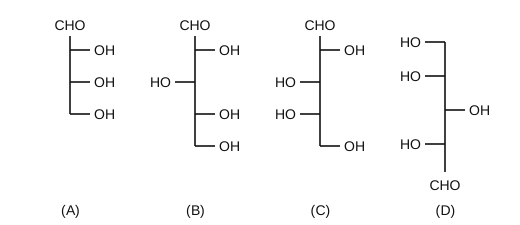
निम्नलिखित में से उन संरचना/संरचनाओं की संख्या पहचानिए जिन्हें D-ग्लिसरैल्डिहाइड से सहसम्बन्धित किया जा सकता है।
- Afourचार
- Boneएक
- Ctwoदो
- Dthreeतीन
Show answer
Concept: In a Fischer projection with CHO at the top, a sugar is D if the OH on the lowest stereocentre (the chiral carbon farthest from CHO) is on the right. A projection may be rotated by 180° in the plane without changing the configuration.
- (A): lowest stereocentre has OH on the right → D.
- (B): lowest stereocentre has OH on the right → D.
- (C): the stereocentre just above the terminal —OH carbon has OH on the left → L, not correlated with D-glyceraldehyde.
- (D): CHO is at the bottom; rotating the projection by 180° in the plane puts CHO on top, and the lowest stereocentre then has OH on the right → D.
- So (A), (B) and (D), i.e. three structures, correlate with D-glyceraldehyde.
Short trick: CHO at bottom? Rotate 180° in plane (allowed) — every substituent switches side.
Answer: (D)
अवधारणा: फिशर प्रक्षेप में CHO ऊपर रखने पर, यदि CHO से सबसे दूर वाले त्रिविम केन्द्र (stereocentre) पर OH दाईं ओर हो तो शर्करा D होती है। प्रक्षेप को तल में 180° घुमाने से विन्यास नहीं बदलता।
- (A) : निम्नतम त्रिविम केन्द्र पर OH दाईं ओर → D।
- (B) : निम्नतम त्रिविम केन्द्र पर OH दाईं ओर → D।
- (C) : अन्तिम —OH कार्बन के ठीक ऊपर वाले त्रिविम केन्द्र पर OH बाईं ओर है → L, अतः D-ग्लिसरैल्डिहाइड से सहसम्बन्धित नहीं।
- (D) : CHO नीचे है; प्रक्षेप को तल में 180° घुमाने पर CHO ऊपर आ जाता है और तब निम्नतम त्रिविम केन्द्र पर OH दाईं ओर होता है → D।
- अतः (A), (B) तथा (D), अर्थात् तीन संरचनाएँ D-ग्लिसरैल्डिहाइड से सहसम्बन्धित हैं।
शॉर्ट ट्रिक: CHO नीचे हो? तल में 180° घुमाइए (मान्य) — प्रत्येक प्रतिस्थापी की दिशा बदल जाती है।
उत्तर: (D)
JEE Main 2025 (January) – Paper 1 (B.E./B.Tech)ChemistryBiomolecules – D and L configuration of sugarsJEE Main 2025 (January) – Paper 1 (B.E./B.Tech) 2025 · 22 Jan Shift 2
Q212.Given below are two statements :
Statement (I) : A spectral line will be observed for a 2px → 2py transition.
Statement (II) : 2px and 2py are degenerate orbitals.
In the light of the above statements, choose the correct answer from the options given below :
नीचे दो कथन दिए गए हैं :
कथन (I) : 2px → 2py संक्रमण के लिए एक स्पेक्ट्रमी रेखा प्रेक्षित होगी।
कथन (II) : 2px तथा 2py समभ्रंश (degenerate) कक्षक हैं।
उपर्युक्त कथनों के आलोक में, नीचे दिए गए विकल्पों में से सही उत्तर चुनिए :
- ABoth Statement I and Statement II are trueकथन I और कथन II दोनों सत्य हैं
- BStatement I is false but Statement II is trueकथन I असत्य है परन्तु कथन II सत्य है
- CBoth Statement I and Statement II are falseकथन I और कथन II दोनों असत्य हैं
- DStatement I is true but Statement II is falseकथन I सत्य है परन्तु कथन II असत्य है
Show answer
Concept: A spectral line arises only when the transition involves two levels of different energy; orbitals of the same subshell are degenerate (equal energy).
- 2px and 2py belong to the same subshell (n = 2, l = 1), so they have exactly the same energy → Statement II is true.
- Since ΔE = 0 for 2px → 2py, no photon is emitted or absorbed, hence no spectral line → Statement I is false.
Short trick: No energy gap → no line. Same n and l ⇒ degenerate.
Answer: (B)
अवधारणा: स्पेक्ट्रमी रेखा तभी बनती है जब संक्रमण भिन्न ऊर्जा के दो स्तरों के बीच हो; एक ही उपकोश के कक्षक समभ्रंश (समान ऊर्जा वाले) होते हैं।
- 2px तथा 2py एक ही उपकोश (n = 2, l = 1) के हैं, अतः इनकी ऊर्जा बिल्कुल समान है → कथन II सत्य है।
- 2px → 2py के लिए ΔE = 0 है, अतः कोई फोटॉन उत्सर्जित/अवशोषित नहीं होता, इसलिए कोई स्पेक्ट्रमी रेखा नहीं बनती → कथन I असत्य है।
शॉर्ट ट्रिक: ऊर्जा अन्तर नहीं → रेखा नहीं। समान n और l ⇒ समभ्रंश।
उत्तर: (B)
JEE Main 2025 (January) – Paper 1 (B.E./B.Tech)ChemistryAtomic structure – Degenerate orbitalsJEE Main 2025 (January) – Paper 1 (B.E./B.Tech) 2025 · 22 Jan Shift 2
Q213.Given below are two statements :
Statement (I) : An element in the extreme left of the periodic table forms acidic oxides.
Statement (II) : Acid is formed during the reaction between water and oxide of a reactive element present in the extreme right of the periodic table.
In the light of the above statements, choose the correct answer from the options given below :
नीचे दो कथन दिए गए हैं :
कथन (I) : आवर्त सारणी के सुदूर बाईं ओर स्थित तत्व अम्लीय ऑक्साइड बनाता है।
कथन (II) : आवर्त सारणी के सुदूर दाईं ओर उपस्थित क्रियाशील तत्व के ऑक्साइड तथा जल की अभिक्रिया में अम्ल बनता है।
उपर्युक्त कथनों के आलोक में, नीचे दिए गए विकल्पों में से सही उत्तर चुनिए :
- AStatement I is true but Statement II is falseकथन I सत्य है परन्तु कथन II असत्य है
- BBoth Statement I and Statement II are trueकथन I और कथन II दोनों सत्य हैं
- CBoth Statement I and Statement II are falseकथन I और कथन II दोनों असत्य हैं
- DStatement I is false but Statement II is trueकथन I असत्य है परन्तु कथन II सत्य है
Show answer
Concept: Across a period, the nature of oxides changes from basic (left, metals) to acidic (right, non-metals).
- Statement I is false: elements at the extreme left are alkali metals; their oxides (Na2O, K2O) are strongly basic, not acidic.
- Statement II is true: a reactive element at the extreme right is a halogen; its oxide reacts with water to give an acid, e.g. Cl2O7 + H2O → 2HClO4.
Short trick: Left = basic oxides, right = acidic oxides; the noble gases apart, the extreme right reactive elements are halogens.
Answer: (D)
अवधारणा: आवर्त में बाएँ से दाएँ जाने पर ऑक्साइडों की प्रकृति क्षारकीय (बाईं ओर, धातुएँ) से अम्लीय (दाईं ओर, अधातुएँ) में बदलती है।
- कथन I असत्य है : सुदूर बाईं ओर क्षार धातुएँ हैं; इनके ऑक्साइड (Na2O, K2O) प्रबल क्षारकीय होते हैं, अम्लीय नहीं।
- कथन II सत्य है : सुदूर दाईं ओर स्थित क्रियाशील तत्व हैलोजन है; इसका ऑक्साइड जल से अभिक्रिया करके अम्ल देता है, जैसे Cl2O7 + H2O → 2HClO4।
शॉर्ट ट्रिक: बाएँ = क्षारकीय ऑक्साइड, दाएँ = अम्लीय ऑक्साइड; उत्कृष्ट गैसों को छोड़कर सुदूर दाईं ओर के क्रियाशील तत्व हैलोजन हैं।
उत्तर: (D)
JEE Main 2025 (January) – Paper 1 (B.E./B.Tech)ChemistryClassification of elements – Nature of oxidesJEE Main 2025 (January) – Paper 1 (B.E./B.Tech) 2025 · 22 Jan Shift 2
Q214.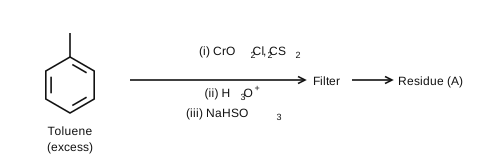
Residue (A) + HCl (dil) → Compound (B)
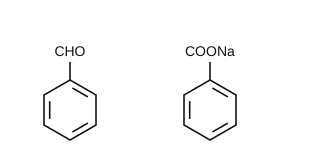
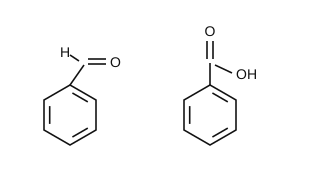
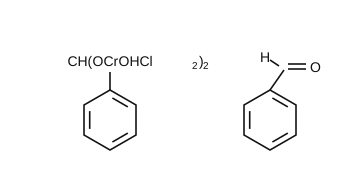
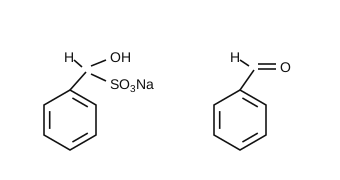
Structure of residue (A) and compound (B) formed respectively is :
अवशेष (A) + HCl (तनु) → यौगिक (B)
क्रमशः बनने वाले अवशेष (A) तथा यौगिक (B) की संरचना है :
- A
- B
- C
- D
Show answer
Concept: Étard reaction: toluene + CrO2Cl2 in CS2 gives the Étard complex, which on hydrolysis gives benzaldehyde; NaHSO3 then forms a crystalline bisulphite adduct used to separate the aldehyde.
- Step (i): toluene + CrO2Cl2/CS2 → Étard complex C6H5CH(OCrOHCl2)2.
- Step (ii): hydrolysis with H3O+ → benzaldehyde C6H5CHO.
- Step (iii): NaHSO3 adds to the CHO group giving the crystalline adduct C6H5CH(OH)SO3Na, which is filtered off → residue (A).
- (A) + dil HCl regenerates pure benzaldehyde → compound (B) = C6H5CHO.
- (C) is wrong because the Étard complex is destroyed in step (ii); (A) and (B) in the first two options wrongly show acid/salt products.
Short trick: NaHSO3 + aldehyde = solid adduct; dilute acid gives the aldehyde back.
Answer: (D)
अवधारणा: एटार्ड अभिक्रिया : टॉलूईन + CrO2Cl2 (CS2 में) से एटार्ड संकुल बनता है, जिसके जल-अपघटन से बेन्ज़ैल्डिहाइड मिलता है; फिर NaHSO3 क्रिस्टलीय बाइसल्फाइट योगज बनाता है जिससे ऐल्डिहाइड को पृथक् किया जाता है।
- चरण (i) : टॉलूईन + CrO2Cl2/CS2 → एटार्ड संकुल C6H5CH(OCrOHCl2)2।
- चरण (ii) : H3O+ से जल-अपघटन → बेन्ज़ैल्डिहाइड C6H5CHO।
- चरण (iii) : NaHSO3, CHO समूह से जुड़कर क्रिस्टलीय योगज C6H5CH(OH)SO3Na बनाता है, जिसे छानकर अलग किया जाता है → अवशेष (A)।
- (A) + तनु HCl से शुद्ध बेन्ज़ैल्डिहाइड पुनः प्राप्त होता है → यौगिक (B) = C6H5CHO।
- (C) गलत है क्योंकि एटार्ड संकुल चरण (ii) में ही नष्ट हो जाता है; पहले दो विकल्पों में (A) तथा (B) को गलत रूप से अम्ल/लवण दिखाया गया है।
शॉर्ट ट्रिक: NaHSO3 + ऐल्डिहाइड = ठोस योगज; तनु अम्ल ऐल्डिहाइड वापस दे देता है।
उत्तर: (D)
JEE Main 2025 (January) – Paper 1 (B.E./B.Tech)ChemistryAldehydes – Étard reaction and bisulphite adductJEE Main 2025 (January) – Paper 1 (B.E./B.Tech) 2025 · 22 Jan Shift 2
Q215.The alkane from below having two secondary hydrogens is :
निम्नलिखित में से दो द्वितीयक (secondary) हाइड्रोजन वाला ऐल्केन है :
- A4-Ethyl-3,4-dimethyloctane4-एथिल-3,4-डाइमेथिलऑक्टेन
- B2,2,3,3-Tetramethylpentane2,2,3,3-टेट्रामेथिलपेन्टेन
- C2,2,4,5-Tetramethylheptane2,2,4,5-टेट्रामेथिलहेप्टेन
- D2,2,4,4-Tetramethylhexane2,2,4,4-टेट्रामेथिलहेक्सेन
Show answer
Concept: A secondary hydrogen is attached to a carbon bonded to exactly two other carbons (a CH2 between two carbons). Count the CH2 groups in each structure.
- (B) 2,2,3,3-Tetramethylpentane, (CH3)3C–C(CH3)2–CH2–CH3: only C-4 is a CH2 → 2 secondary H. ✓
- (A) 4-Ethyl-3,4-dimethyloctane has CH2 at C-2, C-5, C-6, C-7 and in the ethyl branch → 10 secondary H.
- (C) 2,2,4,5-Tetramethylheptane has CH2 at C-3 and C-6 → 4 secondary H.
- (D) 2,2,4,4-Tetramethylhexane has CH2 at C-3 and C-5 → 4 secondary H.
Short trick: 2 secondary H = exactly one CH2 group in the skeleton.
Answer: (B)
अवधारणा: द्वितीयक हाइड्रोजन उस कार्बन से जुड़ा होता है जो ठीक दो अन्य कार्बनों से बंधा हो (दो कार्बनों के बीच CH2)। प्रत्येक संरचना में CH2 समूह गिनिए।
- (B) 2,2,3,3-टेट्रामेथिलपेन्टेन, (CH3)3C–C(CH3)2–CH2–CH3 : केवल C-4 ही CH2 है → 2 द्वितीयक H। ✓
- (A) 4-एथिल-3,4-डाइमेथिलऑक्टेन में C-2, C-5, C-6, C-7 तथा एथिल शाखा में CH2 हैं → 10 द्वितीयक H।
- (C) 2,2,4,5-टेट्रामेथिलहेप्टेन में C-3 तथा C-6 पर CH2 → 4 द्वितीयक H।
- (D) 2,2,4,4-टेट्रामेथिलहेक्सेन में C-3 तथा C-5 पर CH2 → 4 द्वितीयक H।
शॉर्ट ट्रिक: 2 द्वितीयक H = कंकाल में ठीक एक CH2 समूह।
उत्तर: (B)
JEE Main 2025 (January) – Paper 1 (B.E./B.Tech)ChemistryHydrocarbons – Classification of hydrogen atomsJEE Main 2025 (January) – Paper 1 (B.E./B.Tech) 2025 · 22 Jan Shift 2
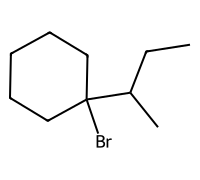
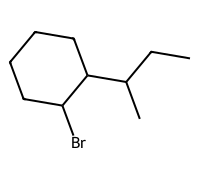
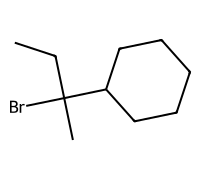
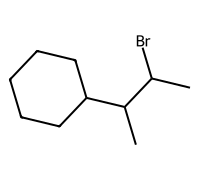
Q216.When sec-butylcyclohexane reacts with bromine in the presence of sunlight, the major product is :
जब sec-ब्यूटिलसाइक्लोहेक्सेन सूर्य के प्रकाश की उपस्थिति में ब्रोमीन से अभिक्रिया करता है, तो मुख्य उत्पाद है :
- A
- B
- C
- D
Show answer
Concept: Photochemical bromination is highly selective and substitutes the hydrogen that gives the most stable free radical (3° ≫ 2° ≫ 1°).
- sec-Butylcyclohexane has two tertiary H atoms: one on the ring carbon bearing the side chain and one on C-2 of the sec-butyl chain.
- The side-chain radical •C(CH3)(C2H5)(C6H11) is the more stabilised site: it has 6 α-hydrogens for hyperconjugation against 5 for the ring radical, and attack there is sterically easier.
- So Br goes to the side-chain tertiary carbon, giving 2-bromo-2-cyclohexylbutane, structure (C).
- (B) and (D) are secondary bromides (less favoured); (A) puts Br on the ring tertiary carbon, which is the minor tertiary product.
Short trick: Br2/hν → find the best 3° H; here it is on the chain, not the ring.
Answer: (C)
अवधारणा: प्रकाश-रासायनिक ब्रोमीनीकरण अत्यधिक वरणात्मक होता है और उसी हाइड्रोजन का प्रतिस्थापन करता है जिससे सबसे स्थायी मुक्त मूलक बने (3° ≫ 2° ≫ 1°)।
- sec-ब्यूटिलसाइक्लोहेक्सेन में दो तृतीयक H हैं : एक पार्श्व शृंखला वाले वलय कार्बन पर तथा एक sec-ब्यूटिल शृंखला के C-2 पर।
- पार्श्व शृंखला वाला मूलक •C(CH3)(C2H5)(C6H11) अधिक स्थायित्व वाला स्थल है : इसमें अतिसंयुग्मन हेतु 6 α-हाइड्रोजन हैं जबकि वलय मूलक में 5, और वहाँ आक्रमण त्रिविम दृष्टि से भी सरल है।
- अतः Br पार्श्व शृंखला के तृतीयक कार्बन पर जाता है और 2-ब्रोमो-2-साइक्लोहेक्सिलब्यूटेन, संरचना (C) बनती है।
- (B) तथा (D) द्वितीयक ब्रोमाइड हैं (कम अनुकूल); (A) में Br वलय के तृतीयक कार्बन पर है, जो गौण तृतीयक उत्पाद है।
शॉर्ट ट्रिक: Br2/hν → सर्वोत्तम 3° H खोजिए; यहाँ वह शृंखला पर है, वलय पर नहीं।
उत्तर: (C)
JEE Main 2025 (January) – Paper 1 (B.E./B.Tech)ChemistryHydrocarbons – Free radical halogenationJEE Main 2025 (January) – Paper 1 (B.E./B.Tech) 2025 · 22 Jan Shift 2
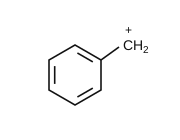
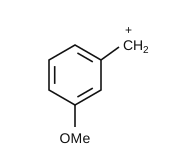
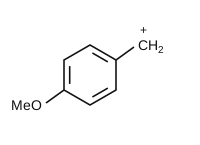
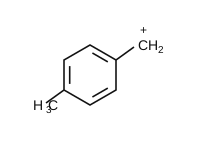
Q217.The most stable carbocation from the following is :
निम्नलिखित में से सबसे स्थायी कार्बधनायन (carbocation) है :
- A
- B
- C
- D
Show answer
Concept: A benzylic carbocation is stabilised by electron-donating groups on the ring; a +M group works only from the ortho/para position, while from the meta position only its −I effect operates.
- (C) p-methoxybenzyl cation: the OMe lone pair conjugates directly with the benzylic positive centre (+M from para) → strongest stabilisation.
- (D) p-methylbenzyl cation: CH3 gives only weaker +I/hyperconjugative donation.
- (A) benzyl cation: no substituent, only ring resonance.
- (B) m-methoxybenzyl cation: from meta, OMe cannot conjugate with the cation and its −I effect destabilises it (least stable).
- Order: (C) > (D) > (A) > (B).
Short trick: para-OMe > para-CH3 > H > meta-OMe for benzylic cations.
Answer: (C)
अवधारणा: बेन्ज़िलिक कार्बधनायन वलय पर इलेक्ट्रॉनदाता समूहों से स्थायी होता है; +M समूह केवल ऑर्थो/पैरा स्थिति से कार्य करता है, जबकि मेटा स्थिति से केवल उसका −I प्रभाव लगता है।
- (C) p-मेथॉक्सीबेन्ज़िल धनायन : OMe का एकाकी युग्म बेन्ज़िलिक धनावेशित केन्द्र से सीधे संयुग्मित होता है (पैरा से +M) → प्रबलतम स्थायीकरण।
- (D) p-मेथिलबेन्ज़िल धनायन : CH3 केवल दुर्बल +I/अतिसंयुग्मन देता है।
- (A) बेन्ज़िल धनायन : कोई प्रतिस्थापी नहीं, केवल वलय अनुनाद।
- (B) m-मेथॉक्सीबेन्ज़िल धनायन : मेटा से OMe धनायन के साथ संयुग्मित नहीं हो सकता और उसका −I प्रभाव इसे अस्थायी करता है (न्यूनतम स्थायी)।
- क्रम : (C) > (D) > (A) > (B)।
शॉर्ट ट्रिक: बेन्ज़िलिक धनायनों के लिए पैरा-OMe > पैरा-CH3 > H > मेटा-OMe।
उत्तर: (C)
JEE Main 2025 (January) – Paper 1 (B.E./B.Tech)ChemistryGeneral organic chemistry – Carbocation stabilityJEE Main 2025 (January) – Paper 1 (B.E./B.Tech) 2025 · 22 Jan Shift 2
Q218.Match the Compounds (List - I) with the appropriate Catalyst/Reagents (List - II) for their reduction into corresponding amines.
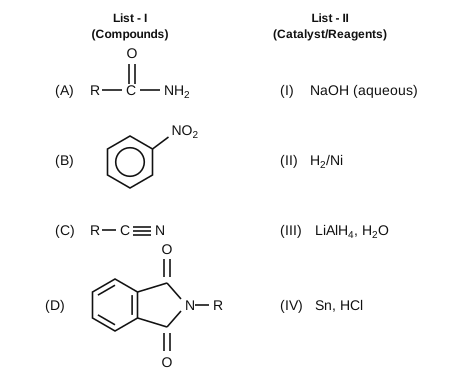
Choose the correct answer from the options given below :
यौगिकों (सूची-I) का उनके संगत ऐमीनों में अपचयन हेतु उपयुक्त उत्प्रेरक/अभिकर्मकों (सूची-II) से मिलान कीजिए।
नीचे दिए गए विकल्पों में से सही उत्तर चुनिए :
- A(A)-(II), (B)-(I), (C)-(III), (D)-(IV)
- B(A)-(III), (B)-(II), (C)-(IV), (D)-(I)
- C(A)-(II), (B)-(IV), (C)-(III), (D)-(I)
- D(A)-(III), (B)-(IV), (C)-(II), (D)-(I)
Show answer
Concept: Each nitrogen compound has a standard reagent for conversion to an amine.
- (A) Amide R–CO–NH2 → amine with LiAlH4 followed by H2O → (III).
- (B) Nitrobenzene → aniline with Sn/HCl (selective reduction of the –NO2 group) → (IV).
- (C) Nitrile R–C≡N → 1° amine R–CH2–NH2 by catalytic hydrogenation with H2/Ni → (II).
- (D) N-Alkylphthalimide → amine R–NH2 on treatment with aqueous NaOH (Gabriel synthesis work-up) → (I).
- This matching, (A)-(III), (B)-(IV), (C)-(II), (D)-(I), appears only in option (D); the other options interchange the reagents of the amide, nitro or nitrile.
Short trick: Amide–LiAlH4, Nitro–Sn/HCl, Nitrile–H2/Ni, Phthalimide–NaOH(aq).
Answer: (D)
अवधारणा: प्रत्येक नाइट्रोजन यौगिक को ऐमीन में बदलने का एक मानक अभिकर्मक है।
- (A) ऐमाइड R–CO–NH2 → LiAlH4 तत्पश्चात् H2O से ऐमीन → (III)।
- (B) नाइट्रोबेन्ज़ीन → Sn/HCl से ऐनिलीन (–NO2 समूह का वरणात्मक अपचयन) → (IV)।
- (C) नाइट्राइल R–C≡N → H2/Ni से उत्प्रेरकीय हाइड्रोजनीकरण द्वारा 1° ऐमीन R–CH2–NH2 → (II)।
- (D) N-ऐल्किलथैलिमाइड → जलीय NaOH से ऐमीन R–NH2 (गैब्रिएल संश्लेषण) → (I)।
- यह मिलान, (A)-(III), (B)-(IV), (C)-(II), (D)-(I), केवल विकल्प (D) में है; शेष विकल्पों में ऐमाइड, नाइट्रो या नाइट्राइल के अभिकर्मक आपस में बदल दिए गए हैं।
शॉर्ट ट्रिक: ऐमाइड–LiAlH4, नाइट्रो–Sn/HCl, नाइट्राइल–H2/Ni, थैलिमाइड–NaOH(aq)।
उत्तर: (D)
JEE Main 2025 (January) – Paper 1 (B.E./B.Tech)ChemistryAmines – Preparation by reductionJEE Main 2025 (January) – Paper 1 (B.E./B.Tech) 2025 · 22 Jan Shift 2
Q219.Arrange the following compounds in increasing order of their dipole moment : HBr, H2S, NF3 and CHCl3
निम्नलिखित यौगिकों को उनके द्विध्रुव आघूर्ण (dipole moment) के बढ़ते क्रम में व्यवस्थित कीजिए : HBr, H2S, NF3 तथा CHCl3
- AH2S < HBr < NF3 < CHCl3
- BNF3 < HBr < H2S < CHCl3
- CHBr < H2S < NF3 < CHCl3
- DCHCl3 < NF3 < HBr < H2S
Show answer
Concept: The net dipole moment is the vector sum of bond moments and lone-pair moments. In NF3 the lone-pair moment opposes the N–F bond moments, making its dipole unusually small.
- NF3: μ ≈ 0.23 D (lone pair opposes N–F moments).
- HBr: μ ≈ 0.79 D (single, weakly polar bond).
- H2S: μ ≈ 0.95 D (two S–H moments add in the bent shape).
- CHCl3: μ ≈ 1.04 D (three C–Cl moments reinforce the resultant).
- Hence NF3 < HBr < H2S < CHCl3.
Short trick: Remember NF3 ≈ 0.2 D (lone pair cancels the bond moments) — it is almost always the smallest in such sets.
Answer: (B)
अवधारणा: नेट द्विध्रुव आघूर्ण आबन्ध आघूर्णों तथा एकाकी युग्म आघूर्ण का सदिश योग होता है। NF3 में एकाकी युग्म का आघूर्ण N–F आबन्ध आघूर्णों के विपरीत होता है, जिससे इसका द्विध्रुव असामान्य रूप से छोटा हो जाता है।
- NF3 : μ ≈ 0.23 D (एकाकी युग्म N–F आघूर्णों के विपरीत)।
- HBr : μ ≈ 0.79 D (एकल, दुर्बल ध्रुवीय आबन्ध)।
- H2S : μ ≈ 0.95 D (मुड़ी आकृति में दो S–H आघूर्ण जुड़ते हैं)।
- CHCl3 : μ ≈ 1.04 D (तीन C–Cl आघूर्ण परिणामी को प्रबल करते हैं)।
- अतः NF3 < HBr < H2S < CHCl3।
शॉर्ट ट्रिक: याद रखिए NF3 ≈ 0.2 D (एकाकी युग्म आबन्ध आघूर्णों को निरस्त करता है) — ऐसे समुच्चयों में यह लगभग सदैव न्यूनतम होता है।
उत्तर: (B)
JEE Main 2025 (January) – Paper 1 (B.E./B.Tech)ChemistryChemical bonding – Dipole momentJEE Main 2025 (January) – Paper 1 (B.E./B.Tech) 2025 · 22 Jan Shift 2
Q220.The maximum covalency of a non-metallic group 15 element ' E ' with weakest E − E bond is :
सबसे दुर्बल E − E आबन्ध वाले अधात्विक वर्ग 15 के तत्व ' E ' की अधिकतम सहसंयोजकता (covalency) है :
- A4
- B6
- C3
- D5
Show answer
Concept: In group 15 the single E–E bond is weakest for nitrogen (N–N), because the small N atoms bring their lone pairs very close, causing strong repulsion. Nitrogen has no d-orbitals, so its covalency cannot exceed 4.
- Single-bond strength: N–N (159 kJ mol−1) < P–P (213) < As–As (180 ≈ similar); N–N is the weakest among the non-metals of the group.
- So E = nitrogen.
- Maximum covalency of N = 4 (as in NH4+), using its four valence orbitals (one 2s + three 2p); expansion to 5 or 6 is impossible without d-orbitals.
Short trick: Weakest E–E in group 15 ⇒ N; N's max covalency = 4 (NH4+).
Answer: (A)
अवधारणा: वर्ग 15 में एकल E–E आबन्ध नाइट्रोजन (N–N) के लिए सबसे दुर्बल होता है, क्योंकि छोटे N परमाणुओं के एकाकी युग्म अति निकट आकर प्रबल प्रतिकर्षण करते हैं। नाइट्रोजन में d-कक्षक नहीं होते, अतः इसकी सहसंयोजकता 4 से अधिक नहीं हो सकती।
- एकल आबन्ध सामर्थ्य : N–N (159 kJ mol−1) वर्ग की अधातुओं में सबसे दुर्बल है।
- अतः E = नाइट्रोजन।
- N की अधिकतम सहसंयोजकता = 4 (जैसे NH4+ में), इसके चार संयोजकता कक्षकों (एक 2s + तीन 2p) से; d-कक्षकों के अभाव में 5 या 6 तक विस्तार असम्भव है।
शॉर्ट ट्रिक: वर्ग 15 में सबसे दुर्बल E–E ⇒ N; N की अधिकतम सहसंयोजकता = 4 (NH4+)।
उत्तर: (A)
JEE Main 2025 (January) – Paper 1 (B.E./B.Tech)Chemistryp-Block elements – Group 15JEE Main 2025 (January) – Paper 1 (B.E./B.Tech) 2025 · 22 Jan Shift 2

