Q221.A proton is moving undeflected in a region of crossed electric and magnetic fields at a constant speed of . When the electric field is switched off, the proton moves along a circular path of radius 2 cm . The magnitude of electric field is N/C. The value of is _______ Take the mass of the proton kg.
एक प्रोटॉन परस्पर लम्बवत (crossed) विद्युत तथा चुम्बकीय क्षेत्रों के क्षेत्र में की नियत चाल से अविक्षेपित (undeflected) गति कर रहा है। विद्युत क्षेत्र हटा देने पर प्रोटॉन 2 cm त्रिज्या के वृत्तीय पथ पर चलता है। विद्युत क्षेत्र का परिमाण N/C है। का मान _______ है। प्रोटॉन का द्रव्यमान kg लीजिए।
Show answer
Concept: Undeflected motion in crossed fields: . In the magnetic field alone: .
- T.
- N/C.
- Comparing with N/C: .
Answer: 2
अवधारणा: परस्पर लम्बवत क्षेत्रों में अविक्षेपित गति: । केवल चुम्बकीय क्षेत्र में: ।
- T।
- N/C।
- N/C से तुलना करने पर: ।
उत्तर: 2
JEE Main 2025 (January) – Paper 1 (B.E./B.Tech)PhysicsMoving charges – velocity selectorJEE Main 2025 (January) – Paper 1 (B.E./B.Tech) 2025 · 22 Jan Shift 2
Q222.The net current flowing in the given circuit is_______ A.
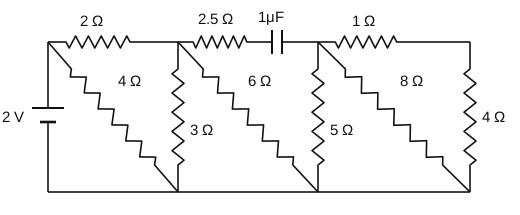
दिए गए परिपथ में प्रवाहित नेट धारा _______ A है।
Show answer
Concept: In steady state no current flows through the capacitor, so the branch containing 2.5 Ω and 1 μF is open. The part of the network to the right of the capacitor has no source, so it carries no current at all. The bottom wire makes all lower junctions a single node.
- Surviving paths from the battery's positive terminal (call it node T) to the bottom node: (i) the 4 Ω diagonal directly, (ii) 2 Ω to the middle-top node, then 3 Ω and 6 Ω in parallel to the bottom.
- , so path (ii) has resistance .
- A through the 4 Ω diagonal; A through the 2 Ω branch.
- Net current from the battery A.
Short trick: A fully-charged capacitor is an open switch — chop off everything beyond it that has no source.
Answer: 1
अवधारणा: स्थायी अवस्था में संधारित्र से कोई धारा नहीं बहती, अतः 2.5 Ω तथा 1 μF वाली शाखा खुली है। संधारित्र के दाईं ओर के भाग में कोई स्रोत नहीं है, अतः वहाँ कोई धारा नहीं बहती। नीचे का तार सभी निचले संधियों को एक ही नोड बना देता है।
- बैटरी के धन सिरे (नोड T) से निचले नोड तक बचे पथ: (i) सीधे 4 Ω विकर्ण से, (ii) 2 Ω से मध्य-ऊपरी नोड तक, फिर 3 Ω तथा 6 Ω समान्तर में नीचे तक।
- , अतः पथ (ii) का प्रतिरोध ।
- 4 Ω विकर्ण से A; 2 Ω शाखा से A।
- बैटरी से नेट धारा A।
शॉर्ट ट्रिक: पूर्ण आवेशित संधारित्र खुले स्विच जैसा है — उसके आगे का स्रोतहीन भाग हटा दीजिए।
उत्तर: 1
JEE Main 2025 (January) – Paper 1 (B.E./B.Tech)PhysicsCurrent electricity – capacitor in steady stateJEE Main 2025 (January) – Paper 1 (B.E./B.Tech) 2025 · 22 Jan Shift 2
Q223.A parallel plate capacitor of area and separation between the plates 10 cm , is charged by a DC current. Consider a hypothetical plane surface of area inside the capacitor and parallel to the plates. At an instant, the current through the circuit is 6A. At the same instant the displacement current through is ________ mA .
क्षेत्रफल तथा प्लेटों के बीच 10 cm दूरी वाले एक समान्तर प्लेट संधारित्र को DC धारा से आवेशित किया जाता है। संधारित्र के भीतर प्लेटों के समान्तर, क्षेत्रफल के एक काल्पनिक समतल पृष्ठ पर विचार कीजिए। किसी क्षण परिपथ में धारा 6 A है। उसी क्षण से होकर विस्थापन धारा ________ mA है।
Show answer
Concept: Between the plates the total displacement current equals the conduction current charging the capacitor, and it is uniformly distributed over the plate area.
- Total displacement current A (spread uniformly over ).
- Through the surface : A.
- mA. (The plate separation does not enter the calculation.)
Answer: 1200
अवधारणा: प्लेटों के बीच कुल विस्थापन धारा, संधारित्र को आवेशित करने वाली चालन धारा के बराबर होती है और प्लेट के क्षेत्रफल पर एकसमान वितरित रहती है।
- कुल विस्थापन धारा A ( पर एकसमान वितरित)।
- पृष्ठ से होकर: A।
- mA। (प्लेटों की दूरी गणना में नहीं आती।)
उत्तर: 1200
JEE Main 2025 (January) – Paper 1 (B.E./B.Tech)PhysicsElectromagnetic waves – displacement currentJEE Main 2025 (January) – Paper 1 (B.E./B.Tech) 2025 · 22 Jan Shift 2
Q224.A tube of length 1 m is filled completely with an ideal liquid of mass 2 M , and closed at both ends. The tube is rotated uniformly in horizontal plane about one of its ends. If the force exerted by the liquid at the other end is F then angular velocity of the tube is in SI unit. The value of is __________.
1 m लम्बाई की एक नली एक आदर्श द्रव से, जिसका द्रव्यमान 2 M है, पूर्णतः भरी है तथा दोनों सिरों पर बन्द है। नली को उसके एक सिरे के परितः क्षैतिज तल में एकसमान रूप से घुमाया जाता है। यदि द्रव द्वारा दूसरे सिरे पर लगाया गया बल F हो, तो नली का कोणीय वेग SI मात्रक में है। का मान __________ है।
Show answer
Concept: Each element of the rotating liquid needs a centripetal force; the far end-cap must supply the resultant inward force on the whole column, so the liquid pushes the far end outward with the equal and opposite force F.
- Mass per unit length . An element at distance needs force .
- .
- With m: .
- Comparing with : .
Answer: 1
अवधारणा: घूमते द्रव के प्रत्येक अवयव को अभिकेन्द्र बल चाहिए; दूर वाला सिरा पूरे स्तम्भ पर आवश्यक परिणामी अन्दर की ओर बल देता है, अतः द्रव उस सिरे पर बराबर व विपरीत बल F बाहर की ओर लगाता है।
- प्रति एकांक लम्बाई द्रव्यमान । दूरी पर अवयव को बल चाहिए।
- ।
- m रखने पर: ।
- से तुलना करने पर: ।
उत्तर: 1
JEE Main 2025 (January) – Paper 1 (B.E./B.Tech)PhysicsFluid mechanics – rotating liquid columnJEE Main 2025 (January) – Paper 1 (B.E./B.Tech) 2025 · 22 Jan Shift 2
Q225.Two long parallel wires
and
, separated by a distance of 6 cm , carry currents of 5A and 4A, respectively, in opposite directions as shown in the figure. Magnitude of the resultant magnetic field at point P at a distance of 4 cm from wire Y is
T. The value of
is __________. Take permeability of free space as
SI units.
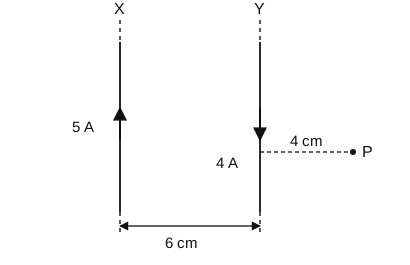
दो लम्बे समान्तर तार
तथा
, जो परस्पर 6 cm दूरी पर हैं, चित्रानुसार क्रमशः 5 A तथा 4 A की धाराएँ विपरीत दिशाओं में वहन करते हैं। तार Y से 4 cm दूरी पर स्थित बिन्दु P पर परिणामी चुम्बकीय क्षेत्र का परिमाण
T है।
का मान __________ है। निर्वात की चुम्बकशीलता
SI मात्रक लीजिए।
Show answer
Concept: Field of a long straight wire: . P lies 4 cm from Y on the side away from X, so it is cm from X. With opposite currents, the two fields at P point in opposite directions.
- T (due to X, current upward).
- T (due to Y, current downward).
- At P, by the right-hand rule, is into the page while is out of the page, so they subtract: T.
- Comparing with T: .
Answer: 1
अवधारणा: लम्बे सीधे तार का क्षेत्र: । P, तार Y से 4 cm दूर, X से दूर वाली ओर है, अतः X से इसकी दूरी cm है। विपरीत धाराओं के कारण P पर दोनों क्षेत्र विपरीत दिशाओं में हैं।
- T (ऊपर की ओर धारा वाले X के कारण)।
- T (नीचे की ओर धारा वाले Y के कारण)।
- दाएँ हाथ के नियम से P पर पृष्ठ के भीतर की ओर तथा पृष्ठ से बाहर की ओर है, अतः वे घटते हैं: T।
- T से तुलना करने पर: ।
उत्तर: 1
JEE Main 2025 (January) – Paper 1 (B.E./B.Tech)PhysicsMagnetic effects of current – field of parallel wiresJEE Main 2025 (January) – Paper 1 (B.E./B.Tech) 2025 · 22 Jan Shift 2
Q226.An electron is made to enter symmetrically between two parallel and equally but oppositely charged metal plates, each of 10 cm length. The electron emerges out of the electric field region with a horizontal component of velocity m/s. If the magnitude of the electric field between the plates is 9.1 V/cm, then the vertical component of velocity of electron is (mass of electron kg and charge of electron C)
एक इलेक्ट्रॉन को दो समान्तर तथा बराबर परन्तु विपरीत रूप से आवेशित धातु की प्लेटों, जिनमें प्रत्येक की लम्बाई 10 cm है, के बीच सममित रूप से प्रवेश कराया जाता है। इलेक्ट्रॉन विद्युत क्षेत्र के क्षेत्र से वेग के क्षैतिज घटक m/s के साथ बाहर निकलता है। यदि प्लेटों के बीच विद्युत क्षेत्र का परिमाण 9.1 V/cm है, तो इलेक्ट्रॉन के वेग का ऊर्ध्वाधर घटक है (इलेक्ट्रॉन का द्रव्यमान kg तथा इलेक्ट्रॉन का आवेश C)
- A0
- B m/s
- C m/s
- D m/s
Show answer
Concept: Inside the plates the electron gains a transverse (vertical) velocity , where and is the time spent in the field.
- .
- .
- .
- .
Short trick: The data is rigged: , so instantly.
Answer: (C) m/s
अवधारणा: प्लेटों के भीतर इलेक्ट्रॉन अनुप्रस्थ (ऊर्ध्वाधर) वेग प्राप्त करता है, जहाँ तथा क्षेत्र में बिताया समय है।
- ।
- ।
- ।
- ।
शॉर्ट ट्रिक: आँकड़े इस प्रकार चुने गए हैं कि , अतः तुरन्त मिल जाता है।
उत्तर: (C) m/s
JEE Main 2025 (January) – Paper 1 (B.E./B.Tech)PhysicsElectrostatics – motion of charge in uniform fieldJEE Main 2025 (January) – Paper 1 (B.E./B.Tech) 2025 · 22 Jan Shift 1
Q227.Given below are two statements : Statement-I : The equivalent emf of two nonideal batteries connected in parallel is smaller than either of the two emfs. Statement-II : The equivalent internal resistance of two nonideal batteries connected in parallel is smaller than the internal resistance of either of the two batteries. In the light of the above statements, choose the correct answer from the options given below.
नीचे दो कथन दिए गए हैं : कथन-I : समान्तर क्रम में जुड़ी दो अनादर्श बैटरियों का तुल्य विद्युत वाहक बल (emf) दोनों में से प्रत्येक emf से छोटा होता है। कथन-II : समान्तर क्रम में जुड़ी दो अनादर्श बैटरियों का तुल्य आन्तरिक प्रतिरोध दोनों में से प्रत्येक बैटरी के आन्तरिक प्रतिरोध से छोटा होता है। उपर्युक्त कथनों के आलोक में, नीचे दिए गए विकल्पों में से सही उत्तर चुनिए।
- ABoth Statement-I and Statement-II are falseकथन-I और कथन-II दोनों असत्य हैं
- BStatement-I is false but Statement-II is trueकथन-I असत्य है परन्तु कथन-II सत्य है
- CBoth Statement-I and Statement-II are trueकथन-I और कथन-II दोनों सत्य हैं
- DStatement-I is true but Statement-II is falseकथन-I सत्य है परन्तु कथन-II असत्य है
Show answer
Concept: For two cells and in parallel: and .
- is a weighted average of and , so it always lies between the two emfs. It cannot be smaller than both. Hence Statement-I is false.
- is smaller than both and (parallel combination). Hence Statement-II is true.
Short trick: Parallel emf = weighted mean (lies between); parallel resistance = always less than the smallest.
Answer: (B) Statement-I is false but Statement-II is true
अवधारणा: समान्तर क्रम में दो सेलों तथा के लिए: तथा ।
- , और का भारित माध्य (weighted average) है, अतः यह सदैव दोनों emf के बीच रहता है। यह दोनों से छोटा नहीं हो सकता। अतः कथन-I असत्य है।
- दोनों और से छोटा होता है (समान्तर संयोजन)। अतः कथन-II सत्य है।
शॉर्ट ट्रिक: समान्तर क्रम में emf = भारित माध्य (दोनों के बीच); समान्तर प्रतिरोध = सबसे छोटे से भी कम।
उत्तर: (B) कथन-I असत्य है परन्तु कथन-II सत्य है
JEE Main 2025 (January) – Paper 1 (B.E./B.Tech)PhysicsCurrent Electricity – cells in parallelJEE Main 2025 (January) – Paper 1 (B.E./B.Tech) 2025 · 22 Jan Shift 1
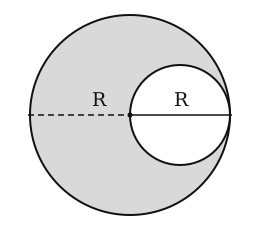
Q228.A uniform circular disc of radius '
' and mass '
' is rotating about an axis perpendicular to its plane and passing through its centre. A small circular part of radius
is removed from the original disc as shown in the figure. Find the moment of inertia of the remaining part of the original disc about the axis as given above.
त्रिज्या '
' तथा द्रव्यमान '
' की एक समरूप वृत्ताकार चकती अपने तल के लम्बवत तथा केन्द्र से होकर जाने वाली अक्ष के परितः घूर्णन कर रही है। चित्र में दर्शाए अनुसार मूल चकती से त्रिज्या
का एक छोटा वृत्ताकार भाग निकाल दिया जाता है। उपर्युक्त अक्ष के परितः मूल चकती के शेष भाग का जड़त्व आघूर्ण ज्ञात कीजिए।
- A
- B
- C
- D
Show answer
Concept: , with the parallel-axis theorem for the removed piece.
- Mass of removed part (area radius): ; its centre is at distance from the axis.
- .
- .
Short trick: For a hole of radius tangent to centre and rim, the hole's is always — just subtract from .
Answer: (D)
अवधारणा: , निकाले गए भाग के लिए समान्तर अक्ष प्रमेय (parallel-axis theorem) का प्रयोग करें।
- निकाले गए भाग का द्रव्यमान (क्षेत्रफल त्रिज्या): ; इसका केन्द्र अक्ष से दूरी पर है।
- ।
- ।
शॉर्ट ट्रिक: केन्द्र और परिधि को स्पर्श करने वाले त्रिज्या के छिद्र का सदैव होता है — बस में से घटाइए।
उत्तर: (D)
JEE Main 2025 (January) – Paper 1 (B.E./B.Tech)PhysicsRotational Motion – moment of inertiaJEE Main 2025 (January) – Paper 1 (B.E./B.Tech) 2025 · 22 Jan Shift 1
Q229.An amount of ice of mass kg and temperature is transformed to vapour of temperature by applying heat. The total amount of work required for this conversion is, (Take, specific heat of ice , specific heat of water , specific heat of steam , Latent heat of ice and Latent heat of steam )
kg द्रव्यमान तथा ताप की बर्फ को ऊष्मा देकर ताप की वाष्प में बदला जाता है। इस रूपान्तरण के लिए आवश्यक कुल कार्य है (बर्फ की विशिष्ट ऊष्मा , जल की विशिष्ट ऊष्मा , वाष्प की विशिष्ट ऊष्मा , बर्फ की गुप्त ऊष्मा तथा वाष्प की गुप्त ऊष्मा लीजिए)
- A3043 J
- B3024 J
- C3003 J
- D3022 J
Show answer
Concept: Add the heats of the five stages: warm the ice, melt it, warm the water, boil it, warm the steam. .
- Ice : .
- Melting: .
- Water : .
- Boiling: .
- Steam : .
- Total ; for kg, .
Short trick: The two latent heats alone give ; adding lands you at without a calculator.
Answer: (A) 3043 J
अवधारणा: पाँच चरणों की ऊष्माएँ जोड़िए: बर्फ को गर्म करना, पिघलाना, जल को गर्म करना, उबालना, वाष्प को गर्म करना। ।
- बर्फ : ।
- गलन: ।
- जल : ।
- क्वथन: ।
- वाष्प : ।
- कुल ; kg के लिए, ।
शॉर्ट ट्रिक: केवल दोनों गुप्त ऊष्माएँ देती हैं; जोड़ने पर बिना कैलकुलेटर मिल जाता है।
उत्तर: (A) 3043 J
JEE Main 2025 (January) – Paper 1 (B.E./B.Tech)PhysicsThermal Properties – calorimetryJEE Main 2025 (January) – Paper 1 (B.E./B.Tech) 2025 · 22 Jan Shift 1
Q230.An electron in the ground state of the hydrogen atom has the orbital radius of m while that for the electron in third excited state is m. The ratio of the de Broglie wavelengths of electron in the excited state to that in the ground state is
हाइड्रोजन परमाणु की निम्नतम अवस्था (ground state) में इलेक्ट्रॉन की कक्षीय त्रिज्या m है, जबकि तृतीय उत्तेजित अवस्था में इलेक्ट्रॉन के लिए यह m है। उत्तेजित अवस्था में इलेक्ट्रॉन की डी-ब्रॉग्ली (de Broglie) तरंगदैर्ध्य का निम्नतम अवस्था की तरंगदैर्ध्य से अनुपात है
- A3
- B16
- C9
- D4
Show answer
Concept: Bohr's quantisation gives .
- Third excited state means ; ground state .
- .
Short trick: so : ratio , no radii needed.
Answer: (D) 4
अवधारणा: बोर की क्वांटीकरण शर्त से ।
- तृतीय उत्तेजित अवस्था का अर्थ है ; निम्नतम अवस्था में ।
- ।
शॉर्ट ट्रिक: अतः : अनुपात , त्रिज्याओं की आवश्यकता ही नहीं।
उत्तर: (D) 4
JEE Main 2025 (January) – Paper 1 (B.E./B.Tech)PhysicsAtoms – de Broglie wavelengthJEE Main 2025 (January) – Paper 1 (B.E./B.Tech) 2025 · 22 Jan Shift 1
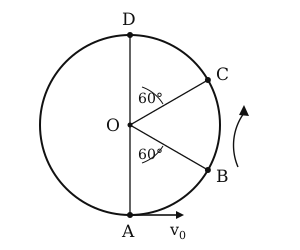
Q231.A bob of mass
is suspended at a point
by a light string of length
and left to perform vertical motion (circular) as shown in figure. Initially, by applying horizontal velocity
at the point ' A ', the string becomes slack when, the bob reaches at the point ' D '. The ratio of the kinetic energy of the bob at the points B and C is
द्रव्यमान
के एक गोलक (bob) को बिन्दु
पर लम्बाई
की हल्की डोरी से लटकाया गया है और चित्र में दर्शाए अनुसार ऊर्ध्वाधर (वृत्तीय) गति करने के लिए छोड़ा गया है। प्रारम्भ में बिन्दु ' A ' पर क्षैतिज वेग
देने पर, गोलक के बिन्दु ' D ' पर पहुँचने पर डोरी ढीली हो जाती है। बिन्दुओं B तथा C पर गोलक की गतिज ऊर्जाओं का अनुपात है
- A1
- B2
- C4
- D3
Show answer
Concept: String just slack at the top D means ; then use energy conservation from A. Heights: with measured at O from OA.
- At D: . Energy from A to D: .
- From the figure, B is from OA: ; C is from OD, i.e. from OA: .
- .
- .
- .
Short trick: With , at angle is : at it is , at it is .
Answer: (B) 2
अवधारणा: शीर्ष बिन्दु D पर डोरी के ठीक ढीली होने का अर्थ है ; फिर A से ऊर्जा संरक्षण लगाइए। ऊँचाई: , जहाँ को O पर OA से मापा गया है।
- D पर: । A से D तक ऊर्जा संरक्षण: ।
- चित्र से, B, OA से पर है: ; C, OD से पर है, अर्थात OA से : ।
- ।
- ।
- ।
शॉर्ट ट्रिक: के साथ, कोण पर : पर , पर ।
उत्तर: (B) 2
JEE Main 2025 (January) – Paper 1 (B.E./B.Tech)PhysicsWork, Energy & Power – vertical circular motionJEE Main 2025 (January) – Paper 1 (B.E./B.Tech) 2025 · 22 Jan Shift 1
Q232.Given is a thin convex lens of glass (refractive index ) and each side having radius of curvature . One side is polished for complete reflection. At what distance from the lens, an object be placed on the optic axis so that the image gets formed on the object itself ?
काँच (अपवर्तनांक ) का एक पतला उत्तल लेंस दिया गया है जिसके प्रत्येक पृष्ठ की वक्रता त्रिज्या है। एक पृष्ठ को पूर्ण परावर्तन के लिए पॉलिश (रजतित) कर दिया गया है। प्रकाशिक अक्ष पर लेंस से कितनी दूरी पर वस्तु रखी जाए कि प्रतिबिम्ब वस्तु पर ही बने?
- A
- B
- C
- D
Show answer
Concept: A silvered lens behaves as a mirror of power . The image falls back on the object when rays retrace their path, i.e. the object is at the centre of curvature of the equivalent mirror: .
- .
- The polished face is a concave mirror of focal length : .
- , so .
- Image on the object object at centre of curvature: .
Short trick: Check with : , the well-known result for an equi-convex silvered lens.
Answer: (D)
अवधारणा: रजतित लेंस एक दर्पण की भाँति व्यवहार करता है जिसकी क्षमता होती है। प्रतिबिम्ब वस्तु पर तभी बनता है जब किरणें दर्पण पर अभिलम्बवत पड़कर अपने पथ पर लौटें, अर्थात वस्तु तुल्य दर्पण के वक्रता केन्द्र पर हो: ।
- ।
- पॉलिश किया गया पृष्ठ फोकस दूरी का अवतल दर्पण है: ।
- , अतः ।
- प्रतिबिम्ब वस्तु पर वस्तु वक्रता केन्द्र पर: ।
शॉर्ट ट्रिक: रखकर जाँचिए: , जो समोत्तल रजतित लेंस का प्रसिद्ध परिणाम है।
उत्तर: (D)
JEE Main 2025 (January) – Paper 1 (B.E./B.Tech)PhysicsRay Optics – silvered lensJEE Main 2025 (January) – Paper 1 (B.E./B.Tech) 2025 · 22 Jan Shift 1
Q233.Which of the following circuits represents a forward biased diode?
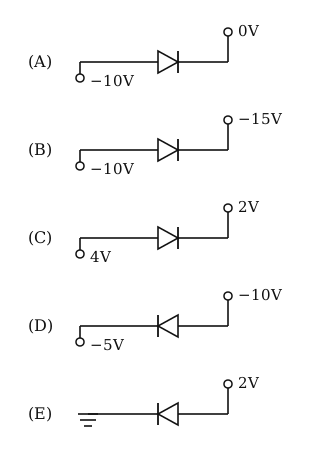
Choose the correct answer from the options given below :
निम्नलिखित में से कौन-सा परिपथ अग्र अभिनत (forward biased) डायोड को दर्शाता है?
नीचे दिए गए विकल्पों में से सही उत्तर चुनिए :
- A(A) and (D) onlyकेवल (A) और (D)
- B(B), (D) and (E) onlyकेवल (B), (D) और (E)
- C(C) and (E) onlyकेवल (C) और (E)
- D(B), (C) and (E) onlyकेवल (B), (C) और (E)
Show answer
Concept: A diode is forward biased when its anode (triangle side / p-side) is at a higher potential than its cathode (bar side / n-side).
- (A): anode at V, cathode at V anode lower reverse biased.
- (B): anode at V, cathode at V anode higher forward biased.
- (C): anode at V, cathode at V forward biased.
- (D): anode at V, cathode at V anode lower reverse biased.
- (E): anode at V, cathode grounded ( V) forward biased.
Short trick: Ignore signs, just compare: current must enter the flat of the triangle; p-side more positive = forward.
Answer: (D) (B), (C) and (E) only
अवधारणा: डायोड तब अग्र अभिनत होता है जब उसका ऐनोड (त्रिभुज वाला सिरा / p-फलक) कैथोड (रेखा वाला सिरा / n-फलक) से उच्च विभव पर हो।
- (A): ऐनोड V पर, कैथोड V पर ऐनोड निम्न पश्च अभिनत।
- (B): ऐनोड V पर, कैथोड V पर ऐनोड उच्च अग्र अभिनत।
- (C): ऐनोड V पर, कैथोड V पर अग्र अभिनत।
- (D): ऐनोड V पर, कैथोड V पर ऐनोड निम्न पश्च अभिनत।
- (E): ऐनोड V पर, कैथोड भूसम्पर्कित ( V) अग्र अभिनत।
शॉर्ट ट्रिक: चिह्नों में न उलझें, केवल तुलना करें: p-फलक अधिक धनात्मक = अग्र अभिनत।
उत्तर: (D) केवल (B), (C) और (E)
JEE Main 2025 (January) – Paper 1 (B.E./B.Tech)PhysicsSemiconductors – p-n junction diodeJEE Main 2025 (January) – Paper 1 (B.E./B.Tech) 2025 · 22 Jan Shift 1
Q234.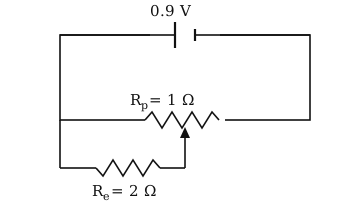
Sliding contact of a potentiometer is in the middle of the potentiometer wire having resistance
as shown in the figure. An external resistance of
is connected via the sliding contact. The electric current in the circuit is :
चित्र में दर्शाए अनुसार,
प्रतिरोध वाले विभवमापी (potentiometer) के तार के मध्य में सर्पी सम्पर्क (sliding contact) है। सर्पी सम्पर्क के द्वारा
का एक बाह्य प्रतिरोध जोड़ा गया है। परिपथ में विद्युत धारा है :
- A0.9 A
- B1.35 A
- C0.3 A
- D1.0 A
Show answer
Concept: The slider divides the wire into two halves of each. connects the slider back to one end of the wire, so it is in parallel with one half; the other half is in series.
- Each half of the potentiometer wire: .
- Parallel part: .
- Total resistance across the battery: .
- Current drawn from the battery: .
Short trick: ; the emf V against instantly gives A.
Answer: (D) 1.0 A
अवधारणा: सर्पी सम्पर्क तार को के दो बराबर भागों में बाँटता है। सर्पी सम्पर्क को तार के एक सिरे से जोड़ता है, अतः वह एक आधे भाग के समान्तर क्रम में है; दूसरा आधा भाग श्रेणी में है।
- विभवमापी तार का प्रत्येक आधा भाग: ।
- समान्तर भाग: ।
- बैटरी के सिरों पर कुल प्रतिरोध: ।
- बैटरी से ली गई धारा: ।
शॉर्ट ट्रिक: ; emf V तथा से तुरन्त A।
उत्तर: (D) 1.0 A
JEE Main 2025 (January) – Paper 1 (B.E./B.Tech)PhysicsCurrent Electricity – potentiometerJEE Main 2025 (January) – Paper 1 (B.E./B.Tech) 2025 · 22 Jan Shift 1
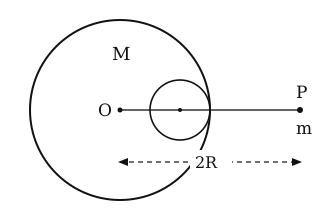
Q235.A small point of mass
is placed at a distance
from the centre '
' of a big uniform solid sphere of mass
and radius
. The gravitational force on '
' due to
is
. A spherical part of radius
is removed from the big sphere as shown in the figure and the gravitational force on
due to remaining part of
is found to be
. The value of ratio
is
द्रव्यमान
का एक छोटा बिन्दु पिण्ड, द्रव्यमान
तथा त्रिज्या
के एक बड़े समरूप ठोस गोले के केन्द्र '
' से
दूरी पर रखा है।
के कारण '
' पर गुरुत्वाकर्षण बल
है। चित्र में दर्शाए अनुसार बड़े गोले से त्रिज्या
का एक गोलीय भाग निकाल दिया जाता है और
के शेष भाग के कारण
पर गुरुत्वाकर्षण बल
पाया जाता है। अनुपात
का मान है
- A12 : 11
- B11 : 10
- C12 : 9
- D16 : 9
Show answer
Concept: Force of the remaining body = force of the full sphere force of the removed sphere (superposition).
- .
- Removed sphere: radius mass ; its centre (tangent to the surface, from the figure) is at from O, so its distance from is .
- .
- .
- .
Short trick: Write both over 48: , cavity takes away .
Answer: (A) 12 : 11
अवधारणा: शेष पिण्ड का बल = पूर्ण गोले का बल निकाले गए गोले का बल (अध्यारोपण सिद्धान्त)।
- ।
- निकाला गया गोला: त्रिज्या द्रव्यमान ; इसका केन्द्र (चित्रानुसार पृष्ठ को स्पर्श करता हुआ) O से पर है, अतः से इसकी दूरी ।
- ।
- ।
- ।
शॉर्ट ट्रिक: दोनों को 48 के हर पर लिखिए: , कोटर घटाता है ।
उत्तर: (A) 12 : 11
JEE Main 2025 (January) – Paper 1 (B.E./B.Tech)PhysicsGravitation – sphere with cavityJEE Main 2025 (January) – Paper 1 (B.E./B.Tech) 2025 · 22 Jan Shift 1
Q236.A closed organ and an open organ tube are filled by two different gases having same bulk modulus but different densities and , respectively. The frequency of harmonic of closed tube is identical with harmonic of open tube. If the length of the closed tube is 10 cm and the density ratio of the gases is , then the length of the open tube is :
एक बन्द ऑर्गन नली तथा एक खुली ऑर्गन नली को समान आयतन प्रत्यास्थता गुणांक (bulk modulus) परन्तु भिन्न घनत्वों क्रमशः तथा वाली दो भिन्न गैसों से भरा गया है। बन्द नली के वें संनादी (harmonic) की आवृत्ति, खुली नली के थे संनादी की आवृत्ति के बराबर है। यदि बन्द नली की लम्बाई 10 cm है तथा गैसों के घनत्वों का अनुपात है, तो खुली नली की लम्बाई है :
- A cm
- B cm
- C cm
- D cm
Show answer
Concept: Closed pipe: (odd ); open pipe: . Speed of sound .
- (gas 1 in the closed tube).
- Equate frequencies: with cm.
- .
Short trick: ; since , directly.
Answer: (D) cm
अवधारणा: बन्द नली: (विषम ); खुली नली: । ध्वनि की चाल ।
- (गैस 1 बन्द नली में है)।
- आवृत्तियाँ बराबर रखिए: , जहाँ cm।
- ।
शॉर्ट ट्रिक: ; चूँकि , सीधे मिल जाता है।
उत्तर: (D) cm
JEE Main 2025 (January) – Paper 1 (B.E./B.Tech)PhysicsWaves – organ pipesJEE Main 2025 (January) – Paper 1 (B.E./B.Tech) 2025 · 22 Jan Shift 1
Q237.If is magnetic field and is permeability of free space, then the dimensions of is
यदि चुम्बकीय क्षेत्र है तथा मुक्त आकाश की चुम्बकशीलता (permeability) है, तो की विमाएँ हैं
- A
- B
- C
- D
Show answer
Concept: , the magnetic field intensity, whose SI unit is ampere per metre.
- From Ampere's law for a long solenoid, , where = turns per unit length.
- So , with unit .
- Dimensions: .
Short trick: Remember is measured in A/m — the answer is read off directly.
Answer: (C)
अवधारणा: , अर्थात चुम्बकीय क्षेत्र तीव्रता, जिसका SI मात्रक ऐम्पियर प्रति मीटर है।
- लम्बी परिनालिका के लिए ऐम्पियर के नियम से, , जहाँ = प्रति एकांक लम्बाई फेरे।
- अतः , जिसका मात्रक है।
- विमाएँ: ।
शॉर्ट ट्रिक: याद रखिए का मात्रक A/m है — उत्तर सीधे पढ़ लीजिए।
उत्तर: (C)
JEE Main 2025 (January) – Paper 1 (B.E./B.Tech)PhysicsUnits & DimensionsJEE Main 2025 (January) – Paper 1 (B.E./B.Tech) 2025 · 22 Jan Shift 1
Q238.A line charge of length
is kept at the center of an edge
of a cube
having edge length '
' as shown in the figure. If the density of line charge is
C per unit length, then the total electric flux through all the faces of the cube will be ____. (Take,
as the free space permittivity)
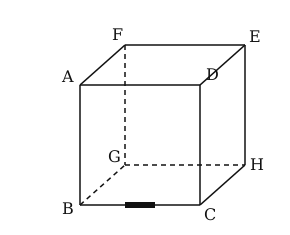
भुजा-लम्बाई '
' वाले घन
के किनारे
के मध्य में
लम्बाई का एक रेखीय आवेश चित्र में दर्शाए अनुसार रखा है। यदि रेखीय आवेश का घनत्व
C प्रति एकांक लम्बाई है, तो घन के सभी फलकों से गुजरने वाला कुल विद्युत फ्लक्स होगा ____। (
को मुक्त आकाश की विद्युतशीलता लीजिए)
- A
- B
- C
- D
Show answer
Concept: Gauss's law with symmetry: a charge lying on an edge of a cube is shared equally by the 4 identical cubes that meet at that edge, so only of its flux passes through the given cube.
- Charge on the line: .
- The line lies along edge , so 4 cubes can be stacked sharing this edge symmetrically.
- Flux through our cube .
Short trick: Edge divide by 4; corner divide by 8; face centre divide by 2.
Answer: (D)
अवधारणा: सममिति के साथ गाउस का नियम: घन के किनारे पर स्थित आवेश उस किनारे पर मिलने वाले 4 सर्वसम घनों में बराबर बँटता है, अतः उसके फ्लक्स का केवल भाग दिए गए घन से गुजरता है।
- रेखीय आवेश पर कुल आवेश: ।
- रेखा किनारे के अनुदिश है, अतः इस किनारे को साझा करते हुए 4 घन सममित रूप से रखे जा सकते हैं।
- हमारे घन से फ्लक्स ।
शॉर्ट ट्रिक: किनारा 4 से भाग; कोना 8 से भाग; फलक का केन्द्र 2 से भाग।
उत्तर: (D)
JEE Main 2025 (January) – Paper 1 (B.E./B.Tech)PhysicsElectrostatics – Gauss's lawJEE Main 2025 (January) – Paper 1 (B.E./B.Tech) 2025 · 22 Jan Shift 1
Q239.Given below are two statements : Statement I : In a vernier callipers, one vernier scale division is always smaller than one main scale division. Statement II : The vernier constant is given by one main scale division multiplied by the number of vernier scale divisions. In the light of the above statements, choose the correct answer from the options given below.
नीचे दो कथन दिए गए हैं : कथन I : वर्नियर कैलिपर्स में, एक वर्नियर पैमाने का भाग सदैव एक मुख्य पैमाने के भाग से छोटा होता है। कथन II : वर्नियर नियतांक, एक मुख्य पैमाने के भाग को वर्नियर पैमाने के भागों की संख्या से गुणा करने पर प्राप्त होता है। उपर्युक्त कथनों के आलोक में, नीचे दिए गए विकल्पों में से सही उत्तर चुनिए।
- AStatement I is true but Statement II is falseकथन I सत्य है परन्तु कथन II असत्य है
- BStatement I is false but Statement II is trueकथन I असत्य है परन्तु कथन II सत्य है
- CBoth Statement I and Statement II are falseकथन I और कथन II दोनों असत्य हैं
- DBoth Statement I and Statement II are trueकथन I और कथन II दोनों सत्य हैं
Show answer
Concept: Vernier constant (least count) 1 MSD 1 VSD, and vernier scales can also be made with VSD larger than MSD (retrograde vernier).
- Statement I: In the common vernier, VSD MSD so VSD MSD; but in a retrograde (backward) vernier, VSD MSD, making one VSD larger than one MSD. The word "always" makes Statement I false.
- Statement II: Vernier constant 1 MSD 1 VSD (not MSD number of VSD). So Statement II is false.
Short trick: VC is a difference of two nearly equal divisions — any formula with a product is instantly wrong.
Answer: (C) Both Statement I and Statement II are false
अवधारणा: वर्नियर नियतांक (अल्पतमांक) 1 MSD 1 VSD, और वर्नियर पैमाने ऐसे भी बनते हैं जिनमें VSD, MSD से बड़ा हो (प्रतिगामी/retrograde वर्नियर)।
- कथन I: सामान्य वर्नियर में VSD MSD, अतः VSD MSD; परन्तु प्रतिगामी वर्नियर में VSD MSD होता है, जिससे एक VSD एक MSD से बड़ा होता है। "सदैव" शब्द के कारण कथन I असत्य है।
- कथन II: वर्नियर नियतांक 1 MSD 1 VSD (MSD भागों की संख्या नहीं)। अतः कथन II असत्य है।
शॉर्ट ट्रिक: VC दो लगभग बराबर भागों का अन्तर है — गुणा वाला कोई भी सूत्र तुरन्त गलत है।
उत्तर: (C) कथन I और कथन II दोनों असत्य हैं
JEE Main 2025 (January) – Paper 1 (B.E./B.Tech)PhysicsExperimental Skills – vernier callipersJEE Main 2025 (January) – Paper 1 (B.E./B.Tech) 2025 · 22 Jan Shift 1
Q240.The work functions of cesium (Cs) and lithium (Li) metals are 1.9 eV and 2.5 eV, respectively. If we incident a light of wavelength 550 nm on these two metal surfaces, then photo-electric effect is possible for the case of
सीज़ियम (Cs) तथा लीथियम (Li) धातुओं के कार्य फलन क्रमशः 1.9 eV तथा 2.5 eV हैं। यदि इन दोनों धातु पृष्ठों पर 550 nm तरंगदैर्ध्य का प्रकाश आपतित किया जाए, तो प्रकाश-विद्युत प्रभाव सम्भव है
- ABoth Cs and LiCs और Li दोनों के लिए
- BNeither Cs nor Liन Cs के लिए, न Li के लिए
- CCs onlyकेवल Cs के लिए
- DLi onlyकेवल Li के लिए
Show answer
Concept: Photoemission occurs only if photon energy (work function).
- .
- For Cs: photoemission possible.
- For Li: not possible.
Short trick: Memorise ; 550 nm eV sits between the two work functions.
Answer: (C) Cs only
अवधारणा: प्रकाश-विद्युत उत्सर्जन तभी होता है जब फोटॉन ऊर्जा (कार्य फलन) हो।
- ।
- Cs के लिए: उत्सर्जन सम्भव।
- Li के लिए: सम्भव नहीं।
शॉर्ट ट्रिक: याद रखिए; 550 nm eV दोनों कार्य फलनों के बीच है।
उत्तर: (C) केवल Cs के लिए
JEE Main 2025 (January) – Paper 1 (B.E./B.Tech)PhysicsDual Nature – photoelectric effectJEE Main 2025 (January) – Paper 1 (B.E./B.Tech) 2025 · 22 Jan Shift 1

