JEE Main 2025 (January) – Paper 1 (B.E./B.Tech) · 750 questions

JEE Main 2025 (January) – Paper 1 (B.E./B.Tech) 2025 PYQs

Real previous year questions, subject-wise. Try the question, then open the answer and the explanation in Hindi & English – free, no login.

Courses – airGurukul

250 questions in Physics.

Q241.
Two spherical bodies of same materials having radii 0.2 m and 0.8 m are placed in same atmosphere. The temperature of the smaller body is 800 K and temperature of the bigger body is 400 K. If the energy radiated from the smaller body is E, the energy radiated from the bigger body is (assume, effect of the surrounding temperature to be negligible),
समान पदार्थ के 0.2 m तथा 0.8 m त्रिज्याओं वाले दो गोलीय पिण्ड एक ही वातावरण में रखे हैं। छोटे पिण्ड का ताप 800 K तथा बड़े पिण्ड का ताप 400 K है। यदि छोटे पिण्ड से विकिरित ऊर्जा E है, तो बड़े पिण्ड से विकिरित ऊर्जा होगी (परिवेश के ताप का प्रभाव नगण्य मानिए),
  1. A16 E
  2. BE
  3. C64 E
  4. D256 E
Show answer

Concept: Stefan's law: radiated power P=σeAT4∝r2T4 for spheres of the same material.

  1. PbigPsmall=(r2r1)2(T2T1)4=(0.80.2)2(400800)4.
  2. =16×116=1.
  3. So the bigger body radiates the same energy E.

Short trick: Radius up 4× gives 16× area; temperature down 2× gives 116 — they cancel exactly.

Answer: (B) E

अवधारणा: स्टीफन का नियम: विकिरित शक्ति P=σeAT4∝r2T4 (समान पदार्थ के गोलों के लिए)।

  1. Pबड़ाPछोटा=(r2r1)2(T2T1)4=(0.80.2)2(400800)4।
  2. =16×116=1।
  3. अतः बड़ा पिण्ड भी उतनी ही ऊर्जा E विकिरित करता है।

शॉर्ट ट्रिक: त्रिज्या 4 गुना ⇒ क्षेत्रफल 16 गुना; ताप आधा ⇒ 116 — दोनों ठीक-ठीक निरस्त हो जाते हैं।

उत्तर: (B) E
JEE Main 2025 (January) – Paper 1 (B.E./B.Tech)PhysicsThermal Radiation – Stefan's lawJEE Main 2025 (January) – Paper 1 (B.E./B.Tech) 2025 · 22 Jan Shift 1
Q242.
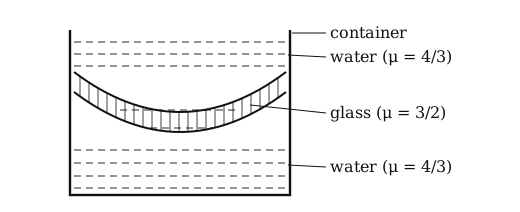
In the diagram given below, there are three lenses formed. Considering negligible thickness of each of them as compared to |R1| and |R2|, i.e., the radii of curvature for upper and lower surfaces of the glass lens, the power of the combination is
नीचे दिए गए चित्र में तीन लेंस बनते हैं। |R1| तथा |R2|, अर्थात काँच के लेंस के ऊपरी तथा निचले पृष्ठों की वक्रता त्रिज्याओं की तुलना में प्रत्येक की मोटाई नगण्य मानते हुए, संयोजन की क्षमता है
  1. A16(1|R1|−1|R2|)
  2. B−16(1|R1|+1|R2|)
  3. C16(1|R1|+1|R2|)
  4. D−16(1|R1|−1|R2|)
Show answer

Concept: For thin lenses in contact, P=P1+P2+P3 with P=(μ−1)(1Ra−1Rb). Take light travelling downward; both surfaces of the bowl-shaped glass have centres of curvature on the incident side, so Ra=−|R1|, Rb=−|R2|.

  1. Upper water lens (flat top, curved bottom): P1=(43−1)(1∞−1−|R1|)=+13|R1|.
  2. Glass lens: P2=(32−1)(1−|R1|−1−|R2|)=12(1|R2|−1|R1|).
  3. Lower water lens (curved top, flat bottom): P3=(43−1)(1−|R2|−0)=−13|R2|.
  4. Sum: P=(13−12)1|R1|+(12−13)1|R2|=−16(1|R1|−1|R2|).

Short trick: Each surface contributes ΔμR: top surface 4/3−3/2−|R1| and bottom 3/2−4/3−|R2| (air–water flat faces contribute nothing) — two terms, done.

Answer: (D) −16(1|R1|−1|R2|)

अवधारणा: सम्पर्क में रखे पतले लेंसों के लिए, P=P1+P2+P3, जहाँ P=(μ−1)(1Ra−1Rb)। प्रकाश को नीचे की ओर चलता मानिए; कटोरीनुमा काँच के दोनों पृष्ठों के वक्रता केन्द्र आपतन की ओर हैं, अतः Ra=−|R1|, Rb=−|R2|।

  1. ऊपरी जल लेंस (ऊपर समतल, नीचे वक्र): P1=(43−1)(1∞−1−|R1|)=+13|R1|।
  2. काँच का लेंस: P2=(32−1)(1−|R1|−1−|R2|)=12(1|R2|−1|R1|)।
  3. निचला जल लेंस (ऊपर वक्र, नीचे समतल): P3=(43−1)(1−|R2|−0)=−13|R2|।
  4. योग: P=(13−12)1|R1|+(12−13)1|R2|=−16(1|R1|−1|R2|)।

शॉर्ट ट्रिक: प्रत्येक पृष्ठ का योगदान ΔμR है: ऊपरी पृष्ठ 4/3−3/2−|R1| तथा निचला 3/2−4/3−|R2| (वायु–जल समतल पृष्ठों का योगदान शून्य) — केवल दो पद, काम समाप्त।

उत्तर: (D) −16(1|R1|−1|R2|)

JEE Main 2025 (January) – Paper 1 (B.E./B.Tech)PhysicsRay Optics – combination of lensesJEE Main 2025 (January) – Paper 1 (B.E./B.Tech) 2025 · 22 Jan Shift 1
Q243.
Given below are two statements : one is labelled as Assertion (A) and the other is labelled as Reason (R). Assertion-(A) : If Young's double slit experiment is performed in an optically denser medium than air, then the consecutive fringes come closer. Reason-(R) : The speed of light reduces in an optically denser medium than air while its frequency does not change. In the light of the above statements, choose the most appropriate answer from the options given below :
नीचे दो कथन दिए गए हैं : एक को अभिकथन (A) तथा दूसरे को कारण (R) कहा गया है। अभिकथन-(A) : यदि यंग का द्विझिरी प्रयोग वायु की अपेक्षा प्रकाशिक रूप से सघन माध्यम में किया जाए, तो क्रमागत फ्रिंजें पास-पास आ जाती हैं। कारण-(R) : वायु की अपेक्षा प्रकाशिक रूप से सघन माध्यम में प्रकाश की चाल घट जाती है जबकि उसकी आवृत्ति अपरिवर्तित रहती है। उपर्युक्त कथनों के आलोक में, नीचे दिए गए विकल्पों में से सबसे उपयुक्त उत्तर चुनिए :
  1. ABoth (A) and (R) are true but (R) is not the correct explanation of (A)(A) और (R) दोनों सत्य हैं परन्तु (R), (A) की सही व्याख्या नहीं है
  2. BBoth (A) and (R) are true and (R) is the correct explanation of (A)(A) और (R) दोनों सत्य हैं और (R), (A) की सही व्याख्या है
  3. C(A) is true but (R) is false(A) सत्य है परन्तु (R) असत्य है
  4. D(A) is false but (R) is true(A) असत्य है परन्तु (R) सत्य है
Show answer

Concept: Fringe width β=λDd; in a medium of refractive index μ, λmedium=λairμ.

  1. In a denser medium v=cμ decreases while frequency f stays fixed, so λ=vf decreases — exactly what (R) states, and (R) is true.
  2. Smaller λ gives smaller β=λDd: fringes come closer, so (A) is true.
  3. The chain (R) ⇒ smaller λ ⇒ smaller β is precisely why (A) happens, so (R) correctly explains (A).

Short trick: In water, YDSE fringe width shrinks by μ: β′=βμ.

Answer: (B) Both (A) and (R) are true and (R) is the correct explanation of (A)

अवधारणा: फ्रिंज चौड़ाई β=λDd; अपवर्तनांक μ वाले माध्यम में λमाध्यम=λवायुμ।

  1. सघन माध्यम में v=cμ घटती है जबकि आवृत्ति f अपरिवर्तित रहती है, अतः λ=vf घट जाती है — यही (R) कहता है, अतः (R) सत्य है।
  2. छोटी λ से β=λDd छोटी होती है: फ्रिंजें पास आ जाती हैं, अतः (A) सत्य है।
  3. (R) ⇒ छोटी λ ⇒ छोटी β — यही शृंखला (A) का कारण है, अतः (R), (A) की सही व्याख्या है।

शॉर्ट ट्रिक: जल में YDSE की फ्रिंज चौड़ाई μ गुना घट जाती है: β′=βμ।

उत्तर: (B) (A) और (R) दोनों सत्य हैं और (R), (A) की सही व्याख्या है

JEE Main 2025 (January) – Paper 1 (B.E./B.Tech)PhysicsWave Optics – Young's double slit experimentJEE Main 2025 (January) – Paper 1 (B.E./B.Tech) 2025 · 22 Jan Shift 1
Q244.
A parallel-plate capacitor of capacitance 40 μF is connected to a 100 V power supply. Now the intermediate space between the plates is filled with a dielectric material of dielectric constant K=2. Due to the introduction of dielectric material, the extra charge and the change in the electrostatic energy in the capacitor, respectively, are
40 μF धारिता के एक समान्तर-प्लेट संधारित्र को 100 V की विद्युत आपूर्ति से जोड़ा गया है। अब प्लेटों के बीच के स्थान को परावैद्युतांक K=2 वाले परावैद्युत पदार्थ से भर दिया जाता है। परावैद्युत पदार्थ भरने के कारण अतिरिक्त आवेश तथा संधारित्र की स्थिरवैद्युत ऊर्जा में परिवर्तन क्रमशः हैं
  1. A4 mC and 0.2 J4 mC और 0.2 J
  2. B8 mC and 2.0 J8 mC और 2.0 J
  3. C2 mC and 0.4 J2 mC और 0.4 J
  4. D2 mC and 0.2 J2 mC और 0.2 J
Show answer

Concept: Battery stays connected, so V is constant: C→KC, Q→KQ, U→KU.

  1. Initially Q1=CV=40 μF×100=4 mC; U1=12CV2=12(40×10−6)(100)2=0.2 J.
  2. With dielectric: C′=80 μF, Q2=8 mC, U2=0.4 J.
  3. Extra charge =Q2−Q1=4 mC; change in energy =U2−U1=0.2 J.

Short trick: With K=2 and battery connected, everything doubles — the increase equals the original values: 4 mC, 0.2 J.

Answer: (A) 4 mC and 0.2 J

अवधारणा: बैटरी जुड़ी रहती है, अतः V नियत: C→KC, Q→KQ, U→KU।

  1. प्रारम्भ में Q1=CV=40 μF×100=4 mC; U1=12CV2=12(40×10−6)(100)2=0.2 J।
  2. परावैद्युत भरने पर: C′=80 μF, Q2=8 mC, U2=0.4 J।
  3. अतिरिक्त आवेश =Q2−Q1=4 mC; ऊर्जा में परिवर्तन =U2−U1=0.2 J।

शॉर्ट ट्रिक: K=2 और बैटरी जुड़ी होने पर सब कुछ दोगुना — वृद्धि मूल मानों के बराबर: 4 mC, 0.2 J।

उत्तर: (A) 4 mC और 0.2 J

JEE Main 2025 (January) – Paper 1 (B.E./B.Tech)PhysicsCapacitance – effect of dielectricJEE Main 2025 (January) – Paper 1 (B.E./B.Tech) 2025 · 22 Jan Shift 1
Q245.
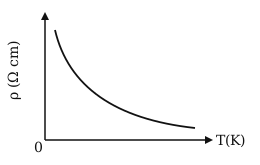
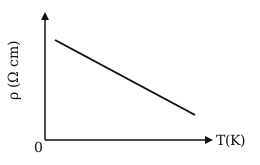
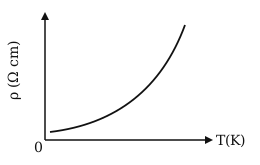
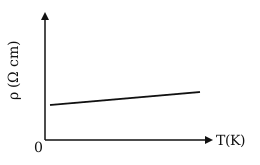
Which of the following resistivity ( ρ ) v/s temperature (T) curves is most suitable to be used in wire bound standard resistors?
निम्नलिखित में से कौन-सा प्रतिरोधकता ( ρ ) व ताप (T) वक्र तार-लिपटे मानक प्रतिरोधकों (wire bound standard resistors) में प्रयोग के लिए सर्वाधिक उपयुक्त है?
  1. A
  2. B
  3. C
  4. D
Show answer

Concept: Standard resistors must keep the same resistance at all working temperatures, so the material must have a very small temperature coefficient of resistivity — alloys like manganin and constantan.

  1. (A) shows resistivity falling sharply with T — semiconductor-like, strongly temperature dependent.
  2. (B) shows a steady linear fall — again a strong T dependence.
  3. (C) shows resistivity rising rapidly — typical of a pure metal, unsuitable.
  4. (D) shows an almost flat line: ρ nearly independent of T — exactly what an alloy such as manganin offers, hence used in standard resistors.

Short trick: Standard resistor = manganin/constantan = flat ρ–T graph.

Answer: (D) the nearly flat curve

अवधारणा: मानक प्रतिरोधकों का प्रतिरोध हर कार्यकारी ताप पर समान रहना चाहिए, अतः पदार्थ का प्रतिरोधकता ताप-गुणांक अत्यन्त छोटा होना चाहिए — मैंगनिन व कॉन्स्टेंटन जैसी मिश्रधातुएँ।

  1. (A) में प्रतिरोधकता T के साथ तेज़ी से गिरती है — अर्धचालक जैसा, ताप पर अत्यधिक निर्भर।
  2. (B) में एकसमान रैखिक गिरावट है — यह भी प्रबल ताप-निर्भरता है।
  3. (C) में प्रतिरोधकता तेज़ी से बढ़ती है — शुद्ध धातु का लक्षण, अनुपयुक्त।
  4. (D) में लगभग समतल रेखा है: ρ ताप से लगभग स्वतन्त्र — मैंगनिन जैसी मिश्रधातु का यही गुण मानक प्रतिरोधकों में काम आता है।

शॉर्ट ट्रिक: मानक प्रतिरोधक = मैंगनिन/कॉन्स्टेंटन = समतल ρ–T ग्राफ।

उत्तर: (D) लगभग समतल वक्र

JEE Main 2025 (January) – Paper 1 (B.E./B.Tech)PhysicsCurrent Electricity – resistivity of materialsJEE Main 2025 (January) – Paper 1 (B.E./B.Tech) 2025 · 22 Jan Shift 1
Q246.
The driver sitting inside a parked car is watching vehicles approaching from behind with the help of his side view mirror, which is a convex mirror with radius of curvature R=2 m. Another car approaches him from behind with a uniform speed of 90 km/hr. When the car is at a distance of 24 m from him, the magnitude of the acceleration of the image of the car in the side view mirror is ' a '. The value of 100a is ______ m/s2.
एक खड़ी कार में बैठा चालक अपने पार्श्व दृश्य दर्पण (side view mirror), जो R=2 m वक्रता त्रिज्या का उत्तल दर्पण है, की सहायता से पीछे से आ रहे वाहनों को देख रहा है। एक अन्य कार पीछे से 90 km/hr की एकसमान चाल से उसकी ओर आ रही है। जब वह कार उससे 24 m की दूरी पर है, तब पार्श्व दृश्य दर्पण में कार के प्रतिबिम्ब के त्वरण का परिमाण ' a ' है। 100a का मान ______ m/s2 है।
Show answer

Concept: For a convex mirror, the image (behind the mirror) sits at y=fxx+f when the object is at distance x (magnitudes, f=R2). Differentiate twice; the object moves uniformly, so only the x˙2 term survives.

  1. f=R2=1 m; speed =90 km/hr=25 m/s, so x˙=−25 m/s, x¨=0.
  2. y=xx+1⇒y˙=x˙(x+1)2.
  3. y¨=x¨(x+1)2−2x˙2(x+1)3=−2×625253 at x=24.
  4. |a|=125015625=0.08 m/s2⇒100a=8.

Short trick: aimage=2f2v2(x+f)3 for a uniformly moving object — plug in f=1, v=25, x=24.

Answer: 8

अवधारणा: उत्तल दर्पण के लिए, वस्तु के x दूरी पर होने पर प्रतिबिम्ब (दर्पण के पीछे) y=fxx+f पर बनता है (परिमाणों में, f=R2)। दो बार अवकलन कीजिए; वस्तु एकसमान चाल से चलती है, अतः केवल x˙2 वाला पद बचता है।

  1. f=R2=1 m; चाल =90 km/hr=25 m/s, अतः x˙=−25 m/s, x¨=0।
  2. y=xx+1⇒y˙=x˙(x+1)2।
  3. y¨=x¨(x+1)2−2x˙2(x+1)3=−2×625253 (x=24 पर)।
  4. |a|=125015625=0.08 m/s2⇒100a=8।

शॉर्ट ट्रिक: एकसमान गति वाली वस्तु के लिए aप्रतिबिम्ब=2f2v2(x+f)3 — f=1, v=25, x=24 रखिए।

उत्तर: 8

JEE Main 2025 (January) – Paper 1 (B.E./B.Tech)PhysicsRay Optics – image motion in spherical mirrorJEE Main 2025 (January) – Paper 1 (B.E./B.Tech) 2025 · 22 Jan Shift 1
Q247.
Two soap bubbles of radius 2 cm and 4 cm, respectively, are in contact with each other. The radius of curvature of the common surface, in cm, is ______.
क्रमशः 2 cm तथा 4 cm त्रिज्या के दो साबुन के बुलबुले एक-दूसरे के सम्पर्क में हैं। उभयनिष्ठ पृष्ठ की वक्रता त्रिज्या, cm में, ______ है।
Show answer

Concept: Excess pressure inside a soap bubble is ΔP=4Tr. The common surface bulges into the bigger bubble, and its radius follows from the pressure difference across it.

  1. P1−P0=4T2 (smaller bubble), P2−P0=4T4 (bigger bubble).
  2. Across the common surface: P1−P2=4Trc.
  3. 4Trc=4T2−4T4⇒1rc=12−14=14.
  4. rc=4 cm.

Short trick: rc=r1r2r2−r1=2×44−2=4 cm.

Answer: 4

अवधारणा: साबुन के बुलबुले के भीतर अतिरिक्त दाब ΔP=4Tr होता है। उभयनिष्ठ पृष्ठ बड़े बुलबुले की ओर उभरता है, और उसकी त्रिज्या पृष्ठ के आर-पार दाबान्तर से मिलती है।

  1. P1−P0=4T2 (छोटा बुलबुला), P2−P0=4T4 (बड़ा बुलबुला)।
  2. उभयनिष्ठ पृष्ठ के आर-पार: P1−P2=4Trc।
  3. 4Trc=4T2−4T4⇒1rc=12−14=14।
  4. rc=4 cm।

शॉर्ट ट्रिक: rc=r1r2r2−r1=2×44−2=4 cm।

उत्तर: 4

JEE Main 2025 (January) – Paper 1 (B.E./B.Tech)PhysicsMechanical Properties of Fluids – soap bubblesJEE Main 2025 (January) – Paper 1 (B.E./B.Tech) 2025 · 22 Jan Shift 1
Q248.
The position vectors of two 1 kg particles, (A) and (B), are given by r→A=(α1t2i^+α2tj^+α3tk^) m and r→B=(β1ti^+β2t2j^+β3tk^) m, respectively; (α1=1 m/s2,α2=3n m/s,α3=2 m/s,β1=2 m/s,β2=−1 m/s2,β3=4p m/s), where t is time, n and p are constants. At t=1 s, |V→A|=|V→B| and velocities V→A and V→B of the particles are orthogonal to each other. At t=1 s, the magnitude of angular momentum of particle (A) with respect to the position of particle (B) is L kg m2s−1. The value of L is ______.
1 kg द्रव्यमान के दो कणों (A) तथा (B) के स्थिति सदिश क्रमशः r→A=(α1t2i^+α2tj^+α3tk^) m तथा r→B=(β1ti^+β2t2j^+β3tk^) m हैं; (α1=1 m/s2,α2=3n m/s,α3=2 m/s,β1=2 m/s,β2=−1 m/s2,β3=4p m/s), जहाँ t समय है तथा n और p नियतांक हैं। t=1 s पर, |V→A|=|V→B| तथा कणों के वेग V→A और V→B परस्पर लम्बवत हैं। t=1 s पर, कण (B) की स्थिति के सापेक्ष कण (A) के कोणीय संवेग का परिमाण L kg m2s−1 है। L का मान ______ है।
Show answer

Concept: Use the two conditions at t=1 s to find n and p, then L→=m(r→A−r→B)×V→A.

  1. V→A=(2α1t, 3n, 2)=(2,3n,2) and V→B=(2, 2β2t, 4p)=(2,−2,4p) at t=1 s.
  2. |V→A|=|V→B|: 8+9n2=8+16p2⇒3n=±4p. Orthogonality: 4−6n+8p=0.
  3. 3n=4p gives 4=0 (impossible); 3n=−4p gives 4+16p=0⇒p=−14, n=13.
  4. So V→A=(2,1,2), V→B=(2,−2,−1) (check: magnitudes 3, dot product 0).
  5. Positions at t=1: r→A=(1,1,2), r→B=(2,−1,−1); r→=r→A−r→B=(−1,2,3).
  6. L→=mr→×V→A=(2⋅2−3⋅1, 3⋅2−(−1)⋅2, −1⋅1−2⋅2)=(1,8,−5).
  7. |L→|2=1+64+25=90⇒|L→|=90⇒L=90.

Short trick: Since |L→|=L, you never need the square root — just report |r→×V→A|2.

Answer: 90

अवधारणा: t=1 s की दोनों शर्तों से n और p निकालिए, फिर L→=m(r→A−r→B)×V→A।

  1. t=1 s पर V→A=(2α1t, 3n, 2)=(2,3n,2) तथा V→B=(2, 2β2t, 4p)=(2,−2,4p)।
  2. |V→A|=|V→B|: 8+9n2=8+16p2⇒3n=±4p। लम्बवतता: 4−6n+8p=0।
  3. 3n=4p से 4=0 (असम्भव); 3n=−4p से 4+16p=0⇒p=−14, n=13।
  4. अतः V→A=(2,1,2), V→B=(2,−2,−1) (जाँच: दोनों परिमाण 3, अदिश गुणनफल 0)।
  5. t=1 पर स्थितियाँ: r→A=(1,1,2), r→B=(2,−1,−1); r→=r→A−r→B=(−1,2,3)।
  6. L→=mr→×V→A=(2⋅2−3⋅1, 3⋅2−(−1)⋅2, −1⋅1−2⋅2)=(1,8,−5)।
  7. |L→|2=1+64+25=90⇒|L→|=90⇒L=90।

शॉर्ट ट्रिक: चूँकि |L→|=L, वर्गमूल की आवश्यकता ही नहीं — सीधे |r→×V→A|2 लिख दीजिए।

उत्तर: 90

JEE Main 2025 (January) – Paper 1 (B.E./B.Tech)PhysicsRotational Motion – angular momentumJEE Main 2025 (January) – Paper 1 (B.E./B.Tech) 2025 · 22 Jan Shift 1
Q249.
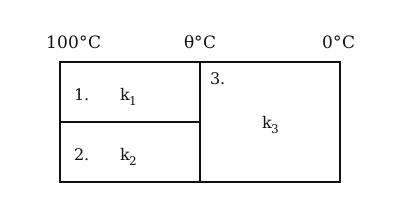
Three conductors of same length having thermal conductivity k1, k2 and k3 are connected as shown in figure.

Area of cross sections of 1st and 2nd conductor are same and for 3rd conductor it is double of the 1st conductor. The temperatures are given in the figure. In steady state condition, the value of θ is ______ ∘C. (Given : k1=60 J s−1m−1K−1, k2=120 J s−1m−1K−1, k3=135 J s−1m−1K−1)
समान लम्बाई के तीन चालक, जिनकी ऊष्मा चालकताएँ k1, k2 तथा k3 हैं, चित्र में दर्शाए अनुसार जुड़े हैं।

पहले तथा दूसरे चालक के अनुप्रस्थ काट के क्षेत्रफल समान हैं और तीसरे चालक का क्षेत्रफल पहले चालक का दोगुना है। ताप चित्र में दिए गए हैं। स्थायी अवस्था में θ का मान ______ ∘C है। (दिया है : k1=60 J s−1m−1K−1, k2=120 J s−1m−1K−1, k3=135 J s−1m−1K−1)
Show answer

Concept: In steady state, heat current into the junction = heat current out: kAΔTL for each rod, with rods 1 and 2 in parallel feeding rod 3.

  1. Heat in through rods 1 and 2 (area A each, from 100∘C to θ): (k1+k2)A(100−θ)L.
  2. Heat out through rod 3 (area 2A, from θ to 0∘C): k3⋅2A(θ−0)L.
  3. (60+120)(100−θ)=135×2θ.
  4. 18000−180θ=270θ⇒450θ=18000⇒θ=40∘C.

Short trick: Effective conductance ratio in : out =180:270=2:3, so θ divides 100→0 as θ=100×25=40.

Answer: 40

अवधारणा: स्थायी अवस्था में सन्धि में आने वाली ऊष्मा धारा = बाहर जाने वाली ऊष्मा धारा: प्रत्येक छड़ के लिए kAΔTL; छड़ 1 व 2 समान्तर क्रम में छड़ 3 को ऊष्मा देती हैं।

  1. छड़ 1 व 2 से आने वाली ऊष्मा (प्रत्येक का क्षेत्रफल A, 100∘C से θ तक): (k1+k2)A(100−θ)L।
  2. छड़ 3 से बाहर जाने वाली ऊष्मा (क्षेत्रफल 2A, θ से 0∘C तक): k3⋅2A(θ−0)L।
  3. (60+120)(100−θ)=135×2θ।
  4. 18000−180θ=270θ⇒450θ=18000⇒θ=40∘C।

शॉर्ट ट्रिक: चालकता अनुपात (अन्दर : बाहर) =180:270=2:3, अतः θ=100×25=40।

उत्तर: 40

JEE Main 2025 (January) – Paper 1 (B.E./B.Tech)PhysicsHeat Transfer – conductionJEE Main 2025 (January) – Paper 1 (B.E./B.Tech) 2025 · 22 Jan Shift 1
Q250.
A particle is projected at an angle of 30∘ from horizontal at a speed of 60 m/s. The height traversed by the particle in the first second is h0 and height traversed in the last second, before it reaches the maximum height, is h1. The ratio h0:h1 is ______ [Take, g=10 m/s2]
एक कण को क्षैतिज से 30∘ कोण पर 60 m/s की चाल से प्रक्षेपित किया जाता है। पहले सेकण्ड में कण द्वारा तय की गई ऊँचाई h0 है तथा अधिकतम ऊँचाई पर पहुँचने से पहले अन्तिम सेकण्ड में तय की गई ऊँचाई h1 है। अनुपात h0:h1 ______ है [g=10 m/s2 लीजिए]
Show answer

Concept: Only the vertical motion matters: uy=usin⁡θ, y(t)=uyt−12gt2, and time to the top is uyg.

  1. uy=60sin⁡30∘=30 m/s; time to maximum height =3010=3 s.
  2. First second: h0=30(1)−5(1)2=25 m.
  3. Last second (from t=2 s to t=3 s): h1=y(3)−y(2)=(90−45)−(60−20)=45−40=5 m.
  4. h0:h1=25:5=5.

Short trick: By time reversal, the last second before the top equals the first second of free fall: h1=12g(1)2=5 m; and h0=uy−5=25 m.

Answer: 5

अवधारणा: केवल ऊर्ध्वाधर गति देखनी है: uy=usin⁡θ, y(t)=uyt−12gt2, तथा शीर्ष तक का समय uyg।

  1. uy=60sin⁡30∘=30 m/s; अधिकतम ऊँचाई तक समय =3010=3 s।
  2. पहला सेकण्ड: h0=30(1)−5(1)2=25 m।
  3. अन्तिम सेकण्ड (t=2 s से t=3 s तक): h1=y(3)−y(2)=(90−45)−(60−20)=45−40=5 m।
  4. h0:h1=25:5=5।

शॉर्ट ट्रिक: समय-व्युत्क्रमण से, शीर्ष से पहले का अन्तिम सेकण्ड मुक्त पतन के पहले सेकण्ड के बराबर है: h1=12g(1)2=5 m; तथा h0=uy−5=25 m।

उत्तर: 5

JEE Main 2025 (January) – Paper 1 (B.E./B.Tech)PhysicsKinematics – projectile motionJEE Main 2025 (January) – Paper 1 (B.E./B.Tech) 2025 · 22 Jan Shift 1