Q41.Choose the correct statements.
(A) Weight of a substance is the amount of matter present in it.
(B) Mass is the force exerted by gravity on an object.
(C) Volume is the amount of space occupied by a substance.
(D) Temperatures below 0°C are possible in Celsius scale, but in Kelvin scale negative temperature is not possible.
(E) Precision refers to the closeness of various measurements for the same quantity.
Choose the correct answer from the options given below :
सही कथन चुनिए।
(A) किसी पदार्थ का भार उसमें उपस्थित द्रव्य की मात्रा है।
(B) द्रव्यमान किसी वस्तु पर गुरुत्व द्वारा लगाया गया बल है।
(C) आयतन किसी पदार्थ द्वारा घेरा गया स्थान है।
(D) सेल्सियस पैमाने पर 0°C से नीचे के ताप संभव हैं, परन्तु केल्विन पैमाने पर ऋणात्मक ताप संभव नहीं है।
(E) परिशुद्धता (precision) एक ही राशि के विभिन्न मापनों की परस्पर निकटता को दर्शाती है।
नीचे दिए गए विकल्पों में से सही उत्तर चुनिए:
- A(A), (D) and (E) Onlyकेवल (A), (D) तथा (E)
- B(C), (D) and (E) Onlyकेवल (C), (D) तथा (E)
- C(A), (B) and (C) Onlyकेवल (A), (B) तथा (C)
- D(B), (C) and (D) Onlyकेवल (B), (C) तथा (D)
Show answer
Concept: Mass = amount of matter; weight = gravitational force on that mass; the definitions in (A) and (B) are swapped.
- (A) Wrong – the amount of matter is the mass, not the weight.
- (B) Wrong – the force exerted by gravity is the weight, not the mass.
- (C) Correct – volume is the space occupied by a substance.
- (D) Correct – 0 K is the absolute zero; negative kelvin temperatures are not possible, while negative °C values are.
- (E) Correct – precision is the closeness of repeated measurements to one another (accuracy is closeness to the true value).
Short trick: Spot the classic mass–weight swap in (A) and (B) – the answer must contain C, D, E.
Answer: (B)
अवधारणा: द्रव्यमान = द्रव्य की मात्रा; भार = उस द्रव्यमान पर गुरुत्वीय बल; कथन (A) और (B) में परिभाषाएँ आपस में बदली हुई हैं।
- (A) गलत – द्रव्य की मात्रा द्रव्यमान है, भार नहीं।
- (B) गलत – गुरुत्व द्वारा लगाया गया बल भार है, द्रव्यमान नहीं।
- (C) सही – आयतन पदार्थ द्वारा घेरा गया स्थान है।
- (D) सही – 0 K परम शून्य है; केल्विन में ऋणात्मक ताप संभव नहीं, जबकि °C में ऋणात्मक मान संभव हैं।
- (E) सही – परिशुद्धता बार-बार किए गए मापनों की परस्पर निकटता है (यथार्थता सत्य मान से निकटता है)।
शॉर्ट ट्रिक: (A) और (B) में द्रव्यमान–भार की अदला-बदली पहचानिए – उत्तर में C, D, E होने ही चाहिए।
उत्तर: (B)
JEE Main 2025 (January) – Paper 1 (B.E./B.Tech)ChemistryBasic concepts – measurementJEE Main 2025 (January) – Paper 1 (B.E./B.Tech) 2025 · 29 Jan Shift 1
Q42.The correct option with order of melting points of the pairs (Mn, Fe), (Tc, Ru) and (Re, Os) is :
(Mn, Fe), (Tc, Ru) तथा (Re, Os) युग्मों के गलनांकों के क्रम वाला सही विकल्प है:
- AFe < Mn, Ru < Tc and Re < OsFe < Mn, Ru < Tc तथा Re < Os
- BMn < Fe, Tc < Ru and Os < ReMn < Fe, Tc < Ru तथा Os < Re
- CMn < Fe, Tc < Ru and Re < OsMn < Fe, Tc < Ru तथा Re < Os
- DFe < Mn, Ru < Tc and Os < ReFe < Mn, Ru < Tc तथा Os < Re
Show answer
Concept: Melting point of transition metals depends on the strength of metallic bonding (number of unpaired d electrons available for bonding).
- Mn (3d54s2): the stable half-filled 3d5 keeps electrons localised, weakening metallic bonding → Mn (1519 K) < Fe (1811 K).
- Similarly in the 4d series Tc melts below Ru: Tc < Ru.
- In the 5d series the maximum is at W and melting points then fall steadily: Re (3459 K) > Os (3306 K), i.e. Os < Re.
- Hence Mn < Fe, Tc < Ru and Os < Re.
Short trick: Group 7 < group 8 in the 3d and 4d rows (Mn, Tc anomaly), but in 5d the order flips: Re > Os.
Answer: (B)
अवधारणा: संक्रमण धातुओं का गलनांक धात्विक आबंधन की प्रबलता (आबंधन हेतु उपलब्ध अयुग्मित d इलेक्ट्रॉनों की संख्या) पर निर्भर करता है।
- Mn (3d54s2): स्थायी अर्ध-पूरित 3d5 इलेक्ट्रॉनों को स्थानीकृत रखता है, जिससे धात्विक आबंधन दुर्बल होता है → Mn (1519 K) < Fe (1811 K)।
- इसी प्रकार 4d श्रेणी में Tc का गलनांक Ru से कम है: Tc < Ru।
- 5d श्रेणी में अधिकतम W पर है और उसके बाद गलनांक लगातार घटते हैं: Re (3459 K) > Os (3306 K), अर्थात् Os < Re।
- अतः Mn < Fe, Tc < Ru तथा Os < Re।
शॉर्ट ट्रिक: 3d व 4d पंक्तियों में समूह 7 < समूह 8 (Mn, Tc विसंगति), पर 5d में क्रम उलट जाता है: Re > Os।
उत्तर: (B)
JEE Main 2025 (January) – Paper 1 (B.E./B.Tech)Chemistryd-block – melting point trendsJEE Main 2025 (January) – Paper 1 (B.E./B.Tech) 2025 · 29 Jan Shift 1
Q43.For a Mg | Mg2+(aq) || Ag+(aq) | Ag the correct Nernst Equation is :
एक Mg | Mg2+(aq) || Ag+(aq) | Ag सेल के लिए सही नर्न्स्ट समीकरण है:
- A
- B
- C
- D
Show answer
Concept: , where for the cell reaction.
- Cell reaction: , with .
- (solids omitted).
- – option (B).
- (A)/(D) miss the square on ; (C) has the square but the wrong sign (its log term is inverted).
Short trick: 2 electrons → must be squared; flipping the fraction flips the sign.
Answer: (B)
अवधारणा: , जहाँ सेल अभिक्रिया के लिए ।
- सेल अभिक्रिया: , जिसमें ।
- (ठोस छोड़ दिए जाते हैं)।
- – विकल्प (B)।
- (A)/(D) में पर वर्ग नहीं है; (C) में वर्ग तो है पर चिह्न गलत है (log पद उल्टा है)।
शॉर्ट ट्रिक: 2 इलेक्ट्रॉन → पर वर्ग अनिवार्य; भिन्न पलटने पर चिह्न पलटता है।
उत्तर: (B)
JEE Main 2025 (January) – Paper 1 (B.E./B.Tech)ChemistryElectrochemistry – Nernst equationJEE Main 2025 (January) – Paper 1 (B.E./B.Tech) 2025 · 29 Jan Shift 1
Q44.In the following substitution reaction:
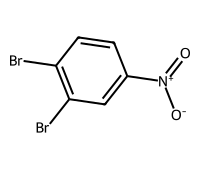
P (Product)
product 'P' formed is :
निम्नलिखित प्रतिस्थापन अभिक्रिया में:
P (उत्पाद)
बनने वाला उत्पाद 'P' है:
- A
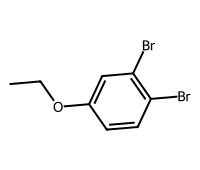
- B
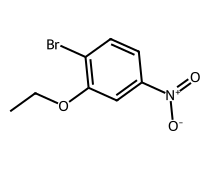
- C
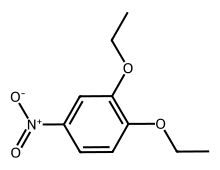
- D
Show answer
Concept: In nucleophilic aromatic substitution the −NO2 group activates only the halogens ortho/para to it (the Meisenheimer intermediate is stabilised by resonance with −NO2).
- The substrate is 1,2-dibromo-4-nitrobenzene: one Br is para to −NO2, the other Br is meta.
- C2H5O− displaces only the para-Br; the meta-Br is not activated and stays.
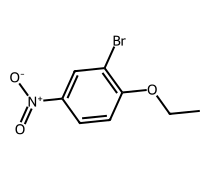
- P = 2-bromo-1-ethoxy-4-nitrobenzene – option (D).
- (A) wrongly replaces −NO2; (B) replaces the unactivated meta-Br; (C) replaces both bromines.
Short trick: In SNAr, count positions from NO2: only ortho/para halogen leaves.
Answer: (D)
अवधारणा: नाभिकस्नेही ऐरोमैटिक प्रतिस्थापन में −NO2 समूह केवल अपने ortho/para हैलोजनों को सक्रिय करता है (माइज़ेनहाइमर मध्यवर्ती −NO2 से अनुनाद द्वारा स्थायी होता है)।
- क्रियाधार 1,2-डाइब्रोमो-4-नाइट्रोबेंजीन है: एक Br, −NO2 के para में तथा दूसरा Br meta में है।
- C2H5O− केवल para-Br को विस्थापित करता है; meta-Br सक्रिय नहीं है, वह बना रहता है।
- P = 2-ब्रोमो-1-एथॉक्सी-4-नाइट्रोबेंजीन – विकल्प (D)।
- (A) में गलत ढंग से −NO2 प्रतिस्थापित है; (B) में असक्रिय meta-Br प्रतिस्थापित है; (C) में दोनों ब्रोमीन प्रतिस्थापित हैं।
शॉर्ट ट्रिक: SNAr में NO2 से स्थिति गिनिए: केवल ortho/para हैलोजन ही निकलता है।
उत्तर: (D)
JEE Main 2025 (January) – Paper 1 (B.E./B.Tech)ChemistryHaloarenes – nucleophilic aromatic substitutionJEE Main 2025 (January) – Paper 1 (B.E./B.Tech) 2025 · 29 Jan Shift 1
Q45.The correct increasing order of stability of the complexes based on Δo value is :
I. [Mn(CN)6]3− II. [Co(CN)6]4− III. [Fe(CN)6]4− IV. [Fe(CN)6]3−
Δo मान के आधार पर संकुलों के स्थायित्व का सही बढ़ता क्रम है:
I. [Mn(CN)6]3− II. [Co(CN)6]4− III. [Fe(CN)6]4− IV. [Fe(CN)6]3−
- AIV III II I
- BI II IV III
- CIII II IV I
- DII III I IV
Show answer
Concept: CN− is a strong-field ligand → all complexes are low spin; stability follows the crystal-field stabilisation energy (in units of Δo).
- I. [Mn(CN)6]3−: Mn3+ d4 → t2g4 → CFSE = −1.6 Δo.
- II. [Co(CN)6]4−: Co2+ d7 → t2g6eg1 → CFSE = −1.8 Δo.
- IV. [Fe(CN)6]3−: Fe3+ d5 → t2g5 → CFSE = −2.0 Δo.
- III. [Fe(CN)6]4−: Fe2+ d6 → t2g6 → CFSE = −2.4 Δo (maximum).
- More negative CFSE = more stable → I II IV III.
Short trick: Low-spin CFSE (−0.4 × number of t2g electrons + 0.6 × eg): d6 (t2g6) is always the champion.
Answer: (B)
अवधारणा: CN− प्रबल क्षेत्र लिगन्ड है → सभी संकुल निम्न-चक्रण हैं; स्थायित्व क्रिस्टल-क्षेत्र स्थायीकरण ऊर्जा (Δo इकाई में) के अनुसार होता है।
- I. [Mn(CN)6]3−: Mn3+ d4 → t2g4 → CFSE = −1.6 Δo।
- II. [Co(CN)6]4−: Co2+ d7 → t2g6eg1 → CFSE = −1.8 Δo।
- IV. [Fe(CN)6]3−: Fe3+ d5 → t2g5 → CFSE = −2.0 Δo।
- III. [Fe(CN)6]4−: Fe2+ d6 → t2g6 → CFSE = −2.4 Δo (अधिकतम)।
- जितनी अधिक ऋणात्मक CFSE, उतना अधिक स्थायित्व → I II IV III।
शॉर्ट ट्रिक: निम्न-चक्रण CFSE (−0.4 × t2g इलेक्ट्रॉन + 0.6 × eg): d6 (t2g6) सदैव सबसे आगे।
उत्तर: (B)
JEE Main 2025 (January) – Paper 1 (B.E./B.Tech)ChemistryCoordination compounds – CFSE & stabilityJEE Main 2025 (January) – Paper 1 (B.E./B.Tech) 2025 · 29 Jan Shift 1
Q46.The molar mass of the water insoluble product formed from the fusion of chromite ore (FeCr2O4) with Na2CO3 in presence of O2 is _______ g mol−1.
क्रोमाइट अयस्क (FeCr2O4) के Na2CO3 के साथ O2 की उपस्थिति में संगलन से बनने वाले जल में अविलेय उत्पाद का मोलर द्रव्यमान _______ g mol−1 है।
Show answer
Concept: The first step of chromium extraction/dichromate manufacture is alkaline oxidative fusion of chromite.
- 4FeCr2O4 + 8Na2CO3 + 7O2 → 8Na2CrO4 + 2Fe2O3 + 8CO2.
- Na2CrO4 (yellow) is water soluble and is leached out; Fe2O3 is the water-insoluble residue.
- M(Fe2O3) = 2 × 56 + 3 × 16 = 112 + 48 = 160 g mol−1.
Short trick: Chromite fusion → soluble chromate + insoluble Fe2O3; remember Fe2O3 = 160.
Answer: 160
अवधारणा: क्रोमियम निष्कर्षण/डाइक्रोमेट निर्माण का पहला चरण क्रोमाइट का क्षारीय ऑक्सीकारी संगलन है।
- 4FeCr2O4 + 8Na2CO3 + 7O2 → 8Na2CrO4 + 2Fe2O3 + 8CO2।
- Na2CrO4 (पीला) जल में विलेय है और निक्षालित हो जाता है; Fe2O3 जल में अविलेय अवशेष है।
- M(Fe2O3) = 2 × 56 + 3 × 16 = 112 + 48 = 160 g mol−1।
शॉर्ट ट्रिक: क्रोमाइट संगलन → विलेय क्रोमेट + अविलेय Fe2O3; Fe2O3 = 160 याद रखिए।
उत्तर: 160
JEE Main 2025 (January) – Paper 1 (B.E./B.Tech)Chemistryd- & f-block – chromite ore chemistryJEE Main 2025 (January) – Paper 1 (B.E./B.Tech) 2025 · 29 Jan Shift 1
Q47.Given below are some nitrogen containing compounds
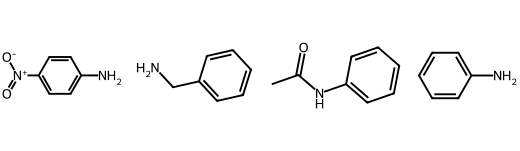
Each of them is treated with HCl separately. 1.0 g of the most basic compound will consume _______ mg of HCl.
(Given molar mass in g mol
−1 C : 12, H : 1, O : 16, Cl : 35.5)
नीचे कुछ नाइट्रोजन युक्त यौगिक दिए गए हैं
प्रत्येक को अलग-अलग HCl से उपचारित किया जाता है। सबसे अधिक क्षारकीय यौगिक का 1.0 g _______ mg HCl का उपभोग करेगा।
(मोलर द्रव्यमान g mol
−1 में दिए हैं: C : 12, H : 1, O : 16, Cl : 35.5)
Show answer
Concept: An sp3 benzylic amine is far more basic than aryl amines (lone pair delocalised into the ring) or an amide (lone pair tied up with C=O).
- Basicity: PhCH2NH2 > aniline > 4-nitroaniline > acetanilide. The most basic compound is benzylamine, C6H5CH2NH2.
- M(C7H9N) = 7 × 12 + 9 × 1 + 14 = 107 g mol−1; moles in 1.0 g = .
- 1 mol amine neutralises 1 mol HCl (M = 36.5): mass of HCl = .
Short trick: mg of HCl per gram = ; with M = 107 → 341 mg.
Answer: 341
अवधारणा: sp3 बेंज़िलिक ऐमीन, ऐरिल ऐमीनों (एकाकी युग्म वलय में विस्थानीकृत) या ऐमाइड (एकाकी युग्म C=O से बँधा) की तुलना में कहीं अधिक क्षारकीय होती है।
- क्षारकता: PhCH2NH2 > ऐनिलीन > 4-नाइट्रोऐनिलीन > ऐसीटैनिलाइड। सबसे अधिक क्षारकीय यौगिक बेंज़िलऐमीन, C6H5CH2NH2 है।
- M(C7H9N) = 7 × 12 + 9 × 1 + 14 = 107 g mol−1; 1.0 g में मोल = ।
- 1 mol ऐमीन 1 mol HCl (M = 36.5) को उदासीन करती है: HCl का द्रव्यमान = ।
शॉर्ट ट्रिक: प्रति ग्राम HCl (mg में) = ; M = 107 → 341 mg।
उत्तर: 341
JEE Main 2025 (January) – Paper 1 (B.E./B.Tech)ChemistryAmines – basicityJEE Main 2025 (January) – Paper 1 (B.E./B.Tech) 2025 · 29 Jan Shift 1
Q48.The sum of sigma (σ) and pi (π) bonds in Hex-1,3-dien-5-yne is _______.
हेक्स-1,3-डाईन-5-आइन (Hex-1,3-dien-5-yne) में सिग्मा (σ) तथा पाई (π) आबंधों का योग _______ है।
Show answer
Concept: Every single bond = 1 σ; a double bond = 1 σ + 1 π; a triple bond = 1 σ + 2 π.
- Hex-1,3-dien-5-yne: CH2=CH−CH=CH−C≡CH.
- σ bonds: 5 C−C + 6 C−H = 11.
- π bonds: 2 (from the two C=C) + 2 (from C≡C) = 4.
- Total = 11 + 4 = 15.
Short trick: For C6H6 chains: σ = atoms − 1 = 11; π = degree of unsaturation = 4 → 15.
Answer: 15
अवधारणा: प्रत्येक एकल आबंध = 1 σ; द्विआबंध = 1 σ + 1 π; त्रिआबंध = 1 σ + 2 π।
- हेक्स-1,3-डाईन-5-आइन: CH2=CH−CH=CH−C≡CH।
- σ आबंध: 5 C−C + 6 C−H = 11।
- π आबंध: 2 (दोनों C=C से) + 2 (C≡C से) = 4।
- योग = 11 + 4 = 15।
शॉर्ट ट्रिक: C6H6 शृंखला में: σ = परमाणु − 1 = 11; π = असंतृप्तता की मात्रा = 4 → 15।
उत्तर: 15
JEE Main 2025 (January) – Paper 1 (B.E./B.Tech)ChemistryChemical bonding – σ and π bond countJEE Main 2025 (January) – Paper 1 (B.E./B.Tech) 2025 · 29 Jan Shift 1
Q49.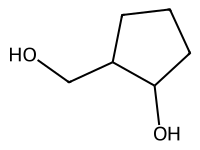
P
Q
R
'S'
0.1 mole of compound ' S ' will weigh _______ g. (Given molar mass in g mol
−1 C : 12, H : 1, O : 16)
P
Q
R
'S'
यौगिक ' S ' के 0.1 मोल का भार _______ g होगा। (मोलर द्रव्यमान g mol
−1 में दिए हैं: C : 12, H : 1, O : 16)
Show answer
Concept: Excess CrO3 oxidises a 2° alcohol to a ketone and a 1° alcohol all the way to a carboxylic acid; ethylene glycol protects only the ketone; a Grignard reagent is simply destroyed (as CH4) by the acidic –COOH proton.
- Substrate = 2-(hydroxymethyl)cyclopentan-1-ol (C6H12O2). CrO3 (excess): ring −OH → C=O, −CH2OH → −COOH; P = 2-oxocyclopentane-1-carboxylic acid.
- One mole HO−CH2−CH2−OH/H+ converts the ketone into its cyclic acetal (1,3-dioxolane); the −COOH does not form an acetal → Q.
- CH3MgI only removes the acidic proton of −COOH (CH4 is evolved, −COO−MgI+ is not attacked); H3O+ workup regenerates −COOH and hydrolyses the acetal → R = 2-oxocyclopentane-1-carboxylic acid again.
- NaBH4 reduces the ketone (not the acid) → S = 2-hydroxycyclopentane-1-carboxylic acid, C6H10O3.
- M(S) = 6 × 12 + 10 × 1 + 3 × 16 = 72 + 10 + 48 = 130 g mol−1; 0.1 mol weighs 0.1 × 130 = 13 g.
Short trick: Grignard + free –COOH = just an acid–base reaction; the sequence only turns –CH2OH into –COOH: C6H12O2 (116) − 2H + O → C6H10O3 (130) → 13 g.
Answer: 13
अवधारणा: आधिक्य CrO3 द्वितीयक ऐल्कोहॉल को कीटोन में तथा प्राथमिक ऐल्कोहॉल को सीधे कार्बोक्सिलिक अम्ल तक ऑक्सीकृत करता है; एथिलीन ग्लाइकॉल केवल कीटोन को संरक्षित करता है; –COOH का अम्लीय प्रोटॉन ग्रिग्नार्ड अभिकर्मक को (CH4 के रूप में) नष्ट कर देता है।
- क्रियाधार = 2-(हाइड्रॉक्सीमेथिल)साइक्लोपेन्टेन-1-ऑल (C6H12O2)। CrO3 (आधिक्य): वलय −OH → C=O, −CH2OH → −COOH; P = 2-ऑक्सोसाइक्लोपेन्टेन-1-कार्बोक्सिलिक अम्ल।
- एक मोल HO−CH2−CH2−OH/H+ कीटोन को उसके चक्रीय ऐसीटैल (1,3-डाइऑक्सोलेन) में बदलता है; −COOH ऐसीटैल नहीं बनाता → Q।
- CH3MgI केवल −COOH का अम्लीय प्रोटॉन हटाता है (CH4 मुक्त होती है, −COO−MgI+ पर आक्रमण नहीं होता); H3O+ कार्य-उपचार −COOH को पुनः बनाता है तथा ऐसीटैल का जल-अपघटन करता है → R = पुनः 2-ऑक्सोसाइक्लोपेन्टेन-1-कार्बोक्सिलिक अम्ल।
- NaBH4 कीटोन को (अम्ल को नहीं) अपचयित करता है → S = 2-हाइड्रॉक्सीसाइक्लोपेन्टेन-1-कार्बोक्सिलिक अम्ल, C6H10O3।
- M(S) = 6 × 12 + 10 × 1 + 3 × 16 = 72 + 10 + 48 = 130 g mol−1; 0.1 mol का भार = 0.1 × 130 = 13 g।
शॉर्ट ट्रिक: ग्रिग्नार्ड + मुक्त –COOH = केवल अम्ल–क्षार अभिक्रिया; पूरा क्रम केवल –CH2OH को –COOH में बदलता है: C6H12O2 (116) − 2H + O → C6H10O3 (130) → 13 g।
उत्तर: 13
JEE Main 2025 (January) – Paper 1 (B.E./B.Tech)ChemistryAlcohols & carbonyls – multistep synthesisJEE Main 2025 (January) – Paper 1 (B.E./B.Tech) 2025 · 29 Jan Shift 1
Q50.If is 30% ionised in an aqueous solution, then the value of van't Hoff factor () is ______ .
यदि जलीय विलयन में 30% आयनित होता है, तो वान्ट हॉफ गुणांक () का मान ______ है।
Show answer
Concept: For dissociation into particles, .
- gives particles.
- , so .
- → required value is 16.
Short trick: for any AB2/A2B type salt.
Answer: 16
अवधारणा: कणों में वियोजन के लिए ।
- से कण मिलते हैं।
- , अतः ।
- → अभीष्ट मान 16।
शॉर्ट ट्रिक: किसी भी AB2/A2B प्रकार के लवण के लिए ।
उत्तर: 16
JEE Main 2025 (January) – Paper 1 (B.E./B.Tech)ChemistrySolutions – van't Hoff factorJEE Main 2025 (January) – Paper 1 (B.E./B.Tech) 2025 · 29 Jan Shift 1
Q51.Concentrated nitric acid is labelled as 75% by mass. The volume in mL of the solution which contains 30 g of nitric acid is ____. Given : Density of nitric acid solution is 1.25 g/mL.
सान्द्र नाइट्रिक अम्ल पर द्रव्यमान अनुसार 75% लेबल लगा है। उस विलयन का mL में आयतन, जिसमें 30 g नाइट्रिक अम्ल है, ____ है। दिया गया है : नाइट्रिक अम्ल विलयन का घनत्व 1.25 g/mL है।
- A40
- B32
- C45
- D55
Show answer
Concept: Mass % gives mass of solute per 100 g of solution; volume = mass of solution / density.
- 75% by mass ⇒ 75 g HNO3 is present in 100 g solution.
- Mass of solution containing 30 g HNO3 = g.
- Volume = mL.
Short trick: mL.
Answer: (B) 32 mL
अवधारणा: द्रव्यमान % से 100 g विलयन में विलेय का द्रव्यमान मिलता है; आयतन = विलयन का द्रव्यमान / घनत्व।
- द्रव्यमान अनुसार 75% ⇒ 100 g विलयन में 75 g HNO3 है।
- 30 g HNO3 वाले विलयन का द्रव्यमान = g।
- आयतन = mL।
शॉर्ट ट्रिक: mL।
उत्तर: (B) 32 mL
JEE Main 2025 (January) – Paper 1 (B.E./B.Tech)ChemistrySolutions – concentration termsJEE Main 2025 (January) – Paper 1 (B.E./B.Tech) 2025 · 28 Jan Shift 2
Q52.Given below are two statements :
Statement (I) : 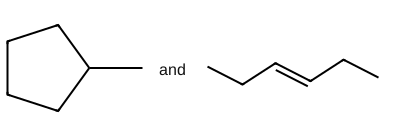
are isomeric compounds.
Statement (II) : 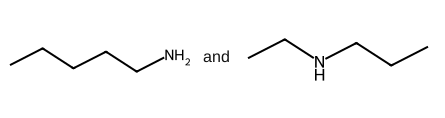
are functional group isomers.
नीचे दो कथन दिए गए हैं :
कथन (I) : समावयवी यौगिक हैं।
कथन (II) : क्रियात्मक समूह समावयवी हैं।
- ABoth Statement (I) and Statement (II) are false.कथन (I) और कथन (II) दोनों असत्य हैं।
- BBoth Statement (I) and Statement (II) are true.कथन (I) और कथन (II) दोनों सत्य हैं।
- CStatement (I) is false but Statement (II) is true.कथन (I) असत्य है परन्तु कथन (II) सत्य है।
- DStatement (I) is true but Statement (II) is false.कथन (I) सत्य है परन्तु कथन (II) असत्य है।
Show answer
Concept: Isomers have the same molecular formula; functional (group) isomers additionally belong to different classes of compounds.
- Statement (I): methylcyclopentane and hex-3-ene both have the molecular formula C6H12 → they are isomers. Statement (I) is true.
- Statement (II): pentan-1-amine (a 1° amine) and N-ethylpropan-1-amine (a 2° amine) both have the formula C5H13N but contain different amine functional classes (–NH2 vs >NH) → functional group isomers. Statement (II) is true.
Short trick: A ring is "one degree of unsaturation", just like one C=C – so cycloalkanes and alkenes of equal carbon count are always isomers (CnH2n).
Answer: (B) Both statements are true.
अवधारणा: समावयवियों का अणुसूत्र समान होता है; क्रियात्मक समूह समावयवी इसके साथ-साथ भिन्न वर्गों के यौगिक होते हैं।
- कथन (I): मेथिलसाइक्लोपेन्टेन तथा हेक्स-3-ईन दोनों का अणुसूत्र C6H12 है → ये समावयवी हैं। कथन (I) सत्य है।
- कथन (II): पेन्टेन-1-ऐमीन (1° ऐमीन) तथा N-एथिलप्रोपेन-1-ऐमीन (2° ऐमीन) दोनों का सूत्र C5H13N है, परन्तु ऐमीन के भिन्न वर्ग (–NH2 बनाम >NH) हैं → क्रियात्मक समूह समावयवी। कथन (II) सत्य है।
शॉर्ट ट्रिक: वलय (ring) भी एक असंतृप्तता कोटि है, C=C की तरह – अतः समान कार्बन संख्या वाले साइक्लोऐल्केन और ऐल्कीन सदैव समावयवी होते हैं (CnH2n)।
उत्तर: (B) दोनों कथन सत्य हैं।
JEE Main 2025 (January) – Paper 1 (B.E./B.Tech)ChemistryOrganic chemistry – isomerismJEE Main 2025 (January) – Paper 1 (B.E./B.Tech) 2025 · 28 Jan Shift 2
Q53.Identify product , and in the following reaction sequence.
CH3−C≡CH [A] [B] + [C]
निम्नलिखित अभिक्रिया अनुक्रम में उत्पाद , तथा को पहचानिए।
CH3−C≡CH [A] [B] + [C]
- A[A] : CH2=CH2, [B] : H3C−CO−CH3, [C] : HCHO
- B[A] : CH3−CH=CH2, [B] : CH3CHO, [C] : CH3CH2OH
- C[A] : CH3−CH=CH2, [B] : CH3CHO, [C] : HCHO
- D[A] : CH3CH2CH3, [B] : CH3CHO, [C] : HCHO
Show answer
Concept: Addition of one mole of H2 converts an alkyne to an alkene; reductive ozonolysis (O3; Zn, H2O) cleaves the C=C bond to two carbonyl compounds.
- Propyne + H2/Pd-C (one mole of H2 adds across C≡C) → [A] = propene, CH3–CH=CH2. The next step is ozonolysis, so [A] must contain a C=C bond.
- Ozonolysis cleaves CH3–CH=CH2 at the double bond: CH3CH= gives [B] = CH3CHO and =CH2 gives [C] = HCHO.
- (A) is wrong: ethene would mean a carbon is lost. (B) is wrong: Zn/H2O work-up gives aldehydes, not ethanol. (D) is wrong: propane has no C=C, so it cannot undergo ozonolysis.
Short trick: Replace C=C by two C=O to write ozonolysis products instantly.
Answer: (C)
अवधारणा: एक मोल H2 जुड़ने पर ऐल्काइन ऐल्कीन बनता है; अपचायी ओज़ोनी-अपघटन (O3; Zn, H2O) C=C आबंध को तोड़कर दो कार्बोनिल यौगिक देता है।
- प्रोपाइन + H2/Pd-C (C≡C पर एक मोल H2 जुड़ता है) → [A] = प्रोपीन, CH3–CH=CH2। अगला चरण ओज़ोनी-अपघटन है, अतः [A] में C=C होना आवश्यक है।
- ओज़ोनी-अपघटन CH3–CH=CH2 को द्विआबंध पर तोड़ता है: CH3CH= से [B] = CH3CHO तथा =CH2 से [C] = HCHO।
- (A) गलत: एथीन बनने पर एक कार्बन लुप्त हो जाता। (B) गलत: Zn/H2O से ऐल्डिहाइड मिलते हैं, एथेनॉल नहीं। (D) गलत: प्रोपेन में C=C नहीं है, अतः ओज़ोनी-अपघटन संभव नहीं।
शॉर्ट ट्रिक: C=C को दो C=O से बदल दीजिए – ओज़ोनी-अपघटन के उत्पाद तुरंत लिख जाते हैं।
उत्तर: (C)
JEE Main 2025 (January) – Paper 1 (B.E./B.Tech)ChemistryHydrocarbons – hydrogenation & ozonolysisJEE Main 2025 (January) – Paper 1 (B.E./B.Tech) 2025 · 28 Jan Shift 2
Q54.The total number of compounds from below when treated with hot KMnO
4 giving benzoic acid is :
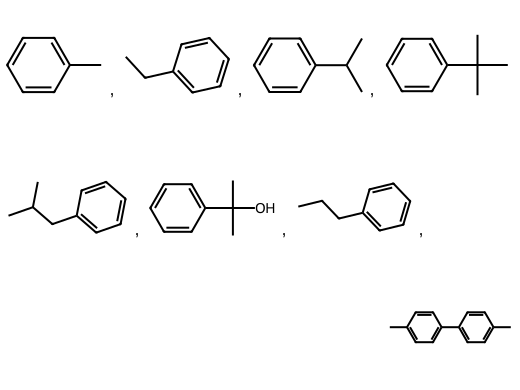
नीचे दिए गए यौगिकों में से गर्म KMnO
4 के साथ अभिकृत करने पर बेन्जोइक अम्ल देने वाले यौगिकों की कुल संख्या है :
- A6
- B3
- C5
- D4
Show answer
Concept: Hot KMnO4 oxidises any alkyl side chain to –COOH, but only if the benzylic carbon carries at least one H.
- Give benzoic acid (benzylic H present): toluene, ethylbenzene, isopropylbenzene (cumene), isobutylbenzene (PhCH2CH(CH3)2) and n-propylbenzene → 5 compounds.
- tert-Butylbenzene: benzylic carbon has no H → resistant, no benzoic acid.
- 2-Phenylpropan-2-ol, PhC(CH3)2OH: again no benzylic H → no benzoic acid.
- 4,4′-Dimethylbiphenyl: oxidation gives biphenyl-4,4′-dicarboxylic acid, not benzoic acid.
Short trick: "No benzylic H → no oxidation"; and the aromatic core always survives, so a biphenyl can never shrink to benzoic acid.
Answer: (C) 5
अवधारणा: गर्म KMnO4 किसी भी ऐल्किल पार्श्व-शृंखला को –COOH में ऑक्सीकृत करता है, परन्तु तभी जब बेन्जाइलिक कार्बन पर कम से कम एक H हो।
- बेन्जोइक अम्ल देते हैं (बेन्जाइलिक H उपस्थित): टॉलूईन, एथिलबेन्जीन, आइसोप्रोपिलबेन्जीन (क्यूमीन), आइसोब्यूटिलबेन्जीन (PhCH2CH(CH3)2) तथा n-प्रोपिलबेन्जीन → 5 यौगिक।
- tert-ब्यूटिलबेन्जीन: बेन्जाइलिक कार्बन पर H नहीं → ऑक्सीकरण नहीं होता।
- 2-फेनिलप्रोपेन-2-ऑल, PhC(CH3)2OH: बेन्जाइलिक H नहीं → बेन्जोइक अम्ल नहीं।
- 4,4′-डाइमेथिलबाइफेनिल: ऑक्सीकरण से बाइफेनिल-4,4′-डाइकार्बोक्सिलिक अम्ल बनता है, बेन्जोइक अम्ल नहीं।
शॉर्ट ट्रिक: "बेन्जाइलिक H नहीं → ऑक्सीकरण नहीं"; ऐरोमैटिक वलय सुरक्षित रहता है, अतः बाइफेनिल कभी बेन्जोइक अम्ल नहीं दे सकता।
उत्तर: (C) 5
JEE Main 2025 (January) – Paper 1 (B.E./B.Tech)ChemistryHydrocarbons – side-chain oxidation of arenesJEE Main 2025 (January) – Paper 1 (B.E./B.Tech) 2025 · 28 Jan Shift 2
Q55.Match List - I with List - II.
List - I
(Complex) | List - II
(Hybridisation of central metal ion) |
|---|
| (A) | [CoF6]3− | (I) | d2sp3 |
| (B) | [NiCl4]2− | (II) | sp3 |
| (C) | [Co(NH3)6]3+ | (III) | sp3d2 |
| (D) | [Ni(CN)4]2− | (IV) | dsp2 |
Choose the correct answer from the options given below :
सूची-I का सूची-II से मिलान कीजिए।
सूची - I
(संकुल) | सूची - II
(केंद्रीय धातु आयन का संकरण) |
|---|
| (A) | [CoF6]3− | (I) | d2sp3 |
| (B) | [NiCl4]2− | (II) | sp3 |
| (C) | [Co(NH3)6]3+ | (III) | sp3d2 |
| (D) | [Ni(CN)4]2− | (IV) | dsp2 |
नीचे दिए गए विकल्पों में से सही उत्तर चुनिए :
- A(A)-(I), (B)-(IV), (C)-(III), (D)-(II)
- B(A)-(I), (B)-(II), (C)-(III), (D)-(IV)
- C(A)-(III), (B)-(IV), (C)-(I), (D)-(II)
- D(A)-(III), (B)-(II), (C)-(I), (D)-(IV)
Show answer
Concept: Weak-field ligands give high-spin (outer-orbital) complexes, strong-field ligands give low-spin (inner-orbital) complexes; for d8 ions strong-field CN− forces square-planar dsp2.
- (A) [CoF6]3−: Co3+ (d6) with weak F− → high-spin, outer d orbitals used → sp3d2 = (III).
- (B) [NiCl4]2−: Ni2+ (d8) with weak Cl− → tetrahedral sp3 = (II).
- (C) [Co(NH3)6]3+: strong-field NH3 on Co3+ → low-spin, inner d2sp3 = (I).
- (D) [Ni(CN)4]2−: Ni2+ (d8) with strong CN− → square planar dsp2 = (IV).
Short trick: F−/Cl− → outer (sp3d2/sp3); NH3/CN− → inner (d2sp3/dsp2).
Answer: (D)
अवधारणा: दुर्बल क्षेत्र लिगन्ड उच्च-चक्रण (बाह्य-कक्षक) संकुल देते हैं, प्रबल क्षेत्र लिगन्ड निम्न-चक्रण (आंतरिक-कक्षक); d8 आयन पर प्रबल CN− वर्ग-समतलीय dsp2 देता है।
- (A) [CoF6]3−: Co3+ (d6), दुर्बल F− → उच्च-चक्रण, बाह्य d कक्षक → sp3d2 = (III)।
- (B) [NiCl4]2−: Ni2+ (d8), दुर्बल Cl− → चतुष्फलकीय sp3 = (II)।
- (C) [Co(NH3)6]3+: Co3+ पर प्रबल NH3 → निम्न-चक्रण, आंतरिक d2sp3 = (I)।
- (D) [Ni(CN)4]2−: Ni2+ (d8), प्रबल CN− → वर्ग-समतलीय dsp2 = (IV)।
शॉर्ट ट्रिक: F−/Cl− → बाह्य (sp3d2/sp3); NH3/CN− → आंतरिक (d2sp3/dsp2)।
उत्तर: (D)
JEE Main 2025 (January) – Paper 1 (B.E./B.Tech)ChemistryCoordination compounds – VBT hybridisationJEE Main 2025 (January) – Paper 1 (B.E./B.Tech) 2025 · 28 Jan Shift 2
Q56.Identify correct statements : (A) Primary amines do not give diazonium salts when treated with NaNO2 in acidic condition. (B) Aliphatic and aromatic primary amines on heating with CHCl3 and ethanolic KOH form carbylamines. (C) Secondary and tertiary amines also give carbylamine test. (D) Benzenesulfonyl chloride is known as Hinsberg's reagent. (E) Tertiary amines reacts with benzenesulfonyl chloride very easily. Choose the correct answer from the options given below :
सही कथनों को पहचानिए : (A) प्राथमिक ऐमीन अम्लीय माध्यम में NaNO2 के साथ अभिकृत करने पर डाइऐज़ोनियम लवण नहीं देते। (B) ऐलिफैटिक तथा ऐरोमैटिक प्राथमिक ऐमीन CHCl3 और एथेनॉलिक KOH के साथ गर्म करने पर कार्बिलऐमीन बनाते हैं। (C) द्वितीयक और तृतीयक ऐमीन भी कार्बिलऐमीन परीक्षण देते हैं। (D) बेन्जीनसल्फोनिल क्लोराइड हिन्सबर्ग अभिकर्मक के नाम से जाना जाता है। (E) तृतीयक ऐमीन बेन्जीनसल्फोनिल क्लोराइड से बहुत सरलता से अभिक्रिया करते हैं। नीचे दिए गए विकल्पों में से सही उत्तर चुनिए :
- A(A) and (B) onlyकेवल (A) और (B)
- B(D) and (E) onlyकेवल (D) और (E)
- C(B) and (D) onlyकेवल (B) और (D)
- D(B) and (C) onlyकेवल (B) और (C)
Show answer
Concept: Diazotisation and the carbylamine (isocyanide) test are reactions of primary amines; Hinsberg's reagent is C6H5SO2Cl.
- (A) False – primary amines DO give diazonium salts with NaNO2/HCl (aromatic ones give stable salts at 273–278 K; aliphatic ones give unstable salts).
- (B) True – all primary amines (aliphatic and aromatic) heated with CHCl3 + ethanolic KOH give foul-smelling carbylamines (isocyanides).
- (C) False – 2° and 3° amines do not give the carbylamine test; it is specific for 1° amines.
- (D) True – benzenesulfonyl chloride is Hinsberg's reagent, used to distinguish 1°, 2° and 3° amines.
- (E) False – tertiary amines have no N–H, so they do not react with benzenesulfonyl chloride.
Answer: (C) (B) and (D) only
अवधारणा: डाइऐज़ोटीकरण तथा कार्बिलऐमीन (आइसोसायनाइड) परीक्षण प्राथमिक ऐमीनों की अभिक्रियाएँ हैं; हिन्सबर्ग अभिकर्मक C6H5SO2Cl है।
- (A) असत्य – प्राथमिक ऐमीन NaNO2/HCl से डाइऐज़ोनियम लवण देते ही हैं (ऐरोमैटिक 273–278 K पर स्थायी लवण; ऐलिफैटिक अस्थायी लवण)।
- (B) सत्य – सभी प्राथमिक ऐमीन (ऐलिफैटिक तथा ऐरोमैटिक) CHCl3 + एथेनॉलिक KOH के साथ गर्म करने पर दुर्गंधयुक्त कार्बिलऐमीन (आइसोसायनाइड) देते हैं।
- (C) असत्य – 2° और 3° ऐमीन कार्बिलऐमीन परीक्षण नहीं देते; यह केवल 1° ऐमीनों के लिए विशिष्ट है।
- (D) सत्य – बेन्जीनसल्फोनिल क्लोराइड ही हिन्सबर्ग अभिकर्मक है, जिससे 1°, 2°, 3° ऐमीनों में भेद किया जाता है।
- (E) असत्य – तृतीयक ऐमीन में N–H नहीं होता, अतः वे बेन्जीनसल्फोनिल क्लोराइड से अभिक्रिया नहीं करते।
उत्तर: (C) केवल (B) और (D)
JEE Main 2025 (January) – Paper 1 (B.E./B.Tech)ChemistryAmines – reactions and testsJEE Main 2025 (January) – Paper 1 (B.E./B.Tech) 2025 · 28 Jan Shift 2
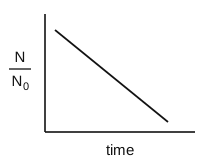
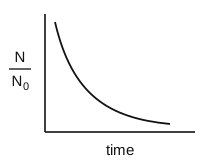
Q57.For bacterial growth in a cell culture, growth law is very similar to the law of radioactive decay. Which of the following graphs is most suitable to represent bacterial colony growth ? Where N - Number of Bacteria at any time, N0 - Initial number of Bacteria.
कोशिका संवर्धन (cell culture) में जीवाणु वृद्धि का नियम रेडियोऐक्टिव क्षय के नियम से अत्यंत मिलता-जुलता है। जीवाणु कॉलोनी की वृद्धि को निरूपित करने के लिए निम्नलिखित में से कौन-सा ग्राफ सर्वाधिक उपयुक्त है? जहाँ N - किसी समय जीवाणुओं की संख्या, N0 - जीवाणुओं की प्रारंभिक संख्या।
- A
- B
- C
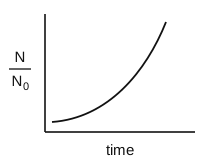
- D
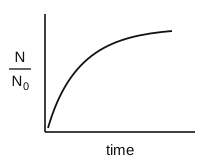
Show answer
Concept: Radioactive decay is first order: . Growth follows the same law with a positive exponent: .
- For growth, : it starts at 1 at and rises faster and faster – an upward, concave-up exponential curve.
- (A) shows a linear decrease and (B) an exponential decay – both describe loss, not growth.
- (D) shows saturation (levelling off), which never does.
- Only (C) shows the ever-steepening exponential rise.
Answer: (C)
अवधारणा: रेडियोऐक्टिव क्षय प्रथम कोटि का है: । वृद्धि उसी नियम से, परन्तु धनात्मक घातांक के साथ होती है: ।
- वृद्धि के लिए : पर मान 1 से प्रारंभ होकर उत्तरोत्तर तेज़ी से बढ़ता है – ऊपर की ओर अवतल (concave-up) चरघातांकी वक्र।
- (A) रैखिक कमी तथा (B) चरघातांकी क्षय दर्शाते हैं – दोनों ह्रास हैं, वृद्धि नहीं।
- (D) संतृप्ति (समतल होना) दर्शाता है, जो में कभी नहीं होता।
- केवल (C) निरंतर तीव्र होती चरघातांकी वृद्धि दर्शाता है।
उत्तर: (C)
JEE Main 2025 (January) – Paper 1 (B.E./B.Tech)ChemistryChemical kinetics – exponential growth lawJEE Main 2025 (January) – Paper 1 (B.E./B.Tech) 2025 · 28 Jan Shift 2
Q58.The amphoteric oxide among V2O3, V2O4 and V2O5, upon reaction with alkali leads to formation of an oxide anion. The oxidation state of V in the oxide anion is :
V2O3, V2O4 तथा V2O5 में से उभयधर्मी ऑक्साइड, क्षार से अभिक्रिया करने पर एक ऑक्साइड ऋणायन बनाता है। इस ऑक्साइड ऋणायन में V की ऑक्सीकरण अवस्था है :
- A+3
- B+4
- C+7
- D+5
Show answer
Concept: Basic character of transition-metal oxides falls and acidic character rises with oxidation state; V2O5 is amphoteric.
- V2O3 is basic, VO2 (V2O4) is largely basic/weakly amphoteric, while V2O5 is the amphoteric oxide (dissolves in both acid and alkali).
- With alkali: V2O5 + 6NaOH → 2Na3VO4 + 3H2O, giving the vanadate ion VO43−.
- In VO43−: x + 4(−2) = −3 ⇒ x = +5.
Short trick: The oxidation state of V does not change in an acid–base reaction; V2O5 is already +5.
Answer: (D) +5
अवधारणा: ऑक्सीकरण अवस्था बढ़ने के साथ संक्रमण धातु ऑक्साइडों का क्षारकीय गुण घटता तथा अम्लीय गुण बढ़ता है; V2O5 उभयधर्मी है।
- V2O3 क्षारकीय है, VO2 (V2O4) मुख्यतः क्षारकीय/अल्प उभयधर्मी, जबकि V2O5 उभयधर्मी ऑक्साइड है (अम्ल और क्षार दोनों में घुलता है)।
- क्षार के साथ: V2O5 + 6NaOH → 2Na3VO4 + 3H2O, अर्थात् वैनेडेट आयन VO43− बनता है।
- VO43− में: x + 4(−2) = −3 ⇒ x = +5।
शॉर्ट ट्रिक: अम्ल–क्षार अभिक्रिया में V की ऑक्सीकरण अवस्था नहीं बदलती; V2O5 में वह पहले से +5 है।
उत्तर: (D) +5
JEE Main 2025 (January) – Paper 1 (B.E./B.Tech)Chemistryd-block – oxides of vanadiumJEE Main 2025 (January) – Paper 1 (B.E./B.Tech) 2025 · 28 Jan Shift 2
Q59.Arrange the following in increasing order of solubility product : Ca(OH)2, AgBr, PbS, HgS
निम्नलिखित को विलेयता गुणनफल के बढ़ते क्रम में व्यवस्थित कीजिए : Ca(OH)2, AgBr, PbS, HgS
- AHgS < AgBr < PbS < Ca(OH)2
- BCa(OH)2 < AgBr < HgS < PbS
- CPbS < HgS < Ca(OH)2 < AgBr
- DHgS < PbS < AgBr < Ca(OH)2
Show answer
Concept: Ksp measures how far a sparingly soluble salt dissolves; metal sulphides of soft heavy metals are the least soluble.
- Approximate Ksp values: HgS ≈ 10−54 (one of the most insoluble salts known).
- PbS ≈ 10−28; AgBr ≈ 5 × 10⁻¹³; Ca(OH)2 ≈ 5.5 × 10⁻⁶ (noticeably soluble, lime water).
- Increasing Ksp: HgS < PbS < AgBr < Ca(OH)2.
Short trick: Softer cation + S2− → more covalent, less soluble: HgS < PbS; halides come next and hydroxides of alkaline-earth metals are the most soluble of such sets.
Answer: (D)
अवधारणा: Ksp बताता है कि अल्प-विलेय लवण कितना घुलता है; भारी (soft) धातुओं के सल्फाइड सबसे कम विलेय होते हैं।
- लगभग Ksp मान: HgS ≈ 10−54 (ज्ञात सबसे अविलेय लवणों में से एक)।
- PbS ≈ 10−28; AgBr ≈ 5 × 10⁻¹³; Ca(OH)2 ≈ 5.5 × 10⁻⁶ (चूने का पानी, पर्याप्त विलेय)।
- बढ़ता Ksp: HgS < PbS < AgBr < Ca(OH)2।
शॉर्ट ट्रिक: नरम धनायन + S2− → अधिक सहसंयोजी, कम विलेय: HgS < PbS; फिर हैलाइड, और क्षारीय-मृदा धातुओं के हाइड्रॉक्साइड ऐसे समुच्चय में सबसे अधिक विलेय।
उत्तर: (D)
JEE Main 2025 (January) – Paper 1 (B.E./B.Tech)ChemistryIonic equilibrium – solubility productJEE Main 2025 (January) – Paper 1 (B.E./B.Tech) 2025 · 28 Jan Shift 2
Q60.The purification method based on the following physical transformation is :
Solid (X) —Heat→ Vapour (X) —Cool→ Solid (X)
निम्नलिखित भौतिक रूपांतरण पर आधारित शोधन विधि है :
ठोस (X) —ऊष्मा (Heat)→ वाष्प (X) —शीतलन (Cool)→ ठोस (X)
- ADistillationआसवन
- BExtractionनिष्कर्षण
- CSublimationऊर्ध्वपातन
- DCrystallizationक्रिस्टलीकरण
Show answer
Concept: Sublimation is the direct conversion of a solid to vapour on heating, and of the vapour back to solid on cooling, without passing through the liquid state.
- The given change is Solid → Vapour → Solid, with no liquid stage anywhere – this is exactly sublimation.
- It purifies sublimable solids (naphthalene, camphor, benzoic acid) from non-volatile impurities.
- (A) Distillation involves liquid → vapour → liquid; (B) extraction uses a solvent; (D) crystallization separates a solid from its saturated solution – none of them match.
Answer: (C) Sublimation
अवधारणा: ऊर्ध्वपातन में ठोस गर्म करने पर सीधे वाष्प में तथा वाष्प ठंडा करने पर सीधे ठोस में बदलता है, बीच में द्रव अवस्था नहीं आती।
- दिया गया परिवर्तन ठोस → वाष्प → ठोस है, कहीं भी द्रव अवस्था नहीं – यही ऊर्ध्वपातन है।
- इससे ऊर्ध्वपातनीय ठोस (नैफ्थैलीन, कपूर, बेन्जोइक अम्ल) अवाष्पशील अशुद्धियों से शुद्ध किए जाते हैं।
- (A) आसवन में द्रव → वाष्प → द्रव होता है; (B) निष्कर्षण में विलायक प्रयुक्त होता है; (D) क्रिस्टलीकरण संतृप्त विलयन से ठोस पृथक् करता है – कोई भी मेल नहीं खाता।
उत्तर: (C) ऊर्ध्वपातन
JEE Main 2025 (January) – Paper 1 (B.E./B.Tech)ChemistryPurification of organic compounds – sublimationJEE Main 2025 (January) – Paper 1 (B.E./B.Tech) 2025 · 28 Jan Shift 2

