Q41.The fractional compression of water at the depth of 2.5 km below the sea level is ______ %. Given, the Bulk modulus of water N m, density of water kgm, acceleration due to gravity m s.
समुद्र तल से 2.5 km की गहराई पर जल का आंशिक संपीडन ______ % है। दिया है, जल का आयतन प्रत्यास्थता गुणांक N m, जल का घनत्व kgm, गुरुत्वीय त्वरण m s।
- A1.25
- B1.0
- C1.75
- D1.5
Show answer
Concept: Bulk modulus , and the pressure increase at depth is .
- N m.
- .
Short trick: — one line.
Answer: (A) 1.25
अवधारणा: आयतन प्रत्यास्थता गुणांक , तथा गहराई पर दाब वृद्धि ।
- N m।
- ।
शॉर्ट ट्रिक: — एक पंक्ति में।
उत्तर: (A) 1.25
JEE Main 2025 (January) – Paper 1 (B.E./B.Tech)PhysicsMechanical Properties of Solids – bulk modulusJEE Main 2025 (January) – Paper 1 (B.E./B.Tech) 2025 · 29 Jan Shift 1
Q42.The pair of physical quantities not having same dimensions is :
भौतिक राशियों का वह युग्म, जिनकी विमाएँ समान नहीं हैं, है :
- APressure and Young's modulusदाब तथा यंग गुणांक
- BSurface tension and impulseपृष्ठ तनाव तथा आवेग
- CTorque and energyबल आघूर्ण तथा ऊर्जा
- DAngular momentum and Planck's constantकोणीय संवेग तथा प्लांक नियतांक
Show answer
Concept: Compare the dimensional formulae of each pair.
- (A) Pressure and Young's modulus: both — same.
- (B) Surface tension , impulse — different.
- (C) Torque and energy: both — same.
- (D) Angular momentum and Planck's constant: both — same.
Short trick: Surface tension is force per length, impulse is force times time — they cannot match.
Answer: (B) Surface tension and impulse
अवधारणा: प्रत्येक युग्म के विमीय सूत्रों की तुलना कीजिए।
- (A) दाब तथा यंग गुणांक: दोनों — समान।
- (B) पृष्ठ तनाव , आवेग — भिन्न।
- (C) बल आघूर्ण तथा ऊर्जा: दोनों — समान।
- (D) कोणीय संवेग तथा प्लांक नियतांक: दोनों — समान।
शॉर्ट ट्रिक: पृष्ठ तनाव = बल प्रति लंबाई, आवेग = बल × समय — ये मेल नहीं खा सकते।
उत्तर: (B) पृष्ठ तनाव तथा आवेग
JEE Main 2025 (January) – Paper 1 (B.E./B.Tech)PhysicsUnits and Dimensions – comparing dimensionsJEE Main 2025 (January) – Paper 1 (B.E./B.Tech) 2025 · 29 Jan Shift 1
Q43.Consider and are the currents flowing simultaneously in two nearby coils 1 & 2, respectively. If self inductance of coil 1, mutual inductance of coil 1 with respect to coil 2, then the value of induced emf in coil 1 will be
माना दो निकटवर्ती कुंडलियों 1 तथा 2 में एक साथ प्रवाहित धाराएँ क्रमशः तथा हैं। यदि कुंडली 1 का स्वप्रेरकत्व, कुंडली 2 के सापेक्ष कुंडली 1 का अन्योन्य प्रेरकत्व हो, तो कुंडली 1 में प्रेरित विद्युत वाहक बल का मान होगा
- A
- B
- C
- D
Show answer
Concept: Total flux through coil 1 is ; the induced emf is .
- .
- Self term carries coil 1's own current ; the mutual term carries the neighbour's current — so (A), (C) and (D) are wrong.
Short trick: Self-inductance goes with its own current, mutual inductance with the other coil's current, both with minus signs.
Answer: (B)
अवधारणा: कुंडली 1 से गुजरने वाला कुल फ्लक्स है; प्रेरित विद्युत वाहक बल ।
- ।
- स्वप्रेरण पद में कुंडली 1 की अपनी धारा और अन्योन्य पद में पड़ोसी कुंडली की धारा आती है — अतः (A), (C) तथा (D) गलत हैं।
शॉर्ट ट्रिक: स्वप्रेरकत्व अपनी धारा के साथ, अन्योन्य प्रेरकत्व दूसरी कुंडली की धारा के साथ, दोनों ऋण चिह्न सहित।
उत्तर: (B)
JEE Main 2025 (January) – Paper 1 (B.E./B.Tech)PhysicsElectromagnetic Induction – self and mutual inductanceJEE Main 2025 (January) – Paper 1 (B.E./B.Tech) 2025 · 29 Jan Shift 1
Q44.Given below are two statements : one is labelled as Assertion (A) and the other is labelled as Reason (R).
Assertion (A) : Time period of a simple pendulum is longer at the top of a mountain than that at the base of the mountain.
Reason (R) : Time period of a simple pendulum decreases with increasing value of acceleration due to gravity and vice-versa.
In the light of the above statements, choose the most appropriate answer from the options given below :
नीचे दो कथन दिए गए हैं : एक को अभिकथन (A) तथा दूसरे को कारण (R) कहा गया है।
अभिकथन (A) : पर्वत की चोटी पर सरल लोलक का आवर्तकाल, पर्वत के आधार की तुलना में अधिक होता है।
कारण (R) : गुरुत्वीय त्वरण का मान बढ़ने पर सरल लोलक का आवर्तकाल घटता है, तथा इसका विलोम भी सत्य है।
उपर्युक्त कथनों के आलोक में, नीचे दिए गए विकल्पों में से सबसे उपयुक्त उत्तर चुनिए :
- ABoth (A) and (R) are true and (R) is the correct explanation of (A)(A) तथा (R) दोनों सत्य हैं और (R), (A) की सही व्याख्या है
- B(A) is true but (R) is false(A) सत्य है परंतु (R) असत्य है
- C(A) is false but (R) is true(A) असत्य है परंतु (R) सत्य है
- DBoth (A) and (R) are true but (R) is not the correct explanation of (A)(A) तथा (R) दोनों सत्य हैं परंतु (R), (A) की सही व्याख्या नहीं है
Show answer
Concept: , and decreases with altitude as .
- (A) is true: at the mountain top is smaller, so is longer than at the base.
- (R) is true: , so decreases as increases and vice-versa.
- (R) directly gives (A): smaller at the top longer . Hence (R) is the correct explanation.
Short trick: Up the mountain: — pendulum clocks run slow at height.
Answer: (A) Both (A) and (R) are true and (R) is the correct explanation of (A)
अवधारणा: , तथा ऊँचाई के साथ घटता है: ।
- (A) सत्य है: पर्वत की चोटी पर छोटा है, अतः आधार की अपेक्षा अधिक है।
- (R) सत्य है: , अतः बढ़ने पर घटता है और विलोमतः।
- (R) से (A) सीधे प्राप्त होता है: चोटी पर छोटा बड़ा । अतः (R) सही व्याख्या है।
शॉर्ट ट्रिक: पर्वत पर चढ़ने पर: — ऊँचाई पर लोलक घड़ियाँ सुस्त चलती हैं।
उत्तर: (A) (A) तथा (R) दोनों सत्य हैं और (R), (A) की सही व्याख्या है
JEE Main 2025 (January) – Paper 1 (B.E./B.Tech)PhysicsOscillations – simple pendulum and gJEE Main 2025 (January) – Paper 1 (B.E./B.Tech) 2025 · 29 Jan Shift 1
Q45.A body of mass '' connected to a massless and unstretchable string goes in verticle circle of radius '' under gravity g. The other end of the string is fixed at the center of circle. If velocity at top of circular path is , where, , then ratio of kinetic energy of the body at bottom to that at top of the circle is
'' द्रव्यमान का एक पिंड, द्रव्यमानहीन तथा न खिंचने वाली डोरी से जुड़कर, गुरुत्व g के अधीन '' त्रिज्या के ऊर्ध्वाधर वृत्त में घूमता है। डोरी का दूसरा सिरा वृत्त के केंद्र पर स्थिर है। यदि वृत्तीय पथ के शीर्ष पर वेग है, जहाँ , तो वृत्त के निम्नतम बिंदु पर पिंड की गतिज ऊर्जा का शीर्ष पर गतिज ऊर्जा से अनुपात है
- A
- B
- C
- D
Show answer
Concept: Energy conservation between the top and bottom of the vertical circle: .
- , so .
- .
Short trick: always holds across a vertical circle of radius .
Answer: (B)
अवधारणा: ऊर्ध्वाधर वृत्त के शीर्ष और निम्नतम बिंदु के बीच ऊर्जा संरक्षण: ।
- , अतः ।
- ।
शॉर्ट ट्रिक: त्रिज्या के ऊर्ध्वाधर वृत्त में सदैव ।
उत्तर: (B)
JEE Main 2025 (January) – Paper 1 (B.E./B.Tech)PhysicsWork, Energy and Power – vertical circular motionJEE Main 2025 (January) – Paper 1 (B.E./B.Tech) 2025 · 29 Jan Shift 1
Q46.In a hydraulic lift, the surface area of the input piston is 6 cm and that of the output piston is 1500 cm. If 100 N force is applied to the input piston to raise the output piston by 20 cm, then the work done is _______ kJ.
एक द्रवचालित लिफ्ट में निवेशी पिस्टन का पृष्ठीय क्षेत्रफल 6 cm तथा निर्गत पिस्टन का 1500 cm है। यदि निर्गत पिस्टन को 20 cm ऊपर उठाने के लिए निवेशी पिस्टन पर 100 N बल लगाया जाए, तो किया गया कार्य _______ kJ है।
Show answer
Concept: Pascal's law: pressure is transmitted equally, so ; work done on the load is .
- Output force: N.
- Output displacement: cm m.
- J kJ.
Answer: 5
अवधारणा: पास्कल का नियम: दाब समान रूप से संचरित होता है, अतः ; भार पर किया गया कार्य ।
- निर्गत बल: N।
- निर्गत विस्थापन: cm m।
- J kJ।
उत्तर: 5
JEE Main 2025 (January) – Paper 1 (B.E./B.Tech)PhysicsMechanical Properties of Fluids – hydraulic liftJEE Main 2025 (January) – Paper 1 (B.E./B.Tech) 2025 · 29 Jan Shift 1
Q47.The coordinates of a particle with respect to origin in a given reference frame is meters. If a force of acts on the particle, then the magnitude of torque (with respect to origin) in z-direction is ______.
किसी निर्देश तंत्र में मूल बिंदु के सापेक्ष एक कण के निर्देशांक मीटर हैं। यदि कण पर बल कार्य करे, तो (मूल बिंदु के सापेक्ष) z-दिशा में बल आघूर्ण का परिमाण ______ है।
Show answer
Concept: Torque about the origin is ; its z-component is .
- N m.
- N m.
Answer: 2
अवधारणा: मूल बिंदु के सापेक्ष बल आघूर्ण है; इसका z-घटक ।
- N m।
- N m।
उत्तर: 2
JEE Main 2025 (January) – Paper 1 (B.E./B.Tech)PhysicsRotational Motion – torqueJEE Main 2025 (January) – Paper 1 (B.E./B.Tech) 2025 · 29 Jan Shift 1
Q48.Two light beams fall on a transparent material block at point 1 and 2 with angle
and
, respectively, as shown in figure. After refraction, the beams intersect at point 3 which is exactly on the interface at other end of the block. Given : the distance between 1 and 2,
cm and
, where refractive index of the block
refractive index of the outside medium
, then the thickness of the block is ________ cm.
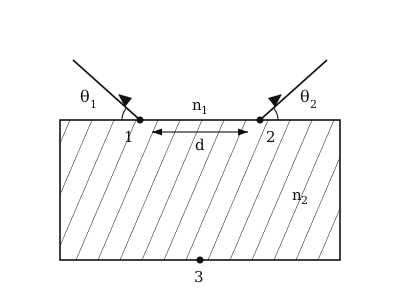
जैसा कि चित्र में दिखाया गया है, दो प्रकाश पुंज किसी पारदर्शी पदार्थ के गुटके पर बिंदु 1 तथा 2 पर क्रमशः कोण
तथा
पर आपतित होते हैं। अपवर्तन के बाद दोनों पुंज बिंदु 3 पर प्रतिच्छेद करते हैं, जो गुटके के दूसरे सिरे के अंतरापृष्ठ पर ही स्थित है। दिया है : बिंदु 1 तथा 2 के बीच की दूरी
cm तथा
, जहाँ गुटके का अपवर्तनांक
बाहरी माध्यम का अपवर्तनांक
है, तो गुटके की मोटाई ________ cm है।
Show answer
Concept: The angles in the figure are measured from the surface, so the angle of incidence (from the normal) is ; apply Snell's law and then simple geometry inside the block.
- .
- Snell's law at the top face: , so .
- By symmetry the refracted rays meet at point 3 midway below 1 and 2: each ray covers a horizontal distance cm while crossing the thickness , with .
- cm.
Answer: 6
अवधारणा: चित्र में कोण पृष्ठ से मापे गए हैं, अतः (अभिलंब से) आपतन कोण है; स्नेल का नियम लगाकर गुटके के भीतर सरल ज्यामिति का प्रयोग कीजिए।
- ।
- ऊपरी पृष्ठ पर स्नेल का नियम: , अतः ।
- सममिति से अपवर्तित किरणें बिंदु 1 और 2 के मध्य के ठीक नीचे बिंदु 3 पर मिलती हैं: मोटाई पार करते हुए प्रत्येक किरण क्षैतिज दूरी cm तय करती है, जहाँ ।
- cm।
उत्तर: 6
JEE Main 2025 (January) – Paper 1 (B.E./B.Tech)PhysicsRay Optics – refraction through a blockJEE Main 2025 (January) – Paper 1 (B.E./B.Tech) 2025 · 29 Jan Shift 1
Q49.A container of fixed volume contains a gas at 27C. To double the pressure of the gas, the temperature of gas should be raised to ______ C.
नियत आयतन के एक पात्र में 27C पर गैस भरी है। गैस का दाब दोगुना करने के लिए, गैस का ताप बढ़ाकर ______ C करना होगा।
Show answer
Concept: At constant volume (Gay-Lussac's law), with temperature in kelvin.
- K.
- K.
- C.
Answer: 327
अवधारणा: नियत आयतन पर (गै-लुसाक का नियम), , जहाँ ताप केल्विन में है।
- K।
- K।
- C।
उत्तर: 327
JEE Main 2025 (January) – Paper 1 (B.E./B.Tech)PhysicsKinetic Theory of Gases – gas lawsJEE Main 2025 (January) – Paper 1 (B.E./B.Tech) 2025 · 29 Jan Shift 1
Q50.The maximum speed of a boat in still water is 27 km/h. Now this boat is moving downstream in a river flowing at 9 km/h. A man in the boat throws a ball vertically upwards with speed of 10 m/s. Range of the ball as observed by an observer at rest on the river bank, is _______ cm. (Take m/s)
स्थिर जल में एक नाव की अधिकतम चाल 27 km/h है। अब यह नाव 9 km/h से बहती नदी में धारा की दिशा (अनुप्रवाह) में चल रही है। नाव में बैठा एक व्यक्ति एक गेंद को 10 m/s की चाल से ऊर्ध्वाधर ऊपर की ओर फेंकता है। नदी के किनारे विराम में खड़े प्रेक्षक द्वारा प्रेक्षित गेंद की परास _______ cm है। ( m/s लीजिए)
Show answer
Concept: For the observer on the bank the ball is a projectile: it keeps the boat's horizontal velocity while rising and falling for the full time of flight .
- Speed of boat relative to the bank km/h m/s.
- Time of flight of the ball: s.
- Range horizontal velocity time m cm.
Answer: 2000
अवधारणा: किनारे पर खड़े प्रेक्षक के लिए गेंद एक प्रक्षेप्य है: वह पूरे उड्डयन काल के दौरान नाव का क्षैतिज वेग बनाए रखती है।
- किनारे के सापेक्ष नाव की चाल km/h m/s।
- गेंद का उड्डयन काल: s।
- परास क्षैतिज वेग समय m cm।
उत्तर: 2000
JEE Main 2025 (January) – Paper 1 (B.E./B.Tech)PhysicsKinematics – relative motion and projectileJEE Main 2025 (January) – Paper 1 (B.E./B.Tech) 2025 · 29 Jan Shift 1
Q51.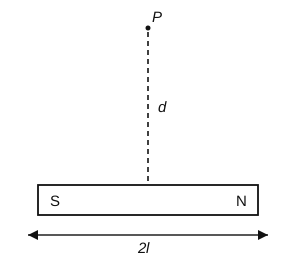
A bar magnet has total length
units and the field point
is at a distance
units from the centre of the magnet. If the relative uncertainty of length measurement is
, then uncertainty of the magnetic field at point
is :
एक छड़ चुम्बक की कुल लम्बाई
मात्रक है तथा क्षेत्र बिंदु
चुम्बक के केंद्र से
मात्रक की दूरी पर है। यदि लम्बाई मापन की आपेक्षिक अनिश्चितता
है, तो बिंदु
पर चुम्बकीय क्षेत्र की अनिश्चितता है :
- A
- B
- C
- D
Show answer
Concept: lies on the equatorial (broad-side) line of the magnet, where ( = pole strength). Relative errors of each length factor add.
- , so .
- Every length ( and ) has uncertainty, so and , hence .
- .
Short trick: For the error multiplies by : here .
Answer: (A)
अवधारणा: बिंदु चुम्बक की निरक्षीय (अनुप्रस्थ) रेखा पर है, जहाँ ( = ध्रुव प्राबल्य)। प्रत्येक लम्बाई गुणक की आपेक्षिक त्रुटियाँ जुड़ती हैं।
- , अतः ।
- प्रत्येक लम्बाई ( तथा ) में अनिश्चितता है, अतः तथा , इसलिए ।
- ।
शॉर्ट ट्रिक: के लिए त्रुटि गुना हो जाती है: यहाँ ।
उत्तर: (A)
JEE Main 2025 (January) – Paper 1 (B.E./B.Tech)PhysicsUnits & Measurements – error analysisJEE Main 2025 (January) – Paper 1 (B.E./B.Tech) 2025 · 28 Jan Shift 2
Q52.A concave mirror produces an image of an object such that the distance between the object and image is 20 cm. If the magnification of the image is '', then the magnitude of the radius of curvature of the mirror is :
एक अवतल दर्पण किसी वस्तु का प्रतिबिम्ब इस प्रकार बनाता है कि वस्तु और प्रतिबिम्ब के बीच की दूरी 20 cm है। यदि प्रतिबिम्ब का आवर्धन '' है, तो दर्पण की वक्रता त्रिज्या का परिमाण है :
- A30 cm
- B3.75 cm
- C15 cm
- D7.5 cm
Show answer
Concept: Mirror magnification and mirror formula , .
- . The image is real, on the same side as the object.
- Distance between object and image .
- With sign convention: . So .
- .
Short trick: for gives at once; then .
Answer: (C) 15 cm
अवधारणा: दर्पण का आवर्धन तथा दर्पण सूत्र , ।
- । प्रतिबिम्ब वास्तविक है, वस्तु की ओर ही बनता है।
- वस्तु और प्रतिबिम्ब के बीच दूरी ।
- चिह्न परिपाटी से: । अतः ।
- ।
शॉर्ट ट्रिक: के लिए से तुरंत मिलता है; फिर ।
उत्तर: (C) 15 cm
JEE Main 2025 (January) – Paper 1 (B.E./B.Tech)PhysicsRay Optics – spherical mirrorsJEE Main 2025 (January) – Paper 1 (B.E./B.Tech) 2025 · 28 Jan Shift 2
Q53.The velocity-time graph of an object moving along a straight line is shown in figure. What is the distance covered by the object between
to
s?
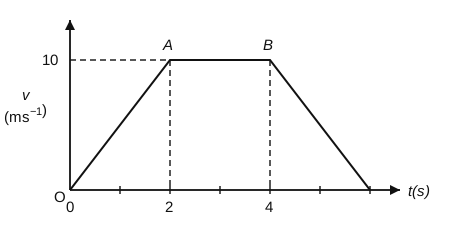
सरल रेखा में गतिमान किसी वस्तु का वेग-समय ग्राफ चित्र में दिखाया गया है।
से
s के बीच वस्तु द्वारा तय की गई दूरी क्या है?
- A30 m
- B11 m
- C10 m
- D13 m
Show answer
Concept: Distance = area under the velocity-time graph (velocity is non-negative here).
- From to s: velocity rises uniformly from 0 to 10 m/s. Area m.
- From s to s: velocity is constant at 10 m/s. Area m.
- Total distance m.
Short trick: Triangle + rectangle: m.
Answer: (A) 30 m
अवधारणा: दूरी = वेग-समय ग्राफ के नीचे का क्षेत्रफल (यहाँ वेग ऋणात्मक नहीं है)।
- से s तक: वेग एकसमान रूप से 0 से 10 m/s तक बढ़ता है। क्षेत्रफल m।
- s से s तक: वेग 10 m/s पर नियत है। क्षेत्रफल m।
- कुल दूरी m।
शॉर्ट ट्रिक: त्रिभुज + आयत: m।
उत्तर: (A) 30 m
JEE Main 2025 (January) – Paper 1 (B.E./B.Tech)PhysicsKinematics – velocity-time graphJEE Main 2025 (January) – Paper 1 (B.E./B.Tech) 2025 · 28 Jan Shift 2
Q54.A body of mass 4 kg is placed on a plane at a point P having coordinate m. Under the action of force N, it moves to a new point Q having coordinates m in 4 sec. The average power and instanteous power at the end of 4 sec are in the ratio of :
4 kg द्रव्यमान का एक पिंड किसी समतल पर निर्देशांक m वाले बिंदु P पर रखा है। बल N के प्रभाव में यह 4 सेकंड में निर्देशांक m वाले नये बिंदु Q पर पहुँच जाता है। 4 सेकंड के अंत पर औसत शक्ति तथा तात्क्षणिक शक्ति का अनुपात है :
- A13 : 6
- B4 : 3
- C1 : 2
- D6 : 13
Show answer
Concept: Average power ; instantaneous power . The body starts from rest, so .
- Displacement m.
- J W.
- ; at s, m/s.
- W.
- .
Short trick: Starting from rest under constant force, — compute the two dot products only.
Answer: (D) 6 : 13
अवधारणा: औसत शक्ति ; तात्क्षणिक शक्ति । पिंड विरामावस्था से चलता है, अतः ।
- विस्थापन m।
- J W।
- ; s पर, m/s।
- W।
- ।
शॉर्ट ट्रिक: विरामावस्था से नियत बल में के लिए केवल दो अदिश गुणनफल तथा निकालिए।
उत्तर: (D) 6 : 13
JEE Main 2025 (January) – Paper 1 (B.E./B.Tech)PhysicsWork, Energy & PowerJEE Main 2025 (January) – Paper 1 (B.E./B.Tech) 2025 · 28 Jan Shift 2
Q55.Match List - I with List - II.
| List - I | List - II |
|---|
| (A) | Angular Impulse | (I) | |
| (B) | Latent Heat | (II) | |
| (C) | Electrical resistivity | (III) | |
| (D) | Electromotive force | (IV) | |
सूची-I का सूची-II से मिलान कीजिए।
| सूची-I | सूची-II |
|---|
| (A) | कोणीय आवेग (Angular Impulse) | (I) | |
| (B) | गुप्त ऊष्मा (Latent Heat) | (II) | |
| (C) | वैद्युत प्रतिरोधकता (Electrical resistivity) | (III) | |
| (D) | विद्युत वाहक बल (Electromotive force) | (IV) | |
- A(A)-(II), (B)-(I), (C)-(IV), (D)-(III)
- B(A)-(I), (B)-(III), (C)-(IV), (D)-(II)
- C(A)-(III), (B)-(I), (C)-(II), (D)-(IV)
- D(A)-(III), (B)-(I), (C)-(IV), (D)-(II)
Show answer
Concept: Work out each dimension from a defining formula.
- (A) Angular impulse = change in angular momentum : → (III).
- (B) Latent heat (J/kg): → (I).
- (C) Resistivity ; with : → (IV).
- (D) EMF : → (II).
- So A-III, B-I, C-IV, D-II. (A), (B) and (C) fail because each misplaces at least one pair — e.g. (A) gives angular impulse the EMF dimension, (B) gives it latent heat's, (C) swaps resistivity and EMF.
Short trick: Any quantity 'per unit charge' carries and resistance-type quantities carry — that fixes (C) and (D) instantly.
Answer: (D) (A)-(III), (B)-(I), (C)-(IV), (D)-(II)
अवधारणा: प्रत्येक राशि की विमा उसके परिभाषा-सूत्र से निकालिए।
- (A) कोणीय आवेग = कोणीय संवेग में परिवर्तन : → (III)।
- (B) गुप्त ऊष्मा (J/kg): → (I)।
- (C) प्रतिरोधकता ; लेने पर: → (IV)।
- (D) विद्युत वाहक बल : → (II)।
- अतः A-III, B-I, C-IV, D-II। विकल्प (A), (B) और (C) गलत हैं क्योंकि प्रत्येक में कम से कम एक जोड़ी गलत है — जैसे (A) कोणीय आवेग को EMF की विमा देता है, (B) उसे गुप्त ऊष्मा की, और (C) प्रतिरोधकता तथा EMF को आपस में बदल देता है।
शॉर्ट ट्रिक: 'प्रति एकांक आवेश' वाली राशि में तथा प्रतिरोध-प्रकार की राशि में आता है — इससे (C) और (D) तुरंत तय हो जाते हैं।
उत्तर: (D) (A)-(III), (B)-(I), (C)-(IV), (D)-(II)
JEE Main 2025 (January) – Paper 1 (B.E./B.Tech)PhysicsUnits & Measurements – dimensionsJEE Main 2025 (January) – Paper 1 (B.E./B.Tech) 2025 · 28 Jan Shift 2
Q56.A uniform magnetic field of 0.4 T acts perpendicular to a circular copper disc 20 cm in radius. The disc is having a uniform angular velocity of about an axis through its centre and perpendicular to the disc. What is the potential difference developed between the axis of the disc and the rim? ()
0.4 T का एकसमान चुम्बकीय क्षेत्र 20 cm त्रिज्या की वृत्ताकार ताँबे की चकती के लम्बवत कार्य करता है। चकती अपने केंद्र से गुजरने वाली तथा चकती के लम्बवत अक्ष के परितः के एकसमान कोणीय वेग से घूम रही है। चकती की अक्ष और रिम (परिधि) के बीच उत्पन्न विभवान्तर क्या है? ()
- A0.5024 V
- B0.0628 V
- C0.2512 V
- D0.1256 V
Show answer
Concept: For a disc rotating in a perpendicular field, the EMF between centre and rim is .
- T, rad/s, m.
- V.
- V.
Short trick: Average of rim speed field sweep: — plug and multiply.
Answer: (C) 0.2512 V
अवधारणा: लम्बवत क्षेत्र में घूमती चकती के केंद्र और रिम के बीच विद्युत वाहक बल होता है।
- T, rad/s, m।
- V।
- V।
शॉर्ट ट्रिक: सीधे में मान रखकर गुणा कीजिए।
उत्तर: (C) 0.2512 V
JEE Main 2025 (January) – Paper 1 (B.E./B.Tech)PhysicsElectromagnetic Induction – rotating discJEE Main 2025 (January) – Paper 1 (B.E./B.Tech) 2025 · 28 Jan Shift 2
Q57.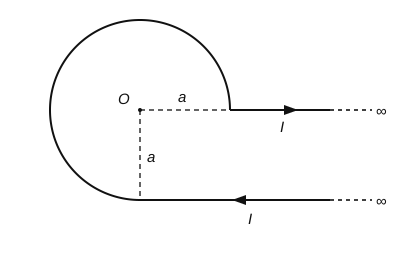
An infinite wire has a circular bend of radius a, and carrying a current I as shown in figure. The magnitude of magnetic field at the origin O of the arc is given by :
एक अनंत तार में a त्रिज्या का वृत्ताकार मोड़ है और इसमें चित्रानुसार धारा I प्रवाहित है। चाप के मूल बिंदु O पर चुम्बकीय क्षेत्र का परिमाण है :
- A
- B
- C
- D
Show answer
Concept: Arc of angle : . Semi-infinite straight wire whose end lies at the foot of the perpendicular from the point: . A wire along a line through the point gives zero field.
- The circular bend subtends at O (a quarter is replaced by the two straight leads): , into the page.
- The lower straight wire runs from the point directly below O (distance ) to infinity: , also into the page.
- The upper straight wire lies along a line passing through O, so it contributes zero.
- .
Short trick: Memorise: full loop , each semi-infinite end-on wire , wire through the point (all in units of ).
Answer: (D)
अवधारणा: कोण के चाप के लिए: । ऐसा अर्ध-अनंत सीधा तार जिसका सिरा बिंदु से डाले गए लम्ब के पाद पर हो: । बिंदु से होकर जाने वाली रेखा पर स्थित तार का क्षेत्र शून्य होता है।
- वृत्ताकार मोड़ O पर कोण बनाता है (एक चौथाई भाग के स्थान पर दो सीधे तार हैं): , कागज के भीतर की ओर।
- नीचे वाला सीधा तार O के ठीक नीचे ( दूरी पर) स्थित बिंदु से अनंत तक जाता है: , यह भी भीतर की ओर।
- ऊपर वाला सीधा तार O से गुजरने वाली रेखा पर है, अतः उसका योगदान शून्य है।
- ।
शॉर्ट ट्रिक: याद रखिए: पूर्ण लूप , लम्ब-पाद पर सिरे वाला अर्ध-अनंत तार , बिंदु से गुजरता तार (सभी के मात्रक में)।
उत्तर: (D)
JEE Main 2025 (January) – Paper 1 (B.E./B.Tech)PhysicsMoving Charges & Magnetism – field of wire and arcJEE Main 2025 (January) – Paper 1 (B.E./B.Tech) 2025 · 28 Jan Shift 2
Q58.In a long glass tube, mixture of two liquids A and B with refractive indices 1.3 and 1.4 respectively, forms a convex refractive meniscus towards A. If an object placed at 13 cm from the vertex of the meniscus in A forms an image with a magnification of '' then the radius of curvature of meniscus is :
एक लम्बी काँच की नली में क्रमशः 1.3 तथा 1.4 अपवर्तनांक वाले दो द्रवों A और B का मिश्रण, A की ओर उत्तल अपवर्तक नवचंद्रक (मेनिस्कस) बनाता है। यदि द्रव A में नवचंद्रक के शीर्ष से 13 cm दूरी पर रखी वस्तु '' आवर्धन वाला प्रतिबिम्ब बनाती है, तो नवचंद्रक की वक्रता त्रिज्या है :
- A cm
- B cm
- C1 cm
- D cm
Show answer
Concept: Refraction at a single spherical surface: , with magnification . Light travels from A () into B ().
- cm. cm.
- .
- cm.
Short trick: and — the arithmetic is designed to be clean.
Answer: (D) cm
अवधारणा: एकल गोलीय पृष्ठ पर अपवर्तन: , तथा आवर्धन । प्रकाश A () से B () में जाता है।
- cm। cm।
- ।
- cm।
शॉर्ट ट्रिक: तथा — गणना जान-बूझकर सरल रखी गई है।
उत्तर: (D) cm
JEE Main 2025 (January) – Paper 1 (B.E./B.Tech)PhysicsRay Optics – refraction at spherical surfaceJEE Main 2025 (January) – Paper 1 (B.E./B.Tech) 2025 · 28 Jan Shift 2
Q59.A 400 g solid cube having an edge of length 10 cm floats in water. How much volume of the cube is outside the water? (Given : density of water )
10 cm भुजा वाला 400 g का एक ठोस घन जल में तैरता है। घन का कितना आयतन जल के बाहर है? (दिया है : जल का घनत्व )
- A1400 cm
- B600 cm
- C4000 cm
- D400 cm
Show answer
Concept: Floating equilibrium: weight = buoyant force, so the submerged volume satisfies .
- Total volume of cube .
- .
- Volume outside water .
Short trick: In water (density 1 g/cm³), submerged volume in cm³ = mass in grams.
Answer: (B) 600 cm
अवधारणा: प्लवन साम्य: भार = उत्प्लावन बल, अतः डूबा हुआ आयतन को संतुष्ट करता है।
- घन का कुल आयतन ।
- ।
- जल के बाहर आयतन ।
शॉर्ट ट्रिक: जल (घनत्व 1 g/cm³) में डूबा आयतन (cm³ में) = द्रव्यमान (ग्राम में)।
उत्तर: (B) 600 cm
JEE Main 2025 (January) – Paper 1 (B.E./B.Tech)PhysicsFluid Mechanics – flotationJEE Main 2025 (January) – Paper 1 (B.E./B.Tech) 2025 · 28 Jan Shift 2
Q60.Given below are two statements. One is labelled as Assertion (A) and the other is labelled as Reason (R).
Assertion (A) : Knowing initial position and initial momentum is enough to determine the position and momentum at any time for a simple harmonic motion with a given angular frequency .
Reason (R) : The amplitude and phase can be expressed in terms of and .
In the light of the above statements, choose the correct answer from the options given below :
नीचे दो कथन दिए गए हैं। एक को अभिकथन (A) तथा दूसरे को कारण (R) कहा गया है।
अभिकथन (A) : दिए गए कोणीय आवृत्ति वाली सरल आवर्त गति के लिए प्रारंभिक स्थिति तथा प्रारंभिक संवेग का ज्ञान, किसी भी समय पर स्थिति और संवेग ज्ञात करने के लिए पर्याप्त है।
कारण (R) : आयाम तथा कला को तथा के पदों में व्यक्त किया जा सकता है।
उपर्युक्त कथनों के आलोक में, नीचे दिए गए विकल्पों में से सही उत्तर चुनिए :
- A(A) is false but (R) is true(A) असत्य है परन्तु (R) सत्य है
- B(A) is true but (R) is false(A) सत्य है परन्तु (R) असत्य है
- CBoth (A) and (R) are true but (R) is NOT the correct explanation of (A)(A) और (R) दोनों सत्य हैं परन्तु (R), (A) की सही व्याख्या नहीं है
- DBoth (A) and (R) are true and (R) is the correct explanation of (A)(A) और (R) दोनों सत्य हैं तथा (R), (A) की सही व्याख्या है
Show answer
Concept: SHM is fully specified by amplitude , phase and : .
- At : and .
- These give and — so (R) is true.
- Once and are known (with given ), and are known at every — so (A) is true.
- (R) is exactly why (A) holds: the initial data fix the two unknown constants of the motion. Hence (A) and (B) are wrong since both statements are true, and (C) is wrong because (R) does explain (A).
Short trick: SHM has two arbitrary constants; two initial conditions determine them completely.
Answer: (D) Both (A) and (R) are true and (R) is the correct explanation of (A)
अवधारणा: सरल आवर्त गति आयाम , कला तथा से पूर्णतः निर्धारित होती है: ।
- पर: तथा ।
- इनसे तथा प्राप्त होते हैं — अतः (R) सत्य है।
- और ज्ञात होने पर (दिए गए के साथ) प्रत्येक पर तथा ज्ञात हो जाते हैं — अतः (A) सत्य है।
- (R) ही (A) के सत्य होने का कारण है: प्रारंभिक मान गति के दोनों अज्ञात स्थिरांकों को निश्चित कर देते हैं। इसलिए (A) और (B) गलत हैं क्योंकि दोनों कथन सत्य हैं, और (C) गलत है क्योंकि (R), (A) की व्याख्या करता है।
शॉर्ट ट्रिक: सरल आवर्त गति में दो स्वेच्छ स्थिरांक होते हैं; दो प्रारंभिक शर्तें उन्हें पूर्णतः निर्धारित कर देती हैं।
उत्तर: (D) (A) और (R) दोनों सत्य हैं तथा (R), (A) की सही व्याख्या है
JEE Main 2025 (January) – Paper 1 (B.E./B.Tech)PhysicsOscillations – SHMJEE Main 2025 (January) – Paper 1 (B.E./B.Tech) 2025 · 28 Jan Shift 2

