Q61.A uniform rod of mass 250 g having length 100 cm is balanced on a sharp edge at 40 cm mark. A mass of 400 g is suspended at 10 cm mark. To maintain the balance of the rod, the mass to be suspended at 90 cm mark, is
250 g द्रव्यमान तथा 100 cm लम्बाई की एक एकसमान छड़ 40 cm चिह्न पर एक तीक्ष्ण किनारे पर संतुलित है। 10 cm चिह्न पर 400 g का द्रव्यमान लटकाया गया है। छड़ का संतुलन बनाए रखने के लिए 90 cm चिह्न पर लटकाया जाने वाला द्रव्यमान है
- A190 g
- B200 g
- C300 g
- D290 g
Show answer
Concept: For rotational equilibrium about the edge, net torque = 0. The rod's weight acts at its centre (50 cm mark).
- Anticlockwise torque (about 40 cm): .
- Clockwise torques: rod's weight , and .
- Balance: .
- g.
Short trick: Work in gram-cm; cancels throughout.
Answer: (A) 190 g
अवधारणा: किनारे के परितः घूर्णी साम्य के लिए कुल बल आघूर्ण = 0। छड़ का भार उसके केंद्र (50 cm चिह्न) पर कार्य करता है।
- वामावर्त बल आघूर्ण (40 cm के परितः): ।
- दक्षिणावर्त बल आघूर्ण: छड़ का भार , तथा ।
- संतुलन: ।
- g।
शॉर्ट ट्रिक: ग्राम-सेमी में गणना कीजिए; हर जगह निरस्त हो जाता है।
उत्तर: (A) 190 g
JEE Main 2025 (January) – Paper 1 (B.E./B.Tech)PhysicsRotational Motion – torque and equilibriumJEE Main 2025 (January) – Paper 1 (B.E./B.Tech) 2025 · 28 Jan Shift 2
Q62.Earth has mass 8 times and radius 2 times that of a planet. If the escape velocity from the earth is 11.2 km/s, the escape velocity in km/s from the planet will be :
पृथ्वी का द्रव्यमान किसी ग्रह के द्रव्यमान का 8 गुना तथा त्रिज्या 2 गुनी है। यदि पृथ्वी से पलायन वेग 11.2 km/s है, तो उस ग्रह से पलायन वेग km/s में होगा :
- A2.8
- B11.2
- C5.6
- D8.4
Show answer
Concept: Escape velocity , so .
- .
- km/s.
Short trick: — just halve 11.2.
Answer: (C) 5.6
अवधारणा: पलायन वेग , अतः ।
- ।
- km/s।
शॉर्ट ट्रिक: — 11.2 का आधा कर दीजिए।
उत्तर: (C) 5.6
JEE Main 2025 (January) – Paper 1 (B.E./B.Tech)PhysicsGravitation – escape velocityJEE Main 2025 (January) – Paper 1 (B.E./B.Tech) 2025 · 28 Jan Shift 2
Q63.The magnetic field of an E.M. wave is given by (S.I. Units). The corresponding electric field in S.I. units is :
किसी विद्युत चुम्बकीय तरंग का चुम्बकीय क्षेत्र (S.I. मात्रक) है। संगत विद्युत क्षेत्र S.I. मात्रकों में है :
- A
- B
- C
- D
Show answer
Concept: In an EM wave, , , and points along propagation. Phase of and is the same.
- The wave moves along (phase ), so , i.e. .
- , so (check: ✓).
- Magnitude , same sine phase .
- So . (B) has wrong (non-unit) direction and cosine phase; (C) and (D) carry phase of a wave moving along .
Short trick: Rotate by clockwise (for propagation) and multiply by .
Answer: (A)
अवधारणा: विद्युत चुम्बकीय तरंग में , , तथा संचरण की दिशा में होता है। और की कला समान रहती है।
- तरंग दिशा में चलती है (कला ), अतः , अर्थात ।
- से (जाँच: ✓)।
- परिमाण , वही sine कला ।
- अतः । विकल्प (B) में दिशा गलत (एकांक सदिश नहीं) तथा cosine कला है; (C) और (D) में कला है, जो दिशा में चलती तरंग की होती है।
शॉर्ट ट्रिक: संचरण के लिए को दक्षिणावर्त घुमाइए और से गुणा कीजिए।
उत्तर: (A)
JEE Main 2025 (January) – Paper 1 (B.E./B.Tech)PhysicsElectromagnetic WavesJEE Main 2025 (January) – Paper 1 (B.E./B.Tech) 2025 · 28 Jan Shift 2
Q64.The kinetic energy of translation of the molecules in 50 g of CO gas at 17C is
17C पर 50 g CO गैस के अणुओं की स्थानान्तरीय गतिज ऊर्जा है
- A4205.5 J
- B4102.8 J
- C3582.7 J
- D3986.3 J
Show answer
Concept: Translational kinetic energy of moles of any gas: (independent of the gas being polyatomic).
- mol (molar mass of CO2 = 44 g/mol); K.
- .
- J.
Short trick: Only the translational part counts: always , never or , whatever the molecule.
Answer: (B) 4102.8 J
अवधारणा: किसी भी गैस के मोल की स्थानान्तरीय गतिज ऊर्जा: (गैस बहुपरमाणुक हो तब भी यही)।
- mol (CO2 का मोलर द्रव्यमान = 44 g/mol); K।
- ।
- J।
शॉर्ट ट्रिक: केवल स्थानान्तरीय भाग लेना है: अणु चाहे जैसा हो, सदैव , कभी या नहीं।
उत्तर: (B) 4102.8 J
JEE Main 2025 (January) – Paper 1 (B.E./B.Tech)PhysicsKinetic Theory of GasesJEE Main 2025 (January) – Paper 1 (B.E./B.Tech) 2025 · 28 Jan Shift 2
Q65.Which of the following phenomena can not be explained by wave theory of light?
निम्नलिखित में से कौन-सी परिघटना प्रकाश के तरंग सिद्धांत से स्पष्ट नहीं की जा सकती?
- ACompton effectकॉम्पटन प्रभाव (Compton effect)
- BRefraction of lightप्रकाश का अपवर्तन
- CReflection of lightप्रकाश का परावर्तन
- DDiffraction of lightप्रकाश का विवर्तन
Show answer
Concept: Wave theory explains propagation phenomena; particle (photon) nature is needed for energy-quantum phenomena.
- Reflection and refraction follow directly from wave fronts (Huygens' principle) — so (C) and (B) are explained by waves.
- Diffraction is a hallmark of waves — (D) is explained by wave theory.
- The Compton effect — the increase in wavelength of X-rays scattered by electrons — requires photons carrying momentum colliding like particles; wave theory cannot account for the wavelength shift.
Short trick: Photoelectric and Compton effects = photon physics; interference, diffraction, polarisation = wave physics.
Answer: (A) Compton effect
अवधारणा: तरंग सिद्धांत संचरण संबंधी परिघटनाएँ समझाता है; ऊर्जा-क्वांटम वाली परिघटनाओं के लिए कण (फोटॉन) प्रकृति चाहिए।
- परावर्तन और अपवर्तन तरंगाग्रों (हाइगेन्स के सिद्धांत) से सीधे प्राप्त होते हैं — अतः (C) और (B) तरंगों से स्पष्ट हो जाते हैं।
- विवर्तन तरंगों की पहचान है — (D) तरंग सिद्धांत से स्पष्ट है।
- कॉम्पटन प्रभाव — इलेक्ट्रॉनों से प्रकीर्णित X-किरणों की तरंगदैर्घ्य में वृद्धि — के लिए संवेग वाले फोटॉनों का कणों की तरह टकराना आवश्यक है; तरंग सिद्धांत इस तरंगदैर्घ्य परिवर्तन की व्याख्या नहीं कर सकता।
शॉर्ट ट्रिक: प्रकाश-विद्युत व कॉम्पटन प्रभाव = फोटॉन भौतिकी; व्यतिकरण, विवर्तन, ध्रुवण = तरंग भौतिकी।
उत्तर: (A) कॉम्पटन प्रभाव
JEE Main 2025 (January) – Paper 1 (B.E./B.Tech)PhysicsDual Nature of Radiation – wave vs photonJEE Main 2025 (January) – Paper 1 (B.E./B.Tech) 2025 · 28 Jan Shift 2
Q66.A balloon and its content having mass is moving up with an acceleration ''. The mass that must be released from the content so that the balloon starts moving up with an acceleration '' will be (Take '' as acceleration due to gravity)
द्रव्यमान का एक गुब्बारा अपनी सामग्री सहित '' त्वरण से ऊपर की ओर गतिमान है। सामग्री में से कितना द्रव्यमान छोड़ना होगा कि गुब्बारा '' त्वरण से ऊपर की ओर चलने लगे? ('' को गुरुत्वीय त्वरण लीजिए)
- A
- B
- C
- D
Show answer
Concept: The upthrust (buoyant force) on the balloon stays the same; only the weight changes when mass is released.
- Initially: .
- After releasing mass : .
- Substitute : .
- .
- .
Short trick: Subtract the two equations of motion directly: .
Answer: (A)
अवधारणा: गुब्बारे पर उत्प्लावन बल अपरिवर्तित रहता है; द्रव्यमान छोड़ने पर केवल भार बदलता है।
- प्रारम्भ में: ।
- द्रव्यमान छोड़ने के बाद: ।
- रखने पर: ।
- ।
- ।
शॉर्ट ट्रिक: गति के दोनों समीकरण सीधे घटाइए: ।
उत्तर: (A)
JEE Main 2025 (January) – Paper 1 (B.E./B.Tech)PhysicsLaws of Motion – variable mass systemJEE Main 2025 (January) – Paper 1 (B.E./B.Tech) 2025 · 28 Jan Shift 2
Q67.The ratio of vapour densities of two gases at the same temperature is , then the ratio of r.m.s. velocities will be :
समान ताप पर दो गैसों के वाष्प घनत्वों का अनुपात है, तो उनकी वर्ग माध्य मूल (r.m.s.) चालों का अनुपात होगा :
- A
- B
- C
- D
Show answer
Concept: , and vapour density is proportional to molar mass . At the same temperature .
- .
- .
Short trick: Lighter gas is faster: invert the density ratio and take the square root.
Answer: (C)
अवधारणा: , तथा वाष्प घनत्व मोलर द्रव्यमान के अनुक्रमानुपाती होता है। समान ताप पर ।
- ।
- ।
शॉर्ट ट्रिक: हल्की गैस तेज़ चलती है: घनत्व अनुपात को उलटकर वर्गमूल लीजिए।
उत्तर: (C)
JEE Main 2025 (January) – Paper 1 (B.E./B.Tech)PhysicsKinetic Theory – r.m.s. speedJEE Main 2025 (January) – Paper 1 (B.E./B.Tech) 2025 · 28 Jan Shift 2
Q68.A parallel plate capacitor of capacitance F is charged to a potential difference of 20 V. The distance between plates is m. The energy density between plates of capacitor is.
F धारिता के एक समांतर पट्टिका संधारित्र को 20 V विभवान्तर तक आवेशित किया गया है। पट्टिकाओं के बीच की दूरी m है। संधारित्र की पट्टिकाओं के बीच ऊर्जा घनत्व है :
- A J/m
- B J/m
- C J/m
- D J/m
Show answer
Concept: Energy density of the electric field: , with between the plates.
- V/m.
- .
- J/m.
Short trick: The capacitance value is a distractor — only matters for energy density.
Answer: (C) J/m
अवधारणा: विद्युत क्षेत्र का ऊर्जा घनत्व: , जहाँ पट्टिकाओं के बीच ।
- V/m।
- ।
- J/m।
शॉर्ट ट्रिक: धारिता का मान भटकाने के लिए है — ऊर्जा घनत्व के लिए केवल चाहिए।
उत्तर: (C) J/m
JEE Main 2025 (January) – Paper 1 (B.E./B.Tech)PhysicsCapacitance – energy densityJEE Main 2025 (January) – Paper 1 (B.E./B.Tech) 2025 · 28 Jan Shift 2
Q69.The frequency of revolution of the electron in Bohr's orbit varies with , the principal quantum number as
बोर कक्षा में इलेक्ट्रॉन के परिक्रमण की आवृत्ति, मुख्य क्वांटम संख्या के साथ किस प्रकार बदलती है?
- A
- B
- C
- D
Show answer
Concept: In the Bohr model, orbital speed and radius .
- Frequency of revolution .
- .
Short trick: Remember the ladder: , , , .
Answer: (D)
अवधारणा: बोर मॉडल में कक्षीय चाल तथा त्रिज्या ।
- परिक्रमण आवृत्ति ।
- ।
शॉर्ट ट्रिक: क्रम याद रखिए: , , , ।
उत्तर: (D)
JEE Main 2025 (January) – Paper 1 (B.E./B.Tech)PhysicsAtoms – Bohr modelJEE Main 2025 (January) – Paper 1 (B.E./B.Tech) 2025 · 28 Jan Shift 2
Q70.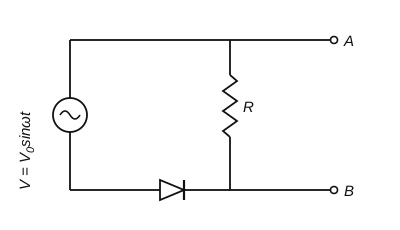
In the circuit shown here, assuming threshold voltage of diode is negligibly small, then voltage
is correctly represented by :
यहाँ दिखाए गए परिपथ में, डायोड की देहली वोल्टता (threshold voltage) को नगण्य मानते हुए, वोल्टता
को सही रूप में निरूपित करता है :
- AV would be zero at all timesV सभी समयों पर शून्य रहेगी
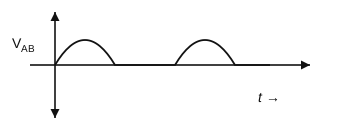
- B
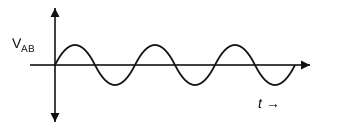
- C
- D
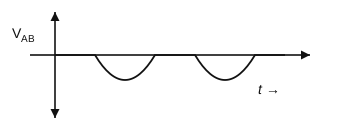
Show answer
Concept: The diode conducts only when forward biased; equals the drop across (A and B are the terminals of the branch). With no current, the drop across is zero.
- During the half cycle with the top source terminal positive, the required current direction through the bottom wire is from B towards the source — opposite to the diode arrow. The diode is reverse biased, no current flows, so .
- During the other half cycle the diode is forward biased; current flows through from B to A, making , i.e. (negative).
- So is zero for one half cycle and reproduces the negative half-sine in the other: negative half-wave pulses. (A) is wrong since current does flow half the time; (B) has the wrong polarity; (C) would need the diode to conduct both ways.
Short trick: A series diode passes only one half cycle — check its arrow to pick the sign of the surviving humps.
Answer: (D) negative half-cycle pulses
अवधारणा: डायोड केवल अग्र अभिनति (forward bias) में चालन करता है; , के सिरों का विभवान्तर है (A और B, शाखा के सिरे हैं)। धारा न बहे तो पर विभव पात शून्य होता है।
- जिस अर्ध चक्र में स्रोत का ऊपरी सिरा धनात्मक होता है, उसमें नीचे के तार में आवश्यक धारा की दिशा B से स्रोत की ओर होती — जो डायोड के तीर के विपरीत है। डायोड पश्च अभिनत रहता है, धारा नहीं बहती, अतः ।
- दूसरे अर्ध चक्र में डायोड अग्र अभिनत होता है; धारा में B से A की ओर बहती है, जिससे , अर्थात (ऋणात्मक)।
- अतः एक अर्ध चक्र में शून्य और दूसरे में ऋणात्मक अर्ध-ज्या: ऋणात्मक अर्ध-तरंग स्पंद। (A) गलत है क्योंकि आधे समय धारा बहती है; (B) में ध्रुवता उलटी है; (C) के लिए डायोड को दोनों दिशाओं में चालन करना पड़ता।
शॉर्ट ट्रिक: श्रेणी में लगा डायोड केवल एक अर्ध चक्र पारित करता है — बचे हुए स्पंदों का चिह्न डायोड के तीर से तय कीजिए।
उत्तर: (D) ऋणात्मक अर्ध-चक्र स्पंद
JEE Main 2025 (January) – Paper 1 (B.E./B.Tech)PhysicsSemiconductors – diode circuitJEE Main 2025 (January) – Paper 1 (B.E./B.Tech) 2025 · 28 Jan Shift 2
Q71.A thin transparent film with refractive index 1.4, is held on circular ring of radius 1.8 cm. The fluid in the film evaporates such that transmission through the film at wavelength 560 nm goes to a minimum every 12 seconds. Assuming that the film is flat on its two sides, the rate of evaporation is ____ .
1.4 अपवर्तनांक वाली एक पतली पारदर्शी फिल्म 1.8 cm त्रिज्या के वृत्ताकार छल्ले पर लगी है। फिल्म का द्रव इस प्रकार वाष्पित होता है कि 560 nm तरंगदैर्घ्य पर फिल्म से पारगमन (transmission) प्रत्येक 12 सेकंड में न्यूनतम हो जाता है। फिल्म को दोनों ओर से समतल मानते हुए, वाष्पन की दर ____ है।
Show answer
Concept: Successive transmission minima of a parallel film occur each time the optical path changes by one wavelength, i.e. the thickness changes by .
- m, lost every 12 s.
- Film area .
- Rate of evaporation .
- .
Short trick: Volume rate in one line.
Answer: 54
अवधारणा: समांतर फिल्म के क्रमागत पारगमन निम्निष्ठ तब आते हैं जब प्रकाशिक पथ एक तरंगदैर्घ्य से बदलता है, अर्थात मोटाई में परिवर्तन हो।
- m, प्रत्येक 12 s में।
- फिल्म का क्षेत्रफल ।
- वाष्पन की दर ।
- ।
शॉर्ट ट्रिक: आयतन दर — एक ही पंक्ति में।
उत्तर: 54
JEE Main 2025 (January) – Paper 1 (B.E./B.Tech)PhysicsWave Optics – thin film interferenceJEE Main 2025 (January) – Paper 1 (B.E./B.Tech) 2025 · 28 Jan Shift 2
Q72.The value of current I in the electrical circuit as given below, when potential at A is equal to the potential at B,
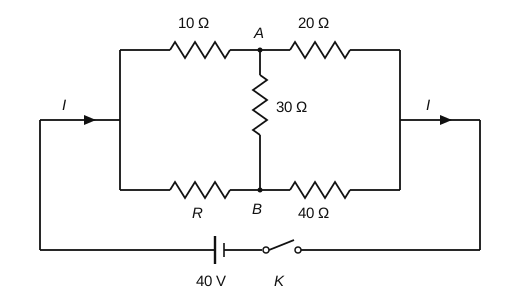
will be ____ A.
नीचे दिए गए विद्युत परिपथ में, जब A का विभव B के विभव के बराबर है,
तब धारा I का मान ____ A होगा।
Show answer
Concept: With no current flows through the 30 Ω branch (balanced-bridge condition), so the two horizontal branches carry independent currents from the same 40 V source.
- Let flow in the top branch (10 Ω, 20 Ω) and in the bottom branch (, 40 Ω).
- gives, from the left node: , and from the right node: . Hence Ω.
- Branch resistances: top Ω, bottom Ω; parallel combination Ω.
- A.
Short trick: Balanced bridge ⇒ delete the 30 Ω resistor; find from the ratio condition, then it is one parallel combination.
Answer: 2
अवधारणा: होने पर 30 Ω शाखा में धारा नहीं बहती (संतुलित सेतु की शर्त), अतः दोनों क्षैतिज शाखाएँ उसी 40 V स्रोत से स्वतंत्र धाराएँ लेती हैं।
- ऊपरी शाखा (10 Ω, 20 Ω) में तथा निचली शाखा (, 40 Ω) में लीजिए।
- से, बाएँ नोड से: , तथा दाएँ नोड से: । अतः Ω।
- शाखा प्रतिरोध: ऊपरी Ω, निचली Ω; समांतर संयोजन Ω।
- A।
शॉर्ट ट्रिक: संतुलित सेतु ⇒ 30 Ω प्रतिरोध हटा दीजिए; अनुपात शर्त से निकालिए, फिर केवल एक समांतर संयोजन बचता है।
उत्तर: 2
JEE Main 2025 (January) – Paper 1 (B.E./B.Tech)PhysicsCurrent Electricity – Wheatstone bridgeJEE Main 2025 (January) – Paper 1 (B.E./B.Tech) 2025 · 28 Jan Shift 2
Q73.An electric dipole of dipole moment Cm is placed in uniform electric field of magnitude V/m. Initially, the dipole moment is parallel to electric field. The work that needs to be done on the dipole to make its dipole moment opposite to the field, will be ____ J.
Cm द्विध्रुव आघूर्ण का एक विद्युत द्विध्रुव V/m परिमाण के एकसमान विद्युत क्षेत्र में रखा है। प्रारम्भ में द्विध्रुव आघूर्ण विद्युत क्षेत्र के समांतर है। द्विध्रुव आघूर्ण को क्षेत्र के विपरीत करने के लिए द्विध्रुव पर किया जाने वाला कार्य ____ J होगा।
Show answer
Concept: Potential energy of a dipole: . Work done by external agent .
- Initial (): . Final (): .
- .
- J.
Short trick: Parallel → antiparallel always costs .
Answer: 12
अवधारणा: द्विध्रुव की स्थितिज ऊर्जा: । बाह्य कर्ता द्वारा किया गया कार्य ।
- प्रारम्भिक (): । अंतिम (): ।
- ।
- J।
शॉर्ट ट्रिक: समांतर → प्रतिसमांतर में सदैव कार्य लगता है।
उत्तर: 12
JEE Main 2025 (January) – Paper 1 (B.E./B.Tech)PhysicsElectrostatics – electric dipoleJEE Main 2025 (January) – Paper 1 (B.E./B.Tech) 2025 · 28 Jan Shift 2
Q74.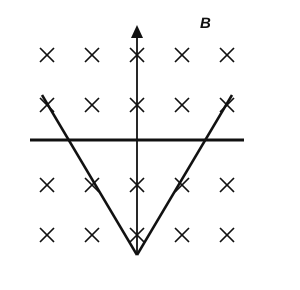
A conducting bar moves on two conducting rails as shown in the figure. A constant magnetic field B exists into the page. The bar starts to move from the vertex at time
with a constant velocity. If the induced EMF is E
, then value of n is _.
एक चालक छड़ चित्रानुसार दो चालक पटरियों पर चलती है। एक नियत चुम्बकीय क्षेत्र B कागज के भीतर की ओर विद्यमान है। छड़ समय
पर शीर्ष (vertex) से नियत वेग से चलना प्रारम्भ करती है। यदि प्रेरित विद्युत वाहक बल E
है, तो n का मान _ है।
Show answer
Concept: Motional EMF , where is the effective length of the bar between the rails.
- The rails form a 'V'. At time the bar is at distance from the vertex.
- The separation between the rails there is ( = opening angle), so .
- EMF .
- Hence .
Short trick: With constant only grows, and it grows linearly with on straight rails.
Answer: 1
अवधारणा: गतिक विद्युत वाहक बल , जहाँ पटरियों के बीच छड़ की प्रभावी लम्बाई है।
- पटरियाँ 'V' आकार बनाती हैं। समय पर छड़ शीर्ष से दूरी पर है।
- वहाँ पटरियों के बीच दूरी ( = खुलने का कोण), अतः ।
- विद्युत वाहक बल ।
- अतः ।
शॉर्ट ट्रिक: नियत पर केवल बढ़ती है, और सीधी पटरियों पर यह के साथ रैखिक बढ़ती है।
उत्तर: 1
JEE Main 2025 (January) – Paper 1 (B.E./B.Tech)PhysicsElectromagnetic Induction – motional EMFJEE Main 2025 (January) – Paper 1 (B.E./B.Tech) 2025 · 28 Jan Shift 2
Q75.The volume contraction of a solid copper cube of edge length 10 cm, when subjected to a hydraulic pressure of Pa, would be ____ mm. (Given bulk modulus of copper )
10 cm भुजा वाले ठोस ताँबे के घन पर Pa का द्रवचालित दाब लगाने पर उसके आयतन में संकुचन ____ mm होगा। (दिया है : ताँबे का आयतन प्रत्यास्थता गुणांक )
Show answer
Concept: Bulk modulus , so .
- .
- .
- , so .
Short trick: ; keep track of the factor for mm.
Answer: 50
अवधारणा: आयतन प्रत्यास्थता गुणांक , अतः ।
- ।
- ।
- , अतः ।
शॉर्ट ट्रिक: ; mm के लिए गुणक का ध्यान रखिए।
उत्तर: 50
JEE Main 2025 (January) – Paper 1 (B.E./B.Tech)PhysicsMechanical Properties of Solids – bulk modulusJEE Main 2025 (January) – Paper 1 (B.E./B.Tech) 2025 · 28 Jan Shift 2
Q76.Three infinitely long wires with linear charge density are placed along the -axis, -axis and -axis respectively. Which of the following denotes an equipotential surface?
रेखीय आवेश घनत्व वाले तीन अनंत लंबे तार क्रमशः -अक्ष, -अक्ष तथा -अक्ष के अनुदिश रखे गए हैं। निम्नलिखित में से कौन-सा एक समविभव पृष्ठ (equipotential surface) को निरूपित करता है?
- A = constant = नियतांक
- B = constant = नियतांक
- C = constant = नियतांक
- D = constant = नियतांक
Show answer
Concept: The potential of an infinite line charge at perpendicular distance is constant; potentials add by superposition.
- Perpendicular distances of point from the -, - and -axes are , and .
- .
- = constant = constant.
Short trick: Sum of logarithms = logarithm of the product, so the product of the squared distances must stay constant.
Answer: (C) = constant
अवधारणा: अनंत रेखीय आवेश से लंबवत दूरी पर विभव नियतांक होता है; अध्यारोपण से विभव जुड़ते हैं।
- बिंदु की -, - तथा -अक्षों से लंबवत दूरियाँ क्रमशः , तथा हैं।
- ।
- = नियतांक = नियतांक।
शॉर्ट ट्रिक: लघुगणकों का योग = गुणनफल का लघुगणक, अतः वर्गित दूरियों का गुणनफल नियत रहना चाहिए।
उत्तर: (C) = नियतांक
JEE Main 2025 (January) – Paper 1 (B.E./B.Tech)PhysicsElectrostatic Potential – equipotential surfacesJEE Main 2025 (January) – Paper 1 (B.E./B.Tech) 2025 · 28 Jan Shift 1
Q77.Given below are two statements: one is labelled as Assertion A and the other is labelled as Reason R
Assertion A: A sound wave has higher speed in solids than gases.
Reason R: Gases have higher value of Bulk modulus than solids.
In the light of the above statements, choose the correct answer from the options given below
नीचे दो कथन दिए गए हैं: एक को अभिकथन A तथा दूसरे को कारण R कहा गया है
अभिकथन A: ध्वनि तरंग की चाल ठोसों में गैसों की अपेक्षा अधिक होती है।
कारण R: गैसों के आयतन प्रत्यास्थता गुणांक (Bulk modulus) का मान ठोसों से अधिक होता है।
उपर्युक्त कथनों के आलोक में, नीचे दिए गए विकल्पों में से सही उत्तर चुनिए
- ABoth A and R are true but R is NOT the correct explanation of AA तथा R दोनों सत्य हैं परंतु R, A की सही व्याख्या नहीं है
- BA is true but R is falseA सत्य है परंतु R असत्य है
- CA is false but R is trueA असत्य है परंतु R सत्य है
- DBoth A and R are true and R is the correct explanation of AA तथा R दोनों सत्य हैं तथा R, A की सही व्याख्या है
Show answer
Concept: Speed of sound ; it is the elastic modulus that decides the speed, and solids are far stiffer than gases.
- A: In solids the elastic modulus is enormously larger than in gases (the increase in modulus far outweighs the increase in density), so sound travels fastest in solids — A is true.
- R: Solids have a much higher Bulk modulus than gases (gases are easily compressible) — R is false.
Answer: (B) A is true but R is false
अवधारणा: ध्वनि की चाल ; चाल प्रत्यास्थता गुणांक पर निर्भर करती है, और ठोस गैसों की तुलना में कहीं अधिक दृढ़ होते हैं।
- A: ठोसों में प्रत्यास्थता गुणांक गैसों की अपेक्षा अत्यधिक बड़ा होता है (गुणांक की वृद्धि घनत्व की वृद्धि से कहीं अधिक होती है), अतः ध्वनि ठोसों में सबसे तेज़ चलती है — A सत्य है।
- R: ठोसों का आयतन प्रत्यास्थता गुणांक गैसों से बहुत अधिक होता है (गैसें आसानी से संपीड्य होती हैं) — R असत्य है।
उत्तर: (B) A सत्य है परंतु R असत्य है
JEE Main 2025 (January) – Paper 1 (B.E./B.Tech)PhysicsWaves – speed of sound in mediaJEE Main 2025 (January) – Paper 1 (B.E./B.Tech) 2025 · 28 Jan Shift 1
Q78.Two capacitors
and
are connected in parallel to a battery. Charge-time graph is shown below for the two capacitors. The energy stored with them are
and
, respectively. Which of the given statements is true?
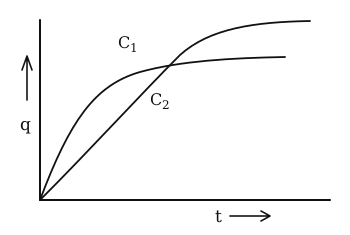
दो संधारित्र
तथा
एक बैटरी से समांतर क्रम में जुड़े हैं। दोनों संधारित्रों के लिए आवेश-समय ग्राफ नीचे दर्शाया गया है। इनमें संचित ऊर्जाएँ क्रमशः
तथा
हैं। दिए गए कथनों में से कौन-सा सत्य है?
- A
- B
- C
- D
Show answer
Concept: In parallel both capacitors reach the same final potential difference of the battery, so the final charge and energy are both proportional to .
- From the graph, the saturation (final) charge of is greater than that of : .
- Same .
- .
Short trick: In parallel, everything scales with the final charge — whichever curve saturates higher has the larger and larger .
Answer: (D)
अवधारणा: समांतर क्रम में दोनों संधारित्र बैटरी के समान अंतिम विभवांतर तक पहुँचते हैं, अतः अंतिम आवेश तथा ऊर्जा दोनों के अनुक्रमानुपाती हैं।
- ग्राफ से, का संतृप्त (अंतिम) आवेश से अधिक है: ।
- समान ।
- ।
शॉर्ट ट्रिक: समांतर क्रम में सब कुछ अंतिम आवेश के साथ बढ़ता है — जो वक्र ऊँचे स्तर पर संतृप्त होता है उसका तथा दोनों बड़े होंगे।
उत्तर: (D)
JEE Main 2025 (January) – Paper 1 (B.E./B.Tech)PhysicsCapacitance – capacitors in parallelJEE Main 2025 (January) – Paper 1 (B.E./B.Tech) 2025 · 28 Jan Shift 1
Q79.A thin prism with angle made of glass having refractive index 1.54, is combined with another thin prism made of glass having refractive index 1.72 to get dispersion without deviation. The angle of the prism in degrees is
अपवर्तनांक 1.54 वाले काँच से बना कोण का एक पतला प्रिज़्म , अपवर्तनांक 1.72 वाले काँच से बने दूसरे पतले प्रिज़्म के साथ इस प्रकार संयोजित किया जाता है कि विचलन रहित विक्षेपण (dispersion without deviation) प्राप्त हो। प्रिज़्म का कोण (डिग्री में) है
- A3
- B16/3
- C4
- D1.5
Show answer
Concept: For a thin prism the deviation is . For zero net deviation the two deviations must cancel: .
Answer: (A) 3
अवधारणा: पतले प्रिज़्म के लिए विचलन होता है। कुल विचलन शून्य होने के लिए दोनों विचलन एक-दूसरे को निरस्त करें: ।
उत्तर: (A) 3
JEE Main 2025 (January) – Paper 1 (B.E./B.Tech)PhysicsRay Optics – dispersion without deviationJEE Main 2025 (January) – Paper 1 (B.E./B.Tech) 2025 · 28 Jan Shift 1
Q80.A particle of mass '
' and charge '
' is fastened to one end '
' of a massless string having equilibrium length
, whose other end is fixed at point '
'. The whole system is placed on a frictionless horizontal plane and is initially at rest. If uniform electric field is switched on along the direction as shown in figure, then the speed of the particle when it crosses the x-axis is
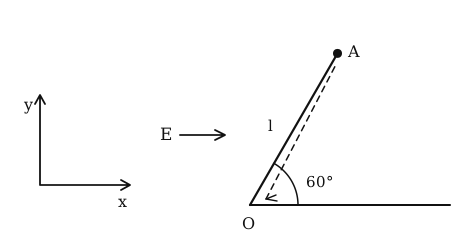
द्रव्यमान '
' तथा आवेश '
' का एक कण, साम्यावस्था लंबाई
वाली द्रव्यमानहीन डोरी के एक सिरे '
' से बाँधा गया है, जिसका दूसरा सिरा बिंदु '
' पर स्थिर है। पूरा निकाय एक घर्षणरहित क्षैतिज तल पर रखा है और प्रारंभ में विरामावस्था में है। यदि चित्र में दर्शाई गई दिशा में एकसमान विद्युत क्षेत्र चालू कर दिया जाए, तो x-अक्ष को पार करते समय कण की चाल होगी
- A
- B
- C
- D
Show answer
Concept: The string tension does no work (always perpendicular to the circular motion about ), so the work-energy theorem needs only the work of the electric force along the -direction.
- Initial position of the particle: .
- When it crosses the x-axis (string taut): position , so displacement along is .
- .
Short trick: Only the -displacement matters: .
Answer: (B)
अवधारणा: डोरी का तनाव कोई कार्य नहीं करता ( के परितः वृत्तीय गति के सदैव लंबवत), अतः कार्य-ऊर्जा प्रमेय में केवल -दिशा में विद्युत बल का कार्य लेना है।
- कण की प्रारंभिक स्थिति: ।
- x-अक्ष पार करते समय (डोरी तनी हुई): स्थिति , अतः के अनुदिश विस्थापन ।
- ।
शॉर्ट ट्रिक: केवल -विस्थापन मायने रखता है: ।
उत्तर: (B)
JEE Main 2025 (January) – Paper 1 (B.E./B.Tech)PhysicsElectrostatics – work-energy theoremJEE Main 2025 (January) – Paper 1 (B.E./B.Tech) 2025 · 28 Jan Shift 1

