Q81.Given below are two statements: one is labelled as Assertion A and the other is labelled as Reason R
Assertion A: In a central force field, the work done is independent of the path chosen.
Reason R: Every force encountered in mechanics does not have an associated potential energy.
In the light of the above statements, choose the most appropriate answer from the options given below
नीचे दो कथन दिए गए हैं: एक को अभिकथन A तथा दूसरे को कारण R कहा गया है
अभिकथन A: केंद्रीय बल क्षेत्र में किया गया कार्य, चुने गए पथ पर निर्भर नहीं करता।
कारण R: यांत्रिकी में मिलने वाले प्रत्येक बल के साथ कोई संबद्ध स्थितिज ऊर्जा नहीं होती।
उपर्युक्त कथनों के आलोक में, नीचे दिए गए विकल्पों में से सर्वाधिक उपयुक्त उत्तर चुनिए
- AA is false but R is trueA असत्य है परंतु R सत्य है
- BBoth A and R are true but R is NOT the correct explanation of AA तथा R दोनों सत्य हैं परंतु R, A की सही व्याख्या नहीं है
- CA is true but R is falseA सत्य है परंतु R असत्य है
- DBoth A and R are true and R is the correct explanation of AA तथा R दोनों सत्य हैं तथा R, A की सही व्याख्या है
Show answer
Concept: A central force is conservative, and only conservative forces have an associated potential energy.
- A: A central force is conservative, so the work done between two points is path independent — A is true.
- R: Non-conservative forces such as friction have no associated potential energy, so indeed not every mechanical force has one — R is also true.
- But R talks about forces lacking a potential energy; it does not explain why work in a central field is path independent. Hence R is not the correct explanation of A.
Answer: (B) Both A and R are true but R is NOT the correct explanation of A
अवधारणा: केंद्रीय बल संरक्षी होता है, और केवल संरक्षी बलों के साथ ही स्थितिज ऊर्जा संबद्ध होती है।
- A: केंद्रीय बल संरक्षी है, अतः दो बिंदुओं के बीच किया गया कार्य पथ पर निर्भर नहीं करता — A सत्य है।
- R: घर्षण जैसे असंरक्षी बलों की कोई संबद्ध स्थितिज ऊर्जा नहीं होती, अतः वास्तव में हर यांत्रिक बल की स्थितिज ऊर्जा नहीं होती — R भी सत्य है।
- परंतु R उन बलों की बात करता है जिनकी स्थितिज ऊर्जा नहीं होती; यह नहीं समझाता कि केंद्रीय क्षेत्र में कार्य पथ-स्वतंत्र क्यों है। अतः R, A की सही व्याख्या नहीं है।
उत्तर: (B) A तथा R दोनों सत्य हैं परंतु R, A की सही व्याख्या नहीं है
JEE Main 2025 (January) – Paper 1 (B.E./B.Tech)PhysicsWork, Energy and Power – conservative forcesJEE Main 2025 (January) – Paper 1 (B.E./B.Tech) 2025 · 28 Jan Shift 1
Q82.Choose the correct nuclear process from the below options
[p: proton, n: neutron, e: electron, e: positron, : neutrino, : antineutrino]
नीचे दिए गए विकल्पों में से सही नाभिकीय प्रक्रिया चुनिए
[p: प्रोटॉन, n: न्यूट्रॉन, e: इलेक्ट्रॉन, e: पॉज़िट्रॉन, : न्यूट्रिनो, : प्रतिन्यूट्रिनो]
- A
- B
- C
- D
Show answer
Concept: In decay a neutron converts into a proton; charge and lepton number must both be conserved.
- Charge conservation: , so an electron must be emitted — options with (A) and (B) violate charge conservation.
- Lepton number conservation: carries lepton number , so a particle with lepton number , the antineutrino , must accompany it — option (C) with gives lepton number , which is wrong.
- Correct process: .
Answer: (D)
अवधारणा: क्षय में न्यूट्रॉन, प्रोटॉन में बदलता है; आवेश तथा लेप्टॉन संख्या दोनों संरक्षित रहनी चाहिए।
- आवेश संरक्षण: , अतः इलेक्ट्रॉन उत्सर्जित होना चाहिए — वाले विकल्प (A) तथा (B) आवेश संरक्षण का उल्लंघन करते हैं।
- लेप्टॉन संख्या संरक्षण: की लेप्टॉन संख्या है, अतः उसके साथ लेप्टॉन संख्या वाला कण, प्रतिन्यूट्रिनो , होना चाहिए — वाला विकल्प (C) लेप्टॉन संख्या देता है, जो गलत है।
- सही प्रक्रिया: ।
उत्तर: (D)
JEE Main 2025 (January) – Paper 1 (B.E./B.Tech)PhysicsNuclei – beta decayJEE Main 2025 (January) – Paper 1 (B.E./B.Tech) 2025 · 28 Jan Shift 1
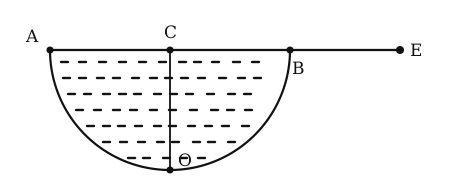
Q83.A hemispherical vessel is completely filled with a liquid of refractive index
. A small coin is kept at the lowest point (O) of the vessel as shown in figure. The minimum value of the refractive index of the liquid so that a person can see the coin from point E (at the level of the vessel) is
एक अर्धगोलीय बर्तन, अपवर्तनांक
वाले द्रव से पूर्णतः भरा है। चित्रानुसार बर्तन के निम्नतम बिंदु (O) पर एक छोटा सिक्का रखा है। द्रव के अपवर्तनांक का वह न्यूनतम मान, जिससे कोई व्यक्ति बिंदु E (बर्तन के तल के स्तर पर) से सिक्के को देख सके, है
- A
- B
- C
- D
Show answer
Concept: To be seen from E (grazing along the liquid surface), the ray O→B must refract at the surface at , i.e. hit the surface exactly at the critical angle: .
- Let the radius be . O is at depth below the centre C of the flat surface, and B is on the rim at horizontal distance from C.
- The ray OB therefore makes with the normal (vertical) at B.
- For grazing emergence towards E: .
Short trick: The O→rim ray of a hemisphere always meets the flat surface at , so .
Answer: (D)
अवधारणा: E से दिखने के लिए (द्रव सतह के सहारे स्पर्शीय निर्गमन), किरण O→B को सतह पर पर अपवर्तित होना चाहिए, अर्थात सतह पर ठीक क्रांतिक कोण पर पड़ना चाहिए: ।
- त्रिज्या मानें। O, समतल सतह के केंद्र C से गहराई पर है, तथा B किनारे पर C से क्षैतिज दूरी पर है।
- अतः किरण OB, B पर अभिलंब (ऊर्ध्वाधर) से कोण बनाती है।
- E की ओर स्पर्शीय निर्गमन के लिए: ।
शॉर्ट ट्रिक: अर्धगोले में O से किनारे तक की किरण समतल सतह से सदैव पर मिलती है, अतः ।
उत्तर: (D)
JEE Main 2025 (January) – Paper 1 (B.E./B.Tech)PhysicsRay Optics – total internal reflectionJEE Main 2025 (January) – Paper 1 (B.E./B.Tech) 2025 · 28 Jan Shift 1
Q84.A Carnot engine (E) is working between two temperatures 473 K and 273 K. In a new system two engines - engine works between 473 K to 373 K and engine works between 373 K to 273 K. If , and are the efficiencies of the engines E, and , respectively, then
एक कार्नो इंजन (E) दो तापों 473 K तथा 273 K के बीच कार्य कर रहा है। एक नए निकाय में दो इंजन हैं - इंजन , 473 K से 373 K के बीच तथा इंजन , 373 K से 273 K के बीच कार्य करता है। यदि , तथा क्रमशः इंजन E, तथा की दक्षताएँ हों, तो
- A
- B
- C
- D
Show answer
Concept: Carnot efficiency ; just compute all three.
- ,
- , so .
Short trick: Exactly: (since ), which is always less than .
Answer: (D)
अवधारणा: कार्नो दक्षता ; तीनों की गणना कीजिए।
- ,
- , अतः ।
शॉर्ट ट्रिक: यथार्थतः: (क्योंकि ), जो सदैव से कम है।
उत्तर: (D)
JEE Main 2025 (January) – Paper 1 (B.E./B.Tech)PhysicsThermodynamics – Carnot engineJEE Main 2025 (January) – Paper 1 (B.E./B.Tech) 2025 · 28 Jan Shift 1
Q85.Consider a long thin conducting wire carrying a uniform current I. A particle having mass "M" and charge "" is released at a distance "" from the wire with a speed along the direction of current in the wire. The particle gets attracted to the wire due to magnetic force. The particle turns round when it is at distance from the wire. The value of is [ is vacuum permeability]
एकसमान धारा I ले जा रहे एक लंबे पतले चालक तार पर विचार कीजिए। द्रव्यमान "M" तथा आवेश "" वाला एक कण, तार से "" दूरी पर, तार में धारा की दिशा के अनुदिश चाल से छोड़ा जाता है। चुंबकीय बल के कारण कण तार की ओर आकर्षित होता है। तार से दूरी पर कण मुड़ जाता (turns round) है। का मान है [ निर्वात की चुंबकशीलता है]
- A
- B
- C
- D
Show answer
Concept: Magnetic force does no work, so the speed stays . Writing Newton's law for the component parallel to the wire links the change of that component to .
- Let the wire lie along the -axis with current , and the particle move in the - plane; .
- Component parallel to the wire: .
- Integrating: .
- "Turns round" means the velocity has reversed: (speed is still , perpendicular component zero at the turning point). So .
- .
Answer: (A)
अवधारणा: चुंबकीय बल कोई कार्य नहीं करता, अतः चाल ही रहती है। तार के समांतर घटक के लिए न्यूटन का नियम लिखने पर उस घटक का परिवर्तन से जुड़ जाता है।
- माना तार -अक्ष के अनुदिश है जिसमें धारा है, तथा कण - तल में चलता है; ।
- तार के समांतर घटक: ।
- समाकलन करने पर: ।
- "मुड़ जाता है" का अर्थ है वेग उलट गया: (चाल अब भी है, मोड़-बिंदु पर लंबवत घटक शून्य)। अतः ।
- ।
उत्तर: (A)
JEE Main 2025 (January) – Paper 1 (B.E./B.Tech)PhysicsMoving Charges and Magnetism – charge near a current-carrying wireJEE Main 2025 (January) – Paper 1 (B.E./B.Tech) 2025 · 28 Jan Shift 1
Q86.A wire of resistance R is bent into an equilateral triangle and an identical wire is bent into a square. The ratio of resistance between the two end points of an edge of the triangle to that of the square is
प्रतिरोध R के एक तार को समबाहु त्रिभुज के आकार में तथा एक सर्वसम तार को वर्ग के आकार में मोड़ा गया है। त्रिभुज की एक भुजा के दोनों सिरों के बीच के प्रतिरोध का, वर्ग की एक भुजा के दोनों सिरों के बीच के प्रतिरोध से अनुपात है
- A8/9
- B27/32
- C32/27
- D9/8
Show answer
Concept: Across one edge, the edge resistance is in parallel with the rest of the loop.
- Triangle: each side . Across one edge: .
- Square: each side . Across one edge: .
- Ratio .
Short trick: For an -sided loop of total , resistance across one side : triangle , square .
Answer: (C) 32/27
अवधारणा: किसी एक भुजा के सिरों के बीच, उस भुजा का प्रतिरोध शेष लूप के समांतर होता है।
- त्रिभुज: प्रत्येक भुजा । एक भुजा के सिरों के बीच: ।
- वर्ग: प्रत्येक भुजा । एक भुजा के सिरों के बीच: ।
- अनुपात ।
शॉर्ट ट्रिक: कुल प्रतिरोध वाले -भुजा लूप में एक भुजा के सिरों के बीच प्रतिरोध : त्रिभुज , वर्ग ।
उत्तर: (C) 32/27
JEE Main 2025 (January) – Paper 1 (B.E./B.Tech)PhysicsCurrent Electricity – equivalent resistanceJEE Main 2025 (January) – Paper 1 (B.E./B.Tech) 2025 · 28 Jan Shift 1
Q87.In the experiment for measurement of viscosity '' of given liquid with a ball having radius R, consider following statements.
A. Graph between terminal velocity V and R will be a parabola.
B. The terminal velocities of different diameter balls are constant for a given liquid.
C. Measurement of terminal velocity is dependent on the temperature.
D. This experiment can be utilized to assess the density of a given liquid.
E. If balls are dropped with some initial speed, the value of will change.
Choose the correct answer from the options given below:
त्रिज्या R वाली गेंद से किसी दिए गए द्रव की श्यानता '' मापने के प्रयोग में, निम्नलिखित कथनों पर विचार कीजिए।
A. सीमांत वेग V तथा R के बीच ग्राफ एक परवलय होगा।
B. दिए गए द्रव के लिए विभिन्न व्यासों की गेंदों के सीमांत वेग नियत होते हैं।
C. सीमांत वेग का मापन ताप पर निर्भर करता है।
D. इस प्रयोग का उपयोग दिए गए द्रव का घनत्व ज्ञात करने में किया जा सकता है।
E. यदि गेंदों को कुछ प्रारंभिक चाल से गिराया जाए, तो का मान बदल जाएगा।
नीचे दिए गए विकल्पों में से सही उत्तर चुनिए:
- AA, B and E Onlyकेवल A, B तथा E
- BB, D and E Onlyकेवल B, D तथा E
- CA, C and D Onlyकेवल A, C तथा D
- DC, D and E Onlyकेवल C, D तथा E
Show answer
Concept: Terminal velocity .
- A: , so the V–R graph is a parabola — correct.
- B: depends on , so balls of different diameters have different terminal velocities — wrong.
- C: (and hence ) changes strongly with temperature — correct.
- D: The formula contains the liquid density , so measuring lets us assess it — correct.
- E: Terminal velocity (and hence the measured ) does not depend on the initial speed; the ball always settles to the same — wrong.
Answer: (C) A, C and D Only
अवधारणा: सीमांत वेग ।
- A: , अतः V–R ग्राफ परवलय है — सही।
- B: , पर निर्भर करता है, अतः भिन्न व्यास की गेंदों के सीमांत वेग भिन्न होते हैं — गलत।
- C: (और इसलिए ) ताप के साथ तेज़ी से बदलता है — सही।
- D: सूत्र में द्रव का घनत्व आता है, अतः मापकर इसे ज्ञात किया जा सकता है — सही।
- E: सीमांत वेग (और इसलिए मापा गया ) प्रारंभिक चाल पर निर्भर नहीं करता; गेंद सदैव उसी पर पहुँचती है — गलत।
उत्तर: (C) केवल A, C तथा D
JEE Main 2025 (January) – Paper 1 (B.E./B.Tech)PhysicsViscosity – terminal velocity experimentJEE Main 2025 (January) – Paper 1 (B.E./B.Tech) 2025 · 28 Jan Shift 1
Q88.Due to presence of an em-wave whose electric component is given by , a cylinder of length 200 cm holds certain amount of em-energy inside it. If another cylinder of same length but half diameter than previous one holds same amount of em-energy, the magnitude of the electric field of the corresponding em-wave should be modified as
एक विद्युतचुंबकीय तरंग, जिसका विद्युत घटक है, की उपस्थिति के कारण 200 cm लंबाई का एक बेलन अपने भीतर कुछ विद्युतचुंबकीय ऊर्जा रखता है। यदि समान लंबाई परंतु पहले से आधे व्यास वाला दूसरा बेलन उतनी ही विद्युतचुंबकीय ऊर्जा रखे, तो संगत विद्युतचुंबकीय तरंग के विद्युत क्षेत्र का परिमाण परिवर्तित करके होना चाहिए
- A
- B
- C
- D
Show answer
Concept: Average em-energy density ; energy inside the cylinder volume, and volume for fixed length.
- Half diameter volume becomes of the earlier volume.
- Same energy energy density must become 4 times: .
- .
Short trick: for equal energy in equal length.
Answer: (B)
अवधारणा: औसत विद्युतचुंबकीय ऊर्जा घनत्व ; बेलन के भीतर ऊर्जा आयतन, तथा नियत लंबाई पर आयतन ।
- आधा व्यास आयतन पहले का हो जाता है।
- समान ऊर्जा ऊर्जा घनत्व 4 गुना होना चाहिए: ।
- ।
शॉर्ट ट्रिक: समान लंबाई में समान ऊर्जा के लिए ।
उत्तर: (B)
JEE Main 2025 (January) – Paper 1 (B.E./B.Tech)PhysicsElectromagnetic Waves – energy densityJEE Main 2025 (January) – Paper 1 (B.E./B.Tech) 2025 · 28 Jan Shift 1
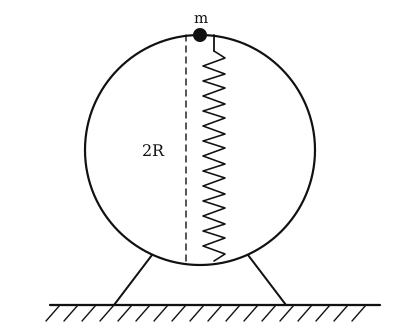
Q89.A bead of mass '
' slides without friction on the wall of a vertical circular hoop of radius '
' as shown in figure. The bead moves under the combined action of gravity and a massless spring (
) attached to the bottom of the hoop. The equilibrium length of the spring is '
'. If the bead is released from top of the hoop with (negligible) zero initial speed, velocity of bead, when the length of spring becomes '
', would be (spring constant is '
', g is acceleration due to gravity)
द्रव्यमान '
' का एक मनका (bead), चित्रानुसार त्रिज्या '
' के ऊर्ध्वाधर वृत्ताकार हूप की दीवार पर बिना घर्षण फिसलता है। मनका, गुरुत्व तथा हूप के निचले बिंदु से जुड़ी द्रव्यमानहीन स्प्रिंग (
) की संयुक्त क्रिया में गति करता है। स्प्रिंग की साम्यावस्था लंबाई '
' है। यदि मनके को हूप के शीर्ष से (नगण्य) शून्य प्रारंभिक चाल से छोड़ा जाए, तो स्प्रिंग की लंबाई '
' हो जाने पर मनके का वेग होगा (स्प्रिंग नियतांक '
' है, g गुरुत्वीय त्वरण है)
- A
- B
- C
- D
Show answer
Concept: Energy conservation: spring PE (initial extension ) and the fall in height both convert into kinetic energy.
- At the top, spring length (diameter), so extension and spring PE .
- Spring length means the bead is at chord distance from the bottom point: from the bottom. Its height above the bottom .
- Fall in height ; final extension , so all spring PE is released.
- .
Answer: (A)
अवधारणा: ऊर्जा संरक्षण: स्प्रिंग की स्थितिज ऊर्जा (प्रारंभिक विस्तार ) तथा ऊँचाई में गिरावट, दोनों गतिज ऊर्जा में बदलते हैं।
- शीर्ष पर स्प्रिंग की लंबाई (व्यास), अतः विस्तार तथा स्प्रिंग स्थितिज ऊर्जा ।
- स्प्रिंग की लंबाई का अर्थ है मनका निचले बिंदु से जीवा-दूरी पर है: निचले बिंदु से । निचले बिंदु से उसकी ऊँचाई ।
- ऊँचाई में गिरावट ; अंतिम विस्तार , अतः पूरी स्प्रिंग ऊर्जा मुक्त होती है।
- ।
उत्तर: (A)
JEE Main 2025 (January) – Paper 1 (B.E./B.Tech)PhysicsWork, Energy and Power – energy conservation with springJEE Main 2025 (January) – Paper 1 (B.E./B.Tech) 2025 · 28 Jan Shift 1
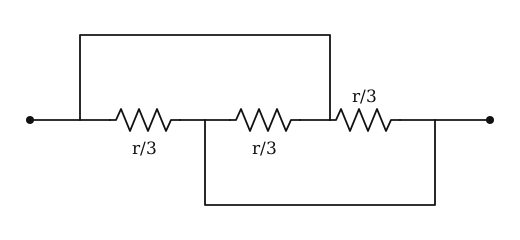
Q90.Find the equivalent resistance between two ends of the following circuit
निम्नलिखित परिपथ के दोनों सिरों के बीच तुल्य प्रतिरोध ज्ञात कीजिए
- A
- B
- C
- D
Show answer
Concept: Plain connecting wires have zero resistance, so points joined by them are the same node — redraw the circuit by labelling nodes.
- Call the left terminal P and the right terminal Q.
- The top wire connects P directly to the junction between the 2nd and 3rd resistors; the bottom wire connects the junction between the 1st and 2nd resistors directly to Q.
- So each resistor has one end at P and the other at Q: all three are in parallel.
- .
Short trick: Shorting wires collapse the chain into three parallel 's.
Answer: (A)
अवधारणा: सादे जोड़ने वाले तारों का प्रतिरोध शून्य होता है, अतः उनसे जुड़े बिंदु एक ही नोड हैं — नोड नामांकित कर परिपथ पुनः बनाइए।
- बाएँ सिरे को P तथा दाएँ सिरे को Q कहें।
- ऊपरी तार P को सीधे दूसरे व तीसरे प्रतिरोधों के बीच के संधि-बिंदु से जोड़ता है; निचला तार पहले व दूसरे प्रतिरोधों के बीच के संधि-बिंदु को सीधे Q से जोड़ता है।
- अतः प्रत्येक प्रतिरोध का एक सिरा P पर तथा दूसरा Q पर है: तीनों समांतर क्रम में हैं।
- ।
शॉर्ट ट्रिक: शॉर्ट करने वाले तार श्रेणी को तीन समांतर में बदल देते हैं।
उत्तर: (A)
JEE Main 2025 (January) – Paper 1 (B.E./B.Tech)PhysicsCurrent Electricity – equivalent resistanceJEE Main 2025 (January) – Paper 1 (B.E./B.Tech) 2025 · 28 Jan Shift 1
Q91.Consider following statements:
A. Surface tension arises due to extra energy of the molecules at the interior as compared to the molecules at the surface, of a liquid.
B. As the temperature of liquid rises, the coefficient of viscosity increases.
C. As the temperature of gas increases, the coefficient of viscosity increases.
D. The onset of turbulence is determined by Reynold's number.
E. In a steady flow two stream lines never intersect.
Choose the correct answer from the options given below:
निम्नलिखित कथनों पर विचार कीजिए:
A. पृष्ठ तनाव, द्रव के पृष्ठ के अणुओं की तुलना में आंतरिक अणुओं की अतिरिक्त ऊर्जा के कारण उत्पन्न होता है।
B. द्रव का ताप बढ़ने पर श्यानता गुणांक बढ़ता है।
C. गैस का ताप बढ़ने पर श्यानता गुणांक बढ़ता है।
D. विक्षुब्धता (turbulence) का प्रारंभ रेनॉल्ड संख्या से निर्धारित होता है।
E. धारारेखीय प्रवाह में दो धारारेखाएँ कभी नहीं काटतीं।
नीचे दिए गए विकल्पों में से सही उत्तर चुनिए:
- AC, D, E Onlyकेवल C, D, E
- BA, D, E Onlyकेवल A, D, E
- CB, C, D Onlyकेवल B, C, D
- DA, B, C Onlyकेवल A, B, C
Show answer
Concept: Facts about surface tension, viscosity-temperature dependence and streamline flow.
- A: It is the surface molecules that have extra energy (unbalanced cohesive forces), not the interior ones — wrong.
- B: Viscosity of liquids decreases with temperature (cohesive forces weaken) — wrong.
- C: Viscosity of gases increases with temperature (faster molecular momentum transfer) — correct.
- D: Turbulence sets in when Reynold's number exceeds its critical value — correct.
- E: Two streamlines can never intersect, else velocity at the crossing point would have two directions — correct.
Answer: (A) C, D, E Only
अवधारणा: पृष्ठ तनाव, श्यानता की ताप-निर्भरता तथा धारारेखीय प्रवाह के तथ्य।
- A: अतिरिक्त ऊर्जा पृष्ठ के अणुओं में होती है (असंतुलित ससंजक बल), आंतरिक अणुओं में नहीं — गलत।
- B: द्रवों की श्यानता ताप बढ़ने पर घटती है (ससंजक बल दुर्बल होते हैं) — गलत।
- C: गैसों की श्यानता ताप बढ़ने पर बढ़ती है (तेज़ आण्विक संवेग स्थानांतरण) — सही।
- D: रेनॉल्ड संख्या क्रांतिक मान से बढ़ने पर विक्षुब्धता प्रारंभ होती है — सही।
- E: दो धारारेखाएँ कभी नहीं काट सकतीं, अन्यथा कटान-बिंदु पर वेग की दो दिशाएँ होतीं — सही।
उत्तर: (A) केवल C, D, E
JEE Main 2025 (January) – Paper 1 (B.E./B.Tech)PhysicsFluid Mechanics – surface tension and viscosityJEE Main 2025 (January) – Paper 1 (B.E./B.Tech) 2025 · 28 Jan Shift 1
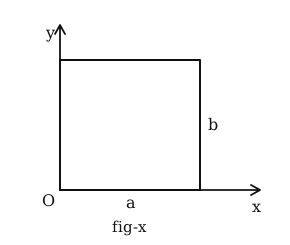
Q92.The center of mass of a thin rectangular plate (fig - x) with sides of length
and
, whose mass per unit area (
) varies as
(where
is a constant), would be
भुजाओं
तथा
वाली एक पतली आयताकार प्लेट (चित्र-x), जिसका प्रति एकांक क्षेत्रफल द्रव्यमान (
),
(जहाँ
एक नियतांक है) के अनुसार बदलता है, का द्रव्यमान केंद्र होगा
- A
- B
- C
- D
Show answer
Concept: with strips ; density depends only on , so the coordinate stays at the middle.
- .
- By symmetry in (σ independent of ): .
Short trick: For over to , (triangle-like distribution).
Answer: (A)
अवधारणा: पट्टियाँ लेकर ; घनत्व केवल पर निर्भर है, अतः निर्देशांक बीच में ही रहता है।
- ।
- में सममिति से (, से स्वतंत्र): ।
शॉर्ट ट्रिक: से तक के लिए (त्रिभुज-सदृश वितरण)।
उत्तर: (A)
JEE Main 2025 (January) – Paper 1 (B.E./B.Tech)PhysicsCentre of Mass – continuous body with variable densityJEE Main 2025 (January) – Paper 1 (B.E./B.Tech) 2025 · 28 Jan Shift 1
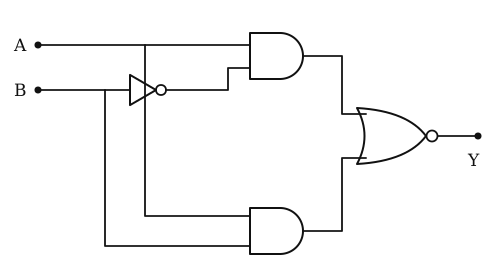
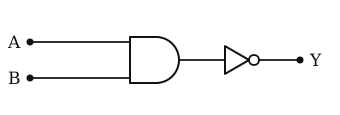
Q93.Which of the following circuits has the same output as that of the given circuit?
निम्नलिखित में से किस परिपथ का निर्गत (output), दिए गए परिपथ के निर्गत के समान है?
- A
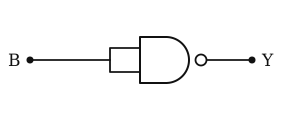
- B
- C
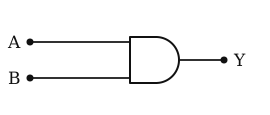
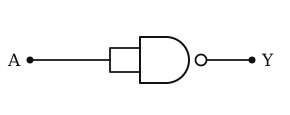
- D
Show answer
Concept: Write the Boolean expression of the given circuit and simplify.
- Top AND gate: inputs and → . Bottom AND gate: inputs and → .
- Both feed a NOR gate: .
- So the circuit is simply a NOT gate on . Option (B) — a NAND with both inputs tied to — gives : same output.
- Option (A) gives , option (C) gives , option (D) gives — all different.
Answer: (B) NAND gate with both inputs tied to A (i.e. )
अवधारणा: दिए गए परिपथ का बूलीय व्यंजक लिखकर सरल कीजिए।
- ऊपरी AND गेट: निवेश तथा → । निचला AND गेट: निवेश तथा → ।
- दोनों एक NOR गेट में जाते हैं: ।
- अतः परिपथ पर केवल एक NOT गेट है। विकल्प (B) — दोनों निवेश से जुड़ा NAND — देता है: समान निर्गत।
- विकल्प (A) देता है, विकल्प (C) , विकल्प (D) — सभी भिन्न हैं।
उत्तर: (B) दोनों निवेश A से जुड़ा NAND गेट (अर्थात )
JEE Main 2025 (January) – Paper 1 (B.E./B.Tech)PhysicsSemiconductors – logic gatesJEE Main 2025 (January) – Paper 1 (B.E./B.Tech) 2025 · 28 Jan Shift 1
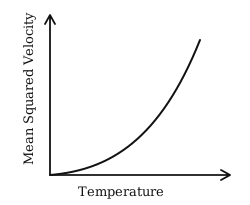
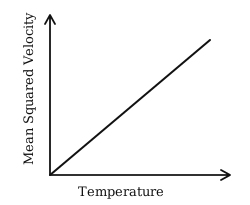
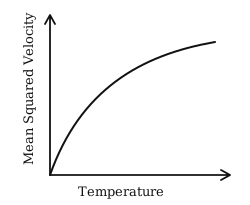
Q94.For a particular ideal gas which of the following graphs represents the variation of mean squared velocity of the gas molecules with temperature?
किसी विशेष आदर्श गैस के लिए निम्नलिखित में से कौन-सा ग्राफ, गैस अणुओं के माध्य वर्ग वेग (mean squared velocity) का ताप के साथ परिवर्तन दर्शाता है?
- A
- B
- C
- D
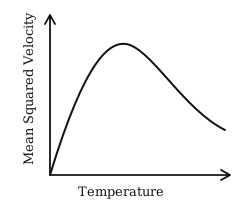
Show answer
Concept: From kinetic theory, , so .
- : the mean squared velocity is directly proportional to absolute temperature.
- So the graph is a straight line passing through the origin — graph (B).
- (A) and (C) show non-linear growth and (D) shows a maximum — none follows .
Short trick: , hence : straight line through origin.
Answer: (B) the straight line through the origin
अवधारणा: अणुगति सिद्धांत से, , अतः ।
- : माध्य वर्ग वेग परम ताप के अनुक्रमानुपाती है।
- अतः ग्राफ मूलबिंदु से गुज़रती सरल रेखा है — ग्राफ (B)।
- (A) तथा (C) अरेखीय वृद्धि दर्शाते हैं और (D) एक उच्चिष्ठ — कोई भी का पालन नहीं करता।
शॉर्ट ट्रिक: , अतः : मूलबिंदु से सरल रेखा।
उत्तर: (B) मूलबिंदु से गुज़रती सरल रेखा
JEE Main 2025 (January) – Paper 1 (B.E./B.Tech)PhysicsKinetic Theory of Gases – mean squared velocity vs temperatureJEE Main 2025 (January) – Paper 1 (B.E./B.Tech) 2025 · 28 Jan Shift 1
Q95.A proton of mass '' has same energy as that of a photon of wavelength ''. If the proton is moving at non-relativistic speed, then ratio of its de Broglie wavelength to the wavelength of photon is.
द्रव्यमान '' के एक प्रोटॉन की ऊर्जा, तरंगदैर्घ्य '' वाले फ़ोटॉन की ऊर्जा के बराबर है। यदि प्रोटॉन अनापेक्षिकीय (non-relativistic) चाल से गतिमान है, तो उसके डी ब्रॉग्ली तरंगदैर्घ्य का फ़ोटॉन के तरंगदैर्घ्य से अनुपात है
- A
- B
- C
- D
Show answer
Concept: For the proton (non-relativistic, KE ); for the photon .
- .
- .
Answer: (D)
अवधारणा: प्रोटॉन के लिए (अनापेक्षिकीय, गतिज ऊर्जा ); फ़ोटॉन के लिए ।
- ।
- ।
उत्तर: (D)
JEE Main 2025 (January) – Paper 1 (B.E./B.Tech)PhysicsDual Nature of Matter – de Broglie wavelengthJEE Main 2025 (January) – Paper 1 (B.E./B.Tech) 2025 · 28 Jan Shift 1
Q96.A double slit interference experiment performed with a light of wavelength 600 nm forms an interference fringe pattern on a screen with 10th bright fringe having its centre at a distance of 10 mm from the central maximum. Distance of the centre of the same 10th bright fringe from the central maximum when the source of light is replaced by another source of wavelength 660 nm would be _________ mm.
600 nm तरंगदैर्घ्य के प्रकाश से किया गया एक द्विझिरी व्यतिकरण प्रयोग, पर्दे पर ऐसा व्यतिकरण फ्रिंज पैटर्न बनाता है जिसमें 10वीं दीप्त फ्रिंज का केंद्र, केंद्रीय उच्चिष्ठ से 10 mm दूरी पर है। यदि प्रकाश स्रोत को 660 nm तरंगदैर्घ्य के दूसरे स्रोत से बदल दिया जाए, तो उसी 10वीं दीप्त फ्रिंज के केंद्र की केंद्रीय उच्चिष्ठ से दूरी _________ mm होगी।
Show answer
Concept: Position of the th bright fringe: for fixed , , .
Answer: 11
अवधारणा: वीं दीप्त फ्रिंज की स्थिति: (नियत , , के लिए)।
उत्तर: 11
JEE Main 2025 (January) – Paper 1 (B.E./B.Tech)PhysicsWave Optics – Young's double slit experimentJEE Main 2025 (January) – Paper 1 (B.E./B.Tech) 2025 · 28 Jan Shift 1
Q97.In a measurement, it is asked to find modulus of elasticity per unit torque applied on the system. The measured quantity has dimension of . If , the value of is ________
एक मापन में, निकाय पर आरोपित प्रति एकांक बल-आघूर्ण (torque) पर प्रत्यास्थता गुणांक ज्ञात करने को कहा गया है। मापी गई राशि की विमा है। यदि हो, तो का मान ________ है
Show answer
Concept: Divide the dimensions: modulus of elasticity , torque .
- So , (as given) and .
Answer: 0
अवधारणा: विमाओं का भाग कीजिए: प्रत्यास्थता गुणांक , बल-आघूर्ण ।
- अतः , (दिया है) तथा ।
उत्तर: 0
JEE Main 2025 (January) – Paper 1 (B.E./B.Tech)PhysicsUnits and Dimensions – dimensional analysisJEE Main 2025 (January) – Paper 1 (B.E./B.Tech) 2025 · 28 Jan Shift 1
Q98.A tiny metallic rectangular sheet has length and breadth of 5 mm and 2.5 mm, respectively. Using a specially designed screw gauge which has pitch of 0.75 mm and 15 divisions in the circular scale, you are asked to find the area of the sheet. In this measurement, the maximum fractional error will be where is _________.
एक छोटी धात्विक आयताकार चादर की लंबाई तथा चौड़ाई क्रमशः 5 mm तथा 2.5 mm है। 0.75 mm चूड़ी अंतराल (pitch) तथा वृत्ताकार पैमाने पर 15 भाग वाले एक विशेष रूप से बनाए गए स्क्रू गेज का उपयोग करके आपको चादर का क्षेत्रफल ज्ञात करना है। इस मापन में अधिकतम भिन्नात्मक त्रुटि होगी, जहाँ _________ है।
Show answer
Concept: Least count ; for , .
- LC ().
- .
Answer: 3
अवधारणा: अल्पतमांक ; के लिए ।
- अल्पतमांक ()।
- ।
उत्तर: 3
JEE Main 2025 (January) – Paper 1 (B.E./B.Tech)PhysicsError Analysis – screw gaugeJEE Main 2025 (January) – Paper 1 (B.E./B.Tech) 2025 · 28 Jan Shift 1
Q99.Two iron solid discs of negligible thickness have radii and and moment of inertia and , respectively. For , the ratio of and would be , where = ________
नगण्य मोटाई की दो ठोस लोहे की चकतियों की त्रिज्याएँ क्रमशः तथा और जड़त्व आघूर्ण क्रमशः तथा हैं। के लिए, तथा का अनुपात होगा, जहाँ = ________
Show answer
Concept: Both discs are of iron (same density ) with the same (negligible) thickness , so mass and .
- So .
Answer: 16
अवधारणा: दोनों चकतियाँ लोहे की हैं (समान घनत्व ) तथा समान (नगण्य) मोटाई की हैं, अतः द्रव्यमान तथा ।
- अतः ।
उत्तर: 16
JEE Main 2025 (January) – Paper 1 (B.E./B.Tech)PhysicsRotational Motion – moment of inertia of discsJEE Main 2025 (January) – Paper 1 (B.E./B.Tech) 2025 · 28 Jan Shift 1
Q100.The moment of inertia of a solid disc rotating along its diameter is 2.5 times higher than the moment of inertia of a ring rotating in similar way. The moment of inertia of a solid sphere which has same radius as the disc and rotating in similar way, is times higher than the moment of inertia of the given ring. Here, = ________. Consider all the bodies have equal masses.
अपने व्यास के परितः घूर्णन करती एक ठोस चकती का जड़त्व आघूर्ण, उसी प्रकार घूर्णन करती एक वलय (ring) के जड़त्व आघूर्ण का 2.5 गुना है। चकती के समान त्रिज्या वाले तथा उसी प्रकार घूर्णन करते एक ठोस गोले का जड़त्व आघूर्ण, दी गई वलय के जड़त्व आघूर्ण का गुना है। यहाँ = ________। सभी पिंडों के द्रव्यमान समान मानिए।
Show answer
Concept: About a diameter: disc , ring , solid sphere (equal masses ).
- Given .
- Sphere (radius , same as disc): .
- .
Answer: 4
अवधारणा: व्यास के परितः: चकती , वलय , ठोस गोला (समान द्रव्यमान )।
- दिया है ।
- गोला (त्रिज्या , चकती के समान): ।
- ।
उत्तर: 4
JEE Main 2025 (January) – Paper 1 (B.E./B.Tech)PhysicsRotational Motion – moment of inertia about diameterJEE Main 2025 (January) – Paper 1 (B.E./B.Tech) 2025 · 28 Jan Shift 1

