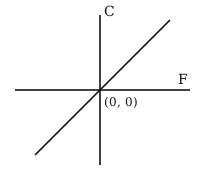
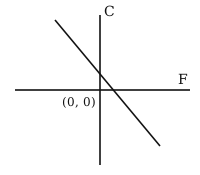
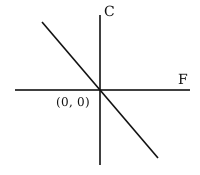
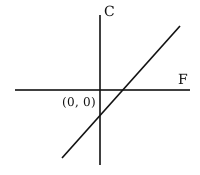
Q101.Which of the following figure represents the relation between Celsius and Fahrenheit temperatures ?
निम्नलिखित में से कौन-सा चित्र सेल्सियस तथा फ़ारेनहाइट तापों के बीच संबंध को निरूपित करता है ?
- A
- B
- C
- D
Show answer
Concept: The Celsius–Fahrenheit relation is , i.e. — a straight line.
- Slope is positive, so the line rises to the right.
- Intercept on the C-axis is (negative); the line cuts the F-axis at (positive side of origin).
- Only the graph in option (D) shows a straight line of positive slope cutting the F-axis to the right of the origin. (A) and (C) pass through the origin, (B) has negative slope.
Short trick: Remember the two anchor points: C F and C F — positive slope, positive F-intercept.
Answer: (D)
अवधारणा: सेल्सियस–फ़ारेनहाइट संबंध अर्थात — एक सरल रेखा है।
- ढाल (slope) धनात्मक है, अतः रेखा दाईं ओर ऊपर उठती है।
- C-अक्ष पर अंतःखंड (ऋणात्मक) है; रेखा F-अक्ष को (मूल बिंदु के दाईं ओर) पर काटती है।
- केवल विकल्प (D) का ग्राफ धनात्मक ढाल वाली ऐसी रेखा दिखाता है जो F-अक्ष को मूल बिंदु के दाईं ओर काटती है। (A) व (C) मूल बिंदु से गुजरती हैं, (B) की ढाल ऋणात्मक है।
शॉर्ट ट्रिक: दो बिंदु याद रखें: C F तथा C F — धनात्मक ढाल, धनात्मक F-अंतःखंड।
उत्तर: (D)
JEE Main 2025 (January) – Paper 1 (B.E./B.Tech)PhysicsThermal properties – temperature scalesJEE Main 2025 (January) – Paper 1 (B.E./B.Tech) 2025 · 24 Jan Shift 2
Q102.The position vector of a moving body at any instant of time is given as m. The magnitude and direction of velocity at s is,
किसी गतिमान पिंड का स्थिति सदिश किसी क्षण m द्वारा दिया गया है। s पर वेग का परिमाण तथा दिशा है,
- A m/s, making an angle of with ve axis m/s, ऋणात्मक अक्ष से कोण बनाते हुए
- B m/s, making an angle of with ve axis m/s, धनात्मक अक्ष से कोण बनाते हुए
- C m/s, making an angle of with ve axis m/s, धनात्मक अक्ष से कोण बनाते हुए
- D m/s, making an angle of with ve axis m/s, ऋणात्मक अक्ष से कोण बनाते हुए
Show answer
Concept: Velocity is the time derivative of the position vector: .
- .
- At s: m/s.
- Magnitude: m/s.
- Angle with the ve axis: , so from the direction (the vector points towards , slightly below the -axis).
Answer: (D)
अवधारणा: वेग, स्थिति सदिश का समय के सापेक्ष अवकलज है: ।
- ।
- s पर: m/s।
- परिमाण: m/s।
- ऋणात्मक अक्ष से कोण: , अतः दिशा से (सदिश की ओर, -अक्ष से थोड़ा नीचे है)।
उत्तर: (D)
JEE Main 2025 (January) – Paper 1 (B.E./B.Tech)PhysicsKinematics – two-dimensional motionJEE Main 2025 (January) – Paper 1 (B.E./B.Tech) 2025 · 24 Jan Shift 2
Q103.The output of the circuit is low (zero) for :
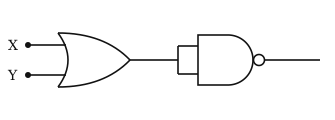
(A) X = 0, Y = 0 (B) X = 0, Y = 1 (C) X = 1, Y = 0 (D) X = 1, Y = 1
Choose the correct answer from the options given below :
परिपथ का निर्गत (output) निम्न (शून्य) होगा :
(A) X = 0, Y = 0 (B) X = 0, Y = 1 (C) X = 1, Y = 0 (D) X = 1, Y = 1
निम्नलिखित विकल्पों में से सही उत्तर चुनिए :
- A(B), (C) and (D) onlyकेवल (B), (C) तथा (D)
- B(A), (B) and (C) onlyकेवल (A), (B) तथा (C)
- C(A), (C) and (D) onlyकेवल (A), (C) तथा (D)
- D(A), (B) and (D) onlyकेवल (A), (B) तथा (D)
Show answer
Concept: A NAND gate with both inputs joined together works as a NOT gate. So the circuit is OR followed by NOT, i.e. a NOR gate.
- First gate: (OR).
- Second gate: output .
- Output is 1 only when (case A); for cases (B), (C), (D), so the output is 0 (low).
Short trick: OR + inverter = NOR: high only for all-zero inputs.
Answer: (A)
अवधारणा: दोनों निवेश जोड़ा हुआ NAND द्वार NOT द्वार की तरह कार्य करता है। अतः परिपथ OR के बाद NOT, अर्थात NOR द्वार है।
- पहला द्वार: (OR)।
- दूसरा द्वार: निर्गत ।
- निर्गत केवल तभी 1 है जब (स्थिति A); स्थितियों (B), (C), (D) में होने से निर्गत 0 (निम्न) है।
शॉर्ट ट्रिक: OR + प्रतिलोमक (inverter) = NOR: केवल सभी निवेश शून्य होने पर ही उच्च।
उत्तर: (A)
JEE Main 2025 (January) – Paper 1 (B.E./B.Tech)PhysicsSemiconductors – logic gatesJEE Main 2025 (January) – Paper 1 (B.E./B.Tech) 2025 · 24 Jan Shift 2
Q104.Young's double slit inteference apparatus is immersed in a liquid of refractive index 1.44. It has slit separation of 1.5 mm. The slits are illuminated by a parallel beam of light whose wavelength in air is 690 nm. The fringe-width on a screen placed behind the plane of slits at a distance of 0.72 m, will be :
यंग का द्वि-झिरी व्यतिकरण उपकरण 1.44 अपवर्तनांक के द्रव में डुबोया गया है। इसमें झिरियों के बीच दूरी 1.5 mm है। झिरियों को प्रकाश के समांतर पुंज से प्रदीप्त किया जाता है जिसकी वायु में तरंगदैर्घ्य 690 nm है। झिरियों के तल से 0.72 m दूरी पर रखे पर्दे पर फ्रिंज-चौड़ाई होगी :
- A0.23 mm
- B0.33 mm
- C0.63 mm
- D0.46 mm
Show answer
Concept: In a medium of refractive index the wavelength shortens to , so the fringe width becomes .
- nm.
- m m.
- mm.
Short trick: Compute the air fringe width mm and divide by .
Answer: (A)
अवधारणा: अपवर्तनांक के माध्यम में तरंगदैर्घ्य घटकर हो जाती है, अतः फ्रिंज चौड़ाई होती है।
- nm।
- m m।
- mm।
शॉर्ट ट्रिक: वायु में फ्रिंज चौड़ाई mm निकालकर से भाग दें।
उत्तर: (A)
JEE Main 2025 (January) – Paper 1 (B.E./B.Tech)PhysicsWave optics – Young's double slit experimentJEE Main 2025 (January) – Paper 1 (B.E./B.Tech) 2025 · 24 Jan Shift 2
Q105.The magnitude of heat exchanged by a system for the given cyclic process ABCA (as shown in figure) is (in SI unit) :
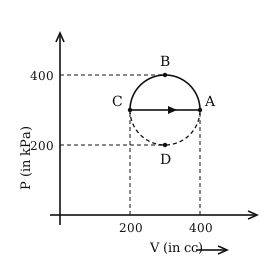
दिए गए चक्रीय प्रक्रम ABCA (चित्रानुसार) के लिए निकाय द्वारा विनिमय की गई ऊष्मा का परिमाण (SI मात्रक में) है :
- A
- B
- C
- Dzeroशून्य
Show answer
Concept: For a complete cycle , so area enclosed by the cycle on the P–V diagram.
- The path ABC is the upper half of a circle of radius 100 (in plot units) centred at (300 cc, 300 kPa), and CA is the straight diameter back to A. The enclosed area is a semicircle.
- Enclosed area .
- J.
Short trick: Convert the enclosed area to SI at once — J, and the semicircle gives J.
Answer: (A)
अवधारणा: पूर्ण चक्र के लिए , अतः P–V आरेख पर चक्र द्वारा परिबद्ध क्षेत्रफल।
- पथ ABC, (300 cc, 300 kPa) केंद्र तथा 100 (आरेख मात्रक) त्रिज्या वाले वृत्त का ऊपरी अर्धभाग है, और CA व्यास के अनुदिश सीधा लौटता है। परिबद्ध क्षेत्र एक अर्धवृत्त है।
- परिबद्ध क्षेत्रफल ।
- J।
शॉर्ट ट्रिक: परिबद्ध क्षेत्रफल को सीधे SI मात्रकों में बदलकर गिनें — J, अर्धवृत्त का क्षेत्रफल ।
उत्तर: (A)
JEE Main 2025 (January) – Paper 1 (B.E./B.Tech)PhysicsThermodynamics – cyclic processJEE Main 2025 (January) – Paper 1 (B.E./B.Tech) 2025 · 24 Jan Shift 2
Q106.A long straight wire of a circular cross-section with radius 'a' carries a steady current . The current is uniformly distributed across this cross-section. The plot of magnitude of magnetic field B with distance from the centre of the wire is given by
वृत्ताकार अनुप्रस्थ काट तथा त्रिज्या 'a' वाले एक लंबे सीधे तार में अपरिवर्ती धारा प्रवाहित है। धारा इस अनुप्रस्थ काट पर एकसमान रूप से वितरित है। तार के केंद्र से दूरी के साथ चुंबकीय क्षेत्र के परिमाण B का आलेख (plot) है
- A
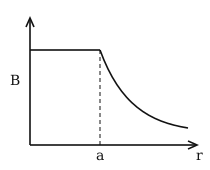
- B
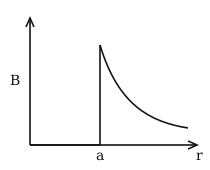
- C
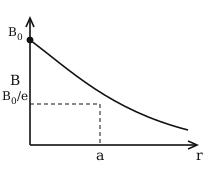
- D
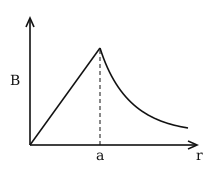
Show answer
Concept: Ampere's circuital law for a uniformly distributed current in a wire of radius .
- Inside (): enclosed current , so — a straight line rising from zero.
- Outside (): — falls off hyperbolically.
- B is maximum at the surface ; the graph rises linearly then decays as — option (D). (A) shows constant B inside, (B) shows zero inside, (C) shows maximum at the centre — all wrong.
Short trick: Solid conductor: B–r graph looks like a mountain peak at (linear up, down).
Answer: (D)
अवधारणा: त्रिज्या के तार में एकसमान वितरित धारा के लिए ऐम्पियर का परिपथीय नियम।
- भीतर (): परिबद्ध धारा , अतः — शून्य से उठती सरल रेखा।
- बाहर (): — अतिपरवलय की तरह घटता है।
- B पृष्ठ पर अधिकतम है; आलेख रैखिक रूप से बढ़कर फिर से घटता है — विकल्प (D)। (A) में भीतर B नियत, (B) में भीतर शून्य, (C) में केंद्र पर अधिकतम — सभी गलत।
शॉर्ट ट्रिक: ठोस चालक: B–r आलेख पर पर्वत-शिखर जैसा (रैखिक ऊपर, नीचे)।
उत्तर: (D)
JEE Main 2025 (January) – Paper 1 (B.E./B.Tech)PhysicsMagnetic effects of current – Ampere's lawJEE Main 2025 (January) – Paper 1 (B.E./B.Tech) 2025 · 24 Jan Shift 2
Q107.In photoelectric effect, the stopping potential v/s frequency curve is plotted. ( is the Planck's constant and is work function of metal)
(A) v/s is linear.
(B) The slope of v/s curve
(C) constant is related to the slope of v/s line.
(D) The value of electric charge of electron is not required to determine using the v/s curve.
(E) The work function can be estimated without knowing the value of .
Choose the correct answer from the options given below :
प्रकाश-विद्युत प्रभाव में निरोधी विभव तथा आवृत्ति के बीच वक्र खींचा गया है। ( प्लांक नियतांक है तथा धातु का कार्य फलन है)
(A) व के बीच संबंध रैखिक है।
(B) – वक्र की ढाल
(C) नियतांक , – रेखा की ढाल से संबंधित है।
(D) – वक्र से ज्ञात करने के लिए इलेक्ट्रॉन के आवेश के मान की आवश्यकता नहीं होती।
(E) का मान जाने बिना कार्य फलन का आकलन किया जा सकता है।
निम्नलिखित विकल्पों में से सही उत्तर चुनिए :
- A(C) and (D) onlyकेवल (C) तथा (D)
- B(A), (C) and (E) onlyकेवल (A), (C) तथा (E)
- C(A), (B) and (C) onlyकेवल (A), (B) तथा (C)
- D(D) and (E) onlyकेवल (D) तथा (E)
Show answer
Concept: Einstein's photoelectric equation: , i.e. .
- (A) True — vs is a straight line.
- (B) False — the slope is , not .
- (C) True — slope, so is related to the slope.
- (D) False — to get from the slope you must know the electronic charge .
- (E) True — the intercept on the axis is ; knowing , follows without .
Answer: (B)
अवधारणा: आइंस्टाइन का प्रकाश-विद्युत समीकरण: , अर्थात ।
- (A) सत्य — व के बीच सरल रेखा होती है।
- (B) असत्य — ढाल है, नहीं।
- (C) सत्य — ढाल, अतः ढाल से संबंधित है।
- (D) असत्य — ढाल से ज्ञात करने के लिए इलेक्ट्रॉन आवेश चाहिए।
- (E) सत्य — अक्ष पर अंतःखंड है; ज्ञात हो तो के बिना मिल जाता है।
उत्तर: (B)
JEE Main 2025 (January) – Paper 1 (B.E./B.Tech)PhysicsModern physics – photoelectric effectJEE Main 2025 (January) – Paper 1 (B.E./B.Tech) 2025 · 24 Jan Shift 2
Q108.A solid sphere and a hollow sphere of the same mass and of same radius are rolled on an inclined plane. Let the time taken to reach the bottom by the solid sphere and the hollow sphere be and , respectively, then
समान द्रव्यमान तथा समान त्रिज्या के एक ठोस गोले तथा एक खोखले गोले को आनत तल पर लुढ़काया जाता है। ठोस गोले तथा खोखले गोले द्वारा तल की तली तक पहुँचने में लिए गए समय क्रमशः तथा हों, तो
- A
- B
- C
- D
Show answer
Concept: For rolling without slipping down an incline, ; smaller means larger acceleration and less time.
- Solid sphere: ; hollow sphere: .
- .
- Since for the same incline, the solid sphere reaches earlier: .
Short trick: In a rolling race the body with the smallest always wins — solid sphere beats hollow sphere.
Answer: (C)
अवधारणा: आनत तल पर बिना फिसले लोटन के लिए ; जितना छोटा, त्वरण उतना बड़ा और समय उतना कम।
- ठोस गोला: ; खोखला गोला: ।
- ।
- समान तल पर , अतः ठोस गोला पहले पहुँचता है: ।
शॉर्ट ट्रिक: लोटन की दौड़ में सबसे छोटे वाला पिंड जीतता है — ठोस गोला खोखले गोले से आगे।
उत्तर: (C)
JEE Main 2025 (January) – Paper 1 (B.E./B.Tech)PhysicsRotational motion – rolling on inclineJEE Main 2025 (January) – Paper 1 (B.E./B.Tech) 2025 · 24 Jan Shift 2
Q109.A small uncharged conducting sphere is placed in contact with an identical sphere but having C charge and then removed to a distance such that the force of repulsion between them is N. The distance between them is (Take as in SI units)
एक छोटे अनावेशित चालक गोले को C आवेश वाले सर्वसम गोले के संपर्क में रखकर इतनी दूरी पर ले जाया जाता है कि उनके बीच प्रतिकर्षण बल N हो। उनके बीच दूरी है ( को SI मात्रकों में लीजिए)
- A3 cm
- B2 cm
- C4 cm
- D1 cm
Show answer
Concept: Identical conducting spheres in contact share charge equally; then Coulomb's law gives the separation.
- After contact, each sphere carries C.
- .
- m cm.
Answer: (B)
अवधारणा: संपर्क में रखे सर्वसम चालक गोले आवेश बराबर बाँट लेते हैं; फिर कूलॉम के नियम से दूरी मिलती है।
- संपर्क के बाद प्रत्येक गोले पर C।
- ।
- m cm।
उत्तर: (B)
JEE Main 2025 (January) – Paper 1 (B.E./B.Tech)PhysicsElectrostatics – Coulomb's lawJEE Main 2025 (January) – Paper 1 (B.E./B.Tech) 2025 · 24 Jan Shift 2
Q110.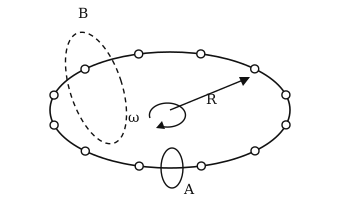
N equally spaced charges each of value q, are placed on a circle of radius R. The circle rotates about its axis with an angular velocity
as shown in the figure. A bigger Amperian loop B encloses the whole circle where as a smaller Amperian loop A encloses a small segment. The difference between enclosed currents,
, for the given Amperian loops is
R त्रिज्या के वृत्त पर, q मान के N समान दूरी पर स्थित आवेश रखे हैं। चित्रानुसार वृत्त अपने अक्ष के परितः कोणीय वेग
से घूर्णन करता है। बड़ा ऐम्पियरीय पाश (Amperian loop) B पूरे वृत्त को घेरता है जबकि छोटा ऐम्पियरीय पाश A एक छोटे खंड को घेरता है। दिए गए ऐम्पियरीय पाशों के लिए परिबद्ध धाराओं का अंतर
है
- A
- B
- C
- D
Show answer
Concept: Enclosed current through an Amperian loop = total charge crossing any surface bounded by the loop per unit time.
- The rotating ring of charges is a circular current. Loop A threads the ring itself (encircles the 'wire'), so in one period all N charges pass through its surface once: .
- Loop B encloses the whole circle; the circulating charges never pierce a surface bounded by B, so .
- .
Short trick: A rotating ring of total charge is a current — only a loop linked with the ring encloses it.
Answer: (D)
अवधारणा: ऐम्पियरीय पाश से परिबद्ध धारा = पाश द्वारा घिरे किसी पृष्ठ को प्रति इकाई समय पार करने वाला कुल आवेश।
- घूमता आवेश-वलय एक वृत्तीय धारा है। पाश A स्वयं वलय ('तार') को घेरता है, अतः एक आवर्तकाल में सभी N आवेश उसके पृष्ठ से एक बार गुजरते हैं: ।
- पाश B पूरे वृत्त को घेरता है; परिक्रमण करते आवेश B से घिरे किसी पृष्ठ को पार नहीं करते, अतः ।
- ।
शॉर्ट ट्रिक: कुल आवेश का घूमता वलय धारा है — केवल वलय से सलंकित (linked) पाश ही उसे परिबद्ध करता है।
उत्तर: (D)
JEE Main 2025 (January) – Paper 1 (B.E./B.Tech)PhysicsMoving charges – current and Amperian loopsJEE Main 2025 (January) – Paper 1 (B.E./B.Tech) 2025 · 24 Jan Shift 2
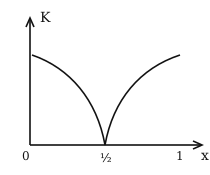
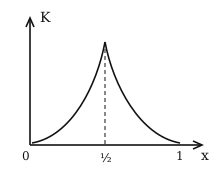
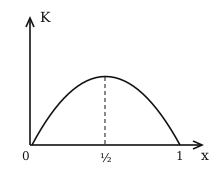
Q111.A particle oscillates along the x-axis according to the law, where m. The kinetic energy (K) of the particle as a function of is correctly represented by the graph
कोई कण x-अक्ष के अनुदिश नियम के अनुसार दोलन करता है, जहाँ m है। कण की गतिज ऊर्जा (K) को के फलन के रूप में कौन-सा ग्राफ सही निरूपित करता है
- A
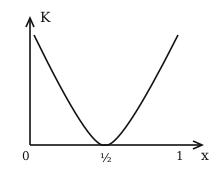
- B
- C
- D
Show answer
Concept: Express the velocity in terms of and use .
- , so (SHM about ).
- .
- : zero at and , maximum at — an inverted parabola, graph (D).
- (A) and (B) show minimum K at (wrong — the centre has maximum speed); (C) has a sharp non-parabolic peak.
Short trick: In SHM, K vs displacement is always an inverted parabola, maximum at the mean position ( here).
Answer: (D)
अवधारणा: वेग को के पदों में लिखकर का उपयोग करें।
- , अतः ( के परितः सरल आवर्त गति)।
- ।
- : तथा पर शून्य, पर अधिकतम — उल्टा परवलय, ग्राफ (D)।
- (A) व (B) में पर K न्यूनतम है (गलत — मध्य स्थिति पर चाल अधिकतम होती है); (C) का शिखर परवलयाकार नहीं है।
शॉर्ट ट्रिक: सरल आवर्त गति में विस्थापन के सापेक्ष K सदैव उल्टा परवलय होता है, माध्य स्थिति (यहाँ ) पर अधिकतम।
उत्तर: (D)
JEE Main 2025 (January) – Paper 1 (B.E./B.Tech)PhysicsOscillations – kinetic energy in SHMJEE Main 2025 (January) – Paper 1 (B.E./B.Tech) 2025 · 24 Jan Shift 2
Q112.A photograph of a landscape is captured by a drone camera at a height of 18 km. The size of the camera film is 2 cm 2 cm and the area of the landscape photographed is 400 km. The focal length of the lens in the drone camera is :
18 km ऊँचाई पर स्थित ड्रोन कैमरे से किसी भू-दृश्य (landscape) का फोटोग्राफ लिया जाता है। कैमरा फिल्म का आकार 2 cm 2 cm है तथा फोटोग्राफ किए गए भू-दृश्य का क्षेत्रफल 400 km है। ड्रोन कैमरे के लेंस की फोकस दूरी है :
- A1.8 cm
- B0.9 cm
- C2.8 cm
- D2.5 cm
Show answer
Concept: For a very distant object the image forms at the focal plane; linear magnification .
- Landscape: area 400 km side km; film side cm.
- .
- m cm.
Answer: (A)
अवधारणा: अत्यधिक दूर की वस्तु का प्रतिबिंब फोकस तल पर बनता है; रैखिक आवर्धन ।
- भू-दृश्य: क्षेत्रफल 400 km भुजा km; फिल्म की भुजा cm।
- ।
- m cm।
उत्तर: (A)
JEE Main 2025 (January) – Paper 1 (B.E./B.Tech)PhysicsRay optics – lens magnificationJEE Main 2025 (January) – Paper 1 (B.E./B.Tech) 2025 · 24 Jan Shift 2
Q113.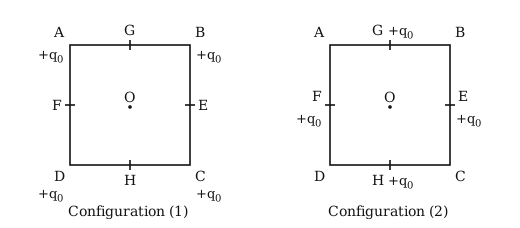
Four identical charges
are kept at the corners A, B, C and D of a square of side a as shown in Configuration (1). The charges are then shifted to the mid points G, E, H and F of the sides as shown in Configuration (2). The work done in changing the configuration of the system is :
चित्रानुसार विन्यास (Configuration) (1) में भुजा a के वर्ग के शीर्षों A, B, C तथा D पर चार सर्वसम आवेश
रखे हैं। फिर आवेशों को विन्यास (2) के अनुसार भुजाओं के मध्य-बिंदुओं G, E, H तथा F पर स्थानांतरित किया जाता है। निकाय का विन्यास बदलने में किया गया कार्य है :
- A
- B
- C
- D
Show answer
Concept: Work done by the external agent , with over all 6 pairs.
- Configuration (1) — corners of square of side : 4 pairs at distance and 2 diagonal pairs at : .
- Configuration (2) — mid points form a square of side with diagonals : .
- .
Short trick: Shrinking a square of like charges by factor multiplies by : .
Answer: (D)
अवधारणा: बाह्य कारक द्वारा किया गया कार्य , जहाँ (सभी 6 युग्मों पर)।
- विन्यास (1) — भुजा के वर्ग के शीर्ष: दूरी पर 4 युग्म तथा पर 2 विकर्ण युग्म: ।
- विन्यास (2) — मध्य-बिंदु भुजा का वर्ग बनाते हैं जिसके विकर्ण हैं: ।
- ।
शॉर्ट ट्रिक: समान आवेशों के वर्ग को गुना छोटा करने पर , गुना हो जाता है: ।
उत्तर: (D)
JEE Main 2025 (January) – Paper 1 (B.E./B.Tech)PhysicsElectrostatics – potential energy of a system of chargesJEE Main 2025 (January) – Paper 1 (B.E./B.Tech) 2025 · 24 Jan Shift 2
Q114.Arrange the following in the ascending order of wavelength :
(A) Microwaves (B) Ultraviolet rays (C) Infrared rays (D) X-rays
Choose the most appropriate answer from the options given below :
निम्नलिखित को तरंगदैर्घ्य के आरोही क्रम में व्यवस्थित कीजिए :
(A) सूक्ष्म तरंगें (Microwaves) (B) पराबैंगनी किरणें (C) अवरक्त किरणें (D) X-किरणें
निम्नलिखित विकल्पों में से सबसे उपयुक्त उत्तर चुनिए :
- A
- B
- C
- D
Show answer
Concept: In the electromagnetic spectrum, wavelength increases in the order: gamma rays, X-rays, UV, visible, infrared, microwaves, radio waves.
- X-rays have the shortest wavelength here ( m).
- Then ultraviolet ( m), then infrared ( m), and microwaves ( m) are the longest.
- Ascending order: .
Short trick: Remember the decreasing-wavelength chain 'Radio-Micro-Infra-Visible-UV-X-Gamma' and read it backwards.
Answer: (D)
अवधारणा: विद्युत-चुंबकीय स्पेक्ट्रम में तरंगदैर्घ्य इस क्रम में बढ़ती है: गामा किरणें, X-किरणें, पराबैंगनी, दृश्य, अवरक्त, सूक्ष्म तरंगें, रेडियो तरंगें।
- यहाँ X-किरणों की तरंगदैर्घ्य सबसे छोटी है ( m)।
- फिर पराबैंगनी ( m), फिर अवरक्त ( m), और सूक्ष्म तरंगें ( m) सबसे लंबी हैं।
- आरोही क्रम: ।
शॉर्ट ट्रिक: घटती तरंगदैर्घ्य की श्रृंखला 'रेडियो-माइक्रो-अवरक्त-दृश्य-UV-X-गामा' याद रखें और उल्टा पढ़ें।
उत्तर: (D)
JEE Main 2025 (January) – Paper 1 (B.E./B.Tech)PhysicsElectromagnetic waves – spectrumJEE Main 2025 (January) – Paper 1 (B.E./B.Tech) 2025 · 24 Jan Shift 2
Q115.The energy E and momentum p of a moving body of mass m are related by some equation. Given that c represents the speed of light, identify the correct equation
m द्रव्यमान के गतिमान पिंड की ऊर्जा E तथा संवेग p किसी समीकरण द्वारा संबंधित हैं। यदि c प्रकाश की चाल है, तो सही समीकरण पहचानिए
- A
- B
- C
- D
Show answer
Concept: The relativistic energy–momentum relation is .
- Check dimensions: J; J and J, so every term of has dimensions of J.
- Options (A) and (C) contain and (A), (B) contain — these terms are not J, so those equations are dimensionally wrong.
- Limits also agree: for , ; for a photon (), .
Short trick: Think of the right triangle with sides and and hypotenuse .
Answer: (D)
अवधारणा: आपेक्षिकीय ऊर्जा–संवेग संबंध है।
- विमाएँ जाँचें: J; J तथा J, अतः के सभी पद J विमा के हैं।
- विकल्प (A) व (C) में और (A), (B) में हैं — ये पद J नहीं हैं, अतः वे समीकरण विमीय रूप से गलत हैं।
- सीमाएँ भी मेल खाती हैं: पर ; फोटॉन () के लिए ।
शॉर्ट ट्रिक: व भुजाओं और कर्ण वाले समकोण त्रिभुज की कल्पना करें।
उत्तर: (D)
JEE Main 2025 (January) – Paper 1 (B.E./B.Tech)PhysicsModern physics – energy-momentum relationJEE Main 2025 (January) – Paper 1 (B.E./B.Tech) 2025 · 24 Jan Shift 2
Q116.The temperature of a body in air falls from C to C in 4 minutes. The temperature of the air is C. The temperature of the body in the next 4 minutes will be:
वायु में रखे किसी पिंड का ताप 4 मिनट में C से गिरकर C हो जाता है। वायु का ताप C है। अगले 4 मिनट में पिंड का ताप होगा:
- AC
- BC
- CC
- DC
Show answer
Concept: Newton's law of cooling (average form): .
- First interval: per min.
- Next interval (final temperature ): .
- C.
Short trick: Excess over surroundings falls by the same factor in equal times: (factor 3), so , giving C.
Answer: (D)
अवधारणा: न्यूटन का शीतलन नियम (औसत रूप): ।
- पहला अंतराल: प्रति मिनट।
- अगला अंतराल (अंतिम ताप ): ।
- C।
शॉर्ट ट्रिक: परिवेश से ताप-आधिक्य समान समय में समान गुणक से घटता है: (गुणक 3), अतः , जिससे C।
उत्तर: (D)
JEE Main 2025 (January) – Paper 1 (B.E./B.Tech)PhysicsThermal properties – Newton's law of coolingJEE Main 2025 (January) – Paper 1 (B.E./B.Tech) 2025 · 24 Jan Shift 2
Q117.A solid sphere is rolling without slipping on a horizontal plane. The ratio of the linear kinetic energy of the centre of mass of the sphere and rotational kinetic energy is :
एक ठोस गोला क्षैतिज तल पर बिना फिसले लुढ़क रहा है। गोले के द्रव्यमान केंद्र की रैखिक गतिज ऊर्जा तथा घूर्णी गतिज ऊर्जा का अनुपात है :
- A
- B
- C
- D
Show answer
Concept: For rolling without slipping, and .
- Translational KE .
- Rotational KE .
- Ratio .
Short trick: for a solid sphere.
Answer: (C)
अवधारणा: बिना फिसले लोटन के लिए तथा ठोस गोले का ।
- स्थानांतरीय गतिज ऊर्जा ।
- घूर्णी गतिज ऊर्जा ।
- अनुपात ।
शॉर्ट ट्रिक: (ठोस गोले के लिए)।
उत्तर: (C)
JEE Main 2025 (January) – Paper 1 (B.E./B.Tech)PhysicsRotational motion – rolling kinetic energyJEE Main 2025 (January) – Paper 1 (B.E./B.Tech) 2025 · 24 Jan Shift 2
Q118.In a Young's double slit experiment, three polarizers are kept as shown in the figure. The transmission axes of
and
are orthogonal to each other. The polarizer
covers both the slits with its transmission axis at
to those of
and
. An unpolarized light of wavelength
and intensity
is incident on
and
. The intensity at a point after
where the path difference between the light waves from
and
is
, is
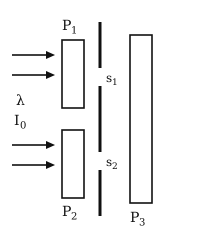
यंग के द्वि-झिरी प्रयोग में चित्रानुसार तीन ध्रुवक (polarizer) रखे हैं।
तथा
के पारगमन अक्ष परस्पर लंबवत हैं। ध्रुवक
दोनों झिरियों को ढकता है और इसका पारगमन अक्ष
व
के अक्षों से
पर है।
तरंगदैर्घ्य तथा
तीव्रता का अध्रुवित प्रकाश
तथा
पर आपतित होता है।
के बाद उस बिंदु पर तीव्रता, जहाँ
तथा
से आने वाली प्रकाश तरंगों के बीच पथांतर
है, होगी
- A
- B
- C
- D
Show answer
Concept: An unpolarized beam loses half its intensity at a polarizer (Malus: for polarized light); interference of two waves: .
- After (and ): intensity from each slit , polarized along orthogonal axes.
- After (at to each): each beam gives , now both polarized along the same axis, so they interfere.
- Path difference , .
- .
Answer: (B)
अवधारणा: ध्रुवक पर अध्रुवित पुंज की तीव्रता आधी रह जाती है (ध्रुवित प्रकाश के लिए मैलस का नियम: ); दो तरंगों का व्यतिकरण: ।
- (तथा ) के बाद: प्रत्येक झिरी से तीव्रता , परस्पर लंबवत अक्षों के अनुदिश ध्रुवित।
- (प्रत्येक से पर) के बाद: प्रत्येक पुंज से , अब दोनों एक ही अक्ष के अनुदिश ध्रुवित हैं, अतः व्यतिकरण करते हैं।
- पथांतर , ।
- ।
उत्तर: (B)
JEE Main 2025 (January) – Paper 1 (B.E./B.Tech)PhysicsWave optics – interference with polarizersJEE Main 2025 (January) – Paper 1 (B.E./B.Tech) 2025 · 24 Jan Shift 2
Q119.Given below are two statements. One is labelled as Assertion (A) and the other is labelled as Reason (R).
Assertion (A) : In an insulated container, a gas is adiabatically shrunk to half of its initial volume. The temperature of the gas decreases.
Reason (R) : Free expansion of an ideal gas is an irreversible and an adiabatic process.
In the light of the above statements, choose the correct answer from the options given below :
नीचे दो कथन दिए गए हैं। एक को अभिकथन (A) तथा दूसरे को कारण (R) कहा गया है।
अभिकथन (A) : एक ऊष्मारोधी पात्र में किसी गैस को रुद्धोष्म रूप से उसके प्रारंभिक आयतन के आधे तक संपीडित किया जाता है। गैस का ताप घट जाता है।
कारण (R) : आदर्श गैस का मुक्त प्रसार एक अनुत्क्रमणीय तथा रुद्धोष्म प्रक्रम है।
उपर्युक्त कथनों के आलोक में, निम्नलिखित विकल्पों में से सही उत्तर चुनिए :
- ABoth (A) and (R) are true but (R) is NOT the correct explanation of (A)(A) तथा (R) दोनों सत्य हैं परंतु (R), (A) की सही व्याख्या नहीं है
- B(A) is false but (R) is true(A) असत्य है परंतु (R) सत्य है
- C(A) is true but (R) is false(A) सत्य है परंतु (R) असत्य है
- DBoth (A) and (R) are true and (R) is the correct explanation of (A)(A) तथा (R) दोनों सत्य हैं तथा (R), (A) की सही व्याख्या है
Show answer
Concept: In an adiabatic compression, work is done on the gas with , so its internal energy and temperature rise ( constant).
- Assertion: shrinking the gas to half its volume adiabatically gives — the temperature increases, not decreases. (A) is false.
- Reason: free expansion is sudden (irreversible) and occurs in an insulated enclosure with no heat exchange (adiabatic). (R) is true.
- Hence (A) is false but (R) is true.
Answer: (B)
अवधारणा: रुद्धोष्म संपीडन में रहते हुए गैस पर कार्य किया जाता है, अतः उसकी आंतरिक ऊर्जा और ताप बढ़ते हैं ( नियत)।
- अभिकथन: गैस का आयतन रुद्धोष्म रूप से आधा करने पर — ताप बढ़ता है, घटता नहीं। (A) असत्य है।
- कारण: मुक्त प्रसार आकस्मिक (अनुत्क्रमणीय) होता है तथा ऊष्मारोधी पात्र में बिना ऊष्मा विनिमय (रुद्धोष्म) होता है। (R) सत्य है।
- अतः (A) असत्य है परंतु (R) सत्य है।
उत्तर: (B)
JEE Main 2025 (January) – Paper 1 (B.E./B.Tech)PhysicsThermodynamics – adiabatic processJEE Main 2025 (January) – Paper 1 (B.E./B.Tech) 2025 · 24 Jan Shift 2
Q120.Given below are two statements. One is labelled as Assertion (A) and the other is labelled as Reason (R).
Assertion (A) : A electron in a certain region of uniform magnetic field is moving with constant velocity in a straight line path.
Reason (R) : The magnetic field in that region is along the direction of velocity of the electron.
In the light of the above statements, choose the correct answer from the options given below :
नीचे दो कथन दिए गए हैं। एक को अभिकथन (A) तथा दूसरे को कारण (R) कहा गया है।
अभिकथन (A) : एकसमान चुंबकीय क्षेत्र के किसी क्षेत्र में एक इलेक्ट्रॉन नियत वेग से सरल रेखीय पथ पर गति कर रहा है।
कारण (R) : उस क्षेत्र में चुंबकीय क्षेत्र इलेक्ट्रॉन के वेग की दिशा के अनुदिश है।
उपर्युक्त कथनों के आलोक में, निम्नलिखित विकल्पों में से सही उत्तर चुनिए :
- A(A) is true but (R) is false(A) सत्य है परंतु (R) असत्य है
- BBoth (A) and (R) are true but (R) is NOT the correct explanation of (A)(A) तथा (R) दोनों सत्य हैं परंतु (R), (A) की सही व्याख्या नहीं है
- CBoth (A) and (R) are true and (R) is the correct explanation of (A)(A) तथा (R) दोनों सत्य हैं तथा (R), (A) की सही व्याख्या है
- D(A) is false but (R) is true(A) असत्य है परंतु (R) सत्य है
Show answer
Concept: Magnetic force on a moving charge: ; it vanishes when is parallel (or antiparallel) to .
- If the electron moves undeflected with constant velocity in a region where only a uniform magnetic field acts, the magnetic force on it must be zero.
- requires — exactly what (R) states.
- So both statements are true and (R) correctly explains (A).
Answer: (C)
अवधारणा: गतिमान आवेश पर चुंबकीय बल: ; जब , के समांतर (या प्रतिसमांतर) हो तो यह शून्य होता है।
- यदि केवल एकसमान चुंबकीय क्षेत्र वाले क्षेत्र में इलेक्ट्रॉन बिना विक्षेप नियत वेग से चलता है, तो उस पर चुंबकीय बल शून्य होना चाहिए।
- के लिए आवश्यक है — यही (R) कहता है।
- अतः दोनों कथन सत्य हैं और (R), (A) की सही व्याख्या है।
उत्तर: (C)
JEE Main 2025 (January) – Paper 1 (B.E./B.Tech)PhysicsMoving charges – force on a charge in magnetic fieldJEE Main 2025 (January) – Paper 1 (B.E./B.Tech) 2025 · 24 Jan Shift 2

