Q121.The ratio of the power of a light source to that the light source is 2. is emitting photons per second at 600 nm. If the wavelength of the source is 300 nm, then the number of photons per second emitted by is ________ .
प्रकाश स्रोत की शक्ति का प्रकाश स्रोत की शक्ति से अनुपात 2 है। , 600 nm पर प्रति सेकंड फोटॉन उत्सर्जित करता है। यदि स्रोत की तरंगदैर्घ्य 300 nm है, तो द्वारा प्रति सेकंड उत्सर्जित फोटॉनों की संख्या ________ है।
Show answer
Concept: Power of a monochromatic source , where is the number of photons emitted per second.
- .
- photons per second.
- So the required number is , i.e. the blank is 5.
Answer: 5
अवधारणा: एकवर्णी स्रोत की शक्ति , जहाँ प्रति सेकंड उत्सर्जित फोटॉनों की संख्या है।
- ।
- फोटॉन प्रति सेकंड।
- अतः अभीष्ट संख्या है, अर्थात रिक्त स्थान 5।
उत्तर: 5
JEE Main 2025 (January) – Paper 1 (B.E./B.Tech)PhysicsModern physics – photonsJEE Main 2025 (January) – Paper 1 (B.E./B.Tech) 2025 · 24 Jan Shift 2
Q122.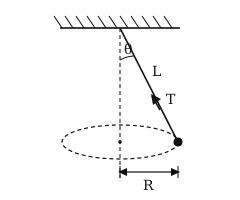
A string of length L is fixed at one end and carries a mass of M at the other end. The mass makes
rotations per second about the vertical axis passing through end of the string as shown. The tension in the string is ________ ML.
L लंबाई की एक डोरी एक सिरे पर बँधी है और दूसरे सिरे पर M द्रव्यमान जुड़ा है। चित्रानुसार द्रव्यमान, डोरी के सिरे से गुजरने वाले ऊर्ध्वाधर अक्ष के परितः प्रति सेकंड
चक्कर लगाता है। डोरी में तनाव ________ ML है।
Show answer
Concept: For a conical pendulum of string length at angle : with , so independent of .
- Frequency rev/s rad/s.
- (SI units).
- Hence the blank is 36.
Short trick: Whenever has in the denominator, becomes a clean number — here 6.
Answer: 36
अवधारणा: लंबाई की डोरी व कोण वाले शंक्वाकार लोलक के लिए: , जहाँ , अतः ( से स्वतंत्र)।
- आवृत्ति चक्कर/सेकंड rad/s।
- (SI मात्रक)।
- अतः रिक्त स्थान 36 है।
शॉर्ट ट्रिक: जब के हर में हो, तो एक सरल संख्या बनता है — यहाँ 6।
उत्तर: 36
JEE Main 2025 (January) – Paper 1 (B.E./B.Tech)PhysicsCircular motion – conical pendulumJEE Main 2025 (January) – Paper 1 (B.E./B.Tech) 2025 · 24 Jan Shift 2
Q123.The increase in pressure required to decrease the volume of a water sample by 0.2% is Nm. Bulk modulus of water is Nm. The value of P is ________.
जल के किसी नमूने का आयतन 0.2% घटाने के लिए आवश्यक दाब वृद्धि Nm है। जल का आयतन प्रत्यास्थता गुणांक (bulk modulus) Nm है। P का मान ________ है।
Show answer
Concept: Bulk modulus: .
- .
- Nm.
- Nm.
Answer: 43
अवधारणा: आयतन प्रत्यास्थता गुणांक: ।
- ।
- Nm।
- Nm।
उत्तर: 43
JEE Main 2025 (January) – Paper 1 (B.E./B.Tech)PhysicsMechanical properties – bulk modulusJEE Main 2025 (January) – Paper 1 (B.E./B.Tech) 2025 · 24 Jan Shift 2
Q124.A tightly wound long solenoid carries a current of 1.5 A. An electron is executing uniform circular motion inside the solenoid with a time period of 75 ns. The number of turns per metre in the solenoid is ________.
[Take mass of electron kg, charge of electron C, N A, ns s]
कसकर लपेटी गई एक लंबी परिनालिका में 1.5 A धारा प्रवाहित है। परिनालिका के भीतर एक इलेक्ट्रॉन 75 ns आवर्तकाल से एकसमान वृत्तीय गति कर रहा है। परिनालिका में प्रति मीटर फेरों की संख्या ________ है।
[इलेक्ट्रॉन का द्रव्यमान kg, इलेक्ट्रॉन का आवेश C, N A, ns s लीजिए]
Show answer
Concept: Period of circular motion of a charge in field B: ; field inside a long solenoid: .
- T.
- turns per metre.
Short trick: Combine directly: — the cancels with .
Answer: 250
अवधारणा: क्षेत्र B में आवेश की वृत्तीय गति का आवर्तकाल: ; लंबी परिनालिका के भीतर क्षेत्र: ।
- T।
- फेरे प्रति मीटर।
शॉर्ट ट्रिक: सीधे जोड़ें: — , के साथ कट जाता है।
उत्तर: 250
JEE Main 2025 (January) – Paper 1 (B.E./B.Tech)PhysicsMagnetic effects of current – solenoidJEE Main 2025 (January) – Paper 1 (B.E./B.Tech) 2025 · 24 Jan Shift 2
Q125.Acceleration due to gravity on the surface of earth is 'g'. If the diameter of earth is reduced to one third of its original value and mass remains unchanged, then the acceleration due to gravity on the surface of the earth is ________ g.
पृथ्वी की सतह पर गुरुत्वीय त्वरण 'g' है। यदि पृथ्वी का व्यास घटाकर अपने मूल मान का एक-तिहाई कर दिया जाए और द्रव्यमान अपरिवर्तित रहे, तो पृथ्वी की सतह पर गुरुत्वीय त्वरण ________ g होगा।
Show answer
Concept: On the surface, .
- Diameter (and hence radius) becomes one third: , mass M unchanged.
- .
- So the new acceleration due to gravity is 9g — the blank is 9.
Short trick: at fixed mass: radius .
Answer: 9
अवधारणा: सतह पर ।
- व्यास (अतः त्रिज्या) एक-तिहाई हो जाती है: , द्रव्यमान M अपरिवर्तित।
- ।
- अतः नया गुरुत्वीय त्वरण 9g है — रिक्त स्थान 9।
शॉर्ट ट्रिक: नियत द्रव्यमान पर : त्रिज्या ।
उत्तर: 9
JEE Main 2025 (January) – Paper 1 (B.E./B.Tech)PhysicsGravitation – acceleration due to gravityJEE Main 2025 (January) – Paper 1 (B.E./B.Tech) 2025 · 24 Jan Shift 2
Q126.During the transition of electron from state A to state C of a Bohr atom, the wavelength of emitted radiation is 2000 Å and it becomes 6000 Å when the electron jumps from state B to state C. Then the wavelength of the radiation emitted during the transition of electrons from state A to state B is
बोर परमाणु में इलेक्ट्रॉन के अवस्था A से अवस्था C में संक्रमण के दौरान उत्सर्जित विकिरण की तरंगदैर्घ्य 2000 Å है तथा इलेक्ट्रॉन के अवस्था B से अवस्था C में कूदने पर यह 6000 Å हो जाती है। तब इलेक्ट्रॉनों के अवस्था A से अवस्था B में संक्रमण के दौरान उत्सर्जित विकिरण की तरंगदैर्घ्य है
- A4000 Å
- B2000 Å
- C3000 Å
- D6000 Å
Show answer
Concept: Energy conservation in transitions: , and , so .
- (in Å)
- Å
Short trick: Å.
Answer: (C) 3000 Å
अवधारणा: संक्रमणों में ऊर्जा संरक्षण: तथा , अतः ।
- (Å में)
- Å
शॉर्ट ट्रिक: Å।
उत्तर: (C) 3000 Å
JEE Main 2025 (January) – Paper 1 (B.E./B.Tech)PhysicsAtomic Physics – Bohr modelJEE Main 2025 (January) – Paper 1 (B.E./B.Tech) 2025 · 24 Jan Shift 1
Q127.Consider the following statements:
A. The junction area of solar cell is made very narrow compared to a photo diode.
B. Solar cells are not connected with any external bias.
C. LED is made of lightly doped p-n junction.
D. Increase of forward current results in continuous increase of LED light intensity.
E. LEDs have to be connected in forward bias for emission of light.
Choose the correct answer from the options given below:
निम्नलिखित कथनों पर विचार कीजिए:
A. सौर सेल (solar cell) का संधि क्षेत्रफल, फोटो डायोड की तुलना में बहुत संकीर्ण बनाया जाता है।
B. सौर सेलों को किसी बाह्य बायस (bias) से नहीं जोड़ा जाता है।
C. LED हल्के अपमिश्रित (lightly doped) p-n संधि से बनाई जाती है।
D. अग्र धारा बढ़ाने से LED के प्रकाश की तीव्रता में निरंतर वृद्धि होती है।
E. प्रकाश उत्सर्जन के लिए LED को अग्र बायस में जोड़ना होता है।
नीचे दिए गए विकल्पों में से सही उत्तर चुनिए:
- AB, E Onlyकेवल B, E
- BB, D, E Onlyकेवल B, D, E
- CA, C Onlyकेवल A, C
- DA, C, E Onlyकेवल A, C, E
Show answer
Concept: Working features of solar cells and LEDs.
- A is wrong: a solar cell is given a large junction area so that it can intercept more light – not a narrow one.
- B is correct: a solar cell generates its own emf from incident light; no external bias is applied.
- C is wrong: an LED uses a heavily doped p-n junction so that recombination of injected carriers gives light.
- D is wrong: the intensity first increases with forward current, reaches a maximum and then decreases – it does not increase continuously.
- E is correct: light is emitted only in forward bias, when carriers are injected across the junction and recombine.
Answer: (A) B, E Only
अवधारणा: सौर सेल तथा LED की कार्यप्रणाली।
- A गलत है: सौर सेल का संधि क्षेत्रफल बड़ा रखा जाता है ताकि अधिक प्रकाश ग्रहण हो – संकीर्ण नहीं।
- B सही है: सौर सेल आपतित प्रकाश से स्वयं विद्युत वाहक बल उत्पन्न करता है; कोई बाह्य बायस नहीं लगाया जाता।
- C गलत है: LED में अत्यधिक अपमिश्रित p-n संधि प्रयुक्त होती है जिससे अंतःक्षेपित वाहकों के पुनर्योजन से प्रकाश मिले।
- D गलत है: अग्र धारा बढ़ाने पर तीव्रता पहले बढ़ती है, अधिकतम होकर फिर घटती है – निरंतर नहीं बढ़ती।
- E सही है: प्रकाश केवल अग्र बायस में उत्सर्जित होता है, जब वाहक संधि पार कर पुनर्योजित होते हैं।
उत्तर: (A) केवल B, E
JEE Main 2025 (January) – Paper 1 (B.E./B.Tech)PhysicsSemiconductor Devices – solar cell and LEDJEE Main 2025 (January) – Paper 1 (B.E./B.Tech) 2025 · 24 Jan Shift 1
Q128.An alternating current is given by . The r.m.s current will be
एक प्रत्यावर्ती धारा द्वारा दी जाती है। वर्ग माध्य मूल (r.m.s) धारा होगी
- A
- B
- C
- D
Show answer
Concept: The sum of a sine and a cosine of the same frequency is a single sinusoid of amplitude ; for any sinusoid .
- , where .
Answer: (B)
अवधारणा: समान आवृत्ति की sine और cosine का योग, आयाम वाली एकल ज्यावक्रीय धारा होती है; किसी भी ज्यावक्रीय धारा के लिए ।
- , जहाँ ।
उत्तर: (B)
JEE Main 2025 (January) – Paper 1 (B.E./B.Tech)PhysicsAlternating Current – rms valueJEE Main 2025 (January) – Paper 1 (B.E./B.Tech) 2025 · 24 Jan Shift 1
Q129.A car of mass '' moves on a banked road having radius '' and banking angle . To avoid slipping from banked road, the maximum permissible speed of the car is . The coefficient of friction between the wheels of the car and the banked road is
'' द्रव्यमान की एक कार, '' त्रिज्या तथा बंकन कोण वाली ढालू (बंकित) सड़क पर चलती है। बंकित सड़क से फिसलने से बचने के लिए कार की अधिकतम अनुमेय चाल है। कार के पहियों और बंकित सड़क के बीच घर्षण गुणांक है
- A
- B
- C
- D
Show answer
Concept: At the maximum speed on a banked road, friction acts down the incline and .
- Put :
Short trick: With the formula must reduce to – only option (C) does.
Answer: (C)
अवधारणा: बंकित सड़क पर अधिकतम चाल पर घर्षण ढाल के अनुदिश नीचे की ओर लगता है और ।
- रखने पर:
शॉर्ट ट्रिक: रखने पर सूत्र पर आना चाहिए – केवल विकल्प (C) में ऐसा होता है।
उत्तर: (C)
JEE Main 2025 (January) – Paper 1 (B.E./B.Tech)PhysicsLaws of Motion – banking of roadsJEE Main 2025 (January) – Paper 1 (B.E./B.Tech) 2025 · 24 Jan Shift 1
Q130.A satellite is launched into a circular orbit of radius '' around the earth. A second satellite is launched into an orbit of radius . The time period of revolution of the second satellite is larger than the first one approximately by
एक उपग्रह पृथ्वी के चारों ओर '' त्रिज्या की वृत्तीय कक्षा में प्रक्षेपित किया जाता है। दूसरा उपग्रह त्रिज्या की कक्षा में प्रक्षेपित किया जाता है। दूसरे उपग्रह का परिक्रमण काल, पहले उपग्रह से लगभग जितना अधिक है, वह है
- A9%
- B3%
- C4.5%
- D2.5%
Show answer
Concept: Kepler's third law: , so for small changes .
Answer: (C) 4.5%
अवधारणा: केप्लर का तृतीय नियम: , अतः छोटे परिवर्तनों के लिए ।
उत्तर: (C) 4.5%
JEE Main 2025 (January) – Paper 1 (B.E./B.Tech)PhysicsGravitation – Kepler's third lawJEE Main 2025 (January) – Paper 1 (B.E./B.Tech) 2025 · 24 Jan Shift 1
Q131.An ideal gas goes from an initial state to final state. During the process, the pressure of gas increases linearly with temperature.
A. The work done by gas during the process is zero.
B. The heat added to gas is different from change in its internal energy.
C. The volume of the gas is increased.
D. The internal energy of the gas is increased.
E. The process is isochoric (constant volume process)
Choose the correct answer from the options given below:
एक आदर्श गैस प्रारंभिक अवस्था से अंतिम अवस्था में जाती है। इस प्रक्रम के दौरान गैस का दाब, ताप के साथ रैखिकतः (एकघाततः) बढ़ता है।
A. प्रक्रम के दौरान गैस द्वारा किया गया कार्य शून्य है।
B. गैस को दी गई ऊष्मा, इसकी आंतरिक ऊर्जा में परिवर्तन से भिन्न है।
C. गैस का आयतन बढ़ जाता है।
D. गैस की आंतरिक ऊर्जा बढ़ जाती है।
E. यह प्रक्रम समआयतनिक (नियत आयतन प्रक्रम) है।
नीचे दिए गए विकल्पों में से सही उत्तर चुनिए:
- AE Onlyकेवल E
- BA, B, C, D Onlyकेवल A, B, C, D
- CA, D, E Onlyकेवल A, D, E
- DA, C Onlyकेवल A, C
Show answer
Concept: For an ideal gas . If throughout, then stays constant – the process is isochoric.
- E correct: with gives constant .
- A correct: since .
- B wrong: with , first law gives – heat added equals the change in internal energy.
- C wrong: the volume does not change.
- D correct: pressure (hence temperature) increases, so .
Answer: (C) A, D, E Only
अवधारणा: आदर्श गैस के लिए । यदि पूरे प्रक्रम में है, तो नियत रहता है – प्रक्रम समआयतनिक है।
- E सही: तथा से नियत।
- A सही: होने से ।
- B गलत: होने पर ऊष्मागतिकी के प्रथम नियम से – दी गई ऊष्मा आंतरिक ऊर्जा के परिवर्तन के बराबर है।
- C गलत: आयतन नहीं बदलता।
- D सही: दाब (अतः ताप) बढ़ता है, इसलिए ।
उत्तर: (C) केवल A, D, E
JEE Main 2025 (January) – Paper 1 (B.E./B.Tech)PhysicsThermodynamics – isochoric processJEE Main 2025 (January) – Paper 1 (B.E./B.Tech) 2025 · 24 Jan Shift 1
Q132.An electron of mass '' with an initial velocity enters an electric field . If the initial de Broglie wavelength is , the value after time would be
'' द्रव्यमान का एक इलेक्ट्रॉन, प्रारंभिक वेग से विद्युत क्षेत्र में प्रवेश करता है। यदि प्रारंभिक डी-ब्रॉग्ली तरंगदैर्घ्य है, तो समय के पश्चात् इसका मान होगा
- A
- B
- C
- D
Show answer
Concept: ; a field perpendicular to the motion adds a velocity component, increasing speed and decreasing .
- Force on the electron: , so while is unchanged.
- Speed:
Answer: (A)
अवधारणा: ; गति के लंबवत क्षेत्र वेग का एक घटक जोड़ता है, जिससे चाल बढ़ती है और घटती है।
- इलेक्ट्रॉन पर बल: , अतः जबकि अपरिवर्तित रहता है।
- चाल:
उत्तर: (A)
JEE Main 2025 (January) – Paper 1 (B.E./B.Tech)PhysicsDual Nature of Matter – de Broglie wavelengthJEE Main 2025 (January) – Paper 1 (B.E./B.Tech) 2025 · 24 Jan Shift 1
Q133.What is the relative decrease in focal length of a lens for an increase in optical power by 0.1 D from 2.5 D? ['D' stands for dioptre]
किसी लेंस की प्रकाशिक क्षमता (optical power) के 2.5 D से 0.1 D बढ़ने पर उसकी फोकस दूरी में आपेक्षिक कमी क्या है? ['D' डायोप्टर के लिए है]
- A0.01
- B0.04
- C0.40
- D0.1
Show answer
Concept: , so for small changes.
- Relative decrease in focal length
- Check: m, m; .
Answer: (B) 0.04
अवधारणा: , अतः छोटे परिवर्तनों के लिए ।
- फोकस दूरी में आपेक्षिक कमी
- जाँच: m, m; ।
उत्तर: (B) 0.04
JEE Main 2025 (January) – Paper 1 (B.E./B.Tech)PhysicsRay Optics – power of a lensJEE Main 2025 (January) – Paper 1 (B.E./B.Tech) 2025 · 24 Jan Shift 1
Q134.A force acts on an object in the -direction. The work done by the force is 5 J when the object is displaced by 1 m. If the constant N then will be
किसी वस्तु पर -दिशा में एक बल कार्य करता है। वस्तु के 1 m विस्थापित होने पर बल द्वारा किया गया कार्य 5 J है। यदि नियतांक N हो, तो होगा
- A15 N/m
- B12 N/m
- C8 N/m
- D10 N/m
Show answer
Concept: Work by a variable force: .
- N/m
Answer: (B) 12 N/m
अवधारणा: परिवर्ती बल द्वारा कार्य: ।
- N/m
उत्तर: (B) 12 N/m
JEE Main 2025 (January) – Paper 1 (B.E./B.Tech)PhysicsWork, Energy and Power – work by a variable forceJEE Main 2025 (January) – Paper 1 (B.E./B.Tech) 2025 · 24 Jan Shift 1
Q135.A thin plano convex lens made of glass of refractive index 1.5 is immersed in a liquid of refractive index 1.2. When the plane side of the lens is silver coated for complete reflection, the lens immersed in the liquid behaves like a concave mirror of focal length 0.2 m. The radius of curvature of the curved surface of the lens is
1.5 अपवर्तनांक के काँच से बना एक पतला समतल-उत्तल लेंस, 1.2 अपवर्तनांक के द्रव में डुबोया गया है। लेंस के समतल पृष्ठ पर पूर्ण परावर्तन हेतु चाँदी की परत (silver coating) चढ़ाने पर, द्रव में डूबा यह लेंस 0.2 m फोकस दूरी के अवतल दर्पण की भाँति व्यवहार करता है। लेंस के वक्र पृष्ठ की वक्रता त्रिज्या है
- A0.20 m
- B0.25 m
- C0.15 m
- D0.10 m
Show answer
Concept: A silvered lens acts as a mirror with ; for a silvered plane surface .
- In the liquid, relative refractive index , so .
- , i.e. .
- m
Answer: (D) 0.10 m
अवधारणा: रजतित लेंस एक दर्पण की तरह कार्य करता है: ; रजतित समतल पृष्ठ के लिए ।
- द्रव में आपेक्षिक अपवर्तनांक , अतः ।
- , अर्थात् ।
- m
उत्तर: (D) 0.10 m
JEE Main 2025 (January) – Paper 1 (B.E./B.Tech)PhysicsRay Optics – silvered lensJEE Main 2025 (January) – Paper 1 (B.E./B.Tech) 2025 · 24 Jan Shift 1
Q136.A particle is executing simple harmonic motion with time period 2 s and amplitude 1 cm. If D and d are the total distance and displacement covered by the particle in 12.5 s, then is
एक कण 2 s आवर्तकाल तथा 1 cm आयाम से सरल आवर्त गति कर रहा है। यदि कण द्वारा 12.5 s में तय की गई कुल दूरी D तथा विस्थापन d है, तो है
- A
- B10
- C
- D25
Show answer
Concept: In one full period the particle covers distance with zero displacement; in a quarter period starting from the mean position it covers distance with displacement .
- (as s).
- Distance: cm.
- Displacement: after the particle is back at the start; in the next it moves from mean to extreme, so cm.
Answer: (D) 25
अवधारणा: एक पूर्ण आवर्तकाल में कण दूरी तय करता है और विस्थापन शून्य होता है; माध्य स्थिति से प्रारंभ कर चौथाई आवर्तकाल में दूरी तथा विस्थापन होता है।
- (क्योंकि s)।
- दूरी: cm।
- विस्थापन: के बाद कण प्रारंभिक बिंदु पर लौट आता है; अगले में वह माध्य से चरम स्थिति तक जाता है, अतः cm।
उत्तर: (D) 25
JEE Main 2025 (January) – Paper 1 (B.E./B.Tech)PhysicsOscillations – distance and displacement in SHMJEE Main 2025 (January) – Paper 1 (B.E./B.Tech) 2025 · 24 Jan Shift 1
Q137.The amount of work done to break a big water drop of radius '' into 27 small drops of equal radius is 10 J. The work done required to break the same big drop into 64 small drops of equal radius will be
'' त्रिज्या की एक बड़ी जल की बूँद को समान त्रिज्या की 27 छोटी बूँदों में तोड़ने में किया गया कार्य 10 J है। उसी बड़ी बूँद को समान त्रिज्या की 64 छोटी बूँदों में तोड़ने के लिए आवश्यक कार्य होगा
- A15 J
- B5 J
- C20 J
- D10 J
Show answer
Concept: Work done = surface tension × increase in surface area. Breaking into equal drops: .
- For : J, so J.
- For : J.
Short trick: J.
Answer: (A) 15 J
अवधारणा: किया गया कार्य = पृष्ठ तनाव × पृष्ठीय क्षेत्रफल में वृद्धि। समान बूँदों में तोड़ने पर: ।
- के लिए: J, अतः J।
- के लिए: J।
शॉर्ट ट्रिक: J।
उत्तर: (A) 15 J
JEE Main 2025 (January) – Paper 1 (B.E./B.Tech)PhysicsMechanical Properties of Fluids – surface energyJEE Main 2025 (January) – Paper 1 (B.E./B.Tech) 2025 · 24 Jan Shift 1
Q138.A plano-convex lens having radius of curvature of first surface 2 cm exhibits focal length of in air. Another plano-convex lens with first surface radius of curvature 3 cm has focal length of when it is immersed in a liquid of refractive index 1.2. If both the lenses are made of same glass of refractive index 1.5, the ratio of and will be
प्रथम पृष्ठ की वक्रता त्रिज्या 2 cm वाले एक समतल-उत्तल लेंस की वायु में फोकस दूरी है। प्रथम पृष्ठ की वक्रता त्रिज्या 3 cm वाले एक अन्य समतल-उत्तल लेंस की, 1.2 अपवर्तनांक के द्रव में डुबोने पर, फोकस दूरी है। यदि दोनों लेंस 1.5 अपवर्तनांक के एक ही काँच के बने हों, तो तथा का अनुपात होगा
- A1 : 2
- B1 : 3
- C3 : 5
- D2 : 3
Show answer
Concept: Lens maker's formula: ; for a plano-convex lens .
- In air: cm.
- In liquid: cm.
Answer: (B) 1 : 3
अवधारणा: लेंस-मेकर सूत्र: ; समतल-उत्तल लेंस के लिए ।
- वायु में: cm।
- द्रव में: cm।
उत्तर: (B) 1 : 3
JEE Main 2025 (January) – Paper 1 (B.E./B.Tech)PhysicsRay Optics – lens maker's formulaJEE Main 2025 (January) – Paper 1 (B.E./B.Tech) 2025 · 24 Jan Shift 1
Q139.An air bubble of radius 0.1 cm lies at a depth of 20 cm below the free surface of a liquid of density 1000 kg/m. If the pressure inside the bubble is 2100 N/m greater than the atmospheric pressure, then the surface tension of the liquid in SI unit is (use m/s)
1000 kg/m घनत्व के द्रव के मुक्त पृष्ठ से 20 cm गहराई पर 0.1 cm त्रिज्या का एक वायु का बुलबुला स्थित है। यदि बुलबुले के भीतर का दाब, वायुमंडलीय दाब से 2100 N/m अधिक है, तो SI मात्रक में द्रव का पृष्ठ तनाव है ( m/s लीजिए)
- A0.1
- B0.05
- C0.02
- D0.25
Show answer
Concept: For an air bubble inside a liquid (one surface): .
- N/m, N/m.
- N/m
- N/m
Answer: (B) 0.05
अवधारणा: द्रव के भीतर वायु के बुलबुले (एक ही पृष्ठ) के लिए: ।
- N/m, N/m।
- N/m
- N/m
उत्तर: (B) 0.05
JEE Main 2025 (January) – Paper 1 (B.E./B.Tech)PhysicsMechanical Properties of Fluids – excess pressure in a bubbleJEE Main 2025 (January) – Paper 1 (B.E./B.Tech) 2025 · 24 Jan Shift 1
Q140.A uniform solid cylinder of mass '' and radius '' rolls along an inclined rough plane of inclination . If it starts to roll from rest from the top of the plane then the linear acceleration of the cylinder's axis will be
'' द्रव्यमान तथा '' त्रिज्या का एक समरूप ठोस बेलन झुकाव वाले खुरदरे नत तल पर लुढ़कता है। यदि यह तल के शीर्ष से विरामावस्था से लुढ़कना प्रारंभ करता है, तो बेलन की अक्ष का रैखिक त्वरण होगा
- A
- B
- C
- D
Show answer
Concept: For rolling without slipping down an incline: ; for a solid cylinder .
Answer: (C)
अवधारणा: नत तल पर बिना फिसले लुढ़कने के लिए: ; ठोस बेलन के लिए ।
उत्तर: (C)
JEE Main 2025 (January) – Paper 1 (B.E./B.Tech)PhysicsRotational Motion – rolling on an inclineJEE Main 2025 (January) – Paper 1 (B.E./B.Tech) 2025 · 24 Jan Shift 1

