Q141.The Young's double slit interference experiment is performed using light consisting of 480 nm and 600 nm wavelengths to form interference patterns. The least number of the bright fringes of 480 nm light that are required for the first coincidence with the bright fringes formed by 600 nm light is
यंग के द्विझिरी व्यतिकरण प्रयोग में व्यतिकरण पैटर्न बनाने के लिए 480 nm तथा 600 nm तरंगदैर्घ्यों वाले प्रकाश का उपयोग किया जाता है। 600 nm के प्रकाश द्वारा बनी दीप्त फ्रिंजों के साथ प्रथम संपाती होने के लिए 480 nm के प्रकाश की दीप्त फ्रिंजों की आवश्यक न्यूनतम संख्या है
- A5
- B4
- C6
- D8
Show answer
Concept: Bright fringes coincide where .
- The first coincidence occurs at (480 nm) and (600 nm), since nm.
Answer: (A) 5
अवधारणा: दीप्त फ्रिंजें वहाँ संपाती होती हैं जहाँ ।
- प्रथम संपात (480 nm) तथा (600 nm) पर होता है, क्योंकि nm।
उत्तर: (A) 5
JEE Main 2025 (January) – Paper 1 (B.E./B.Tech)PhysicsWave Optics – Young's double slit experimentJEE Main 2025 (January) – Paper 1 (B.E./B.Tech) 2025 · 24 Jan Shift 1
Q142.A parallel plate capacitor was made with two rectangular plates, each with a length of cm and breath of cm. The distance between the plates is 3 m. Out of the following, which are the ways to increase the capacitance by a factor of 10?
A. cm, cm, m
B. cm, cm, m
C. cm, cm, m
D. cm, cm, m
E. cm, cm, m
Choose the correct answer from the options given below:
दो आयताकार पट्टिकाओं, प्रत्येक की लंबाई cm तथा चौड़ाई cm, से एक समांतर पट्टिका संधारित्र बनाया गया। पट्टिकाओं के बीच की दूरी 3 m है। निम्नलिखित में से धारिता को 10 गुना बढ़ाने के तरीके कौन-से हैं?
A. cm, cm, m
B. cm, cm, m
C. cm, cm, m
D. cm, cm, m
E. cm, cm, m
नीचे दिए गए विकल्पों में से सही उत्तर चुनिए:
- AA onlyकेवल A
- BC onlyकेवल C
- CB and D onlyकेवल B और D
- DC and E onlyकेवल C और E
Show answer
Concept: , so . Original value of (cmm); we need 10.
- A: – capacitance becomes 30 times, not 10. Wrong.
- B: – capacitance decreases. Wrong.
- C: – exactly 10 times. Correct.
- D: – decreases. Wrong.
- E: – exactly 10 times. Correct.
Answer: (D) C and E only
अवधारणा: , अतः । मूल मान (cmm); हमें 10 चाहिए।
- A: – धारिता 30 गुना हो जाती है, 10 नहीं। गलत।
- B: – धारिता घट जाती है। गलत।
- C: – ठीक 10 गुना। सही।
- D: – घट जाती है। गलत।
- E: – ठीक 10 गुना। सही।
उत्तर: (D) केवल C और E
JEE Main 2025 (January) – Paper 1 (B.E./B.Tech)PhysicsElectrostatic Potential and Capacitance – parallel plate capacitorJEE Main 2025 (January) – Paper 1 (B.E./B.Tech) 2025 · 24 Jan Shift 1
Q143.Consider a parallel plate capacitor of area A (of each plate) and separation 'd' between the plates. If is the electric field and is the permittivity of free space between the plates, then potential energy stored in the capacitor is
A क्षेत्रफल (प्रत्येक पट्टिका का) तथा पट्टिकाओं के बीच 'd' पृथकन वाले एक समांतर पट्टिका संधारित्र पर विचार कीजिए। यदि पट्टिकाओं के बीच विद्युत क्षेत्र तथा मुक्त आकाश की विद्युतशीलता हो, तो संधारित्र में संचित स्थितिज ऊर्जा है
- A
- B
- C
- D
Show answer
Concept: Energy density of the electric field: ; total energy = energy density × volume between the plates.
- Volume between plates .
Answer: (B)
अवधारणा: विद्युत क्षेत्र का ऊर्जा घनत्व: ; कुल ऊर्जा = ऊर्जा घनत्व × पट्टिकाओं के बीच का आयतन।
- पट्टिकाओं के बीच का आयतन ।
उत्तर: (B)
JEE Main 2025 (January) – Paper 1 (B.E./B.Tech)PhysicsElectrostatic Potential and Capacitance – energy storedJEE Main 2025 (January) – Paper 1 (B.E./B.Tech) 2025 · 24 Jan Shift 1
Q144.An object of mass '' is projected from origin in a vertical xy plane at an angle with the x axis with an initial velocity . The magnitude and direction of the angular momentum of the object with respect to origin, when it reaches at the maximum height, will be [ is acceleration due to gravity]
'' द्रव्यमान की एक वस्तु मूलबिंदु से ऊर्ध्वाधर xy तल में x अक्ष से कोण पर प्रारंभिक वेग से प्रक्षेपित की जाती है। अधिकतम ऊँचाई पर पहुँचने पर, मूलबिंदु के सापेक्ष वस्तु के कोणीय संवेग का परिमाण तथा दिशा होगी [ गुरुत्वीय त्वरण है]
- A along negative z-axis ऋणात्मक z-अक्ष के अनुदिश
- B along positive z-axis धनात्मक z-अक्ष के अनुदिश
- C along negative z-axis ऋणात्मक z-अक्ष के अनुदिश
- D along positive z-axis धनात्मक z-अक्ष के अनुदिश
Show answer
Concept: . At the top of the trajectory the velocity is horizontal: , and the height is .
- , .
- Direction: , i.e. along the negative z-axis.
Answer: (C) along negative z-axis
अवधारणा: । प्रक्षेप-पथ के शीर्ष पर वेग क्षैतिज होता है: , तथा ऊँचाई ।
- , ।
- दिशा: , अर्थात् ऋणात्मक z-अक्ष के अनुदिश।
उत्तर: (C) ऋणात्मक z-अक्ष के अनुदिश
JEE Main 2025 (January) – Paper 1 (B.E./B.Tech)PhysicsRotational Motion – angular momentum of a projectileJEE Main 2025 (January) – Paper 1 (B.E./B.Tech) 2025 · 24 Jan Shift 1
Q145.For an experimental expression , where all the digits are significant. Then to report the value of we should write
एक प्रायोगिक व्यंजक के लिए, जहाँ सभी अंक सार्थक हैं। तब का मान रिपोर्ट करने के लिए हमें लिखना चाहिए
- A
- B
- C
- D
Show answer
Concept: In multiplication and division the result must be reported with as many significant figures as the quantity having the least significant figures.
- 32.3 has 3 significant figures, 1125 has 4, 27.4 has 3 → result must have 3 significant figures.
- Rounded to 3 significant figures: .
Answer: (B)
अवधारणा: गुणा और भाग में परिणाम उतने ही सार्थक अंकों में रिपोर्ट किया जाता है जितने सबसे कम सार्थक अंकों वाली राशि में होते हैं।
- 32.3 में 3 सार्थक अंक, 1125 में 4, 27.4 में 3 → परिणाम में 3 सार्थक अंक होने चाहिए।
- 3 सार्थक अंकों तक पूर्णांकित: ।
उत्तर: (B)
JEE Main 2025 (January) – Paper 1 (B.E./B.Tech)PhysicsUnits and Measurements – significant figuresJEE Main 2025 (January) – Paper 1 (B.E./B.Tech) 2025 · 24 Jan Shift 1
Q146.A current of 5 A exists in a square loop of side m. Then the magnitude of the magnetic field B at the centre of the square loop will be T. where, value of is _____. [Take TmA]
m भुजा के एक वर्गाकार लूप में 5 A की धारा प्रवाहित है। तब वर्गाकार लूप के केंद्र पर चुंबकीय क्षेत्र B का परिमाण T होगा, जहाँ का मान _____ है। [ TmA लीजिए]
Show answer
Concept: Field at the centre of a square loop of side : each side contributes , and the four contributions add.
- With A, m:
- T, so .
Answer: 8
अवधारणा: भुजा के वर्गाकार लूप के केंद्र पर क्षेत्र: प्रत्येक भुजा का योगदान है, और चारों योगदान जुड़ते हैं।
- A, m रखने पर:
- T, अतः ।
उत्तर: 8
JEE Main 2025 (January) – Paper 1 (B.E./B.Tech)PhysicsMoving Charges and Magnetism – field of a square loopJEE Main 2025 (January) – Paper 1 (B.E./B.Tech) 2025 · 24 Jan Shift 1
Q147.A square loop of sides
m is held normally in front of a point charge
C. The flux of the electric field through the shaded region is
, where the value of
is _____.
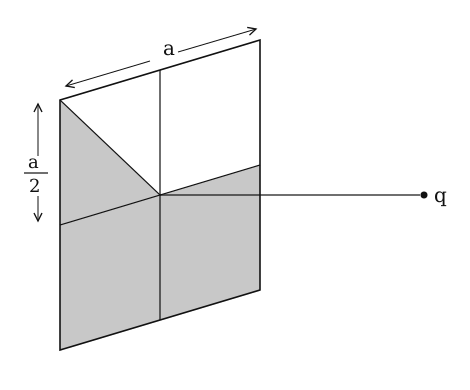
m भुजाओं वाला एक वर्गाकार लूप, बिंदु आवेश
C के सम्मुख अभिलंबवत रखा गया है। छायांकित क्षेत्र से विद्युत क्षेत्र का फ्लक्स
है, जहाँ
का मान _____ है।
Show answer
Concept: The charge sits on the axis at a distance from the centre of the square, so the square is one face of a cube of side with at its centre; by Gauss's law each face carries flux .
- Flux through the whole square face: .
- The two midlines and the diagonal divide the face symmetrically: each quadrant carries , and the diagonal through the corner splits a quadrant into two equal-flux triangles of each (the plane containing the diagonal and the axis is a symmetry plane).
- Shaded region = two full quadrants + one half-quadrant triangle (with C).
- Comparing with : .
Answer: 48
अवधारणा: आवेश, वर्ग के केंद्र से दूरी पर अक्ष पर स्थित है, अतः वर्ग, भुजा वाले उस घन का एक फलक है जिसके केंद्र पर है; गाउस के नियम से प्रत्येक फलक से फ्लक्स होता है।
- पूरे वर्गाकार फलक से फ्लक्स: ।
- दोनों मध्य-रेखाएँ तथा विकर्ण फलक को सममित भागों में बाँटते हैं: प्रत्येक चौथाई भाग से , और कोने से जाने वाला विकर्ण एक चौथाई भाग को वाले दो समान-फ्लक्स त्रिभुजों में बाँटता है (विकर्ण और अक्ष वाला तल सममिति तल है)।
- छायांकित क्षेत्र = दो पूर्ण चौथाई भाग + एक अर्ध-चौथाई त्रिभुज ( C के साथ)।
- से तुलना करने पर: ।
उत्तर: 48
JEE Main 2025 (January) – Paper 1 (B.E./B.Tech)PhysicsElectric Charges and Fields – Gauss's lawJEE Main 2025 (January) – Paper 1 (B.E./B.Tech) 2025 · 24 Jan Shift 1
Q148.The temperature of 1 mole of an ideal monoatomic gas is increased by C at constant pressure. The total heat added and change in internal energy are and , respectively. If then the value of is _____
1 मोल आदर्श एकपरमाणुक गैस का ताप, नियत दाब पर C बढ़ाया जाता है। दी गई कुल ऊष्मा तथा आंतरिक ऊर्जा में परिवर्तन क्रमशः तथा हैं। यदि हो, तो का मान _____ है
Show answer
Concept: At constant pressure ; the internal energy change is always . For a monoatomic gas , .
Answer: 15
अवधारणा: नियत दाब पर ; आंतरिक ऊर्जा में परिवर्तन सदैव होता है। एकपरमाणुक गैस के लिए , ।
उत्तर: 15
JEE Main 2025 (January) – Paper 1 (B.E./B.Tech)PhysicsThermodynamics – specific heats of gasesJEE Main 2025 (January) – Paper 1 (B.E./B.Tech) 2025 · 24 Jan Shift 1
Q149.The least count of a screw guage is 0.01 mm. If the pitch is increased by 75% and number of divisions on the circular scale is reduced by 50%, the new least count will be _____ mm
एक स्क्रू गेज का अल्पतमांक 0.01 mm है। यदि चूड़ी अंतराल (pitch) 75% बढ़ा दिया जाए और वृत्ताकार पैमाने पर भागों की संख्या 50% घटा दी जाए, तो नया अल्पतमांक _____ mm होगा
Show answer
Concept: Least count of a screw gauge .
- New pitch ; new number of divisions .
- New least count mm
- mm mm
Answer: 35
अवधारणा: स्क्रू गेज का अल्पतमांक ।
- नया चूड़ी अंतराल ; भागों की नई संख्या ।
- नया अल्पतमांक mm
- mm mm
उत्तर: 35
JEE Main 2025 (January) – Paper 1 (B.E./B.Tech)PhysicsUnits and Measurements – screw gaugeJEE Main 2025 (January) – Paper 1 (B.E./B.Tech) 2025 · 24 Jan Shift 1
Q150.A wire of resistance 9 is bent to form an equilateral triangle. Then the equivalent resistance across any two vertices will be _____ ohm.
9 प्रतिरोध के एक तार को मोड़कर समबाहु त्रिभुज बनाया जाता है। तब किन्हीं दो शीर्षों के बीच तुल्य प्रतिरोध _____ ओम होगा।
Show answer
Concept: Each side of the triangle has resistance ; across two vertices, one side is in parallel with the other two sides in series.
- Between two vertices: parallel to .
Answer: 2
अवधारणा: त्रिभुज की प्रत्येक भुजा का प्रतिरोध है; दो शीर्षों के बीच एक भुजा, शेष दो श्रेणीबद्ध भुजाओं के समांतर होती है।
- दो शीर्षों के बीच: समांतर ।
उत्तर: 2
JEE Main 2025 (January) – Paper 1 (B.E./B.Tech)PhysicsCurrent Electricity – equivalent resistanceJEE Main 2025 (January) – Paper 1 (B.E./B.Tech) 2025 · 24 Jan Shift 1
Q151.A galvanometer having a coil of resistance need 20 mA of current for full-scale deflection. If a maximum current of 3 A is to be measured using this galvanometer, the resistance of the shunt to be added to the galvanometer should be , where is
एक गैल्वेनोमीटर की कुंडली का प्रतिरोध है तथा पूर्ण स्केल विक्षेप के लिए इसमें 20 mA धारा चाहिए। यदि इस गैल्वेनोमीटर द्वारा अधिकतम 3 A धारा मापनी हो, तो गैल्वेनोमीटर के साथ जोड़े जाने वाले शंट (shunt) का प्रतिरोध होना चाहिए, जहाँ है
- A596
- B149
- C298
- D447
Show answer
Concept: To convert a galvanometer into an ammeter, a shunt is connected in parallel with it.
- , , .
- .
- , so comparing with , .
Short trick: — the shunt divides by where .
Answer: (B)
अवधारणा: गैल्वेनोमीटर को अमीटर में बदलने के लिए उसके समान्तर में शंट जोड़ा जाता है।
- , , ।
- ।
- , अतः से तुलना करने पर ।
शॉर्ट ट्रिक: — जहाँ , शंट को से भाग देता है।
उत्तर: (B)
JEE Main 2025 (January) – Paper 1 (B.E./B.Tech)PhysicsCurrent Electricity – galvanometer and shuntJEE Main 2025 (January) – Paper 1 (B.E./B.Tech) 2025 · 23 Jan Shift 2
Q152.A ball having kinetic energy KE, is projected at an angle of from the horizontal. What will be the kinetic energy of ball at the highest point of its flight ?
गतिज ऊर्जा KE वाली एक गेंद क्षैतिज से कोण पर प्रक्षेपित की जाती है। उड़ान के उच्चतम बिंदु पर गेंद की गतिज ऊर्जा क्या होगी?
- A
- B
- C
- D
Show answer
Concept: At the highest point only the horizontal component of the velocity survives, so .
- At the top, .
- .
Short trick: .
Answer: (D)
अवधारणा: उच्चतम बिंदु पर वेग का केवल क्षैतिज घटक शेष रहता है, अतः ।
- उच्चतम बिंदु पर ।
- ।
शॉर्ट ट्रिक: ।
उत्तर: (D)
JEE Main 2025 (January) – Paper 1 (B.E./B.Tech)PhysicsKinematics – projectile motionJEE Main 2025 (January) – Paper 1 (B.E./B.Tech) 2025 · 23 Jan Shift 2
Q153.Two charges and are placed at and respectively. Given, , the electrostatic potential energy of the charge configuration is :
दो आवेश तथा क्रमशः तथा पर रखे हैं। दिया है, । इस आवेश विन्यास की स्थिरवैद्युत स्थितिज ऊर्जा है :
- A-1.8 J
- B-2.0 J
- C-1.5 J
- D-1.2 J
Show answer
Concept: Potential energy of a two-charge system: .
- Separation .
- .
- .
Short trick: with a negative sign (unlike charges attract).
Answer: (A)
अवधारणा: दो आवेशों के निकाय की स्थितिज ऊर्जा: ।
- दूरी ।
- ।
- ।
शॉर्ट ट्रिक: , ऋणात्मक चिह्न के साथ (विपरीत आवेश आकर्षित होते हैं)।
उत्तर: (A)
JEE Main 2025 (January) – Paper 1 (B.E./B.Tech)PhysicsElectrostatics – potential energy of a system of chargesJEE Main 2025 (January) – Paper 1 (B.E./B.Tech) 2025 · 23 Jan Shift 2
Q154.Two point charges and , constituting an electric dipole, are placed at and in a uniform electric field of strength . The work done on the dipole in rotating it from the equilibrium through is :
एक विद्युत द्विध्रुव बनाने वाले दो बिंदु आवेश तथा , तीव्रता के एकसमान विद्युत क्षेत्र में तथा पर रखे हैं। द्विध्रुव को साम्यावस्था से घुमाने में द्विध्रुव पर किया गया कार्य है :
- A18.4 mJ
- B14.4 mJ
- C12.4 mJ
- D16.4 mJ
Show answer
Concept: Work done in rotating a dipole in a uniform field: ; from stable equilibrium () to , .
- Dipole moment .
- .
- .
Short trick: Equilibrium → always costs ; here mJ.
Answer: (B)
अवधारणा: एकसमान क्षेत्र में द्विध्रुव को घुमाने में किया गया कार्य: ; स्थायी साम्यावस्था () से तक ।
- द्विध्रुव आघूर्ण ।
- ।
- ।
शॉर्ट ट्रिक: साम्यावस्था → में सदैव कार्य लगता है; यहाँ mJ।
उत्तर: (B)
JEE Main 2025 (January) – Paper 1 (B.E./B.Tech)PhysicsElectrostatics – electric dipole in a uniform fieldJEE Main 2025 (January) – Paper 1 (B.E./B.Tech) 2025 · 23 Jan Shift 2
Q155.A massless spring gets elongated by amount under a tension of 5 N . Its elongation is under the tension of 7 N . For the elongation of , the tension in the spring will be,
एक द्रव्यमानहीन स्प्रिंग 5 N तनाव के अंतर्गत मात्रा से लंबी हो जाती है। 7 N तनाव के अंतर्गत इसका दीर्घीकरण (elongation) है। दीर्घीकरण के लिए स्प्रिंग में तनाव होगा,
- A39 N
- B15 N
- C11 N
- D20 N
Show answer
Concept: For an ideal spring, tension (Hooke's law), so tensions superpose linearly with elongations.
- and .
- Required tension .
- .
Short trick: Replace each directly by its force: N.
Answer: (C)
अवधारणा: आदर्श स्प्रिंग के लिए तनाव (हुक का नियम), अतः तनाव दीर्घीकरण के साथ रैखिक रूप से जुड़ते हैं।
- तथा ।
- अभीष्ट तनाव ।
- ।
शॉर्ट ट्रिक: प्रत्येक के स्थान पर सीधे उसका बल रखिए: N।
उत्तर: (C)
JEE Main 2025 (January) – Paper 1 (B.E./B.Tech)PhysicsElasticity – Hooke's law for a springJEE Main 2025 (January) – Paper 1 (B.E./B.Tech) 2025 · 23 Jan Shift 2
Q156.Water of mass gram is slowly heated to increase the temperature from to . The change in entropy of the water, given specific heat of water is , is :
ग्राम द्रव्यमान के जल को धीरे-धीरे गर्म करके उसका ताप से किया जाता है। जल की एन्ट्रॉपी (entropy) में परिवर्तन, जबकि जल की विशिष्ट ऊष्मा है, होगा :
- A
- Bzeroशून्य
- C
- D
Show answer
Concept: For reversible (slow) heating, .
- .
- With the given specific heat (in the stated units), .
- Entropy increases on heating (), so (B) and (C) are ruled out; (D) would follow only if , which ignores division by .
Short trick: Slow heating at variable always gives the logarithmic form .
Answer: (A)
अवधारणा: उत्क्रमणीय (धीमे) तापन के लिए ।
- ।
- दी गई विशिष्ट ऊष्मा (दिए गए मात्रकों में) रखने पर ।
- गर्म करने पर एन्ट्रॉपी बढ़ती है (), अतः (B) तथा (C) असंभव हैं; (D) तभी आता जब होता, जिसमें से भाग छूट गया है।
शॉर्ट ट्रिक: परिवर्ती ताप पर धीमे तापन में सदैव लघुगणकीय रूप आता है।
उत्तर: (A)
JEE Main 2025 (January) – Paper 1 (B.E./B.Tech)PhysicsThermodynamics – entropy changeJEE Main 2025 (January) – Paper 1 (B.E./B.Tech) 2025 · 23 Jan Shift 2
Q157.Water flows in a horizontal pipe whose one end is closed with a valve. The reading of the pressure gauge attached to the pipe is . The reading of the pressure gauge falls to when the valve is opened. The speed of water flowing in the pipe is proportional to
एक क्षैतिज पाइप, जिसका एक सिरा वाल्व से बंद है, में जल बहता है। पाइप से जुड़े दाबमापी (pressure gauge) का पाठ्यांक है। वाल्व खोलने पर दाबमापी का पाठ्यांक गिरकर हो जाता है। पाइप में बहते जल की चाल अनुक्रमानुपाती है
- A
- B
- C
- D
Show answer
Concept: Bernoulli's equation for a horizontal pipe: .
- Valve closed: water at rest, gauge reads static pressure .
- Valve open: .
- .
Short trick: Pressure drop converts to kinetic energy: .
Answer: (D)
अवधारणा: क्षैतिज पाइप के लिए बरनूली समीकरण: ।
- वाल्व बंद: जल स्थिर है, दाबमापी स्थैतिक दाब दर्शाता है।
- वाल्व खुला: ।
- ।
शॉर्ट ट्रिक: दाब में कमी गतिज ऊर्जा में बदलती है: ।
उत्तर: (D)
JEE Main 2025 (January) – Paper 1 (B.E./B.Tech)PhysicsFluid Mechanics – Bernoulli's principleJEE Main 2025 (January) – Paper 1 (B.E./B.Tech) 2025 · 23 Jan Shift 2
Q158.A concave mirror of focal length in air is dipped in a liquid of refractive index . Its focal length in the liquid will be:
वायु में फोकस दूरी वाले एक अवतल दर्पण को अपवर्तनांक के द्रव में डुबोया जाता है। द्रव में इसकी फोकस दूरी होगी:
- A
- B
- C
- D
Show answer
Concept: A mirror works by reflection, and the law of reflection does not depend on the surrounding medium.
- For a mirror, , which involves only the geometry (radius of curvature ).
- Dipping in a liquid changes neither nor the law of reflection, so is unchanged.
- Options (A), (C), (D) would apply to lenses (refraction), not to mirrors.
Short trick: Mirror formulae never contain — focal length of a mirror is medium-independent.
Answer: (B)
अवधारणा: दर्पण परावर्तन से कार्य करता है, और परावर्तन का नियम माध्यम पर निर्भर नहीं करता।
- दर्पण के लिए , जो केवल ज्यामिति (वक्रता त्रिज्या ) पर निर्भर है।
- द्रव में डुबोने से न बदलता है न परावर्तन का नियम, अतः अपरिवर्तित रहती है।
- विकल्प (A), (C), (D) लेंस (अपवर्तन) पर लागू होते, दर्पण पर नहीं।
शॉर्ट ट्रिक: दर्पण के सूत्रों में कभी नहीं आता — दर्पण की फोकस दूरी माध्यम से स्वतंत्र होती है।
उत्तर: (B)
JEE Main 2025 (January) – Paper 1 (B.E./B.Tech)PhysicsRay Optics – mirrorsJEE Main 2025 (January) – Paper 1 (B.E./B.Tech) 2025 · 23 Jan Shift 2
Q159.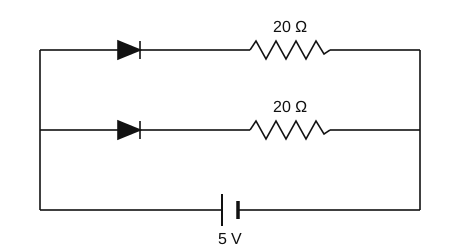
What is the current through the battery in the circuit shown below
नीचे दर्शाए गए परिपथ में बैटरी से प्रवाहित धारा क्या है
- A1.5 A
- B0.5 A
- C0.25 A
- D1.0 A
Show answer
Concept: An ideal diode conducts (zero resistance) when forward biased and blocks when reverse biased.
- Both diodes point in the direction of conventional current driven by the 5 V battery, so both are forward biased and act as plain wires.
- The two resistors are then in parallel: .
- .
Short trick: Both branches conduct → two equal resistors in parallel halve the resistance.
Answer: (B)
अवधारणा: आदर्श डायोड अग्र अभिनत (forward biased) होने पर चालन करता है (शून्य प्रतिरोध) तथा पश्च अभिनत होने पर धारा रोकता है।
- दोनों डायोड 5 V बैटरी द्वारा चलाई गई पारंपरिक धारा की दिशा में हैं, अतः दोनों अग्र अभिनत हैं और सीधे तार की तरह व्यवहार करते हैं।
- तब दोनों प्रतिरोध समान्तर क्रम में हैं: ।
- ।
शॉर्ट ट्रिक: दोनों शाखाएँ चालन करती हैं → दो समान प्रतिरोध समान्तर में प्रतिरोध आधा कर देते हैं।
उत्तर: (B)
JEE Main 2025 (January) – Paper 1 (B.E./B.Tech)PhysicsSemiconductors – diode circuitsJEE Main 2025 (January) – Paper 1 (B.E./B.Tech) 2025 · 23 Jan Shift 2
Q160.The refractive index of the material of a glass prism is . The angle of minimum deviation is equal to the angle of the prism. What is the angle of the prism?
एक काँच के प्रिज़्म के पदार्थ का अपवर्तनांक है। न्यूनतम विचलन कोण, प्रिज़्म कोण के बराबर है। प्रिज़्म का कोण क्या है?
- A
- B
- C
- D
Show answer
Concept: Prism formula: .
- Given : .
- .
- .
Short trick: When , ; (a standard result).
Answer: (A)
अवधारणा: प्रिज़्म सूत्र: ।
- दिया है : ।
- ।
- ।
शॉर्ट ट्रिक: जब हो तो ; (मानक परिणाम)।
उत्तर: (A)
JEE Main 2025 (January) – Paper 1 (B.E./B.Tech)PhysicsRay Optics – prismJEE Main 2025 (January) – Paper 1 (B.E./B.Tech) 2025 · 23 Jan Shift 2

