Q161.Given below are two statements about X-ray spectra of elements :
Statement (I) : A plot of ( = frequency of X-rays emitted) vs atomic mass is a straight line.
Statement (II) : A plot of ( = frequency of X-rays emitted) vs atomic number is a straight line.
In the light of the above statements, choose the correct answer from the options given below :
तत्वों के X-किरण स्पेक्ट्रम के बारे में नीचे दो कथन दिए गए हैं :
कथन (I) : ( = उत्सर्जित X-किरणों की आवृत्ति) बनाम परमाणु द्रव्यमान का आलेख एक सरल रेखा है।
कथन (II) : ( = उत्सर्जित X-किरणों की आवृत्ति) बनाम परमाणु क्रमांक का आलेख एक सरल रेखा है।
उपर्युक्त कथनों के आलोक में, नीचे दिए गए विकल्पों में से सही उत्तर चुनिए :
- ABoth Statement I and Statement II are trueकथन I तथा कथन II दोनों सत्य हैं
- BStatement I is false but Statement II is trueकथन I असत्य है परन्तु कथन II सत्य है
- CBoth Statement I and Statement II are falseकथन I तथा कथन II दोनों असत्य हैं
- DStatement I is true but Statement II is falseकथन I सत्य है परन्तु कथन II असत्य है
Show answer
Concept: Moseley's law: – the square root of the frequency of characteristic X-rays varies linearly with the atomic number Z, not with atomic mass.
- Statement I plots against atomic mass: Moseley showed that it is the atomic number, not the mass, that gives a straight line – Statement I is false.
- Statement II plots (not ) against Z: since , this plot is a parabola, not a straight line – Statement II is false.
- Hence both statements are false.
Short trick: Only vs Z is linear; any other combination (mass, or v itself) is not.
Answer: (C)
अवधारणा: मोज़ले का नियम: – अभिलाक्षणिक X-किरणों की आवृत्ति का वर्गमूल परमाणु क्रमांक Z के साथ रैखिक बदलता है, परमाणु द्रव्यमान के साथ नहीं।
- कथन I में को परमाणु द्रव्यमान के विरुद्ध आलेखित किया गया है: मोज़ले ने दिखाया कि सरल रेखा परमाणु क्रमांक से मिलती है, द्रव्यमान से नहीं – कथन I असत्य।
- कथन II में Z के विरुद्ध ( नहीं) है: चूँकि , यह आलेख परवलय है, सरल रेखा नहीं – कथन II असत्य।
- अतः दोनों कथन असत्य हैं।
शॉर्ट ट्रिक: केवल बनाम Z रैखिक है; अन्य कोई संयोजन (द्रव्यमान या स्वयं v) नहीं।
उत्तर: (C)
JEE Main 2025 (January) – Paper 1 (B.E./B.Tech)ChemistryAtomic Structure – Moseley's lawJEE Main 2025 (January) – Paper 1 (B.E./B.Tech) 2025 · 23 Jan Shift 2
Q162.Identify A, B and C in the given below reaction sequence
A Pb(NO3)2 B C
नीचे दिए गए अभिक्रिया अनुक्रम में A, B तथा C को पहचानिए
A Pb(NO3)2 B C
- APbCl2, PbSO4, PbCrO4
- BPbS, PbSO4, Pb(CH3COO)2
- CPbCl2, Pb(SO4)2, PbCrO4
- DPbS, PbSO4, PbCrO4
Show answer
Concept: Classic lead chemistry: galena dissolves in HNO3; Pb2+ gives white PbSO4, which dissolves in ammonium acetate and finally precipitates yellow PbCrO4.
- A + HNO3 → Pb(NO3)2: the sulphide ore PbS dissolves in dilute HNO3, so A = PbS. (PbCl2 would introduce chloride, not match this step's typical use.)
- Pb(NO3)2 + H2SO4 → PbSO4 (white ppt.), so B = PbSO4; lead is +2, so Pb(SO4)2 of (C) is wrong.
- PbSO4 dissolves in ammonium acetate (soluble lead acetate forms in acetic acid medium) and K2CrO4 then precipitates yellow PbCrO4, so C = PbCrO4 – (B) stops at the acetate and misses the final product.
Short trick: PbS → Pb(NO3)2 → PbSO4 → (acetate) → PbCrO4 (yellow) is the standard confirmatory chain for Pb2+.
Answer: (D)
अवधारणा: लेड की प्रसिद्ध रसायन: गैलेना HNO3 में घुलता है; Pb2+ सफेद PbSO4 देता है, जो अमोनियम ऐसीटेट में घुलकर अंत में पीला PbCrO4 अवक्षेपित करता है।
- A + HNO3 → Pb(NO3)2: सल्फाइड अयस्क PbS तनु HNO3 में घुल जाता है, अतः A = PbS। (PbCl2 से क्लोराइड आता, जो इस चरण से मेल नहीं खाता।)
- Pb(NO3)2 + H2SO4 → PbSO4 (सफेद अवक्षेप), अतः B = PbSO4; लेड +2 में है, अतः (C) का Pb(SO4)2 गलत है।
- PbSO4 अमोनियम ऐसीटेट में घुल जाता है (ऐसीटिक अम्ल माध्यम में विलेय लेड ऐसीटेट बनता है) और फिर K2CrO4 पीला PbCrO4 अवक्षेपित करता है, अतः C = PbCrO4 – (B) ऐसीटेट पर ही रुककर अंतिम उत्पाद छोड़ देता है।
शॉर्ट ट्रिक: PbS → Pb(NO3)2 → PbSO4 → (ऐसीटेट) → PbCrO4 (पीला) Pb2+ की मानक पुष्टि शृंखला है।
उत्तर: (D)
JEE Main 2025 (January) – Paper 1 (B.E./B.Tech)Chemistryp-Block / Qualitative analysis – compounds of leadJEE Main 2025 (January) – Paper 1 (B.E./B.Tech) 2025 · 23 Jan Shift 2
Q163.Given below are two statements :
Statement (I) : The boiling points of alcohols and phenols increase with increase in the number of C-atoms.
Statement (II) : The boiling points of alcohols and phenols are higher in comparison to other class of compounds such as ethers, haloalkanes.
In the light of the above statements, choose the correct answer from the options given below :
नीचे दो कथन दिए गए हैं :
कथन (I) : ऐल्कोहॉलों तथा फ़िनॉलों के क्वथनांक C-परमाणुओं की संख्या बढ़ने के साथ बढ़ते हैं।
कथन (II) : ऐल्कोहॉलों तथा फ़िनॉलों के क्वथनांक ईथर, हैलोऐल्केन जैसे अन्य वर्गों के यौगिकों की तुलना में उच्च होते हैं।
उपर्युक्त कथनों के आलोक में, नीचे दिए गए विकल्पों में से सही उत्तर चुनिए :
- ABoth Statement I and Statement II are falseकथन I तथा कथन II दोनों असत्य हैं
- BBoth Statement I and Statement II are trueकथन I तथा कथन II दोनों सत्य हैं
- CStatement I is false but Statement II is trueकथन I असत्य है परन्तु कथन II सत्य है
- DStatement I is true but Statement II is falseकथन I सत्य है परन्तु कथन II असत्य है
Show answer
Concept: Boiling point rises with molecular size (van der Waals forces) and is specially high where intermolecular hydrogen bonding exists.
- With more C-atoms the surface area and van der Waals attraction increase, so b.p. of alcohols and phenols increases with the number of carbons – Statement I is true.
- The –OH group forms strong intermolecular H-bonds; ethers and haloalkanes of comparable molar mass cannot H-bond among themselves, so alcohols/phenols boil much higher – Statement II is true.
- Therefore both statements are correct.
Short trick: H-bonding (–OH) > dipole (C–X, C–O–C) > dispersion: that single order settles both statements.
Answer: (B)
अवधारणा: क्वथनांक आण्विक आकार (वान्डरवाल्स बल) के साथ बढ़ता है और अंतराआण्विक हाइड्रोजन बंधन होने पर विशेष रूप से उच्च होता है।
- C-परमाणु बढ़ने पर पृष्ठीय क्षेत्रफल व वान्डरवाल्स आकर्षण बढ़ते हैं, अतः ऐल्कोहॉलों व फ़िनॉलों का क्वथनांक कार्बन संख्या के साथ बढ़ता है – कथन I सत्य।
- –OH समूह प्रबल अंतराआण्विक H-बंध बनाता है; तुलनीय मोलर द्रव्यमान के ईथर व हैलोऐल्केन आपस में H-बंध नहीं बना सकते, अतः ऐल्कोहॉल/फ़िनॉल बहुत उच्च ताप पर उबलते हैं – कथन II सत्य।
- अतः दोनों कथन सही हैं।
शॉर्ट ट्रिक: H-बंधन (–OH) > द्विध्रुव (C–X, C–O–C) > परिक्षेपण: यही क्रम दोनों कथन तय कर देता है।
उत्तर: (B)
JEE Main 2025 (January) – Paper 1 (B.E./B.Tech)ChemistryAlcohols & Phenols – boiling pointsJEE Main 2025 (January) – Paper 1 (B.E./B.Tech) 2025 · 23 Jan Shift 2
Q164.Consider a binary solution of two volatile liquid components 1 and 2. and are the mole fractions of component 1 in liquid and vapour phase, respectively. The slope and intercept of the linear plot of vs are given respectively as:
दो वाष्पशील द्रव घटकों 1 तथा 2 के एक द्विअंगी विलयन पर विचार कीजिए। तथा क्रमशः द्रव तथा वाष्प प्रावस्था में घटक 1 के मोल अंश हैं। बनाम के रैखिक आलेख की प्रवणता (slope) तथा अंतःखंड (intercept) क्रमशः हैं:
- A
- B
- C
- D
Show answer
Concept: Dalton + Raoult: ; rearrange into a straight line in and .
- .
- Solve for : .
- So slope and intercept .
- (C) has the sign of the intercept reversed, while (A) and (D) invert the slope.
Short trick: With on the y-axis the slope must contain on top (swap of the familiar -form).
Answer: (B)
अवधारणा: डाल्टन + राउल्ट: ; इसे तथा में सरल रेखा के रूप में लिखिए।
- ।
- के लिए हल करने पर: ।
- अतः प्रवणता तथा अंतःखंड ।
- (C) में अंतःखंड का चिह्न उल्टा है, जबकि (A) व (D) में प्रवणता उलटी है।
शॉर्ट ट्रिक: जब y-अक्ष पर हो तो प्रवणता के अंश में आना चाहिए।
उत्तर: (B)
JEE Main 2025 (January) – Paper 1 (B.E./B.Tech)ChemistrySolutions – Raoult's law for two volatile liquidsJEE Main 2025 (January) – Paper 1 (B.E./B.Tech) 2025 · 23 Jan Shift 2
Q165.The ascending order of relative rate of solvolysis of following compounds is :
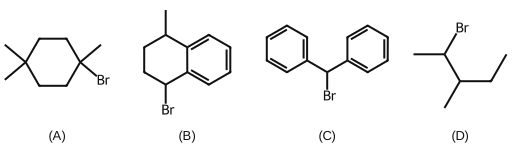
निम्नलिखित यौगिकों की विलेय-अपघटन (solvolysis) की आपेक्षिक दर का आरोही क्रम है :
- A(C) < (B) < (A) < (D)
- B(D) < (A) < (B) < (C)
- C(D) < (B) < (A) < (C)
- D(C) < (D) < (B) < (A)
Show answer
Concept: Solvolysis follows the SN1 path, so the rate is governed by the stability of the carbocation formed on ionisation of C–Br.
- (C) Ph2CHBr ionises to the benzhydryl cation Ph2CH+, stabilised by resonance with two benzene rings – fastest.
- (B) gives a secondary benzylic carbocation (resonance with one ring) – next fastest.
- (A) gives a simple tertiary alkyl carbocation (only hyperconjugation/induction) – slower than benzylic.
- (D) 2-bromo-3-methylpentane gives an ordinary secondary alkyl carbocation – slowest.
- Ascending order: (D) < (A) < (B) < (C).
Short trick: Cation stability: dibenzylic > monobenzylic > 3° alkyl > 2° alkyl – solvolysis rate follows the same order.
Answer: (B)
अवधारणा: विलेय-अपघटन SN1 पथ से होता है, अतः दर C–Br के आयनन से बने कार्बधनायन के स्थायित्व से निर्धारित होती है।
- (C) Ph2CHBr आयनित होकर बेंज़हाइड्रिल धनायन Ph2CH+ देता है, जो दो बेंज़ीन वलयों के अनुनाद से स्थायी है – सबसे तीव्र।
- (B) द्वितीयक बेंज़िलिक कार्बधनायन देता है (एक वलय से अनुनाद) – उससे धीमा।
- (A) साधारण तृतीयक ऐल्किल कार्बधनायन देता है (केवल अतिसंयुग्मन/प्रेरणिक प्रभाव) – बेंज़िलिक से धीमा।
- (D) 2-ब्रोमो-3-मेथिलपेन्टेन साधारण द्वितीयक ऐल्किल कार्बधनायन देता है – सबसे धीमा।
- आरोही क्रम: (D) < (A) < (B) < (C)।
शॉर्ट ट्रिक: धनायन स्थायित्व: द्विबेंज़िलिक > एकबेंज़िलिक > 3° ऐल्किल > 2° ऐल्किल – विलेय-अपघटन दर भी यही क्रम।
उत्तर: (B)
JEE Main 2025 (January) – Paper 1 (B.E./B.Tech)ChemistryHaloalkanes & Haloarenes – SN1 solvolysisJEE Main 2025 (January) – Paper 1 (B.E./B.Tech) 2025 · 23 Jan Shift 2
Q166.Match List - I with List - II.
| List - I | List - II |
|---|
| (A) | Bronze | (I) | Cu, Ni |
| (B) | Brass | (II) | Fe, Cr, Ni, C |
| (C) | UK silver coin | (III) | Cu, Zn |
| (D) | Stainless steel | (IV) | Cu, Sn |
Choose the correct answer from the options given below :
सूची-I का सूची-II से मिलान कीजिए।
| सूची - I | सूची - II |
|---|
| (A) | काँसा (Bronze) | (I) | Cu, Ni |
| (B) | पीतल (Brass) | (II) | Fe, Cr, Ni, C |
| (C) | UK चाँदी का सिक्का | (III) | Cu, Zn |
| (D) | स्टेनलेस स्टील | (IV) | Cu, Sn |
नीचे दिए गए विकल्पों में से सही उत्तर चुनिए :
- A(A)-(IV), (B)-(II), (C)-(III), (D)-(I)
- B(A)-(IV), (B)-(III), (C)-(I), (D)-(II)
- C(A)-(III), (B)-(IV), (C)-(II), (D)-(I)
- D(A)-(III), (B)-(I), (C)-(IV), (D)-(II)
Show answer
Concept: Compositions of common alloys.
- (A) Bronze = copper + tin → (IV) Cu, Sn.
- (B) Brass = copper + zinc → (III) Cu, Zn.
- (C) Modern UK “silver” coins are cupronickel = copper + nickel → (I) Cu, Ni.
- (D) Stainless steel = iron with chromium, nickel and carbon → (II) Fe, Cr, Ni, C.
- The other options swap bronze/brass or coin/steel compositions, which contradicts these standard formulations.
Short trick: Bronze–tin, brass–zinc; coins are cupronickel.
Answer: (B)
अवधारणा: सामान्य मिश्रातुओं का संघटन।
- (A) काँसा = ताँबा + टिन → (IV) Cu, Sn।
- (B) पीतल = ताँबा + जस्ता → (III) Cu, Zn।
- (C) आधुनिक UK “चाँदी” के सिक्के क्यूप्रोनिकल = ताँबा + निकल → (I) Cu, Ni।
- (D) स्टेनलेस स्टील = लोहा + क्रोमियम, निकल व कार्बन → (II) Fe, Cr, Ni, C।
- अन्य विकल्प काँसा/पीतल या सिक्का/स्टील के संघटन आपस में बदल देते हैं, जो मानक संघटनों के विरुद्ध है।
शॉर्ट ट्रिक: काँसा–टिन, पीतल–जस्ता; सिक्के क्यूप्रोनिकल होते हैं।
उत्तर: (B)
JEE Main 2025 (January) – Paper 1 (B.E./B.Tech)ChemistryGeneral Principles of Metallurgy – alloysJEE Main 2025 (January) – Paper 1 (B.E./B.Tech) 2025 · 23 Jan Shift 2
Q167.Match List - I with List - II.
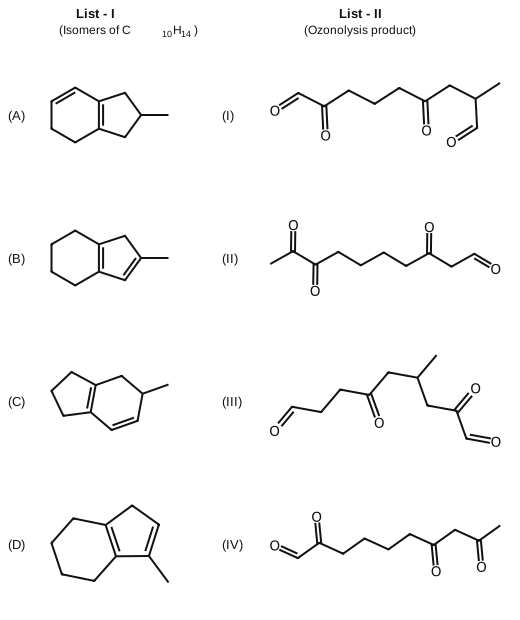
Choose the correct answer from the options given below :
सूची-I का सूची-II से मिलान कीजिए।
नीचे दिए गए विकल्पों में से सही उत्तर चुनिए :
- A(A)-(I), (B)-(IV), (C)-(III), (D)-(II)
- B(A)-(III), (B)-(II), (C)-(I), (D)-(IV)
- C(A)-(III), (B)-(IV), (C)-(I), (D)-(II)
- D(A)-(II), (B)-(III), (C)-(I), (D)-(IV)
Show answer
Concept: Ozonolysis cleaves every C=C into two C=O groups. Each bicyclic diene has one C=C at the ring fusion (tetra-substituted → two ketone carbons) and one C=C in a ring; opening both rings gives a single chain with four carbonyls, whose pattern identifies the parent diene.
- (A): the methyl sits on the saturated CH2–CH(CH3)–CH2 part of the five-membered ring and the second C=C (CH=CH) is in the six-membered ring → chain OHC–CH2CH2–CO–CH2–CH(CH3)–CH2–CO–CHO = (III).
- (B): the 5-ring C=C carries the methyl on the carbon away from the fusion → cleavage gives a CH3CO–CH2– end and an OHC–CO– end: OHC–CO–(CH2)4–CO–CH2–COCH3 = (IV).
- (C): both C=C lie in the six-membered ring (fusion + CH=CH) with the methyl on the sp3 CH → OHC–CH(CH3)–CH2–CO–(CH2)3–CO–CHO = (I).
- (D): the methyl is on the 5-ring alkene carbon attached to the fusion → CH3–CO–CO– end: CH3CO–CO–(CH2)4–CO–CH2–CHO = (II).
- Thus (A)-(III), (B)-(IV), (C)-(I), (D)-(II); the other combinations pair at least one diene with a product whose carbonyl pattern (position of CH3 and of the –CO–CHO/–CO–COCH3 ends) cannot arise from it.
Short trick: A methyl on a double-bond carbon ends up α to a C=O (methyl ketone / α-diketone); a methyl on an sp3 carbon stays as a CH(CH3) inside the chain.
Answer: (C)
अवधारणा: ओज़ोनी अपघटन प्रत्येक C=C को दो C=O में तोड़ देता है। प्रत्येक द्विचक्रीय डाईन में एक C=C वलय-संधि पर (चतुःप्रतिस्थापित → दो कीटोन कार्बन) तथा एक C=C किसी वलय में है; दोनों वलय खुलने पर चार कार्बोनिल वाली एक शृंखला बनती है, जिसका प्रारूप मूल डाईन की पहचान कराता है।
- (A): मेथिल पाँच-सदस्यीय वलय के संतृप्त CH2–CH(CH3)–CH2 भाग पर है और दूसरा C=C (CH=CH) छह-सदस्यीय वलय में है → शृंखला OHC–CH2CH2–CO–CH2–CH(CH3)–CH2–CO–CHO = (III)।
- (B): 5-वलय के C=C पर मेथिल संधि से दूर वाले कार्बन पर है → विदलन से एक सिरा CH3CO–CH2– तथा दूसरा OHC–CO– बनता है: OHC–CO–(CH2)4–CO–CH2–COCH3 = (IV)।
- (C): दोनों C=C छह-सदस्यीय वलय में हैं (संधि + CH=CH) और मेथिल sp3 CH पर है → OHC–CH(CH3)–CH2–CO–(CH2)3–CO–CHO = (I)।
- (D): मेथिल 5-वलय के उस ऐल्कीन कार्बन पर है जो संधि से जुड़ा है → CH3–CO–CO– सिरा: CH3CO–CO–(CH2)4–CO–CH2–CHO = (II)।
- अतः (A)-(III), (B)-(IV), (C)-(I), (D)-(II); शेष संयोजनों में कम-से-कम एक डाईन ऐसे उत्पाद से जोड़ी गई है जिसका कार्बोनिल प्रारूप (CH3 तथा –CO–CHO/–CO–COCH3 सिरों की स्थिति) उससे नहीं बन सकता।
शॉर्ट ट्रिक: द्विबंध कार्बन पर बैठा मेथिल C=O के α पर पहुँचता है (मेथिल कीटोन / α-डाइकीटोन); sp3 कार्बन का मेथिल शृंखला के भीतर CH(CH3) ही रहता है।
उत्तर: (C)
JEE Main 2025 (January) – Paper 1 (B.E./B.Tech)ChemistryHydrocarbons – ozonolysis of alkenesJEE Main 2025 (January) – Paper 1 (B.E./B.Tech) 2025 · 23 Jan Shift 2
Q168.pH of water is 7 at 25∘C. If water is heated to 80∘C., it's pH will :
25∘C पर जल का pH 7 है। यदि जल को 80∘C तक गर्म किया जाए, तो इसका pH :
- ADecreaseघटेगा
- BH+ concentration increases, OH− concentration decreasesH+ सांद्रता बढ़ेगी, OH− सांद्रता घटेगी
- CRemains the sameसमान रहेगा
- DIncreaseबढ़ेगा
Show answer
Concept: Self-ionisation of water is endothermic, so Kw increases with temperature.
- At 80 °C, Kw > 10−14, so [H+] = [OH−] = √Kw > 10−7 M.
- pH = −log[H+] therefore falls below 7, although the water is still neutral ([H+] = [OH−]).
- (B) is wrong because both ion concentrations increase equally; (C) and (D) contradict the increase of Kw.
Short trick: Hot water: neutral but pH < 7 – neutrality means equality of the two ions, not pH = 7.
Answer: (A)
अवधारणा: जल का स्व-आयनन ऊष्माशोषी है, अतः ताप बढ़ने पर Kw बढ़ता है।
- 80 °C पर Kw > 10−14, अतः [H+] = [OH−] = √Kw > 10−7 M।
- pH = −log[H+] इसलिए 7 से नीचे गिर जाता है, यद्यपि जल अब भी उदासीन है ([H+] = [OH−])।
- (B) गलत है क्योंकि दोनों आयनों की सांद्रता समान रूप से बढ़ती है; (C) व (D) Kw के बढ़ने के विरुद्ध हैं।
शॉर्ट ट्रिक: गर्म जल: उदासीन परन्तु pH < 7 – उदासीनता दोनों आयनों की समानता है, pH = 7 नहीं।
उत्तर: (A)
JEE Main 2025 (January) – Paper 1 (B.E./B.Tech)ChemistryIonic Equilibrium – ionic product of waterJEE Main 2025 (January) – Paper 1 (B.E./B.Tech) 2025 · 23 Jan Shift 2
Q169.Identify the coordination complexes in which the central metal ion has d4 configuration.
(A) [FeO4]2−
(B) [Mn(CN)6]3−
(C) [Fe(CN)6]3−
(D) Cr2(O−C(=O)−Me)4(H2O)2
(E) [NiF6]2−
Choose the correct answer from the options given below :
उन उपसहसंयोजन संकुलों को पहचानिए जिनमें केंद्रीय धातु आयन का d4 विन्यास है।
(A) [FeO4]2−
(B) [Mn(CN)6]3−
(C) [Fe(CN)6]3−
(D) Cr2(O−C(=O)−Me)4(H2O)2
(E) [NiF6]2−
नीचे दिए गए विकल्पों में से सही उत्तर चुनिए :
- A(B), (C) and (D) onlyकेवल (B), (C) तथा (D)
- B(C) and (E) onlyकेवल (C) तथा (E)
- C(B) and (D) onlyकेवल (B) तथा (D)
- D(A), (B) and (E) onlyकेवल (A), (B) तथा (E)
Show answer
Concept: Count d-electrons as (group number of metal) − (oxidation state).
- (A) [FeO4]2−: Fe is +6 → 3d2.
- (B) [Mn(CN)6]3−: Mn is +3 → 3d4. ✔
- (C) [Fe(CN)6]3−: Fe is +3 → 3d5.
- (D) Cr2(OOC–Me)4(H2O)2 (chromium(II) acetate): each acetate is −1, so Cr is +2 → 3d4. ✔
- (E) [NiF6]2−: Ni is +4 → 3d6.
- Only (B) and (D) are d4.
Short trick: Mn3+ and Cr2+ are the classic d4 ions.
Answer: (C)
अवधारणा: d-इलेक्ट्रॉन = (धातु की वर्ग संख्या) − (ऑक्सीकरण अवस्था)।
- (A) [FeO4]2−: Fe +6 → 3d2।
- (B) [Mn(CN)6]3−: Mn +3 → 3d4। ✔
- (C) [Fe(CN)6]3−: Fe +3 → 3d5।
- (D) Cr2(OOC–Me)4(H2O)2 (क्रोमियम(II) ऐसीटेट): प्रत्येक ऐसीटेट −1, अतः Cr +2 → 3d4। ✔
- (E) [NiF6]2−: Ni +4 → 3d6।
- केवल (B) तथा (D) d4 हैं।
शॉर्ट ट्रिक: Mn3+ तथा Cr2+ प्रसिद्ध d4 आयन हैं।
उत्तर: (C)
JEE Main 2025 (January) – Paper 1 (B.E./B.Tech)ChemistryCoordination Compounds – d-electron configurationJEE Main 2025 (January) – Paper 1 (B.E./B.Tech) 2025 · 23 Jan Shift 2
Q170.When a non-volatile solute is added to the solvent, the vapour pressure of the solvent decreases by 10 mm of Hg . The mole fraction of the solute in the solution is 0.2 . What would be the mole fraction of the solvent if decrease in vapour pressure is 20 mm of Hg ?
जब किसी विलायक में एक अवाष्पशील विलेय मिलाया जाता है, तो विलायक का वाष्प दाब 10 mm Hg घट जाता है। विलयन में विलेय का मोल अंश 0.2 है। यदि वाष्प दाब में कमी 20 mm Hg हो, तो विलायक का मोल अंश क्या होगा ?
- A0.8
- B0.4
- C0.2
- D0.6
Show answer
Concept: Relative lowering of vapour pressure: .
- First case: mm Hg.
- Second case: .
- Mole fraction of solvent .
Short trick: Doubling Δp doubles (0.2 → 0.4), so solvent fraction is 0.6.
Answer: (D)
अवधारणा: वाष्प दाब का आपेक्षिक अवनमन: ।
- पहली स्थिति: mm Hg।
- दूसरी स्थिति: ।
- विलायक का मोल अंश ।
शॉर्ट ट्रिक: Δp दुगुना → दुगुना (0.2 → 0.4), अतः विलायक अंश 0.6।
उत्तर: (D)
JEE Main 2025 (January) – Paper 1 (B.E./B.Tech)ChemistrySolutions – relative lowering of vapour pressureJEE Main 2025 (January) – Paper 1 (B.E./B.Tech) 2025 · 23 Jan Shift 2
Q171.0.01 mole of an organic compound (X) containing 10% hydrogen, on complete combustion produced 0.9 g H2O . Molar mass of (X) is _____ g mol−1.
10% हाइड्रोजन युक्त एक कार्बनिक यौगिक (X) के 0.01 मोल के पूर्ण दहन से 0.9 g H2O उत्पन्न हुआ। (X) का मोलर द्रव्यमान _____ g mol−1 है।
Show answer
Concept: All hydrogen of the compound appears in the water formed; combine it with the mass-percent of H.
- Moles of H2O mol → moles of H atoms mol → mass of H g.
- H is 10% of the compound: mass of X burnt g.
- This mass corresponds to 0.01 mol, so .
Short trick: g of H = g of H2O ÷ 9; then divide by the H-fraction and by the moles.
Answer: 100
अवधारणा: यौगिक का सारा हाइड्रोजन बने जल में जाता है; इसे H के द्रव्यमान-प्रतिशत से जोड़िए।
- H2O के मोल mol → H परमाणुओं के मोल mol → H का द्रव्यमान g।
- H यौगिक का 10% है: जले हुए X का द्रव्यमान g।
- यह द्रव्यमान 0.01 mol का है, अतः ।
शॉर्ट ट्रिक: H का ग्राम = H2O का ग्राम ÷ 9; फिर H-अंश व मोल से भाग दीजिए।
उत्तर: 100
JEE Main 2025 (January) – Paper 1 (B.E./B.Tech)ChemistrySome Basic Concepts – molar mass from combustion dataJEE Main 2025 (January) – Paper 1 (B.E./B.Tech) 2025 · 23 Jan Shift 2
Q172.A compound ' X ' absorbs 2 moles of hydrogen and ' X ' upon oxidation with KMnO4 | H+ gives
CH3−CO−CH3, CH3−CO−OH and CH3−CO−CH2CH2−CO−OH.
The total number of σ bonds present in the compound ' X ' is ______
एक यौगिक ' X ' हाइड्रोजन के 2 मोल अवशोषित करता है तथा ' X ' KMnO4 | H+ के साथ ऑक्सीकरण पर
CH3−CO−CH3, CH3−CO−OH तथा CH3−CO−CH2CH2−CO−OH देता है।
यौगिक ' X ' में उपस्थित σ बंधों की कुल संख्या ______ है।
Show answer
Concept: Two moles of H2 absorbed → two C=C; oxidative cleavage with KMnO4/H+ converts each doubly-bonded carbon into C=O (–COOH if it carried an H). Rebuild X by joining the fragments at their carbonyl carbons.
- CH3COCH3 comes from a (CH3)2C= end; CH3COOH from a CH3–CH= end; CH3CO–CH2CH2–COOH from the middle piece =C(CH3)–CH2CH2–CH=.
- Joining: X = (CH3)2C=C(CH3)–CH2CH2–CH=CH–CH3 (2,3-dimethylocta-2,6-diene), C10H18, which indeed adds 2 H2.
- σ count: C–C σ bonds (10 carbons, acyclic; each C=C contributes one σ) and C–H σ bonds .
- Total σ .
Short trick: For an acyclic CnHm molecule, σ bonds regardless of how many π bonds it has.
Answer: 27
अवधारणा: 2 मोल H2 अवशोषण → दो C=C; KMnO4/H+ से ऑक्सीकारी विदलन प्रत्येक द्विबंधित कार्बन को C=O (H होने पर –COOH) में बदलता है। खंडों को कार्बोनिल कार्बनों पर जोड़कर X बनाइए।
- CH3COCH3 (CH3)2C= सिरे से; CH3COOH CH3–CH= सिरे से; CH3CO–CH2CH2–COOH बीच वाले खंड =C(CH3)–CH2CH2–CH= से।
- जोड़ने पर: X = (CH3)2C=C(CH3)–CH2CH2–CH=CH–CH3 (2,3-डाइमेथिलऑक्टा-2,6-डाईन), C10H18, जो वास्तव में 2 H2 जोड़ता है।
- σ गणना: C–C σ बंध (10 कार्बन, अचक्रीय; प्रत्येक C=C में एक σ) तथा C–H σ बंध ।
- कुल σ ।
शॉर्ट ट्रिक: अचक्रीय CnHm अणु में σ बंध , π बंधों की संख्या चाहे जो हो।
उत्तर: 27
JEE Main 2025 (January) – Paper 1 (B.E./B.Tech)ChemistryOrganic Chemistry – structure elucidation and σ bondsJEE Main 2025 (January) – Paper 1 (B.E./B.Tech) 2025 · 23 Jan Shift 2
Q173.When 81.0 g of aluminium is allowed to react with 128.0 g of oxygen gas, the mass of aluminium oxide produced in grams is_______ - (Nearest integer) Given : Molar mass of Al is 27.0 g mol−1 Molar mass of O is 16.0 g mol−1
जब 81.0 g ऐलुमिनियम को 128.0 g ऑक्सीजन गैस के साथ अभिक्रिया करने दिया जाता है, तो उत्पन्न ऐलुमिनियम ऑक्साइड का द्रव्यमान (ग्राम में) _______ है। (निकटतम पूर्णांक) दिया है : Al का मोलर द्रव्यमान 27.0 g mol−1, O का मोलर द्रव्यमान 16.0 g mol−1
Show answer
Concept: ; find the limiting reagent, then the product mass.
- Moles: Al mol; O2 mol.
- 3 mol Al needs mol O2 (< 4 mol available) → Al is limiting.
- Al2O3 formed mol; .
- Mass g.
Short trick: Divide moles by coefficients (3/4 = 0.75 vs 4/3 = 1.33): smaller ratio (Al) limits.
Answer: 153
अवधारणा: ; सीमांत अभिकर्मक निकालकर उत्पाद का द्रव्यमान ज्ञात कीजिए।
- मोल: Al mol; O2 mol।
- 3 mol Al को mol O2 चाहिए (उपलब्ध 4 mol से कम) → Al सीमांत है।
- बना Al2O3 mol; ।
- द्रव्यमान g।
शॉर्ट ट्रिक: मोल ÷ गुणांक (3/4 = 0.75 बनाम 4/3 = 1.33): छोटा अनुपात (Al) सीमांत।
उत्तर: 153
JEE Main 2025 (January) – Paper 1 (B.E./B.Tech)ChemistryMole Concept – limiting reagentJEE Main 2025 (January) – Paper 1 (B.E./B.Tech) 2025 · 23 Jan Shift 2
Q174.The bond dissociation enthalpy of X2, calculated from the given data is ______ . (Nearest integer)
[Given : M+X− is a pure ionic compound and X forms a diatomic molecule X2 in gaseous state]
दिए गए आँकड़ों से परिकलित X2 की बंध वियोजन एन्थैल्पी ______ है। (निकटतम पूर्णांक)
[दिया है : M+X− एक शुद्ध आयनिक यौगिक है तथा X गैसीय अवस्था में द्विपरमाणुक अणु X2 बनाता है]
Show answer
Concept: Born–Haber cycle: (lattice enthalpy as given is for breaking the solid, so formation of the solid from gaseous ions contributes ).
- Substitute (all in kJ mol−1): .
- .
- .
Short trick: Only ½X2 is used, so the unknown enters as D/2 – don't forget to double at the end.
Answer: 200
अवधारणा: बॉर्न–हैबर चक्र: (दी गई जालक एन्थैल्पी ठोस तोड़ने की है, अतः गैसीय आयनों से ठोस बनने का योगदान )।
- मान रखिए (सभी kJ mol−1 में): ।
- ।
- ।
शॉर्ट ट्रिक: केवल ½X2 प्रयुक्त है, अतः अज्ञात D/2 के रूप में आता है – अंत में दुगुना करना न भूलिए।
उत्तर: 200
JEE Main 2025 (January) – Paper 1 (B.E./B.Tech)ChemistryThermochemistry – Born–Haber cycleJEE Main 2025 (January) – Paper 1 (B.E./B.Tech) 2025 · 23 Jan Shift 2
Q175.Consider the following sequence of reactions.
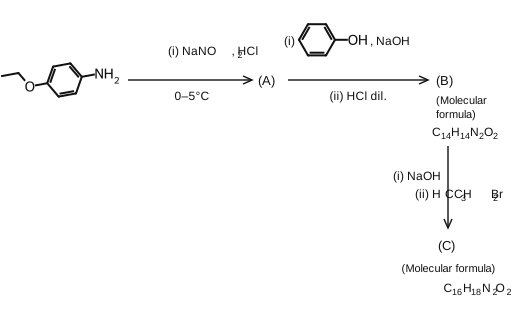
Total number of sp
3 hybridised carbon atoms in the major product C formed is________
निम्नलिखित अभिक्रिया अनुक्रम पर विचार कीजिए।
बने मुख्य उत्पाद C में sp
3 संकरित कार्बन परमाणुओं की कुल संख्या ________ है।
Show answer
Concept: Diazotisation → azo coupling with phenol → Williamson etherification of the phenolic –OH.
- 4-Ethoxyaniline + NaNO2/HCl at 0–5 °C gives the diazonium salt (A), 4-ethoxybenzenediazonium chloride.
- (A) couples with phenol in NaOH (coupling at the para position), and mild acidification gives the azo dye (B): 4-[(4-ethoxyphenyl)diazenyl]phenol, C14H14N2O2.
- (B) + NaOH forms the phenoxide, which reacts with CH3CH2Br (Williamson synthesis) to give (C): 1-ethoxy-4-[(4-ethoxyphenyl)diazenyl]benzene – both rings now carry –OC2H5; formula C16H18N2O2.
- In (C) the aromatic carbons and the –N=N– unit are sp2; the only sp3 carbons are the two –OCH2CH3 groups: .
Short trick: In an aromatic azo dye, count only the carbons of the alkoxy/alkyl chains for sp3.
Answer: 4
अवधारणा: डाइएज़ोटीकरण → फ़िनॉल के साथ ऐज़ो युग्मन → फ़िनॉलिक –OH का विलियमसन ईथरीकरण।
- 4-एथॉक्सीऐनिलीन + NaNO2/HCl (0–5 °C) डाइएज़ोनियम लवण (A), 4-एथॉक्सीबेंज़ीनडाइएज़ोनियम क्लोराइड देता है।
- (A) NaOH में फ़िनॉल से युग्मित होता है (पैरा स्थिति पर), तथा मंद अम्लीकरण से ऐज़ो रंजक (B) मिलता है: 4-[(4-एथॉक्सीफ़ेनिल)डाइऐज़ेनिल]फ़िनॉल, C14H14N2O2।
- (B) + NaOH से फ़िनॉक्साइड बनता है, जो CH3CH2Br से (विलियमसन संश्लेषण) (C) देता है – अब दोनों वलयों पर –OC2H5 है; सूत्र C16H18N2O2।
- (C) में ऐरोमैटिक कार्बन तथा –N=N– इकाई sp2 हैं; sp3 कार्बन केवल दोनों –OCH2CH3 समूहों के हैं: ।
शॉर्ट ट्रिक: ऐरोमैटिक ऐज़ो रंजक में sp3 के लिए केवल ऐल्कॉक्सी/ऐल्किल शृंखलाओं के कार्बन गिनिए।
उत्तर: 4
JEE Main 2025 (January) – Paper 1 (B.E./B.Tech)ChemistryDiazonium Salts – azo coupling and Williamson synthesisJEE Main 2025 (January) – Paper 1 (B.E./B.Tech) 2025 · 23 Jan Shift 2
Q176.Given below are two statements:
Statement I: Fructose does not contain an aldehydic group but still reduces Tollen's reagent
Statement II: In the presence of base, fructose undergoes rearrangement to give glucose.
In the light of the above statements, choose the correct answer from the options given below
नीचे दो कथन दिए गए हैं:
कथन I: फ्रक्टोस में ऐल्डिहाइडिक समूह नहीं होता, फिर भी यह टॉलेन अभिकर्मक (Tollen's reagent) को अपचयित करता है।
कथन II: क्षार की उपस्थिति में फ्रक्टोस पुनर्विन्यास (rearrangement) द्वारा ग्लूकोस देता है।
उपर्युक्त कथनों के आलोक में, नीचे दिए गए विकल्पों में से सही उत्तर चुनिए
- ABoth Statement I and Statement II are trueकथन I और कथन II दोनों सत्य हैं
- BBoth Statement I and Statement II are falseकथन I और कथन II दोनों असत्य हैं
- CStatement I is true but Statement II is falseकथन I सत्य है परन्तु कथन II असत्य है
- DStatement I is false but Statement II is trueकथन I असत्य है परन्तु कथन II सत्य है
Show answer
Concept: Tollen's test is done in an alkaline medium; in base, ketoses isomerise to aldoses (Lobry de Bruyn–van Ekenstein rearrangement).
- Fructose is a ketohexose – it has a ketonic C=O, no –CHO group.
- In the basic medium of Tollen's reagent, fructose tautomerises through an enediol intermediate to glucose (and mannose), which contain the –CHO group.
- The aldose so formed reduces Ag(NH3)2+ to a silver mirror, so fructose is a reducing sugar.
- Hence Statement I is true, and Statement II correctly explains it – both are true.
Short trick: All monosaccharides (even ketoses) are reducing sugars – base converts ketose → aldose.
Answer: (A)
अवधारणा: टॉलेन परीक्षण क्षारीय माध्यम में होता है; क्षार में कीटोस, ऐल्डोस में समावयवित हो जाते हैं (लोब्री डी ब्रुइन–वान एकेन्स्टाइन पुनर्विन्यास)।
- फ्रक्टोस एक कीटोहेक्सोस है – इसमें कीटोनिक C=O है, –CHO समूह नहीं।
- टॉलेन अभिकर्मक के क्षारीय माध्यम में फ्रक्टोस ईनडाइऑल (enediol) मध्यवर्ती से होकर ग्लूकोस (तथा मैनोस) में बदल जाता है, जिनमें –CHO समूह होता है।
- इस प्रकार बना ऐल्डोस Ag(NH3)2+ को रजत दर्पण में अपचयित करता है, अतः फ्रक्टोस अपचायक शर्करा है।
- अतः कथन I सत्य है और कथन II उसकी सही व्याख्या करता है – दोनों सत्य हैं।
शॉर्ट ट्रिक: सभी मोनोसैकेराइड (कीटोस भी) अपचायक शर्कराएँ हैं – क्षार कीटोस → ऐल्डोस बदल देता है।
उत्तर: (A)
JEE Main 2025 (January) – Paper 1 (B.E./B.Tech)ChemistryBiomolecules – carbohydrates (fructose)JEE Main 2025 (January) – Paper 1 (B.E./B.Tech) 2025 · 23 Jan Shift 1
Q177.The complex that shows Facial - Meridional isomerism is:
वह संकुल जो फलकीय–रेखांशिक (Facial–Meridional) समावयवता दर्शाता है:
- A[Co(en)2Cl2]+
- B[Co(en)3]3+
- C[Co(NH3)3Cl3]
- D[Co(NH3)4Cl2]+
Show answer
Concept: Facial (fac) and meridional (mer) isomerism arises only in octahedral complexes of the type [Ma3b3].
- [Co(NH3)3Cl3] is of the [Ma3b3] type: the three Cl− may occupy one triangular face (fac) or lie on a meridian (mer).
- (A) [Co(en)2Cl2]+ shows cis–trans (and optical) isomerism, not fac–mer.
- (B) [Co(en)3]3+ shows only optical isomerism.
- (D) [Co(NH3)4Cl2]+ ([Ma4b2]) shows cis–trans isomerism.
Short trick: fac–mer ⇔ [Ma3b3] only.
Answer: (C)
अवधारणा: फलकीय (fac) तथा रेखांशिक (mer) समावयवता केवल [Ma3b3] प्रकार के अष्टफलकीय संकुलों में होती है।
- [Co(NH3)3Cl3], [Ma3b3] प्रकार का है: तीनों Cl− एक त्रिभुजाकार फलक पर (fac) या एक मध्याह्न रेखा पर (mer) स्थित हो सकते हैं।
- (A) [Co(en)2Cl2]+ समपक्ष–विपक्ष (तथा ध्रुवण) समावयवता दर्शाता है, fac–mer नहीं।
- (B) [Co(en)3]3+ केवल ध्रुवण (optical) समावयवता दर्शाता है।
- (D) [Co(NH3)4Cl2]+ ([Ma4b2]) समपक्ष–विपक्ष समावयवता दर्शाता है।
शॉर्ट ट्रिक: fac–mer ⇔ केवल [Ma3b3]।
उत्तर: (C)
JEE Main 2025 (January) – Paper 1 (B.E./B.Tech)ChemistryCoordination compounds – isomerismJEE Main 2025 (January) – Paper 1 (B.E./B.Tech) 2025 · 23 Jan Shift 1
Q178.
In the above diagram, the standard electrode potentials are given in volts (over the arrow). The value of is
उपर्युक्त आरेख में मानक इलेक्ट्रोड विभव वोल्ट में (तीर के ऊपर) दिए गए हैं। का मान है
- A2.1 V
- B1.7 V
- C1.4 V
- D1.2 V
Show answer
Concept: Electrode potentials are not additive, but is. For successive steps, .
- FeO42− (Fe in +6) → Fe3+: , V.
- Fe3+ → Fe2+: , V.
- FeO42− → Fe2+ involves electrons.
- V.
Short trick: Weight each step's potential by its electron count and divide by total electrons.
Answer: (B)
अवधारणा: इलेक्ट्रोड विभव योगशील नहीं होते, परन्तु योगशील है। क्रमिक पदों के लिए ।
- FeO42− (Fe, +6 अवस्था) → Fe3+: , V।
- Fe3+ → Fe2+: , V।
- FeO42− → Fe2+ में कुल इलेक्ट्रॉन लगते हैं।
- V।
शॉर्ट ट्रिक: प्रत्येक पद के विभव को उसके इलेक्ट्रॉनों की संख्या से भारित कर कुल इलेक्ट्रॉनों से भाग दीजिए।
उत्तर: (B)
JEE Main 2025 (January) – Paper 1 (B.E./B.Tech)ChemistryElectrochemistry – electrode potentials (Latimer diagram)JEE Main 2025 (January) – Paper 1 (B.E./B.Tech) 2025 · 23 Jan Shift 1
Q179.The element that does not belong to the same period of the remaining elements (modern periodic table) is:
वह तत्त्व जो (आधुनिक आवर्त सारणी में) शेष तत्त्वों के आवर्त से सम्बन्धित नहीं है:
- AIridiumइरीडियम (Iridium)
- BPlatinumप्लैटिनम (Platinum)
- COsmiumऑस्मियम (Osmium)
- DPalladiumपैलेडियम (Palladium)
Show answer
Concept: Os, Ir, Pt are consecutive 5d-series elements, while Pd belongs to the 4d series.
- Osmium (Z = 76), Iridium (Z = 77) and Platinum (Z = 78) all lie in period 6 (5d transition series).
- Palladium (Z = 46) lies in period 5 (4d transition series), in the same group (10) as platinum.
- Hence palladium is the odd one out.
Short trick: Fe–Ru–Os, Co–Rh–Ir, Ni–Pd–Pt are vertical triads; Os, Ir, Pt sit side-by-side in period 6, Pd one row above.
Answer: (D)
अवधारणा: Os, Ir, Pt क्रमागत 5d-श्रेणी के तत्त्व हैं, जबकि Pd 4d-श्रेणी का तत्त्व है।
- ऑस्मियम (Z = 76), इरीडियम (Z = 77) तथा प्लैटिनम (Z = 78) तीनों आवर्त 6 (5d संक्रमण श्रेणी) में हैं।
- पैलेडियम (Z = 46) आवर्त 5 (4d संक्रमण श्रेणी) में है, प्लैटिनम के ही वर्ग (10) में।
- अतः पैलेडियम भिन्न है।
शॉर्ट ट्रिक: Fe–Ru–Os, Co–Rh–Ir, Ni–Pd–Pt ऊर्ध्वाधर त्रिक हैं; Os, Ir, Pt आवर्त 6 में साथ-साथ हैं, Pd एक आवर्त ऊपर।
उत्तर: (D)
JEE Main 2025 (January) – Paper 1 (B.E./B.Tech)ChemistryPeriodic table – d-block periodsJEE Main 2025 (January) – Paper 1 (B.E./B.Tech) 2025 · 23 Jan Shift 1
Q180.Match the LIST-I with LIST-II
LIST-I
(Classification of molecules based on octet rule) | LIST-II
(Example) |
|---|
| A. | Molecules obeying octet rule | I. | NO, NO2 |
| B. | Molecules with incomplete octet | II. | BCl3, AlCl3 |
| C. | Molecules with incomplete octet with odd electron | III. | H2SO4, PCl5 |
| D. | Molecules with expanded octet | IV. | CCl4, CO2 |
Choose the correct answer from the options given below:
सूची-I का सूची-II से मिलान कीजिए
सूची-I
(अष्टक नियम के आधार पर अणुओं का वर्गीकरण) | सूची-II
(उदाहरण) |
|---|
| A. | अष्टक नियम का पालन करने वाले अणु | I. | NO, NO2 |
| B. | अपूर्ण अष्टक वाले अणु | II. | BCl3, AlCl3 |
| C. | विषम इलेक्ट्रॉन सहित अपूर्ण अष्टक वाले अणु | III. | H2SO4, PCl5 |
| D. | प्रसारित अष्टक वाले अणु | IV. | CCl4, CO2 |
नीचे दिए गए विकल्पों में से सही उत्तर चुनिए:
- AA-IV, B-I, C-III, D-II
- BA-IV, B-II, C-I, D-III
- CA-II, B-IV, C-III, D-I
- DA-III, B-II, C-I, D-IV
Show answer
Concept: Octet rule – central atom with 8 electrons; exceptions: incomplete octet (electron-deficient), odd-electron species, expanded octet (more than 8 electrons).
- A → IV: in CCl4 and CO2, carbon has exactly 8 electrons – octet obeyed.
- B → II: BCl3 (6 e− on B) and AlCl3 (6 e− on Al) have incomplete octets.
- C → I: NO (11 valence e−) and NO2 (17 valence e−) are odd-electron molecules with incomplete octet on N.
- D → III: in H2SO4 (12 e− on S) and PCl5 (10 e− on P) the octet is expanded.
Short trick: Group 13 halides → incomplete; NO/NO2/ClO2 → odd electron; period-3 onwards (S, P) → expansion possible.
Answer: (B)
अवधारणा: अष्टक नियम – केन्द्रीय परमाणु पर 8 इलेक्ट्रॉन; अपवाद: अपूर्ण अष्टक (इलेक्ट्रॉन-न्यून), विषम-इलेक्ट्रॉन स्पीशीज़, प्रसारित अष्टक (8 से अधिक इलेक्ट्रॉन)।
- A → IV: CCl4 तथा CO2 में कार्बन पर ठीक 8 इलेक्ट्रॉन हैं – अष्टक नियम का पालन।
- B → II: BCl3 (B पर 6 e−) तथा AlCl3 (Al पर 6 e−) में अपूर्ण अष्टक है।
- C → I: NO (11 संयोजी e−) तथा NO2 (17 संयोजी e−) विषम-इलेक्ट्रॉन अणु हैं, N पर अपूर्ण अष्टक।
- D → III: H2SO4 (S पर 12 e−) तथा PCl5 (P पर 10 e−) में प्रसारित अष्टक है।
शॉर्ट ट्रिक: वर्ग 13 के हैलाइड → अपूर्ण; NO/NO2/ClO2 → विषम इलेक्ट्रॉन; आवर्त-3 से आगे (S, P) → अष्टक प्रसार सम्भव।
उत्तर: (B)
JEE Main 2025 (January) – Paper 1 (B.E./B.Tech)ChemistryChemical bonding – octet rule and its exceptionsJEE Main 2025 (January) – Paper 1 (B.E./B.Tech) 2025 · 23 Jan Shift 1

