NEET UG · 2,240 questions

NEET UG 2015, 2016, 2017, 2018, 2019, 2020, 2021, 2022, 2023, 2024, 2025, 2026 PYQs

Real previous year questions, subject-wise. Try the question, then open the answer and the explanation in Hindi & English – free, no login.

Courses – airGurukul

720 questions in Biology.

Q1.
The number of vertebrae in a human is ______.
मनुष्य में कशेरुकाओं (vertebrae) की संख्या ______ है।
  1. A7
  2. B12
  3. C26
  4. D206
Show answer

Concept: The adult human vertebral column is formed by 26 serially arranged vertebrae.

  1. Cervical 7 + thoracic 12 + lumbar 5 + sacral 1 (fused) + coccygeal 1 (fused) = 26.
  2. 7 is only the number of cervical vertebrae and 12 only the thoracic vertebrae (also the number of pairs of ribs).
  3. 206 is the total number of bones in the adult human skeleton, not the vertebrae.

Short trick: Formula of vertebral column: C7 T12 L5 S1 Co1 → 7+12+5+1+1 = 26 (in a child 33, as sacrum = 5 and coccyx = 4 are still separate).

Answer: (C) 26

अवधारणा: वयस्क मनुष्य का कशेरुक दंड (vertebral column) क्रमबद्ध रूप से व्यवस्थित 26 कशेरुकाओं से बना होता है।

  1. ग्रीवा (cervical) 7 + वक्षीय (thoracic) 12 + कटि (lumbar) 5 + त्रिक (sacral) 1 (समेकित) + अनुत्रिक (coccygeal) 1 (समेकित) = 26।
  2. 7 केवल ग्रीवा कशेरुकाओं की संख्या है और 12 केवल वक्षीय कशेरुकाओं की (जो पसलियों के जोड़ों की संख्या भी है)।
  3. 206 वयस्क मानव कंकाल की कुल अस्थियों की संख्या है, कशेरुकाओं की नहीं।

शॉर्ट ट्रिक: कशेरुक दंड का सूत्र: C7 T12 L5 S1 Co1 → 7+12+5+1+1 = 26 (बच्चे में 33, क्योंकि त्रिक के 5 और अनुत्रिक के 4 कशेरुक अभी अलग होते हैं)।

उत्तर: (C) 26
NEET UGBiologyLocomotion and movement – axial skeletonNEET UG 2026 · 21 Jun Shift 1
Q2.
Symbiotic association between fungi and algae are called _____.
कवक (fungi) और शैवाल (algae) के बीच सहजीवी संबंध को _____ कहते हैं।
  1. Alichensलाइकेन (lichens)
  2. Bspongesस्पंज (sponges)
  3. Cmycorrhizaकवकमूल (mycorrhiza)
  4. Dchrysophytesक्राइसोफाइट्स (chrysophytes)
Show answer

Concept: Lichens are symbiotic associations (mutually useful) between algae (phycobiont) and fungi (mycobiont).

  1. Algae prepare food for the fungus; the fungus gives shelter and absorbs mineral nutrients and water for the alga.
  2. Mycorrhiza is an association of a fungus with the roots of higher plants – not with algae.
  3. Sponges are animals (phylum Porifera); chrysophytes are diatoms/desmids (protists).

Short trick: Lichen = "Alga + Fungus = Li-chen" – they are good pollution indicators (do not grow in SO2-polluted air).

Answer: (A) lichens

अवधारणा: लाइकेन शैवाल (फाइकोबायंट) और कवक (माइकोबायंट) के बीच परस्पर लाभदायक सहजीवी संबंध हैं।

  1. शैवाल कवक के लिए भोजन बनाते हैं; कवक शैवाल को आश्रय देता है तथा उसके लिए खनिज पोषक और जल अवशोषित करता है।
  2. कवकमूल (mycorrhiza) कवक का उच्च पादपों की जड़ों के साथ संबंध है – शैवाल के साथ नहीं।
  3. स्पंज जंतु हैं (संघ पोरीफेरा); क्राइसोफाइट्स डायटम/डेस्मिड (प्रोटिस्टा) हैं।

शॉर्ट ट्रिक: लाइकेन = "शैवाल + कवक" – ये प्रदूषण के अच्छे सूचक हैं (SO2 प्रदूषित वायु में नहीं उगते)।

उत्तर: (A) लाइकेन

NEET UGBiologyBiological classification – lichensNEET UG 2026 · 21 Jun Shift 1
Q3.
Cell theory was formulated by_____.
कोशिका सिद्धांत _____ द्वारा प्रतिपादित किया गया था।
  1. ASchleiden and Schwannश्लाइडेन और श्वान (Schleiden and Schwann)
  2. BRobert Brownरॉबर्ट ब्राउन (Robert Brown)
  3. CSinger and Nicolsonसिंगर और निकोलसन (Singer and Nicolson)
  4. DAntonie Von Leeuwenhoekएंटोनी वॉन ल्यूवेनहॉक (Antonie Von Leeuwenhoek)
Show answer

Concept: M.J. Schleiden (botanist, 1838) and T. Schwann (zoologist, 1839) together formulated the cell theory.

  1. Schleiden: all plants are made of different kinds of cells; Schwann: animal cells have a thin outer layer (plasma membrane) and plants have a cell wall.
  2. Robert Brown discovered the nucleus.
  3. Singer and Nicolson gave the fluid mosaic model of membrane (1972).
  4. Leeuwenhoek first saw and described a live cell. Rudolf Virchow later added "Omnis cellula-e cellula".

Short trick: Cell theory = "S + S" (Schleiden + Schwann); modified by Virchow (cells arise from pre-existing cells).

Answer: (A) Schleiden and Schwann

अवधारणा: एम.जे. श्लाइडेन (वनस्पतिशास्त्री, 1838) और टी. श्वान (प्राणिशास्त्री, 1839) ने मिलकर कोशिका सिद्धांत प्रतिपादित किया।

  1. श्लाइडेन: सभी पौधे विभिन्न प्रकार की कोशिकाओं से बने हैं; श्वान: जंतु कोशिकाओं के बाहर एक पतली परत (प्लाज्मा झिल्ली) होती है और पादप कोशिकाओं में कोशिका भित्ति होती है।
  2. रॉबर्ट ब्राउन ने केंद्रक की खोज की।
  3. सिंगर और निकोलसन ने झिल्ली का तरल किर्मीर मॉडल (fluid mosaic model, 1972) दिया।
  4. ल्यूवेनहॉक ने सबसे पहले जीवित कोशिका देखी और उसका वर्णन किया। बाद में रुडोल्फ विर्खो ने "Omnis cellula-e cellula" जोड़ा।

शॉर्ट ट्रिक: कोशिका सिद्धांत = "S + S" (श्लाइडेन + श्वान); विर्खो ने संशोधित किया (कोशिकाएँ पूर्ववर्ती कोशिकाओं से बनती हैं)।

उत्तर: (A) श्लाइडेन और श्वान

NEET UGBiologyCell – cell theoryNEET UG 2026 · 21 Jun Shift 1
Q4.
Which of the following are characteristics of prokaryotic cells ?
(a) Ribosomes are made of 50S and 30S subunits
(b) They can have plasmids
(c) They contain mesosome
(d) They have peroxisomes
Choose the correct answer from the options given below :
निम्नलिखित में से कौन-से प्रोकैरियोटिक कोशिकाओं के लक्षण हैं ?
(a) राइबोसोम 50S और 30S उप-इकाइयों से बने होते हैं
(b) इनमें प्लाज्मिड हो सकते हैं
(c) इनमें मीसोसोम होता है
(d) इनमें परऑक्सीसोम होते हैं
नीचे दिए गए विकल्पों में से सही उत्तर चुनिए :
  1. A(b) and (c) onlyकेवल (b) और (c)
  2. B(a) and (c) onlyकेवल (a) और (c)
  3. C(a), (c) and (d) onlyकेवल (a), (c) और (d)
  4. D(a), (b) and (c) onlyकेवल (a), (b) और (c)
Show answer

Concept: Prokaryotes lack membrane-bound organelles; they have 70S ribosomes, plasmids and mesosomes.

  1. (a) Correct – 70S ribosome = 50S + 30S subunits.
  2. (b) Correct – many bacteria have small circular extra-chromosomal DNA (plasmids), e.g. giving antibiotic resistance.
  3. (c) Correct – mesosome is an infolding of the plasma membrane (helps in wall formation, DNA replication, respiration).
  4. (d) Incorrect – peroxisome is a membrane-bound organelle, found only in eukaryotes.

Short trick: In prokaryotes remember "R-P-M" (70S Ribosome, Plasmid, Mesosome) – anything membrane-bound (peroxisome, mitochondria, ER, Golgi) is absent.

Answer: (D) (a), (b) and (c) only

अवधारणा: प्रोकैरियोट में झिल्ली-आबद्ध कोशिकांग नहीं होते; इनमें 70S राइबोसोम, प्लाज्मिड और मीसोसोम होते हैं।

  1. (a) सही – 70S राइबोसोम = 50S + 30S उप-इकाइयाँ।
  2. (b) सही – अनेक जीवाणुओं में छोटा वृत्ताकार गुणसूत्रबाह्य DNA (प्लाज्मिड) होता है, जैसे प्रतिजैविक प्रतिरोध देने वाला।
  3. (c) सही – मीसोसोम प्लाज्मा झिल्ली का अंतर्वलन है (भित्ति निर्माण, DNA प्रतिकृति, श्वसन में सहायक)।
  4. (d) गलत – परऑक्सीसोम झिल्ली-आबद्ध कोशिकांग है, जो केवल यूकैरियोट में मिलता है।

शॉर्ट ट्रिक: प्रोकैरियोट में "R-P-M" याद रखें (70S राइबोसोम, प्लाज्मिड, मीसोसोम) – कोई भी झिल्ली-आबद्ध अंग (परऑक्सीसोम, माइटोकॉन्ड्रिया, ER, गॉल्जी) अनुपस्थित।

उत्तर: (D) केवल (a), (b) और (c)

NEET UGBiologyCell – prokaryotic cellNEET UG 2026 · 21 Jun Shift 1
Q5.
Which of the following is not a part of human central neural system ?
निम्नलिखित में से कौन-सा मानव केंद्रीय तंत्रिका तंत्र का भाग नहीं है ?
  1. AArachnoidजालतानिका (Arachnoid)
  2. BDura materदृढ़तानिका (Dura mater)
  3. CPia materमृदुतानिका (Pia mater)
  4. DPericardiumहृदयावरण (Pericardium)
Show answer

Concept: The brain (and spinal cord) of the CNS is protected by three cranial meninges: dura mater, arachnoid and pia mater.

  1. Dura mater – outer tough layer; arachnoid – thin middle layer; pia mater – inner layer in contact with brain tissue. All three belong to the CNS coverings.
  2. Pericardium is the double-layered membrane around the heart – part of the circulatory system, not the neural system.

Short trick: Meninges order from outside: "DAP" – Dura, Arachnoid, Pia. Pericardium = "peri + cardia" = around the heart.

Answer: (D) Pericardium

अवधारणा: केंद्रीय तंत्रिका तंत्र का मस्तिष्क (और मेरुरज्जु) तीन मस्तिष्कावरणों (meninges) से सुरक्षित रहता है: दृढ़तानिका, जालतानिका और मृदुतानिका।

  1. दृढ़तानिका – बाहरी मजबूत परत; जालतानिका – पतली मध्य परत; मृदुतानिका – मस्तिष्क ऊतक के संपर्क वाली भीतरी परत। तीनों CNS के आवरण हैं।
  2. हृदयावरण (pericardium) हृदय के चारों ओर की दोहरी झिल्ली है – यह परिसंचरण तंत्र का भाग है, तंत्रिका तंत्र का नहीं।

शॉर्ट ट्रिक: बाहर से मस्तिष्कावरण का क्रम: "DAP" – Dura, Arachnoid, Pia। Pericardium = "peri + cardia" = हृदय के चारों ओर।

उत्तर: (D) हृदयावरण (Pericardium)

NEET UGBiologyNeural control – central nervous systemNEET UG 2026 · 21 Jun Shift 1
Q6.
Mitochondrial inner membrane encloses _____.
माइटोकॉन्ड्रिया की आंतरिक झिल्ली _____ को घेरती है।
  1. Amatrixमैट्रिक्स (matrix)
  2. Bcytosolकोशिकाद्रव्य (cytosol)
  3. Cmucusश्लेष्मा (mucus)
  4. Daqueous humorनेत्रोद (aqueous humor)
Show answer

Concept: Mitochondria have two membranes and two compartments: the outer compartment (between membranes) and the inner compartment filled with matrix.

  1. The inner membrane (folded into cristae) encloses the dense homogeneous matrix containing circular DNA, 70S ribosomes and Krebs-cycle enzymes.
  2. Cytosol lies outside the mitochondrion; mucus is a secretion of goblet cells; aqueous humor is fluid of the eye.

Short trick: Inner membrane → matrix (Krebs cycle); cristae (on inner membrane) → ETS/ATP synthase.

Answer: (A) matrix

अवधारणा: माइटोकॉन्ड्रिया में दो झिल्लियाँ और दो कक्ष होते हैं: बाहरी कक्ष (दोनों झिल्लियों के बीच) और मैट्रिक्स से भरा आंतरिक कक्ष।

  1. आंतरिक झिल्ली (जो क्रिस्टी में वलित होती है) घने समांगी मैट्रिक्स को घेरती है, जिसमें वृत्ताकार DNA, 70S राइबोसोम और क्रेब्स चक्र के एंजाइम होते हैं।
  2. कोशिकाद्रव्य माइटोकॉन्ड्रिया के बाहर होता है; श्लेष्मा गॉब्लेट कोशिकाओं का स्राव है; नेत्रोद आँख का द्रव है।

शॉर्ट ट्रिक: आंतरिक झिल्ली → मैट्रिक्स (क्रेब्स चक्र); क्रिस्टी (आंतरिक झिल्ली पर) → ETS/ATP सिंथेज़।

उत्तर: (A) मैट्रिक्स

NEET UGBiologyCell – mitochondriaNEET UG 2026 · 21 Jun Shift 1
Q7.
Match List-I with List-II.
List-IList-II
A. CristaeI. Flat membrane sacs in stroma of chloroplast
B. CisternaeII. Infoldings in mitochondria
C. ThylakoidsIII. Cell membrane
D. PhospholipidIV. Disc shaped sacs in the Golgi apparatus
Choose the correct answer from the options given below :
सूची-I का सूची-II से मिलान कीजिए।
सूची-Iसूची-II
A. क्रिस्टी (Cristae)I. हरितलवक के पीठिका (stroma) में चपटी झिल्लीमय थैलियाँ
B. सिस्टर्नी (Cisternae)II. माइटोकॉन्ड्रिया में अंतर्वलन
C. थाइलेकॉइड (Thylakoids)III. कोशिका झिल्ली
D. फॉस्फोलिपिड (Phospholipid)IV. गॉल्जी उपकरण में चक्रिका-आकार की थैलियाँ
नीचे दिए गए विकल्पों में से सही उत्तर चुनिए :
  1. AA-III, B-IV, C-I, D-II
  2. BA-II, B-IV, C-I, D-III
  3. CA-II, B-IV, C-III, D-I
  4. DA-IV, B-III, C-I, D-II
Show answer

Concept: Each organelle has a characteristic membrane structure (NCERT, Cell: The Unit of Life).

  1. A. Cristae – infoldings of inner mitochondrial membrane → II.
  2. B. Cisternae – flat, disc-shaped sacs stacked in Golgi apparatus → IV.
  3. C. Thylakoids – flat membranous sacs in the stroma of chloroplast (stacked as grana) → I.
  4. D. Phospholipid – lipid bilayer forms the cell membrane → III.

Short trick: Only option (B) begins with A-II and has C-I; (A) and (D) put cristae wrong, (C) puts thylakoid in cell membrane.

Answer: (B) A-II, B-IV, C-I, D-III

अवधारणा: प्रत्येक कोशिकांग की एक विशिष्ट झिल्लीमय संरचना होती है (NCERT, कोशिका: जीवन की इकाई)।

  1. A. क्रिस्टी – माइटोकॉन्ड्रिया की आंतरिक झिल्ली के अंतर्वलन → II।
  2. B. सिस्टर्नी – गॉल्जी उपकरण में ढेर के रूप में व्यवस्थित चपटी चक्रिका-आकार थैलियाँ → IV।
  3. C. थाइलेकॉइड – हरितलवक की पीठिका में चपटी झिल्लीमय थैलियाँ (ग्रैना के रूप में ढेर) → I।
  4. D. फॉस्फोलिपिड – लिपिड द्विपरत कोशिका झिल्ली बनाती है → III।

शॉर्ट ट्रिक: केवल विकल्प (B) A-II से शुरू होता है और उसमें C-I है; (A) और (D) में क्रिस्टी गलत है, (C) में थाइलेकॉइड को कोशिका झिल्ली से मिलाया गया है।

उत्तर: (B) A-II, B-IV, C-I, D-III

NEET UGBiologyCell – cell organellesNEET UG 2026 · 21 Jun Shift 1
Q8.
The plastid that stores xanthophyll is known as _____.
ज़ैंथोफिल का संचय करने वाला लवक _____ कहलाता है।
  1. Achloroplastहरितलवक (chloroplast)
  2. Bchromoplastवर्णीलवक (chromoplast)
  3. Caleuroplastएल्यूरोप्लास्ट (aleuroplast)
  4. Damyloplastएमाइलोप्लास्ट (amyloplast)
Show answer

Concept: Chromoplasts contain fat-soluble carotenoid pigments like carotene and xanthophylls, giving yellow, orange or red colour.

  1. Chromoplast – stores carotene and xanthophyll (colour of petals, ripe fruits).
  2. Chloroplast – mainly chlorophyll; its yellow pigments are only accessory pigments for photosynthesis, not stored.
  3. Aleuroplast stores proteins; amyloplast stores starch (both are colourless leucoplasts).

Short trick: Leucoplasts: "AAE" – Amyloplast (starch), Aleuroplast (protein), Elaioplast (oil). Coloured non-green = Chromoplast.

Answer: (B) chromoplast

अवधारणा: वर्णीलवक में वसा-विलेय कैरोटिनॉइड वर्णक जैसे कैरोटीन और ज़ैंथोफिल होते हैं, जो पीला, नारंगी या लाल रंग देते हैं।

  1. वर्णीलवक – कैरोटीन और ज़ैंथोफिल का संचय (पंखुड़ियों, पके फलों का रंग)।
  2. हरितलवक – मुख्यतः क्लोरोफिल; इसके पीले वर्णक केवल प्रकाश-संश्लेषण के सहायक वर्णक हैं, संचित नहीं होते।
  3. एल्यूरोप्लास्ट प्रोटीन संचित करता है; एमाइलोप्लास्ट मंड (स्टार्च) संचित करता है (दोनों रंगहीन अवर्णीलवक हैं)।

शॉर्ट ट्रिक: अवर्णीलवक: "AAE" – एमाइलोप्लास्ट (मंड), एल्यूरोप्लास्ट (प्रोटीन), इलायोप्लास्ट (तेल)। रंगीन पर हरा नहीं = वर्णीलवक।

उत्तर: (B) वर्णीलवक (chromoplast)

NEET UGBiologyCell – plastidsNEET UG 2026 · 21 Jun Shift 1
Q9.
Which of the following statements related to pituitary gland are correct ?
(a) It is divided anatomically into adenohypophysis and neurohypophysis
(b) It secretes follicle stimulating hormone
(c) It secretes melanocyte stimulating hormone
(d) It does not secrete prolactin
Choose the correct answer from the options given below :
पीयूष ग्रंथि से संबंधित निम्नलिखित में से कौन-से कथन सही हैं ?
(a) यह शारीरिक रूप से एडिनोहाइपोफाइसिस और न्यूरोहाइपोफाइसिस में विभाजित है
(b) यह पुटिका उद्दीपक हॉर्मोन (FSH) स्रावित करती है
(c) यह मेलानोसाइट उद्दीपक हॉर्मोन (MSH) स्रावित करती है
(d) यह प्रोलैक्टिन स्रावित नहीं करती
नीचे दिए गए विकल्पों में से सही उत्तर चुनिए :
  1. A(a) and (b) onlyकेवल (a) और (b)
  2. B(a), (b) and (c) onlyकेवल (a), (b) और (c)
  3. C(c) and (d) onlyकेवल (c) और (d)
  4. D(b) and (c) onlyकेवल (b) और (c)
Show answer

Concept: Pituitary (hypophysis) has adenohypophysis (pars distalis + pars intermedia) and neurohypophysis (pars nervosa).

  1. (a) Correct – anatomical division into adenohypophysis and neurohypophysis.
  2. (b) Correct – pars distalis secretes GH, PRL, TSH, ACTH, LH and FSH.
  3. (c) Correct – pars intermedia secretes melanocyte stimulating hormone (MSH).
  4. (d) Incorrect – prolactin (PRL) is secreted by pars distalis.

Short trick: Pars distalis hormones: "GPA-TLF" – GH, PRL, ACTH, TSH, LH, FSH; pars intermedia → MSH; neurohypophysis stores oxytocin & vasopressin.

Answer: (B) (a), (b) and (c) only

अवधारणा: पीयूष ग्रंथि (हाइपोफाइसिस) में एडिनोहाइपोफाइसिस (पार्स डिस्टेलिस + पार्स इंटरमीडिया) और न्यूरोहाइपोफाइसिस (पार्स नर्वोसा) होते हैं।

  1. (a) सही – एडिनोहाइपोफाइसिस और न्यूरोहाइपोफाइसिस में शारीरिक विभाजन।
  2. (b) सही – पार्स डिस्टेलिस GH, PRL, TSH, ACTH, LH और FSH स्रावित करता है।
  3. (c) सही – पार्स इंटरमीडिया मेलानोसाइट उद्दीपक हॉर्मोन (MSH) स्रावित करता है।
  4. (d) गलत – प्रोलैक्टिन (PRL) पार्स डिस्टेलिस द्वारा स्रावित होता है।

शॉर्ट ट्रिक: पार्स डिस्टेलिस के हॉर्मोन: "GPA-TLF" – GH, PRL, ACTH, TSH, LH, FSH; पार्स इंटरमीडिया → MSH; न्यूरोहाइपोफाइसिस ऑक्सीटोसिन व वैसोप्रेसिन का संचय करता है।

उत्तर: (B) केवल (a), (b) और (c)

NEET UGBiologyChemical coordination – pituitary glandNEET UG 2026 · 21 Jun Shift 1
Q10.
Photorespiration reaction catalyzed by RuBisCo is shown below :
RuBP + O2 → 3-Phosphoglycerate + X
Identify "X" from the given options :
RuBisCo द्वारा उत्प्रेरित प्रकाश-श्वसन अभिक्रिया नीचे दी गई है :
RuBP + O2 → 3-Phosphoglycerate + X
दिए गए विकल्पों में से "X" को पहचानिए :
  1. APhosphoenolpyruvateफॉस्फोईनॉलपाइरुवेट (Phosphoenolpyruvate)
  2. B2-Phosphoglycolate2-फॉस्फोग्लाइकोलेट (2-Phosphoglycolate)
  3. COxaloacetateऑक्सैलोएसीटेट (Oxaloacetate)
  4. DMalateमैलेट (Malate)
Show answer

Concept: When RuBisCo acts as an oxygenase, RuBP (5C) + O2 gives one PGA (3C) and one phosphoglycolate (2C).

  1. Carbon balance: 5C (RuBP) → 3C (PGA) + 2C → X is the 2-carbon compound 2-phosphoglycolate.
  2. PEP is the primary CO2 acceptor in C4 plants; oxaloacetate (4C) is the first product of C4 fixation; malate is the 4C acid sent to bundle sheath – none are photorespiration products.

Short trick: Count carbons: 5 − 3 = 2 → "glycolate" (2C). Photorespiration = C2 cycle.

Answer: (B) 2-Phosphoglycolate

अवधारणा: जब RuBisCo ऑक्सीजिनेज़ की तरह कार्य करता है, तो RuBP (5C) + O2 से एक PGA (3C) और एक फॉस्फोग्लाइकोलेट (2C) बनता है।

  1. कार्बन संतुलन: 5C (RuBP) → 3C (PGA) + 2C → X दो-कार्बन यौगिक 2-फॉस्फोग्लाइकोलेट है।
  2. PEP, C4 पादपों में प्राथमिक CO2 ग्राही है; ऑक्सैलोएसीटेट (4C) C4 स्थिरीकरण का प्रथम उत्पाद है; मैलेट पूलाच्छद (bundle sheath) में भेजा जाने वाला 4C अम्ल है – इनमें से कोई भी प्रकाश-श्वसन का उत्पाद नहीं।

शॉर्ट ट्रिक: कार्बन गिनें: 5 − 3 = 2 → "ग्लाइकोलेट" (2C)। प्रकाश-श्वसन = C2 चक्र।

उत्तर: (B) 2-फॉस्फोग्लाइकोलेट

NEET UGBiologyPhotosynthesis – photorespirationNEET UG 2026 · 21 Jun Shift 1
Q11.
Mad cow disease is caused by _____.
मैड काउ रोग _____ के कारण होता है।
  1. Aprionsप्रिऑन (prions)
  2. Bviroidsविरॉइड (viroids)
  3. CAspergillus sp.
  4. DMycoplasma sp.
Show answer

Concept: Prions are infectious agents made of abnormally folded protein (similar in size to viruses).

  1. Bovine spongiform encephalopathy (BSE) – "mad cow disease" in cattle – and its human analogue Creutzfeldt–Jakob disease (CJD) are caused by prions.
  2. Viroids are free RNA without protein coat (e.g. potato spindle tuber disease).
  3. Aspergillus is a fungus; Mycoplasma is a wall-less bacterium – neither causes BSE.

Short trick: Prion = PROteinaceous INfectious particle → protein only; Viroid = RNA only.

Answer: (A) prions

अवधारणा: प्रिऑन असामान्य रूप से वलित प्रोटीन से बने संक्रामक कारक हैं (आकार में विषाणु के समान)।

  1. गायों में बोवाइन स्पंजीफॉर्म एनसेफैलोपैथी (BSE) – "मैड काउ रोग" – और मनुष्य में इसका समरूप क्रूट्ज़फेल्ट-जैकब रोग (CJD) प्रिऑन से होते हैं।
  2. विरॉइड प्रोटीन आवरण रहित मुक्त RNA हैं (जैसे आलू का स्पिंडल ट्यूबर रोग)।
  3. Aspergillus एक कवक है; Mycoplasma भित्ति-रहित जीवाणु है – इनमें से कोई BSE नहीं करता।

शॉर्ट ट्रिक: प्रिऑन = PROteinaceous INfectious कण → केवल प्रोटीन; विरॉइड = केवल RNA।

उत्तर: (A) प्रिऑन

NEET UGBiologyBiological classification – prionsNEET UG 2026 · 21 Jun Shift 1
Q12.
Which pigment has absorption peak at 700 nm in the photosynthetic reaction centre PS I (P700) ?
प्रकाश-संश्लेषी अभिक्रिया केंद्र PS I (P700) में कौन-से वर्णक का अवशोषण शिखर 700 nm पर होता है ?
  1. AChlorophyll bक्लोरोफिल b
  2. BChlorophyll aक्लोरोफिल a
  3. CXanthophyllsज़ैंथोफिल
  4. DCarotenoidsकैरोटिनॉइड
Show answer

Concept: The reaction centre of each photosystem is a special chlorophyll a molecule.

  1. PS I reaction centre chlorophyll a absorbs maximally at 700 nm (P700); PS II reaction centre chlorophyll a at 680 nm (P680).
  2. Chlorophyll b, xanthophylls and carotenoids are accessory pigments of the light-harvesting complex (antenna) – they pass energy to the reaction centre but are not the reaction centre.

Short trick: Reaction centre is always "a" (chlorophyll a – the chief pigment); PS I → 700, PS II → 680 (numbered by discovery, not order).

Answer: (B) Chlorophyll a

अवधारणा: प्रत्येक वर्णक तंत्र का अभिक्रिया केंद्र एक विशेष क्लोरोफिल a अणु होता है।

  1. PS I का अभिक्रिया केंद्र क्लोरोफिल a 700 nm पर अधिकतम अवशोषण करता है (P700); PS II का अभिक्रिया केंद्र क्लोरोफिल a 680 nm पर (P680)।
  2. क्लोरोफिल b, ज़ैंथोफिल और कैरोटिनॉइड प्रकाश-संग्राही संकुल (एंटीना) के सहायक वर्णक हैं – ये ऊर्जा अभिक्रिया केंद्र को देते हैं पर स्वयं अभिक्रिया केंद्र नहीं हैं।

शॉर्ट ट्रिक: अभिक्रिया केंद्र सदा "a" (क्लोरोफिल a – मुख्य वर्णक); PS I → 700, PS II → 680 (खोज के क्रम से नामकरण)।

उत्तर: (B) क्लोरोफिल a

NEET UGBiologyPhotosynthesis – photosystemsNEET UG 2026 · 21 Jun Shift 1
Q13.
In water, frogs respire using _____.
जल में मेंढक _____ द्वारा श्वसन करते हैं।
  1. Askinत्वचा
  2. Bbuccal cavityमुख गुहा
  3. Clungsफेफड़े
  4. Dtracheaश्वासनली (trachea)
Show answer

Concept: Frogs show cutaneous respiration in water: the moist, highly vascular skin exchanges gases by diffusion.

  1. In water – skin (cutaneous respiration) only.
  2. On land – buccal cavity, skin and lungs are used; lungs (pulmonary respiration) are used on land.
  3. Trachea is the respiratory organ of insects; frogs do not have a tracheal system of respiration.
  4. During hibernation/aestivation also the frog respires through skin.

Short trick: Frog: "Water → Skin; Land → Skin + Buccal + Lungs".

Answer: (A) skin

अवधारणा: जल में मेंढक त्वचीय श्वसन करता है: नम, अत्यधिक रुधिर-वाहिकायुक्त त्वचा विसरण द्वारा गैसों का आदान-प्रदान करती है।

  1. जल में – केवल त्वचा (त्वचीय श्वसन)।
  2. स्थल पर – मुख गुहा, त्वचा और फेफड़े प्रयुक्त होते हैं; फेफड़े (फुप्फुसीय श्वसन) स्थल पर ही काम आते हैं।
  3. श्वासनली (trachea) कीटों का श्वसन अंग है; मेंढक में श्वासनलिकीय श्वसन तंत्र नहीं होता।
  4. शीतनिद्रा/ग्रीष्मनिद्रा में भी मेंढक त्वचा से श्वसन करता है।

शॉर्ट ट्रिक: मेंढक: "जल → त्वचा; स्थल → त्वचा + मुख गुहा + फेफड़े"।

उत्तर: (A) त्वचा

NEET UGBiologyAnimal kingdom – frog respirationNEET UG 2026 · 21 Jun Shift 1
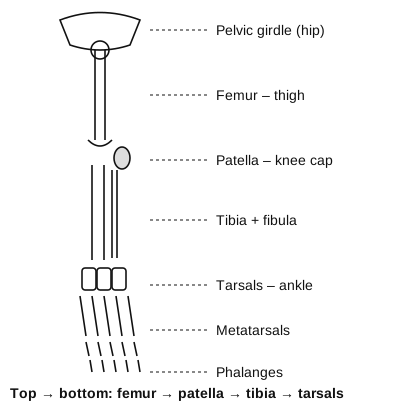
Q14.
Which of the following represents the correct sequence of arrangement of bones in the lower limb of humans ?
निम्नलिखित में से कौन-सा मनुष्य के निचले पाद (lower limb) में अस्थियों की व्यवस्था का सही क्रम दर्शाता है ?
  1. AFemur-tibia-patella-tarsalफीमर-टिबिया-पटेला-टार्सल
  2. BPatella-femur-tibia-tarsalपटेला-फीमर-टिबिया-टार्सल
  3. CFemur-patella-tibia-tarsalफीमर-पटेला-टिबिया-टार्सल
  4. DFemur-tarsal-patella-tibiaफीमर-टार्सल-पटेला-टिबिया
Show answer

Concept: Each lower limb has 30 bones: femur 1, patella 1, tibia and fibula 2, tarsals 7, metatarsals 5, phalanges 14.

  1. Going from hip downwards: femur (thigh bone, longest bone) → patella (knee cap, at the knee joint between femur and tibia) → tibia (with fibula) in the leg → tarsals (ankle).
  2. Option (A) puts the patella below the tibia; (B) starts with the patella above the femur; (D) puts tarsals (ankle) before the knee – all wrong.

Short trick: Walk down your own leg: thigh → knee → shin → ankle = F → P → T → T.

Answer: (C) Femur-patella-tibia-tarsal

अवधारणा: प्रत्येक निचले पाद में 30 अस्थियाँ होती हैं: फीमर 1, पटेला 1, टिबिया और फिबुला 2, टार्सल 7, मेटाटार्सल 5, फैलेन्जेस 14।

  1. कूल्हे से नीचे की ओर: फीमर (जाँघ की अस्थि, सबसे लंबी अस्थि) → पटेला (घुटने की टोपी, फीमर और टिबिया के बीच घुटने के जोड़ पर) → टाँग में टिबिया (फिबुला के साथ) → टार्सल (टखना)।
  2. विकल्प (A) पटेला को टिबिया के नीचे रखता है; (B) पटेला को फीमर से ऊपर रखता है; (D) टखने (टार्सल) को घुटने से पहले रखता है – सभी गलत।

शॉर्ट ट्रिक: अपनी टाँग पर नीचे चलिए: जाँघ → घुटना → पिंडली → टखना = F → P → T → T।

उत्तर: (C) फीमर-पटेला-टिबिया-टार्सल

NEET UGBiologyLocomotion and movement – appendicular skeletonNEET UG 2026 · 21 Jun Shift 1
Q15.
Phyllotaxy is the pattern of arrangement of ____.
पर्णविन्यास (phyllotaxy) ____ की व्यवस्था का प्रतिरूप है।
  1. Aleavesपत्तियों
  2. Bflowersपुष्पों
  3. Cfruitsफलों
  4. Dsepalsबाह्यदलों
Show answer

Concept: Phyllotaxy is the pattern of arrangement of leaves on the stem or branch.

  1. Types: alternate (china rose, mustard, sunflower), opposite (Calotropis, guava) and whorled (Alstonia).
  2. Arrangement of flowers on the floral axis = inflorescence; arrangement of sepals/petals in bud = aestivation; fruits have no such term.

Short trick: Phyllo = leaf (Greek), taxis = arrangement. Compare: Aestivation – floral bud; Inflorescence – flowers; Venation – veins.

Answer: (A) leaves

अवधारणा: पर्णविन्यास तने या शाखा पर पत्तियों की व्यवस्था का प्रतिरूप है।

  1. प्रकार: एकांतर (गुड़हल, सरसों, सूरजमुखी), सम्मुख (आक/Calotropis, अमरूद) और चक्करदार (Alstonia)।
  2. पुष्पी अक्ष पर पुष्पों की व्यवस्था = पुष्पक्रम; कली में बाह्यदल/दल की व्यवस्था = पुष्पदल विन्यास (aestivation); फलों के लिए ऐसा कोई पद नहीं।

शॉर्ट ट्रिक: Phyllo = पत्ती (ग्रीक), taxis = व्यवस्था। तुलना: पुष्पदल विन्यास – पुष्प कली; पुष्पक्रम – पुष्प; शिराविन्यास – शिराएँ।

उत्तर: (A) पत्तियों

NEET UGBiologyMorphology of flowering plants – phyllotaxyNEET UG 2026 · 21 Jun Shift 1
Q16.
Match List-I with List-II
List-IList-II
A. StarchI. Fights infection
B. AntibodyII. Energy storage
C. ConcanavalinIII. Glucose transport
D. Glut-4IV. Lectin
Choose the correct answer from the options given below :
सूची-I का सूची-II से मिलान कीजिए।
सूची-Iसूची-II
A. मंड (Starch)I. संक्रमण से लड़ना
B. प्रतिरक्षी (Antibody)II. ऊर्जा संचय
C. कॉन्कैनावेलिन (Concanavalin)III. ग्लूकोज़ परिवहन
D. Glut-4IV. लेक्टिन
नीचे दिए गए विकल्पों में से सही उत्तर चुनिए :
  1. AA-I, B-II, C-IV, D-III
  2. BA-II, B-I, C-IV, D-III
  3. CA-II, B-I, C-III, D-IV
  4. DA-I, B-II, C-III, D-IV
Show answer

Concept: NCERT table of protein functions: collagen – intercellular ground substance, trypsin – enzyme, insulin – hormone, antibody – fights infection, receptor – sensory reception, GLUT-4 – enables glucose transport into cells.

  1. A. Starch – storage polysaccharide of plants → energy storage (II).
  2. B. Antibody – immunoglobulin that fights infection (I).
  3. C. Concanavalin A – a plant lectin (secondary metabolite, binds sugars) (IV).
  4. D. GLUT-4 – membrane transporter protein for glucose (III).

Short trick: A-II and B-I are obvious → only (B) and (C) remain; Concanavalin is a lectin, so C-IV → (B).

Answer: (B) A-II, B-I, C-IV, D-III

अवधारणा: NCERT की प्रोटीन कार्य तालिका: कोलैजन – अंतरकोशिकीय आधार पदार्थ, ट्रिप्सिन – एंजाइम, इंसुलिन – हॉर्मोन, प्रतिरक्षी – संक्रमण से लड़ना, ग्राही – संवेदी ग्रहण, GLUT-4 – कोशिकाओं में ग्लूकोज़ परिवहन।

  1. A. मंड – पादपों का संचयी पॉलिसैकेराइड → ऊर्जा संचय (II)।
  2. B. प्रतिरक्षी – संक्रमण से लड़ने वाला इम्यूनोग्लोबुलिन (I)।
  3. C. कॉन्कैनावेलिन A – एक पादप लेक्टिन (द्वितीयक उपापचयज, शर्कराओं से बंधता है) (IV)।
  4. D. GLUT-4 – ग्लूकोज़ का झिल्ली परिवाहक प्रोटीन (III)।

शॉर्ट ट्रिक: A-II और B-I स्पष्ट हैं → केवल (B) और (C) बचते हैं; कॉन्कैनावेलिन लेक्टिन है, अतः C-IV → (B)।

उत्तर: (B) A-II, B-I, C-IV, D-III

NEET UGBiologyBiomolecules – functions of proteins and polysaccharidesNEET UG 2026 · 21 Jun Shift 1
Q17.
Given below are two statements:
Statement I : When any plane passing through the central axis of the body divides the organism into two identical halves, it is called radial symmetry.
Statement II : In phylum Echinodermata, both adults and larvae are radially symmetrical.
In the light of the above statements, choose the most appropriate answer from the options given below:
नीचे दो कथन दिए गए हैं :
कथन I : जब शरीर के केंद्रीय अक्ष से गुजरने वाला कोई भी तल जीव को दो समरूप अर्धांशों में विभाजित करता है, तो उसे अरीय सममिति कहते हैं।
कथन II : संघ इकाइनोडर्मेटा में वयस्क और लार्वा दोनों अरीय सममित होते हैं।
उपर्युक्त कथनों के आलोक में, नीचे दिए गए विकल्पों में से सबसे उपयुक्त उत्तर चुनिए :
  1. ABoth Statement I and Statement II are correctकथन I और कथन II दोनों सही हैं
  2. BBoth Statement I and Statement II are incorrectकथन I और कथन II दोनों गलत हैं
  3. CStatement I is correct but Statement II is incorrectकथन I सही है लेकिन कथन II गलत है
  4. DStatement I is incorrect but Statement II is correctकथन I गलत है लेकिन कथन II सही है
Show answer

Concept: Radial symmetry: any plane through the central axis gives identical halves (coelenterates, ctenophores, adult echinoderms).

  1. Statement I – correct; it is the NCERT definition of radial symmetry.
  2. Statement II – incorrect; adult echinoderms are radially (pentamerous) symmetrical but their larvae are bilaterally symmetrical.

Short trick: Echinoderm = "Radial adult, Bilateral baby" – the bilateral larva shows they evolved from bilateral ancestors.

Answer: (C) Statement I is correct but Statement II is incorrect

अवधारणा: अरीय सममिति: केंद्रीय अक्ष से गुजरने वाला कोई भी तल समरूप अर्धांश देता है (सीलेंट्रेट, टीनोफोर, वयस्क इकाइनोडर्म)।

  1. कथन I – सही; यह अरीय सममिति की NCERT परिभाषा है।
  2. कथन II – गलत; वयस्क इकाइनोडर्म अरीय (पंचतयी) सममित होते हैं, परंतु उनके लार्वा द्विपार्श्व सममित होते हैं।

शॉर्ट ट्रिक: इकाइनोडर्म = "वयस्क अरीय, शिशु द्विपार्श्व" – द्विपार्श्व लार्वा बताता है कि ये द्विपार्श्व पूर्वजों से विकसित हुए।

उत्तर: (C) कथन I सही है लेकिन कथन II गलत है

NEET UGBiologyAnimal kingdom – symmetryNEET UG 2026 · 21 Jun Shift 1
Q18.
Endomembrane system includes __________.
अंतःझिल्ली तंत्र में __________ सम्मिलित हैं।
  1. Aendoplasmic reticulum, Golgi complex, lysosomes and vacuoleअंतर्द्रव्यी जालिका, गॉल्जी सम्मिश्र, लयनकाय और रिक्तिका
  2. Bendoplasmic reticulum, chloroplast, peroxisomes and vacuoleअंतर्द्रव्यी जालिका, हरितलवक, परऑक्सीसोम और रिक्तिका
  3. Cmitochondria, chloroplast, peroxisomes and vacuoleमाइटोकॉन्ड्रिया, हरितलवक, परऑक्सीसोम और रिक्तिका
  4. DGolgi complex, chloroplast, peroxisomes and vacuoleगॉल्जी सम्मिश्र, हरितलवक, परऑक्सीसोम और रिक्तिका
Show answer

Concept: Organelles whose functions are coordinated are grouped as the endomembrane system: ER, Golgi complex, lysosomes and vacuoles.

  1. These four work together (synthesis → packaging → transport/digestion/storage).
  2. Mitochondria, chloroplasts and peroxisomes are not part of it because their functions are not coordinated with the above.
  3. Every wrong option contains chloroplast and/or peroxisome/mitochondria.

Short trick: Endomembrane = "ER-GoLV" – ER, Golgi, Lysosome, Vacuole; never M-C-P (Mitochondria, Chloroplast, Peroxisome).

Answer: (A) endoplasmic reticulum, Golgi complex, lysosomes and vacuole

अवधारणा: जिन कोशिकांगों के कार्य समन्वित होते हैं उन्हें अंतःझिल्ली तंत्र में रखा जाता है: ER, गॉल्जी सम्मिश्र, लयनकाय और रिक्तिकाएँ।

  1. ये चारों मिलकर कार्य करते हैं (संश्लेषण → पैकेजिंग → परिवहन/पाचन/संचय)।
  2. माइटोकॉन्ड्रिया, हरितलवक और परऑक्सीसोम इसका भाग नहीं हैं क्योंकि इनके कार्य उपर्युक्त के साथ समन्वित नहीं हैं।
  3. प्रत्येक गलत विकल्प में हरितलवक और/या परऑक्सीसोम/माइटोकॉन्ड्रिया है।

शॉर्ट ट्रिक: अंतःझिल्ली = "ER-GoLV" – ER, गॉल्जी, लयनकाय, रिक्तिका; कभी नहीं M-C-P (माइटोकॉन्ड्रिया, हरितलवक, परऑक्सीसोम)।

उत्तर: (A) अंतर्द्रव्यी जालिका, गॉल्जी सम्मिश्र, लयनकाय और रिक्तिका

NEET UGBiologyCell – endomembrane systemNEET UG 2026 · 21 Jun Shift 1
Q19.
How many molecules of pyruvic acid are produced at the end of glycolysis from 206 molecules of glucose ?
ग्लूकोज़ के 206 अणुओं से ग्लाइकोलिसिस के अंत में पाइरुविक अम्ल के कितने अणु बनते हैं ?
  1. A206
  2. B309
  3. C103
  4. D412
Show answer

Concept: In glycolysis one glucose (6C) is partially oxidised to two molecules of pyruvic acid (3C each).

  1. 1 glucose → 2 pyruvic acid.
  2. 206 glucose → 206 × 2 = 412 pyruvic acid.

Short trick: Glycolysis doubles the count (6C → 2 × 3C): just multiply by 2.

Answer: (D) 412

अवधारणा: ग्लाइकोलिसिस में एक ग्लूकोज़ (6C) आंशिक रूप से ऑक्सीकृत होकर पाइरुविक अम्ल के दो अणु (प्रत्येक 3C) बनाता है।

  1. 1 ग्लूकोज़ → 2 पाइरुविक अम्ल।
  2. 206 ग्लूकोज़ → 206 × 2 = 412 पाइरुविक अम्ल।

शॉर्ट ट्रिक: ग्लाइकोलिसिस संख्या दोगुनी कर देता है (6C → 2 × 3C): बस 2 से गुणा करें।

उत्तर: (D) 412

NEET UGBiologyRespiration in plants – glycolysisNEET UG 2026 · 21 Jun Shift 1
Q20.
Which of the following plant growth regulators is used as herbicide ?
निम्नलिखित में से कौन-सा पादप वृद्धि नियामक शाकनाशी (herbicide) के रूप में प्रयुक्त होता है ?
  1. A2,4-D
  2. BKinetinकाइनेटिन (Kinetin)
  3. CAbscisic acidएब्सिसिक अम्ल (Abscisic acid)
  4. DGibberellinजिबरेलिन (Gibberellin)
Show answer

Concept: 2,4-D (2,4-dichlorophenoxyacetic acid) is a synthetic auxin widely used to kill dicotyledonous weeds.

  1. It does not affect mature monocots, so it is used to prepare weed-free lawns and cereal fields.
  2. Kinetin – cytokinin (cell division); ABA – stress hormone (stomatal closure, dormancy); gibberellin – stem elongation, bolting – none used as herbicide.

Short trick: "2,4-D = Dicot Destroyer" – kills Dicot weeds, spares monocots (grass/lawn).

Answer: (A) 2,4-D

अवधारणा: 2,4-D (2,4-डाइक्लोरोफीनॉक्सीऐसिटिक अम्ल) एक संश्लेषित ऑक्सिन है जो द्विबीजपत्री खरपतवारों को नष्ट करने के लिए व्यापक रूप से प्रयुक्त होता है।

  1. यह परिपक्व एकबीजपत्री पादपों को प्रभावित नहीं करता, इसलिए खरपतवार-मुक्त लॉन और अनाज के खेत बनाने में प्रयुक्त होता है।
  2. काइनेटिन – साइटोकाइनिन (कोशिका विभाजन); ABA – प्रतिबल हॉर्मोन (रंध्र बंद होना, प्रसुप्ति); जिबरेलिन – तना दीर्घीकरण, बोल्टिंग – कोई भी शाकनाशी नहीं।

शॉर्ट ट्रिक: "2,4-D = Dicot Destroyer" – द्विबीजपत्री खरपतवार नष्ट, एकबीजपत्री (घास/लॉन) सुरक्षित।

उत्तर: (A) 2,4-D

NEET UGBiologyPlant growth regulators – auxinsNEET UG 2026 · 21 Jun Shift 1