NEET UG · 2,240 questions

NEET UG 2015, 2016, 2017, 2018, 2019, 2020, 2021, 2022, 2023, 2024, 2025, 2026 PYQs

Real previous year questions, subject-wise. Try the question, then open the answer and the explanation in Hindi & English – free, no login.

Courses – airGurukul

200 questions in Botany.

Q1.
A transcription unit in DNA is defined primarily by the three regions in DNA and these are with respect to upstream and down stream end.
DNA में एक अनुलेखन इकाई (transcription unit) मुख्य रूप से DNA के तीन क्षेत्रों द्वारा परिभाषित होती है, और ये अपस्ट्रीम (upstream) तथा डाउनस्ट्रीम (downstream) छोर के सापेक्ष हैं:
  1. AStructural gene, Transposons, Operator geneसंरचनात्मक जीन, ट्रांसपोसॉन, ऑपरेटर जीन
  2. BInductor, Repressor, Structural geneप्रेरक (Inductor), दमनकारी (Repressor), संरचनात्मक जीन
  3. CPromotor, Structural gene, Terminatorउन्नायक (Promotor), संरचनात्मक जीन, समापक (Terminator)
  4. DRepressor, Operator gene, Structural geneदमनकारी (Repressor), ऑपरेटर जीन, संरचनात्मक जीन
Show answer

Concept: A transcription unit has three regions: a promoter, the structural gene and a terminator.

  1. The promoter lies towards the 5′ end (upstream) of the structural gene, taken with respect to the coding strand. RNA polymerase binds here.
  2. The structural gene in the middle is the part that is transcribed.
  3. The terminator lies towards the 3′ end (downstream) of the coding strand and marks the end of transcription.
  4. Repressor, operator and inducer belong to operon regulation, and transposons are jumping genes. None of them defines a transcription unit.

Short trick: Think of the order P – S – T from 5′ to 3′: promoter, structural gene, terminator, like Start – Song – sTop.

Answer: (C) Promotor, Structural gene, Terminator

अवधारणा: अनुलेखन इकाई के तीन क्षेत्र होते हैं: उन्नायक (promoter), संरचनात्मक जीन और समापक (terminator)।

  1. उन्नायक, संरचनात्मक जीन के 5′ छोर (अपस्ट्रीम) की ओर होता है। यह कोडिंग रज्जुक के सापेक्ष माना जाता है। RNA पॉलीमरेज़ यहीं जुड़ता है।
  2. बीच में स्थित संरचनात्मक जीन वह भाग है जिसका अनुलेखन होता है।
  3. समापक, कोडिंग रज्जुक के 3′ छोर (डाउनस्ट्रीम) की ओर होता है और अनुलेखन का अंत निर्धारित करता है।
  4. दमनकारी, ऑपरेटर और प्रेरक ओपेरॉन नियमन के भाग हैं, और ट्रांसपोसॉन कूदने वाले जीन हैं। इनमें से कोई भी अनुलेखन इकाई को परिभाषित नहीं करता।

शॉर्ट ट्रिक: 5′ से 3′ तक क्रम P – S – T याद रखें: उन्नायक, संरचनात्मक जीन, समापक।

उत्तर: (C) उन्नायक, संरचनात्मक जीन, समापक
NEET UGBotanyMolecular basis of inheritance – transcription unitNEET UG 2024 · 5 May Shift 1
Q2.
Identify the set of correct statements:
A. The flowers of Vallisneria are colorful and produce nectar.
B. The flowers of waterlily are not pollinated by water.
C. In most of water pollinated species, the pollen grains are protected from wetting.
D. Pollen grains of some hydrophytes are long and ribbon like.
E. In some hydrophytes, the pollen grains are carried passively inside water.
Choose the correct answer from the options given below:
सही कथनों के समुच्चय को पहचानिए:
A. Vallisneria के पुष्प रंगीन होते हैं और मकरंद (nectar) उत्पन्न करते हैं।
B. जल लिली (waterlily) के पुष्पों का परागण जल द्वारा नहीं होता।
C. अधिकांश जल-परागित प्रजातियों में परागकण भीगने से सुरक्षित रहते हैं।
D. कुछ जलोद्भिदों (hydrophytes) के परागकण लंबे और फीते (ribbon) जैसे होते हैं।
E. कुछ जलोद्भिदों में परागकण निष्क्रिय रूप से जल के अंदर बहकर जाते हैं।
नीचे दिए गए विकल्पों में से सही उत्तर चुनिए:
  1. AA, B, C and D onlyकेवल A, B, C और D
  2. BA, C, D and E onlyकेवल A, C, D और E
  3. CB, C, D and E onlyकेवल B, C, D और E
  4. DC, D and E onlyकेवल C, D और E
Show answer

Concept: NCERT: wind- and water-pollinated flowers are not very colourful and do not produce nectar.

  1. A – false. Vallisneria is water-pollinated, so its flowers are neither colourful nor nectar-producing.
  2. B – true. In water lily and water hyacinth the flowers rise above the water and are pollinated by insects or wind.
  3. C – true. Pollen grains are protected from wetting by a mucilaginous covering.
  4. D – true. In seagrasses such as Zostera, pollen grains are long and ribbon-like.
  5. E – true. These pollen grains are carried passively inside the water to the stigma.

Short trick: Once A is false, only option (C) and option (D) remain. B is a direct NCERT line, so B must be in the answer, which gives (C).

Answer: (C) B, C, D and E only

अवधारणा: NCERT: वायु और जल द्वारा परागित पुष्प अधिक रंगीन नहीं होते और मकरंद उत्पन्न नहीं करते।

  1. A – असत्य। Vallisneria जल-परागित है, इसलिए इसके पुष्प न रंगीन होते हैं और न मकरंद बनाते हैं।
  2. B – सत्य। जल लिली और जलकुंभी में पुष्प जल-सतह से ऊपर निकलते हैं और कीटों या वायु द्वारा परागित होते हैं।
  3. C – सत्य। परागकणों पर श्लेष्मी आवरण (mucilaginous covering) होता है जो उन्हें भीगने से बचाता है।
  4. D – सत्य। Zostera जैसी समुद्री घासों में परागकण लंबे और फीते जैसे होते हैं।
  5. E – सत्य। ये परागकण जल के अंदर निष्क्रिय रूप से वर्तिकाग्र तक पहुँचते हैं।

शॉर्ट ट्रिक: A असत्य होते ही केवल विकल्प (C) और (D) बचते हैं। B, NCERT की सीधी पंक्ति है, इसलिए B उत्तर में होगा, यानी (C)।

उत्तर: (C) केवल B, C, D और E

NEET UGBotanySexual reproduction in flowering plants – water pollinationNEET UG 2024 · 5 May Shift 1
Q3.
Lecithin, a small molecular weight organic compound found in living tissues, is an example of
लेसिथिन (Lecithin), जीवित ऊतकों में पाया जाने वाला एक कम आणविक भार वाला कार्बनिक यौगिक, किसका उदाहरण है?
  1. APhospholipidsफॉस्फोलिपिड
  2. BGlyceridesग्लिसराइड
  3. CCarbohydratesकार्बोहाइड्रेट
  4. DAmino acidsऐमीनो अम्ल
Show answer

Concept: Lipids that contain phosphorus as a phosphorylated organic group are called phospholipids. Lecithin is the NCERT example.

  1. Lecithin = glycerol + 2 fatty acids + a phosphate group linked to choline.
  2. It is found in cell membranes.
  3. Glycerides contain only glycerol and fatty acids, with no phosphate. Carbohydrates and amino acids are different classes of biomolecule.

Short trick: Lecithin is the textbook example of a phospholipid. In NCERT's figure, look for the P in its structure.

Answer: (A) Phospholipids

अवधारणा: जिन लिपिडों में फॉस्फोरस फॉस्फोरिलीकृत कार्बनिक समूह के रूप में होता है, वे फॉस्फोलिपिड कहलाते हैं। लेसिथिन इसका NCERT उदाहरण है।

  1. लेसिथिन = ग्लिसरॉल + 2 वसीय अम्ल + कोलीन से जुड़ा फॉस्फेट समूह।
  2. यह कोशिका झिल्ली में पाया जाता है।
  3. ग्लिसराइड में केवल ग्लिसरॉल और वसीय अम्ल होते हैं, फॉस्फेट नहीं होता। कार्बोहाइड्रेट और ऐमीनो अम्ल अलग वर्ग के जैव अणु हैं।

शॉर्ट ट्रिक: लेसिथिन फॉस्फोलिपिड का पाठ्यपुस्तक उदाहरण है। NCERT के चित्र में इसकी संरचना में P देखें।

उत्तर: (A) फॉस्फोलिपिड

NEET UGBotanyBiomolecules – lipidsNEET UG 2024 · 5 May Shift 1
Q4.
These are regarded as major causes of biodiversity loss:
A. Over exploitation
B. Co-extinction
C. Mutation
D. Habitat loss and fragmentation
E. Migration
Choose the correct option:
निम्नलिखित को जैव विविधता ह्रास के प्रमुख कारण माना जाता है:
A. अति-दोहन (Over exploitation)
B. सह-विलुप्ति (Co-extinction)
C. उत्परिवर्तन (Mutation)
D. आवास क्षति और विखंडन
E. प्रवास (Migration)
सही विकल्प चुनिए:
  1. AA, B, C and D onlyकेवल A, B, C और D
  2. BA, B and E onlyकेवल A, B और E
  3. CA, B and D onlyकेवल A, B और D
  4. DA, C and D onlyकेवल A, C और D
Show answer

Concept: NCERT lists four major causes of biodiversity loss, the "Evil Quartet": habitat loss and fragmentation, over-exploitation, alien species invasions and co-extinctions.

  1. A (over-exploitation), B (co-extinction) and D (habitat loss and fragmentation) are in the Evil Quartet.
  2. C – mutation creates variation and so adds to diversity. It is not a cause of loss.
  3. E – migration is a natural movement of organisms and is not listed as a major cause.

Short trick: Use the mnemonic HOAC: Habitat loss, Over-exploitation, Alien species, Co-extinction. The only option with no C or E is (C).

Answer: (C) A, B and D only

अवधारणा: NCERT जैव विविधता ह्रास के चार प्रमुख कारण बताती है, जिन्हें "Evil Quartet" कहते हैं: आवास क्षति और विखंडन, अति-दोहन, विदेशी जातियों का आक्रमण और सह-विलुप्ति।

  1. A (अति-दोहन), B (सह-विलुप्ति) और D (आवास क्षति और विखंडन) Evil Quartet में शामिल हैं।
  2. C – उत्परिवर्तन विविधता उत्पन्न करता है और इस प्रकार विविधता बढ़ाता है। यह ह्रास का कारण नहीं है।
  3. E – प्रवास जीवों का प्राकृतिक आवागमन है और इसे प्रमुख कारणों में नहीं गिना जाता।

शॉर्ट ट्रिक: स्मृति-सूत्र HOAC: आवास (Habitat), अति-दोहन (Over-exploitation), विदेशी (Alien), सह-विलुप्ति (Co-extinction)। जिस विकल्प में C या E नहीं है, वह केवल (C) है।

उत्तर: (C) केवल A, B और D

NEET UGBotanyBiodiversity – causes of lossNEET UG 2024 · 5 May Shift 1
Q5.
Match List I with List II.
List-IList-II
A. Clostridium butylicumI. Ethanol
B. Saccharomyces cerevisiaeII. Streptokinase
C. Trichoderma polysporumIII. Butyric acid
D. Streptococcus sp.IV. Cyclosporin-A
Choose the correct answer from the options given below:
सूची-I का सूची-II से मिलान कीजिए।
सूची-Iसूची-II
A. Clostridium butylicumI. एथेनॉल
B. Saccharomyces cerevisiaeII. स्ट्रेप्टोकाइनेज़
C. Trichoderma polysporumIII. ब्यूटिरिक अम्ल
D. Streptococcus sp.IV. साइक्लोस्पोरिन-A
नीचे दिए गए विकल्पों में से सही उत्तर चुनिए:
  1. AA-II, B-IV, C-III, D-I
  2. BA-III, B-I, C-IV, D-II
  3. CA-IV, B-I, C-III, D-II
  4. DA-III, B-I, C-II, D-IV
Show answer

Concept: Microbial products from NCERT: Clostridium butylicum gives butyric acid, yeast gives ethanol, Trichoderma polysporum gives cyclosporin A, and Streptococcus gives streptokinase.

  1. A → III: Clostridium butylicum produces butyric acid.
  2. B → I: Saccharomyces cerevisiae (yeast) is used for the commercial production of ethanol.
  3. C → IV: Trichoderma polysporum produces cyclosporin A, an immunosuppressant used in organ transplants.
  4. D → II: Streptococcus produces streptokinase, a "clot buster".

Short trick: Butylicum gives butyric acid, and Streptococcus gives streptokinase. These two pairs alone give A-III and D-II, which only option (B) has.

Answer: (B) A-III, B-I, C-IV, D-II

अवधारणा: NCERT के सूक्ष्मजीवी उत्पाद: Clostridium butylicum से ब्यूटिरिक अम्ल, यीस्ट से एथेनॉल, Trichoderma polysporum से साइक्लोस्पोरिन A, और Streptococcus से स्ट्रेप्टोकाइनेज़ मिलता है।

  1. A → III: Clostridium butylicum ब्यूटिरिक अम्ल बनाता है।
  2. B → I: Saccharomyces cerevisiae (यीस्ट) का उपयोग एथेनॉल के व्यावसायिक उत्पादन में होता है।
  3. C → IV: Trichoderma polysporum साइक्लोस्पोरिन A बनाता है, जो अंग प्रत्यारोपण में प्रयुक्त प्रतिरक्षा-निरोधक है।
  4. D → II: Streptococcus स्ट्रेप्टोकाइनेज़ बनाता है, जो "थक्का घोलक" (clot buster) है।

शॉर्ट ट्रिक: Butylicum से butyric अम्ल, और Streptococcus से streptokinase। इन्हीं दो जोड़ों से A-III और D-II मिलते हैं, जो केवल विकल्प (B) में हैं।

उत्तर: (B) A-III, B-I, C-IV, D-II

NEET UGBotanyMicrobes in human welfare – industrial productsNEET UG 2024 · 5 May Shift 1
Q6.
Match List I with List II.
List-IList-II
A. RhizopusI. Mushroom
B. UstilagoII. Smut fungus
C. PucciniaIII. Bread mould
D. AgaricusIV. Rust fungus
Choose the correct answer from the options given below:
सूची-I का सूची-II से मिलान कीजिए।
सूची-Iसूची-II
A. RhizopusI. छत्रक (मशरूम)
B. UstilagoII. कंड कवक (Smut fungus)
C. PucciniaIII. ब्रेड मोल्ड
D. AgaricusIV. किट्ट कवक (Rust fungus)
नीचे दिए गए विकल्पों में से सही उत्तर चुनिए:
  1. AA-I, B-III, C-II, D-IV
  2. BA-III, B-II, C-I, D-IV
  3. CA-IV, B-III, C-II, D-I
  4. DA-III, B-II, C-IV, D-I
Show answer

Concept: Common fungi named in NCERT: Rhizopus is the bread mould, Ustilago causes smut, Puccinia causes rust, and Agaricus is the mushroom.

  1. A → III: Rhizopus is a phycomycete, the bread mould.
  2. B → II: Ustilago is the smut fungus (basidiomycete).
  3. C → IV: Puccinia is the rust fungus of wheat.
  4. D → I: Agaricus is the mushroom.

Short trick: Follow the vowel "u": Ustilago → smut and Puccinia → rust; Rhizopus is the common bread mould. Only option (D) gives A-III, B-II, C-IV.

Answer: (D) A-III, B-II, C-IV, D-I

अवधारणा: NCERT में बताए गए सामान्य कवक: Rhizopus ब्रेड मोल्ड है, Ustilago कंड रोग पैदा करता है, Puccinia किट्ट रोग पैदा करता है, और Agaricus छत्रक (मशरूम) है।

  1. A → III: Rhizopus एक फाइकोमाइसीट है, ब्रेड मोल्ड।
  2. B → II: Ustilago कंड कवक है (बेसिडियोमाइसीट)।
  3. C → IV: Puccinia गेहूँ का किट्ट कवक है।
  4. D → I: Agaricus छत्रक (मशरूम) है।

शॉर्ट ट्रिक: स्वर "u" पर ध्यान दें: Ustilago → smut (कंड) और Puccinia → rust (किट्ट); Rhizopus सामान्य bread mould (ब्रेड मोल्ड) है। A-III, B-II, C-IV केवल विकल्प (D) में है।

उत्तर: (D) A-III, B-II, C-IV, D-I

NEET UGBotanyBiological classification – fungiNEET UG 2024 · 5 May Shift 1
Q7.
The lactose present in the growth medium of bacteria is transported to the cell by the action of:
जीवाणु के वृद्धि माध्यम में उपस्थित लैक्टोज़ किसकी क्रिया द्वारा कोशिका में पहुँचाया जाता है?
  1. AAcetylaseऐसीटिलेज़
  2. BPermeaseपरमिएज़ (Permease)
  3. CPolymeraseपॉलीमरेज़
  4. DBeta-galactosidaseबीटा-गैलेक्टोसिडेज़
Show answer

Concept: The lac operon has three structural genes: z (β-galactosidase), y (permease) and a (transacetylase).

  1. Permease (from gene y) increases the permeability of the cell to β-galactosides and brings lactose into the cell.
  2. β-galactosidase hydrolyses lactose into galactose and glucose inside the cell. It does not transport lactose.
  3. Transacetylase (acetylase) has no role in transport, and polymerase is not a lac-operon product.

Short trick: The genes run z-y-a, which you can read as "Zara Yahan Aao". Permease is the one that brings lactose in, like a permit to enter.

Answer: (B) Permease

अवधारणा: लैक ओपेरॉन में तीन संरचनात्मक जीन होते हैं: z (β-गैलेक्टोसिडेज़), y (परमिएज़) और a (ट्रांसऐसीटिलेज़)।

  1. परमिएज़ (जीन y का उत्पाद) β-गैलेक्टोसाइड के लिए कोशिका की पारगम्यता बढ़ाता है और लैक्टोज़ को कोशिका में लाता है।
  2. β-गैलेक्टोसिडेज़ कोशिका के अंदर लैक्टोज़ को गैलेक्टोज़ और ग्लूकोज़ में जल-अपघटित करता है। यह लैक्टोज़ का परिवहन नहीं करता।
  3. ट्रांसऐसीटिलेज़ (ऐसीटिलेज़) की परिवहन में कोई भूमिका नहीं है, और पॉलीमरेज़ लैक ओपेरॉन का उत्पाद नहीं है।

शॉर्ट ट्रिक: जीन क्रम z-y-a को "ज़रा यहाँ आओ" से याद रखें। परमिएज़ ही लैक्टोज़ को अंदर लाता है, जैसे प्रवेश का परमिट।

उत्तर: (B) परमिएज़

NEET UGBotanyMolecular basis of inheritance – lac operonNEET UG 2024 · 5 May Shift 1
Q8.
List of endangered species was released by
संकटग्रस्त (endangered) जातियों की सूची किसके द्वारा जारी की गई थी?
  1. AWWF
  2. BFOAM
  3. CIUCN
  4. DGEAC
Show answer

Concept: The IUCN (International Union for Conservation of Nature) publishes the Red List of threatened species, which includes the endangered ones.

  1. The IUCN Red List (2004) documents the extinction of 784 species in the last 500 years.
  2. WWF is a conservation NGO and does not publish the Red List.
  3. GEAC (Genetic Engineering Appraisal Committee) regulates GM research in India.
  4. FOAM is not the body that publishes the list of threatened species.

Short trick: Remember IUCN = Red List = Red Data Book.

Answer: (C) IUCN

अवधारणा: IUCN (इंटरनेशनल यूनियन फॉर कंज़र्वेशन ऑफ नेचर) संकटग्रस्त जातियों की रेड लिस्ट प्रकाशित करता है, जिसमें संकटापन्न (endangered) जातियाँ भी शामिल हैं।

  1. IUCN रेड लिस्ट (2004) में पिछले 500 वर्षों में 784 जातियों की विलुप्ति दर्ज है।
  2. WWF एक संरक्षण NGO है और रेड लिस्ट प्रकाशित नहीं करता।
  3. GEAC (जेनेटिक इंजीनियरिंग अप्रेज़ल कमेटी) भारत में GM अनुसंधान का नियमन करती है।
  4. FOAM वह संस्था नहीं है जो संकटग्रस्त जातियों की सूची प्रकाशित करती है।

शॉर्ट ट्रिक: IUCN = रेड लिस्ट = रेड डेटा बुक याद रखें।

उत्तर: (C) IUCN

NEET UGBotanyBiodiversity – IUCN Red ListNEET UG 2024 · 5 May Shift 1
Q9.
How many molecules of ATP and NADPH are required for every molecule of CO2 fixed in the Calvin cycle
केल्विन चक्र में स्थिरीकृत होने वाले प्रत्येक CO2 अणु के लिए ATP और NADPH के कितने अणु आवश्यक होते हैं?
  1. A2 molecules of ATP and 2 molecules of NADPHATP के 2 अणु और NADPH के 2 अणु
  2. B3 molecules of ATP and 3 molecules of NADPHATP के 3 अणु और NADPH के 3 अणु
  3. C3 molecules of ATP and 2 molecules of NADPHATP के 3 अणु और NADPH के 2 अणु
  4. D2 molecules of ATP and 3 molecules of NADPHATP के 2 अणु और NADPH के 3 अणु
Show answer

Concept: Per CO2 fixed: reduction uses 2 ATP + 2 NADPH, and regeneration of RuBP uses 1 ATP.

  1. Carboxylation: 1 CO2 + RuBP gives 2 PGA.
  2. Reduction: 2 PGA use 2 ATP and 2 NADPH.
  3. Regeneration of RuBP uses 1 more ATP.
  4. Total per CO2 = 3 ATP + 2 NADPH. For one glucose (6 CO2) this is 18 ATP + 12 NADPH.

Short trick: Remember 3 : 2 per CO2, and multiply by 6 to get 18 : 12 per glucose.

Answer: (C) 3 ATP and 2 NADPH

अवधारणा: प्रति CO2 स्थिरीकरण: अपचयन में 2 ATP + 2 NADPH और RuBP के पुनर्जनन में 1 ATP लगता है।

  1. कार्बोक्सिलीकरण: 1 CO2 + RuBP से 2 PGA बनते हैं।
  2. अपचयन: 2 PGA में 2 ATP और 2 NADPH लगते हैं।
  3. RuBP के पुनर्जनन में 1 और ATP लगता है।
  4. कुल प्रति CO2 = 3 ATP + 2 NADPH। एक ग्लूकोज़ (6 CO2) के लिए यह 18 ATP + 12 NADPH होता है।

शॉर्ट ट्रिक: प्रति CO2 3 : 2 याद रखें, और 6 से गुणा करके प्रति ग्लूकोज़ 18 : 12 पाएँ।

उत्तर: (C) 3 ATP और 2 NADPH

NEET UGBotanyPhotosynthesis – Calvin cycleNEET UG 2024 · 5 May Shift 1
Q10.
The equation of Verhulst-Pearl logistic growth is dNdt=rN[K−NK],
From this equation, K indicates.
वरहुल्स्ट-पर्ल संभार (logistic) वृद्धि का समीकरण dNdt=rN[K−NK] है।
इस समीकरण में K क्या दर्शाता है?
  1. ABiotic potentialजैविक विभव (Biotic potential)
  2. BCarrying capacityपोषण क्षमता (Carrying capacity)
  3. CPopulation densityसमष्टि घनत्व
  4. DIntrinsic rate of natural increaseप्राकृतिक वृद्धि की स्वाभाविक दर
Show answer

Concept: In logistic growth, N = population density at time t, r = intrinsic rate of natural increase and K = carrying capacity.

  1. K is the maximum population that the habitat's resources can support. The sigmoid curve levels off at K, which is its asymptote.
  2. When N = K, dNdt=0, so growth stops.
  3. r is the intrinsic rate of natural increase and N is the population density, so (C) and (D) describe other terms.

Short trick: Read K as the "Kapacity" of the habitat, i.e. the carrying capacity.

Answer: (B) Carrying capacity

अवधारणा: संभार वृद्धि में N = समय t पर समष्टि घनत्व, r = प्राकृतिक वृद्धि की स्वाभाविक दर, और K = पोषण क्षमता।

  1. K वह अधिकतम समष्टि है जिसे आवास के संसाधन सँभाल सकते हैं। सिग्मॉइड वक्र K पर स्थिर हो जाता है, जो उसकी अनंतस्पर्शी (asymptote) है।
  2. जब N = K, तब dNdt=0 होता है, अतः वृद्धि रुक जाती है।
  3. r प्राकृतिक वृद्धि की स्वाभाविक दर है और N समष्टि घनत्व है, अतः (C) और (D) अन्य पदों को दर्शाते हैं।

शॉर्ट ट्रिक: K को आवास की "Kapacity" यानी पोषण क्षमता समझें।

उत्तर: (B) पोषण क्षमता

NEET UGBotanyOrganisms and populations – logistic growthNEET UG 2024 · 5 May Shift 1
Q11.
Bulliform cells are responsible for
आवर्ध त्वक् कोशिकाएँ (Bulliform cells) किसके लिए उत्तरदायी हैं?
  1. AProtecting the plant from salt stress.पादप को लवण तनाव से बचाना।
  2. BIncreased photosynthesis in monocots.एकबीजपत्रियों में प्रकाश-संश्लेषण बढ़ाना।
  3. CProviding large spaces for storage of sugars.शर्करा संग्रह के लिए बड़े स्थान उपलब्ध कराना।
  4. DInward curling of leaves in monocots.एकबीजपत्रियों में पत्तियों का अंदर की ओर मुड़ना।
Show answer

Concept: In grasses, some adaxial (upper) epidermal cells along the veins become large, empty, colourless bulliform cells.

  1. When the leaves are turgid, the bulliform cells keep the leaf surface exposed.
  2. Under water stress they become flaccid and the leaf curls inwards, which reduces water loss.
  3. They have no chloroplasts, so they do not increase photosynthesis. They do not store sugar or protect against salt stress.

Short trick: Bulliform cells change the leaf's form by rolling it in when water is short.

Answer: (D) Inward curling of leaves in monocots

अवधारणा: घासों में शिराओं के साथ स्थित कुछ अभ्यक्ष (ऊपरी) बाह्यत्वचीय कोशिकाएँ बड़ी, खाली और रंगहीन आवर्ध त्वक् कोशिकाएँ बन जाती हैं।

  1. जब पत्तियाँ स्फीत (turgid) होती हैं, तो आवर्ध त्वक् कोशिकाएँ पत्ती की सतह को खुला रखती हैं।
  2. जल-तनाव में ये श्लथ (flaccid) हो जाती हैं और पत्ती अंदर की ओर मुड़ जाती है, जिससे जल-हानि घटती है।
  3. इनमें हरितलवक नहीं होते, अतः ये प्रकाश-संश्लेषण नहीं बढ़ातीं। ये शर्करा संग्रह या लवण-तनाव से रक्षा भी नहीं करतीं।

शॉर्ट ट्रिक: Bulliform कोशिकाएँ पानी की कमी में पत्ती को मोड़कर उसका form (आकार) बदल देती हैं।

उत्तर: (D) एकबीजपत्रियों में पत्तियों का अंदर की ओर मुड़ना

NEET UGBotanyAnatomy of flowering plants – monocot leafNEET UG 2024 · 5 May Shift 1
Q12.
Which one of the following is not a criterion for classification of fungi?
निम्नलिखित में से कौन-सा कवकों के वर्गीकरण का आधार नहीं है?
  1. AMode of nutritionपोषण की विधि
  2. BMode of spore formationबीजाणु बनने की विधि
  3. CFruiting bodyफलनकाय (Fruiting body)
  4. DMorphology of myceliumकवकजाल (mycelium) की आकारिकी
Show answer

Concept: NCERT: fungi are divided into classes on the basis of mycelium morphology, mode of spore formation and fruiting bodies.

  1. (B), (C) and (D) are the three criteria NCERT states.
  2. Mode of nutrition is the same in all fungi: they are heterotrophic (saprophytic or parasitic). Because it does not vary, it cannot be used to separate classes.

Short trick: Use M-S-F: Mycelium, Spores, Fruiting body. Nutrition is not one of them.

Answer: (A) Mode of nutrition

अवधारणा: NCERT: कवकों को कवकजाल की आकारिकी, बीजाणु बनने की विधि और फलनकाय के आधार पर वर्गों में बाँटा जाता है।

  1. (B), (C) और (D) वही तीन आधार हैं जो NCERT बताती है।
  2. पोषण की विधि सभी कवकों में एक जैसी है: वे विषमपोषी (मृतोपजीवी या परजीवी) होते हैं। यह बदलती नहीं, इसलिए इससे वर्गों को अलग नहीं किया जा सकता।

शॉर्ट ट्रिक: M-S-F याद रखें: कवकजाल (Mycelium), बीजाणु (Spores), फलनकाय (Fruiting body)। पोषण इनमें नहीं है।

उत्तर: (A) पोषण की विधि

NEET UGBotanyBiological classification – fungiNEET UG 2024 · 5 May Shift 1
Q13.
Tropical regions show greatest level of species richness because
A. Tropical latitudes have remained relatively undisturbed for millions of years, hence more time was available for species diversification.
B. Tropical environments are more seasonal.
C. More solar energy is available in tropics.
D. Constant environments promote niche specialization.
E. Tropical environments are constant and predictable.
Choose the correct answer from the options given below:
उष्णकटिबंधीय क्षेत्रों में जातीय समृद्धि का स्तर सबसे अधिक होता है, क्योंकि
A. उष्णकटिबंधीय अक्षांश लाखों वर्षों से अपेक्षाकृत अबाधित रहे हैं, अतः जाति-विविधीकरण के लिए अधिक समय मिला।
B. उष्णकटिबंधीय पर्यावरण अधिक मौसमी (seasonal) होते हैं।
C. उष्णकटिबंध में अधिक सौर ऊर्जा उपलब्ध होती है।
D. स्थिर पर्यावरण निकेत विशिष्टीकरण (niche specialization) को बढ़ावा देते हैं।
E. उष्णकटिबंधीय पर्यावरण स्थिर और पूर्वानुमेय होते हैं।
नीचे दिए गए विकल्पों में से सही उत्तर चुनिए:
  1. AA and B onlyकेवल A और B
  2. BA, B and E onlyकेवल A, B और E
  3. CA, B and D onlyकेवल A, B और D
  4. DA, C, D and E onlyकेवल A, C, D और E
Show answer

Concept: NCERT gives three reasons for high tropical diversity: a long evolutionary time without glaciation, a less seasonal and more constant environment, and more solar energy, which means higher productivity.

  1. A – true. Tropical latitudes were not disturbed by glaciations, so species had more time to diversify.
  2. B – false. Tropical environments are less seasonal than temperate ones.
  3. C – true. More solar energy leads to higher productivity.
  4. D and E – true. Constant, predictable environments promote niche specialisation and so give greater diversity.

Short trick: B contradicts E, so B must be out. Only option (D) has no B.

Answer: (D) A, C, D and E only

अवधारणा: NCERT उष्णकटिबंधीय उच्च विविधता के तीन कारण बताती है: हिमनदन (glaciation) के बिना लंबा विकासीय समय, कम मौसमी और अधिक स्थिर पर्यावरण, तथा अधिक सौर ऊर्जा, जिससे उत्पादकता अधिक होती है।

  1. A – सत्य। उष्णकटिबंधीय अक्षांश हिमनदन से बाधित नहीं हुए, इसलिए जातियों को विविधीकरण के लिए अधिक समय मिला।
  2. B – असत्य। उष्णकटिबंधीय पर्यावरण शीतोष्ण की तुलना में कम मौसमी होते हैं।
  3. C – सत्य। अधिक सौर ऊर्जा से उत्पादकता अधिक होती है।
  4. D और E – सत्य। स्थिर और पूर्वानुमेय पर्यावरण निकेत विशिष्टीकरण बढ़ाते हैं, जिससे विविधता अधिक होती है।

शॉर्ट ट्रिक: B, E का विरोधी है, इसलिए B बाहर होगा। जिस विकल्प में B नहीं है, वह केवल (D) है।

उत्तर: (D) केवल A, C, D और E

NEET UGBotanyBiodiversity – latitudinal gradientNEET UG 2024 · 5 May Shift 1
Q14.
Which of the following is an example of actinomorphic flower?
निम्नलिखित में से कौन-सा त्रिज्यासममित (actinomorphic) पुष्प का उदाहरण है?
  1. ACassia
  2. BPisum
  3. CSesbania
  4. DDatura
Show answer

Concept: A flower is actinomorphic if any radial plane through its centre divides it into two equal halves. NCERT examples are mustard, Datura and chilli.

  1. Datura (Solanaceae) is actinomorphic.
  2. Pisum (pea), Cassia and Sesbania are zygomorphic: they can be divided into two similar halves along only one vertical plane. Pea and Sesbania have papilionaceous corollas, and Cassia is zygomorphic too.

Short trick: Use MDC (Mustard, Datura, Chilli) for actinomorphic flowers and PBGC (Pea, Bean, Gulmohur, Cassia) for zygomorphic ones.

Answer: (D) Datura

अवधारणा: यदि केंद्र से गुजरने वाला कोई भी त्रिज्य तल पुष्प को दो समान भागों में बाँटे, तो पुष्प त्रिज्यासममित होता है। NCERT के उदाहरण सरसों, Datura और मिर्च हैं।

  1. Datura (सोलेनेसी) त्रिज्यासममित है।
  2. Pisum (मटर), Cassia और Sesbania एकव्याससममित (zygomorphic) हैं: इन्हें केवल एक ऊर्ध्व तल में दो समान भागों में बाँटा जा सकता है। मटर और Sesbania में पैपिलियोनेसी दलपुंज होता है, और Cassia भी एकव्याससममित है।

शॉर्ट ट्रिक: त्रिज्यासममित के लिए MDC (सरसों, धतूरा, मिर्च) और एकव्याससममित के लिए PBGC (मटर, सेम, गुलमोहर, कैसिया) याद रखें।

उत्तर: (D) Datura

NEET UGBotanyMorphology of flowering plants – symmetry of flowerNEET UG 2024 · 5 May Shift 1
Q15.
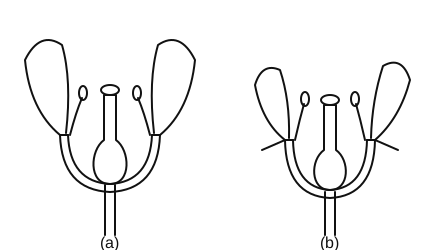
Identify the type of flowers based on the position of calyx, corolla and androecium with respect to the ovary from the given figures (a) and (b)
दिए गए चित्रों (a) और (b) में अंडाशय के सापेक्ष बाह्यदलपुंज, दलपुंज और पुमंग की स्थिति के आधार पर पुष्पों के प्रकार को पहचानिए:
  1. A(a) Hypogynous; (b) Epigynous(a) अधोजायांगी; (b) उपरिजायांगी
  2. B(a) Perigynous; (b) Epigynous(a) परिजायांगी; (b) उपरिजायांगी
  3. C(a) Perigynous; (b) Perigynous(a) परिजायांगी; (b) परिजायांगी
  4. D(a) Epigynous; (b) Hypogynous(a) उपरिजायांगी; (b) अधोजायांगी
Show answer

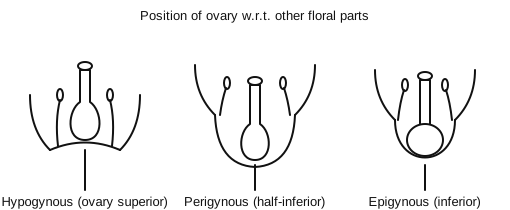
Concept: In a perigynous flower the gynoecium sits in the centre of a cup-shaped thalamus. The sepals, petals and stamens arise from the rim of the cup at almost the same level as the ovary, which is called half-inferior (e.g. plum, rose, peach).

  1. In both (a) and (b), the ovary sits at the bottom of a cup-shaped thalamus.
  2. In both, the sepals, petals and stamens arise from the rim of that cup, not below the ovary as in hypogynous flowers and not above it as in epigynous ones.
  3. So both flowers are perigynous. In an epigynous flower the thalamus fuses with the ovary wall and the other parts arise above the ovary, which is not seen in either figure.

Short trick: Look at where the petals start. Below the ovary means hypo, at the cup rim beside the ovary means peri, and on top of the ovary means epi.

Answer: (C) (a) Perigynous; (b) Perigynous

अवधारणा: परिजायांगी पुष्प में जायांग प्यालेनुमा पुष्पासन के केंद्र में होता है। बाह्यदल, दल और पुंकेसर प्याले के किनारे से लगभग अंडाशय के स्तर पर निकलते हैं; ऐसे अंडाशय को अर्ध-अधोवर्ती कहते हैं (जैसे आलूबुखारा, गुलाब, आड़ू)।

  1. (a) और (b) दोनों में अंडाशय प्यालेनुमा पुष्पासन के तल में स्थित है।
  2. दोनों में बाह्यदल, दल और पुंकेसर उसी प्याले के किनारे से निकलते हैं; न तो अंडाशय के नीचे से (अधोजायांगी की तरह) और न ही अंडाशय के ऊपर से (उपरिजायांगी की तरह)।
  3. अतः दोनों पुष्प परिजायांगी हैं। उपरिजायांगी पुष्प में पुष्पासन अंडाशय की भित्ति से जुड़ जाता है और अन्य भाग अंडाशय के ऊपर से निकलते हैं, जो किसी भी चित्र में नहीं दिखता।

शॉर्ट ट्रिक: देखें कि दल कहाँ से शुरू होते हैं। अंडाशय के नीचे से हों तो अधो, प्याले के किनारे पर अंडाशय के बराबर हों तो परि, और अंडाशय के ऊपर से हों तो उपरि।

उत्तर: (C) (a) परिजायांगी; (b) परिजायांगी

NEET UGBotanyMorphology of flowering plants – position of ovaryNEET UG 2024 · 5 May Shift 1
Q16.
Match List I with List II.
List-IList-II
A. NucleolusI. Site of formation of glycolipid
B. CentrioleII. Organisation like the cartwheel
C. LeucoplastsIII. Site for active ribosomal RNA synthesis
D. Golgi apparatusIV. For storing nutrients
Choose the correct answer from the options given below:
सूची-I का सूची-II से मिलान कीजिए।
सूची-Iसूची-II
A. केंद्रिका (Nucleolus)I. ग्लाइकोलिपिड निर्माण का स्थल
B. तारक केंद्र (Centriole)II. गाड़ी के पहिए (cartwheel) जैसा संगठन
C. अवर्णीलवक (Leucoplasts)III. सक्रिय राइबोसोमल RNA संश्लेषण का स्थल
D. गॉल्जी उपकरणIV. पोषक पदार्थों के संग्रह हेतु
नीचे दिए गए विकल्पों में से सही उत्तर चुनिए:
  1. AA-II, B-III, C-I, D-IV
  2. BA-III, B-IV, C-II, D-I
  3. CA-I, B-II, C-III, D-IV
  4. DA-III, B-II, C-IV, D-I
Show answer

Concept: Each organelle is matched to its NCERT function.

  1. A → III: the nucleolus is the site of active ribosomal RNA synthesis.
  2. B → II: a centriole has a cartwheel organisation of 9 peripheral triplet fibrils.
  3. C → IV: leucoplasts are colourless plastids that store nutrients (amyloplasts store starch, elaioplasts oil, aleuroplasts protein).
  4. D → I: the Golgi apparatus is the important site of formation of glycoproteins and glycolipids.

Short trick: Nucleolus goes with rRNA and Centriole with cartwheel. A-III with B-II is found only in option (D).

Answer: (D) A-III, B-II, C-IV, D-I

अवधारणा: प्रत्येक कोशिकांग को उसके NCERT कार्य से मिलाया गया है।

  1. A → III: केंद्रिका सक्रिय राइबोसोमल RNA संश्लेषण का स्थल है।
  2. B → II: तारक केंद्र में 9 परिधीय त्रिक तंतुकों का गाड़ी के पहिए जैसा संगठन होता है।
  3. C → IV: अवर्णीलवक रंगहीन लवक हैं जो पोषक पदार्थों का संग्रह करते हैं (मंडलवक में मंड, तेललवक में तेल, प्रोटीनलवक में प्रोटीन)।
  4. D → I: गॉल्जी उपकरण ग्लाइकोप्रोटीन और ग्लाइकोलिपिड निर्माण का महत्त्वपूर्ण स्थल है।

शॉर्ट ट्रिक: केंद्रिका को rRNA से और तारक केंद्र को गाड़ी के पहिए (cartwheel) जैसे संगठन से जोड़ें। A-III के साथ B-II केवल विकल्प (D) में है।

उत्तर: (D) A-III, B-II, C-IV, D-I

NEET UGBotanyCell: the unit of life – cell organellesNEET UG 2024 · 5 May Shift 1
Q17.
What is the fate of a piece of DNA carrying only gene of interest which is transferred into an alien organism?
A. The piece of DNA would be able to multiply itself independently in the progeny cells of the organism.
B. It may get integrated into the genome of the recipient.
C. It may multiply and be inherited along with the host DNA.
D. The alien piece of DNA is not an integral part of chromosome.
E. It shows ability to replicate.
Choose the correct answer from the options given below:
केवल वांछित जीन वाले DNA के एक खंड को किसी विदेशी (alien) जीव में स्थानांतरित करने पर उसका क्या होता है?
A. DNA का यह खंड जीव की संतति कोशिकाओं में स्वतंत्र रूप से अपनी संख्या बढ़ा सकेगा।
B. यह ग्राही (recipient) के जीनोम में समाकलित (integrate) हो सकता है।
C. यह परपोषी DNA के साथ गुणित होकर वंशागत हो सकता है।
D. विदेशी DNA खंड गुणसूत्र का अभिन्न अंग नहीं होता।
E. यह प्रतिकृतिकरण की क्षमता दर्शाता है।
नीचे दिए गए विकल्पों में से सही उत्तर चुनिए:
  1. AD and E onlyकेवल D और E
  2. BB and C onlyकेवल B और C
  3. CA and E onlyकेवल A और E
  4. DA and B onlyकेवल A और B
Show answer

Concept: NCERT: a piece of DNA with only the gene of interest has no origin of replication (ori), so it cannot replicate on its own.

  1. Such DNA cannot multiply independently in the progeny cells, so A and E are false.
  2. It may get integrated into the recipient's genome (B true). It then multiplies and is inherited along with the host DNA (C true).
  3. D is false: the useful fate is integration, after which the alien DNA becomes part of the host chromosome (which is why it can then replicate).

Short trick: No ori means no independent replication. The DNA must "hitch-hike" on the host chromosome, which is what B and C describe.

Answer: (B) B and C only

अवधारणा: NCERT: केवल वांछित जीन वाले DNA खंड में प्रतिकृतिकरण उद्भव (ori) नहीं होता, इसलिए वह स्वयं प्रतिकृति नहीं बना सकता।

  1. ऐसा DNA संतति कोशिकाओं में स्वतंत्र रूप से गुणित नहीं हो सकता, अतः A और E असत्य हैं।
  2. यह ग्राही के जीनोम में समाकलित हो सकता है (B सत्य)। फिर यह परपोषी DNA के साथ गुणित होकर वंशागत होता है (C सत्य)।
  3. D असत्य है: समाकलन के बाद विदेशी DNA परपोषी गुणसूत्र का भाग बन जाता है (इसी कारण वह तब प्रतिकृति बना पाता है)।

शॉर्ट ट्रिक: ori नहीं तो स्वतंत्र प्रतिकृतिकरण भी नहीं। DNA को परपोषी गुणसूत्र के सहारे चलना पड़ता है, जो B और C बताते हैं।

उत्तर: (B) केवल B और C

NEET UGBotanyBiotechnology – principles (fate of alien DNA)NEET UG 2024 · 5 May Shift 1
Q18.
Hind II always cuts DNA molecules at a particular point called recognition sequence and it consists of
Hind II सदैव DNA अणुओं को एक विशेष बिंदु पर काटता है जिसे पहचान अनुक्रम (recognition sequence) कहते हैं। इसमें होते हैं:
  1. A6 bp
  2. B4 bp
  3. C10 bp
  4. D8 bp
Show answer

Concept: Hind II was the first restriction endonuclease isolated. It always cuts DNA at a specific recognition sequence of six base pairs.

  1. NCERT: "…recognising a specific sequence of six base pairs. This specific base sequence is known as the recognition sequence for Hind II."
  2. So the recognition sequence consists of 6 bp.

Short trick: Hind II is the first enzyme and has a six-bp site, the same length as the classic EcoRI site GAATTC.

Answer: (A) 6 bp

अवधारणा: Hind II पहला पृथक किया गया प्रतिबंधन एंडोन्यूक्लिएज़ था। यह DNA को सदैव छह क्षारक युग्मों के एक विशिष्ट पहचान अनुक्रम पर काटता है।

  1. NCERT: "…छह क्षार युग्मों के विशिष्ट अनुक्रम को पहचानकर; इस विशिष्ट क्षार अनुक्रम को Hind II का पहचान अनुक्रम कहते हैं।"
  2. अतः पहचान अनुक्रम में 6 bp होते हैं।

शॉर्ट ट्रिक: Hind II पहला एंजाइम है और इसका स्थल छह bp का है, जितना प्रसिद्ध EcoRI स्थल GAATTC।

उत्तर: (A) 6 bp

NEET UGBotanyBiotechnology – restriction enzymesNEET UG 2024 · 5 May Shift 1
Q19.
The cofactor of the enzyme carboxypeptidase is
कार्बोक्सीपेप्टिडेज़ एंजाइम का सहकारक (cofactor) है:
  1. ANiacinनियासिन
  2. BFlavinफ्लेविन
  3. CHaemहीम
  4. DZincजिंक
Show answer

Concept: Cofactors can be prosthetic groups, coenzymes or metal ions. Zinc is the NCERT example of a metal-ion cofactor for the proteolytic enzyme carboxypeptidase.

  1. Haem is the prosthetic group of peroxidase and catalase.
  2. NAD and NADP contain the vitamin niacin, and FAD contains flavin (riboflavin). These are coenzymes of dehydrogenases and other enzymes.
  3. Zn2+ is the cofactor of carboxypeptidase.

Short trick: Think "Zinc Cuts" for Carboxypeptidase, a protein-cutting enzyme.

Answer: (D) Zinc

अवधारणा: सहकारक प्रोस्थेटिक समूह, सहएंजाइम या धातु आयन हो सकते हैं। प्रोटीन-अपघटक एंजाइम कार्बोक्सीपेप्टिडेज़ के लिए धातु-आयन सहकारक का NCERT उदाहरण जिंक है।

  1. हीम, परऑक्सीडेज़ और कैटालेज़ का प्रोस्थेटिक समूह है।
  2. NAD और NADP में विटामिन नियासिन होता है, और FAD में फ्लेविन (राइबोफ्लेविन) होता है। ये डीहाइड्रोजिनेज़ आदि के सहएंजाइम हैं।
  3. Zn2+ कार्बोक्सीपेप्टिडेज़ का सहकारक है।

शॉर्ट ट्रिक: "Zinc Cuts" से Carboxypeptidase याद रखें, जो प्रोटीन काटने वाला एंजाइम है।

उत्तर: (D) जिंक

NEET UGBotanyBiomolecules – enzyme cofactorsNEET UG 2024 · 5 May Shift 1
Q20.
Which of the following are required for the dark reaction of photosynthesis?
A. Light
B. Chlorophyll
C. CO2
D. ATP
E. NADPH
Choose the correct answer from the options given below:
प्रकाश-संश्लेषण की अदीप्त अभिक्रिया (dark reaction) के लिए निम्नलिखित में से कौन-से आवश्यक हैं?
A. प्रकाश
B. पर्णहरित (Chlorophyll)
C. CO2
D. ATP
E. NADPH
नीचे दिए गए विकल्पों में से सही उत्तर चुनिए:
  1. AB, C and D onlyकेवल B, C और D
  2. BC, D and E onlyकेवल C, D और E
  3. CD and E onlyकेवल D और E
  4. DA, B and C onlyकेवल A, B और C
Show answer

Concept: The biosynthetic (dark) phase does not depend directly on light. It needs the products of the light reaction, ATP and NADPH, besides CO2 and H2O.

  1. C, D and E are required: RuBisCO fixes CO2, and the reduction of PGA uses ATP and NADPH.
  2. A (light) and B (chlorophyll) are needed only in the light reaction, which happens in the thylakoids.

Short trick: The dark reaction is the "kitchen" in the stroma: it needs raw material (CO2) and fuel (ATP + NADPH), not sunlight or pigment.

Answer: (B) C, D and E only

अवधारणा: जैवसंश्लेषी (अदीप्त) प्रावस्था सीधे प्रकाश पर निर्भर नहीं होती। इसे CO2 और H2O के अतिरिक्त प्रकाश अभिक्रिया के उत्पादों ATP और NADPH की आवश्यकता होती है।

  1. C, D और E आवश्यक हैं: RuBisCO CO2 का स्थिरीकरण करता है, और PGA के अपचयन में ATP और NADPH लगते हैं।
  2. A (प्रकाश) और B (पर्णहरित) केवल प्रकाश अभिक्रिया में आवश्यक हैं, जो थाइलेकॉइड में होती है।

शॉर्ट ट्रिक: अदीप्त अभिक्रिया स्ट्रोमा की "रसोई" है: इसे कच्चा माल (CO2) और ईंधन (ATP + NADPH) चाहिए, सूर्य-प्रकाश या वर्णक नहीं।

उत्तर: (B) केवल C, D और E

NEET UGBotanyPhotosynthesis – dark reactionNEET UG 2024 · 5 May Shift 1