Q1.For the following reaction sequence, choose the correct option
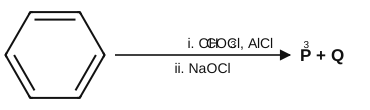
निम्नलिखित अभिक्रिया अनुक्रम के लिए सही विकल्प चुनिए
- AIf P is the sodium salt of a carboxylic acid, Q is a primary alcohol.यदि P किसी कार्बोक्सिलिक अम्ल का सोडियम लवण है, तो Q एक प्राथमिक ऐल्कोहॉल है।
- BP and Q are aromatic compounds.P और Q ऐरोमैटिक यौगिक हैं।
- CIf P gives a carboxylic acid on acidification, Q gives a poisonous gas on exposure to air and light.यदि P अम्लीकरण पर कार्बोक्सिलिक अम्ल देता है, तो Q वायु और प्रकाश के संपर्क में आने पर एक विषैली गैस देता है।
- DBoth P and Q are carbonyl compounds.P और Q दोनों कार्बोनिल यौगिक हैं।
Show answer
Concept: Friedel-Crafts acylation puts a COCH3 group on benzene; a methyl ketone with NaOCl undergoes the haloform reaction (RCOCH3 → RCOO−Na+ + CHCl3).
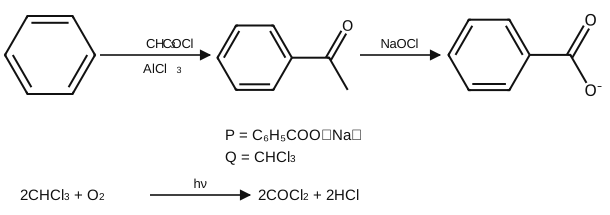
- C6H6 + CH3COCl/AlCl3 → C6H5COCH3 (acetophenone).
- C6H5COCH3 + 3NaOCl → C6H5COONa (P) + CHCl3 (Q) + 2NaOH.
- P on acidification gives benzoic acid; Q (chloroform) is slowly oxidised by air in light to phosgene: 2CHCl3 + O2 → 2COCl2 + 2HCl – a poisonous gas. So (C) is correct.
- (A) Q is CHCl3, not an alcohol. (B) CHCl3 is not aromatic. (D) Neither sodium benzoate (carboxylate) nor CHCl3 is a carbonyl compound (aldehyde/ketone).
Short trick: CH3CO– group + NaOCl ⇒ "haloform": acid salt + CHX3. Chloroform is stored in dark, closed, full bottles because of phosgene.
Answer: (C) Q (CHCl3) gives poisonous COCl2
अवधारणा: फ्रीडेल-क्राफ्ट्स ऐसिलन से बेंज़ीन पर COCH3 समूह जुड़ता है; मेथिल कीटोन NaOCl के साथ हैलोफॉर्म अभिक्रिया देता है (RCOCH3 → RCOO−Na+ + CHCl3)।
- C6H6 + CH3COCl/AlCl3 → C6H5COCH3 (ऐसीटोफ़ीनोन)।
- C6H5COCH3 + 3NaOCl → C6H5COONa (P) + CHCl3 (Q) + 2NaOH।
- P अम्लीकरण पर बेंज़ोइक अम्ल देता है; Q (क्लोरोफॉर्म) प्रकाश में वायु द्वारा धीरे-धीरे फॉस्जीन में ऑक्सीकृत होता है: 2CHCl3 + O2 → 2COCl2 + 2HCl – एक विषैली गैस। अतः (C) सही है।
- (A) Q, CHCl3 है, ऐल्कोहॉल नहीं। (B) CHCl3 ऐरोमैटिक नहीं है। (D) न सोडियम बेंज़ोएट (कार्बोक्सिलेट) और न CHCl3 कार्बोनिल यौगिक (ऐल्डिहाइड/कीटोन) है।
शॉर्ट ट्रिक: CH3CO– समूह + NaOCl ⇒ "हैलोफॉर्म": अम्ल-लवण + CHX3। फॉस्जीन बनने के कारण क्लोरोफॉर्म को गहरे रंग की, बंद, पूरी भरी बोतलों में रखा जाता है।
उत्तर: (C) Q (CHCl3) विषैली COCl2 देता है
NEET UGChemistryAldehydes & ketones – Friedel-Crafts acylation and haloform reactionNEET UG 2026 · 21 Jun Shift 1
Q2.Given below are two statements:
Statement-I : [Fe(ox)3]3− is chiral.
Statement-II : trans-[Cr(H2O)2(ox)2]− is chiral.
(Given : oxH2 = HOOC – COOH)
In light of the above statements, choose the most appropriate answer from the options given below:
नीचे दो कथन दिए गए हैं:
कथन-I : [Fe(ox)3]3− किरेल है।
कथन-II : trans-[Cr(H2O)2(ox)2]− किरेल है।
(दिया है : oxH2 = HOOC – COOH)
उपर्युक्त कथनों के आलोक में, नीचे दिए गए विकल्पों में से सबसे उपयुक्त उत्तर चुनिए:
- ABoth Statement-I and Statement-II are correct.कथन-I और कथन-II दोनों सही हैं।
- BBoth Statement-I and Statement-II are incorrect.कथन-I और कथन-II दोनों गलत हैं।
- CStatement-I is correct but Statement-II is incorrect.कथन-I सही है लेकिन कथन-II गलत है।
- DStatement-I is incorrect but Statement-II is correct.कथन-I गलत है लेकिन कथन-II सही है।
Show answer
Concept: A complex is chiral only if it has no mirror plane (or centre of symmetry). [M(AA)3] is always chiral; trans-[M(AA)2B2] has a mirror plane, only the cis form is chiral.
- [Fe(ox)3]3−: three bidentate oxalates form a propeller – Δ and Λ forms are non-superimposable mirror images → chiral. Statement-I correct.
- trans-[Cr(H2O)2(ox)2]−: both ox ligands lie in one plane with the two H2O above and below; that equatorial plane is a mirror plane → achiral. Statement-II incorrect.
Short trick: AA3 → always optically active; (AA)2B2 → only cis is optically active, trans never.
Answer: (C) Statement-I correct, Statement-II incorrect
अवधारणा: कोई संकुल तभी किरेल होता है जब उसमें कोई दर्पण तल (या सममिति केंद्र) न हो। [M(AA)3] सदैव किरेल होता है; trans-[M(AA)2B2] में दर्पण तल होता है, केवल cis रूप किरेल होता है।
- [Fe(ox)3]3−: तीन द्विदंतुर ऑक्सेलेट प्रोपेलर जैसी संरचना बनाते हैं – Δ और Λ रूप अध्यारोपणीय नहीं होने वाले दर्पण प्रतिबिंब हैं → किरेल। कथन-I सही।
- trans-[Cr(H2O)2(ox)2]−: दोनों ox लिगन्ड एक ही तल में हैं और दोनों H2O उसके ऊपर-नीचे; यह विषुवतीय तल दर्पण तल है → अकिरेल। कथन-II गलत।
शॉर्ट ट्रिक: AA3 → सदैव ध्रुवण घूर्णक; (AA)2B2 → केवल cis ध्रुवण घूर्णक, trans कभी नहीं।
उत्तर: (C) कथन-I सही, कथन-II गलत
NEET UGChemistryCoordination compounds – optical isomerismNEET UG 2026 · 21 Jun Shift 1
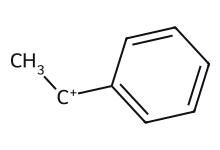
Q3.The following carbocation is stabilized by the interaction of the empty p orbital with
निम्नलिखित कार्बधनायन रिक्त p कक्षक की किसके साथ अन्योन्यक्रिया द्वारा स्थायीकृत होता है?
- Afilled σ and filled π orbitalsभरे हुए σ और भरे हुए π कक्षक
- Bempty σ and empty π* orbitalsरिक्त σ और रिक्त π* कक्षक
- Cempty σ* and filled π orbitalsरिक्त σ* और भरे हुए π कक्षक
- Dempty σ* and empty π* orbitalsरिक्त σ* और रिक्त π* कक्षक
Show answer
Concept: An empty p orbital (electron-deficient) is stabilised only by donation of electrons – i.e. by overlap with filled orbitals.
- Resonance: the empty p orbital overlaps with the filled π orbitals of the benzene ring (benzylic cation, + charge delocalised to o/p positions).
- Hyperconjugation: it also overlaps with the filled σ(C–H) orbitals of the adjacent CH3 group (3 α-H).
- Empty orbitals (σ*, π*) cannot donate electrons, so (B), (C), (D) are wrong.
Short trick: Cation needs electrons → partner must be FILLED (σ for hyperconjugation, π for resonance).
Answer: (A) filled σ and filled π orbitals
अवधारणा: रिक्त p कक्षक (इलेक्ट्रॉन-न्यून) केवल इलेक्ट्रॉन दान से स्थायी होता है – अर्थात भरे हुए कक्षकों के साथ अतिव्यापन से।
- अनुनाद: रिक्त p कक्षक बेंज़ीन वलय के भरे हुए π कक्षकों से अतिव्यापन करता है (बेंज़िलिक धनायन, + आवेश o/p स्थितियों पर विस्थानीकृत)।
- अतिसंयुग्मन (hyperconjugation): यह संलग्न CH3 समूह के भरे हुए σ(C–H) कक्षकों (3 α-H) से भी अतिव्यापन करता है।
- रिक्त कक्षक (σ*, π*) इलेक्ट्रॉन दान नहीं कर सकते, अतः (B), (C), (D) गलत हैं।
शॉर्ट ट्रिक: धनायन को इलेक्ट्रॉन चाहिए → साथी कक्षक भरा हुआ होना चाहिए (अतिसंयुग्मन हेतु σ, अनुनाद हेतु π)।
उत्तर: (A) भरे हुए σ और भरे हुए π कक्षक
NEET UGChemistryCarbocation stability – resonance and hyperconjugationNEET UG 2026 · 21 Jun Shift 1
Q4.In potash alum, the ratio of K+ and SO42− ions is
पोटाश ऐलम में K+ और SO42− आयनों का अनुपात है
- A1 : 2
- B2 : 1
- C2 : 3
- D3 : 2
Show answer
Concept: Potash alum is K2SO4·Al2(SO4)3·24H2O, i.e. KAl(SO4)2·12H2O.
- Per formula KAl(SO4)2·12H2O: 1 K+, 1 Al3+, 2 SO42−.
- K+ : SO42− = 1 : 2 (check charge: +1 +3 = +4 = 2 × 2).
Short trick: Alum = M+M3+(SO4)2·12H2O – always one M+ for two sulphates.
Answer: (A) 1 : 2
अवधारणा: पोटाश ऐलम K2SO4·Al2(SO4)3·24H2O है, अर्थात KAl(SO4)2·12H2O।
- सूत्र KAl(SO4)2·12H2O में: 1 K+, 1 Al3+, 2 SO42−।
- K+ : SO42− = 1 : 2 (आवेश जाँच: +1 +3 = +4 = 2 × 2)।
शॉर्ट ट्रिक: ऐलम = M+M3+(SO4)2·12H2O – दो सल्फेट पर सदैव एक M+।
उत्तर: (A) 1 : 2
NEET UGChemistryDouble salts – potash alumNEET UG 2026 · 21 Jun Shift 1
Q5.The correct statement about peptides and proteins is
पेप्टाइडों और प्रोटीनों के बारे में सही कथन है
- ATertiary structure of proteins has two or more polypeptide subunitsप्रोटीनों की तृतीयक संरचना में दो या अधिक पॉलिपेप्टाइड उप-इकाइयाँ होती हैं
- BOnly the proteins having a quaternary structure are biologically active.केवल चतुष्क संरचना वाले प्रोटीन ही जैविक रूप से सक्रिय होते हैं।
- CIn β-pleated sheet structures, peptide chains are held together by intermolecular hydrogen bonds.β-प्लीटेड शीट संरचनाओं में पेप्टाइड शृंखलाएँ अंतराअणुक (intermolecular) हाइड्रोजन आबंधों द्वारा एक साथ जुड़ी रहती हैं।
- DIn α-helices, the polypeptide chain is twisted into a left-handed screw (helix) through intramolecular hydrogen bonds.α-हेलिक्स में पॉलिपेप्टाइड शृंखला अंतःअणुक (intramolecular) हाइड्रोजन आबंधों द्वारा वामावर्ती पेंच (हेलिक्स) में मुड़ी होती है।
Show answer
Concept: NCERT: β-pleated sheet – chains laid side by side, held by intermolecular H-bonds; α-helix – right-handed helix with intramolecular H-bonds (–NH of one turn to C=O of the next).
- (A) wrong: two or more subunits = quaternary structure, not tertiary.
- (B) wrong: many proteins with only tertiary structure (e.g. myoglobin, most enzymes) are biologically active.
- (C) correct: neighbouring chains in a β-sheet are joined by intermolecular H-bonds.
- (D) wrong: the α-helix is a right-handed screw.
Short trick: α – intrA – Right-handed; β – betWEEN chains (inter).
Answer: (C) β-sheets held by intermolecular H-bonds
अवधारणा: NCERT: β-प्लीटेड शीट – शृंखलाएँ अगल-बगल, अंतराअणुक H-आबंधों से जुड़ी; α-हेलिक्स – दक्षिणावर्ती हेलिक्स, अंतःअणुक H-आबंध (एक घुमाव का –NH अगले घुमाव के C=O से)।
- (A) गलत: दो या अधिक उप-इकाइयाँ = चतुष्क संरचना, तृतीयक नहीं।
- (B) गलत: केवल तृतीयक संरचना वाले अनेक प्रोटीन (जैसे मायोग्लोबिन, अधिकांश एंज़ाइम) जैविक रूप से सक्रिय होते हैं।
- (C) सही: β-शीट में पड़ोसी शृंखलाएँ अंतराअणुक H-आबंधों से जुड़ी होती हैं।
- (D) गलत: α-हेलिक्स दक्षिणावर्ती (right-handed) पेंच होता है।
शॉर्ट ट्रिक: α – अंतः (intra) – दक्षिणावर्ती; β – शृंखलाओं के बीच (inter)।
उत्तर: (C) β-शीट अंतराअणुक H-आबंधों से जुड़ी
NEET UGChemistryBiomolecules – structure of proteinsNEET UG 2026 · 21 Jun Shift 1
Q6.The numbers 17.0145 and 21.0235 were rounded to three figures after the decimal point. The resulting numbers, respectively, are
संख्याओं 17.0145 और 21.0235 को दशमलव के बाद तीन अंकों तक पूर्णांकित किया गया। प्राप्त संख्याएँ क्रमशः हैं
- A17.014 and 21.02317.014 और 21.023
- B17.015 and 21.02317.015 और 21.023
- C17.014 and 21.02417.014 और 21.024
- D17.015 and 21.02417.015 और 21.024
Show answer
Concept: NCERT rounding rule: if the digit to be dropped is exactly 5, the preceding digit is left unchanged if it is even and increased by 1 if it is odd.
- 17.0145: dropped digit 5, preceding digit 4 (even) → stays → 17.014.
- 21.0235: dropped digit 5, preceding digit 3 (odd) → becomes 4 → 21.024.
Short trick: "5 makes it EVEN": after rounding, the last kept digit must be even.
Answer: (C) 17.014 and 21.024
अवधारणा: NCERT पूर्णांकन नियम: यदि हटाया जाने वाला अंक ठीक 5 है, तो उससे पहले का अंक सम हो तो अपरिवर्तित रहता है और विषम हो तो 1 बढ़ा दिया जाता है।
- 17.0145: हटाया गया अंक 5, पहले का अंक 4 (सम) → अपरिवर्तित → 17.014।
- 21.0235: हटाया गया अंक 5, पहले का अंक 3 (विषम) → 4 बनता है → 21.024।
शॉर्ट ट्रिक: "5 सम बनाता है": पूर्णांकन के बाद अंतिम रखा गया अंक सम होना चाहिए।
उत्तर: (C) 17.014 और 21.024
NEET UGChemistrySome basic concepts – rounding offNEET UG 2026 · 21 Jun Shift 1
Q7.The correct order of solubility of the given salts in water at 298 K is
| Salt | Ksp at 298 K |
|---|
| AgBr | |
| Zn(OH)2 | |
| Hg2Cl2 | |
298 K पर जल में दिए गए लवणों की विलेयता का सही क्रम है
| लवण | 298 K पर Ksp |
|---|
| AgBr | |
| Zn(OH)2 | |
| Hg2Cl2 | |
- AHg2Cl2 > Zn(OH)2 > AgBr
- BAgBr > Zn(OH)2 > Hg2Cl2
- CHg2Cl2 > AgBr > Zn(OH)2
- DZn(OH)2 > AgBr > Hg2Cl2
Show answer
Concept: Ksp values can be compared directly only for salts of the same type; otherwise convert each to molar solubility s.
- AgBr (1:1): Ksp = s2 → M.
- Zn(OH)2 (1:2): Ksp = s(2s)2 = 4s3 → M.
- Hg2Cl2 ⇌ Hg22+ + 2Cl−: Ksp = 4s3 → M.
- Order: Zn(OH)2 (6.3 × 10⁻⁶) > AgBr (7.1 × 10⁻⁷) > Hg2Cl2 (6.9 × 10⁻⁷).
Short trick: Remember Hg2Cl2 gives the dimeric Hg22+ ion, so it is an AB2-type salt (Ksp = 4s3), not A2B2.
Answer: (D) Zn(OH)2 > AgBr > Hg2Cl2
अवधारणा: Ksp मानों की सीधी तुलना केवल समान प्रकार के लवणों में की जा सकती है; अन्यथा प्रत्येक को मोलर विलेयता s में बदलें।
- AgBr (1:1): Ksp = s2 → M।
- Zn(OH)2 (1:2): Ksp = s(2s)2 = 4s3 → M।
- Hg2Cl2 ⇌ Hg22+ + 2Cl−: Ksp = 4s3 → M।
- क्रम: Zn(OH)2 (6.3 × 10⁻⁶) > AgBr (7.1 × 10⁻⁷) > Hg2Cl2 (6.9 × 10⁻⁷)।
शॉर्ट ट्रिक: याद रखें Hg2Cl2 द्विलकी Hg22+ आयन देता है, अतः यह AB2 प्रकार का लवण है (Ksp = 4s3), A2B2 नहीं।
उत्तर: (D) Zn(OH)2 > AgBr > Hg2Cl2
NEET UGChemistryIonic equilibrium – solubility productNEET UG 2026 · 21 Jun Shift 1
Q8.Among the following options, the correct trend in the electron gain enthalpy is
निम्नलिखित विकल्पों में से इलेक्ट्रॉन लब्धि एन्थैल्पी की सही प्रवृत्ति है
- AF > Cl > Br > I
- BBr > Cl > F > I
- CCl > F > Br > I
- DI > Br > Cl > F
Show answer
Concept: Electron gain enthalpy (magnitude, more negative) of halogens: Cl (−349) > F (−328) > Br (−325) > I (−295) kJ mol−1.
- Down the group the added electron goes farther from the nucleus → less negative ΔegH (Cl > Br > I).
- F is an exception: its very small 2p subshell causes strong inter-electronic repulsion, so F is less negative than Cl.
Short trick: Halogen anomaly: "Cl beats F" – same pattern as O < S for group 16.
Answer: (C) Cl > F > Br > I
अवधारणा: हैलोजनों की इलेक्ट्रॉन लब्धि एन्थैल्पी (परिमाण, अधिक ऋणात्मक): Cl (−349) > F (−328) > Br (−325) > I (−295) kJ mol−1।
- वर्ग में नीचे जाने पर जुड़ने वाला इलेक्ट्रॉन नाभिक से दूर जाता है → ΔegH कम ऋणात्मक (Cl > Br > I)।
- F अपवाद है: इसके अत्यंत छोटे 2p उपकोश में तीव्र अंतर-इलेक्ट्रॉनिक प्रतिकर्षण होता है, इसलिए F, Cl से कम ऋणात्मक है।
शॉर्ट ट्रिक: हैलोजन अपवाद: "Cl, F से आगे" – वर्ग 16 में O < S जैसा ही।
उत्तर: (C) Cl > F > Br > I
NEET UGChemistryPeriodic properties – electron gain enthalpyNEET UG 2026 · 21 Jun Shift 1
Q9.Assertion A:
For an ideal solution formed by mixing liquids P and Q, ΔmixH = 0 and ΔmixV = 0
Reason R:
No interactions occur between P and Q
In the light of the above statements, choose the most appropriate answer from the options given below.
अभिकथन A:
द्रवों P और Q को मिलाकर बने आदर्श विलयन के लिए ΔmixH = 0 और ΔmixV = 0
कारण R:
P और Q के बीच कोई अन्योन्यक्रिया नहीं होती
उपर्युक्त कथनों के आलोक में, नीचे दिए गए विकल्पों में से सबसे उपयुक्त उत्तर चुनिए।
- ABoth A and R are correct and R is the correct explanation of AA और R दोनों सही हैं और R, A की सही व्याख्या है
- BBoth A and R are correct but R is NOT the correct explanation of AA और R दोनों सही हैं लेकिन R, A की सही व्याख्या नहीं है
- CA is correct but R is not correctA सही है लेकिन R सही नहीं है
- DA is not correct but R is correctA सही नहीं है लेकिन R सही है
Show answer
Concept: In an ideal solution the A–B interactions are nearly equal to the A–A and B–B interactions; hence no heat change and no volume change on mixing.
- A is correct: ideal solution ⇒ ΔmixH = 0, ΔmixV = 0 (and obeys Raoult’s law).
- R is wrong: P–Q interactions do exist; they are simply of the same strength as P–P and Q–Q interactions. "No interaction" would describe an ideal gas, not a liquid solution.
Short trick: Ideal solution = "equal" interactions, not "zero" interactions.
Answer: (C) A is correct but R is not correct
अवधारणा: आदर्श विलयन में A–B अन्योन्यक्रियाएँ लगभग A–A और B–B अन्योन्यक्रियाओं के बराबर होती हैं; अतः मिलाने पर न ऊष्मा परिवर्तन होता है, न आयतन परिवर्तन।
- A सही है: आदर्श विलयन ⇒ ΔmixH = 0, ΔmixV = 0 (तथा राउल्ट नियम का पालन)।
- R गलत है: P–Q अन्योन्यक्रियाएँ होती हैं; वे बस P–P और Q–Q अन्योन्यक्रियाओं जितनी ही प्रबल होती हैं। "कोई अन्योन्यक्रिया नहीं" आदर्श गैस का वर्णन है, द्रव विलयन का नहीं।
शॉर्ट ट्रिक: आदर्श विलयन = "बराबर" अन्योन्यक्रिया, "शून्य" अन्योन्यक्रिया नहीं।
उत्तर: (C) A सही है लेकिन R सही नहीं है
NEET UGChemistrySolutions – ideal solutions (assertion-reason)NEET UG 2026 · 21 Jun Shift 1
Q10.The amino acid that gives a red-blood colour on treating its sodium fusion extract with sodium nitroprusside is
वह ऐमीनो अम्ल जिसका सोडियम संगलन निष्कर्ष सोडियम नाइट्रोप्रुसाइड के साथ उपचारित करने पर रक्त-लाल रंग देता है, है
- Aleucineल्यूसीन (leucine)
- Bthreonineथ्रिओनीन (threonine)
- Cmethionineमेथिओनीन (methionine)
- Dserineसेरीन (serine)
Show answer
Concept: Sodium nitroprusside is the reagent for sulphur in the sodium fusion (Lassaigne’s) extract: S2− + [Fe(CN)5NO]2− → [Fe(CN)5NOS]4− (coloured complex). So the amino acid must contain sulphur.
- Methionine, CH3–S–CH2CH2CH(NH2)COOH, contains S → Na2S in the extract → positive nitroprusside test.
- Leucine (C6H13NO2), threonine and serine (–OH containing) have no sulphur → no colour.
Short trick: S-containing amino acids: only Methionine and Cysteine (“MC has Sulphur”).
Answer: (C) methionine
अवधारणा: सोडियम नाइट्रोप्रुसाइड सोडियम संगलन (लैसें) निष्कर्ष में सल्फर का अभिकर्मक है: S2− + [Fe(CN)5NO]2− → [Fe(CN)5NOS]4− (रंगीन संकुल)। अतः ऐमीनो अम्ल में सल्फर होना चाहिए।
- मेथिओनीन, CH3–S–CH2CH2CH(NH2)COOH, में S है → निष्कर्ष में Na2S → नाइट्रोप्रुसाइड परीक्षण धनात्मक।
- ल्यूसीन (C6H13NO2), थ्रिओनीन और सेरीन (–OH युक्त) में सल्फर नहीं है → कोई रंग नहीं।
शॉर्ट ट्रिक: S युक्त ऐमीनो अम्ल: केवल मेथिओनीन और सिस्टीन।
उत्तर: (C) मेथिओनीन
NEET UGChemistryOrganic analysis – Lassaigne’s test for sulphurNEET UG 2026 · 21 Jun Shift 1
Q11.The standard electrode potential (E°) for the half-cell reaction Fe3+ + e− → Fe2+ at 298 K is
(Given : E°(Fe3+/Fe) = −0.04 V and E°(Fe2+/Fe) = −0.44 V at 298 K)
298 K पर अर्ध-सेल अभिक्रिया Fe3+ + e− → Fe2+ के लिए मानक इलेक्ट्रोड विभव (E°) है
(दिया है : 298 K पर E°(Fe3+/Fe) = −0.04 V और E°(Fe2+/Fe) = −0.44 V)
- A+0.40 V
- B+0.76 V
- C−0.48 V
- D+0.92 V
Show answer
Concept: Electrode potentials are not additive, but ΔG° = −nFE° is. Add the ΔG° values and convert back.
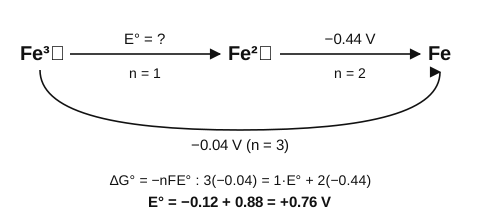
- Fe3+ + 3e− → Fe: ΔG°1 = −3F(−0.04) = +0.12F
- Fe → Fe2+ + 2e− (reverse of Fe2+/Fe): ΔG°2 = −[−2F(−0.44)] = −0.88F
- Adding: Fe3+ + e− → Fe2+, ΔG° = 0.12F − 0.88F = −0.76F
- −1·F·E° = −0.76F ⇒ E° = +0.76 V
Short trick: n3E3 = n1E1 − n2E2: 1·E = 3(−0.04) − 2(−0.44) = +0.76 V.
Answer: (B) +0.76 V
अवधारणा: इलेक्ट्रोड विभव योज्य नहीं होते, परंतु ΔG° = −nFE° योज्य है। ΔG° मान जोड़कर पुनः E° में बदलें।
- Fe3+ + 3e− → Fe: ΔG°1 = −3F(−0.04) = +0.12F
- Fe → Fe2+ + 2e− (Fe2+/Fe का उल्टा): ΔG°2 = −[−2F(−0.44)] = −0.88F
- जोड़ने पर: Fe3+ + e− → Fe2+, ΔG° = 0.12F − 0.88F = −0.76F
- −1·F·E° = −0.76F ⇒ E° = +0.76 V
शॉर्ट ट्रिक: n3E3 = n1E1 − n2E2: 1·E = 3(−0.04) − 2(−0.44) = +0.76 V।
उत्तर: (B) +0.76 V
NEET UGChemistryElectrochemistry – combining electrode potentialsNEET UG 2026 · 21 Jun Shift 1
Q12.In an acidic medium, 10 mL of 0.25 M oxalic acid is titrated with KMnO4 solution. If the volume of KMnO4 solution required to reach end point is 10 mL, the strength of the KMnO4 solution is
अम्लीय माध्यम में 0.25 M ऑक्सैलिक अम्ल के 10 mL का KMnO4 विलयन से अनुमापन किया जाता है। यदि अंत्य बिंदु तक पहुँचने के लिए KMnO4 विलयन का 10 mL आयतन आवश्यक है, तो KMnO4 विलयन की प्रबलता है
- A0.10 M
- B0.20 M
- C0.25 M
- D0.15 M
Show answer
Concept: 2MnO4− + 5C2O42− + 16H+ → 2Mn2+ + 10CO2 + 8H2O; n-factor: KMnO4 = 5, oxalic acid = 2.
- Equivalents equal: M1n1V1 = M2n2V2.
- M × 5 × 10 = 0.25 × 2 × 10 ⇒ 50M = 5 ⇒ M = 0.10 M.
- (Mole check: 2.5 mmol oxalic acid needs 2/5 × 2.5 = 1.0 mmol MnO4− in 10 mL → 0.10 M.)
Short trick: Equal volumes ⇒ M(KMnO4) = 0.25 × 2/5 = 0.10 M.
Answer: (A) 0.10 M
अवधारणा: 2MnO4− + 5C2O42− + 16H+ → 2Mn2+ + 10CO2 + 8H2O; n-गुणांक: KMnO4 = 5, ऑक्सैलिक अम्ल = 2।
- तुल्यांक बराबर: M1n1V1 = M2n2V2।
- M × 5 × 10 = 0.25 × 2 × 10 ⇒ 50M = 5 ⇒ M = 0.10 M।
- (मोल जाँच: 2.5 mmol ऑक्सैलिक अम्ल को 2/5 × 2.5 = 1.0 mmol MnO4− चाहिए, जो 10 mL में है → 0.10 M।)
शॉर्ट ट्रिक: आयतन बराबर ⇒ M(KMnO4) = 0.25 × 2/5 = 0.10 M।
उत्तर: (A) 0.10 M
NEET UGChemistryRedox titration – KMnO<sub>4</sub> vs oxalic acidNEET UG 2026 · 21 Jun Shift 1
Q13.According to crystal field theory, the correct order of ligands with respect to their decreasing order of field strength is
क्रिस्टल क्षेत्र सिद्धांत के अनुसार, लिगन्डों का उनकी क्षेत्र प्रबलता के घटते क्रम में सही क्रम है
- ACO > NH3 > H2O > Cl−
- BCO > H2O > NH3 > Cl−
- CCl− > H2O > NH3 > CO
- DCl− > NH3 > H2O > CO
Show answer
Concept: Spectrochemical series (NCERT): I− < Br− < SCN− < Cl− < S2− < F− < OH− < C2O42− < H2O < NCS− < edta4− < NH3 < en < CN− < CO.
- CO is the strongest (σ-donor + π-acceptor).
- NH3 > H2O (N is a better σ-donor than O).
- Cl− is a weak-field halide ligand.
- So CO > NH3 > H2O > Cl−; (B) swaps NH3/H2O and (C), (D) are reversed.
Short trick: Halides weakest, CO/CN− strongest; "Ammonia Above Aqua".
Answer: (A) CO > NH3 > H2O > Cl−
अवधारणा: स्पेक्ट्रमीरासायनिक श्रेणी (NCERT): I− < Br− < SCN− < Cl− < S2− < F− < OH− < C2O42− < H2O < NCS− < edta4− < NH3 < en < CN− < CO।
- CO सबसे प्रबल है (σ-दाता + π-ग्राही)।
- NH3 > H2O (N, O की तुलना में बेहतर σ-दाता है)।
- Cl− दुर्बल क्षेत्र हैलाइड लिगन्ड है।
- अतः CO > NH3 > H2O > Cl−; (B) में NH3/H2O उलटे हैं तथा (C), (D) पूरा उल्टा क्रम हैं।
शॉर्ट ट्रिक: हैलाइड सबसे दुर्बल, CO/CN− सबसे प्रबल; "अमोनिया, एक्वा से ऊपर"।
उत्तर: (A) CO > NH3 > H2O > Cl−
NEET UGChemistryCoordination compounds – spectrochemical seriesNEET UG 2026 · 21 Jun Shift 1
Q14.Two moles of an ideal gas undergo free expansion from 10 L to 100 L at 300 K. The values of ΔSSystem and ΔSSurroundings are (R is universal gas constant)
एक आदर्श गैस के दो मोल 300 K पर 10 L से 100 L तक मुक्त प्रसार करते हैं। ΔSSystem और ΔSSurroundings के मान हैं (R सार्वत्रिक गैस नियतांक है)
- AΔSSystem = 0; ΔSSurroundings = 0
- BΔSSystem = 4.606R; ΔSSurroundings = −4.606R
- CΔSSystem = 0; ΔSSurroundings = 4.606 R
- DΔSSystem = 4.606R; ΔSSurroundings = 0
Show answer
Concept: Entropy is a state function: ΔSsys for an isothermal ideal-gas change is nR ln(V2/V1) whatever the path. In free expansion q = 0, w = 0, so the surroundings exchange no heat.
- ΔSsys = 2R ln(100/10) = 2R × 2.303 log 10 = 4.606R.
- Free expansion (against vacuum): qactual = 0 ⇒ ΔSsurr = −q/T = 0.
- ΔStotal = 4.606R > 0 – spontaneous, irreversible (as expected).
- (B) would describe a reversible isothermal expansion (ΔStotal = 0), not free expansion.
Short trick: Free expansion: system gets the reversible-path value, surroundings get zero.
Answer: (D) ΔSSystem = 4.606R; ΔSSurroundings = 0
अवधारणा: एन्ट्रॉपी अवस्था फलन है: आदर्श गैस के समतापी परिवर्तन के लिए ΔSsys = nR ln(V2/V1), पथ कोई भी हो। मुक्त प्रसार में q = 0, w = 0, अतः परिवेश से कोई ऊष्मा विनिमय नहीं होता।
- ΔSsys = 2R ln(100/10) = 2R × 2.303 log 10 = 4.606R।
- मुक्त प्रसार (निर्वात के विरुद्ध): qवास्तविक = 0 ⇒ ΔSsurr = −q/T = 0।
- ΔStotal = 4.606R > 0 – स्वतः प्रवर्तित, अनुत्क्रमणीय (जैसा अपेक्षित)।
- (B) उत्क्रमणीय समतापी प्रसार (ΔStotal = 0) का वर्णन करेगा, मुक्त प्रसार का नहीं।
शॉर्ट ट्रिक: मुक्त प्रसार: निकाय को उत्क्रमणीय पथ वाला मान, परिवेश को शून्य।
उत्तर: (D) ΔSSystem = 4.606R; ΔSSurroundings = 0
NEET UGChemistryThermodynamics – entropy change in free expansionNEET UG 2026 · 21 Jun Shift 1
Q15. is a zero-order reaction, where k = 1.0 mol L−1 min−1. If the initial concentration of A is 2 M, then the time taken to complete 75% of the reaction will be
एक शून्य कोटि की अभिक्रिया है, जहाँ k = 1.0 mol L−1 min−1 है। यदि A की प्रारंभिक सांद्रता 2 M है, तो अभिक्रिया के 75% पूर्ण होने में लगा समय होगा
- A1.5 min
- B0.75 min
- C1.0 min
- D2.0 min
Show answer
Concept: For aA → products, rate of reaction r = −(1/a)d[A]/dt = k (zero order) ⇒ [A]0 − [A] = a·k·t.
- 75% of 2 M reacts: Δ[A] = 1.5 M.
- Here a = 2: −(1/2)d[A]/dt = k ⇒ Δ[A] = 2kt.
- t = 1.5/(2 × 1.0) = 0.75 min.
Short trick: Rate constant is defined for the reaction (divide by the coefficient); A disappears 2k fast.
Answer: (B) 0.75 min
अवधारणा: aA → उत्पाद के लिए अभिक्रिया वेग r = −(1/a)d[A]/dt = k (शून्य कोटि) ⇒ [A]0 − [A] = a·k·t।
- 2 M का 75% अभिक्रिया करता है: Δ[A] = 1.5 M।
- यहाँ a = 2: −(1/2)d[A]/dt = k ⇒ Δ[A] = 2kt।
- t = 1.5/(2 × 1.0) = 0.75 min।
शॉर्ट ट्रिक: वेग नियतांक अभिक्रिया के लिए परिभाषित है (गुणांक से भाग दें); A, 2k की दर से घटता है।
उत्तर: (B) 0.75 min
NEET UGChemistryChemical kinetics – zero-order reactionNEET UG 2026 · 21 Jun Shift 1
Q16.Given below are two statements : one is labelled as Assertion A and the other is labelled as Reason R.
Assertion A : Generally, 3d transition metals have high melting points.
Reason R : Involvement of 3d-electrons in addition to 4s-electrons in the interatomic metallic bonding.
In light of the above statements, choose the most appropriate answer from the options given below:
नीचे दो कथन दिए गए हैं : एक को अभिकथन A और दूसरे को कारण R कहा गया है।
अभिकथन A : सामान्यतः 3d संक्रमण धातुओं के गलनांक उच्च होते हैं।
कारण R : अंतरापरमाण्विक धात्विक आबंधन में 4s-इलेक्ट्रॉनों के अतिरिक्त 3d-इलेक्ट्रॉनों की भी भागीदारी।
उपर्युक्त कथनों के आलोक में, नीचे दिए गए विकल्पों में से सबसे उपयुक्त उत्तर चुनिए:
- ABoth A and R are correct and R is the correct explanation of AA और R दोनों सही हैं और R, A की सही व्याख्या है
- BBoth A and R are correct but R is NOT the correct explanation of AA और R दोनों सही हैं लेकिन R, A की सही व्याख्या नहीं है
- CA is correct but R is not correctA सही है लेकिन R सही नहीं है
- DA is not correct but R is correctA सही नहीं है लेकिन R सही है
Show answer
Concept: NCERT: transition metals have high melting points because of the involvement of a greater number of electrons from (n−1)d in addition to ns electrons in interatomic metallic bonding.
- A is true: e.g. Cr, V, Ti melt far above Ca or K.
- R is true and is exactly the reason – more bonding electrons per atom ⇒ stronger metallic bonds ⇒ higher m.p. (maximum near d5).
Short trick: More unpaired d-electrons → stronger metallic bond → m.p. rises up to mid-series.
Answer: (A) Both A and R correct; R explains A
अवधारणा: NCERT: संक्रमण धातुओं के गलनांक उच्च होते हैं क्योंकि अंतरापरमाण्विक धात्विक आबंधन में ns इलेक्ट्रॉनों के अतिरिक्त (n−1)d के अधिक इलेक्ट्रॉन भाग लेते हैं।
- A सत्य है: जैसे Cr, V, Ti के गलनांक Ca या K से बहुत अधिक हैं।
- R सत्य है और यही कारण है – प्रति परमाणु अधिक आबंधी इलेक्ट्रॉन ⇒ प्रबल धात्विक आबंध ⇒ उच्च गलनांक (d5 के आसपास अधिकतम)।
शॉर्ट ट्रिक: अधिक अयुग्मित d-इलेक्ट्रॉन → प्रबल धात्विक आबंध → श्रेणी के मध्य तक गलनांक बढ़ता है।
उत्तर: (A) A और R दोनों सही; R, A की व्याख्या है
NEET UGChemistryd-block elements – melting pointsNEET UG 2026 · 21 Jun Shift 1
Q17.For a salt XY, which is a strong electrolyte, the plot of Λm versus has a slope of −90.0 S cm2 mol−3/2 L1/2 at 298 K. At 0.01 M concentration of XY, the values of Λm is 145 S cm2 mol−1. The limiting molar conductivity of Y− ion (, in S cm2 mol−1) at 298 K will be
(Given = 74.0 S cm2 mol−1)
प्रबल विद्युत-अपघट्य लवण XY के लिए 298 K पर Λm बनाम आलेख की प्रवणता −90.0 S cm2 mol−3/2 L1/2 है। XY की 0.01 M सांद्रता पर Λm का मान 145 S cm2 mol−1 है। 298 K पर Y− आयन की सीमांत मोलर चालकता (, S cm2 mol−1 में) होगी
(दिया है = 74.0 S cm2 mol−1)
- A80.0
- B100.0
- C90.0
- D76.0
Show answer
Concept: Debye–Hückel–Onsager: (slope = −A); Kohlrausch: .
- ; 145 = Λ0 − 90 × 0.1 ⇒ Λ0 = 145 + 9 = 154 S cm2 mol−1.
- = 154 − 74 = 80.0 S cm2 mol−1.
Short trick: Slope is negative, so Λ0 is always LARGER than the measured Λm – add |slope|·√c.
Answer: (A) 80.0
अवधारणा: डेबाई–हकेल–ऑन्सागर: (प्रवणता = −A); कोलराउश: ।
- ; 145 = Λ0 − 90 × 0.1 ⇒ Λ0 = 145 + 9 = 154 S cm2 mol−1।
- = 154 − 74 = 80.0 S cm2 mol−1।
शॉर्ट ट्रिक: प्रवणता ऋणात्मक है, इसलिए Λ0 सदैव मापे गए Λm से बड़ा – |प्रवणता|·√c जोड़ें।
उत्तर: (A) 80.0
NEET UGChemistryElectrochemistry – Kohlrausch’s lawNEET UG 2026 · 21 Jun Shift 1
Q18.The amount of carbon dioxide evolved upon complete combustion of 116 g of n-butane is
(Given : atomic mass in amu H = 1, C = 12 and O = 16)
116 g n-ब्यूटेन के पूर्ण दहन पर निकलने वाली कार्बन डाइऑक्साइड की मात्रा है
(दिया है : परमाणु द्रव्यमान amu में H = 1, C = 12 और O = 16)
- A352 g
- B322 g
- C176 g
- D362 g
Show answer
Concept: 2C4H10 + 13O2 → 8CO2 + 10H2O: each mole of butane gives 4 mol CO2.
- M(C4H10) = 48 + 10 = 58 g mol−1 ⇒ 116 g = 2 mol.
- CO2 = 2 × 4 = 8 mol = 8 × 44 = 352 g.
Short trick: Carbon balance: mass CO2 = (moles C) × 44 = 2 × 4 × 44.
Answer: (A) 352 g
अवधारणा: 2C4H10 + 13O2 → 8CO2 + 10H2O: ब्यूटेन का प्रत्येक मोल 4 mol CO2 देता है।
- M(C4H10) = 48 + 10 = 58 g mol−1 ⇒ 116 g = 2 mol।
- CO2 = 2 × 4 = 8 mol = 8 × 44 = 352 g।
शॉर्ट ट्रिक: कार्बन संतुलन: CO2 का द्रव्यमान = (C के मोल) × 44 = 2 × 4 × 44।
उत्तर: (A) 352 g
NEET UGChemistryStoichiometry – combustion of butaneNEET UG 2026 · 21 Jun Shift 1
Q19.For an elementary chemical reaction, the Arrhenius plot is given below.
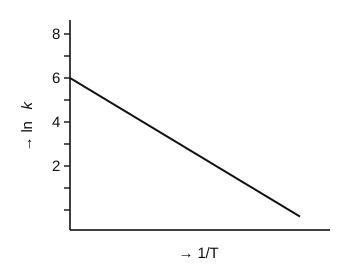
If the energy of activation is 6.64 kJ mol
−1 and R = 8.3 J K
−1 mol
−1, the temperature at which the rate constant becomes e
2 min
−1, is
एक प्राथमिक रासायनिक अभिक्रिया के लिए आरेनियस आलेख नीचे दिया गया है।
यदि सक्रियण ऊर्जा 6.64 kJ mol
−1 और R = 8.3 J K
−1 mol
−1 है, तो वह ताप जिस पर वेग नियतांक e
2 min
−1 हो जाता है, है
- A125 K
- B150 K
- C200 K
- D250 K
Show answer
Concept: : the intercept of the ln k vs 1/T line is ln A.
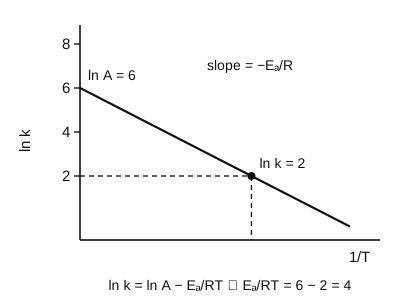
- From the graph, intercept ln A = 6.
- k = e2 ⇒ ln k = 2 ⇒ Ea/RT = 6 − 2 = 4.
- T = Ea/(4R) = 6640/(4 × 8.3) = 6640/33.2 = 200 K.
Short trick: Read ln A from the y-intercept, then T = Ea/[R(ln A − ln k)].
Answer: (C) 200 K
अवधारणा: : ln k बनाम 1/T रेखा का अंतःखंड ln A है।
- आलेख से अंतःखंड ln A = 6।
- k = e2 ⇒ ln k = 2 ⇒ Ea/RT = 6 − 2 = 4।
- T = Ea/(4R) = 6640/(4 × 8.3) = 6640/33.2 = 200 K।
शॉर्ट ट्रिक: y-अंतःखंड से ln A पढ़ें, फिर T = Ea/[R(ln A − ln k)]।
उत्तर: (C) 200 K
NEET UGChemistryChemical kinetics – Arrhenius plotNEET UG 2026 · 21 Jun Shift 1
Q20.Given below are two statements:
Statement-I : Heating NaCl with concentrated H2SO4 and MnO2 results in oxidation of Mn.
Statement-II : Heating NaI with concentrated H2SO4 and MnO2 results in reduction of Mn.
In light of the above statements, choose the most appropriate answer from the options given below:
नीचे दो कथन दिए गए हैं:
कथन-I : NaCl को सांद्र H2SO4 और MnO2 के साथ गर्म करने पर Mn का ऑक्सीकरण होता है।
कथन-II : NaI को सांद्र H2SO4 और MnO2 के साथ गर्म करने पर Mn का अपचयन होता है।
उपर्युक्त कथनों के आलोक में, नीचे दिए गए विकल्पों में से सबसे उपयुक्त उत्तर चुनिए:
- ABoth Statement-I and Statement-II are correct.कथन-I और कथन-II दोनों सही हैं।
- BBoth Statement-I and Statement-II are incorrect.कथन-I और कथन-II दोनों गलत हैं।
- CStatement-I is correct but Statement-II is incorrect.कथन-I सही है लेकिन कथन-II गलत है।
- DStatement-I is incorrect but Statement-II is correct.कथन-I गलत है लेकिन कथन-II सही है।
Show answer
Concept: MnO2 acts as an oxidising agent: it oxidises X− to X2 and is itself reduced from Mn(+4) to Mn(+2).
- 4NaCl + MnO2 + 4H2SO4 → MnCl2 + 4NaHSO4 + 2H2O + Cl2: Mn +4 → +2 = reduction, so Statement-I (oxidation of Mn) is incorrect.
- 2NaI + MnO2 + 3H2SO4 → 2NaHSO4 + MnSO4 + 2H2O + I2: Mn +4 → +2 = reduction. Statement-II correct.
Short trick: Halide → halogen means halide is oxidised, so the partner (MnO2) MUST be reduced.
Answer: (D) Statement-I incorrect, Statement-II correct
अवधारणा: MnO2 ऑक्सीकारक का कार्य करता है: यह X− को X2 में ऑक्सीकृत करता है और स्वयं Mn(+4) से Mn(+2) में अपचयित होता है।
- 4NaCl + MnO2 + 4H2SO4 → MnCl2 + 4NaHSO4 + 2H2O + Cl2: Mn +4 → +2 = अपचयन, अतः कथन-I (Mn का ऑक्सीकरण) गलत है।
- 2NaI + MnO2 + 3H2SO4 → 2NaHSO4 + MnSO4 + 2H2O + I2: Mn +4 → +2 = अपचयन। कथन-II सही।
शॉर्ट ट्रिक: हैलाइड → हैलोजन का अर्थ है हैलाइड का ऑक्सीकरण, अतः साथी (MnO2) का अपचयन अनिवार्य है।
उत्तर: (D) कथन-I गलत, कथन-II सही
NEET UGChemistryp-block – preparation of halogens (redox)NEET UG 2026 · 21 Jun Shift 1

