Q181.The reaction that does NOT take place in a blast furnace between 900 K to 1500 K temperature range during extraction of iron is :
आयरन के निष्कर्षण के दौरान वात्या भट्टी (blast furnace) में 900 K से 1500 K ताप परास के बीच कौन-सी अभिक्रिया नहीं होती है?
- AFe2O3 + CO → 2FeO + CO2
- BFeO + CO → Fe + CO2
- CC + CO2 → 2CO
- DCaO + SiO2 → CaSiO3
Show answer
Concept: NCERT zones of the blast furnace: 500–800 K (upper, cooler) – reduction of Fe2O3/Fe3O4 by CO; 900–1500 K (hotter) – C + CO2 → 2CO, FeO + CO → Fe + CO2, limestone → CaO, slag formation.
- (A) Fe2O3 + CO → 2FeO + CO2 occurs in the 500–800 K zone, not 900–1500 K ✔ (this is the answer).
- (B) FeO + CO → Fe + CO2 – 900–1500 K zone.
- (C) C + CO2 → 2CO – 900–1500 K zone.
- (D) CaO + SiO2 → CaSiO3 (slag) – in the hotter lower region.
Short trick: Fe2O3/Fe3O4 are reduced up top (cool, 500–800 K); FeO is finished off lower down (900–1500 K).
Answer: (A) Fe2O3 + CO → 2FeO + CO2
अवधारणा: NCERT के अनुसार वात्या भट्टी के क्षेत्र: 500–800 K (ऊपरी, ठंडा) – CO द्वारा Fe2O3/Fe3O4 का अपचयन; 900–1500 K (गर्म) – C + CO2 → 2CO, FeO + CO → Fe + CO2, चूना-पत्थर → CaO, धातुमल (slag) निर्माण।
- (A) Fe2O3 + CO → 2FeO + CO2, 500–800 K क्षेत्र में होती है, 900–1500 K में नहीं ✔ (यही उत्तर है)।
- (B) FeO + CO → Fe + CO2 – 900–1500 K क्षेत्र।
- (C) C + CO2 → 2CO – 900–1500 K क्षेत्र।
- (D) CaO + SiO2 → CaSiO3 (धातुमल) – गर्म निचले क्षेत्र में।
शॉर्ट ट्रिक: Fe2O3/Fe3O4 ऊपर (ठंडे, 500–800 K) अपचयित होते हैं; FeO नीचे (900–1500 K) पूर्ण अपचयित होता है।
उत्तर: (A) Fe2O3 + CO → 2FeO + CO2
NEET UGChemistryMetallurgy – blast furnace reactionsNEET UG 2023 · 7 May Shift 1
Q182.Which amongst the following options is the correct relation between change in enthalpy and change in internal energy?
निम्नलिखित विकल्पों में से कौन-सा एन्थैल्पी परिवर्तन और आन्तरिक ऊर्जा परिवर्तन के बीच सही सम्बन्ध है?
- AΔH = ΔU – ΔngRT
- BΔH = ΔU + ΔngRT
- CΔH – ΔU = –ΔnRT
- DΔH + ΔU = ΔnR
Show answer
Concept: H = U + pV; for ideal gases at constant T and p, Δ(pV) = ΔngRT.
- ΔH = ΔU + pΔV
- pΔV = ΔngRT (Δng = moles of gaseous products – moles of gaseous reactants)
- ∴ ΔH = ΔU + ΔngRT → (B).
- (A) and (C) have the wrong sign; (D) is dimensionally wrong (no T).
Short trick: H is 'U plus work term' – always a plus: ΔH = ΔU + ΔngRT.
Answer: (B) ΔH = ΔU + ΔngRT
अवधारणा: H = U + pV; आदर्श गैसों के लिए स्थिर T और p पर Δ(pV) = ΔngRT।
- ΔH = ΔU + pΔV
- pΔV = ΔngRT (Δng = गैसीय उत्पादों के मोल – गैसीय अभिकारकों के मोल)
- ∴ ΔH = ΔU + ΔngRT → (B)।
- (A) और (C) में चिह्न गलत है; (D) विमीय रूप से गलत है (T नहीं है)।
शॉर्ट ट्रिक: H = 'U और कार्य पद' – सदैव धन: ΔH = ΔU + ΔngRT।
उत्तर: (B) ΔH = ΔU + ΔngRT
NEET UGChemistryThermodynamics – ΔH and ΔUNEET UG 2023 · 7 May Shift 1
Q183.On balancing the given redox reaction,
the coefficients a, b and c are found to be, respectively-
दी गई अपचयोपचय अभिक्रिया को संतुलित करने पर,
गुणांक a, b और c क्रमशः प्राप्त होते हैं-
- A1, 3, 8
- B3, 8, 1
- C1, 8, 3
- D8, 1, 3
Show answer
Concept: Balance electrons first (oxidation-number method), then charge with H+, then O/H with H2O.
- Cr: +6 → +3, gain 3 e– per Cr → 6 e– per Cr2O72–.
- S: +4 → +6, loss 2 e– per SO32– → need 3 SO32–. So a = 1, b = 3.
- Charge: left = –2 – 6 + c, right = +6 – 6 = 0 → c = 8.
- Check O: 7 + 9 = 16 = 12 (SO42–) + 4 (H2O = c/2 = 4) ✔
- Cr2O72– + 3SO32– + 8H+ → 2Cr3+ + 3SO42– + 4H2O
Short trick: Dichromate in acid always takes 6 e–, so b = 6/2 = 3; then balance the charge to get c.
Answer: (A) 1, 3, 8
अवधारणा: पहले इलेक्ट्रॉन संतुलित कीजिए (ऑक्सीकरण-संख्या विधि), फिर H+ से आवेश, फिर H2O से O/H।
- Cr: +6 → +3, प्रति Cr 3 e– ग्रहण → प्रति Cr2O72– 6 e–।
- S: +4 → +6, प्रति SO32– 2 e– त्याग → 3 SO32– चाहिए। अतः a = 1, b = 3।
- आवेश: बायाँ = –2 – 6 + c, दायाँ = +6 – 6 = 0 → c = 8।
- O की जाँच: 7 + 9 = 16 = 12 (SO42–) + 4 (H2O = c/2 = 4) ✔
- Cr2O72– + 3SO32– + 8H+ → 2Cr3+ + 3SO42– + 4H2O
शॉर्ट ट्रिक: अम्ल में डाइक्रोमेट सदैव 6 e– लेता है, अतः b = 6/2 = 3; फिर आवेश मिलाकर c ज्ञात कीजिए।
उत्तर: (A) 1, 3, 8
NEET UGChemistryRedox reactions – balancingNEET UG 2023 · 7 May Shift 1
Q184.What fraction of one edge centred octahedral void lies in one unit cell of fcc?
fcc की एक एकक कोष्ठिका में, एक कोर-केन्द्रित (edge centred) अष्टफलकीय रिक्ति का कितना भाग स्थित होता है?
- A
- B
- C
- D
Show answer
Concept: In fcc, octahedral voids are at the body centre (1, wholly inside) and at the 12 edge centres; each edge is shared by 4 unit cells.
- An edge-centre void is shared by 4 cells → fraction in one cell = 1/4.
- Check: total octahedral voids = 1 + 12 × 1/4 = 4 = number of atoms in fcc ✔
Short trick: Sharing rule: corner 1/8, edge 1/4, face 1/2, body 1.
Answer: (C)
अवधारणा: fcc में अष्टफलकीय रिक्तियाँ काय-केन्द्र (1, पूर्णतः भीतर) तथा 12 कोर-केन्द्रों पर होती हैं; प्रत्येक कोर 4 एकक कोष्ठिकाओं द्वारा साझा होती है।
- कोर-केन्द्र रिक्ति 4 कोष्ठिकाओं में साझा → एक कोष्ठिका में भाग = 1/4।
- जाँच: कुल अष्टफलकीय रिक्तियाँ = 1 + 12 × 1/4 = 4 = fcc में परमाणुओं की संख्या ✔
शॉर्ट ट्रिक: साझेदारी नियम: कोना 1/8, कोर 1/4, फलक 1/2, काय 1।
उत्तर: (C)
NEET UGChemistrySolid state – octahedral voids in fccNEET UG 2023 · 7 May Shift 1
Q185.Given below are two statements :
Statement I: The nutrient deficient water bodies lead to eutrophication
Statement II: Eutrophication leads to decrease in the level of oxygen in the water bodies.
In the light of the above statements, choose the correct answer from the options given below:
नीचे दो कथन दिए गए हैं:
कथन I: पोषक-न्यून जलाशय सुपोषण (eutrophication) की ओर ले जाते हैं
कथन II: सुपोषण से जलाशयों में ऑक्सीजन का स्तर घट जाता है।
उपर्युक्त कथनों के आलोक में, नीचे दिए गए विकल्पों में से सही उत्तर चुनिए:
- ABoth Statement I and Statement II are trueकथन I और कथन II दोनों सत्य हैं
- BBoth Statement I and Statement II are falseकथन I और कथन II दोनों असत्य हैं
- CStatement I is correct but Statement II is falseकथन I सत्य है परन्तु कथन II असत्य है
- DStatement I is incorrect but Statement II is trueकथन I असत्य है परन्तु कथन II सत्य है
Show answer
Concept: Eutrophication: nutrient-enriched (phosphate, nitrate) water supports dense plant/algal growth, which depletes O2 and kills aquatic animals.
- Statement I – incorrect: it is nutrient-rich, not nutrient-deficient, water that becomes eutrophic.
- Statement II – true: decay of the algal bloom consumes dissolved oxygen (BOD rises), so O2 level falls.
Short trick: Eu-trophic = 'well-fed' – too many nutrients, not too few.
Answer: (D) Statement I is incorrect but Statement II is true
अवधारणा: सुपोषण: पोषक-समृद्ध (फॉस्फेट, नाइट्रेट) जल घने पादप/शैवाल वृद्धि को सहारा देता है, जिससे O2 घटती है और जलीय जन्तु मरते हैं।
- कथन I – गलत: पोषक-समृद्ध जल सुपोषित होता है, पोषक-न्यून नहीं।
- कथन II – सत्य: शैवाल प्रस्फुटन के अपघटन में घुलित ऑक्सीजन खर्च होती है (BOD बढ़ता है), अतः O2 स्तर घटता है।
शॉर्ट ट्रिक: यू-ट्रॉफिक = 'भरपूर पोषित' – पोषक बहुत अधिक, कम नहीं।
उत्तर: (D) कथन I असत्य है परन्तु कथन II सत्य है
NEET UGChemistryEnvironmental chemistry – eutrophicationNEET UG 2023 · 7 May Shift 1
Q186.The equilibrium concentrations of the species in the reaction A + B ⇌ C + D are 2, 3, 10 and 6 mol L–1, respectively at 300 K. ΔG° for the reaction is (R = 2 cal/mol K)
अभिक्रिया A + B ⇌ C + D में स्पीशीज़ की साम्य सान्द्रताएँ 300 K पर क्रमशः 2, 3, 10 तथा 6 mol L–1 हैं। अभिक्रिया के लिए ΔG° है (R = 2 cal/mol K)
- A1372.60 cal
- B–137.26 cal
- C–1381.80 cal
- D–13.73 cal
Show answer
Concept: ΔG° = –2.303 RT log K.
- K = [C][D]/([A][B]) = (10 × 6)/(2 × 3) = 60/6 = 10.
- ΔG° = –2.303 × 2 × 300 × log 10 = –2.303 × 600 × 1.
- ΔG° = –1381.8 cal.
Short trick: When K = 10, ΔG° is simply –2.303RT; here 2.303 × 600 = 1381.8.
Answer: (C) –1381.80 cal
अवधारणा: ΔG° = –2.303 RT log K।
- K = [C][D]/([A][B]) = (10 × 6)/(2 × 3) = 60/6 = 10।
- ΔG° = –2.303 × 2 × 300 × log 10 = –2.303 × 600 × 1।
- ΔG° = –1381.8 cal।
शॉर्ट ट्रिक: जब K = 10 हो, ΔG° केवल –2.303RT है; यहाँ 2.303 × 600 = 1381.8।
उत्तर: (C) –1381.80 cal
NEET UGChemistryEquilibrium – ΔG° and KNEET UG 2023 · 7 May Shift 1
Q187.Which complex compound is most stable?
कौन-सा संकुल यौगिक सबसे अधिक स्थायी है?
- A[Co(NH3)4(H2O)Br](NO3)2
- B[Co(NH3)3(NO3)3]
- C[CoCl2(en)2]NO3
- D[Co(NH3)6]2(SO4)3
Show answer
Concept: Chelate effect: polydentate ligands that form rings with the metal give much more stable complexes than comparable monodentate ligands (entropy gain).
- (C) contains two ethane-1,2-diamine (en) ligands, each forming a 5-membered chelate ring with Co(III) → greatest stability.
- (A), (B), (D) have only monodentate ligands (NH3, H2O, Br–, NO3–) → no chelation.
- All are Co(III), so the deciding factor is chelation.
Short trick: Spot 'en', 'ox', 'EDTA' – chelating ligand = most stable complex.
Answer: (C) [CoCl2(en)2]NO3
अवधारणा: कीलेट प्रभाव: धातु के साथ वलय बनाने वाले बहुदन्तुर लिगन्ड तुलनीय एकदन्तुर लिगन्डों की अपेक्षा कहीं अधिक स्थायी संकुल बनाते हैं (एन्ट्रॉपी वृद्धि)।
- (C) में दो एथेन-1,2-डाइऐमीन (en) लिगन्ड हैं, प्रत्येक Co(III) के साथ 5-सदस्यीय कीलेट वलय बनाता है → सर्वाधिक स्थायित्व।
- (A), (B), (D) में केवल एकदन्तुर लिगन्ड हैं (NH3, H2O, Br–, NO3–) → कोई कीलेशन नहीं।
- सभी Co(III) हैं, अतः निर्णायक कारक कीलेशन है।
शॉर्ट ट्रिक: 'en', 'ox', 'EDTA' देखिए – कीलेटी लिगन्ड = सबसे स्थायी संकुल।
उत्तर: (C) [CoCl2(en)2]NO3
NEET UGChemistryCoordination compounds – chelate effectNEET UG 2023 · 7 May Shift 1
Q188.Match List-I with List–II :
| List-I (Oxoacids of Sulphur) | List-II (Bonds) |
|---|
| A. Peroxodisulphuric acid | I. Two S–OH, Four S=O, One S–O–S |
| B. Sulphuric acid | II. Two S–OH, One S=O |
| C. Pyrosulphuric acid | III. Two S–OH, Four S=O, One S–O–O–S |
| D. Sulphurous acid | IV. Two S–OH, Two S=O |
Choose the correct answer from the options given below.
सूची-I का सूची-II से मिलान कीजिए:
| सूची-I (सल्फर के ऑक्सोअम्ल) | सूची-II (आबंध) |
|---|
| A. परॉक्सोडाइसल्फ्यूरिक अम्ल | I. दो S–OH, चार S=O, एक S–O–S |
| B. सल्फ्यूरिक अम्ल | II. दो S–OH, एक S=O |
| C. पाइरोसल्फ्यूरिक अम्ल | III. दो S–OH, चार S=O, एक S–O–O–S |
| D. सल्फ्यूरस अम्ल | IV. दो S–OH, दो S=O |
नीचे दिए गए विकल्पों में से सही उत्तर चुनिए।
- AA–I, B–III, C–II, D–IV
- BA–III, B–IV, C–I, D–II
- CA–I, B–III, C–IV, D–II
- DA–III, B–IV, C–II, D–I
Show answer
Concept: Draw the structures: H2SO3 = OS(OH)2; H2SO4 = O2S(OH)2; H2S2O7 = HO–SO2–O–SO2–OH; H2S2O8 = HO–SO2–O–O–SO2–OH.
- A Peroxodisulphuric acid H2S2O8: 2 S–OH, 4 S=O, one peroxo S–O–O–S → III.
- B Sulphuric acid H2SO4: 2 S–OH, 2 S=O → IV.
- C Pyrosulphuric acid (oleum) H2S2O7: 2 S–OH, 4 S=O, one S–O–S → I.
- D Sulphurous acid H2SO3: 2 S–OH, 1 S=O → II.
Short trick: 'Peroxo' always means an –O–O– link; 'pyro/di' = two units joined by –O–.
Answer: (B) A–III, B–IV, C–I, D–II
अवधारणा: संरचनाएँ बनाइए: H2SO3 = OS(OH)2; H2SO4 = O2S(OH)2; H2S2O7 = HO–SO2–O–SO2–OH; H2S2O8 = HO–SO2–O–O–SO2–OH।
- A परॉक्सोडाइसल्फ्यूरिक अम्ल H2S2O8: 2 S–OH, 4 S=O, एक परॉक्सो S–O–O–S → III।
- B सल्फ्यूरिक अम्ल H2SO4: 2 S–OH, 2 S=O → IV।
- C पाइरोसल्फ्यूरिक अम्ल (ओलियम) H2S2O7: 2 S–OH, 4 S=O, एक S–O–S → I।
- D सल्फ्यूरस अम्ल H2SO3: 2 S–OH, 1 S=O → II।
शॉर्ट ट्रिक: 'परॉक्सो' का अर्थ सदैव –O–O– बंध; 'पाइरो/डाइ' = दो इकाइयाँ –O– से जुड़ी।
उत्तर: (B) A–III, B–IV, C–I, D–II
NEET UGChemistryp-Block (group 16) – oxoacids of sulphurNEET UG 2023 · 7 May Shift 1
Q189.Pumice stone is an example of
प्यूमिस पत्थर (pumice stone) किसका उदाहरण है?
- ASolसॉल (Sol)
- BGelजेल (Gel)
- CSolid solठोस सॉल (Solid sol)
- DFoamफेन (Foam)
Show answer
Concept: Colloids are classified by dispersed phase and dispersion medium; pumice stone = gas dispersed in a solid medium.
- A colloid whose dispersion medium is solid falls in the solid-sol family; pumice (air/gas trapped in solid rock) is the 'solid foam' member of this family → closest option: solid sol.
- (A) Sol – solid dispersed in liquid (paints, cell fluids).
- (B) Gel – liquid dispersed in solid (cheese, butter, jellies).
- (D) Foam – gas dispersed in liquid (froth, whipped cream, soap lather) – the medium is liquid, not solid.
Short trick: Read the name from the medium: solid medium → 'solid …'; gas in solid (pumice, foam rubber) = solid foam/solid sol.
Answer: (C) Solid sol
अवधारणा: कोलॉइडों का वर्गीकरण परिक्षिप्त प्रावस्था और परिक्षेपण माध्यम के आधार पर होता है; प्यूमिस पत्थर = ठोस माध्यम में परिक्षिप्त गैस।
- जिस कोलॉइड का परिक्षेपण माध्यम ठोस हो वह ठोस-सॉल परिवार में आता है; प्यूमिस (ठोस चट्टान में फँसी वायु/गैस) इस परिवार का 'ठोस फेन' सदस्य है → निकटतम विकल्प: ठोस सॉल।
- (A) सॉल – द्रव में परिक्षिप्त ठोस (पेन्ट, कोशिका द्रव)।
- (B) जेल – ठोस में परिक्षिप्त द्रव (पनीर, मक्खन, जेली)।
- (D) फेन – द्रव में परिक्षिप्त गैस (झाग, व्हिप्ड क्रीम, साबुन का झाग) – माध्यम द्रव है, ठोस नहीं।
शॉर्ट ट्रिक: नाम माध्यम से पढ़िए: ठोस माध्यम → 'ठोस …'; ठोस में गैस (प्यूमिस, फोम रबर) = ठोस फेन/ठोस सॉल।
उत्तर: (C) ठोस सॉल
NEET UGChemistrySurface chemistry – classification of colloidsNEET UG 2023 · 7 May Shift 1
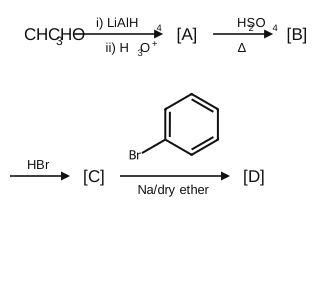
Q190.Identify the final product [D] obtained in the following sequence of reactions.
निम्नलिखित अभिक्रिया अनुक्रम में प्राप्त अंतिम उत्पाद [D] को पहचानिए।
- A
- B
- CC4H10
- DHC ≡ C⊖Na+
Show answer
Concept: LiAlH4 reduces aldehyde → 1° alcohol; conc. H2SO4/Δ dehydrates → alkene; HBr adds → alkyl bromide; Na/dry ether with an aryl halide = Wurtz–Fittig → alkylbenzene.
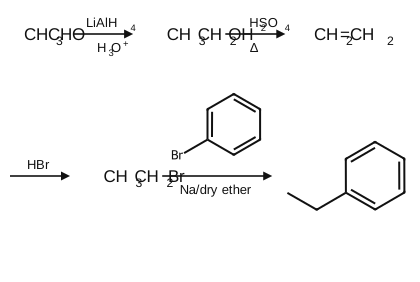
- [A] CH3CH2OH (ethanol).
- [B] CH2=CH2 (ethene).
- [C] CH3CH2Br (bromoethane).
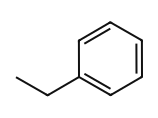
- [D] C6H5Br + CH3CH2Br + 2Na → C6H5CH2CH3 (ethylbenzene) + 2NaBr.
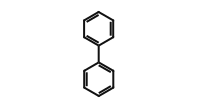
- Biphenyl (B) and butane (C) are only side products of Fittig/Wurtz self-coupling; (D) is unrelated.
Short trick: Wurtz–Fittig = aryl–X + alkyl–X + Na → aryl–alkyl; the alkyl here has 2 C (from CH3CHO).
Answer: (A) Ethylbenzene
अवधारणा: LiAlH4 ऐल्डिहाइड → 1° ऐल्कोहॉल में अपचयित करता है; सान्द्र H2SO4/Δ निर्जलीकरण → ऐल्कीन; HBr योग → ऐल्किल ब्रोमाइड; ऐरिल हैलाइड के साथ Na/शुष्क ईथर = वुर्ट्ज़–फिटिग → ऐल्किलबेंज़ीन।
- [A] CH3CH2OH (एथेनॉल)।
- [B] CH2=CH2 (एथीन)।
- [C] CH3CH2Br (ब्रोमोएथेन)।
- [D] C6H5Br + CH3CH2Br + 2Na → C6H5CH2CH3 (एथिलबेंज़ीन) + 2NaBr।
- बाइफेनिल (B) और ब्यूटेन (C) केवल फिटिग/वुर्ट्ज़ स्व-युग्मन के सह-उत्पाद हैं; (D) असम्बन्धित है।
शॉर्ट ट्रिक: वुर्ट्ज़–फिटिग = ऐरिल–X + ऐल्किल–X + Na → ऐरिल–ऐल्किल; यहाँ ऐल्किल में 2 C हैं (CH3CHO से)।
उत्तर: (A) एथिलबेंज़ीन
NEET UGChemistryHaloarenes – Wurtz–Fittig reaction sequenceNEET UG 2023 · 7 May Shift 1
Q191.Gadolinium has a low value of third ionisation enthalpy because of
गैडोलिनियम (Gd) की तृतीय आयनन एन्थैल्पी का मान कम होता है, इसका कारण है
- Asmall sizeछोटा आकार
- Bhigh exchange enthalpyउच्च विनिमय एन्थैल्पी (exchange enthalpy)
- Chigh electronegativityउच्च विद्युत-ऋणात्मकता
- Dhigh basic characterउच्च क्षारकीय गुण
Show answer
Concept: A half-filled f7 shell is extra stable because of high exchange energy; reaching it makes ionisation easy.
- Gd: [Xe]4f75d16s2. Gd2+: [Xe]4f75d1.
- The third electron removed is the lone 5d electron, leaving Gd3+ = [Xe]4f7 – a half-filled, highly stable configuration with maximum exchange energy.
- Hence IE3 is low. Size, electronegativity and basic character do not decide this particular ionisation step.
Short trick: Low IE whenever the product ion gets 4f0, 4f7 or 4f14 (La, Gd, Lu) – 'half/full shell = exchange energy'.
Answer: (B) high exchange enthalpy
अवधारणा: अर्ध-पूरित f7 कोश उच्च विनिमय ऊर्जा के कारण अतिरिक्त स्थायी होता है; उस तक पहुँचना आयनन को आसान बनाता है।
- Gd: [Xe]4f75d16s2। Gd2+: [Xe]4f75d1।
- तीसरा निकलने वाला इलेक्ट्रॉन अकेला 5d इलेक्ट्रॉन है, जिससे Gd3+ = [Xe]4f7 बनता है – अर्ध-पूरित, अधिकतम विनिमय ऊर्जा वाला अत्यंत स्थायी विन्यास।
- अतः IE3 कम है। आकार, विद्युत-ऋणात्मकता और क्षारकीय गुण इस आयनन चरण को निर्धारित नहीं करते।
शॉर्ट ट्रिक: जब भी बनने वाले आयन में 4f0, 4f7 या 4f14 (La, Gd, Lu) मिले, IE कम – 'आधा/पूरा कोश = विनिमय ऊर्जा'।
उत्तर: (B) उच्च विनिमय एन्थैल्पी
NEET UGChemistryd- and f-block – lanthanoids (ionisation enthalpy)NEET UG 2022 · 17 Jul Shift 1
Q192.Which one is not correct mathematical equation for Dalton's Law of partial pressure? Here p = total pressure of gaseous mixture
डाल्टन के आंशिक दाब नियम के लिए निम्नलिखित में से कौन-सा गणितीय समीकरण सही नहीं है? यहाँ p = गैसीय मिश्रण का कुल दाब
- A
- B
- C, where = partial pressure of ith gas; = mole fraction of ith gas in gaseous mixture, जहाँ = iवीं गैस का आंशिक दाब; = गैसीय मिश्रण में iवीं गैस का मोल-अंश
- D, where = mole fraction of ith gas in gaseous mixture = pressure of ith gas in pure state, जहाँ = गैसीय मिश्रण में iवीं गैस का मोल-अंश, = शुद्ध अवस्था में iवीं गैस का दाब
Show answer
Concept: Dalton: total pressure of non-reacting gases = sum of partial pressures; each partial pressure = (mole fraction × total pressure).
- (A) – the law itself. Correct.
- (B) Each (ideal gas), so the sum is correct.
- (C) – correct form of Dalton's law.
- (D) is Raoult's law (vapour pressure of a component over a liquid solution), not Dalton's law. Incorrect.
Short trick: (pure-state pressure) = Raoult; (total) = Dalton.
Answer: (D)
अवधारणा: डाल्टन: अभिक्रिया न करने वाली गैसों का कुल दाब = आंशिक दाबों का योग; प्रत्येक आंशिक दाब = (मोल-अंश × कुल दाब)।
- (A) – स्वयं नियम। सही।
- (B) प्रत्येक (आदर्श गैस), अतः योग सही है।
- (C) – डाल्टन नियम का सही रूप।
- (D) राउल्ट का नियम है (द्रव विलयन के ऊपर घटक का वाष्प दाब), डाल्टन का नियम नहीं। गलत।
शॉर्ट ट्रिक: (शुद्ध अवस्था का दाब) = राउल्ट; (कुल दाब) = डाल्टन।
उत्तर: (D)
NEET UGChemistryStates of matter – Dalton's law of partial pressuresNEET UG 2022 · 17 Jul Shift 1
Q193.Assertion (A): In a particular point defect, an ionic solid is electrically neutral, even if few of its cations are missing from its unit cells.
Reason (R): In an ionic solid, Frenkel defect arises due to dislocation of cation from its lattice site to interstitial site, maintaining overall electrical neutrality.
Choose the most appropriate answer from the options given below:
अभिकथन (A): एक विशेष बिंदु दोष में, आयनिक ठोस विद्युत रूप से उदासीन रहता है, भले ही उसके एकक कोष्ठिकाओं से कुछ धनायन अनुपस्थित हों।
कारण (R): आयनिक ठोस में फ्रेंकेल दोष, धनायन के अपने जालक स्थल से अंतराकाशी स्थल पर विस्थापन के कारण उत्पन्न होता है, जिससे समग्र विद्युत उदासीनता बनी रहती है।
नीचे दिए गए विकल्पों में से सबसे उपयुक्त उत्तर चुनिए:
- ABoth (A) and (R) are correct and (R) is the correct explanation of (A)(A) और (R) दोनों सही हैं तथा (R), (A) की सही व्याख्या है
- BBoth (A) and (R) are correct but (R) is not the correct explanation of (A)(A) और (R) दोनों सही हैं परंतु (R), (A) की सही व्याख्या नहीं है
- C(A) is correct but (R) is not correct(A) सही है परंतु (R) सही नहीं है
- D(A) is not correct but (R) is correct(A) सही नहीं है परंतु (R) सही है
Show answer
Concept: Schottky defect: equal numbers of cations and anions are missing → neutral. Frenkel defect: a cation shifts to an interstitial site → neutral, but no ion is 'missing' from the crystal.
- (A): cations can be missing and the solid stays neutral – true for Schottky defect (matching anions also missing). A is correct.
- (R): description of Frenkel defect is correct.
- But in Frenkel defect no cation leaves the crystal – it is only displaced. So (R) does not explain (A); (A) is explained by Schottky defect.
Short trick: 'Missing ions' = Schottky (density ↓); 'displaced ion' = Frenkel (density same).
Answer: (B)
अवधारणा: शॉट्की दोष: समान संख्या में धनायन और ऋणायन अनुपस्थित → उदासीन। फ्रेंकेल दोष: धनायन अंतराकाशी स्थल पर चला जाता है → उदासीन, परंतु क्रिस्टल से कोई आयन 'अनुपस्थित' नहीं होता।
- (A): धनायन अनुपस्थित हो सकते हैं और ठोस उदासीन रहता है – शॉट्की दोष के लिए सत्य (साथ में उतने ही ऋणायन भी अनुपस्थित)। A सही है।
- (R): फ्रेंकेल दोष का वर्णन सही है।
- परंतु फ्रेंकेल दोष में कोई धनायन क्रिस्टल नहीं छोड़ता – केवल विस्थापित होता है। अतः (R), (A) की व्याख्या नहीं करता; (A) की व्याख्या शॉट्की दोष से होती है।
शॉर्ट ट्रिक: 'अनुपस्थित आयन' = शॉट्की (घनत्व ↓); 'विस्थापित आयन' = फ्रेंकेल (घनत्व समान)।
उत्तर: (B)
NEET UGChemistrySolid state – point defectsNEET UG 2022 · 17 Jul Shift 1
Q194.The pH of the solution containing 50 mL each of 0.10 M sodium acetate and 0.01 M acetic acid is
[Given pKa of CH3COOH = 4.57]
50 mL 0.10 M सोडियम ऐसीटेट तथा 50 mL 0.01 M ऐसीटिक अम्ल युक्त विलयन का pH है
[दिया है: CH3COOH का pKa = 4.57]
- A5.57
- B3.57
- C4.57
- D2.57
Show answer
Concept: Acidic buffer – Henderson equation: .
- Equal volumes mixed → both concentrations halve, ratio unchanged: [salt]/[acid] = 0.05/0.005 = 10.
- pH = 4.57 + log 10 = 4.57 + 1 = 5.57.
Short trick: Salt 10 times acid → pH = pKa + 1.
Answer: (A) 5.57
अवधारणा: अम्लीय बफर – हेंडरसन समीकरण: ।
- समान आयतन मिलाने पर दोनों सांद्रताएँ आधी हो जाती हैं, अनुपात वही रहता है: [लवण]/[अम्ल] = 0.05/0.005 = 10।
- pH = 4.57 + log 10 = 4.57 + 1 = 5.57।
शॉर्ट ट्रिक: लवण, अम्ल का 10 गुना → pH = pKa + 1।
उत्तर: (A) 5.57
NEET UGChemistryIonic equilibrium – buffer pHNEET UG 2022 · 17 Jul Shift 1
Q195.Identify the incorrect statement from the following
निम्नलिखित में से गलत कथन को पहचानिए
- AAlkali metals react with water to form their hydroxidesक्षार धातुएँ जल से अभिक्रिया करके अपने हाइड्रॉक्साइड बनाती हैं
- BThe oxidation number of K in KO2 is + 4.KO2 में K की ऑक्सीकरण संख्या + 4 है।
- CIonisation enthalpy of alkali metals decreases from top to bottom in the group.क्षार धातुओं की आयनन एन्थैल्पी वर्ग में ऊपर से नीचे की ओर घटती है।
- DLithium is the strongest reducing agent among the alkali metals.क्षार धातुओं में लीथियम सबसे प्रबल अपचायक है।
Show answer
Concept: KO2 is potassium superoxide: K+ and O2−.
- (A) 2M + 2H2O → 2MOH + H2 – correct.
- (B) In KO2, K is +1 (alkali metal is always +1); the superoxide ion O2− carries −1. So '+4' is incorrect.
- (C) Size increases down the group → IE decreases – correct.
- (D) Li has the most negative E° (−3.04 V) due to very high hydration enthalpy → strongest reducing agent in water – correct.
Short trick: Group-1 metal in any compound = +1. Any other value is wrong at sight.
Answer: (B)
अवधारणा: KO2 पोटैशियम सुपरऑक्साइड है: K+ तथा O2−।
- (A) 2M + 2H2O → 2MOH + H2 – सही।
- (B) KO2 में K की ऑक्सीकरण संख्या +1 है (क्षार धातु सदैव +1); सुपरऑक्साइड आयन O2− पर −1 है। अतः '+4' गलत है।
- (C) वर्ग में नीचे जाने पर आकार बढ़ता है → IE घटती है – सही।
- (D) अत्यधिक जलयोजन एन्थैल्पी के कारण Li का E° सबसे अधिक ऋणात्मक (−3.04 V) है → जल में सबसे प्रबल अपचायक – सही।
शॉर्ट ट्रिक: किसी भी यौगिक में वर्ग-1 धातु = +1। कोई अन्य मान देखते ही गलत।
उत्तर: (B)
NEET UGChemistrys-Block elements – alkali metalsNEET UG 2022 · 17 Jul Shift 1
Q196.Statement I: The acidic strength of monosubstituted nitrophenol is higher than phenol because of electron withdrawing nitro group.
Statement II: o-nitrophenol, m-nitrophenol and p-nitrophenol will have same acidic strength as they have one nitro group attached to the phenolic ring.
Choose the most appropriate answer from the options given below:
कथन I: इलेक्ट्रॉन-आकर्षी नाइट्रो समूह के कारण एकल-प्रतिस्थापित नाइट्रोफ़ीनॉल की अम्लीय प्रबलता फ़ीनॉल से अधिक होती है।
कथन II: o-नाइट्रोफ़ीनॉल, m-नाइट्रोफ़ीनॉल तथा p-नाइट्रोफ़ीनॉल की अम्लीय प्रबलता समान होगी क्योंकि इनमें फ़ीनॉलिक वलय से एक ही नाइट्रो समूह जुड़ा है।
नीचे दिए गए विकल्पों में से सबसे उपयुक्त उत्तर चुनिए:
- ABoth Statement I and Statement II are correct.कथन I और कथन II दोनों सही हैं।
- BBoth Statement I and Statement II are incorrect.कथन I और कथन II दोनों गलत हैं।
- CStatement I is correct but Statement II is incorrect.कथन I सही है परंतु कथन II गलत है।
- DStatement I is incorrect but Statement II is correct.कथन I गलत है परंतु कथन II सही है।
Show answer
Concept: –NO2 stabilises phenoxide ion by −I (all positions) and −R (only o and p) effects.
- Statement I: every nitrophenol is more acidic than phenol (pKa 10.0) – correct.
- Statement II: position matters. pKa: p-nitrophenol 7.1, o-nitrophenol 7.2, m-nitrophenol 8.3 – they are not equal. Incorrect.
- m-isomer has no −R stabilisation, so it is the weakest of the three.
Short trick: Acidity order to remember: p > o > m > phenol (o is a little lower than p due to intramolecular H-bond).
Answer: (C)
अवधारणा: –NO2 समूह −I प्रभाव (सभी स्थितियों पर) तथा −R प्रभाव (केवल o और p पर) द्वारा फ़ीनॉक्साइड आयन को स्थायी करता है।
- कथन I: प्रत्येक नाइट्रोफ़ीनॉल, फ़ीनॉल (pKa 10.0) से अधिक अम्लीय है – सही।
- कथन II: स्थिति का प्रभाव पड़ता है। pKa: p-नाइट्रोफ़ीनॉल 7.1, o-नाइट्रोफ़ीनॉल 7.2, m-नाइट्रोफ़ीनॉल 8.3 – समान नहीं हैं। गलत।
- m-समावयव में −R द्वारा स्थायित्व नहीं मिलता, इसलिए यह तीनों में सबसे दुर्बल है।
शॉर्ट ट्रिक: याद रखें अम्लता क्रम: p > o > m > फ़ीनॉल (अंतःअणुक H-आबंध के कारण o, p से थोड़ा कम)।
उत्तर: (C)
NEET UGChemistryAlcohols, phenols – acidity of nitrophenolsNEET UG 2022 · 17 Jul Shift 1
Q197.What mass of 95% pure CaCO3 will be required to neutralise 50 mL of 0.5 M HCl solution according to the following reaction?
CaCO3(s) + 2HCl(aq) → CaCl2(aq) + CO2(g) + 2H2O(l)
[Calculate upto second place of decimal point]
निम्नलिखित अभिक्रिया के अनुसार 0.5 M HCl विलयन के 50 mL को उदासीन करने के लिए 95% शुद्ध CaCO3 का कितना द्रव्यमान आवश्यक होगा?
CaCO3(s) + 2HCl(aq) → CaCl2(aq) + CO2(g) + 2H2O(l)
[दशमलव के दूसरे स्थान तक गणना कीजिए]
- A1.25g
- B1.32g
- C3.65g
- D9.50g
Show answer
Concept: Moles of HCl = M × V(L); 1 mol CaCO3 neutralises 2 mol HCl; impure mass = pure mass × 100/purity.
- n(HCl) = 0.5 × 0.050 = 0.025 mol.
- n(CaCO3) = 0.025/2 = 0.0125 mol → mass of pure CaCO3 = 0.0125 × 100 = 1.25 g.
- Mass of 95% pure sample = 1.25 × 100/95 = 1.316 ≈ 1.32 g.
Short trick: 1.25 g is the trap (pure mass); impure sample must weigh a little more than 1.25 g → only 1.32 fits.
Answer: (B) 1.32 g
अवधारणा: HCl के मोल = M × V(L); 1 मोल CaCO3, 2 मोल HCl को उदासीन करता है; अशुद्ध द्रव्यमान = शुद्ध द्रव्यमान × 100/शुद्धता।
- n(HCl) = 0.5 × 0.050 = 0.025 मोल।
- n(CaCO3) = 0.025/2 = 0.0125 मोल → शुद्ध CaCO3 का द्रव्यमान = 0.0125 × 100 = 1.25 g।
- 95% शुद्ध नमूने का द्रव्यमान = 1.25 × 100/95 = 1.316 ≈ 1.32 g।
शॉर्ट ट्रिक: 1.25 g जाल (trap) है (शुद्ध द्रव्यमान); अशुद्ध नमूना 1.25 g से थोड़ा अधिक होगा → केवल 1.32 उपयुक्त।
उत्तर: (B) 1.32 g
NEET UGChemistrySome basic concepts – stoichiometry and purityNEET UG 2022 · 17 Jul Shift 1
Q198.The IUPAC name of an element with atomic number 119 is
परमाणु क्रमांक 119 वाले तत्व का IUPAC नाम है
- Aununennium
- Bunnilennium
- Cunununnium
- Dununoctium
Show answer
Concept: Digit roots: 0 nil, 1 un, 2 bi, 3 tri, 4 quad, 5 pent, 6 hex, 7 sept, 8 oct, 9 enn + 'ium'.
- 119 → 1 (un) + 1 (un) + 9 (enn) + ium = ununennium (symbol Uue).
- unnilennium = 109, unununnium = 111, ununoctium = 118.
Short trick: Read the digits left to right: un-un-enn.
Answer: (A) ununennium
अवधारणा: अंकों के मूल: 0 nil, 1 un, 2 bi, 3 tri, 4 quad, 5 pent, 6 hex, 7 sept, 8 oct, 9 enn + 'ium'।
- 119 → 1 (un) + 1 (un) + 9 (enn) + ium = ununennium (प्रतीक Uue)।
- unnilennium = 109, unununnium = 111, ununoctium = 118।
शॉर्ट ट्रिक: अंकों को बाएँ से दाएँ पढ़िए: un-un-enn।
उत्तर: (A) ununennium
NEET UGChemistryClassification of elements – IUPAC nomenclature (Z > 100)NEET UG 2022 · 17 Jul Shift 1
Q199.Choose the correct statement:
सही कथन चुनिए:
- ADiamond and graphite have two dimensional network.हीरा और ग्रेफ़ाइट दोनों में द्वि-आयामी जालक होता है।
- BDiamond is covalent and graphite is ionic.हीरा सहसंयोजक है तथा ग्रेफ़ाइट आयनिक है।
- CDiamond is sp3 hybridised and graphite is sp2 hybridized.हीरा sp3 संकरित है तथा ग्रेफ़ाइट sp2 संकरित है।
- DBoth diamond and graphite are used as dry lubricants.हीरा और ग्रेफ़ाइट दोनों शुष्क स्नेहक के रूप में प्रयुक्त होते हैं।
Show answer
Concept: Diamond: each C sp3, tetrahedral 3-D network. Graphite: each C sp2, hexagonal layers.
- (A) Diamond is a 3-D network; only graphite is layered (2-D). Wrong.
- (B) Both are covalent network solids. Wrong.
- (C) Correct.
- (D) Only graphite (slippery layers) is a dry lubricant; diamond is the hardest substance (abrasive). Wrong.
Short trick: Diamond = 4 bonds = sp3 = 3-D hard; graphite = 3 bonds + free electron = sp2 = layers, conducts, lubricates.
Answer: (C)
अवधारणा: हीरा: प्रत्येक C sp3, चतुष्फलकीय त्रि-आयामी जालक। ग्रेफ़ाइट: प्रत्येक C sp2, षट्कोणीय परतें।
- (A) हीरा त्रि-आयामी जालक है; केवल ग्रेफ़ाइट परतदार (द्वि-आयामी) है। गलत।
- (B) दोनों सहसंयोजक जालक ठोस हैं। गलत।
- (C) सही।
- (D) केवल ग्रेफ़ाइट (फिसलने वाली परतें) शुष्क स्नेहक है; हीरा सबसे कठोर पदार्थ है (अपघर्षक)। गलत।
शॉर्ट ट्रिक: हीरा = 4 आबंध = sp3 = 3-D कठोर; ग्रेफ़ाइट = 3 आबंध + मुक्त इलेक्ट्रॉन = sp2 = परतें, चालक, स्नेहक।
उत्तर: (C)
NEET UGChemistryp-Block (group 14) – allotropes of carbonNEET UG 2022 · 17 Jul Shift 1
Q200.Statement I: In the coagulation of a negative sol, the flocculating power of the three given ions is in the order -
Al3+ > Ba2+ > Na+
Statement II: In the coagulation of a positive sol, the flocculating power of the three given salts is in the order -
NaCl > Na2SO4 > Na3PO4
Choose the most appropriate answer from the options given below:
कथन I: ऋणात्मक सॉल के स्कंदन में, दिए गए तीन आयनों की ऊर्णन क्षमता (flocculating power) का क्रम है -
Al3+ > Ba2+ > Na+
कथन II: धनात्मक सॉल के स्कंदन में, दिए गए तीन लवणों की ऊर्णन क्षमता का क्रम है -
NaCl > Na2SO4 > Na3PO4
नीचे दिए गए विकल्पों में से सबसे उपयुक्त उत्तर चुनिए:
- ABoth Statement I and Statement II are correct.कथन I और कथन II दोनों सही हैं।
- BBoth Statement I and Statement II are incorrect.कथन I और कथन II दोनों गलत हैं।
- CStatement I is correct but Statement II is incorrect.कथन I सही है परंतु कथन II गलत है।
- DStatement I is incorrect but Statement II is correct.कथन I गलत है परंतु कथन II सही है।
Show answer
Concept: Hardy–Schulze rule: the ion carrying charge opposite to the sol coagulates it, and its power rises with its charge (valency).
- Negative sol → cations act: Al3+ > Ba2+ > Na+. Statement I correct.
- Positive sol → anions act: PO43− > SO42− > Cl−, so Na3PO4 > Na2SO4 > NaCl. Statement II gives the reverse – incorrect.
Short trick: Opposite charge, higher valency = stronger coagulant (3 > 2 > 1).
Answer: (C)
अवधारणा: हार्डी–शुल्ज़ नियम: सॉल के विपरीत आवेश वाला आयन उसका स्कंदन करता है, और उसकी क्षमता उसके आवेश (संयोजकता) के साथ बढ़ती है।
- ऋणात्मक सॉल → धनायन कार्य करते हैं: Al3+ > Ba2+ > Na+। कथन I सही।
- धनात्मक सॉल → ऋणायन कार्य करते हैं: PO43− > SO42− > Cl−, अतः Na3PO4 > Na2SO4 > NaCl। कथन II उल्टा क्रम देता है – गलत।
शॉर्ट ट्रिक: विपरीत आवेश, अधिक संयोजकता = प्रबल स्कंदक (3 > 2 > 1)।
उत्तर: (C)
NEET UGChemistrySurface chemistry – coagulation (Hardy–Schulze rule)NEET UG 2022 · 17 Jul Shift 1

