Q181.In the figure shown here, what is the equivalent focal length of the combination of lenses (Assume that all layers are thin)?
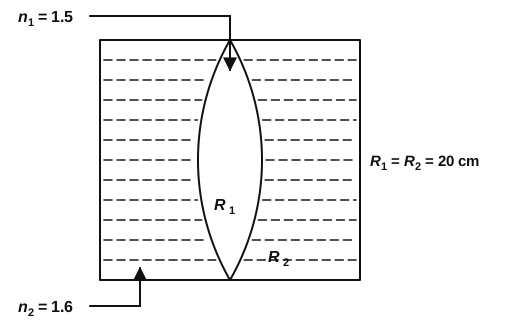
यहाँ दर्शाए गए चित्र में लेंसों के संयोजन की तुल्य फोकस दूरी क्या है (मान लीजिए सभी परतें पतली हैं)?
- A40 cm
- B−40 cm
- C−100 cm
- D−50 cm
Show answer
Concept: Split the system into three thin lenses in contact and use for each; then .
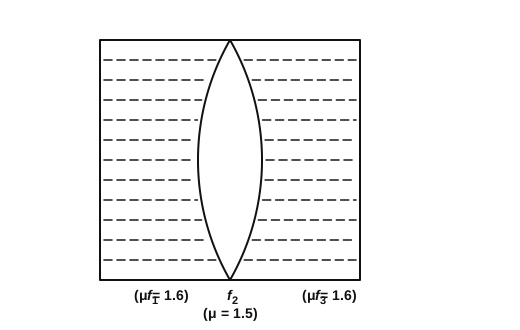
- Middle biconvex lens (, R = 20 cm each side): ⇒ cm
- Each outer layer () is plano-concave with R = 20 cm:
- cm (diverging)
Short trick: Power way: P ∝ (μ − 1)/R: two concave layers give 2 × 0.6 = 1.2, the convex core gives 2 × 0.5 = 1.0 ⇒ net −0.2/20 = −1/100 cm⁻¹.
Answer: (C) −100 cm
अवधारणा: निकाय को सम्पर्क में रखे तीन पतले लेंसों में बाँटें और प्रत्येक के लिए लगाएँ; फिर ।
- बीच का उभयोत्तल लेंस (, दोनों ओर R = 20 cm): ⇒ cm
- प्रत्येक बाहरी परत () R = 20 cm वाला समतल-अवतल लेंस है:
- cm (अपसारी)
शॉर्ट ट्रिक: क्षमता विधि: P ∝ (μ − 1)/R: दो अवतल परतें 2 × 0.6 = 1.2, उत्तल कोर 2 × 0.5 = 1.0 देता है ⇒ कुल −0.2/20 = −1/100 cm⁻¹।
उत्तर: (C) −100 cm
NEET UGPhysicsRay optics – combination of thin lenses (lens maker’s formula)NEET UG 2023 · 7 May Shift 1
Q182.An electric dipole is placed as shown in the figure,
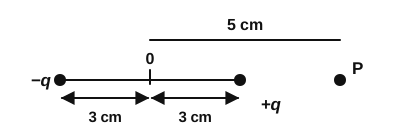
The electric potential (in
V) at point P due to the dipole is (
= permittivity of free space and
):
एक विद्युत द्विध्रुव चित्र में दर्शाए अनुसार रखा गया है,
द्विध्रुव के कारण बिंदु P पर विद्युत विभव (
V में) है (
= मुक्त आकाश की विद्युतशीलता तथा
):
- A
- B
- C
- D
Show answer
Concept: Potential is a scalar: (exact, since P is not far from the dipole).
- P is 5 cm from the centre O; +q is 3 cm from O on the same side ⇒ = 2 cm = 0.02 m; −q is on the other side ⇒ = 8 cm = 0.08 m.
- V
Short trick: Do not use the short-dipole formula here (r is not ≫ a); add the two point-charge potentials directly.
Answer: (A)
अवधारणा: विभव अदिश है: (यथार्थ, क्योंकि P द्विध्रुव से बहुत दूर नहीं है)।
- P केंद्र O से 5 cm दूर है; +q उसी ओर O से 3 cm पर ⇒ = 2 cm = 0.02 m; −q दूसरी ओर ⇒ = 8 cm = 0.08 m।
- V
शॉर्ट ट्रिक: यहाँ लघु द्विध्रुव सूत्र न लगाएँ (r ≫ a नहीं है); दोनों बिंदु-आवेशों के विभव सीधे जोड़ें।
उत्तर: (A)
NEET UGPhysicsElectrostatics – potential due to a dipole (axial point)NEET UG 2023 · 7 May Shift 1
Q183.A horizontal bridge is built across a river. A student standing on the bridge throws a small ball vertically upwards with a velocity . The ball strikes the water surface after 4 s. The height of bridge above water surface is (Take ):
एक नदी पर एक क्षैतिज पुल बना है। पुल पर खड़ा एक छात्र एक छोटी गेंद को वेग से ऊर्ध्वाधरतः ऊपर फेंकता है। गेंद 4 s बाद जल की सतह से टकराती है। जल की सतह से पुल की ऊँचाई है ( लीजिए):
- A56 m
- B60 m
- C64 m
- D68 m
Show answer
Concept: Take upward positive; the displacement from bridge to water is : .
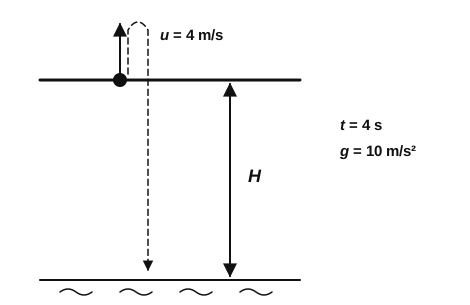
Short trick: Free-fall 4 s from rest drops 80 m; the 4 m/s upward throw gives back = 16 m ⇒ 80 − 16 = 64 m.
Answer: (C) 64 m
अवधारणा: ऊपर की दिशा धनात्मक लें; पुल से जल तक विस्थापन है: ।
शॉर्ट ट्रिक: विराम से 4 s मुक्त पतन में 80 m गिरती; 4 m/s ऊपर फेंकने से = 16 m वापस ⇒ 80 − 16 = 64 m।
उत्तर: (C) 64 m
NEET UGPhysicsKinematics – motion under gravityNEET UG 2023 · 7 May Shift 1
Q184.Calculate the maximum acceleration of a moving car so that a body lying on the floor of the car remains stationary. The coefficient of static friction between the body and the floor is 0.15 ()
चलती हुई कार का वह अधिकतम त्वरण ज्ञात कीजिए जिससे कार के फर्श पर रखा पिंड स्थिर बना रहे। पिंड तथा फर्श के बीच स्थैतिक घर्षण गुणांक 0.15 है ()
- A
- B
- C
- D
Show answer
Concept: Static friction is the only horizontal force that can accelerate the body with the car; it cannot exceed .
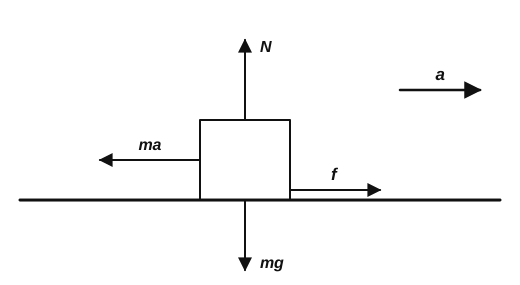
- In the car frame the pseudo force (backward) must be balanced by friction .
Short trick: – mass cancels; 0.15 × 10 = 1.5.
Answer: (C)
अवधारणा: स्थैतिक घर्षण ही एकमात्र क्षैतिज बल है जो पिंड को कार के साथ त्वरित कर सकता है; यह से अधिक नहीं हो सकता।
- कार के निर्देश तंत्र में छद्म बल (पीछे की ओर) को घर्षण संतुलित करता है।
शॉर्ट ट्रिक: – द्रव्यमान कट जाता है; 0.15 × 10 = 1.5।
उत्तर: (C)
NEET UGPhysicsLaws of motion – static friction (pseudo force)NEET UG 2023 · 7 May Shift 1
Q185.10 resistors, each of resistance R are connected in series to a battery of emf E and negligible internal resistance. Then those are connected in parallel to the same battery, the current is increased n times. The value of n is:
दस प्रतिरोधक, प्रत्येक का प्रतिरोध R, विद्युत वाहक बल E तथा नगण्य आंतरिक प्रतिरोध वाली बैटरी से श्रेणी में जोड़े जाते हैं। फिर उन्हें उसी बैटरी से समांतर में जोड़ने पर धारा n गुना बढ़ जाती है। n का मान है:
- A10
- B100
- C1
- D1000
Show answer
Concept: Series: ; parallel: ; with an ideal battery .
Short trick: ⇒ current ratio = = 100.
Answer: (B) 100
अवधारणा: श्रेणी: ; समांतर: ; आदर्श बैटरी के साथ ।
शॉर्ट ट्रिक: ⇒ धारा अनुपात = = 100।
उत्तर: (B) 100
NEET UGPhysicsCurrent electricity – series and parallel combination of resistorsNEET UG 2023 · 7 May Shift 1
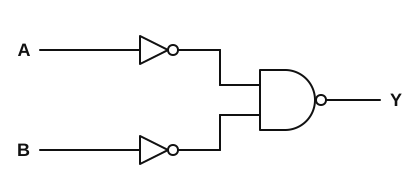
Q186.For the following logic circuit, the truth table is:
निम्नलिखित तर्क परिपथ के लिए सत्यमान सारणी है:
- A
- B
- C
- D
Show answer
Concept: Inputs pass through NOT gates and then a NAND gate: ; by De Morgan’s theorem this is .
- → OR gate
- OR table: 00→0, 01→1, 10→1, 11→1 = option (B).
- (A) is NAND, (C) is just NOT B, (D) is AND – all wrong.
Short trick: Bubbles on inputs + NAND = OR (inverted inputs into NAND); likewise bubbles on inputs + NOR = AND.
Answer: (B) OR-gate truth table 0, 1, 1, 1
अवधारणा: निवेश NOT द्वारों से होकर NAND द्वार में जाते हैं: ; डी-मॉर्गन प्रमेय से यह है।
- → OR द्वार
- OR सारणी: 00→0, 01→1, 10→1, 11→1 = विकल्प (B)।
- (A) NAND है, (C) केवल NOT B है, (D) AND है – सभी गलत।
शॉर्ट ट्रिक: निवेशों पर बबल + NAND = OR; इसी प्रकार निवेशों पर बबल + NOR = AND।
उत्तर: (B) OR द्वार की सत्यमान सारणी 0, 1, 1, 1
NEET UGPhysicsSemiconductor electronics – logic gates (NOT + NAND = OR)NEET UG 2023 · 7 May Shift 1
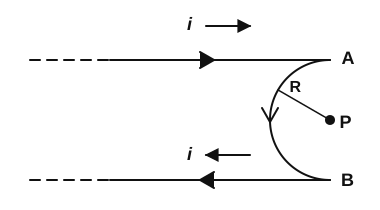
Q187.A very long conducting wire is bent in a semi-circular shape from A to B as shown in figure. The magnetic field at point P for steady current configuration is given by:
एक बहुत लंबे चालक तार को चित्र में दर्शाए अनुसार A से B तक अर्धवृत्ताकार आकार में मोड़ा गया है। स्थायी धारा विन्यास के लिए बिंदु P पर चुम्बकीय क्षेत्र है:
- A pointed into the page पृष्ठ के अंदर की ओर
- B pointed away from the page पृष्ठ से बाहर की ओर
- C pointed away from the page पृष्ठ से बाहर की ओर
- D pointed into the page पृष्ठ के अंदर की ओर
Show answer
Concept: Semi-infinite straight wire ending at the foot of the perpendicular: . Semicircular arc at its centre: .
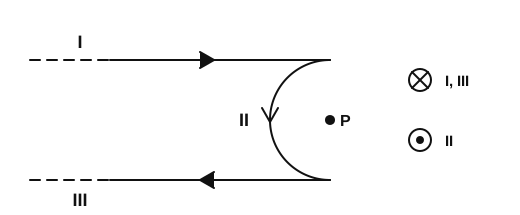
- Part I (upper wire, current → , P below it): into the page.
- Part III (lower wire, current ←, P above it): into the page.
- Part II (arc A → B round the left, anticlockwise about P): out of the page.
- Net ; since , the arc wins → out of the page.
Short trick: Arc term vs two wire terms each; so direction = arc’s direction (out).
Answer: (C) pointed away from the page
अवधारणा: लम्ब के पाद पर समाप्त होने वाला अर्ध-अनंत सीधा तार: । अर्धवृत्ताकार चाप के केंद्र पर: ।
- भाग I (ऊपरी तार, धारा → , P इसके नीचे): पृष्ठ के अंदर।
- भाग III (निचला तार, धारा ←, P इसके ऊपर): पृष्ठ के अंदर।
- भाग II (चाप A → B बाईं ओर से, P के परितः वामावर्त): पृष्ठ से बाहर।
- कुल ; चूँकि , चाप प्रबल → पृष्ठ से बाहर।
शॉर्ट ट्रिक: चाप पद बनाम दो तार पद, प्रत्येक ; अतः दिशा = चाप की दिशा (बाहर)।
उत्तर: (C) पृष्ठ से बाहर की ओर
NEET UGPhysicsMoving charges and magnetism – field due to straight wires and semicircular arcNEET UG 2023 · 7 May Shift 1
Q188.The resistance of platinum wire at is and at . The temperature coefficient of resistance of the wire is:
प्लैटिनम के तार का प्रतिरोध पर तथा पर है। तार का प्रतिरोध ताप गुणांक है:
- A
- B
- C
- D
Show answer
Concept: .
Short trick: Fractional rise 4.8/2 = 2.4 over 80 °C → 2.4/80 = 0.03.
Answer: (C)
अवधारणा: ।
शॉर्ट ट्रिक: आंशिक वृद्धि 4.8/2 = 2.4, 80 °C में → 2.4/80 = 0.03।
उत्तर: (C)
NEET UGPhysicsCurrent electricity – temperature coefficient of resistanceNEET UG 2023 · 7 May Shift 1
Q189.A wire carrying a current I along the positive x-axis has length L. It is kept in a magnetic field T. The magnitude of the magnetic force acting on the wire is:
धनात्मक x-अक्ष के अनुदिश धारा I प्रवाहित करने वाले तार की लम्बाई L है। इसे चुम्बकीय क्षेत्र T में रखा गया है। तार पर लगने वाले चुम्बकीय बल का परिमाण है:
- A3IL
- B IL
- C5IL
- D IL
Show answer
Concept: with .
- , ,
Short trick: Only the components of B perpendicular to the wire matter: ; the part (along the wire) gives no force.
Answer: (C) 5IL
अवधारणा: , जहाँ ।
- , ,
शॉर्ट ट्रिक: केवल तार के लंबवत B के घटक मायने रखते हैं: ; भाग (तार के अनुदिश) कोई बल नहीं देता।
उत्तर: (C) 5IL
NEET UGPhysicsMoving charges and magnetism – force on a current-carrying wireNEET UG 2023 · 7 May Shift 1
Q190.Two thin lenses are of same focal lengths (f), but one is convex and the other one is concave. When they are placed in contact with each other, the equivalent focal length of the combination will be:
दो पतले लेंसों की फोकस दूरियाँ समान (f) हैं, परंतु एक उत्तल तथा दूसरा अवतल है। जब इन्हें एक-दूसरे के सम्पर्क में रखा जाता है, तो संयोजन की तुल्य फोकस दूरी होगी:
- AZeroशून्य
- B
- C
- DInfiniteअनंत
Show answer
Concept: Lenses in contact: (powers add).
- – the combination behaves like a plane glass plate (power zero).
Short trick: Equal and opposite powers cancel: P = 0 ⇒ F = ∞.
Answer: (D) Infinite
अवधारणा: सम्पर्क में रखे लेंस: (क्षमताएँ जुड़ती हैं)।
- – संयोजन एक समतल काँच की पट्टिका जैसा व्यवहार करता है (क्षमता शून्य)।
शॉर्ट ट्रिक: समान और विपरीत क्षमताएँ निरस्त होती हैं: P = 0 ⇒ F = ∞।
उत्तर: (D) अनंत
NEET UGPhysicsRay optics – lenses in contactNEET UG 2023 · 7 May Shift 1
Q191.The graph which shows the variation of the de Broglie wavelength () of a particle and its associated momentum (p) is
किसी कण की दे ब्रॉग्ली तरंगदैर्घ्य () तथा उससे संबद्ध संवेग (p) के बीच परिवर्तन को दर्शाने वाला ग्राफ है
- A
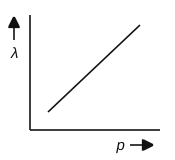
- B
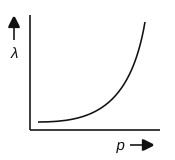
- C
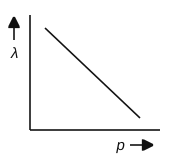
- D
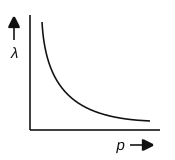
Show answer
Concept: de Broglie relation , so .
- = constant – this is a rectangular hyperbola.
- As p increases, falls steeply first and then flattens, never touching either axis.
- Graph (A) and (C) are straight lines (linear relation) and (B) is increasing – all wrong.
Short trick: = constant ⇒ always a rectangular hyperbola in the first quadrant.
Answer: (D) the falling hyperbola
अवधारणा: दे ब्रॉग्ली संबंध , अतः ।
- = नियतांक – यह एक आयताकार अतिपरवलय (rectangular hyperbola) है।
- p बढ़ने पर पहले तेज़ी से घटता है फिर धीरे-धीरे, और किसी भी अक्ष को नहीं छूता।
- ग्राफ (A) और (C) सरल रेखाएँ (रैखिक संबंध) हैं तथा (B) बढ़ता हुआ है – सभी गलत।
शॉर्ट ट्रिक: = नियतांक ⇒ प्रथम चतुर्थांश में सदैव आयताकार अतिपरवलय।
उत्तर: (D) घटता हुआ अतिपरवलय
NEET UGPhysicsDual nature – de Broglie wavelengthNEET UG 2022 · 17 Jul Shift 1
Q192.As the temperature increases, the electrical resistance:
ताप बढ़ने पर विद्युत प्रतिरोध:
- AIncreases for both conductors and semiconductorsचालकों और अर्धचालकों दोनों के लिए बढ़ता है
- BDecreases for both conductors and semiconductorsचालकों और अर्धचालकों दोनों के लिए घटता है
- CIncreases for conductors but decreases for semiconductorsचालकों के लिए बढ़ता है परन्तु अर्धचालकों के लिए घटता है
- DDecreases for conductors but increases for semiconductorsचालकों के लिए घटता है परन्तु अर्धचालकों के लिए बढ़ता है
Show answer
Concept: . In conductors n is fixed and falls with T; in semiconductors n rises exponentially with T.
- Conductor: more lattice vibrations → more collisions → decreases → R increases (positive temperature coefficient).
- Semiconductor: heat breaks covalent bonds → many more carriers (n) → R decreases (negative temperature coefficient).
- Hence options (A), (B), (D) are wrong.
Short trick: Metals: “hot = harder”; semiconductors: “hot = freer carriers”.
Answer: (C) Increases for conductors, decreases for semiconductors
अवधारणा: । चालकों में n नियत रहता है और ताप बढ़ने पर घटता है; अर्धचालकों में ताप के साथ n चरघातांकी रूप से बढ़ता है।
- चालक: जालक कंपन बढ़ते हैं → टक्करें बढ़ती हैं → घटता है → R बढ़ता है (धनात्मक ताप गुणांक)।
- अर्धचालक: ऊष्मा से सहसंयोजक बंध टूटते हैं → आवेश वाहक (n) बहुत बढ़ जाते हैं → R घटता है (ऋणात्मक ताप गुणांक)।
- अतः विकल्प (A), (B), (D) गलत हैं।
शॉर्ट ट्रिक: धातु: “गर्म = कठिन मार्ग”; अर्धचालक: “गर्म = अधिक मुक्त वाहक”।
उत्तर: (C) चालकों के लिए बढ़ता है, अर्धचालकों के लिए घटता है
NEET UGPhysicsCurrent electricity – temperature dependence of resistanceNEET UG 2022 · 17 Jul Shift 1
Q193.Let T1 and T2 be the energy of an electron in the first and second excited states of hydrogen atom, respectively. According to the Bohr’s model of an atom; the ratio T1 : T2 is:
माना T1 तथा T2 क्रमशः हाइड्रोजन परमाणु की प्रथम तथा द्वितीय उत्तेजित अवस्थाओं में इलेक्ट्रॉन की ऊर्जा हैं। बोर के परमाणु मॉडल के अनुसार अनुपात T1 : T2 है:
- A1 : 4
- B4 : 1
- C4 : 9
- D9 : 4
Show answer
Concept: eV. First excited state is n = 2, second excited state is n = 3.
- eV eV
- eV eV
Short trick: Excited state number + 1 = n. Ratio of energies = inverse ratio of = 3² : 2².
Answer: (D) 9 : 4
अवधारणा: eV। प्रथम उत्तेजित अवस्था n = 2 तथा द्वितीय उत्तेजित अवस्था n = 3 है।
- eV eV
- eV eV
शॉर्ट ट्रिक: उत्तेजित अवस्था क्रमांक + 1 = n। ऊर्जाओं का अनुपात = का व्युत्क्रम अनुपात = 3² : 2²।
उत्तर: (D) 9 : 4
NEET UGPhysicsAtoms – Bohr model energy levelsNEET UG 2022 · 17 Jul Shift 1
Q194.Two objects of mass 10 kg and 20 kg respectively are connected to the two ends of a rigid rod of length 10 m with negligible mass. The distance of the center of mass of the system from the 10 kg mass is:
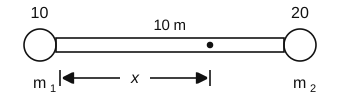
10 kg तथा 20 kg द्रव्यमान की दो वस्तुएँ नगण्य द्रव्यमान की 10 m लंबी एक दृढ़ छड़ के दोनों सिरों से जुड़ी हैं। 10 kg द्रव्यमान से निकाय के द्रव्यमान केंद्र की दूरी है:
- A m
- B m
- C10 m
- D5 m
Show answer
Concept: Taking the 10 kg mass at the origin, .
- m ≈ 6.67 m from the 10 kg mass (closer to the heavier mass, as expected).
Short trick: Distance from = .
Answer: (B) m
अवधारणा: 10 kg द्रव्यमान को मूल बिंदु पर लेने पर, ।
- m ≈ 6.67 m, 10 kg द्रव्यमान से (भारी द्रव्यमान के अधिक निकट, जैसा अपेक्षित है)।
शॉर्ट ट्रिक: से दूरी = ।
उत्तर: (B) m
NEET UGPhysicsSystem of particles – centre of massNEET UG 2022 · 17 Jul Shift 1
Q195.The ratio of the distance travelled by a freely falling body in the 1st, 2nd, 3rd and 4th second
स्वतंत्र रूप से गिरती हुई किसी वस्तु द्वारा 1ले, 2रे, 3रे तथा 4थे सेकंड में तय की गई दूरियों का अनुपात
- A1 : 2 : 3 : 4
- B1 : 4 : 9 : 16
- C1 : 3 : 5 : 7
- D1 : 1 : 1 : 1
Show answer
Concept: Distance in the nth second (u = 0): .
- Option (B) 1 : 4 : 9 : 16 is the ratio of total distances in 1, 2, 3, 4 s – a common trap.
Short trick: Galileo’s law of odd numbers – from rest, successive equal time intervals give 1 : 3 : 5 : 7 …
Answer: (C) 1 : 3 : 5 : 7
अवधारणा: nवें सेकंड में तय दूरी (u = 0): ।
- विकल्प (B) 1 : 4 : 9 : 16, 1, 2, 3, 4 s में तय कुल दूरियों का अनुपात है – एक सामान्य भ्रम।
शॉर्ट ट्रिक: गैलीलियो का विषम संख्या नियम – विरामावस्था से, क्रमागत समान समय अंतरालों में दूरियाँ 1 : 3 : 5 : 7 …
उत्तर: (C) 1 : 3 : 5 : 7
NEET UGPhysicsKinematics – free fall (Galileo’s law of odd numbers)NEET UG 2022 · 17 Jul Shift 1
Q196.The ratio of the radius of gyration of a thin uniform disc about an axis passing through its centre and normal to its plane to the radius of gyration of the disc about its diameter is
किसी पतली एकसमान चकती की, उसके केंद्र से गुजरने वाली तथा उसके तल के अभिलंबवत अक्ष के परितः घूर्णन त्रिज्या (radius of gyration) का, उसके व्यास के परितः घूर्णन त्रिज्या से अनुपात है
- A2 : 1
- B : 1
- C4 : 1
- D1 :
Show answer
Concept: . For a disc and, by the perpendicular-axis theorem, .
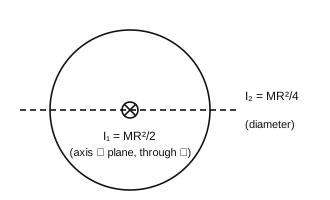
Short trick: K ∝ √I, and ⇒ .
Answer: (B) : 1
अवधारणा: । चकती के लिए तथा लंबवत अक्ष प्रमेय से ।
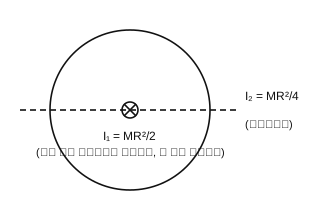
शॉर्ट ट्रिक: K ∝ √I, तथा ⇒ ।
उत्तर: (B) : 1
NEET UGPhysicsRotational motion – radius of gyrationNEET UG 2022 · 17 Jul Shift 1
Q197.The angular speed of a fly wheel moving with uniform angular acceleration changes from 1200 rpm to 3120 rpm in 16 seconds. The angular acceleration in rad/s2 is:
एकसमान कोणीय त्वरण से गतिमान एक गतिपालक चक्र (fly wheel) की कोणीय चाल 16 सेकंड में 1200 rpm से 3120 rpm हो जाती है। कोणीय त्वरण rad/s2 में है:
- A
- B
- C
- D
Show answer
Concept: with in rad/s: 1 rpm = rad/s.
- rpm rad/s
- rad/s²
Short trick: 1920/60 = 32 rev/s gained in 16 s ⇒ 2 rev/s² = 2 × 2π = 4π rad/s².
Answer: (B)
अवधारणा: , जहाँ rad/s में: 1 rpm = rad/s।
- rpm rad/s
- rad/s²
शॉर्ट ट्रिक: 1920/60 = 32 rev/s, 16 s में ⇒ 2 rev/s² = 2 × 2π = 4π rad/s²।
उत्तर: (B)
NEET UGPhysicsRotational kinematics – angular accelerationNEET UG 2022 · 17 Jul Shift 1
Q198.An ideal gas undergoes four different processes from the same initial state as shown in the figure below. Those processes are adiabatic, isothermal, isobaric and isochoric. The curve which represents the adiabatic process among 1, 2, 3 and 4 is:
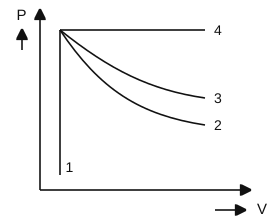
एक आदर्श गैस समान प्रारंभिक अवस्था से चार भिन्न प्रक्रमों से गुजरती है, जैसा नीचे चित्र में दर्शाया गया है। ये प्रक्रम रुद्धोष्म, समतापी, समदाबी तथा समआयतनिक हैं। 1, 2, 3 तथा 4 में से रुद्धोष्म प्रक्रम को निरूपित करने वाला वक्र है:
- A1
- B2
- C3
- D4
Show answer
Concept: Slopes on a P-V diagram: isobaric = 0, isochoric = ∞ (vertical), isothermal , adiabatic (steeper since ).
- Curve 4 is horizontal → isobaric.
- Curve 1 is vertical → isochoric.
- Of the two falling curves, the steeper one (curve 2) is adiabatic; the gentler one (curve 3) is isothermal.
Short trick: Adiabatic is always γ times steeper than isothermal from the same point.
Answer: (B) 2
अवधारणा: P-V आरेख पर ढाल: समदाबी = 0, समआयतनिक = ∞ (ऊर्ध्वाधर), समतापी , रुद्धोष्म (अधिक ढालू क्योंकि )।
- वक्र 4 क्षैतिज है → समदाबी।
- वक्र 1 ऊर्ध्वाधर है → समआयतनिक।
- दोनों गिरते वक्रों में से अधिक ढालू (वक्र 2) रुद्धोष्म है; कम ढालू (वक्र 3) समतापी है।
शॉर्ट ट्रिक: एक ही बिंदु से रुद्धोष्म वक्र सदैव समतापी से γ गुना अधिक ढालू होता है।
उत्तर: (B) 2
NEET UGPhysicsThermodynamics – P-V curves of processesNEET UG 2022 · 17 Jul Shift 1
Q199.Two hollow conducting spheres of radii R1 and R2 (R1 >> R2) have equal charges. The potential would be:
त्रिज्याओं R1 तथा R2 (R1 >> R2) के दो खोखले चालक गोलों पर समान आवेश हैं। विभव होगा:
- AMore on bigger sphereबड़े गोले पर अधिक
- BMore on smaller sphereछोटे गोले पर अधिक
- CEqual on both the sphereदोनों गोलों पर समान
- DDependent on the material properly of the sphereगोले के पदार्थ के गुण पर निर्भर
Show answer
Concept: Potential of a charged conducting sphere: – independent of material.
- Same Q ⇒ .
- : the smaller sphere is at higher potential.
- Option (D) is wrong: for a conductor V depends only on Q and R.
Short trick: Same charge on a smaller sphere = more “crowded” = higher potential (that is why sharp points leak charge).
Answer: (B) More on smaller sphere
अवधारणा: आवेशित चालक गोले का विभव: – पदार्थ पर निर्भर नहीं।
- समान Q ⇒ ।
- : छोटा गोला उच्च विभव पर है।
- विकल्प (D) गलत: चालक के लिए V केवल Q तथा R पर निर्भर है।
शॉर्ट ट्रिक: छोटे गोले पर समान आवेश = अधिक “भीड़” = अधिक विभव (इसी कारण नुकीले सिरों से आवेश का क्षरण होता है)।
उत्तर: (B) छोटे गोले पर अधिक
NEET UGPhysicsElectrostatics – potential of charged spheresNEET UG 2022 · 17 Jul Shift 1
Q200.When light propagates through a material medium of relative permittivity , and relative permeability , the velocity of light, v is given by (c - velocity of light in vacuum)
जब प्रकाश आपेक्षिक विद्युतशीलता तथा आपेक्षिक चुम्बकशीलता वाले किसी द्रव्य माध्यम में संचरित होता है, तो प्रकाश का वेग v होगा (c - निर्वात में प्रकाश का वेग)
- A
- B
- C
- D
Show answer
Concept: Speed of an EM wave: , with and .
- Since , .
- Options (B), (C) are dimensionless – cannot be a speed; (A) holds only in vacuum.
Short trick: Refractive index and .
Answer: (D)
अवधारणा: विद्युतचुम्बकीय तरंग की चाल: , जहाँ तथा ।
- चूँकि , अतः ।
- विकल्प (B), (C) विमाहीन हैं – चाल नहीं हो सकते; (A) केवल निर्वात में सत्य है।
शॉर्ट ट्रिक: अपवर्तनांक तथा ।
उत्तर: (D)
NEET UGPhysicsEM waves – speed of light in a mediumNEET UG 2022 · 17 Jul Shift 1

