Q201.A long solenoid of radius 1 mm has 100 turns per mm. If 1 A current flows in the solenoid, the magnetic field strength at the centre of the solenoid is :
1 mm त्रिज्या की एक लंबी परिनालिका में प्रति mm 100 फेरे हैं। यदि परिनालिका में 1 A धारा प्रवाहित हो, तो परिनालिका के केंद्र पर चुम्बकीय क्षेत्र की तीव्रता है:
- A6.28 × 10-2 T
- B12.56 × 10-2 T
- C12.26 × 10-4 T
- D6.28 × 10-4 T
Show answer
Concept: Inside a long solenoid (n = turns per metre); the radius does not matter.
- turns/m
- T
- T
Short trick: Radius 1 mm is a distractor – B inside an ideal long solenoid is independent of radius.
Answer: (B) 12.56 × 10⁻² T
अवधारणा: लंबी परिनालिका के अंदर (n = प्रति मीटर फेरे); त्रिज्या का कोई प्रभाव नहीं।
- फेरे/m
- T
- T
शॉर्ट ट्रिक: 1 mm त्रिज्या भ्रमित करने वाला आँकड़ा है – आदर्श लंबी परिनालिका के अंदर B त्रिज्या पर निर्भर नहीं।
उत्तर: (B) 12.56 × 10⁻² T
NEET UGPhysicsMagnetism – field of a solenoidNEET UG 2022 · 17 Jul Shift 1
Q202.The peak voltage of the ac source is equal to :
ac स्रोत की शिखर वोल्टता बराबर है:
- Athe value of voltage supplied to the circuitपरिपथ को दी गई वोल्टता के मान के
- Bthe rms value of the ac sourceac स्रोत के rms मान के
- C times the rms value of the ac sourceac स्रोत के rms मान के गुने के
- D times the rms value of the ac sourceac स्रोत के rms मान के गुने के
Show answer
Concept: For a sinusoidal voltage .
- Example: 220 V mains (rms) has a peak of about 311 V.
- Option (D) inverts the relation; (A), (B) refer to the rms value, not the peak.
Short trick: Peak is always the bigger one: .
Answer: (C) times the rms value
अवधारणा: ज्यावक्रीय वोल्टता के लिए ।
- उदाहरण: 220 V (rms) घरेलू आपूर्ति का शिखर मान लगभग 311 V है।
- विकल्प (D) संबंध को उलट देता है; (A), (B) rms मान को दर्शाते हैं, शिखर मान को नहीं।
शॉर्ट ट्रिक: शिखर मान सदैव बड़ा: ।
उत्तर: (C) rms मान का गुना
NEET UGPhysicsAlternating current – peak and rms valuesNEET UG 2022 · 17 Jul Shift 1
Q203.An electric lift with a maximum load of 2000 kg (lift + passengers) is moving up with a constant speed of 1.5 ms-1. The frictional force opposing the motion is 3000 N. The minimum power delivered by the motor to the lift in watts is: (g = 10 ms-2)
अधिकतम 2000 kg भार (लिफ्ट + यात्री) वाली एक विद्युत लिफ्ट 1.5 ms-1 की नियत चाल से ऊपर जा रही है। गति का विरोध करने वाला घर्षण बल 3000 N है। मोटर द्वारा लिफ्ट को दी गई न्यूनतम शक्ति वाट में है: (g = 10 ms-2)
- A23000
- B20000
- C34500
- D23500
Show answer
Concept: At constant velocity the net force is zero, so motor force = weight + friction; .
- Weight = 2000 × 10 = 20000 N
- N
- W
Short trick: Option (A) 23000 is the force, not the power – multiply by v.
Answer: (C) 34500 W
अवधारणा: नियत वेग पर कुल बल शून्य है, अतः मोटर बल = भार + घर्षण; ।
- भार = 2000 × 10 = 20000 N
- N
- W
शॉर्ट ट्रिक: विकल्प (A) 23000 बल है, शक्ति नहीं – v से गुणा कीजिए।
उत्तर: (C) 34500 W
NEET UGPhysicsWork, energy and power – power of a lift motorNEET UG 2022 · 17 Jul Shift 1
Q204.In a Young's double slit experiment, a student observes 8 fringes in a certain segment of screen when a monochromatic light of 600 nm wavelength is used. If the wavelength of light is changed to 400 nm, then the number of fringes he would observe in the same region of the screen is
यंग के द्वि-झिरी प्रयोग में 600 nm तरंगदैर्घ्य का एकवर्णी प्रकाश प्रयुक्त करने पर एक छात्र पर्दे के एक निश्चित भाग में 8 फ्रिंजें देखता है। यदि प्रकाश की तरंगदैर्घ्य 400 nm कर दी जाए, तो पर्दे के उसी भाग में वह कितनी फ्रिंजें देखेगा?
- A6
- B8
- C9
- D12
Show answer
Concept: Fringe width . For a fixed region, = constant ⇒ = constant.
Short trick: Smaller λ ⇒ narrower fringes ⇒ more fringes: 8 × 600/400 = 12.
Answer: (D) 12
अवधारणा: फ्रिंज चौड़ाई । निश्चित भाग के लिए = नियतांक ⇒ = नियतांक।
शॉर्ट ट्रिक: कम λ ⇒ संकरी फ्रिंजें ⇒ अधिक फ्रिंजें: 8 × 600/400 = 12।
उत्तर: (D) 12
NEET UGPhysicsWave optics – YDSE fringe countNEET UG 2022 · 17 Jul Shift 1
Q205.A copper wire of length 10 m and radius m has electrical resistance of 10 Ω. The current density in the wire for an electric field strength of 10 (V/m) is:
10 m लंबाई तथा m त्रिज्या के एक ताँबे के तार का विद्युत प्रतिरोध 10 Ω है। 10 (V/m) विद्युत क्षेत्र तीव्रता के लिए तार में धारा घनत्व है:
- A104 A/m2
- B106 A/m2
- C10-5 A/m2
- D105 A/m2
Show answer
Concept: gives ; then Ohm’s law in vector form .
- m²
- Ω m
- A/m²
Short trick: Shortcut: .
Answer: (D) 105 A/m2
अवधारणा: से ज्ञात करें; फिर ओम के नियम का सदिश रूप ।
- m²
- Ω m
- A/m²
शॉर्ट ट्रिक: शॉर्टकट: ।
उत्तर: (D) 105 A/m2
NEET UGPhysicsCurrent electricity – resistivity and current densityNEET UG 2022 · 17 Jul Shift 1
Q206.The dimensions [MLT-2A-2] belong to the:
विमाएँ [MLT-2A-2] किसकी हैं?
- AMagnetic fluxचुम्बकीय फ्लक्स
- BSelf inductanceस्वप्रेरकत्व
- CMagnetic permeabilityचुम्बकीय पारगम्यता (permeability)
- DElectric permittivityविद्युत विद्युतशीलता (permittivity)
Show answer
Concept: From : .
- Magnetic flux: – wrong.
- Self inductance: – wrong (extra L).
- Permittivity : – wrong.
- Permeability : – matches.
Short trick: = force per (current)²; also cross-checks.
Answer: (C) Magnetic permeability
अवधारणा: से: ।
- चुम्बकीय फ्लक्स: – गलत।
- स्वप्रेरकत्व: – गलत (एक L अतिरिक्त)।
- विद्युतशीलता : – गलत।
- पारगम्यता : – मेल खाता है।
शॉर्ट ट्रिक: = बल प्रति (धारा)²; साथ ही से जाँच करें।
उत्तर: (C) चुम्बकीय पारगम्यता
NEET UGPhysicsUnits and dimensions – magnetic permeabilityNEET UG 2022 · 17 Jul Shift 1
Q207.If the initial tension on a stretched string is doubled, then the ratio of the initial and final speeds of a transverse wave along the string is:
यदि किसी तनी हुई डोरी का प्रारंभिक तनाव दोगुना कर दिया जाए, तो डोरी के अनुदिश अनुप्रस्थ तरंग की प्रारंभिक तथा अंतिम चालों का अनुपात है:
- A1 : 1
- B : 1
- C1 :
- D1 : 2
Show answer
Concept: ⇒ for the same string.
- ⇒ ratio 1 :
Short trick: Tension doubled ⇒ speed × √2; initial : final = 1 : √2.
Answer: (C) 1 :
अवधारणा: ⇒ उसी डोरी के लिए ।
- ⇒ अनुपात 1 :
शॉर्ट ट्रिक: तनाव दोगुना ⇒ चाल × √2; प्रारंभिक : अंतिम = 1 : √2।
उत्तर: (C) 1 :
NEET UGPhysicsWaves – speed of transverse wave on a stringNEET UG 2022 · 17 Jul Shift 1
Q208.In half wave rectification, if the input frequency is 60 Hz, then the output frequency would be:
अर्ध-तरंग दिष्टकरण में यदि निवेशी आवृत्ति 60 Hz हो, तो निर्गत आवृत्ति होगी:
- AZeroशून्य
- B30 Hz
- C60 Hz
- D120 Hz
Show answer
Concept: A half-wave rectifier passes only one half of every input cycle, so it gives one output pulse per input cycle.
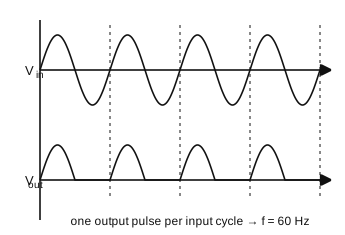
- Input: 60 cycles per second.
- Output: one positive pulse for each cycle ⇒ 60 pulses per second.
- Output (ripple) frequency = 60 Hz. A full-wave rectifier would give 2 × 60 = 120 Hz (option D trap).
Short trick: Half-wave: fout = fin; full-wave: fout = 2fin.
Answer: (C) 60 Hz
अवधारणा: अर्ध-तरंग दिष्टकारी प्रत्येक निवेशी चक्र का केवल एक अर्धभाग पारित करता है, अतः प्रत्येक निवेशी चक्र पर एक निर्गत स्पंद देता है।
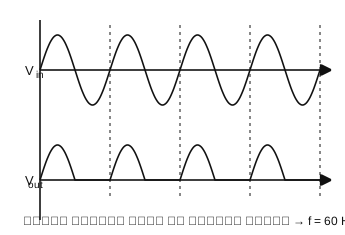
- निवेश: 60 चक्र प्रति सेकंड।
- निर्गत: प्रत्येक चक्र के लिए एक धनात्मक स्पंद ⇒ 60 स्पंद प्रति सेकंड।
- निर्गत (ऊर्मिका) आवृत्ति = 60 Hz। पूर्ण-तरंग दिष्टकारी 2 × 60 = 120 Hz देगा (विकल्प D का भ्रम)।
शॉर्ट ट्रिक: अर्ध-तरंग: fout = fin; पूर्ण-तरंग: fout = 2fin।
उत्तर: (C) 60 Hz
NEET UGPhysicsSemiconductors – half-wave rectifierNEET UG 2022 · 17 Jul Shift 1
Q209.The displacement time graphs of two moving particles make angles of 30° and 45° with the x-axis as shown in the figure. The ratio of their respective velocity is
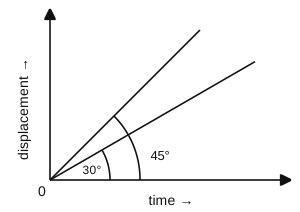
दो गतिमान कणों के विस्थापन-समय ग्राफ x-अक्ष से 30° तथा 45° के कोण बनाते हैं, जैसा चित्र में दर्शाया गया है। उनके संगत वेगों का अनुपात है
- A : 1
- B1 : 1
- C1 : 2
- D1 :
Show answer
Concept: Velocity = slope of the displacement-time graph = .
- ,
Short trick: Steeper line = faster; 30° line is slower, so the ratio must be less than 1 – only (C) or (D); tan ratio gives (D).
Answer: (D) 1 :
अवधारणा: वेग = विस्थापन-समय ग्राफ की ढाल = ।
- ,
शॉर्ट ट्रिक: अधिक ढालू रेखा = अधिक तेज़; 30° वाली रेखा धीमी है, अतः अनुपात 1 से कम – केवल (C) या (D); tan का अनुपात (D) देता है।
उत्तर: (D) 1 :
NEET UGPhysicsKinematics – slope of displacement-time graphNEET UG 2022 · 17 Jul Shift 1
Q210.A square loop of side 1 m and resistance 1 Ω is placed in a magnetic field of 0.5 T. If the plane of loop is perpendicular to the direction of magnetic field, the magnetic flux through the loop is
1 m भुजा तथा 1 Ω प्रतिरोध का एक वर्गाकार लूप 0.5 T के चुम्बकीय क्षेत्र में रखा है। यदि लूप का तल चुम्बकीय क्षेत्र की दिशा के लंबवत हो, तो लूप से गुजरने वाला चुम्बकीय फ्लक्स है
- A2 weber2 वेबर
- B0.5 weber0.5 वेबर
- C1 weber1 वेबर
- DZero weberशून्य वेबर
Show answer
Concept: , θ = angle between and the area vector (normal to the plane).
- Plane ⊥ field ⇒ normal ∥ field ⇒ θ = 0°.
- Wb
- Resistance 1 Ω is irrelevant to flux.
Short trick: “Plane perpendicular to B” = maximum flux BA; “plane parallel to B” = zero flux.
Answer: (B) 0.5 weber
अवधारणा: , θ = तथा क्षेत्रफल सदिश (तल के अभिलंब) के बीच कोण।
- तल ⊥ क्षेत्र ⇒ अभिलंब ∥ क्षेत्र ⇒ θ = 0°।
- Wb
- 1 Ω प्रतिरोध फ्लक्स के लिए अप्रासंगिक है।
शॉर्ट ट्रिक: “तल B के लंबवत” = अधिकतम फ्लक्स BA; “तल B के समांतर” = शून्य फ्लक्स।
उत्तर: (B) 0.5 वेबर
NEET UGPhysicsEMI – magnetic fluxNEET UG 2022 · 17 Jul Shift 1
Q211.The energy that will be ideally radiated by a 100 kW transmitter in 1 hour is:
एक 100 kW प्रेषित्र (transmitter) द्वारा 1 घंटे में आदर्श रूप से विकिरित ऊर्जा होगी:
- A36 × 107 J
- B36 × 104 J
- C36 × 105 J
- D1 × 105 J
Show answer
Concept: Energy = Power × time (SI units).
- P = 100 kW = W; t = 1 h = 3600 s
- J
- J
Short trick: 1 kWh = 3.6 × 10⁶ J ⇒ 100 kWh = 3.6 × 10⁸ J.
Answer: (A) 36 × 107 J
अवधारणा: ऊर्जा = शक्ति × समय (SI मात्रकों में)।
- P = 100 kW = W; t = 1 h = 3600 s
- J
- J
शॉर्ट ट्रिक: 1 kWh = 3.6 × 10⁶ J ⇒ 100 kWh = 3.6 × 10⁸ J।
उत्तर: (A) 36 × 107 J
NEET UGPhysicsWork, energy and power – energy from powerNEET UG 2022 · 17 Jul Shift 1
Q212.A body of mass 60 g experiences a gravitational force of 3.0 N, when placed at a particular point. The magnitude of the gravitational field intensity at that point is :
60 g द्रव्यमान की एक वस्तु किसी विशेष बिंदु पर रखे जाने पर 3.0 N का गुरुत्वीय बल अनुभव करती है। उस बिंदु पर गुरुत्वीय क्षेत्र तीव्रता का परिमाण है:
- A0.05 N/kg
- B50 N/kg
- C20 N/kg
- D180 N/kg
Show answer
Concept: Gravitational field intensity = force per unit mass, .
- m = 60 g = 0.06 kg
- N/kg
Short trick: Convert grams to kg first – using 60 directly gives the trap 0.05.
Answer: (B) 50 N/kg
अवधारणा: गुरुत्वीय क्षेत्र तीव्रता = प्रति एकांक द्रव्यमान बल, ।
- m = 60 g = 0.06 kg
- N/kg
शॉर्ट ट्रिक: पहले ग्राम को kg में बदलें – सीधे 60 लेने पर भ्रामक उत्तर 0.05 आता है।
उत्तर: (B) 50 N/kg
NEET UGPhysicsGravitation – gravitational field intensityNEET UG 2022 · 17 Jul Shift 1
Q213.Match List - I with List - II
List-I
(Electromagnetic Waves) | List-II
(Wavelength) |
|---|
| (a) AM radio waves | (i) 10-10 m |
| (b) Microwaves | (ii) 102 m |
| (c) Infrared radiations | (iii) 10-2 m |
| (d) X-rays | (iv) 10-4 m |
Choose the correct answer from the options given below:
सूची - I का सूची - II से मिलान कीजिए
सूची-I
(विद्युतचुम्बकीय तरंगें) | सूची-II
(तरंगदैर्घ्य) |
|---|
| (a) AM रेडियो तरंगें | (i) 10-10 m |
| (b) सूक्ष्म तरंगें (Microwaves) | (ii) 102 m |
| (c) अवरक्त विकिरण (Infrared) | (iii) 10-2 m |
| (d) X-किरणें | (iv) 10-4 m |
नीचे दिए गए विकल्पों में से सही उत्तर चुनिए:
- A(a) - (iv), (b) - (iii), (c) - (ii), (d) - (i)
- B(a) - (iii), (b) - (ii), (c) - (i), (d) - (iv)
- C(a) - (iii), (b) - (iv), (c) - (ii), (d) - (i)
- D(a) - (ii), (b) - (iii), (c) - (iv), (d) - (i)
Show answer
Concept: Order of wavelengths: radio > microwave > infrared > visible > UV > X-rays > γ-rays.
- AM radio waves: hundreds of metres → m (ii).
- Microwaves: mm–cm range → m (iii).
- Infrared: about m (iv) (between microwave and visible).
- X-rays: about m = 1 Å (i).
Short trick: “Raging Martians Invaded Venus Using X-ray Guns” – λ decreases left to right; just place the four values in descending order.
Answer: (D) (a) - (ii), (b) - (iii), (c) - (iv), (d) - (i)
अवधारणा: तरंगदैर्घ्य का क्रम: रेडियो > सूक्ष्म तरंग > अवरक्त > दृश्य > पराबैंगनी > X-किरणें > γ-किरणें।
- AM रेडियो तरंगें: सैकड़ों मीटर → m (ii)।
- सूक्ष्म तरंगें: mm–cm परास → m (iii)।
- अवरक्त: लगभग m (iv) (सूक्ष्म तरंग और दृश्य के बीच)।
- X-किरणें: लगभग m = 1 Å (i)।
शॉर्ट ट्रिक: “Raging Martians Invaded Venus Using X-ray Guns” – बाएँ से दाएँ λ घटती है; चारों मानों को अवरोही क्रम में रख दें।
उत्तर: (D) (a) - (ii), (b) - (iii), (c) - (iv), (d) - (i)
NEET UGPhysicsEM waves – electromagnetic spectrumNEET UG 2022 · 17 Jul Shift 1
Q214.A shell of mass m is at rest initially. It explodes into three fragments having mass in the ratio 2 : 2 : 1. If the fragments having equal mass fly off along mutually perpendicular directions with speed v, the speed of the third (lighter) fragment is
m द्रव्यमान का एक गोला प्रारंभ में विरामावस्था में है। यह 2 : 2 : 1 द्रव्यमान अनुपात वाले तीन टुकड़ों में फट जाता है। यदि समान द्रव्यमान वाले टुकड़े परस्पर लंबवत दिशाओं में v चाल से उड़ते हैं, तो तीसरे (हल्के) टुकड़े की चाल है
- Av
- B
- C
- D
Show answer
Concept: Initial momentum is zero, so the vector sum of the three fragment momenta is zero.
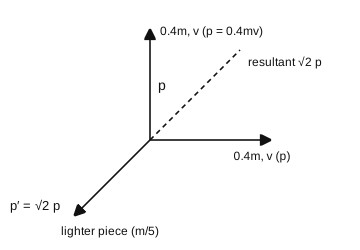
- Masses: i.e. 0.4m, 0.4m, 0.2m.
- Each equal piece: p = 0.4mv; they are perpendicular ⇒ resultant = .
- Lighter piece:
Short trick: Mass ratio heavy:light = 2:1 ⇒ speed of light piece = 2 × √2 v.
Answer: (C)
अवधारणा: प्रारंभिक संवेग शून्य है, अतः तीनों टुकड़ों के संवेगों का सदिश योग शून्य होगा।
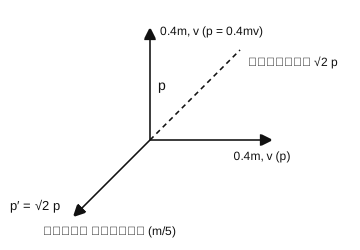
- द्रव्यमान: अर्थात 0.4m, 0.4m, 0.2m।
- प्रत्येक समान टुकड़ा: p = 0.4mv; ये लंबवत हैं ⇒ परिणामी = ।
- हल्का टुकड़ा:
शॉर्ट ट्रिक: भारी:हल्का द्रव्यमान = 2:1 ⇒ हल्के टुकड़े की चाल = 2 × √2 v।
उत्तर: (C)
NEET UGPhysicsConservation of momentum – explosionNEET UG 2022 · 17 Jul Shift 1
Q215.A biconvex lens has radii of curvature, 20 cm each. If the refractive index of the material of the lens is 1.5, the power of the lens is:
एक उभयोत्तल लेंस की प्रत्येक वक्रता त्रिज्या 20 cm है। यदि लेंस के पदार्थ का अपवर्तनांक 1.5 है, तो लेंस की क्षमता है:
- A+2D
- B+20D
- C+5D
- DInfinityअनंत
Show answer
Concept: Lens maker’s formula ; for biconvex cm, cm.
- cm⁻¹
- f = 20 cm = 0.2 m
- D
Short trick: Equi-biconvex lens with μ = 1.5 ⇒ f = R. So f = 20 cm, P = 100/20 = +5 D.
Answer: (C) +5D
अवधारणा: लेंस निर्माता सूत्र ; उभयोत्तल के लिए cm, cm।
- cm⁻¹
- f = 20 cm = 0.2 m
- D
शॉर्ट ट्रिक: μ = 1.5 वाले सम-उभयोत्तल लेंस के लिए f = R। अतः f = 20 cm, P = 100/20 = +5 D।
उत्तर: (C) +5D
NEET UGPhysicsRay optics – lens maker’s formula and powerNEET UG 2022 · 17 Jul Shift 1
Q216.Given below are two statements
Statement I : Biot-Savart's law gives us the expression for the magnetic field strength of an infinitesimal current element (Idl) of a current carrying conductor only.
Statement II: Biot-Savart's law is analogous to Coulomb's inverse square law of charge q, with the former being related to the field produced by a scalar source, Idl while the latter being produced by a vector source, q.
In light of above statements choose the most appropriate answer from the options given below:
नीचे दो कथन दिए गए हैं
कथन I : बायो-सावर्ट नियम केवल किसी धारावाही चालक के अतिसूक्ष्म धारा अवयव (Idl) के चुम्बकीय क्षेत्र की तीव्रता का व्यंजक देता है।
कथन II : बायो-सावर्ट नियम आवेश q के कूलॉम के व्युत्क्रम वर्ग नियम के अनुरूप है, जिसमें पहला एक अदिश स्रोत Idl द्वारा उत्पन्न क्षेत्र से संबंधित है जबकि दूसरा एक सदिश स्रोत q द्वारा उत्पन्न होता है।
उपरोक्त कथनों के आलोक में नीचे दिए गए विकल्पों में से सबसे उपयुक्त उत्तर चुनिए:
- ABoth Statement I and Statement II are correctकथन I तथा कथन II दोनों सही हैं
- BBoth Statement I and Statement II are incorrectकथन I तथा कथन II दोनों गलत हैं
- CStatement I is correct and Statement II is incorrectकथन I सही है तथा कथन II गलत है
- DStatement I is incorrect and Statement II is correctकथन I गलत है तथा कथन II सही है
Show answer
Concept: Biot-Savart law: – the source is a vector.
- Statement I: the law gives the field of a current element Idl – correct.
- Statement II: the analogy (inverse-square) is right, but the labels are swapped – Idl is a vector source and charge q is a scalar source. Hence incorrect.
Short trick: Charge has no direction (scalar); a current element has direction (vector) – that is why Biot-Savart has a cross product.
Answer: (C) Statement I is correct and Statement II is incorrect
अवधारणा: बायो-सावर्ट नियम: – स्रोत एक सदिश है।
- कथन I: यह नियम धारा अवयव Idl का क्षेत्र देता है – सही।
- कथन II: व्युत्क्रम-वर्ग समानता सही है, परन्तु नाम उलटे हैं – Idl एक सदिश स्रोत है तथा आवेश q एक अदिश स्रोत है। अतः गलत।
शॉर्ट ट्रिक: आवेश की कोई दिशा नहीं (अदिश); धारा अवयव की दिशा होती है (सदिश) – इसीलिए बायो-सावर्ट में सदिश गुणनफल आता है।
उत्तर: (C) कथन I सही है तथा कथन II गलत है
NEET UGPhysicsMoving charges – Biot-Savart lawNEET UG 2022 · 17 Jul Shift 1
Q217.In the given nuclear reaction, the element X is:
दी गई नाभिकीय अभिक्रिया में तत्व X है:
- A
- B
- C
- D
Show answer
Concept: In β⁺ decay a proton becomes a neutron: . Mass number A is unchanged, Z decreases by 1.
- A: 22 → 22 (positron and neutrino carry no nucleons).
- Z: 11 → 11 − 1 = 10 (charge conservation: 11 = Z + 1).
- Z = 10 is neon ⇒ X = .
Short trick: β⁺: A same, Z − 1. β⁻: A same, Z + 1.
Answer: (C)
अवधारणा: β⁺ क्षय में एक प्रोटॉन न्यूट्रॉन में बदलता है: । द्रव्यमान संख्या A अपरिवर्तित, Z में 1 की कमी।
- A: 22 → 22 (पॉज़िट्रॉन तथा न्यूट्रिनो में कोई न्यूक्लिऑन नहीं)।
- Z: 11 → 11 − 1 = 10 (आवेश संरक्षण: 11 = Z + 1)।
- Z = 10 नियॉन है ⇒ X = ।
शॉर्ट ट्रिक: β⁺: A वही, Z − 1। β⁻: A वही, Z + 1।
उत्तर: (C)
NEET UGPhysicsNuclei – β⁺ decayNEET UG 2022 · 17 Jul Shift 1
Q218.Plane angle and solid angle have:
समतल कोण तथा घन कोण में होते हैं:
- AUnits but no dimensionsमात्रक परन्तु विमाएँ नहीं
- BDimensions but no unitsविमाएँ परन्तु मात्रक नहीं
- CNo units and no dimensionsन मात्रक न विमाएँ
- DBoth units and dimensionsमात्रक तथा विमाएँ दोनों
Show answer
Concept: Plane angle = arc/radius (radian, rad); solid angle = area/radius² (steradian, sr).
- Both are ratios of like quantities ⇒ dimensionless.
- Yet they have SI units: rad and sr.
- So: units but no dimensions.
Short trick: Every dimensionless quantity need not be unitless – rad and sr are the classic examples (also strain has neither).
Answer: (A) Units but no dimensions
अवधारणा: समतल कोण = चाप/त्रिज्या (रेडियन, rad); घन कोण = क्षेत्रफल/त्रिज्या² (स्टेरेडियन, sr)।
- दोनों समान राशियों के अनुपात हैं ⇒ विमाहीन।
- फिर भी इनके SI मात्रक हैं: rad तथा sr।
- अतः: मात्रक हैं परन्तु विमाएँ नहीं।
शॉर्ट ट्रिक: प्रत्येक विमाहीन राशि मात्रकहीन नहीं होती – rad तथा sr इसके प्रसिद्ध उदाहरण हैं (विकृति में दोनों नहीं होते)।
उत्तर: (A) मात्रक परन्तु विमाएँ नहीं
NEET UGPhysicsUnits and dimensions – supplementary quantitiesNEET UG 2022 · 17 Jul Shift 1
Q219.The angle between the electric lines of force and the equipotential surface is:
विद्युत बल रेखाओं तथा समविभव पृष्ठ के बीच कोण है:
- A0°
- B45°
- C90°
- D180°
Show answer
Concept: No work is done in moving a charge along an equipotential surface: .
- for every on the surface with .
- ⇒ ⊥ surface: field lines cut equipotentials at 90°.
Short trick: Field lines point “downhill” in potential, straight across the contour – always perpendicular.
Answer: (C) 90°
अवधारणा: समविभव पृष्ठ के अनुदिश आवेश को ले जाने में कोई कार्य नहीं होता: ।
- पृष्ठ पर प्रत्येक के लिए , जबकि ।
- ⇒ ⊥ पृष्ठ: बल रेखाएँ समविभव पृष्ठों को 90° पर काटती हैं।
शॉर्ट ट्रिक: बल रेखाएँ विभव की “ढलान” की ओर, समोच्च रेखा के सीधे आर-पार चलती हैं – सदैव लंबवत।
उत्तर: (C) 90°
NEET UGPhysicsElectrostatics – equipotential surfacesNEET UG 2022 · 17 Jul Shift 1
Q220.A light ray falls on a glass surface of refractive index , at an angle 60°. The angle between the refracted and reflected rays would be:
एक प्रकाश किरण अपवर्तनांक वाले काँच के पृष्ठ पर 60° के कोण पर आपतित होती है। अपवर्तित तथा परावर्तित किरणों के बीच कोण होगा:
- A30°
- B60°
- C90°
- D120°
Show answer
Concept: Snell’s law ; reflected ray makes angle i with the normal on the incident side.
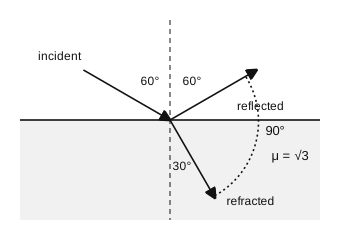
- Reflected ray is 60° from the normal, i.e. 30° above the surface; refracted ray is 30° from the normal, i.e. 60° below the surface.
- Angle between them = 180° − (60° + 30°) = 90°.
Short trick: ⇒ this is the Brewster angle, where reflected ⊥ refracted.
Answer: (C) 90°
अवधारणा: स्नेल का नियम ; परावर्तित किरण आपतन वाली ओर अभिलंब से कोण i बनाती है।
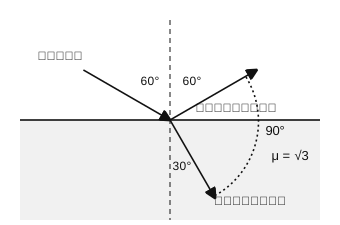
- परावर्तित किरण अभिलंब से 60° अर्थात पृष्ठ से 30° ऊपर है; अपवर्तित किरण अभिलंब से 30° अर्थात पृष्ठ से 60° नीचे है।
- इनके बीच कोण = 180° − (60° + 30°) = 90°।
शॉर्ट ट्रिक: ⇒ यह ब्रूस्टर कोण है, जहाँ परावर्तित ⊥ अपवर्तित।
उत्तर: (C) 90°
NEET UGPhysicsRay optics – reflection and refraction (Brewster condition)NEET UG 2022 · 17 Jul Shift 1

