NEET UG · 2,240 questions

NEET UG 2015, 2016, 2017, 2018, 2019, 2020, 2021, 2022, 2023, 2024, 2025, 2026 PYQs

Real previous year questions, subject-wise. Try the question, then open the answer and the explanation in Hindi & English – free, no login.

Courses – airGurukul

560 questions in Physics.

Q221.
In the given circuits (a), (b) and (c), the potential drop across the two p-n junctions are equal in:
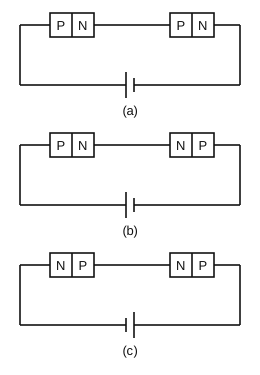
दिए गए परिपथों (a), (b) तथा (c) में दोनों p-n संधियों के सिरों पर विभवपात किसमें बराबर है?
  1. ACircuit (a) onlyकेवल परिपथ (a) में
  2. BCircuit (b) onlyकेवल परिपथ (b) में
  3. CCircuit (c) onlyकेवल परिपथ (c) में
  4. DBoth circuits (a) and (c)परिपथ (a) तथा (c) दोनों में
Show answer

Concept: Identical diodes in series carry the same current; if both are biased the same way (both forward or both reverse), they share the voltage equally.

  1. (a) P-N … P-N: both junctions face the same way ⇒ same bias ⇒ equal drops.
  2. (b) P-N … N-P: one forward, one reverse biased ⇒ the reverse-biased one takes almost the whole voltage ⇒ unequal.
  3. (c) N-P … N-P: both face the same way ⇒ same bias ⇒ equal drops.

Short trick: Just check whether the two diodes point the same way round the loop: same orientation ⇒ equal drops.

Answer: (D) Both circuits (a) and (c)

अवधारणा: श्रेणी में जुड़े समरूप डायोडों से समान धारा बहती है; यदि दोनों एक ही प्रकार से बायसित हों (दोनों अग्र या दोनों पश्च), तो वोल्टता बराबर बँटती है।

  1. (a) P-N … P-N: दोनों संधियाँ एक ही दिशा में ⇒ समान बायस ⇒ समान विभवपात।
  2. (b) P-N … N-P: एक अग्र, एक पश्च बायसित ⇒ पश्च बायसित संधि लगभग पूरी वोल्टता ले लेती है ⇒ असमान।
  3. (c) N-P … N-P: दोनों एक ही दिशा में ⇒ समान बायस ⇒ समान विभवपात।

शॉर्ट ट्रिक: केवल देखें कि लूप में दोनों डायोड एक ही दिशा में हैं या नहीं: समान दिशा ⇒ समान विभवपात।

उत्तर: (D) परिपथ (a) तथा (c) दोनों में
NEET UGPhysicsSemiconductors – biasing of p-n junctionsNEET UG 2022 · 17 Jul Shift 1
Q222.
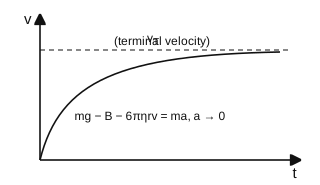
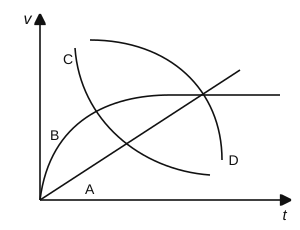
A spherical ball is dropped in a long column of a highly viscous liquid. The curve in the graph shown, which represents the speed of the ball (v) as a function of time (t) is:
एक गोलाकार गेंद को अत्यधिक श्यान द्रव के एक लंबे स्तंभ में गिराया जाता है। दर्शाए गए ग्राफ में वह वक्र, जो गेंद की चाल (v) को समय (t) के फलन के रूप में निरूपित करता है, है:
  1. AA
  2. BB
  3. CC
  4. DD
Show answer

Concept: Net force =mg−FB−6πηrv; the viscous drag grows with v until the net force becomes zero (terminal velocity).

  1. At t = 0, v = 0 and acceleration is maximum (steep start).
  2. As v rises, drag rises and acceleration falls ⇒ curve bends over.
  3. Finally v = constant vT ⇒ horizontal line. This is curve B.
  4. A (uniform increase) ignores drag; C and D show decreasing speed – wrong.

Short trick: v-t for terminal velocity looks like a charging capacitor: v=vT(1−e−t/τ).

Answer: (B) B

अवधारणा: कुल बल =mg−FB−6πηrv; श्यान कर्षण v के साथ बढ़ता है जब तक कुल बल शून्य न हो जाए (सीमांत वेग)।

  1. t = 0 पर v = 0 तथा त्वरण अधिकतम (ढालू प्रारंभ)।
  2. v बढ़ने पर कर्षण बढ़ता है और त्वरण घटता है ⇒ वक्र मुड़ने लगता है।
  3. अंत में v = नियत vT ⇒ क्षैतिज रेखा। यह वक्र B है।
  4. A (एकसमान वृद्धि) कर्षण की उपेक्षा करता है; C तथा D घटती चाल दर्शाते हैं – गलत।

शॉर्ट ट्रिक: सीमांत वेग का v-t ग्राफ आवेशित होते संधारित्र जैसा: v=vT(1−e−t/τ)।

उत्तर: (B) B

NEET UGPhysicsFluids – viscosity and terminal velocityNEET UG 2022 · 17 Jul Shift 1
Q223.
Two resistors of resistances, 100 Ω and 200 Ω are connected in parallel in an electrical circuit. The ratio of thermal energy developed in 100 Ω to that in 200 Ω in a given time is
100 Ω तथा 200 Ω प्रतिरोध वाले दो प्रतिरोधक एक विद्युत परिपथ में समांतर क्रम में जुड़े हैं। दिए गए समय में 100 Ω में उत्पन्न ऊष्मीय ऊर्जा का 200 Ω में उत्पन्न ऊष्मीय ऊर्जा से अनुपात है
  1. A1 : 2
  2. B2 : 1
  3. C1 : 4
  4. D4 : 1
Show answer

Concept: In parallel the voltage V is common, so H=V2tR⇒H∝1R.

  1. H1H2=R2R1=200100
  2. =2:1

Short trick: Parallel ⇒ use V2/R (smaller R heats more); series ⇒ use I2R (larger R heats more).

Answer: (B) 2 : 1

अवधारणा: समांतर क्रम में वोल्टता V उभयनिष्ठ है, अतः H=V2tR⇒H∝1R।

  1. H1H2=R2R1=200100
  2. =2:1

शॉर्ट ट्रिक: समांतर ⇒ V2/R लें (छोटा R अधिक गर्म); श्रेणी ⇒ I2R लें (बड़ा R अधिक गर्म)।

उत्तर: (B) 2 : 1

NEET UGPhysicsCurrent electricity – Joule heating in parallelNEET UG 2022 · 17 Jul Shift 1
Q224.
When two monochromatic light of frequency ν and ν/2 are incident on a photoelectric metal, their stopping potential becomes Vs/2 and Vs respectively. The threshold frequency for this metal is:
जब आवृत्ति ν तथा ν/2 के दो एकवर्णी प्रकाश किसी प्रकाश-विद्युत धातु पर आपतित होते हैं, तो उनके निरोधी विभव क्रमशः Vs/2 तथा Vs हो जाते हैं। इस धातु की देहली आवृत्ति है:
  1. A2ν
  2. B3ν
  3. C23ν
  4. D32ν
Show answer

Concept: Einstein’s photoelectric equation eVs=hν−hν0 applied to both lights, then eliminate Vs.

  1. Light of frequency ν: eVs2=hν−hν0 … (i)
  2. Light of frequency ν/2: eVs=hν2−hν0 … (ii)
  3. Multiply (i) by 2 and equate with (ii): 2hν−2hν0=hν2−hν0
  4. hν0=2hν−hν2=32hν⇒ν0=32ν
  5. Note: physically this is odd (a threshold above both frequencies, and the lower frequency having the larger stopping potential), but solving the given equations yields only 32ν, so (D) is the most appropriate choice; (A) 2ν, (B) 3ν, (C) 23ν do not satisfy both equations.

Short trick: Check options directly: put ν0=32ν ⇒ (i) gives eVs=−hν and (ii) gives eVs=−hν – consistent; no other option makes both equal.

Answer: (D) 32ν

अवधारणा: दोनों प्रकाशों पर आइंस्टीन का प्रकाश-विद्युत समीकरण eVs=hν−hν0 लगाइए, फिर Vs का विलोपन कीजिए।

  1. आवृत्ति ν वाला प्रकाश: eVs2=hν−hν0 … (i)
  2. आवृत्ति ν/2 वाला प्रकाश: eVs=hν2−hν0 … (ii)
  3. (i) को 2 से गुणा करके (ii) के बराबर रखें: 2hν−2hν0=hν2−hν0
  4. hν0=2hν−hν2=32hν⇒ν0=32ν
  5. ध्यान दें: भौतिक रूप से यह असामान्य है (देहली आवृत्ति दोनों आवृत्तियों से अधिक, तथा कम आवृत्ति का निरोधी विभव अधिक), परन्तु दिए गए समीकरणों को हल करने पर केवल 32ν प्राप्त होता है, अतः (D) सबसे उपयुक्त विकल्प है; (A) 2ν, (B) 3ν, (C) 23ν दोनों समीकरणों को संतुष्ट नहीं करते।

शॉर्ट ट्रिक: विकल्पों को सीधे जाँचें: ν0=32ν रखने पर (i) से eVs=−hν तथा (ii) से भी eVs=−hν – संगत; कोई अन्य विकल्प दोनों को बराबर नहीं करता।

उत्तर: (D) 32ν

NEET UGPhysicsDual nature – photoelectric equationNEET UG 2022 · 17 Jul Shift 1
Q225.
If a soap bubble expands, the pressure inside the bubble:
यदि साबुन का एक बुलबुला फैलता है, तो बुलबुले के अंदर का दाब:
  1. Adecreasesघटता है
  2. Bincreasesबढ़ता है
  3. Cremains the sameसमान रहता है
  4. Dis equal to the atmospheric pressureवायुमंडलीय दाब के बराबर होता है
Show answer

Concept: Excess pressure inside a soap bubble (two surfaces): Pin−Pout=4SR.

  1. Pin=P0+4SR
  2. Bubble expands ⇒ R increases ⇒ 4SR decreases ⇒ Pin decreases (but stays above P0).
  3. So (B), (C) are wrong, and (D) is wrong because excess pressure never becomes zero for finite R.

Short trick: Smaller bubble = higher inside pressure (that is why a small bubble feeds a big one when connected).

Answer: (A) decreases

अवधारणा: साबुन के बुलबुले (दो पृष्ठ) के अंदर आधिक्य दाब: Pin−Pout=4SR।

  1. Pin=P0+4SR
  2. बुलबुला फैलता है ⇒ R बढ़ता है ⇒ 4SR घटता है ⇒ Pin घटता है (परन्तु P0 से अधिक रहता है)।
  3. अतः (B), (C) गलत हैं, तथा (D) गलत है क्योंकि सीमित R के लिए आधिक्य दाब कभी शून्य नहीं होता।

शॉर्ट ट्रिक: छोटा बुलबुला = अधिक आंतरिक दाब (इसी कारण जोड़ने पर छोटा बुलबुला बड़े को हवा देता है)।

उत्तर: (A) घटता है

NEET UGPhysicsMechanical properties of fluids – excess pressure in a bubbleNEET UG 2022 · 17 Jul Shift 1
Q226.
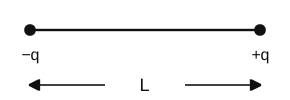
Two point charges −q and +q are placed at a distance of L, as shown in the figure.

The magnitude of electric field intensity at a distance R (R >> L) varies as:
दो बिंदु आवेश −q तथा +q, L दूरी पर रखे गए हैं, जैसा चित्र में दर्शाया गया है।

R (R >> L) दूरी पर विद्युत क्षेत्र तीव्रता का परिमाण किस प्रकार परिवर्तित होता है?
  1. A1R2
  2. B1R3
  3. C1R4
  4. D1R6
Show answer

Concept: Equal and opposite charges separated by L form an electric dipole, p = qL.

  1. Far away (R >> L): E=kpR31+3cos2⁡θ
  2. For any direction, E∝1R3.

Short trick: Monopole: 1/R², dipole: 1/R³, quadrupole: 1/R⁴ – each order adds one power.

Answer: (B) 1R3

अवधारणा: L दूरी पर स्थित समान तथा विपरीत आवेश एक विद्युत द्विध्रुव बनाते हैं, p = qL।

  1. दूर (R >> L): E=kpR31+3cos2⁡θ
  2. किसी भी दिशा में, E∝1R3।

शॉर्ट ट्रिक: एकल ध्रुव: 1/R², द्विध्रुव: 1/R³, चतुर्ध्रुव: 1/R⁴ – प्रत्येक क्रम में एक घात बढ़ती है।

उत्तर: (B) 1R3

NEET UGPhysicsElectrostatics – field of a dipoleNEET UG 2022 · 17 Jul Shift 1
Q227.
The area of rectangular field (in m2) of length 55.3 m and breadth 25 m after rounding off the value for correct significant digits is:
55.3 m लंबाई तथा 25 m चौड़ाई वाले आयताकार खेत का क्षेत्रफल (m2 में), सही सार्थक अंकों तक पूर्णांकन के बाद है:
  1. A138 × 101
  2. B1382
  3. C1382.5
  4. D14 × 102
Show answer

Concept: In multiplication the result keeps as many significant figures as the factor with the fewest significant figures.

  1. 55.3 has 3 s.f.; 25 has 2 s.f. ⇒ answer must have 2 s.f.
  2. 55.3 × 25 = 1382.5 m²
  3. Rounded to 2 s.f.: 1.4 × 10³ = 14 × 10² m²

Short trick: Count s.f. in each option: (A) 3, (B) 4, (C) 5, (D) 2 – only (D) has 2.

Answer: (D) 14 × 102

अवधारणा: गुणन में परिणाम में उतने ही सार्थक अंक रखे जाते हैं जितने सबसे कम सार्थक अंकों वाली राशि में हों।

  1. 55.3 में 3 सार्थक अंक; 25 में 2 सार्थक अंक ⇒ उत्तर में 2 सार्थक अंक।
  2. 55.3 × 25 = 1382.5 m²
  3. 2 सार्थक अंकों तक पूर्णांकन: 1.4 × 10³ = 14 × 10² m²

शॉर्ट ट्रिक: प्रत्येक विकल्प में सार्थक अंक गिनें: (A) 3, (B) 4, (C) 5, (D) 2 – केवल (D) में 2 हैं।

उत्तर: (D) 14 × 102

NEET UGPhysicsUnits and measurement – significant figuresNEET UG 2022 · 17 Jul Shift 1
Q228.
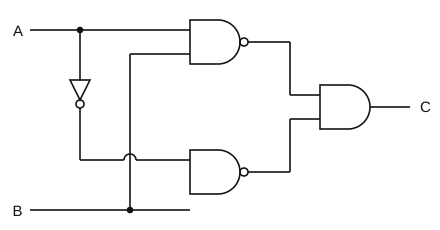
The truth table for the given logic circuit is:
दिए गए तर्क परिपथ के लिए सत्यमान सारणी है:
  1. A
    ABC
    000
    011
    101
    110
  2. B
    ABC
    001
    010
    100
    111
  3. C
    ABC
    001
    010
    101
    110
  4. D
    ABC
    000
    011
    100
    111
Show answer

Concept: Read the circuit: upper NAND gets A and B; A passes through a NOT gate, so the lower NAND gets Ā and B; both NAND outputs feed an AND gate.

  1. Y1=A⋅B―, Y2=A¯⋅B―, C=Y1⋅Y2
  2. Truth table:
    ABĀY₁ = NAND(A, B)Y₂ = NAND(Ā, B)C = Y₁·Y₂
    001111
    011100
    100111
    110010
  3. Boolean check: C=AB―⋅A¯B―=AB+A¯B―=B(A+A¯)―=B¯
  4. C = 1, 0, 1, 0 ⇒ option (C).

Short trick: Output is simply B¯: C = 1 whenever B = 0 – pick the table where C is opposite of B.

Answer: (C) C = 1, 0, 1, 0

अवधारणा: परिपथ पढ़ें: ऊपरी NAND को A तथा B मिलते हैं; A एक NOT द्वार से गुजरता है, अतः निचले NAND को Ā तथा B मिलते हैं; दोनों NAND निर्गत एक AND द्वार में जाते हैं।

  1. Y1=A⋅B―, Y2=A¯⋅B―, C=Y1⋅Y2
  2. सत्यमान सारणी:
    ABĀY₁ = NAND(A, B)Y₂ = NAND(Ā, B)C = Y₁·Y₂
    001111
    011100
    100111
    110010
  3. बूलियन जाँच: C=AB―⋅A¯B―=AB+A¯B―=B(A+A¯)―=B¯
  4. C = 1, 0, 1, 0 ⇒ विकल्प (C)।

शॉर्ट ट्रिक: निर्गत केवल B¯ है: जब B = 0 तब C = 1 – वह सारणी चुनें जिसमें C, B का उलटा हो।

उत्तर: (C) C = 1, 0, 1, 0

NEET UGPhysicsSemiconductors – logic gatesNEET UG 2022 · 17 Jul Shift 1
Q229.
Given below are two statements: One is labelled as Assertion (A) and the other is labelled as Reason (R).
Assertion (A): The stretching of a spring is determined by the shear modulus of the material of the spring.
Reason (R): A coil spring of copper has more tensile strength than a steel spring of same dimensions.
In the light of the above statements choose the most appropriate answer from the options given below:
नीचे दो कथन दिए गए हैं: एक को अभिकथन (A) तथा दूसरे को कारण (R) कहा गया है।
अभिकथन (A): किसी कमानी (spring) का खिंचाव कमानी के पदार्थ के अपरूपण गुणांक (shear modulus) द्वारा निर्धारित होता है।
कारण (R): समान विमाओं वाली स्टील की कमानी की तुलना में ताँबे की कुंडलित कमानी की तनन सामर्थ्य अधिक होती है।
उपरोक्त कथनों के आलोक में नीचे दिए गए विकल्पों में से सबसे उपयुक्त उत्तर चुनिए:
  1. ABoth Statement I and Statement II are correctकथन I तथा कथन II दोनों सही हैं
  2. BBoth Statement I and Statement II are incorrectकथन I तथा कथन II दोनों गलत हैं
  3. CStatement I is correct and Statement II is incorrectकथन I सही है तथा कथन II गलत है
  4. DStatement I is incorrect and Statement II is correctकथन I गलत है तथा कथन II सही है
Show answer

Concept: When a coil spring is stretched, the wire is twisted, not lengthened – its shape changes at constant length, so the shear (rigidity) modulus decides the stretch.

  1. Assertion (Statement I): correct – spring constant k=Gd48D3N depends on shear modulus G.
  2. Reason (Statement II): incorrect – steel has much higher elastic moduli and tensile strength than copper; that is why springs are made of steel.
  3. So A is correct, R is incorrect.

Short trick: Springs are made of steel, not copper – that alone kills the Reason.

Answer: (C) Statement I is correct and Statement II is incorrect

अवधारणा: कुंडलित कमानी को खींचने पर तार की लंबाई नहीं बढ़ती बल्कि उसमें ऐंठन होती है – आकृति बदलती है, अतः खिंचाव अपरूपण (दृढ़ता) गुणांक द्वारा निर्धारित होता है।

  1. अभिकथन (कथन I): सही – कमानी नियतांक k=Gd48D3N अपरूपण गुणांक G पर निर्भर है।
  2. कारण (कथन II): गलत – स्टील के प्रत्यास्थता गुणांक तथा तनन सामर्थ्य ताँबे से बहुत अधिक होते हैं; इसीलिए कमानियाँ स्टील की बनाई जाती हैं।
  3. अतः A सही है, R गलत है।

शॉर्ट ट्रिक: कमानियाँ स्टील से बनती हैं, ताँबे से नहीं – इसी से कारण गलत सिद्ध हो जाता है।

उत्तर: (C) कथन I सही है तथा कथन II गलत है

NEET UGPhysicsMechanical properties of solids – elastic moduliNEET UG 2022 · 17 Jul Shift 1
Q230.
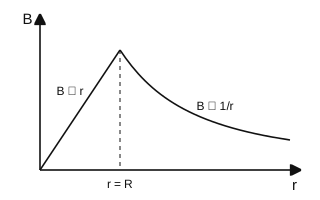
From Ampere’s circuital law for a long straight wire of circular cross-section carrying a steady current, the variation of magnetic field in the inside and outside region of the wire is:
स्थायी धारा वाले वृत्ताकार अनुप्रस्थ काट के एक लंबे सीधे तार के लिए ऐम्पियर के परिपथीय नियम से, तार के अंदर तथा बाहर के क्षेत्र में चुम्बकीय क्षेत्र का परिवर्तन है:
  1. AUniform and remains constant for both the regionsदोनों क्षेत्रों के लिए एकसमान तथा नियत रहता है
  2. BA linearly increasing function of distance up to the boundary of the wire and then linearly decreasing for the outside regionतार की सीमा तक दूरी का रैखिक रूप से बढ़ता फलन तथा फिर बाहरी क्षेत्र के लिए रैखिक रूप से घटता है
  3. CA linearly increasing function of distance r up to the boundary of the wire and then decreasing one with 1/r dependence for the outside regionतार की सीमा तक दूरी r का रैखिक रूप से बढ़ता फलन तथा फिर बाहरी क्षेत्र के लिए 1/r निर्भरता के साथ घटता है
  4. DA linearly decreasing function of distance up to the boundary of the wire and then a linearly increasing one for the outside regionतार की सीमा तक दूरी का रैखिक रूप से घटता फलन तथा फिर बाहरी क्षेत्र के लिए रैखिक रूप से बढ़ता है
Show answer

Concept: ∮B→⋅dl→=μ0Ienc on a circle of radius r (current uniformly spread).

  1. Inside (r < R): Ienc=Ir2R2 ⇒ B⋅2πr=μ0Ir2R2 ⇒ B=μ0Ir2πR2∝r
  2. Outside (r ≥ R): Ienc=I ⇒ B=μ0I2πr∝1r
  3. Maximum at the surface r = R.

Short trick: Same shape as the gravitational/electric field of a uniform solid sphere, but with 1/r outside instead of 1/r².

Answer: (C) Linear inside, 1/r outside

अवधारणा: त्रिज्या r के वृत्त पर ∮B→⋅dl→=μ0Ienc (धारा एकसमान वितरित)।

  1. अंदर (r < R): Ienc=Ir2R2 ⇒ B⋅2πr=μ0Ir2R2 ⇒ B=μ0Ir2πR2∝r
  2. बाहर (r ≥ R): Ienc=I ⇒ B=μ0I2πr∝1r
  3. पृष्ठ r = R पर अधिकतम।

शॉर्ट ट्रिक: एकसमान ठोस गोले के गुरुत्वीय/विद्युत क्षेत्र जैसी आकृति, परन्तु बाहर 1/r² के स्थान पर 1/r।

उत्तर: (C) अंदर रैखिक, बाहर 1/r

NEET UGPhysicsMoving charges – Ampere’s circuital lawNEET UG 2022 · 17 Jul Shift 1
Q231.
A series LCR circuit with inductance 10 H, capacitance 10 μF, resistance 50 Ω is connected to an ac source of voltage, V = 200 sin(100 t) volt. If the resonant frequency of the LCR circuit is ν0 and the frequency of the ac source is ν, then:
10 H प्रेरकत्व, 10 μF धारिता तथा 50 Ω प्रतिरोध वाला एक श्रेणी LCR परिपथ वोल्टता V = 200 sin(100 t) वोल्ट वाले ac स्रोत से जुड़ा है। यदि LCR परिपथ की अनुनादी आवृत्ति ν0 तथा ac स्रोत की आवृत्ति ν है, तो:
  1. Aν0=ν=50 Hz
  2. Bν0=ν=50π Hz
  3. Cν0=50π Hz, ν=50 Hz
  4. Dν0=100 Hz; ν0=100π Hz
Show answer

Concept: Source: V=V0sin⁡ωt ⇒ ν=ω2π. Resonance: ω0=1LC.

  1. ω=100 rad/s ⇒ ν=1002π=50π Hz
  2. LC=10×10×10−6=10−4 s² ⇒ ω0=110−2=100 rad/s
  3. ν0=1002π=50π Hz = ν – the circuit is driven at resonance.

Short trick: Compare ω directly: 1/LC=100 = source ω ⇒ ν0=ν; only (A) or (B), and 100/2π = 50/π.

Answer: (B) ν0=ν=50π Hz

अवधारणा: स्रोत: V=V0sin⁡ωt ⇒ ν=ω2π। अनुनाद: ω0=1LC।

  1. ω=100 rad/s ⇒ ν=1002π=50π Hz
  2. LC=10×10×10−6=10−4 s² ⇒ ω0=110−2=100 rad/s
  3. ν0=1002π=50π Hz = ν – परिपथ अनुनाद पर चालित है।

शॉर्ट ट्रिक: सीधे ω की तुलना करें: 1/LC=100 = स्रोत का ω ⇒ ν0=ν; केवल (A) या (B), तथा 100/2π = 50/π।

उत्तर: (B) ν0=ν=50π Hz

NEET UGPhysicsAlternating current – LCR resonanceNEET UG 2022 · 17 Jul Shift 1
Q232.
Match List - I with List - II
List-IList-II
(a) Gravitational constant (G)(i) [L2T-2]
(b) Gravitational potential energy(ii) [M-1L3T-2]
(c) Gravitational potential(iii) [LT-2]
(d) Gravitational intensity(iv) [ML2T-2]
Choose the correct answer from the options given below:
सूची - I का सूची - II से मिलान कीजिए
सूची-Iसूची-II
(a) गुरुत्वाकर्षण नियतांक (G)(i) [L2T-2]
(b) गुरुत्वीय स्थितिज ऊर्जा(ii) [M-1L3T-2]
(c) गुरुत्वीय विभव(iii) [LT-2]
(d) गुरुत्वीय तीव्रता(iv) [ML2T-2]
नीचे दिए गए विकल्पों में से सही उत्तर चुनिए:
  1. A(a) - (ii), (b) - (i), (c) - (iv), (d) - (iii)
  2. B(a) - (ii), (b) - (iv), (c) - (i), (d) - (iii)
  3. C(a) - (ii), (b) - (iv), (c) - (iii), (d) - (i)
  4. D(a) - (iv), (b) - (ii), (c) - (i), (d) - (iii)
Show answer

Concept: Write each quantity from its defining formula.

  1. G = Fr2m2 ⇒ [M−1L3T−2] → (ii)
  2. Potential energy = energy ⇒ [ML2T−2] → (iv)
  3. Potential = energy/mass ⇒ [L2T−2] → (i)
  4. Intensity = force/mass = acceleration ⇒ [LT−2] → (iii)

Short trick: Potential = (velocity)², intensity = acceleration (g) – two quick anchors.

Answer: (B) (a) - (ii), (b) - (iv), (c) - (i), (d) - (iii)

अवधारणा: प्रत्येक राशि को उसके परिभाषा सूत्र से लिखें।

  1. G = Fr2m2 ⇒ [M−1L3T−2] → (ii)
  2. स्थितिज ऊर्जा = ऊर्जा ⇒ [ML2T−2] → (iv)
  3. विभव = ऊर्जा/द्रव्यमान ⇒ [L2T−2] → (i)
  4. तीव्रता = बल/द्रव्यमान = त्वरण ⇒ [LT−2] → (iii)

शॉर्ट ट्रिक: विभव = (वेग)², तीव्रता = त्वरण (g) – दो त्वरित संकेत।

उत्तर: (B) (a) - (ii), (b) - (iv), (c) - (i), (d) - (iii)

NEET UGPhysicsUnits and dimensions – gravitational quantitiesNEET UG 2022 · 17 Jul Shift 1
Q233.
Two pendulums of length 121 cm and 100 cm start vibrating in phase. At some instant, the two are at their mean position in the same phase. The minimum number of vibrations of the shorter pendulum after which the two are again in phase at the mean position is :
121 cm तथा 100 cm लंबाई के दो लोलक समान कला में कंपन प्रारंभ करते हैं। किसी क्षण दोनों समान कला में अपनी माध्य स्थिति पर हैं। छोटे लोलक के कंपनों की न्यूनतम संख्या, जिसके बाद दोनों पुनः माध्य स्थिति पर समान कला में होंगे, है:
  1. A11
  2. B9
  3. C10
  4. D8
Show answer

Concept: T=2πlg ⇒ T∝l. They are in phase again when both have completed whole numbers of oscillations in the same time.

  1. Tlong:Tshort=121:100=11:10
  2. Let Tlong=11k, Tshort=10k. Need n1(11k)=n2(10k) with smallest integers.
  3. n1=10 (long), n2=11 (short): time = 110k.
  4. Shorter pendulum makes 11 vibrations (the faster one makes one extra).

Short trick: The faster (shorter) pendulum gains exactly one oscillation: nshort = TlongTlong−Tshort=111=11.

Answer: (A) 11

अवधारणा: T=2πlg ⇒ T∝l। दोनों पुनः कला में तब होंगे जब समान समय में दोनों पूर्ण संख्या में दोलन कर लें।

  1. Tlong:Tshort=121:100=11:10
  2. माना Tlong=11k, Tshort=10k। न्यूनतम पूर्णांकों के लिए n1(11k)=n2(10k)।
  3. n1=10 (लंबा), n2=11 (छोटा): समय = 110k।
  4. छोटा लोलक 11 कंपन करता है (तेज़ लोलक एक अतिरिक्त कंपन करता है)।

शॉर्ट ट्रिक: तेज़ (छोटा) लोलक ठीक एक दोलन आगे निकलता है: nshort = TlongTlong−Tshort=111=11।

उत्तर: (A) 11

NEET UGPhysicsOscillations – simple pendulums in phaseNEET UG 2022 · 17 Jul Shift 1
Q234.
A big circular coil of 1000 turns and average radius 10 m is rotating about its horizontal diameter at 2 rad s-1. If the vertical component of earth’s magnetic field at that place is 2 × 10⁻⁵ T and electrical resistance of the coil is 12.56 Ω, then the maximum induced current in the coil will be:
1000 फेरों तथा 10 m औसत त्रिज्या की एक बड़ी वृत्ताकार कुंडली अपने क्षैतिज व्यास के परितः 2 rad s-1 से घूर्णन कर रही है। यदि उस स्थान पर पृथ्वी के चुम्बकीय क्षेत्र का ऊर्ध्वाधर घटक 2 × 10⁻⁵ T है तथा कुंडली का विद्युत प्रतिरोध 12.56 Ω है, तो कुंडली में अधिकतम प्रेरित धारा होगी:
  1. A0.25 A
  2. B1.5 A
  3. C1 A
  4. D2 A
Show answer

Concept: Rotating about a horizontal diameter, the coil cuts the vertical field: ε=NBAωsin⁡ωt, so εmax=NBAω.

  1. A=πr2=π×102=100π m²
  2. εmax=1000×2×10−5×100π×2=4π=12.56 V
  3. Imax=12.5612.56=1 A

Short trick: NBAω = 10³ × 2×10⁻⁵ × 100π × 2 = 4π ≈ 12.56; R = 12.56 = 4π ⇒ I = 1 A.

Answer: (C) 1 A

अवधारणा: क्षैतिज व्यास के परितः घूमने पर कुंडली ऊर्ध्वाधर क्षेत्र को काटती है: ε=NBAωsin⁡ωt, अतः εmax=NBAω।

  1. A=πr2=π×102=100π m²
  2. εmax=1000×2×10−5×100π×2=4π=12.56 V
  3. Imax=12.5612.56=1 A

शॉर्ट ट्रिक: NBAω = 10³ × 2×10⁻⁵ × 100π × 2 = 4π ≈ 12.56; R = 12.56 = 4π ⇒ I = 1 A।

उत्तर: (C) 1 A

NEET UGPhysicsEMI – AC generator (rotating coil)NEET UG 2022 · 17 Jul Shift 1
Q235.
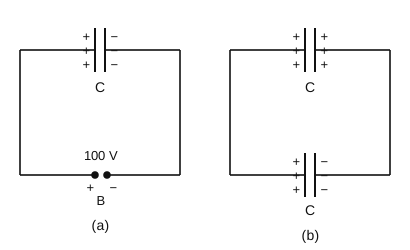
A capacitor of capacitance C = 900 pF is charged fully by 100 V battery B as shown in figure (a). Then B is disconnected from the battery and connected to another uncharged capacitor of capacitance C = 900 pF as shown in figure (b). The electrostatic energy stored by the system (b) is:
धारिता C = 900 pF वाले एक संधारित्र को 100 V बैटरी B द्वारा पूर्णतः आवेशित किया जाता है, जैसा चित्र (a) में दर्शाया गया है। फिर इसे बैटरी से हटाकर धारिता C = 900 pF वाले एक अन्य अनावेशित संधारित्र से जोड़ा जाता है, जैसा चित्र (b) में दर्शाया गया है। निकाय (b) द्वारा संचित स्थिरवैद्युत ऊर्जा है:
  1. A4.5 × 10-6 J
  2. B3.25 × 10-6 J
  3. C2.25 × 10-6 J
  4. D1.5 × 10-6 J
Show answer

Concept: After disconnecting the battery, charge is conserved; two equal capacitors in parallel share it, Ceq=2C and U=Q22Ceq.

  1. Q=CV=900×10−12×100=9×10⁻⁸ C
  2. Initial energy Ua=12CV2=12×900×10−12×104=4.5×10⁻⁶ J
  3. Ub=Q22(2C)=81×10−163600×10−12=2.25×10⁻⁶ J

Short trick: Equal capacitors sharing charge ⇒ energy halves: 4.5 → 2.25 μJ (the other half is lost as heat/radiation).

Answer: (C) 2.25 × 10⁻⁶ J

अवधारणा: बैटरी हटाने के बाद आवेश संरक्षित रहता है; दो समान संधारित्र समांतर में इसे बाँटते हैं, Ceq=2C तथा U=Q22Ceq।

  1. Q=CV=900×10−12×100=9×10⁻⁸ C
  2. प्रारंभिक ऊर्जा Ua=12CV2=12×900×10−12×104=4.5×10⁻⁶ J
  3. Ub=Q22(2C)=81×10−163600×10−12=2.25×10⁻⁶ J

शॉर्ट ट्रिक: समान संधारित्रों में आवेश बँटने पर ऊर्जा आधी: 4.5 → 2.25 μJ (शेष आधी ऊष्मा/विकिरण में व्यय)।

उत्तर: (C) 2.25 × 10⁻⁶ J

NEET UGPhysicsCapacitors – charge sharing and energyNEET UG 2022 · 17 Jul Shift 1
Q236.
A nucleus of mass number 189 splits into two nuclei having mass number 125 and 64. The ratio of radius of two daughter nuclei respectively is:
द्रव्यमान संख्या 189 का एक नाभिक, द्रव्यमान संख्या 125 तथा 64 वाले दो नाभिकों में विभाजित होता है। दोनों संतति नाभिकों की त्रिज्याओं का क्रमशः अनुपात है:
  1. A1 : 1
  2. B4 : 5
  3. C5 : 4
  4. D25 : 16
Show answer

Concept: Nuclear radius R=R0A1/3.

  1. R1=R0(125)1/3=5R0
  2. R2=R0(64)1/3=4R0
  3. R1:R2=5:4

Short trick: 125 and 64 are perfect cubes (5³, 4³) – the answer is just 5 : 4.

Answer: (C) 5 : 4

अवधारणा: नाभिकीय त्रिज्या R=R0A1/3।

  1. R1=R0(125)1/3=5R0
  2. R2=R0(64)1/3=4R0
  3. R1:R2=5:4

शॉर्ट ट्रिक: 125 तथा 64 पूर्ण घन हैं (5³, 4³) – उत्तर सीधे 5 : 4।

उत्तर: (C) 5 : 4

NEET UGPhysicsNuclei – nuclear radiusNEET UG 2022 · 17 Jul Shift 1
Q237.
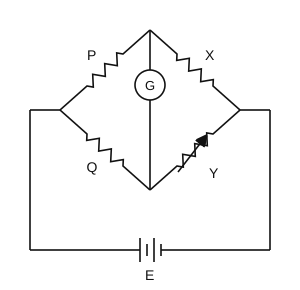
A Wheatstone bridge is used to determine the value of unknown resistance X by adjusting the variable resistance Y as shown in the figure. For the most precise measurement of X, the resistances P and Q:
चित्र में दर्शाए अनुसार परिवर्ती प्रतिरोध Y को समायोजित करके अज्ञात प्रतिरोध X का मान ज्ञात करने के लिए एक व्हीटस्टोन सेतु प्रयुक्त किया जाता है। X के सबसे यथार्थ मापन के लिए प्रतिरोध P तथा Q:
  1. AShould be approximately equal to 2Xलगभग 2X के बराबर होने चाहिए
  2. BShould be approximately equal and are smallलगभग बराबर तथा छोटे होने चाहिए
  3. CShould be very large and unequalबहुत बड़े तथा असमान होने चाहिए
  4. DDo not play any significant roleकोई महत्वपूर्ण भूमिका नहीं निभाते
Show answer

Concept: A Wheatstone bridge is most sensitive when all four arms are of the same order and small, so that a small imbalance sends a detectable current through the galvanometer.

  1. Balance: PQ=XY.
  2. P ≈ Q (ratio ≈ 1) ⇒ Y ≈ X, all arms comparable ⇒ maximum sensitivity.
  3. Small P, Q ⇒ larger galvanometer current for a given imbalance ⇒ null point is sharper.
  4. Very large / unequal P, Q (C) reduce sensitivity; (D) is wrong since P/Q fixes X.

Short trick: Sensitivity is best when the bridge is “balanced by equals”: P ≈ Q ≈ X ≈ Y, and not too large.

Answer: (B) Approximately equal and small

अवधारणा: व्हीटस्टोन सेतु तब सबसे अधिक सुग्राही होता है जब चारों भुजाएँ एक ही कोटि की तथा छोटी हों, ताकि थोड़े से असंतुलन पर भी धारामापी में पहचानने योग्य धारा प्रवाहित हो।

  1. संतुलन: PQ=XY।
  2. P ≈ Q (अनुपात ≈ 1) ⇒ Y ≈ X, सभी भुजाएँ तुलनीय ⇒ अधिकतम सुग्राहिता।
  3. छोटे P, Q ⇒ दिए गए असंतुलन पर धारामापी में अधिक धारा ⇒ शून्य विक्षेप बिंदु अधिक स्पष्ट।
  4. बहुत बड़े / असमान P, Q (C) सुग्राहिता घटाते हैं; (D) गलत है क्योंकि P/Q से ही X निर्धारित होता है।

शॉर्ट ट्रिक: सुग्राहिता सर्वोत्तम तब, जब सेतु “समान भुजाओं” से संतुलित हो: P ≈ Q ≈ X ≈ Y, तथा बहुत बड़े न हों।

उत्तर: (B) लगभग बराबर तथा छोटे

NEET UGPhysicsCurrent electricity – Wheatstone bridge sensitivityNEET UG 2022 · 17 Jul Shift 1
Q238.
The volume occupied by the molecules contained in 4.5 kg water at STP, if the intermolecular forces vanish away is:
यदि अंतराअणुक बल समाप्त हो जाएँ, तो STP पर 4.5 kg जल में उपस्थित अणुओं द्वारा घेरा गया आयतन है:
  1. A5.6 × 106 m3
  2. B5.6 × 103 m3
  3. C5.6 × 10-3 m3
  4. D5.6 m3
Show answer

Concept: With no intermolecular forces the water behaves as an ideal gas: 1 mol occupies 22.4 L at STP.

  1. n = 4500 g18 g mol−1=250 mol
  2. V = 250 × 22.4 L = 5600 L
  3. = 5.6 m³ (1 m³ = 1000 L)

Short trick: Moles × 22.4 L, then ÷ 1000 for m³ – no need for PV = nRT.

Answer: (D) 5.6 m3

अवधारणा: अंतराअणुक बलों के अभाव में जल आदर्श गैस की तरह व्यवहार करेगा: STP पर 1 mol का आयतन 22.4 L।

  1. n = 4500 g18 g mol−1=250 mol
  2. V = 250 × 22.4 L = 5600 L
  3. = 5.6 m³ (1 m³ = 1000 L)

शॉर्ट ट्रिक: मोल × 22.4 L, फिर m³ के लिए ÷ 1000 – PV = nRT की आवश्यकता नहीं।

उत्तर: (D) 5.6 m3

NEET UGPhysicsKinetic theory – molar volume at STPNEET UG 2022 · 17 Jul Shift 1
Q239.
A ball is projected with a velocity, 10 ms-1, at an angle of 60° with the vertical direction. Its speed at the highest point of its trajectory will be:
एक गेंद 10 ms-1 वेग से ऊर्ध्वाधर दिशा से 60° के कोण पर प्रक्षेपित की जाती है। इसके प्रक्षेप-पथ के उच्चतम बिंदु पर इसकी चाल होगी:
  1. AZeroशून्य
  2. B53 ms-1
  3. C5 ms-1
  4. D10 ms-1
Show answer

Concept: At the highest point only the horizontal component of velocity remains, and it stays constant throughout the flight.

  1. Angle with the vertical = 60° ⇒ angle with the horizontal = 30°.
  2. Horizontal component = usin⁡60∘ (measured from vertical) = 10×32
  3. =53 m/s ≈ 8.66 m/s

Short trick: Read the angle carefully: “with the vertical” ⇒ horizontal part uses sin, not cos. 5 m/s is the trap.

Answer: (B) 53 ms-1

अवधारणा: उच्चतम बिंदु पर केवल वेग का क्षैतिज घटक बचता है, जो पूरी उड़ान में नियत रहता है।

  1. ऊर्ध्वाधर से कोण = 60° ⇒ क्षैतिज से कोण = 30°।
  2. क्षैतिज घटक = usin⁡60∘ (ऊर्ध्वाधर से मापा गया) = 10×32
  3. =53 m/s ≈ 8.66 m/s

शॉर्ट ट्रिक: कोण ध्यान से पढ़ें: “ऊर्ध्वाधर से” ⇒ क्षैतिज घटक में sin, cos नहीं। 5 m/s भ्रामक उत्तर है।

उत्तर: (B) 53 ms-1

NEET UGPhysicsKinematics – projectile at highest pointNEET UG 2022 · 17 Jul Shift 1
Q240.
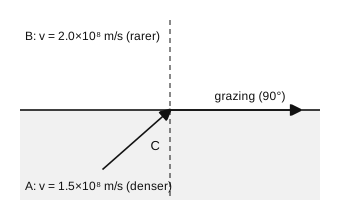
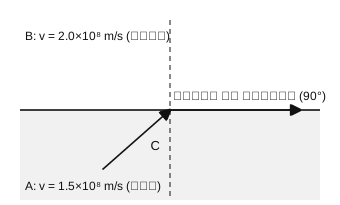
Two transparent media A and B are separated by a plane boundary. The speed of light in those media are 1.5 × 10⁸ m/s and 2.0 × 10⁸ m/s, respectively. The critical angle for a ray of light for these two media is:
दो पारदर्शी माध्यम A तथा B एक समतल सीमा द्वारा पृथक हैं। इन माध्यमों में प्रकाश की चालें क्रमशः 1.5 × 10⁸ m/s तथा 2.0 × 10⁸ m/s हैं। इन दोनों माध्यमों के लिए प्रकाश किरण का क्रांतिक कोण है:
  1. Asin-1(0.5000)
  2. Bsin-1(0.750)
  3. Ctan-1(0.500)
  4. Dtan-1(0.750)
Show answer

Concept: For light going from denser to rarer medium, sin⁡C=μrarerμdenser=vdenservrarer.

  1. Light is slower in A ⇒ A is denser.
  2. μA=3×1081.5×108=2, μB=3×1082×108=1.5
  3. sin⁡C=1.52=0.75 ⇒ C=sin−1⁡(0.750)

Short trick: Directly: sin C = (smaller speed)/(larger speed) = 1.5/2.0. Critical angle is always a sin⁻¹, so (C), (D) are out at once.

Answer: (B) sin-1(0.750)

अवधारणा: सघन से विरल माध्यम में जाते प्रकाश के लिए sin⁡C=μrarerμdenser=vdenservrarer।

  1. A में प्रकाश धीमा है ⇒ A सघन माध्यम है।
  2. μA=3×1081.5×108=2, μB=3×1082×108=1.5
  3. sin⁡C=1.52=0.75 ⇒ C=sin−1⁡(0.750)

शॉर्ट ट्रिक: सीधे: sin C = (कम चाल)/(अधिक चाल) = 1.5/2.0। क्रांतिक कोण सदैव sin⁻¹ होता है, अतः (C), (D) तुरंत बाहर।

उत्तर: (B) sin-1(0.750)

NEET UGPhysicsRay optics – critical angleNEET UG 2022 · 17 Jul Shift 1