Q241.A radioactive nucleus undergoes spontaneous decay in the sequence , where Z is the atomic number of element X. The possible decay particles in the sequence are:
एक रेडियोऐक्टिव नाभिक स्वतः क्षय के अनुक्रम से गुजरता है, जहाँ Z तत्व X का परमाणु क्रमांक है। इस अनुक्रम में संभावित क्षय कण हैं:
- A
- B
- C
- D
Show answer
Concept: In decay, the change in atomic number tells the particle: → Z decreases by 1, → Z increases by 1, → Z decreases by 2 (A by 4).
- X (Z) → B (Z − 1): Z falls by 1 ⇒ emission (a proton turns into a neutron).
- B (Z − 1) → C (Z − 3): Z falls by 2 ⇒ emission.
- C (Z − 3) → D (Z − 2): Z rises by 1 ⇒ emission (a neutron turns into a proton).
- Sequence = .
Short trick: Track only ΔZ: −1, −2, +1 ↔ β⁺, α, β⁻. Only option (A) starts with β⁺ and ends with β⁻ with α in between.
Answer: (A)
अवधारणा: क्षय में परमाणु क्रमांक का परिवर्तन कण बताता है: → Z में 1 की कमी, → Z में 1 की वृद्धि, → Z में 2 की कमी (A में 4 की कमी)।
- X (Z) → B (Z − 1): Z में 1 की कमी ⇒ उत्सर्जन (एक प्रोटॉन न्यूट्रॉन में बदलता है)।
- B (Z − 1) → C (Z − 3): Z में 2 की कमी ⇒ उत्सर्जन।
- C (Z − 3) → D (Z − 2): Z में 1 की वृद्धि ⇒ उत्सर्जन (एक न्यूट्रॉन प्रोटॉन में बदलता है)।
- अनुक्रम = ।
शॉर्ट ट्रिक: केवल ΔZ देखिए: −1, −2, +1 ↔ β⁺, α, β⁻। केवल विकल्प (A) β⁺ से शुरू होकर β⁻ पर समाप्त होता है और बीच में α है।
उत्तर: (A)
NEET UGPhysicsNuclei – radioactive decayNEET UG 2021 · 12 Sep Shift 1
Q242.Polar molecules are the molecules:
ध्रुवीय अणु वे अणु हैं जो:
- AAcquire a dipole moment only when magnetic field is absent.केवल चुंबकीय क्षेत्र की अनुपस्थिति में द्विध्रुव आघूर्ण प्राप्त करते हैं।
- BHaving a permanent electric dipole moment.स्थायी वैद्युत द्विध्रुव आघूर्ण रखते हैं।
- CHaving zero dipole moment.शून्य द्विध्रुव आघूर्ण रखते हैं।
- Dpresence of electric field due to displacement of charges.आवेशों के विस्थापन के कारण वैद्युत क्षेत्र की उपस्थिति।
Show answer
Concept: In a polar molecule (e.g. H2O, HCl) the centres of positive and negative charge do not coincide even without any external field, so it has a permanent dipole moment.
- (A) Wrong – a magnetic field has nothing to do with the electric dipole moment of a molecule.
- (B) Correct – permanent dipole moment is the definition of a polar molecule.
- (C) Wrong – zero dipole moment (in the absence of field) describes a non-polar molecule (O2, CO2).
- (D) Wrong – a dipole moment produced only by displacement of charges in an applied field is an induced dipole, typical of non-polar molecules.
Short trick: Polar = Permanent; Non-polar = only iNduced (in a field).
Answer: (B) Having a permanent electric dipole moment
अवधारणा: ध्रुवीय अणु (जैसे H2O, HCl) में बाह्य क्षेत्र के बिना भी धन और ऋण आवेशों के केंद्र संपाती नहीं होते, इसलिए इनका स्थायी द्विध्रुव आघूर्ण होता है।
- (A) गलत – चुंबकीय क्षेत्र का अणु के वैद्युत द्विध्रुव आघूर्ण से कोई संबंध नहीं है।
- (B) सही – स्थायी द्विध्रुव आघूर्ण ही ध्रुवीय अणु की परिभाषा है।
- (C) गलत – (क्षेत्र की अनुपस्थिति में) शून्य द्विध्रुव आघूर्ण अध्रुवीय अणु (O2, CO2) का लक्षण है।
- (D) गलत – केवल लगाए गए क्षेत्र में आवेशों के विस्थापन से उत्पन्न द्विध्रुव आघूर्ण प्रेरित द्विध्रुव है, जो अध्रुवीय अणुओं में होता है।
शॉर्ट ट्रिक: ध्रुवीय = स्थायी (Permanent); अध्रुवीय = केवल प्रेरित (क्षेत्र में)।
उत्तर: (B) स्थायी वैद्युत द्विध्रुव आघूर्ण रखते हैं
NEET UGPhysicsElectric charges and fields – electric dipoleNEET UG 2021 · 12 Sep Shift 1
Q243.The effective resistance of a parallel connection that consists of four wires of equal length, equal area of cross-section and same material is 0.25 Ω. What will be the effective resistance if they are connected in series?
समान लंबाई, समान अनुप्रस्थ-काट क्षेत्रफल और समान पदार्थ के चार तारों से बने समांतर संयोजन का प्रभावी प्रतिरोध 0.25 Ω है। यदि इन्हें श्रेणीक्रम में जोड़ा जाए तो प्रभावी प्रतिरोध क्या होगा?
- A1 Ω
- B4 Ω
- C0.25 Ω
- D0.5 Ω
Show answer
Concept: Identical wires have the same resistance R; n identical resistors give R/n in parallel and nR in series.
- Parallel: R/4 = 0.25 Ω ⇒ R = 1 Ω.
- Series: .
Short trick: For n equal resistors, ⇒ .
Answer: (B) 4 Ω
अवधारणा: समान तारों का प्रतिरोध R समान होता है; n समान प्रतिरोध समांतर में R/n और श्रेणी में nR देते हैं।
- समांतर: R/4 = 0.25 Ω ⇒ R = 1 Ω।
- श्रेणी: ।
शॉर्ट ट्रिक: n समान प्रतिरोधों के लिए ⇒ ।
उत्तर: (B) 4 Ω
NEET UGPhysicsCurrent electricity – combination of resistorsNEET UG 2021 · 12 Sep Shift 1
Q244.Column-I gives certain physical terms associated with flow of current through a metallic conductor. Column-II gives some mathematical relations involving electrical quantities. Match Column-I and Column-II with appropriate relations.
| Column I | Column II |
|---|
| (A) Drift Velocity | (P) |
| (B) Electrical Resistivity | (Q) |
| (C) Relaxation Period | (R) |
| (D) Current Density | (S) |
स्तंभ-I में धात्विक चालक से धारा प्रवाह से संबंधित कुछ भौतिक पद दिए गए हैं। स्तंभ-II में वैद्युत राशियों से संबंधित कुछ गणितीय संबंध दिए गए हैं। स्तंभ-I का स्तंभ-II से उपयुक्त संबंधों के साथ मिलान कीजिए।
| स्तंभ-I | स्तंभ-II |
|---|
| (A) अपवाह वेग (Drift Velocity) | (P) |
| (B) वैद्युत प्रतिरोधकता (Electrical Resistivity) | (Q) |
| (C) विश्रांति काल (Relaxation Period) | (R) |
| (D) धारा घनत्व (Current Density) | (S) |
- AA-R, B-P, C-S, D-Q
- BA-R, B-Q, C-S, D-P
- CA-R, B-S, C-P, D-Q
- DA-R, B-S, C-Q, D-P
Show answer
Concept: Free-electron model: , , and Ohm’s law .
- Drift velocity ⇒ A-R.
- Resistivity from ⇒ ⇒ B-S.
- From ⇒ ⇒ C-P.
- Current density ⇒ D-Q.
Short trick: All options have A-R; just check D: (Q) → only (C) has D-Q.
Answer: (C) A-R, B-S, C-P, D-Q
अवधारणा: मुक्त-इलेक्ट्रॉन मॉडल: , , तथा ओम का नियम ।
- अपवाह वेग ⇒ A-R।
- से प्रतिरोधकता ⇒ B-S।
- से ⇒ C-P।
- धारा घनत्व ⇒ D-Q।
शॉर्ट ट्रिक: सभी विकल्पों में A-R है; केवल D जाँचिए: (Q) → केवल (C) में D-Q है।
उत्तर: (C) A-R, B-S, C-P, D-Q
NEET UGPhysicsCurrent electricity – drift velocity, resistivityNEET UG 2021 · 12 Sep Shift 1
Q245.The equivalent capacitance of the combination shown in the figure is:
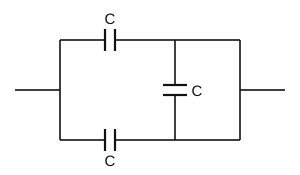
चित्र में दर्शाए गए संयोजन की तुल्य धारिता है:
- AC/2
- B3C/2
- C3C
- D2C
Show answer
Concept: A capacitor whose both plates are connected to the same node (same potential) stores no charge – it is short-circuited and drops out.
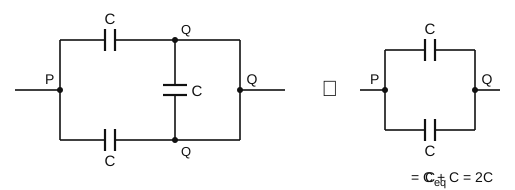
- Name the left junction P and the right junction Q. The top and bottom wires to the right of the two outer capacitors are both joined to Q.
- So both plates of the middle capacitor are at the potential of Q ⇒ it is shorted (no charge).
- The remaining top C and bottom C are each connected between P and Q ⇒ parallel.
- .
Short trick: Whenever a capacitor sits between two points joined by a plain wire, delete it first.
Answer: (D) 2C
अवधारणा: जिस संधारित्र की दोनों प्लेटें एक ही संधि (समान विभव) से जुड़ी हों, उसमें कोई आवेश संचित नहीं होता – वह लघुपथित (short-circuited) होकर हट जाता है।
- बाएँ संधि-बिंदु को P और दाएँ संधि-बिंदु को Q कहें। दोनों बाहरी संधारित्रों के दाईं ओर के ऊपरी और निचले तार, दोनों Q से जुड़े हैं।
- अतः बीच वाले संधारित्र की दोनों प्लेटें Q के विभव पर हैं ⇒ वह लघुपथित है (आवेश शून्य)।
- शेष ऊपरी C और निचला C दोनों P और Q के बीच जुड़े हैं ⇒ समांतर क्रम।
- ।
शॉर्ट ट्रिक: जब भी कोई संधारित्र किसी सीधे तार से जुड़े दो बिंदुओं के बीच हो, पहले उसे हटा दीजिए।
उत्तर: (D) 2C
NEET UGPhysicsCapacitance – combination of capacitorsNEET UG 2021 · 12 Sep Shift 1
Q246.In a potentiometer circuit a cell of EMF 1.5 V gives balance point at 36 cm length of wire. If another cell of EMF 2.5 V replaces the first cell, then at what length of the wire, the balance point occurs?
एक विभवमापी परिपथ में 1.5 V विद्युत वाहक बल (EMF) का सेल तार की 36 cm लंबाई पर संतुलन बिंदु देता है। यदि पहले सेल के स्थान पर 2.5 V EMF का दूसरा सेल लगा दिया जाए, तो संतुलन बिंदु तार की किस लंबाई पर प्राप्त होगा?
- A64 cm
- B62 cm
- C60 cm
- D21.6 cm
Show answer
Concept: With the same driving current, the potential gradient k is constant, so balancing length ∝ EMF: .
- ⇒ .
- cm.
Short trick: Larger EMF ⇒ longer balancing length; 21.6 cm is the trap (inverse ratio).
Answer: (C) 60 cm
अवधारणा: समान मुख्य धारा पर विभव प्रवणता k नियत रहती है, अतः संतुलन लंबाई ∝ EMF: ।
- ⇒ ।
- cm।
शॉर्ट ट्रिक: अधिक EMF ⇒ अधिक संतुलन लंबाई; 21.6 cm उल्टे अनुपात वाला जाल है।
उत्तर: (C) 60 cm
NEET UGPhysicsCurrent electricity – potentiometerNEET UG 2021 · 12 Sep Shift 1
Q247.The escape velocity from the Earth’s surface is v. The escape velocity from the surface of another planet having a radius, four times that of Earth and same mass density is:
पृथ्वी के पृष्ठ से पलायन वेग v है। किसी अन्य ग्रह, जिसकी त्रिज्या पृथ्वी की चार गुनी है और द्रव्यमान घनत्व समान है, के पृष्ठ से पलायन वेग है:
- A3v
- B4v
- Cv
- D2v
Show answer
Concept: with .
- .
- Same ρ ⇒ .
- R becomes 4R ⇒ becomes 4v.
Short trick: Same density: (and ). Same mass: – don’t mix them.
Answer: (B) 4v
अवधारणा: तथा ।
- ।
- समान ρ ⇒ ।
- R के 4R होने पर = 4v।
शॉर्ट ट्रिक: समान घनत्व: (और )। समान द्रव्यमान: – दोनों को न मिलाएँ।
उत्तर: (B) 4v
NEET UGPhysicsGravitation – escape velocityNEET UG 2021 · 12 Sep Shift 1
Q248.A cup of coffee cools from 90°C to 80°C in t minutes, when the room temperature is 20°C. The time taken by a similar cup of coffee to cool from 80°C to 60°C at a room temperature same at 20°C is
कमरे का ताप 20°C होने पर कॉफ़ी का एक कप t मिनट में 90°C से 80°C तक ठंडा होता है। कमरे का ताप 20°C ही रहने पर, इसी प्रकार के कॉफ़ी के कप को 80°C से 60°C तक ठंडा होने में लगा समय है
- A
- B
- C
- D
Show answer
Concept: Newton’s law of cooling (average form): .
- Case 1: .
- Case 2: .
- Divide: ⇒ .
- .
Short trick: Twice the drop at a smaller excess temperature must take MORE than 2t ⇒ only 13t/5 = 2.6t fits.
Answer: (D)
अवधारणा: न्यूटन का शीतलन नियम (औसत रूप): ।
- स्थिति 1: ।
- स्थिति 2: ।
- भाग देने पर: ⇒ ।
- ।
शॉर्ट ट्रिक: कम आधिक्य ताप पर दोगुनी गिरावट में 2t से अधिक समय लगेगा ⇒ केवल 13t/5 = 2.6t उपयुक्त है।
उत्तर: (D)
NEET UGPhysicsThermal properties of matter – Newton’s law of coolingNEET UG 2021 · 12 Sep Shift 1
Q249.A capacitor of capacitance ‘C’, is connected across an ac source of voltage V, given by . The displacement current between the plates of the capacitor, would then be given by:
धारिता ‘C’ का एक संधारित्र द्वारा दी गई वोल्टता V के ac स्रोत से जुड़ा है। संधारित्र की प्लेटों के बीच विस्थापन धारा होगी:
- A
- B
- C
- D
Show answer
Concept: Displacement current between the plates equals the conduction current in the leads: .
- .
- .
Short trick: Dimension check: current amplitude = (removes A, D); differentiating sin gives cos (removes B).
Answer: (C)
अवधारणा: प्लेटों के बीच विस्थापन धारा, संयोजी तारों में चालन धारा के बराबर होती है: ।
- ।
- ।
शॉर्ट ट्रिक: धारा आयाम = (A, D हटे); sin का अवकलन cos देता है (B हटा)।
उत्तर: (C)
NEET UGPhysicsElectromagnetic waves – displacement currentNEET UG 2021 · 12 Sep Shift 1
Q250.A small block slides down on a smooth inclined plane, starting from rest at time t = 0. Let be the distance travelled by the block in the interval t = n – 1 to t = n. Then, the ratio is:
एक छोटा गुटका समय t = 0 पर विराम से प्रारंभ होकर एक चिकने आनत तल पर नीचे की ओर फिसलता है। माना , t = n – 1 से t = n के अंतराल में गुटके द्वारा तय की गई दूरी है। तब अनुपात है:
- A
- B
- C
- D
Show answer
Concept: Distance in the nth second: ; on a smooth incline (constant), u = 0.
- .
- .
- .
Short trick: Galileo’s odd-number rule: from rest, successive equal intervals cover 1 : 3 : 5 : … ⇒ consecutive ratio (2n−1):(2n+1). Check n = 1 → 1/3.
Answer: (D)
अवधारणा: n वें सेकंड में दूरी: ; चिकने आनत तल पर (नियत), u = 0।
- ।
- ।
- ।
शॉर्ट ट्रिक: गैलीलियो का विषम संख्या नियम: विराम से समान क्रमागत अंतरालों में दूरियाँ 1 : 3 : 5 : … ⇒ क्रमागत अनुपात (2n−1):(2n+1)। n = 1 रखें → 1/3।
उत्तर: (D)
NEET UGPhysicsMotion in a straight line – distance in nth secondNEET UG 2021 · 12 Sep Shift 1
Q251.If force [F], acceleration [A] and time [T] are chosen as the fundamental physical quantities. Find the dimensions of energy.
यदि बल [F], त्वरण [A] और समय [T] को मूल भौतिक राशियाँ चुना जाए, तो ऊर्जा की विमाएँ ज्ञात कीजिए।
- A
- B
- C
- D
Show answer
Concept: Write and equate powers of M, L, T.
- .
- M: a = 1; L: a + b = 2 ⇒ b = 1.
- T: −2a − 2b + c = −2 ⇒ −4 + c = −2 ⇒ c = 2.
- .
Short trick: Energy = force × distance and distance = acceleration × time² ⇒ E = F·A·T² directly.
Answer: (D)
अवधारणा: लिखकर M, L, T की घातें बराबर कीजिए।
- ।
- M: a = 1; L: a + b = 2 ⇒ b = 1।
- T: −2a − 2b + c = −2 ⇒ −4 + c = −2 ⇒ c = 2।
- ।
शॉर्ट ट्रिक: ऊर्जा = बल × दूरी तथा दूरी = त्वरण × समय² ⇒ सीधे E = F·A·T²।
उत्तर: (D)
NEET UGPhysicsUnits and measurements – dimensional analysisNEET UG 2021 · 12 Sep Shift 1
Q252.For a plane electromagnetic wave propagating in x-direction, which one of the following combination gives the correct possible directions for electric field (E) and magnetic field (B) respectively?
x-दिशा में संचरित एक समतल विद्युतचुंबकीय तरंग के लिए, निम्नलिखित में से कौन-सा संयोजन क्रमशः वैद्युत क्षेत्र (E) और चुंबकीय क्षेत्र (B) की सही संभावित दिशाएँ देता है?
- A
- B
- C
- D
Show answer
Concept: In an EM wave and points along the direction of propagation (+x here).
- (A) (antiparallel) ✗.
- (B) and (C): E and B parallel ⇒ cross product 0 ✗.
- (D) ✓ (and ).
Short trick: First reject parallel/antiparallel pairs (A, B, C); the only remaining pair must be the answer.
Answer: (D)
अवधारणा: विद्युतचुंबकीय तरंग में तथा संचरण की दिशा (यहाँ +x) में होता है।
- (A) (प्रतिसमांतर) ✗।
- (B) और (C): E और B समांतर ⇒ सदिश गुणनफल 0 ✗।
- (D) ✓ (और )।
शॉर्ट ट्रिक: पहले समांतर/प्रतिसमांतर युग्म (A, B, C) हटाइए; बचा हुआ एकमात्र युग्म ही उत्तर है।
उत्तर: (D)
NEET UGPhysicsElectromagnetic waves – direction of E and BNEET UG 2021 · 12 Sep Shift 1
Q253.A spring is stretched by 5 cm by a force 10 N. The time period of the oscillations when a mass of 2 kg is suspended by it is:
एक स्प्रिंग 10 N बल द्वारा 5 cm खींची जाती है। जब इससे 2 kg का द्रव्यमान लटकाया जाता है, तो दोलनों का आवर्तकाल है:
- A3.14 s
- B0.628 s
- C0.0628 s
- D6.28 s
Show answer
Concept: Hooke’s law F = kx gives k; then .
- .
- s.
Short trick: Direct: s.
Answer: (B) 0.628 s
अवधारणा: हुक के नियम F = kx से k ज्ञात करें; फिर ।
- ।
- s।
शॉर्ट ट्रिक: सीधे: s।
उत्तर: (B) 0.628 s
NEET UGPhysicsOscillations – spring-mass systemNEET UG 2021 · 12 Sep Shift 1
Q254.A particle is released from height S from the surface of the Earth. At a certain height its kinetic energy is three times its potential energy. The height from the surface of earth and the speed of the particle at that instant are respectively
एक कण को पृथ्वी के पृष्ठ से S ऊँचाई से छोड़ा जाता है। किसी ऊँचाई पर इसकी गतिज ऊर्जा इसकी स्थितिज ऊर्जा की तीन गुनी है। उस क्षण पृथ्वी के पृष्ठ से ऊँचाई और कण की चाल क्रमशः हैं
- A
- B
- C
- D
Show answer
Concept: Total mechanical energy mgS is conserved; PE measured from the ground.
- KE = 3 PE ⇒ KE + PE = 4 mgh = mgS ⇒ .
- ⇒ .
- .
Short trick: KE : PE = 3 : 1 ⇒ PE is 1/4 of total ⇒ h = S/4; speed must have units of √(gS) – (C) is not even a speed.
Answer: (B)
अवधारणा: कुल यांत्रिक ऊर्जा mgS संरक्षित रहती है; स्थितिज ऊर्जा धरातल से मापी जाती है।
- KE = 3 PE ⇒ KE + PE = 4 mgh = mgS ⇒ ।
- ⇒ ।
- ।
शॉर्ट ट्रिक: KE : PE = 3 : 1 ⇒ PE कुल का 1/4 ⇒ h = S/4; चाल का मात्रक √(gS) होना चाहिए – (C) तो चाल ही नहीं है।
उत्तर: (B)
NEET UGPhysicsWork, energy and power – conservation of energyNEET UG 2021 · 12 Sep Shift 1
Q255.A lens of large focal length and large aperture is best suited as an objective of an astronomical telescope since:
बड़ी फोकस दूरी और बड़े द्वारक (aperture) वाला लेंस खगोलीय दूरदर्शक के अभिदृश्यक (objective) के रूप में सर्वोत्तम है, क्योंकि:
- AA large aperture contributes to the quality and visibility of the imagesबड़ा द्वारक प्रतिबिंबों की गुणवत्ता और दृश्यता में योगदान देता है
- BA large area of the objective ensures better light gathering powerअभिदृश्यक का बड़ा क्षेत्रफल बेहतर प्रकाश संग्रहण क्षमता सुनिश्चित करता है
- CA large aperture provides a better resolutionबड़ा द्वारक बेहतर विभेदन (resolution) प्रदान करता है
- DAll of the aboveउपर्युक्त सभी
Show answer
Concept: Large fo gives high magnification (); large aperture D gives more light () and better resolving power ().
- (A) True – more light and less diffraction make faint objects visible and images sharper.
- (B) True – light gathering power ∝ area ∝ D², so faint stars become visible.
- (C) True – limiting angle decreases as D increases ⇒ better resolution.
- All three statements are correct ⇒ (D).
Short trick: Big D ⇒ Brighter + Better resolution; big fo ⇒ Bigger magnification.
Answer: (D) All of the above
अवधारणा: बड़ी fo से अधिक आवर्धन (); बड़े द्वारक D से अधिक प्रकाश () और बेहतर विभेदन क्षमता () मिलती है।
- (A) सत्य – अधिक प्रकाश और कम विवर्तन से धुंधले पिंड दिखते हैं और प्रतिबिंब स्पष्ट होते हैं।
- (B) सत्य – प्रकाश संग्रहण क्षमता ∝ क्षेत्रफल ∝ D², अतः धुंधले तारे भी दिखते हैं।
- (C) सत्य – सीमांत कोण , D बढ़ने पर घटता है ⇒ बेहतर विभेदन।
- तीनों कथन सही हैं ⇒ (D)।
शॉर्ट ट्रिक: बड़ा D ⇒ अधिक चमक + बेहतर विभेदन; बड़ी fo ⇒ अधिक आवर्धन।
उत्तर: (D) उपर्युक्त सभी
NEET UGPhysicsRay optics – astronomical telescopeNEET UG 2021 · 12 Sep Shift 1
Q256.Two charged spherical conductors of radius and are connected by a wire. Then the ratio of surface charge densities of the sphere is:
त्रिज्याओं और के दो आवेशित गोलीय चालक एक तार द्वारा जोड़े गए हैं। तब गोलों के पृष्ठ आवेश घनत्वों का अनुपात है:
- A
- B
- C
- D
Show answer
Concept: Connected conductors reach the same potential: , and .
- Equal potential ⇒ .
- .
Short trick: Since , equal V ⇒ (charge crowds at sharp, small-radius parts – the principle of a lightning conductor).
Answer: (D)
अवधारणा: जुड़े हुए चालक समान विभव पर आ जाते हैं: , तथा ।
- समान विभव ⇒ ।
- ।
शॉर्ट ट्रिक: चूँकि , समान V ⇒ (आवेश नुकीले, कम त्रिज्या वाले भागों पर अधिक – तड़ित चालक का सिद्धांत)।
उत्तर: (D)
NEET UGPhysicsElectrostatic potential – connected conductorsNEET UG 2021 · 12 Sep Shift 1
Q257.A convex lens ‘A’ of focal length 20 cm and a concave lens ‘B’ of focal length 5 cm are kept along the same axis with a distance ‘d’ between them. If a parallel beam of light falling on ‘A’ leaves ‘B’ as a parallel beam, then the distance ‘d’ in cm will be:
20 cm फोकस दूरी का एक उत्तल लेंस ‘A’ और 5 cm फोकस दूरी का एक अवतल लेंस ‘B’ एक ही अक्ष पर उनके बीच ‘d’ दूरी रखकर स्थित हैं। यदि ‘A’ पर आपतित समांतर प्रकाश-पुंज ‘B’ से समांतर पुंज के रूप में निकलता है, तो दूरी ‘d’ (cm में) होगी:
- A50
- B30
- C25
- D15
Show answer
Concept: For the emergent beam to be parallel, the image formed by A (its focus) must lie at the focus of B; for a diverging lens that means the converging rays head towards a point 5 cm behind B.
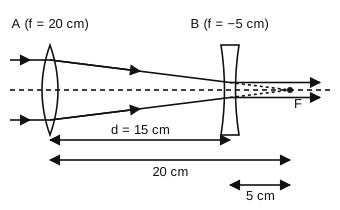
- A converges the parallel beam towards its focus F, 20 cm from A.
- B makes these converging rays parallel only if F is also B’s (virtual-object) focus: F is 5 cm beyond B.
- d = 20 − 5 = 15 cm. (Check: .)
Short trick: Afocal (telescope-type) system: d = f1 + f2 with sign ⇒ 20 + (−5) = 15 cm.
Answer: (D) 15
अवधारणा: निर्गत पुंज समांतर होने के लिए A द्वारा बना प्रतिबिंब (इसका फोकस) B के फोकस पर होना चाहिए; अपसारी लेंस के लिए अभिसारी किरणें B के 5 cm पीछे के बिंदु की ओर जानी चाहिए।
- A समांतर पुंज को अपने फोकस F की ओर अभिसरित करता है, जो A से 20 cm पर है।
- B इन अभिसारी किरणों को तभी समांतर करेगा जब F, B का भी (आभासी बिंब) फोकस हो: F, B से 5 cm आगे है।
- d = 20 − 5 = 15 cm। (जाँच: ।)
शॉर्ट ट्रिक: अफोकसी (दूरदर्शक-प्रकार) निकाय: d = f1 + f2 (चिह्न सहित) ⇒ 20 + (−5) = 15 cm।
उत्तर: (D) 15
NEET UGPhysicsRay optics – combination of lensesNEET UG 2021 · 12 Sep Shift 1
Q258.An infinitely long straight conductor carries a current of 5 A as shown. An electron is moving with a speed of 10
5 m/s parallel to the conductor. The perpendicular distance between the electron and the conductor is 20 cm at an instant. Calculate the magnitude of the force experienced by the electron at the instant.
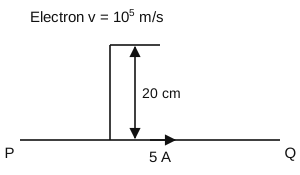
दर्शाए अनुसार एक अनंत लंबे सीधे चालक में 5 A धारा प्रवाहित है। एक इलेक्ट्रॉन 10
5 m/s की चाल से चालक के समांतर गति कर रहा है। किसी क्षण इलेक्ट्रॉन और चालक के बीच लंबवत दूरी 20 cm है। उस क्षण इलेक्ट्रॉन पर लगने वाले बल का परिमाण ज्ञात कीजिए।
- A N
- B N
- C N
- D N
Show answer
Concept: Field of a long wire ; velocity parallel to the wire is ⊥ to B, so F = evB.
- T.
- .
- N.
Short trick: cancels the π – so options with π (A, D) are out at once.
Answer: (B) N
अवधारणा: लंबे तार का क्षेत्र ; तार के समांतर वेग, B के लंबवत होता है, अतः F = evB।
- T।
- ।
- N।
शॉर्ट ट्रिक: में π कट जाता है – अतः π वाले विकल्प (A, D) तुरंत हटें।
उत्तर: (B) N
NEET UGPhysicsMoving charges and magnetism – force on moving chargeNEET UG 2021 · 12 Sep Shift 1
Q259.If E and G respectively denote energy and gravitational constant, then E/G has dimensions of:
यदि E और G क्रमशः ऊर्जा और गुरुत्वाकर्षण नियतांक को दर्शाते हैं, तो E/G की विमाएँ हैं:
- A
- B
- C
- D
Show answer
Concept: ; from , .
- .
- .
Short trick: E/G = (Gm²/r)/G = m²/r ⇒ M² L⁻¹ instantly.
Answer: (C)
अवधारणा: ; से ।
- ।
- ।
शॉर्ट ट्रिक: E/G = (Gm²/r)/G = m²/r ⇒ तुरंत M² L⁻¹।
उत्तर: (C)
NEET UGPhysicsUnits and measurements – dimensionsNEET UG 2021 · 12 Sep Shift 1
Q260.The velocity of a small ball of mass M and density d, when dropped in a container filled with glycerine becomes constant after some time. If the density of glycerine is , then the viscous force acting on the ball will be:
द्रव्यमान M और घनत्व d की एक छोटी गेंद को ग्लिसरीन से भरे पात्र में गिराने पर कुछ समय बाद इसका वेग नियत हो जाता है। यदि ग्लिसरीन का घनत्व है, तो गेंद पर लगने वाला श्यान बल होगा:
- A
- B2 Mg
- C
- DMg
Show answer
Concept: At terminal velocity the net force is zero: weight = buoyant force + viscous force.
- Volume ; buoyant force = .
- Viscous force = .
Short trick: Viscous force = Mg(1 − ρliquid/ρball) = Mg(1 − 1/2).
Answer: (C)
अवधारणा: सीमांत वेग पर नेट बल शून्य होता है: भार = उत्प्लावन बल + श्यान बल।
- आयतन ; उत्प्लावन बल = ।
- श्यान बल = ।
शॉर्ट ट्रिक: श्यान बल = Mg(1 − ρद्रव/ρगेंद) = Mg(1 − 1/2)।
उत्तर: (C)
NEET UGPhysicsMechanical properties of fluids – terminal velocityNEET UG 2021 · 12 Sep Shift 1

