Q261.The electron concentration in an n-type semiconductor is the same as hole concentration in a p-type semiconductor. An external field (electric) is applied across each of them. Compare the currents in them.
एक n-प्रकार के अर्धचालक में इलेक्ट्रॉन सांद्रता, एक p-प्रकार के अर्धचालक में होल सांद्रता के बराबर है। प्रत्येक पर एक बाह्य (वैद्युत) क्षेत्र लगाया जाता है। इनमें धाराओं की तुलना कीजिए।
- ACurrent in n-type > current in p-typen-प्रकार में धारा > p-प्रकार में धारा
- BNo current will flow in p-type, current will only flow in n-typep-प्रकार में कोई धारा नहीं बहेगी, केवल n-प्रकार में धारा बहेगी
- CCurrent in n-type = current in p-typen-प्रकार में धारा = p-प्रकार में धारा
- DCurrent in p-type > current in n-typep-प्रकार में धारा > n-प्रकार में धारा
Show answer
Concept: Current ; with equal carrier concentration and field, current ∝ mobility μ, and electrons are more mobile than holes ().
- Same n, e, A, E ⇒ .
- (B) wrong – holes do carry current in p-type.
- (C) wrong – mobilities differ.
- (D) wrong – holes are slower.
Short trick: Electrons are “free”, holes move by hopping of bound electrons ⇒ electrons win.
Answer: (A) Current in n-type > current in p-type
अवधारणा: धारा ; समान वाहक सांद्रता और क्षेत्र पर धारा ∝ गतिशीलता μ, और इलेक्ट्रॉन होल की अपेक्षा अधिक गतिशील होते हैं ()।
- समान n, e, A, E ⇒ ।
- (B) गलत – p-प्रकार में होल धारा प्रवाहित करते हैं।
- (C) गलत – गतिशीलताएँ भिन्न हैं।
- (D) गलत – होल धीमे होते हैं।
शॉर्ट ट्रिक: इलेक्ट्रॉन “मुक्त” होते हैं, होल बद्ध इलेक्ट्रॉनों के कूदने से चलते हैं ⇒ इलेक्ट्रॉन आगे।
उत्तर: (A) n-प्रकार में धारा > p-प्रकार में धारा
NEET UGPhysicsSemiconductor electronics – carrier mobilityNEET UG 2021 · 12 Sep Shift 1
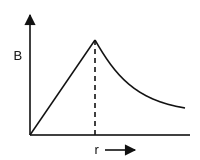
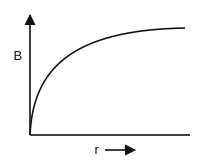
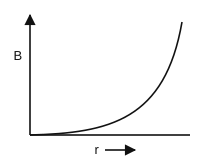
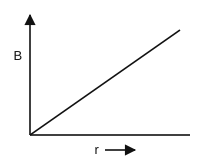
Q262.A thick current cable of radius R carries current ‘I’ uniformly distributed across its cross-section. The variation of magnetic field B(r) due to the cable with the distance ‘r’ from the axis of the cable is represented by:
त्रिज्या R की एक मोटी धारावाही केबल में धारा ‘I’ इसके अनुप्रस्थ-काट पर एकसमान रूप से वितरित है। केबल के अक्ष से दूरी ‘r’ के साथ केबल के कारण चुंबकीय क्षेत्र B(r) का परिवर्तन किसके द्वारा निरूपित होता है:
- A
- B
- C
- D
Show answer
Concept: Ampere’s law with uniform current density .
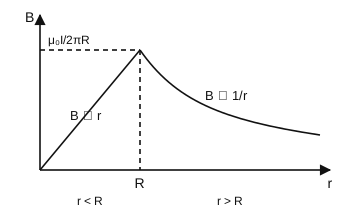
- Inside (r < R): ⇒ ⇒ .
- Outside (r > R): .
- Maximum at the surface ⇒ linear rise then 1/r fall ⇒ graph (A).
Short trick: Solid cylinder ≈ solid sphere of charge: “linear inside, inverse outside, peak at surface”.
Answer: (A) Graph (A)
अवधारणा: ऐम्पियर का नियम , एकसमान धारा घनत्व के साथ।
- अंदर (r < R): ⇒ ⇒ ।
- बाहर (r > R): ।
- पृष्ठ पर अधिकतम ⇒ पहले रैखिक वृद्धि फिर 1/r के अनुसार कमी ⇒ ग्राफ (A)।
शॉर्ट ट्रिक: ठोस बेलन ≈ आवेशित ठोस गोला: “अंदर रैखिक, बाहर व्युत्क्रम, पृष्ठ पर शिखर”।
उत्तर: (A) ग्राफ (A)
NEET UGPhysicsMoving charges and magnetism – Ampere’s circuital lawNEET UG 2021 · 12 Sep Shift 1
Q263.A screw gauge gives the following readings when used to measure the diameter of a wire
Main scale reading : 0 mm
Circular scale reading : 52 divisions
Given that 1 mm on main scale corresponds to 100 divisions on the circular scale. The diameter of the wire from the above data is:
एक तार का व्यास मापने में प्रयुक्त स्क्रू गेज निम्नलिखित पाठ्यांक देता है
मुख्य पैमाने का पाठ्यांक : 0 mm
वृत्तीय पैमाने का पाठ्यांक : 52 भाग
दिया है कि मुख्य पैमाने का 1 mm वृत्तीय पैमाने के 100 भागों के संगत है। उपर्युक्त आँकड़ों से तार का व्यास है:
- A0.26 cm
- B0.052 cm
- C0.52 cm
- D0.026 cm
Show answer
Concept: Reading = MSR + (CSR × least count); least count = pitch / number of circular divisions.
- LC = 1 mm / 100 = 0.01 mm.
- Diameter = 0 + 52 × 0.01 = 0.52 mm.
- 0.52 mm = 0.052 cm.
Short trick: Watch the unit switch: answer in cm ⇒ divide mm by 10 (0.52 cm is the mm-value trap).
Answer: (B) 0.052 cm
अवधारणा: पाठ्यांक = MSR + (CSR × अल्पतमांक); अल्पतमांक = चूड़ी अंतराल / वृत्तीय भागों की संख्या।
- LC = 1 mm / 100 = 0.01 mm।
- व्यास = 0 + 52 × 0.01 = 0.52 mm।
- 0.52 mm = 0.052 cm।
शॉर्ट ट्रिक: मात्रक बदलने पर ध्यान दें: उत्तर cm में ⇒ mm को 10 से भाग दें (0.52 cm, mm-मान वाला जाल है)।
उत्तर: (B) 0.052 cm
NEET UGPhysicsUnits and measurements – screw gaugeNEET UG 2021 · 12 Sep Shift 1
Q264.The number of photons per second on an average emitted by the source of monochromatic light of wavelength 600 nm, when it delivers the power of watt will be: ( Js)
600 nm तरंगदैर्ध्य के एकवर्णी प्रकाश स्रोत द्वारा, जब यह वाट शक्ति प्रदान करता है, औसतन प्रति सेकंड उत्सर्जित फोटॉनों की संख्या होगी: ( Js)
- A
- B
- C
- D
Show answer
Concept: Power = (photons per second) × energy of one photon: .
- J.
- per second.
Short trick: Photon energy in eV ≈ 1240/λ(nm) = 2.07 eV ≈ 3.3 × 10⁻¹⁹ J – the 3.3 cancels neatly.
Answer: (A)
अवधारणा: शक्ति = (प्रति सेकंड फोटॉन) × एक फोटॉन की ऊर्जा: ।
- J।
- प्रति सेकंड।
शॉर्ट ट्रिक: eV में फोटॉन ऊर्जा ≈ 1240/λ(nm) = 2.07 eV ≈ 3.3 × 10⁻¹⁹ J – 3.3 सीधे कट जाता है।
उत्तर: (A)
NEET UGPhysicsDual nature of radiation – photon fluxNEET UG 2021 · 12 Sep Shift 1
Q265.Water falls from a height of 60 m at the rate of 15 kg/s to operate a turbine. The losses due to frictional force are 10% of the input energy. How much power is generated by the turbine? (g = 10 m/s2)
एक टरबाइन को चलाने के लिए पानी 60 m की ऊँचाई से 15 kg/s की दर से गिरता है। घर्षण बल के कारण हानियाँ निवेशी ऊर्जा का 10% हैं। टरबाइन द्वारा कितनी शक्ति उत्पन्न होती है? (g = 10 m/s2)
- A12.3 kW
- B7.0 kW
- C10.2 kW
- D8.1 kW
Show answer
Concept: Input power = rate of loss of PE = ; output = 90% of input.
- W.
- Loss = 10% = 900 W.
- W = 8.1 kW.
Short trick: Output = 0.9 × ṁgh = 0.9 × 9 kW = 8.1 kW.
Answer: (D) 8.1 kW
अवधारणा: निवेशी शक्ति = स्थितिज ऊर्जा ह्रास की दर = ; निर्गत = निवेश का 90%।
- W।
- हानि = 10% = 900 W।
- W = 8.1 kW।
शॉर्ट ट्रिक: निर्गत = 0.9 × ṁgh = 0.9 × 9 kW = 8.1 kW।
उत्तर: (D) 8.1 kW
NEET UGPhysicsWork, energy and power – powerNEET UG 2021 · 12 Sep Shift 1
Q266.An electromagnetic wave of wavelength ‘’ is incident on a photosensitive surface of negligible work function. If ‘m’ mass is of photoelectron emitted from the surface has de-Broglie wavelength , then:
तरंगदैर्ध्य ‘’ की एक विद्युतचुंबकीय तरंग नगण्य कार्य-फलन वाले एक प्रकाश-सुग्राही पृष्ठ पर आपतित होती है। यदि पृष्ठ से उत्सर्जित ‘m’ द्रव्यमान के प्रकाशइलेक्ट्रॉन की दे-ब्रॉग्ली तरंगदैर्ध्य है, तो:
- A
- B
- C
- D
Show answer
Concept: With zero work function, all photon energy becomes KE: ; and .
- .
- .
Short trick: Dimension check: has unit 1/length, so is a length ✓; (B), (C) fail units, (D) has λ and λd swapped.
Answer: (A)
अवधारणा: शून्य कार्य-फलन पर फोटॉन की पूरी ऊर्जा गतिज ऊर्जा बनती है: ; तथा ।
- ।
- ।
शॉर्ट ट्रिक: विमीय जाँच: का मात्रक 1/लंबाई है, अतः लंबाई है ✓; (B), (C) मात्रक में असफल, (D) में λ और λd उलटे हैं।
उत्तर: (A)
NEET UGPhysicsDual nature of matter – de Broglie wavelengthNEET UG 2021 · 12 Sep Shift 1
Q267.Match Column-I and Column-II and choose the correct match from the given choices.
| Column I | Column II |
|---|
| (A) Root mean square speed of gas molecules | (P) |
| (B) Pressure exerted by ideal gas | (Q) |
| (C) Average kinetic energy of a molecule | (R) |
| (D) Total internal energy of 1 mole of a diatomic gas | (S) |
स्तंभ-I का स्तंभ-II से मिलान कीजिए और दिए गए विकल्पों में से सही मिलान चुनिए।
| स्तंभ-I | स्तंभ-II |
|---|
| (A) गैस अणुओं की वर्ग-माध्य-मूल चाल | (P) |
| (B) आदर्श गैस द्वारा आरोपित दाब | (Q) |
| (C) एक अणु की औसत गतिज ऊर्जा | (R) |
| (D) द्विपरमाणुक गैस के 1 मोल की कुल आंतरिक ऊर्जा | (S) |
- AA-Q, B-P, C-S, D-R
- BA-R, B-Q, C-P, D-S
- CA-R, B-P, C-S, D-Q
- DA-Q, B-R, C-S, D-P
Show answer
Concept: Kinetic theory results: , , average KE per molecule , and U of 1 mol of a diatomic gas (5 degrees of freedom) .
- A (rms speed) → Q.
- B (pressure) → P.
- C (average KE of a molecule) → S.
- D (U of 1 mol diatomic) → R.
Short trick: Only one entry has the unit of speed (Q) ⇒ A-Q; options (A) and (D) remain, and B must be pressure P ⇒ (A).
Answer: (A) A-Q, B-P, C-S, D-R
अवधारणा: अणुगति सिद्धांत के परिणाम: , , प्रति अणु औसत गतिज ऊर्जा , तथा द्विपरमाणुक गैस (5 स्वातंत्र्य कोटि) के 1 मोल की U ।
- A (वर्ग-माध्य-मूल चाल) → Q।
- B (दाब) → P।
- C (एक अणु की औसत गतिज ऊर्जा) → S।
- D (1 मोल द्विपरमाणुक की U) → R।
शॉर्ट ट्रिक: केवल एक प्रविष्टि (Q) का मात्रक चाल का है ⇒ A-Q; विकल्प (A) और (D) बचते हैं, और B दाब P होना चाहिए ⇒ (A)।
उत्तर: (A) A-Q, B-P, C-S, D-R
NEET UGPhysicsKinetic theory – rms speed, pressure, energyNEET UG 2021 · 12 Sep Shift 1
Q268.A nucleus with mass number 240 breaks into two fragments each of mass number 120, the binding energy per nucleon of unfragmented nuclei is 7.6 MeV while that of fragments is 8.5 MeV. The total gain in the Binding Energy in the process is:
द्रव्यमान संख्या 240 का एक नाभिक, द्रव्यमान संख्या 120 वाले दो खंडों में टूटता है। अविखंडित नाभिक की प्रति न्यूक्लिऑन बंधन ऊर्जा 7.6 MeV है जबकि खंडों की 8.5 MeV है। इस प्रक्रम में बंधन ऊर्जा में कुल वृद्धि है:
- A804 MeV
- B216 MeV
- C0.9 MeV
- D9.4 MeV
Show answer
Concept: Total BE = (BE per nucleon) × A; gain = BE(products) − BE(parent).
- BE (parent) = 240 × 7.6 = 1824 MeV.
- BE (fragments) = 2 × 120 × 8.5 = 2040 MeV.
- Gain = 2040 − 1824 = 216 MeV.
Short trick: Nucleon number is unchanged ⇒ gain = 240 × (8.5 − 7.6) = 240 × 0.9 = 216 MeV (0.9 MeV is only per nucleon).
Answer: (B) 216 MeV
अवधारणा: कुल बंधन ऊर्जा = (प्रति न्यूक्लिऑन BE) × A; वृद्धि = BE(उत्पाद) − BE(जनक)।
- BE (जनक) = 240 × 7.6 = 1824 MeV।
- BE (खंड) = 2 × 120 × 8.5 = 2040 MeV।
- वृद्धि = 2040 − 1824 = 216 MeV।
शॉर्ट ट्रिक: न्यूक्लिऑन संख्या अपरिवर्तित ⇒ वृद्धि = 240 × (8.5 − 7.6) = 240 × 0.9 = 216 MeV (0.9 MeV केवल प्रति न्यूक्लिऑन है)।
उत्तर: (B) 216 MeV
NEET UGPhysicsNuclei – binding energy in fissionNEET UG 2021 · 12 Sep Shift 1
Q269.A parallel plate capacitor has a uniform electric field ‘’ in the space between the plates. If the distance between the plates is ‘d’ and the area of each plate is ‘A’ the energy stored in the capacitor is: ( = permittivity of free space)
एक समांतर प्लेट संधारित्र की प्लेटों के बीच के स्थान में एकसमान वैद्युत क्षेत्र ‘’ है। यदि प्लेटों के बीच की दूरी ‘d’ और प्रत्येक प्लेट का क्षेत्रफल ‘A’ है, तो संधारित्र में संचित ऊर्जा है: ( = मुक्त आकाश की विद्युतशीलता)
- A
- B
- C
- D
Show answer
Concept: Energy density of an electric field ; total energy = u × volume.
- .
- .
Short trick: (C) is only the energy density (per unit volume); multiply by volume Ad.
Answer: (A)
अवधारणा: वैद्युत क्षेत्र का ऊर्जा घनत्व ; कुल ऊर्जा = u × आयतन।
- ।
- ।
शॉर्ट ट्रिक: (C) केवल ऊर्जा घनत्व (प्रति एकांक आयतन) है; आयतन Ad से गुणा करें।
उत्तर: (A)
NEET UGPhysicsCapacitance – energy densityNEET UG 2021 · 12 Sep Shift 1
Q270.Find the value of angle of emergence from the prism. Refractive index of the glass is
.
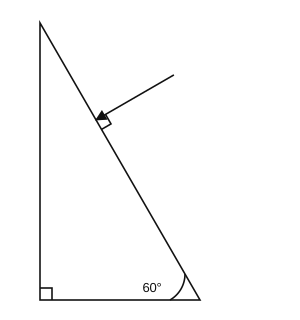
प्रिज़्म से निर्गत कोण का मान ज्ञात कीजिए। काँच का अपवर्तनांक
है।
- A45°
- B90°
- C60°
- D30°
Show answer
Concept: A ray incident normally goes undeviated; at the next face apply Snell’s law (after checking it is below the critical angle).
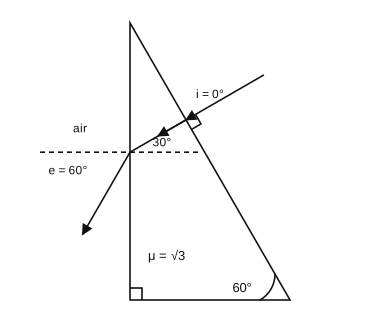
- The ray enters normally (i = 0) through the face opposite the right angle, so it travels ⊥ to that face.
- That face makes 60° with the base, so the ray inside makes 30° with the horizontal, i.e. with the normal to the vertical face: r = 30°.
- Critical angle: ⇒ C ≈ 35°; since 30° < C the ray emerges.
- ⇒ e = 60°.
Short trick: Normal-incidence prism problems: angle inside at the 2nd face = the prism angle between the two faces (here 30°).
Answer: (C) 60°
अवधारणा: अभिलंबवत आपतित किरण बिना विचलन के जाती है; अगले फलक पर स्नेल का नियम लगाएँ (पहले क्रांतिक कोण जाँचें)।
- किरण समकोण के सामने वाले फलक से अभिलंबवत (i = 0) प्रवेश करती है, अतः उस फलक के लंबवत चलती है।
- वह फलक आधार से 60° बनाता है, अतः अंदर किरण क्षैतिज से, अर्थात् ऊर्ध्वाधर फलक के अभिलंब से 30° बनाती है: r = 30°।
- क्रांतिक कोण: ⇒ C ≈ 35°; चूँकि 30° < C, किरण बाहर निकलती है।
- ⇒ e = 60°।
शॉर्ट ट्रिक: अभिलंब आपतन वाले प्रिज़्म प्रश्न: दूसरे फलक पर अंदर का कोण = दोनों फलकों के बीच का प्रिज़्म कोण (यहाँ 30°)।
उत्तर: (C) 60°
NEET UGPhysicsRay optics – refraction through a prismNEET UG 2021 · 12 Sep Shift 1
Q271.A dipole is placed in an electric field as shown. In which direction will it move?
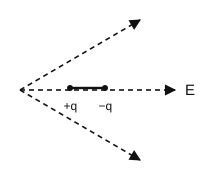
दर्शाए अनुसार एक द्विध्रुव को वैद्युत क्षेत्र में रखा गया है। यह किस दिशा में गति करेगा?
- ATowards the left as its potential energy will decreaseबाईं ओर, क्योंकि इसकी स्थितिज ऊर्जा घटेगी
- BTowards the right as its potential energy will increaseदाईं ओर, क्योंकि इसकी स्थितिज ऊर्जा बढ़ेगी
- CTowards the left as its potential energy will increaseबाईं ओर, क्योंकि इसकी स्थितिज ऊर्जा बढ़ेगी
- DTowards the right as its potential energy will decreaseदाईं ओर, क्योंकि इसकी स्थितिज ऊर्जा घटेगी
Show answer
Concept: In a non-uniform field a dipole feels a net force and moves towards lower potential energy, .
- The field lines diverge to the right ⇒ field strength decreases from left to right.
- +q is on the left (stronger field), −q on the right: force on +q (to the right, qEleft) is larger than the force on −q (to the left, qEright) ⇒ net force to the right.
- Here (from −q to +q) points left, opposite to ⇒ U = +pE, which decreases as E decreases, i.e. towards the right.
- So it moves right and its PE decreases ⇒ (D). Any natural motion is always towards lower PE, which rules out (B) and (C).
Short trick: A body moves spontaneously only towards lower PE ⇒ reject “increase” options; then compare the forces on the two charges.
Answer: (D) Towards the right as its potential energy will decrease
अवधारणा: असमान क्षेत्र में द्विध्रुव पर नेट बल लगता है और यह कम स्थितिज ऊर्जा, , की ओर चलता है।
- क्षेत्र रेखाएँ दाईं ओर फैलती हैं ⇒ क्षेत्र की तीव्रता बाएँ से दाएँ घटती है।
- +q बाईं ओर (प्रबल क्षेत्र) और −q दाईं ओर है: +q पर बल (दाईं ओर, qEबायाँ), −q पर बल (बाईं ओर, qEदायाँ) से अधिक है ⇒ नेट बल दाईं ओर।
- यहाँ (−q से +q की ओर) बाईं ओर है, के विपरीत ⇒ U = +pE, जो E घटने पर, अर्थात् दाईं ओर, घटती है।
- अतः यह दाईं ओर चलता है और इसकी स्थितिज ऊर्जा घटती है ⇒ (D)। कोई भी स्वतः गति सदैव कम स्थितिज ऊर्जा की ओर होती है, अतः (B) और (C) गलत।
शॉर्ट ट्रिक: वस्तु स्वतः केवल कम स्थितिज ऊर्जा की ओर चलती है ⇒ “बढ़ेगी” वाले विकल्प हटाएँ; फिर दोनों आवेशों पर बलों की तुलना करें।
उत्तर: (D) दाईं ओर, क्योंकि इसकी स्थितिज ऊर्जा घटेगी
NEET UGPhysicsElectric charges and fields – dipole in non-uniform fieldNEET UG 2021 · 12 Sep Shift 1
Q272.Consider the following Statements (A) and (B) and identify the correct answer.
A. A zener diode is connected in reverse bias, when used as a voltage regulator.
B. The potential barrier of p-n junction lies between 0.1 V to 0.3 V.
निम्नलिखित कथनों (A) और (B) पर विचार कीजिए और सही उत्तर पहचानिए।
A. वोल्टता नियंत्रक के रूप में प्रयुक्त होने पर ज़ेनर डायोड को पश्चदिशिक बायस (reverse bias) में जोड़ा जाता है।
B. p-n संधि का विभव प्राचीर 0.1 V से 0.3 V के बीच होता है।
- A(A) is correct (B) is incorrect.(A) सही है, (B) गलत है।
- B(A) is incorrect but (B) is correct.(A) गलत है परंतु (B) सही है।
- C(A) and (B) both are correct.(A) और (B) दोनों सही हैं।
- D(A) and (B) both are incorrect.(A) और (B) दोनों गलत हैं।
Show answer
Concept: A Zener regulator works in the reverse-breakdown region; the barrier potential of a p-n junction is about 0.7 V for Si and 0.3 V for Ge.
- (A) Correct – in reverse breakdown the Zener voltage stays constant while current changes, so it is reverse biased as a regulator.
- (B) Incorrect – the barrier is ≈ 0.7 V for silicon (≈ 0.3 V for germanium); it does not lie only between 0.1 V and 0.3 V.
- Hence (A) is correct and (B) is incorrect.
Short trick: NCERT numbers: VB(Si) ≈ 0.7 V, VB(Ge) ≈ 0.3 V; Zener ⇒ always reverse bias.
Answer: (A) (A) is correct (B) is incorrect.
अवधारणा: ज़ेनर नियंत्रक पश्चदिशिक भंजन (reverse breakdown) क्षेत्र में कार्य करता है; p-n संधि का प्राचीर विभव Si के लिए लगभग 0.7 V और Ge के लिए 0.3 V होता है।
- (A) सही – पश्चदिशिक भंजन में धारा बदलने पर भी ज़ेनर वोल्टता नियत रहती है, अतः नियंत्रक के रूप में यह पश्चदिशिक बायस में होता है।
- (B) गलत – सिलिकॉन के लिए प्राचीर ≈ 0.7 V (जर्मेनियम के लिए ≈ 0.3 V) है; यह केवल 0.1 V से 0.3 V के बीच नहीं होता।
- अतः (A) सही है और (B) गलत है।
शॉर्ट ट्रिक: NCERT मान: VB(Si) ≈ 0.7 V, VB(Ge) ≈ 0.3 V; ज़ेनर ⇒ सदैव पश्चदिशिक बायस।
उत्तर: (A) (A) सही है, (B) गलत है।
NEET UGPhysicsSemiconductor electronics – Zener diode, p-n junctionNEET UG 2021 · 12 Sep Shift 1
Q273.A half-life of a radioactive nuclide is 100 hours. The fraction of original activity that will remain after 150 hours would be:
एक रेडियोऐक्टिव न्यूक्लाइड (nuclide) की अर्ध-आयु 100 घंटे है। 150 घंटे बाद मूल सक्रियता का कितना अंश शेष रहेगा?
- A
- B
- C
- D
Show answer
Concept: (valid for non-integer number of half-lives too).
- n = t / T1/2 = 150 / 100 = 3/2.
- ≈ 0.354.
Short trick: After 1 half-life ½, after 2 it is ¼ ⇒ answer must lie between 0.25 and 0.5: only 1/(2√2) ≈ 0.35 fits.
Answer: (D)
अवधारणा: (अर्ध-आयुओं की असंपूर्ण संख्या के लिए भी मान्य)।
- n = t / T1/2 = 150 / 100 = 3/2।
- ≈ 0.354।
शॉर्ट ट्रिक: 1 अर्ध-आयु के बाद ½, 2 के बाद ¼ ⇒ उत्तर 0.25 और 0.5 के बीच होना चाहिए: केवल 1/(2√2) ≈ 0.35 उपयुक्त।
उत्तर: (D)
NEET UGPhysicsNuclei – half-lifeNEET UG 2021 · 12 Sep Shift 1
Q274.An inductor of inductance L, a capacitor of capacitance C and a resistor of resistance ‘R’ are connected in series to an ac source of potential difference ‘V’ volts as shown in figure. Potential difference across L, C and R is 40 V, 10 V and 40 V, respectively. The amplitude of current flowing through LCR series circuit is
. The impedance of the circuit is:
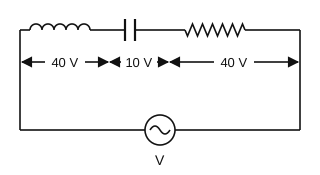
प्रेरकत्व L का एक प्रेरक, धारिता C का एक संधारित्र और प्रतिरोध ‘R’ का एक प्रतिरोधक, चित्रानुसार ‘V’ वोल्ट विभवांतर के ac स्रोत से श्रेणीक्रम में जुड़े हैं। L, C और R के सिरों पर विभवांतर क्रमशः 40 V, 10 V और 40 V है। LCR श्रेणी परिपथ में प्रवाहित धारा का आयाम
है। परिपथ की प्रतिबाधा है:
- A4 Ω
- B5 Ω
- C Ω
- D Ω
Show answer
Concept: Meter readings of voltage are rms values; in series LCR and .
- V.
- Current amplitude A ⇒ A.
- .
Short trick: Phasor 3-4-5 triangle: VR = 40, VL − VC = 30 ⇒ V = 50; never add 40 + 10 + 40 directly.
Answer: (B) 5 Ω
अवधारणा: वोल्टता के मापक पाठ्यांक rms मान होते हैं; श्रेणी LCR में तथा ।
- V।
- धारा आयाम A ⇒ A।
- ।
शॉर्ट ट्रिक: फेज़र 3-4-5 त्रिभुज: VR = 40, VL − VC = 30 ⇒ V = 50; 40 + 10 + 40 सीधे कभी न जोड़ें।
उत्तर: (B) 5 Ω
NEET UGPhysicsAlternating current – series LCR impedanceNEET UG 2021 · 12 Sep Shift 1
Q275.A body is executing simple harmonic motion with frequency ‘n’, the frequency of its potential energy is:
एक पिंड आवृत्ति ‘n’ से सरल आवर्त गति कर रहा है, इसकी स्थितिज ऊर्जा की आवृत्ति है:
- A3n
- B4n
- Cn
- D2n
Show answer
Concept: with gives .
- U varies as , i.e. with angular frequency 2ω.
- Frequency of PE = 2n.
Short trick: PE (and KE) is maximum twice in every oscillation (at both extremes) ⇒ double frequency.
Answer: (D) 2n
अवधारणा: के साथ से ।
- U, के अनुसार अर्थात् कोणीय आवृत्ति 2ω से बदलती है।
- स्थितिज ऊर्जा की आवृत्ति = 2n।
शॉर्ट ट्रिक: प्रत्येक दोलन में स्थितिज (और गतिज) ऊर्जा दो बार अधिकतम (दोनों चरम सीमाओं पर) होती है ⇒ दोगुनी आवृत्ति।
उत्तर: (D) 2n
NEET UGPhysicsOscillations – energy in SHMNEET UG 2021 · 12 Sep Shift 1
Q276.From a circular ring of mass ‘M’ and radius ‘R’ an arc corresponding to a 90° sector is removed. The moment of inertia of the remaining part of the ring about an axis passing through the centre of the ring and perpendicular to the plane of the ring is ‘K’ times ‘MR2’. Then the value of ‘K’ is:
द्रव्यमान ‘M’ और त्रिज्या ‘R’ के एक वृत्ताकार वलय से 90° त्रिज्यखंड के संगत एक चाप हटा दिया जाता है। वलय के केंद्र से गुजरने वाली और वलय के तल के लंबवत अक्ष के परितः वलय के शेष भाग का जड़त्व आघूर्ण ‘MR2’ का ‘K’ गुना है। तब ‘K’ का मान है:
- A
- B
- C
- D
Show answer
Concept: Every element of a ring (or arc) lies at distance R from the central perpendicular axis, so for any arc of mass m.
- Removed 90° = 1/4 of the ring ⇒ remaining mass = .
- ⇒ K = 3/4.
Short trick: For an arc about the axis through its centre of curvature, I = (mass) × R² – shape of the arc does not matter.
Answer: (C)
अवधारणा: वलय (या चाप) का प्रत्येक अवयव केंद्रीय लंबवत अक्ष से R दूरी पर है, अतः m द्रव्यमान के किसी भी चाप के लिए ।
- हटाया गया 90° = वलय का 1/4 ⇒ शेष द्रव्यमान = ।
- ⇒ K = 3/4।
शॉर्ट ट्रिक: चाप के वक्रता केंद्र से गुजरने वाले अक्ष के परितः I = (द्रव्यमान) × R² – चाप का आकार मायने नहीं रखता।
उत्तर: (C)
NEET UGPhysicsSystem of particles – moment of inertia of ringNEET UG 2021 · 12 Sep Shift 1
Q277.A series LCR circuit containing 5.0 H inductor, 80 μF capacitor and 40 Ω resistor is connected to 230 V variable frequency ac source. The angular frequencies of the source at which power transferred to the circuit is half the power at the resonant angular frequency are likely to be:
5.0 H प्रेरक, 80 μF संधारित्र और 40 Ω प्रतिरोधक वाला एक श्रेणी LCR परिपथ 230 V के परिवर्ती आवृत्ति ac स्रोत से जुड़ा है। स्रोत की वे कोणीय आवृत्तियाँ, जिन पर परिपथ को स्थानांतरित शक्ति, अनुनादी कोणीय आवृत्ति पर शक्ति की आधी है, संभवतः हैं:
- A46 rad/s and 54 rad/s46 rad/s और 54 rad/s
- B42 rad/s and 58 rad/s42 rad/s और 58 rad/s
- C25 rad/s and 75 rad/s25 rad/s और 75 rad/s
- D50 rad/s and 25 rad/s50 rad/s और 25 rad/s
Show answer
Concept: Half-power points lie at with bandwidth and .
- rad/s.
- rad/s.
- rad/s and 54 rad/s.
Short trick: The pair must be centred on ω0 = 50 with a gap R/L = 8 ⇒ 46 & 54.
Answer: (A) 46 rad/s and 54 rad/s
अवधारणा: अर्ध-शक्ति बिंदु पर होते हैं, जहाँ बैंड-चौड़ाई तथा ।
- rad/s।
- rad/s।
- rad/s और 54 rad/s।
शॉर्ट ट्रिक: युग्म ω0 = 50 पर केंद्रित और R/L = 8 के अंतर वाला होना चाहिए ⇒ 46 और 54।
उत्तर: (A) 46 rad/s और 54 rad/s
NEET UGPhysicsAlternating current – half-power frequenciesNEET UG 2021 · 12 Sep Shift 1
Q278.A uniform conducting wire of length 12a and resistance ‘R’ is wound up as a current carrying coil in the shape of,
(i) an equilateral triangle of side ‘a’.
(ii) a square of side ‘a’.
The magnetic dipole moments of the coil in each case respectively are:
लंबाई 12a और प्रतिरोध ‘R’ के एक एकसमान चालक तार को धारावाही कुंडली के रूप में लपेटा जाता है, जिसका आकार है
(i) भुजा ‘a’ का एक समबाहु त्रिभुज।
(ii) भुजा ‘a’ का एक वर्ग।
प्रत्येक स्थिति में कुंडली के चुंबकीय द्विध्रुव आघूर्ण क्रमशः हैं:
- A3 Ia2 and 4 Ia23 Ia2 और 4 Ia2
- B4 Ia2 and 3 Ia24 Ia2 और 3 Ia2
- C Ia2 and 3 Ia2 Ia2 और 3 Ia2
- D3 Ia2 and Ia23 Ia2 और Ia2
Show answer
Concept: Magnetic moment of a coil m = NIA; the number of turns N = total length / perimeter of one turn.
- Triangle: perimeter 3a ⇒ N = 12a/3a = 4; area = ⇒ .
- Square: perimeter 4a ⇒ N = 3; area = a² ⇒ m = 3Ia².
Short trick: Same wire length: compare N × (area per turn) – the square always gives more moment than the triangle.
Answer: (C) Ia2 and 3 Ia2
अवधारणा: कुंडली का चुंबकीय आघूर्ण m = NIA; फेरों की संख्या N = कुल लंबाई / एक फेरे का परिमाप।
- त्रिभुज: परिमाप 3a ⇒ N = 12a/3a = 4; क्षेत्रफल = ⇒ ।
- वर्ग: परिमाप 4a ⇒ N = 3; क्षेत्रफल = a² ⇒ m = 3Ia²।
शॉर्ट ट्रिक: समान तार लंबाई: N × (प्रति फेरा क्षेत्रफल) की तुलना करें – वर्ग सदैव त्रिभुज से अधिक आघूर्ण देता है।
उत्तर: (C) Ia2 और 3 Ia2
NEET UGPhysicsMoving charges and magnetism – magnetic dipole moment of coilNEET UG 2021 · 12 Sep Shift 1
Q279.A step down transformer connected to an ac mains supply of 220 V is made to operate at 11 V, 44 W lamp. Ignoring power losses in the transformer, what is the current in the primary circuit?
220 V के ac मुख्य आपूर्ति से जुड़े एक अपचायी (step down) ट्रांसफ़ॉर्मर से 11 V, 44 W का लैंप चलाया जाता है। ट्रांसफ़ॉर्मर में शक्ति हानियों की उपेक्षा करते हुए, प्राथमिक परिपथ में धारा क्या है?
- A2 A
- B4 A
- C0.2 A
- D0.4 A
Show answer
Concept: Ideal transformer: input power = output power, .
- Output power = 44 W.
- ⇒ A.
Short trick: Secondary current = 44/11 = 4 A (trap); step-down by 20 ⇒ primary current = 4/20 = 0.2 A.
Answer: (C) 0.2 A
अवधारणा: आदर्श ट्रांसफ़ॉर्मर: निवेशी शक्ति = निर्गत शक्ति, ।
- निर्गत शक्ति = 44 W।
- ⇒ A।
शॉर्ट ट्रिक: द्वितीयक धारा = 44/11 = 4 A (जाल); 20 गुना अपचयन ⇒ प्राथमिक धारा = 4/20 = 0.2 A।
उत्तर: (C) 0.2 A
NEET UGPhysicsAlternating current – transformerNEET UG 2021 · 12 Sep Shift 1
Q280.Twenty seven drops of same size are charged at 220 V each. They combine to form a bigger drop. Calculate the potential of the bigger drop.
समान आकार की सत्ताईस बूँदें प्रत्येक 220 V पर आवेशित हैं। ये मिलकर एक बड़ी बूँद बनाती हैं। बड़ी बूँद का विभव ज्ञात कीजिए।
- A1520 V
- B1980 V
- C660 V
- D1320 V
Show answer
Concept: Volume conservation: ; charge adds: Q = nq ⇒ .
- n = 27 ⇒ R = 3r, Q = 27q.
- V.
Short trick: Big-drop rules: V × n2/3, charge × n, capacitance × n1/3, energy × n5/3.
Answer: (B) 1980 V
अवधारणा: आयतन संरक्षण: ; आवेश जुड़ते हैं: Q = nq ⇒ ।
- n = 27 ⇒ R = 3r, Q = 27q।
- V।
शॉर्ट ट्रिक: बड़ी बूँद के नियम: V × n2/3, आवेश × n, धारिता × n1/3, ऊर्जा × n5/3।
उत्तर: (B) 1980 V
NEET UGPhysicsElectrostatic potential – combining dropsNEET UG 2021 · 12 Sep Shift 1

