Q281.Two conducting circular loops of radii and are placed in the same plane with their centres coinciding. If , the mutual inductance M between them will be directly proportional to:
त्रिज्याओं और के दो चालक वृत्ताकार लूप एक ही तल में इस प्रकार रखे हैं कि उनके केंद्र संपाती हैं। यदि , तो उनके बीच अन्योन्य प्रेरकत्व M किसके अनुक्रमानुपाती होगा:
- A
- B
- C
- D
Show answer
Concept: Pass current I1 in the big loop; its field at the centre is nearly uniform over the small loop. .
- at the centre.
- .
- ⇒ .
Short trick: M = (field of big loop per unit current) × (area of small loop) ⇒ (1/R1) × R2².
Answer: (B)
अवधारणा: बड़े लूप में धारा I1 प्रवाहित करें; इसका केंद्र पर क्षेत्र छोटे लूप पर लगभग एकसमान है। ।
- केंद्र पर ।
- ।
- ⇒ ।
शॉर्ट ट्रिक: M = (प्रति एकांक धारा बड़े लूप का क्षेत्र) × (छोटे लूप का क्षेत्रफल) ⇒ (1/R1) × R2²।
उत्तर: (B)
NEET UGPhysicsElectromagnetic induction – mutual inductanceNEET UG 2021 · 12 Sep Shift 1
Q282.A particle of mass ‘m’ is projected with a velocity (k < 1) from the surface of the earth. ( = escape velocity)
The maximum height above the surface reached by the particle is:
द्रव्यमान ‘m’ का एक कण पृथ्वी के पृष्ठ से वेग (k < 1) से प्रक्षेपित किया जाता है। ( = पलायन वेग)
कण द्वारा पृष्ठ से ऊपर प्राप्त अधिकतम ऊँचाई है:
- A
- B
- C
- D
Show answer
Concept: Energy conservation with and .
- .
- ⇒ .
- .
Short trick: Checks: k → 1 ⇒ H → ∞ (escape) and small k ⇒ H ≈ Rk² = u²/2g. Only (B) satisfies both.
Answer: (B)
अवधारणा: और के साथ ऊर्जा संरक्षण।
- ।
- ⇒ ।
- ।
शॉर्ट ट्रिक: जाँच: k → 1 ⇒ H → ∞ (पलायन) तथा छोटे k पर H ≈ Rk² = u²/2g। केवल (B) दोनों को संतुष्ट करता है।
उत्तर: (B)
NEET UGPhysicsGravitation – maximum height of projectileNEET UG 2021 · 12 Sep Shift 1
Q283.A uniform rod of length 200 cm and mass 500 g is balanced on a wedge placed at 40 cm mark. A mass of 2 kg is suspended from the rod at 20 cm and another unknown mass ‘m’ is suspended from the rod at 160 cm mark as shown in the figure. Find the value of ‘m’ such that the rod is in equilibrium. (g = 10 m/s
2)
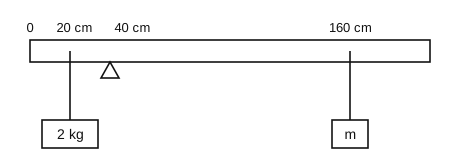
लंबाई 200 cm और द्रव्यमान 500 g की एक एकसमान छड़ 40 cm चिह्न पर रखी एक फन्नी (wedge) पर संतुलित है। चित्रानुसार छड़ से 20 cm पर 2 kg का द्रव्यमान और 160 cm चिह्न पर एक अज्ञात द्रव्यमान ‘m’ लटकाया गया है। ‘m’ का वह मान ज्ञात कीजिए जिससे छड़ साम्यावस्था में रहे। (g = 10 m/s
2)
- A1/6 kg
- B1/12 kg
- C1/2 kg
- D1/3 kg
Show answer
Concept: Take torques about the wedge (40 cm mark); the rod’s weight acts at its centre (100 cm mark).
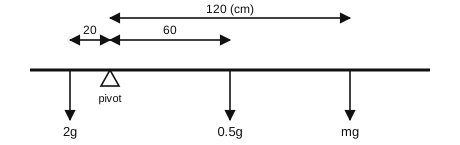
- Anticlockwise: 2 kg at 20 cm from the pivot ⇒ 2g × 20.
- Clockwise: rod 0.5 kg at 60 cm ⇒ 0.5g × 60; mass m at 120 cm ⇒ mg × 120.
- 2 × 20 = 0.5 × 60 + 120m ⇒ 40 = 30 + 120m ⇒ m = 10/120 = 1/12 kg.
Short trick: Don’t forget the rod’s own weight – ignoring it gives m = 1/3 kg (a trap option).
Answer: (B) 1/12 kg
अवधारणा: फन्नी (40 cm चिह्न) के परितः बल-आघूर्ण लें; छड़ का भार इसके केंद्र (100 cm चिह्न) पर कार्य करता है।
- वामावर्त: धुरी से 20 cm पर 2 kg ⇒ 2g × 20।
- दक्षिणावर्त: 60 cm पर छड़ 0.5 kg ⇒ 0.5g × 60; 120 cm पर द्रव्यमान m ⇒ mg × 120।
- 2 × 20 = 0.5 × 60 + 120m ⇒ 40 = 30 + 120m ⇒ m = 10/120 = 1/12 kg।
शॉर्ट ट्रिक: छड़ का अपना भार न भूलें – इसे छोड़ने पर m = 1/3 kg (जाल विकल्प) आता है।
उत्तर: (B) 1/12 kg
NEET UGPhysicsSystem of particles – rotational equilibriumNEET UG 2021 · 12 Sep Shift 1
Q284.A ball of mass 0.15 kg is dropped from a height 10 m, strikes the ground and rebounds to the same height. The magnitude of impulse imparted to the ball is (g = 10 m/s2) nearly:
0.15 kg द्रव्यमान की एक गेंद 10 m की ऊँचाई से गिराई जाती है, धरातल से टकराती है और उसी ऊँचाई तक वापस उछलती है। गेंद को दिए गए आवेग का परिमाण (g = 10 m/s2) लगभग है:
- A21 kg m/s
- B1.4 kg m/s
- C0 kg m/s
- D4.2 kg m/s
Show answer
Concept: Impulse = change in momentum; the velocity reverses with the same magnitude.
- Speed at impact m/s; rebound speed is the same (same height).
- Impulse = m[u − (−u)] = 2mu = 2 × 0.15 × 14.14 ≈ 4.2 kg m/s.
Short trick: Rebound to same height ⇒ impulse = 2m√(2gh); 0 is the trap (momentum reverses, it does not cancel).
Answer: (D) 4.2 kg m/s
अवधारणा: आवेग = संवेग में परिवर्तन; वेग समान परिमाण के साथ उलट जाता है।
- टकराने पर चाल m/s; उछलने की चाल भी समान (समान ऊँचाई)।
- आवेग = m[u − (−u)] = 2mu = 2 × 0.15 × 14.14 ≈ 4.2 kg m/s।
शॉर्ट ट्रिक: समान ऊँचाई तक उछाल ⇒ आवेग = 2m√(2gh); 0 जाल है (संवेग उलटता है, निरस्त नहीं होता)।
उत्तर: (D) 4.2 kg m/s
NEET UGPhysicsLaws of motion – impulseNEET UG 2021 · 12 Sep Shift 1
Q285.A particle moving in a circle of radius R with a uniform speed takes a time T to complete one revolution. If this particle were projected with the same speed at an angle ‘θ’ to the horizontal, the maximum height attained by it equals 4R. The angle of projection, θ, is then given by:
त्रिज्या R के वृत्त में एकसमान चाल से गतिमान एक कण एक परिक्रमा पूरी करने में समय T लेता है। यदि इस कण को उसी चाल से क्षैतिज से ‘θ’ कोण पर प्रक्षेपित किया जाए, तो इसके द्वारा प्राप्त अधिकतम ऊँचाई 4R के बराबर है। तब प्रक्षेपण कोण θ है:
- A
- B
- C
- D
Show answer
Concept: Uniform circular motion gives ; projectile maximum height .
- .
- .
- .
Short trick: H involves sin²θ ⇒ answer is a sin⁻¹ form; and H ∝ v² ∝ 1/T² ⇒ sinθ ∝ T, so T² must be in the numerator ⇒ (B).
Answer: (B)
अवधारणा: एकसमान वृत्तीय गति से ; प्रक्षेप्य की अधिकतम ऊँचाई ।
- ।
- ।
- ।
शॉर्ट ट्रिक: H में sin²θ है ⇒ उत्तर sin⁻¹ रूप में; और H ∝ v² ∝ 1/T² ⇒ sinθ ∝ T, अतः T² अंश में होना चाहिए ⇒ (B)।
उत्तर: (B)
NEET UGPhysicsMotion in a plane – projectile and circular motionNEET UG 2021 · 12 Sep Shift 1
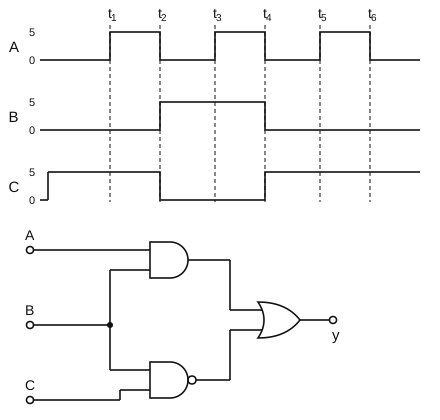
Q286.For the given circuit, the input digital signals are applied at the terminals A, B and C. What would be the output at the terminal y?
दिए गए परिपथ के लिए, निवेशी अंकीय सिग्नल टर्मिनलों A, B और C पर लगाए गए हैं। टर्मिनल y पर निर्गत क्या होगा?
- A

- B

- C

- D

Show answer
Concept: Read the circuit: AND(A, B) and NAND(B, C) feed an OR gate ⇒ .
| Interval | A | B | C | A·B | | Y |
|---|
| 0 – t1 | 0 | 0 | 1 | 0 | 1 | 1 |
| t1 – t2 | 1 | 0 | 1 | 0 | 1 | 1 |
| t2 – t3 | 0 | 1 | 0 | 0 | 1 | 1 |
| t3 – t4 | 1 | 1 | 0 | 1 | 1 | 1 |
| t4 – t5 | 0 | 0 | 1 | 0 | 1 | 1 |
| t5 – t6 | 1 | 0 | 1 | 0 | 1 | 1 |
| after t6 | 0 | 0 | 1 | 0 | 1 | 1 |
- From the waveforms, B = 1 only between t2 and t4, and exactly in that interval C = 0.
- So B·C = 0 at all times ⇒ at all times.
- An OR gate with one input permanently 1 gives Y = 1 always ⇒ a constant 5 V output.
Short trick: Look for a gate whose output never changes (here the NAND); if it feeds an OR with a constant 1, the output is constant HIGH – no full truth table needed.
Answer: (C) constant 5 V output
अवधारणा: परिपथ पढ़ें: AND(A, B) और NAND(B, C) एक OR गेट को निवेश देते हैं ⇒ ।
| अंतराल | A | B | C | A·B | | Y |
|---|
| 0 – t1 | 0 | 0 | 1 | 0 | 1 | 1 |
| t1 – t2 | 1 | 0 | 1 | 0 | 1 | 1 |
| t2 – t3 | 0 | 1 | 0 | 0 | 1 | 1 |
| t3 – t4 | 1 | 1 | 0 | 1 | 1 | 1 |
| t4 – t5 | 0 | 0 | 1 | 0 | 1 | 1 |
| t5 – t6 | 1 | 0 | 1 | 0 | 1 | 1 |
| t6 के बाद | 0 | 0 | 1 | 0 | 1 | 1 |
- तरंग-रूपों से, B = 1 केवल t2 और t4 के बीच है, और ठीक उसी अंतराल में C = 0 है।
- अतः B·C सदैव 0 ⇒ सदैव 1।
- जिस OR गेट का एक निवेश स्थायी रूप से 1 हो, उसका निर्गत Y सदैव 1 ⇒ नियत 5 V निर्गत।
शॉर्ट ट्रिक: ऐसा गेट खोजें जिसका निर्गत कभी नहीं बदलता (यहाँ NAND); यदि वह OR को नियत 1 देता है, तो निर्गत नियत उच्च (HIGH) – पूरी सत्यमान सारणी की आवश्यकता नहीं।
उत्तर: (C) नियत 5 V निर्गत
NEET UGPhysicsSemiconductor electronics – logic gatesNEET UG 2021 · 12 Sep Shift 1
Q287.In the product
For q = 1 and and
What will be the complete expression for ?
गुणनफल में
q = 1 तथा और के लिए
का पूर्ण व्यंजक क्या होगा?
- A
- B
- C
- D
Show answer
Concept: Expand the cross product with the determinant and compare components.
- .
- : −2B = 12 ⇒ B = −6.
- : −(2B0 − 6B) = −20 ⇒ 2B0 + 36 = 20 ⇒ B0 = −8.
- Check : 4(−8) − 6(−6) = −32 + 36 = 4 ✓ ⇒ .
Short trick: Only the k̂-component (2B − 4B = −2B) needs B alone ⇒ B = −6 immediately; only (D) has −6 for both î and ĵ. Also ✓.
Answer: (D)
अवधारणा: सारणिक (determinant) से सदिश गुणनफल का विस्तार करें और घटकों की तुलना करें।
- ।
- : −2B = 12 ⇒ B = −6।
- : −(2B0 − 6B) = −20 ⇒ 2B0 + 36 = 20 ⇒ B0 = −8।
- जाँच: 4(−8) − 6(−6) = −32 + 36 = 4 ✓ ⇒ ।
शॉर्ट ट्रिक: केवल k̂-घटक (2B − 4B = −2B) में केवल B है ⇒ तुरंत B = −6; केवल (D) में î और ĵ दोनों के लिए −6 है। साथ ही ✓।
उत्तर: (D)
NEET UGPhysicsMoving charges and magnetism – Lorentz force (vector)NEET UG 2021 · 12 Sep Shift 1
Q288.A car starts from rest and accelerates at 5 m/s2. At t = 4 s, a ball is dropped out of a window by a person sitting in the car. What is the velocity and acceleration of the ball at t = 6 s? (Take g = 10 m/s2)
एक कार विराम से प्रारंभ होकर 5 m/s2 से त्वरित होती है। t = 4 s पर कार में बैठा एक व्यक्ति खिड़की से एक गेंद गिराता है। t = 6 s पर गेंद का वेग और त्वरण क्या है? (g = 10 m/s2 लें)
- A m/s, 0
- B m/s, 10 m/s2
- C20 m/s, 5 m/s2
- D20 m/s, 0
Show answer
Concept: Once released, the ball keeps the car’s horizontal velocity at that instant and has only the acceleration g (air resistance neglected).
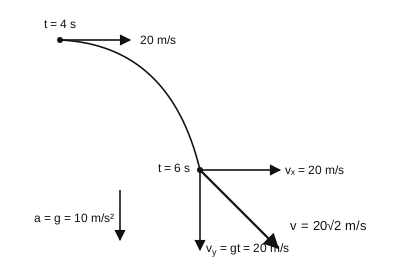
- At t = 4 s: car speed = 0 + 5 × 4 = 20 m/s ⇒ m/s (constant afterwards).
- Free fall for 2 s: m/s.
- m/s; acceleration = g = 10 m/s² (vertically down).
Short trick: After release the car’s 5 m/s² no longer acts on the ball ⇒ a = g only.
Answer: (B) m/s, 10 m/s2
अवधारणा: छोड़े जाने के बाद गेंद उस क्षण कार का क्षैतिज वेग बनाए रखती है और इस पर केवल त्वरण g होता है (वायु प्रतिरोध नगण्य)।
- t = 4 s पर: कार की चाल = 0 + 5 × 4 = 20 m/s ⇒ m/s (इसके बाद नियत)।
- 2 s का मुक्त पतन: m/s।
- m/s; त्वरण = g = 10 m/s² (ऊर्ध्वाधर नीचे)।
शॉर्ट ट्रिक: छोड़ने के बाद कार का 5 m/s² गेंद पर कार्य नहीं करता ⇒ केवल a = g।
उत्तर: (B) m/s, 10 m/s2
NEET UGPhysicsMotion in a plane – relative motion and free fallNEET UG 2021 · 12 Sep Shift 1
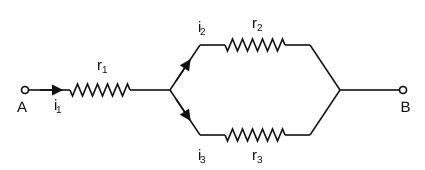
Q289.Three resistors having resistance
,
and
are connected as shown in the given circuit. The ratio
of currents in terms of resistances used in the circuit is:
प्रतिरोध
,
और
वाले तीन प्रतिरोधक दिए गए परिपथ में दर्शाए अनुसार जुड़े हैं। परिपथ में प्रयुक्त प्रतिरोधों के पदों में धाराओं का अनुपात
है:
- A
- B
- C
- D
Show answer
Concept: In two parallel branches the current divides in the inverse ratio of resistances: .
- through splits into (through ) and (through ); same voltage: .
- ⇒ .
Short trick: Current in one branch = total × (OTHER branch resistance)/(sum); r1 (series) cannot appear ⇒ (A), (B), (C) out.
Answer: (D)
अवधारणा: दो समांतर शाखाओं में धारा प्रतिरोधों के व्युत्क्रम अनुपात में बँटती है: ।
- से होकर , ( से) और ( से) में बँटती है; समान वोल्टता: ।
- ⇒ ।
शॉर्ट ट्रिक: एक शाखा में धारा = कुल × (दूसरी शाखा का प्रतिरोध)/(योग); r1 (श्रेणी) नहीं आ सकता ⇒ (A), (B), (C) हटें।
उत्तर: (D)
NEET UGPhysicsCurrent electricity – current divisionNEET UG 2021 · 12 Sep Shift 1
Q290.A point object is placed at a distance of 60 cm from a convex lens of focal length 30 cm. If a plane mirror were put perpendicular to the principal axis of the lens and at a distance of 40 cm from it, the final image would be formed at a distance of:
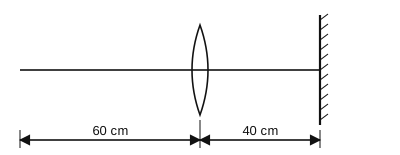
30 cm फोकस दूरी के एक उत्तल लेंस से 60 cm की दूरी पर एक बिंदु बिंब रखा है। यदि लेंस के मुख्य अक्ष के लंबवत और इससे 40 cm की दूरी पर एक समतल दर्पण रख दिया जाए, तो अंतिम प्रतिबिंब किस दूरी पर बनेगा:
- A30 cm from the plane mirror, it would be a virtual image.समतल दर्पण से 30 cm पर, यह आभासी प्रतिबिंब होगा।
- B20 cm from the plane mirror, it would be a virtual image.समतल दर्पण से 20 cm पर, यह आभासी प्रतिबिंब होगा।
- C20 cm from the lens, it would be a real image.लेंस से 20 cm पर, यह वास्तविक प्रतिबिंब होगा।
- D30 cm from the lens, it would be a real image.लेंस से 30 cm पर, यह वास्तविक प्रतिबिंब होगा।
Show answer
Concept: Treat it step by step: lens → mirror → lens again, using each time with the light’s direction as positive.
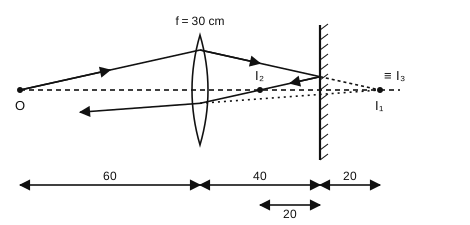
- Lens (1st pass): u = −60, f = +30 ⇒ ⇒ = +60 cm, i.e. 20 cm behind the mirror (I1).
- Mirror: I1 is a virtual object 20 cm behind it ⇒ real image I2 20 cm in front of the mirror, i.e. 20 cm from the lens.
- Lens (2nd pass, light now travelling left): object I2 at u = −20 cm, f = +30 ⇒ ⇒ = −60 cm.
- Final image is virtual, 60 cm from the lens on the mirror side ⇒ 60 − 40 = 20 cm behind the plane mirror.
Short trick: Object inside f on the return trip (20 < 30) ⇒ the lens acts as a magnifier ⇒ final image is VIRTUAL: only (A) or (B); |v| = 60 ⇒ 20 cm beyond the mirror.
Answer: (B) 20 cm from the plane mirror, it would be a virtual image.
अवधारणा: क्रमशः हल करें: लेंस → दर्पण → पुनः लेंस, प्रत्येक बार प्रकाश की दिशा को धनात्मक मानकर लगाएँ।
- लेंस (पहली बार): u = −60, f = +30 ⇒ ⇒ = +60 cm, अर्थात् दर्पण के 20 cm पीछे (I1)।
- दर्पण: I1 इसके 20 cm पीछे एक आभासी बिंब है ⇒ दर्पण के 20 cm सामने वास्तविक प्रतिबिंब I2, अर्थात् लेंस से 20 cm पर।
- लेंस (दूसरी बार, प्रकाश अब बाईं ओर): बिंब I2, u = −20 cm, f = +30 ⇒ ⇒ = −60 cm।
- अंतिम प्रतिबिंब आभासी है, लेंस से 60 cm पर दर्पण की ओर ⇒ समतल दर्पण के 60 − 40 = 20 cm पीछे।
शॉर्ट ट्रिक: वापसी में बिंब f के अंदर (20 < 30) ⇒ लेंस आवर्धक की तरह ⇒ अंतिम प्रतिबिंब आभासी: केवल (A) या (B); |v| = 60 ⇒ दर्पण के 20 cm पीछे।
उत्तर: (B) समतल दर्पण से 20 cm पर, यह आभासी प्रतिबिंब होगा।
NEET UGPhysicsRay optics – lens and plane mirror combinationNEET UG 2021 · 12 Sep Shift 1
Q291.A short electric dipole has a dipole moment of C m. The electric potential due to the dipole at a point at a distance of 0.6 m from the centre of the dipole, situated on a line making an angle of with the dipole axis is :
एक लघु विद्युत द्विध्रुव का द्विध्रुव आघूर्ण C m है। द्विध्रुव के केंद्र से 0.6 m दूरी पर स्थित किसी बिंदु पर, जो द्विध्रुव अक्ष से का कोण बनाने वाली रेखा पर है, द्विध्रुव के कारण विद्युत विभव है :
- A400 V
- BZeroशून्य
- C50 V
- D200 V
Show answer
Concept: For a short dipole, .
- V
Short trick: ; , then halve for → 200 V. (Zero only on the equatorial line, .)
Answer: (D) 200 V
अवधारणा: लघु द्विध्रुव के लिए ।
- V
शॉर्ट ट्रिक: ; , फिर के लिए आधा करें → 200 V। (शून्य केवल निरक्षीय रेखा पर।)
उत्तर: (D) 200 V
NEET UGPhysicsElectrostatics – potential of a dipoleNEET UG 2020 · 13 Sep Shift 1
Q292.A series LCR circuit is connected to an ac voltage source. When L is removed from the circuit, the phase difference between current and voltage is . If instead C is removed from the circuit, the phase difference is again between current and voltage. The power factor of the circuit is :
एक श्रेणी LCR परिपथ एक ac वोल्टता स्रोत से जुड़ा है। जब परिपथ से L को हटा दिया जाता है, तो धारा और वोल्टता के बीच कलान्तर है। यदि इसके स्थान पर C को परिपथ से हटाया जाए, तो धारा और वोल्टता के बीच कलान्तर पुनः है। परिपथ का शक्ति गुणांक (power factor) है :
- A1.0
- B−1.0
- Czeroशून्य
- D0.5
Show answer
Concept: Phase angle: ; power factor .
- L removed (RC): ⇒ .
- C removed (RL): ⇒ .
- So ⇒ resonance, , .
Short trick: Same phase angle with L alone and with C alone ⇒ ⇒ resonance ⇒ power factor 1. Power factor can never be negative, so (B) is out at once.
Answer: (A) 1.0
अवधारणा: कलान्तर: ; शक्ति गुणांक ।
- L हटाने पर (RC): ⇒ ।
- C हटाने पर (RL): ⇒ ।
- अतः ⇒ अनुनाद (resonance), , ।
शॉर्ट ट्रिक: केवल L और केवल C के साथ समान कलान्तर ⇒ ⇒ अनुनाद ⇒ शक्ति गुणांक 1। शक्ति गुणांक कभी ऋणात्मक नहीं होता, अतः (B) तुरंत बाहर।
उत्तर: (A) 1.0
NEET UGPhysicsAlternating current – LCR circuit, power factorNEET UG 2020 · 13 Sep Shift 1
Q293.Light of frequency 1.5 times the threshold frequency is incident on a photosensitive material. What will be the photoelectric current if the frequency is halved and intensity is doubled?
देहली आवृत्ति (threshold frequency) की 1.5 गुनी आवृत्ति का प्रकाश एक प्रकाश-सुग्राही पदार्थ पर आपतित होता है। यदि आवृत्ति आधी कर दी जाए और तीव्रता दोगुनी कर दी जाए, तो प्रकाश-विद्युत धारा क्या होगी?
- Aone-fourthएक-चौथाई
- Bzeroशून्य
- Cdoubledदोगुनी
- Dfour timesचार गुनी
Show answer
Concept: Photoemission occurs only if ; intensity cannot compensate for a frequency below threshold.
- New frequency .
- ⇒ no electron is emitted, whatever the intensity.
- Hence photoelectric current = zero.
Short trick: First check frequency vs threshold; intensity matters only when emission is already possible.
Answer: (B) zero
अवधारणा: प्रकाश-उत्सर्जन तभी होता है जब ; देहली से कम आवृत्ति की पूर्ति तीव्रता नहीं कर सकती।
- नई आवृत्ति ।
- ⇒ तीव्रता कितनी भी हो, कोई इलेक्ट्रॉन उत्सर्जित नहीं होगा।
- अतः प्रकाश-विद्युत धारा = शून्य।
शॉर्ट ट्रिक: पहले आवृत्ति की तुलना देहली आवृत्ति से करें; तीव्रता का प्रभाव तभी है जब उत्सर्जन संभव हो।
उत्तर: (B) शून्य
NEET UGPhysicsDual nature – photoelectric effectNEET UG 2020 · 13 Sep Shift 1
Q294.Dimensions of stress are :
प्रतिबल (stress) की विमाएँ हैं :
- A
- B
- C
- D
Show answer
Concept: Stress = force/area, i.e. the same dimensions as pressure.
- ,
Short trick: Stress = pressure = energy density → all are . (C) is force, (D) is energy, (A) is surface tension/spring constant.
Answer: (B)
अवधारणा: प्रतिबल = बल/क्षेत्रफल, अर्थात् दाब के समान विमाएँ।
- ,
शॉर्ट ट्रिक: प्रतिबल = दाब = ऊर्जा घनत्व → सभी । (C) बल की, (D) ऊर्जा की, (A) पृष्ठ तनाव/स्प्रिंग नियतांक की विमा है।
उत्तर: (B)
NEET UGPhysicsUnits and dimensions – stressNEET UG 2020 · 13 Sep Shift 1
Q295.An electron is accelerated from rest through a potential difference of V volt. If the de Broglie wavelength of the electron is nm, the potential difference is :
एक इलेक्ट्रॉन को विरामावस्था से V वोल्ट के विभवान्तर द्वारा त्वरित किया जाता है। यदि इलेक्ट्रॉन की दे ब्रॉग्ली तरंगदैर्ध्य nm है, तो विभवान्तर है :
- A V
- B V
- C10 V
- D V
Show answer
Concept: For an electron accelerated through V volt, nm.
- ⇒ V
Short trick: Remember Å nm; the given λ is exactly of 1.227 nm ⇒ .
Answer: (B) V
अवधारणा: V वोल्ट से त्वरित इलेक्ट्रॉन के लिए nm।
- ⇒ V
शॉर्ट ट्रिक: याद रखें Å nm; दिया गया λ ठीक 1.227 nm का है ⇒ ।
उत्तर: (B) V
NEET UGPhysicsDual nature – de Broglie wavelength of electronNEET UG 2020 · 13 Sep Shift 1
Q296.The capacitance of a parallel plate capacitor with air as medium is 6 μF. With the introduction of a dielectric medium, the capacitance becomes 30 μF. The permittivity of the medium is :
वायु माध्यम वाले एक समांतर पट्टिका संधारित्र की धारिता 6 μF है। एक परावैद्युत माध्यम डालने पर धारिता 30 μF हो जाती है। माध्यम की विद्युतशीलता (permittivity) है :
- A
- B
- C
- D
Show answer
Concept: and .
Short trick: (B) is just K (dimensionless) with wrong units – a classic trap. → .
Answer: (A)
अवधारणा: तथा ।
शॉर्ट ट्रिक: (B) केवल K (विमाहीन) है जिसके साथ गलत मात्रक लगे हैं – एक सामान्य जाल। → ।
उत्तर: (A)
NEET UGPhysicsCapacitance – dielectricNEET UG 2020 · 13 Sep Shift 1
Q297.The solids which have the negative temperature coefficient of resistance are :
वे ठोस जिनका प्रतिरोध ताप गुणांक ऋणात्मक होता है, हैं :
- Asemiconductors onlyकेवल अर्धचालक
- Binsulators and semiconductorsविद्युतरोधी और अर्धचालक
- Cmetalsधातुएँ
- Dinsulators onlyकेवल विद्युतरोधी
Show answer
Concept: Negative α means resistance falls as temperature rises – happens when heating frees more charge carriers.
- Semiconductors: more electron–hole pairs are created on heating ⇒ ρ decreases ⇒ α negative.
- Insulators: the very large band gap is crossed by a few more electrons on heating ⇒ ρ also decreases ⇒ α negative.
- Metals: carrier number is fixed, collisions increase ⇒ ρ increases ⇒ α positive (so (C) is wrong).
- (A) and (D) are incomplete – both classes show negative α.
Short trick: Metals: α positive. Everything with a band gap (semiconductors and insulators): α negative.
Answer: (B) insulators and semiconductors
अवधारणा: ऋणात्मक α का अर्थ है ताप बढ़ने पर प्रतिरोध घटना – यह तब होता है जब गर्म करने पर अधिक आवेश वाहक मुक्त होते हैं।
- अर्धचालक: गर्म करने पर अधिक इलेक्ट्रॉन–होल युग्म बनते हैं ⇒ ρ घटता है ⇒ α ऋणात्मक।
- विद्युतरोधी: गर्म करने पर कुछ और इलेक्ट्रॉन बहुत बड़े ऊर्जा अंतराल को पार करते हैं ⇒ ρ घटता है ⇒ α ऋणात्मक।
- धातुएँ: वाहकों की संख्या नियत, टक्करें बढ़ती हैं ⇒ ρ बढ़ता है ⇒ α धनात्मक (अतः (C) गलत)।
- (A) और (D) अधूरे हैं – दोनों वर्गों में α ऋणात्मक होता है।
शॉर्ट ट्रिक: धातु: α धनात्मक। ऊर्जा अंतराल (band gap) वाले सभी (अर्धचालक तथा विद्युतरोधी): α ऋणात्मक।
उत्तर: (B) विद्युतरोधी और अर्धचालक
NEET UGPhysicsCurrent electricity – temperature coefficient of resistanceNEET UG 2020 · 13 Sep Shift 1
Q298.For transistor action, which of the following statements is correct?
ट्रांजिस्टर क्रिया के लिए, निम्नलिखित में से कौन-सा कथन सही है?
- ABoth emitter junction as well as the collector junction are forward biased.उत्सर्जक संधि तथा संग्राहक संधि दोनों अग्र अभिनत होती हैं।
- BThe base region must be very thin and lightly doped.आधार क्षेत्र बहुत पतला और अल्प मादित (lightly doped) होना चाहिए।
- CBase, emitter and collector regions should have same doping concentrations.आधार, उत्सर्जक और संग्राहक क्षेत्रों की मादन सांद्रता समान होनी चाहिए।
- DBase, emitter and collector regions should have same size.आधार, उत्सर्जक और संग्राहक क्षेत्रों का आकार समान होना चाहिए।
Show answer
Concept: In the active mode, the emitter injects carriers that must cross the base to the collector with very little recombination.
- Thin, lightly doped base ⇒ few recombinations ⇒ most emitter current reaches the collector – (B) correct.
- (A) wrong: for amplification the emitter–base junction is forward biased and the collector–base junction is reverse biased.
- (C) wrong: emitter is heavily doped, base lightly, collector moderately.
- (D) wrong: collector is largest, base is thinnest.
Short trick: NCERT line: “Emitter – heavily doped, Base – very thin and lightly doped, Collector – moderately doped and large.”
Answer: (B) The base region must be very thin and lightly doped.
अवधारणा: सक्रिय अवस्था में उत्सर्जक वाहकों को अंतःक्षेपित करता है जिन्हें बहुत कम पुनर्संयोजन के साथ आधार पार कर संग्राहक तक पहुँचना होता है।
- पतला, अल्प मादित आधार ⇒ कम पुनर्संयोजन ⇒ उत्सर्जक धारा का अधिकांश भाग संग्राहक तक पहुँचता है – (B) सही।
- (A) गलत: प्रवर्धन के लिए उत्सर्जक–आधार संधि अग्र अभिनत तथा संग्राहक–आधार संधि पश्च अभिनत होती है।
- (C) गलत: उत्सर्जक अधिक मादित, आधार अल्प मादित, संग्राहक मध्यम मादित होता है।
- (D) गलत: संग्राहक सबसे बड़ा तथा आधार सबसे पतला होता है।
शॉर्ट ट्रिक: NCERT पंक्ति: “उत्सर्जक – अधिक मादित, आधार – बहुत पतला व अल्प मादित, संग्राहक – मध्यम मादित व बड़ा।”
उत्तर: (B) आधार क्षेत्र बहुत पतला और अल्प मादित होना चाहिए।
NEET UGPhysicsSemiconductors – transistor actionNEET UG 2020 · 13 Sep Shift 1
Q299.A screw gauge has least count of 0.01 mm and there are 50 divisions in its circular scale. The pitch of the screw gauge is :
एक स्क्रू गेज का अल्पतमांक 0.01 mm है और इसके वृत्तीय पैमाने पर 50 भाग हैं। स्क्रू गेज का चूड़ी अंतराल (pitch) है :
- A0.5 mm
- B1.0 mm
- C0.01 mm
- D0.25 mm
Show answer
Concept: Least count = pitch ÷ number of circular-scale divisions.
- Pitch = LC × N = 0.01 mm × 50
- Pitch = 0.5 mm
Short trick: Pitch is always LC × divisions; it must be larger than LC, so (C) is impossible.
Answer: (A) 0.5 mm
अवधारणा: अल्पतमांक = चूड़ी अंतराल ÷ वृत्तीय पैमाने के भागों की संख्या।
- चूड़ी अंतराल = LC × N = 0.01 mm × 50
- चूड़ी अंतराल = 0.5 mm
शॉर्ट ट्रिक: चूड़ी अंतराल सदैव LC × भाग; यह LC से बड़ा होना चाहिए, अतः (C) असंभव।
उत्तर: (A) 0.5 mm
NEET UGPhysicsUnits and measurement – screw gaugeNEET UG 2020 · 13 Sep Shift 1
Q300.The phase difference between displacement and acceleration of a particle in a simple harmonic motion is :
सरल आवर्त गति करते किसी कण के विस्थापन और त्वरण के बीच कलान्तर है :
- A rad
- Bzeroशून्य
- C rad
- D rad
Show answer
Concept: In SHM .
- ,
- So acceleration leads displacement by rad.
Short trick: Minus sign = opposite direction = phase difference π. (Velocity is ahead of x.)
Answer: (C) rad
अवधारणा: सरल आवर्त गति में ।
- ,
- अतः त्वरण विस्थापन से rad आगे है।
शॉर्ट ट्रिक: ऋण चिह्न = विपरीत दिशा = कलान्तर π। (वेग, x से आगे होता है।)
उत्तर: (C) rad
NEET UGPhysicsOscillations – SHM phase relationsNEET UG 2020 · 13 Sep Shift 1

